

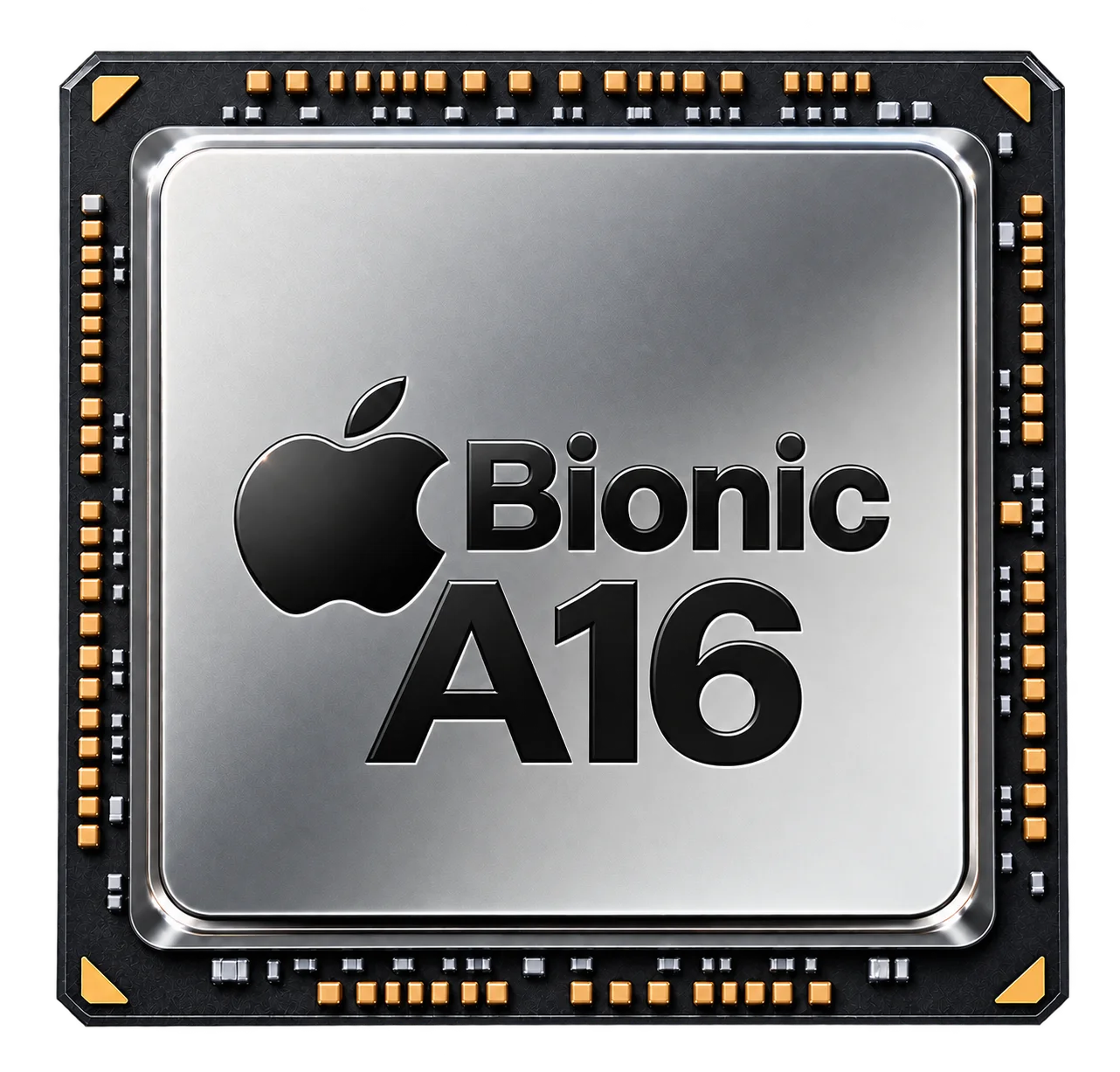
Apple A16 Bionic
Apple's 6-core flagship chipset, announced in September 2022 and manufactured on a 4nm process, with Everest and Sawtooth CPU cores and an Apple A16 GPU.
Benchmarks
Benchmark results and sub-scores are taken from the supplied A16 Bionic dataset.
Overall AnTuTu score covering CPU, GPU, memory and UX performance.
Single-core and multi-core CPU performance with detailed workload results.
GPU compute performance using the Metal API.
3D graphics results from Solar Bay and Wild Life Extreme.
NanoReview Performance Ratings
Composite ratings out of 100 from the supplied dataset.
CPU & AI Performance
4× Sawtooth up to 2.02 GHz
Graphics, Memory & Storage
Multimedia (Camera & ISP)
Connectivity
General Info
information About Apple A16
Introduction
The A16 Bionic vs Dimensity 8550 vs Snapdragon 8s Gen 4 comparison combines Apple’s 2022 flagship processor with two newer Android chipsets. Despite launching years apart, their NanoReview overall scores are close.
Apple A16 Bionic was announced in September 2022 and uses a six-core custom CPU and Apple’s integrated GPU. Snapdragon 8s Gen 4 arrived in April 2025 with a Cortex-X4-based CPU and Adreno 825 graphics. MediaTek Dimensity 8550 was announced in May 2026 and uses eight Cortex-A725 cores with Mali-G720 MP8 graphics. All three use TSMC’s 4nm manufacturing process.
NanoReview rates Snapdragon 8s Gen 4 at 76 overall, A16 Bionic at 75, and Dimensity 8550 at 75. Their category ratings tell a more detailed story: A16 leads CPU performance and battery efficiency, Snapdragon 8s Gen 4 performs strongly in multi-core workloads, and Dimensity 8550 leads NanoReview’s current gaming rating.
Quick Answer
The Snapdragon 8s Gen 4 is the overall winner according to NanoReview, scoring 76, while Apple A16 Bionic and MediaTek Dimensity 8550 both score 75. A16 leads CPU performance and battery efficiency, Dimensity 8550 leads the gaming rating and AnTuTu 11, and Snapdragon 8s Gen 4 offers strong multi-core performance, modern connectivity and balanced flagship-class hardware.
Specification Comparison
| Specification | Apple A16 Bionic | Dimensity 8550 | Snapdragon 8s Gen 4 |
|---|---|---|---|
| Market class | Flagship | Mid-range | Flagship |
| Announcement | September 2022 | May 2026 | April 2025 |
| Manufacturing | TSMC | TSMC | TSMC |
| Process | 4nm | 4nm | 4nm |
| CPU cores | 6 | 8 | 8 |
| CPU architecture | 2× Everest + 4× Sawtooth | 8× Cortex-A725 | Cortex-X4 + Cortex-A720 |
| Maximum CPU clock | 3.46GHz | 3.40GHz | 3.21GHz |
| L2 cache | 16MB | 1MB | 2MB |
| L3 cache | Not listed | 6MB | 8MB |
| GPU | Apple A16 GPU | Mali-G720 MP8 | Adreno 825 |
| GPU architecture | Apple Bionic GPU | Valhall, 5th gen | Adreno 800 |
| GPU frequency | 1398MHz | 1508MHz | 1150MHz |
| Theoretical GPU performance | 1789.4 GFLOPS | 3088.4 GFLOPS | 2355.2 GFLOPS |
| AI hardware | Apple Neural Engine | MediaTek NPU 880 | Qualcomm Hexagon |
| Listed AI performance | 17 TOPS | Not listed | Not listed |
| Memory | LPDDR5 | LPDDR5X | LPDDR5X |
| Memory frequency | 3200MHz | 4800MHz | 4800MHz |
| Maximum bandwidth | 51.2GB/s | 76.8GB/s | 76.8GB/s |
| Maximum RAM | 6GB | 24GB | 24GB |
| Storage | NVMe | UFS 4.0/UFS 4.1 | UFS 4.0 |
| Maximum display resolution | 2796×1290 | 2960×1440 | 3840×2160 |
| Maximum camera resolution | 48MP | 320MP | 320MP |
| Video recording | 4K60 | 4K60 | 4K60 |
| Maximum 5G download | 7.5Gbps | 5.17Gbps | 4.2Gbps |
| Wi-Fi | Wi-Fi 6 | Wi-Fi 6 | Wi-Fi 7 |
| Bluetooth | 5.3 | 6.0 | 6.0 |
Source: NanoReview’s individual specifications pages. A missing specification means NanoReview does not list an equivalent figure, not necessarily that the hardware lacks that feature.
CPU Architecture and Performance
A16 Bionic leads NanoReview’s CPU rating, while Snapdragon 8s Gen 4 has the strongest multi-core result and Dimensity 8550 uses eight high-clocked Cortex-A725 cores.
A16 Bionic contains two custom Everest performance cores at 3.46GHz and four Sawtooth efficiency cores at 2.02GHz. Its 16MB L2 cache and Apple’s custom CPU architecture help it deliver strong single-thread performance.
Snapdragon 8s Gen 4 uses one Cortex-X4 core at 3.21GHz, three Cortex-A720 cores at 3.0GHz, two A720 cores at 2.8GHz and two A720 cores at 2.02GHz. It has 8MB L3 cache and an ARMv9.2-A instruction set.
Dimensity 8550 uses one Cortex-A725 core at 3.4GHz, three at 3.2GHz and four at 2.2GHz. Its eight-core configuration uses the same Cortex-A725 family across all cores and includes 6MB L3 cache.
NanoReview’s CPU ratings are 81 for A16 Bionic, 76 for Snapdragon 8s Gen 4 and 69 for Dimensity 8550. Geekbench 6 results also favor A16 in single-core performance, while Snapdragon 8s Gen 4 narrowly leads multi-core. Dimensity 8550’s reported CPU results are promising, but its benchmark sample is currently very small.
GPU and Gaming Performance
Dimensity 8550 has the highest NanoReview gaming rating and theoretical GPU FLOPS figure, while Snapdragon 8s Gen 4 has more established graphics benchmark results.
A16 Bionic’s integrated GPU is listed at 1789.4 GFLOPS. Snapdragon 8s Gen 4’s Adreno 825 reaches 2355.2 GFLOPS, while Dimensity 8550’s Mali-G720 MP8 is listed at 3088.4 GFLOPS.
Their current gaming ratings are:
| Processor | Gaming Score |
|---|---|
| Apple A16 Bionic | 56 |
| Snapdragon 8s Gen 4 | 64 |
| Dimensity 8550 | 70 |
These ratings favor Dimensity 8550. However, NanoReview currently lists fewer than three Geekbench GPU Compute samples for this chip and does not provide comparable 3DMark results on its individual page. Its apparent gaming lead should therefore be treated as provisional rather than definitive.
Theoretical FLOPS measure estimated floating-point throughput, not guaranteed frame rates. GPU architecture, driver maturity, game optimization, rendering APIs and thermal behavior all influence real-world performance. Snapdragon 8s Gen 4 has multiple published 3DMark results, providing a broader evidence base for its graphics performance than is currently available for Dimensity 8550.
Manufacturing and Battery Efficiency
A16 Bionic leads NanoReview’s battery rating with 95 points, while Dimensity 8550 and Snapdragon 8s Gen 4 tie at 91.
All three processors use TSMC’s 4nm process according to NanoReview. Their battery scores differ: 95 for A16 Bionic, 91 for Dimensity 8550 and 91 for Snapdragon 8s Gen 4.
A16’s higher score indicates the strongest efficiency rating in this comparison. It does not guarantee that every iPhone using A16 will outlast every Android phone using the competing processors. Battery capacity, display characteristics, mobile reception, operating-system optimization and sustained power limits all affect actual runtime.
RAM, Memory and Storage
Dimensity 8550 and Snapdragon 8s Gen 4 tie for the highest listed memory bandwidth at 76.8GB/s and support up to 24GB RAM.
A16 Bionic supports LPDDR5 memory at 3200MHz, with 51.2GB/s bandwidth and up to 6GB RAM. Its storage is listed as NVMe.
Dimensity 8550 and Snapdragon 8s Gen 4 both use LPDDR5X at 4800MHz, with 76.8GB/s maximum bandwidth and support for up to 24GB RAM. Dimensity 8550 lists UFS 4.0 and UFS 4.1, while Snapdragon 8s Gen 4 lists UFS 4.0.
On listed specifications, both Android chipsets offer higher memory bandwidth and greater maximum RAM capacity than A16 Bionic. However, memory architecture and operating-system behavior differ between iOS and Android, so raw capacity alone does not determine application responsiveness.
AI and NPU
A16 Bionic has the highest explicitly listed AI throughput figure, while the two Android chips have dedicated AI accelerators without equivalent TOPS measurements on NanoReview.
NanoReview lists A16 Bionic’s Apple Neural Engine at 17 TOPS. Dimensity 8550 uses the MediaTek NPU 880, and Snapdragon 8s Gen 4 uses Qualcomm Hexagon AI hardware.
Because equivalent TOPS figures are not available for all three, the published data does not establish a reliable numerical AI ranking. Real-world AI performance also depends on model support, precision, software frameworks, memory access and whether applications can efficiently use the accelerator.
Camera, ISP and Video
Snapdragon 8s Gen 4 and Dimensity 8550 support the highest listed camera resolution, while all three list 4K60 video capture.
A16 Bionic lists support for up to 48MP camera hardware and 4K60 video recording. Snapdragon 8s Gen 4 supports up to 320MP cameras and 4K60 recording, while Dimensity 8550 also lists up to 320MP and 4K60 capture.
Snapdragon 8s Gen 4 additionally lists 8K60 video playback, but that does not mean it records video at 8K. For capture, the listed maximum is 4K60. Similarly, a chipset’s maximum supported camera resolution does not guarantee better photo quality. Sensor size, lens design, stabilization and image-processing software determine much of the final result.
Display and Connectivity
Snapdragon 8s Gen 4 offers the highest listed display resolution and Wi-Fi standard, while A16 Bionic has the highest listed 5G download speed.
A16 Bionic lists maximum display support of 2796×1290. Dimensity 8550 lists 2960×1440, while Snapdragon 8s Gen 4 supports up to 3840×2160 according to NanoReview. These are chipset capabilities rather than guarantees that every phone will use those resolutions.
The listed 5G download speeds are 7.5Gbps for A16 Bionic, 5.17Gbps for Dimensity 8550 and 4.2Gbps for Snapdragon 8s Gen 4. A16 has the highest published peak download specification here, while its rivals offer newer wireless standards.
Snapdragon 8s Gen 4 supports Wi-Fi 7 and Bluetooth 6.0. Dimensity 8550 supports Wi-Fi 6 and Bluetooth 6.0, while A16 Bionic lists Wi-Fi 6 and Bluetooth 5.3.
Benchmark Comparison
Dimensity 8550 leads AnTuTu 11 and NanoReview’s gaming rating, A16 Bionic leads single-core CPU performance, and Snapdragon 8s Gen 4 narrowly leads Geekbench multi-core.
| Benchmark or Rating | A16 Bionic | Dimensity 8550 | Snapdragon 8s Gen 4 |
|---|---|---|---|
| NanoReview overall score | 75 | 75 | 76 |
| CPU rating | 81 | 69 | 76 |
| Gaming rating | 56 | 70 | 64 |
| Battery rating | 95 | 91 | 91 |
| AnTuTu 11 | 1,626,008 | 2,429,134 | 2,314,417 |
| Geekbench 6 single-core | 2,631 | 1,558 | 2,072 |
| Geekbench 6 multi-core | 6,602 | 6,283 | 6,649 |
| Geekbench GPU Compute | 22,851* | 15,146* | 18,498* |
| 3DMark Steel Nomad Light | Not listed | Not listed | 1,688 |
| 3DMark Solar Bay | 4,266 | Not listed | 7,641 |
| 3DMark Wild Life Extreme | 3,335 | Not listed | 3,705 |
Source: NanoReview’s current individual processor pages. Geekbench GPU Compute uses Metal for A16 Bionic and Vulkan for the Android chips; results across these APIs should not be treated as directly comparable.
Benchmark caveat: NanoReview currently lists fewer than three Geekbench 6 CPU and GPU Compute samples for Dimensity 8550, along with just one listed smartphone result. Its AnTuTu result of 2,429,134 is therefore preliminary. NanoReview also warns that AnTuTu results from iOS and Android are not directly comparable.
The benchmark table demonstrates why the overall score differs from individual test results. A16 leads single-core CPU performance, Snapdragon 8s Gen 4 narrowly leads multi-core, and Dimensity 8550 has the highest AnTuTu 11 score. Dimensity 8550’s gaming rating is promising, but its limited sample base prevents a definitive conclusion that it will outperform the established Snapdragon platform in every game.
Real-World Performance
Snapdragon 8s Gen 4 is the strongest all-round choice by NanoReview’s overall score, A16 Bionic is strongest for CPU responsiveness and efficiency, and Dimensity 8550 is promising for gaming and memory-intensive workloads.
A16 Bionic has the highest CPU and battery ratings, making it attractive for supported iOS applications and users who value responsiveness. Its older platform limits memory bandwidth and maximum listed camera capability relative to the two Android chipsets, but Apple’s hardware-software integration remains important.
Snapdragon 8s Gen 4 combines a Cortex-X4 CPU, Adreno 825 GPU, 76.8GB/s memory bandwidth, UFS 4.0 and Wi-Fi 7. Its multi-core result and wider set of published graphics benchmarks make it the most balanced Android-oriented choice in this comparison by NanoReview’s overall ranking.
Dimensity 8550 has impressive current AnTuTu and gaming ratings, plus high memory bandwidth, 24GB RAM support, UFS 4.1 and Bluetooth 6.0. However, limited benchmark samples mean these results should be considered early evidence rather than final proof of its long-term performance position.
Strengths and Weaknesses
Apple A16 Bionic
Strengths
- Highest CPU score.
- Highest Geekbench single-core score.
- Highest battery rating at 95.
- Apple Neural Engine rated at 17 TOPS.
- NVMe storage.
- Strong integration with Apple’s operating system.
Weaknesses
- Maximum RAM listed at 6GB.
- Lower listed memory bandwidth than both Android rivals.
- No UFS 4.0 option listed.
- Wi-Fi 6 and Bluetooth 5.3.
MediaTek Dimensity 8550
Strengths
- Highest NanoReview gaming rating.
- Highest current AnTuTu 11 result.
- 3088.4 GFLOPS theoretical GPU performance.
- 76.8GB/s memory bandwidth.
- Up to 24GB RAM.
- UFS 4.0/UFS 4.1 support.
- Bluetooth 6.0.
Weaknesses
- Lowest CPU rating of the three.
- Limited Geekbench sample size.
- Wi-Fi 6 rather than Wi-Fi 7.
- 4K60 maximum listed video capture.
Snapdragon 8s Gen 4
Strengths
- Highest overall NanoReview score.
- Strong CPU and multi-core performance.
- Adreno 825 graphics with broad 3DMark results.
- 76.8GB/s memory bandwidth.
- Up to 24GB RAM.
- UFS 4.0, Wi-Fi 7 and Bluetooth 6.0.
- 91 battery rating.
Weaknesses
- Lower CPU rating than A16 Bionic.
- Lower AnTuTu score than Dimensity 8550.
- Lower listed 5G download speed than A16 Bionic.
- 4K60 maximum listed video capture.
Best Processor for Different Users
| Use Case | Best Choice | Reason |
|---|---|---|
| Overall performance | Snapdragon 8s Gen 4 | Highest NanoReview score |
| CPU performance | A16 Bionic | Highest CPU rating |
| Gaming rating | Dimensity 8550 | Highest current rating, but limited evidence |
| Battery efficiency | A16 Bionic | Score of 95 |
| AnTuTu 11 | Dimensity 8550 | Highest listed result; preliminary |
| Geekbench single-core | A16 Bionic | Highest score |
| Geekbench multi-core | Snapdragon 8s Gen 4 | Highest score |
| Memory bandwidth | Dimensity 8550 / Snapdragon 8s Gen 4 — tie | 76.8GB/s |
| Maximum RAM | Dimensity 8550 / Snapdragon 8s Gen 4 — tie | Up to 24GB |
| AI TOPS specification | A16 Bionic | 17 TOPS listed |
| Camera resolution capability | Dimensity 8550 / Snapdragon 8s Gen 4 — tie | Up to 320MP |
| Wireless standards | Snapdragon 8s Gen 4 | Wi-Fi 7 and Bluetooth 6.0 |
Final Verdict and Ranking
Snapdragon 8s Gen 4 ranks first overall, with A16 Bionic and Dimensity 8550 tied for second on NanoReview’s current overall score.
#1 Snapdragon 8s Gen 4
The Snapdragon 8s Gen 4 wins with a NanoReview score of 76. It provides a balanced combination of CPU performance, multi-core results, established graphics benchmarks, high memory bandwidth and modern connectivity. It is the safest overall choice based on the currently reported data.
#2 Apple A16 Bionic and Dimensity 8550 — Tie
Both score 75 overall, but their strengths are very different. A16 Bionic leads CPU performance, single-core Geekbench and battery efficiency. Dimensity 8550 leads the current gaming rating and AnTuTu 11, with strong memory and storage specifications. Its limited benchmark sample base, however, means its apparent advantages should be treated cautiously.
Winner Summary
| Category | Winner |
|---|---|
| Overall | Snapdragon 8s Gen 4 |
| CPU rating | A16 Bionic |
| Gaming rating | Dimensity 8550, provisional |
| Battery efficiency | A16 Bionic |
| AnTuTu 11 | Dimensity 8550, provisional |
| Geekbench single-core | A16 Bionic |
| Geekbench multi-core | Snapdragon 8s Gen 4 |
| Memory bandwidth | Dimensity 8550 / Snapdragon 8s Gen 4 — tie |
| Maximum RAM | Dimensity 8550 / Snapdragon 8s Gen 4 — tie |
| AI TOPS specification | A16 Bionic |
| Camera resolution capability | Dimensity 8550 / Snapdragon 8s Gen 4 — tie |
| Wireless standards | Snapdragon 8s Gen 4 |
Final Ranking
- Snapdragon 8s Gen 4 — 76
- Apple A16 Bionic — 75
- MediaTek Dimensity 8550 — 75
The main conclusion is that Snapdragon 8s Gen 4 is the most balanced overall processor in this comparison, A16 Bionic remains strongest for CPU performance and battery efficiency, and Dimensity 8550 has promising graphics and AnTuTu results that need more benchmark samples to confirm. For a real phone purchase, cooling, device software, battery capacity, camera implementation and price can be just as important as the chipset score.
Sources: NanoReview pages for Apple A16 Bionic, MediaTek Dimensity 8550 and Qualcomm Snapdragon 8s Gen 4. Data checked October 10, 2026.
Images Of Apple A16
Trailer Of Apple A16

Author & Post Info
Faisal Ur Rehman
Faisal Rehman is the founder and editor of FSL Specs, where he publishes in-depth smartphone specifications, comparisons, buying guides, and technology insights. With extensive experience in mobile hardware research and technical analysis, he provides accurate and up-to-date information on Android smartphones, processors, displays, cameras, batteries, performance benchmarks, and software features. His goal is to simplify complex specifications and help readers choose the right device with confidence.
Explore FSL Specs
Questions About Apple A16
What are the main specifications of the Apple A16 Bionic chipset?
The A16 Bionic is a 4nm Apple chip with a 6-core CPU, 5-core GPU, 16-core Neural Engine, and 16 billion transistors. It also includes 6GB of LPDDR5 RAM and an upgraded image signal processor for computational photography.
How fast is the Apple A16 Bionic processor?
It has two performance cores at up to 3.46 GHz and four efficiency cores at 2.02 GHz. Apple says the CPU is up to 40% faster than competing chips, while its performance cores use 20% less power than the A15 Bionic.
Is the A16 Bionic good for gaming?
Yes, its 5-core GPU offers 50% more memory bandwidth than the A15, which helps with graphics-heavy games and apps. It supports Metal 3 and delivers smooth performance for most modern mobile games, though it lacks the A17 Pro’s hardware ray tracing
How powerful is the A16 Bionic Neural Engine?
The 16-core Neural Engine can perform nearly 17 trillion operations per second (17 TOPS). It speeds up on-device AI tasks such as Face ID, photo analysis, Live Text, and camera processing
Which devices use the Apple A16 Bionic chip?
The A16 Bionic powers the iPhone 14 Pro, iPhone 14 Pro Max, iPhone 15, and iPhone 15 Plus. The iPad (11th generation) uses an A16 variant with a 5-core CPU and 4-core GPU.
Does the A16 Bionic support 5G and modern connectivity?
Yes, it supports 5G sub-6 GHz and mmWave, Gigabit LTE, Wi-Fi 6, Bluetooth 5.3, NFC, and Ultra Wideband. Availability of mmWave and certain 5G features can vary by country, carrier, and iPhone model