Introduction
The Exynos 2500 vs Apple A19 vs Dimensity 8500 comparison brings together three processors aimed at different segments of the smartphone market.
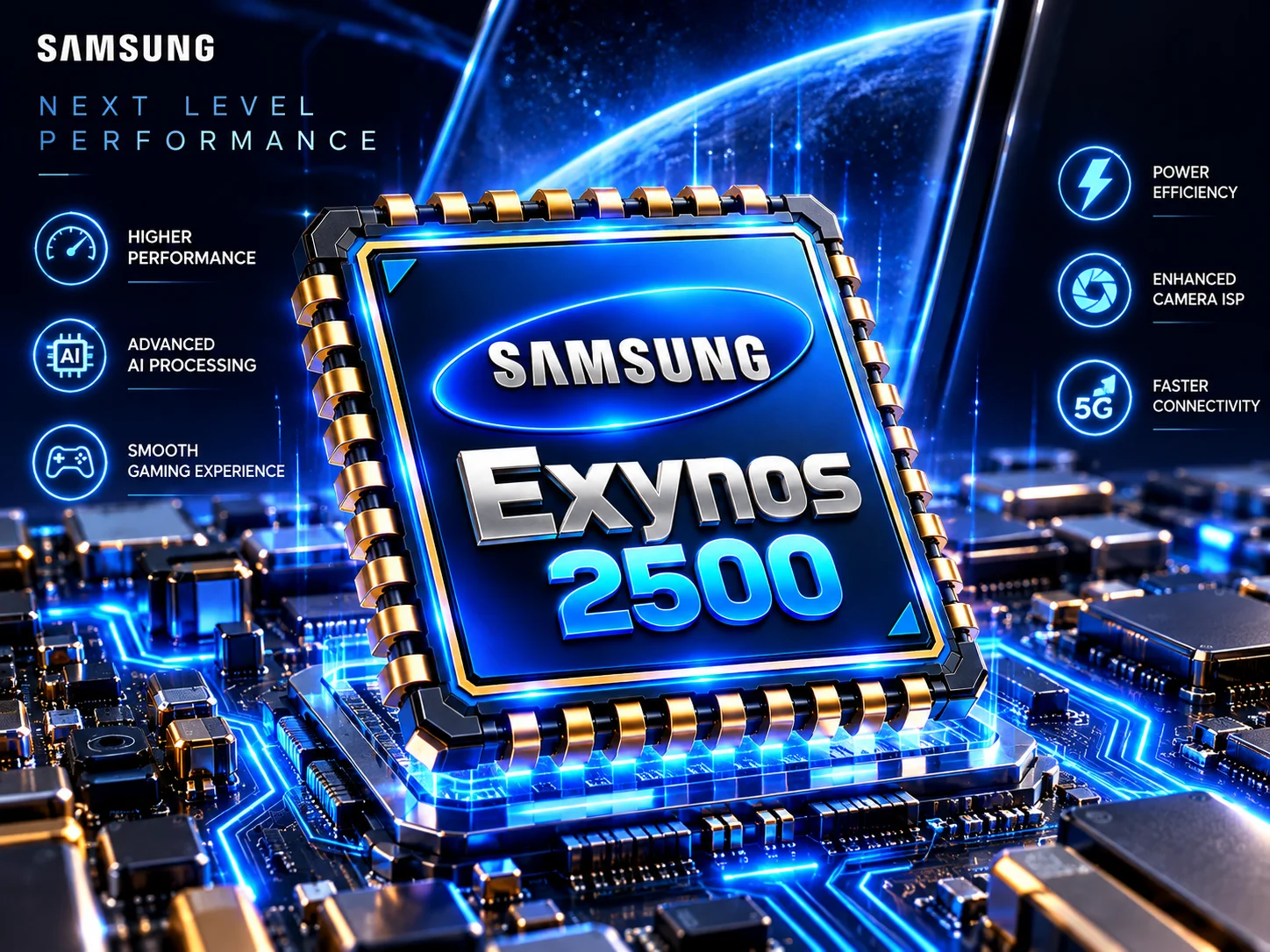
Samsung’s Exynos 2500 is a flagship-class chipset built on a 3nm process and uses a 10-core CPU with Samsung’s Xclipse 950 GPU. Apple’s A19 takes a different approach with six CPU cores and Apple’s integrated GPU, while the Dimensity 8500 is positioned as a mid-range chipset using eight Cortex-A725 cores and Mali-G720 graphics.
On NanoReview’s current scoring system, the Apple A19 leads the group clearly with a 90 overall score, followed by the Exynos 2500 at 78 and Dimensity 8500 at 68. The ratings also show that the A19 has the strongest CPU, gaming and battery scores of these three chips.
Quick Answer
The Apple A19 is the strongest overall processor in this comparison, with the highest NanoReview score, CPU performance, gaming performance, and battery-life rating. The Exynos 2500 is the strongest Android flagship-oriented alternative, offering a powerful 10-core CPU, RDNA 3 graphics, 8K video support, Wi-Fi 7 and a 3nm process. The Dimensity 8500 offers strong multi-core performance, high memory bandwidth and modern UFS 4.x storage at a lower mid-range positioning.
Exynos 2500 vs Apple A19 vs Dimensity 8500: Specifications
| Specification | Exynos 2500 | Apple A19 | Dimensity 8500 |
|---|
| Class | Flagship | Flagship | Mid-range |
| Announcement | June 2025 | September 2025 | January 2026 |
| Process | 3nm | 3nm | 4nm |
| CPU cores | 10 | 6 | 8 |
| CPU architecture | Cortex-X925 + Cortex-A725 + Cortex-A520 | Apple CPU cores | Cortex-A725 |
| Max CPU clock | 3.3 GHz | 4.26 GHz | 3.4 GHz |
| Instruction set | ARMv9.2-A | ARMv9.2-A | ARMv9.2-A |
| GPU | Samsung Xclipse 950 | Apple A19 GPU | Mali-G720 MP8 |
| GPU architecture | RDNA 3 | Apple A GPU | Valhall 5th gen |
| GPU frequency | 999 MHz | 1620 MHz | 1508 MHz |
| FLOPS | 4091.9 GFLOPS | 2073.6 GFLOPS | 3088.4 GFLOPS |
| NPU/AI | NPU, 59 TOPS | Neural Engine | MediaTek NPU 880 |
| RAM | LPDDR5X | LPDDR5X | LPDDR5X |
| Max memory bandwidth | 76.8 GB/s | 68.2 GB/s | 76.8 GB/s |
| Maximum RAM | 24 GB | 12 GB | 24 GB |
| Storage | UFS 4.0 | NVMe | UFS 4.0/UFS 4.1 |
| Max display | 3840 × 2160 | Not listed on page | 2960 × 1440 |
| Max camera | 320 MP | 48 MP | 320 MP |
| Video capture | 8K 30fps, 4K 120fps | 4K 120fps | 4K 60fps |
| 5G | Yes | Yes | Yes |
| Max download | 12.1 Gbps | 10 Gbps | 5.17 Gbps |
| Wi-Fi | Wi-Fi 7 | Wi-Fi 7 | Wi-Fi 6 |
| Bluetooth | 5.4 | 6.0 | 6.0 |
The specifications above are taken from the respective NanoReview chipset pages.
Processor Overview
Apple A19 is the strongest overall chipset here, while Exynos 2500 provides the most substantial Android flagship hardware combination and Dimensity 8500 targets a lower performance tier.
The Exynos 2500 uses a 10-core configuration consisting of one Cortex-X925 core at 3.3 GHz, two Cortex-A725 cores at 2.74 GHz, five Cortex-A725 cores at 2.36 GHz and two Cortex-A520 efficiency cores at 1.8 GHz. It has 16 MB of L3 cache and is manufactured by Samsung on a 3nm process.
Apple’s A19 has six cores, consisting of two cores running at 4.26 GHz and four cores at 2.6 GHz. NanoReview lists 8 MB of L2 cache and a 3nm TSMC manufacturing process.
The Dimensity 8500 uses eight Cortex-A725 cores: one at 3.4 GHz, three at 3.2 GHz and four at 2.2 GHz. It is manufactured using TSMC’s 4nm process and has 6 MB of L3 cache.
This means the three processors represent three different design philosophies. Exynos emphasizes a large heterogeneous CPU and flagship connectivity, Apple emphasizes high-performance custom CPU cores, while MediaTek uses a highly clocked homogeneous Cortex-A725 configuration.
CPU Performance
Apple A19 has the strongest CPU performance rating, while Exynos 2500 is substantially ahead of Dimensity 8500 in NanoReview’s CPU rating.
NanoReview rates the Apple A19 at 92 for CPU performance, Exynos 2500 at 82, and Dimensity 8500 at 67.
The benchmark results explain much of the difference. The A19 records 3,692 single-core and 9,454 multi-core in Geekbench 6. Exynos 2500 records 2,285 single-core and 7,874 multi-core, while Dimensity 8500 records 1,555 single-core and 6,405 multi-core.
The A19’s very high single-core result is particularly important for demanding everyday workloads, application responsiveness and tasks that depend heavily on one or a few CPU cores.
Exynos 2500 has a wider 10-core configuration and performs strongly in multi-core workloads, but it does not reach the A19’s CPU benchmark level.
Dimensity 8500 is interesting because its multi-core result is relatively strong compared with its single-core score. Its eight Cortex-A725 cores make it suitable for sustained multi-threaded workloads, but it remains below both flagship chips in NanoReview’s CPU rating.
GPU and Gaming
Apple A19 has the highest NanoReview gaming rating, while Exynos 2500 has the highest theoretical GPU FLOPS figure among the three.
NanoReview gives the Apple A19 a gaming score of 83, compared with 65 for Exynos 2500 and 53 for Dimensity 8500.
The GPU specifications tell a different but complementary story.
Exynos 2500 integrates the Samsung Xclipse 950, based on AMD’s RDNA 3 architecture. NanoReview lists 1,024 shaders and 4,091.9 GFLOPS.
Dimensity 8500 uses an Mali-G720 MP8 GPU with 1,024 shaders and a listed theoretical performance of 3,088.4 GFLOPS.
The A19 GPU is listed at 2,073.6 GFLOPS, although Apple’s custom GPU architecture means FLOPS alone should not be treated as a direct gaming-performance ranking. NanoReview’s gaming score and its 3DMark results provide a more useful performance indicator. The A19 records 2,147 in 3DMark Steel Nomad Light and 9,465 in Solar Bay.
Therefore, theoretical GPU compute figures should not be confused with actual gaming performance. For a user choosing primarily on gaming, NanoReview’s current gaming score favors the A19.
Manufacturing and Efficiency
Apple A19 has the strongest efficiency rating, followed by Dimensity 8500 and Exynos 2500.
All three chips use relatively modern manufacturing technologies, but the A19 and Exynos 2500 are built on 3nm while Dimensity 8500 uses 4nm. NanoReview lists battery-life scores of 96 for A19, 91 for Dimensity 8500, and 88 for Exynos 2500.
The process node alone does not determine smartphone battery life. CPU architecture, operating voltage, clock speeds, GPU workload, modem behavior, thermal design and software optimization all contribute.
For this particular comparison, however, NanoReview’s efficiency rating gives the A19 a clear advantage.
RAM, Memory and Storage
Exynos 2500 and Dimensity 8500 provide the highest listed memory bandwidth, while Exynos 2500 offers a flagship-oriented memory and storage combination.
Both Exynos 2500 and Dimensity 8500 support LPDDR5X at 4800 MHz with a maximum bandwidth of 76.8 GB/s and up to 24 GB of RAM according to NanoReview.
The A19 uses LPDDR5X at 4266 MHz with a listed maximum bandwidth of 68.2 GB/s and maximum memory of 12 GB.
Exynos 2500 supports UFS 4.0, while Dimensity 8500 supports UFS 4.0/UFS 4.1. NanoReview lists NVMe storage for the A19.
For Android phones, the Dimensity 8500 therefore has an unusually strong memory specification for its class, while Exynos 2500 combines comparable bandwidth with flagship-level processing and multimedia capabilities.
AI and NPU
Exynos 2500 has the clearest published AI performance figure on NanoReview, with a listed NPU theoretical performance of 59 TOPS.
NanoReview lists an NPU in the Exynos 2500 and gives its theoretical performance as 59 TOPS. The A19 uses Apple’s Neural Engine, while Dimensity 8500 uses the MediaTek NPU 880.
However, TOPS figures from different architectures should not automatically be treated as directly comparable. Actual AI performance depends on precision, supported operators, software frameworks, memory access and whether a workload runs on the CPU, GPU or dedicated neural processor.
For that reason, the available NanoReview data supports identifying the hardware capabilities, but not declaring a definitive real-world AI winner from TOPS alone.
Camera, ISP and Video
Exynos 2500 has the strongest listed video capability, while Exynos 2500 and Dimensity 8500 support much higher maximum camera resolutions than the A19’s NanoReview specification.
Exynos 2500 supports a listed maximum camera resolution of 320 MP, 8K video recording at 30fps and 4K recording at 120fps. It can also play 8K video at 60fps according to NanoReview.
Dimensity 8500 also supports up to 320 MP, but its listed video capture capability is limited to 4K at 60fps.
The A19 page lists a maximum camera resolution of 48 MP and 4K recording at 120fps.
These maximum-resolution figures describe chipset capability rather than guaranteed smartphone camera quality. Sensor selection, ISP tuning, computational photography and the phone manufacturer’s camera software remain critical.
Display and Connectivity
Exynos 2500 provides the strongest overall connectivity specification in this comparison, particularly for 5G download capability and display support.
NanoReview lists a maximum display resolution of 3840 × 2160 for Exynos 2500, compared with 2960 × 1440 for Dimensity 8500.
The Exynos 2500 uses an Exynos 5400 modem, supports Wi-Fi 7, and has a listed maximum 5G download speed of 12.1 Gbps.
Apple A19 uses the Snapdragon X80 modem according to NanoReview, with up to 10 Gbps download and 3.7 Gbps upload, alongside Wi-Fi 7 and Bluetooth 6.0.
Dimensity 8500 supports 5G at up to 5.17 Gbps download, Wi-Fi 6 and Bluetooth 6.0.
This gives Exynos 2500 the strongest raw connectivity specification on paper, while the A19 remains highly capable.
Benchmark Comparison
Apple A19 leads the overall benchmark picture, Exynos 2500 follows closely in aggregate performance, and Dimensity 8500’s strongest area is multi-core performance relative to its class.
| Benchmark | Exynos 2500 | Apple A19 | Dimensity 8500 |
|---|
| AnTuTu 11 | 2,289,696 | 2,156,126 | 2,120,347 |
| Geekbench 6 Single | 2,285 | 3,692 | 1,555 |
| Geekbench 6 Multi | 7,874 | 9,454 | 6,405 |
| Gaming score | 65 | 83 | 53 |
| Battery score | 88 | 96 | 91 |
| NanoReview score | 78 | 90 | 68 |
NanoReview’s listed AnTuTu 11 result actually places Exynos 2500 first among these three at approximately 2.29 million, ahead of A19 at approximately 2.16 million and Dimensity 8500 at approximately 2.12 million.
The Geekbench results tell a different story: A19 is clearly ahead in both single-core and multi-core performance. This illustrates why one benchmark should not be used as the sole definition of processor performance.
The overall NanoReview score also favors the A19 because its broader ratings combine CPU, gaming and battery performance rather than relying on one benchmark result.
Real-World Performance
For everyday flagship performance, the Apple A19 is the strongest choice; Exynos 2500 is highly competitive for Android gaming, multimedia and connectivity; Dimensity 8500 is better suited to performance-focused upper-mid-range phones.
The A19’s high CPU rating makes it particularly attractive for demanding applications, fast application loading, image processing and workloads that benefit from strong single-core performance.
Exynos 2500 is more balanced from a hardware-feature perspective. Its 10-core CPU, Xclipse 950 GPU, 76.8 GB/s memory bandwidth, UFS 4.0, 8K video capability and Wi-Fi 7 support make it a comprehensive flagship platform.
Dimensity 8500 is not intended to compete directly with the A19’s flagship CPU performance. Its value is in combining eight high-performance Cortex-A725 cores with LPDDR5X-4800, 76.8 GB/s bandwidth and UFS 4.x storage. That makes it particularly suitable for powerful mid-range smartphones.
Strengths and Weaknesses
Exynos 2500
Strengths
- 3nm manufacturing
- 10-core CPU
- Xclipse 950 RDNA 3 GPU
- 4,091.9 GFLOPS theoretical GPU performance
- 76.8 GB/s memory bandwidth
- Up to 24 GB RAM
- UFS 4.0
- 8K video recording
- Wi-Fi 7
- 12.1 Gbps listed 5G download
Weaknesses
- Lower NanoReview CPU score than A19
- Lower gaming score than A19
- Battery score below both competitors
- Bluetooth 5.4 rather than Bluetooth 6.0
Apple A19
Strengths
- Highest NanoReview overall score
- Highest CPU score
- Highest gaming score
- Highest battery score
- Excellent Geekbench results
- 3nm TSMC manufacturing
- Wi-Fi 7 and Bluetooth 6.0
- 4K 120fps video recording
Weaknesses
- Lower listed memory bandwidth than Exynos 2500 and Dimensity 8500
- Maximum RAM listed at 12 GB
- NanoReview lists a 48 MP maximum camera resolution
- Lower theoretical FLOPS than the two Android competitors
Dimensity 8500
Strengths
- 76.8 GB/s memory bandwidth
- LPDDR5X-4800
- Up to 24 GB RAM
- UFS 4.0/UFS 4.1
- 320 MP maximum camera capability
- 3,088.4 GFLOPS theoretical GPU performance
- Strong 6,405 Geekbench multi-core score
- 91 battery score
Weaknesses
- Lowest NanoReview overall score
- Lowest gaming score
- Much lower single-core performance than A19 and Exynos 2500
- 4nm rather than 3nm
- Wi-Fi 6 instead of Wi-Fi 7
- 4K60 maximum listed video capture
Best Processor for Different Users
| User type | Best choice | Reason |
|---|
| Overall performance | Apple A19 | Highest NanoReview score |
| CPU performance | Apple A19 | Highest CPU and Geekbench results |
| Gaming | Apple A19 | Highest NanoReview gaming rating |
| Android flagship | Exynos 2500 | Strong CPU, GPU, memory and connectivity package |
| Battery efficiency | Apple A19 | Highest battery score |
| AI hardware | Exynos 2500 | 59 TOPS listed NPU figure |
| Camera resolution capability | Exynos 2500 / Dimensity 8500 | Up to 320 MP listed |
| Video recording | Exynos 2500 | 8K30 and 4K120 |
| Memory bandwidth | Exynos 2500 / Dimensity 8500 | 76.8 GB/s |
| Connectivity | Exynos 2500 | 12.1 Gbps listed 5G download and Wi-Fi 7 |
| Performance-focused mid-range phone | Dimensity 8500 | Strong multi-core and memory specifications |
Final Verdict and Ranking
Apple A19 is the overall winner, Exynos 2500 ranks second, and Dimensity 8500 ranks third in this NanoReview comparison.
1. Apple A19
The Apple A19 takes first place because it combines the strongest NanoReview overall score with the highest CPU, gaming and battery ratings. Its Geekbench 6 results are particularly strong, demonstrating excellent single-core and multi-core CPU performance.
2. Exynos 2500
The Exynos 2500 takes second place, but its hardware specification is exceptionally competitive. It has the highest AnTuTu 11 result of the three in NanoReview’s listed results, 3nm manufacturing, RDNA 3 graphics, 76.8 GB/s memory bandwidth, 8K recording and very advanced connectivity.
Its main disadvantage is that NanoReview’s CPU, gaming and battery ratings all remain below the A19.
3. Dimensity 8500
The Dimensity 8500 ranks third overall, primarily because it belongs to a lower performance class and has the lowest NanoReview overall, CPU and gaming ratings. However, it should not be dismissed. Its 6,405 Geekbench 6 multi-core score, 76.8 GB/s memory bandwidth, 24 GB maximum RAM and UFS 4.x support make it a strong choice for performance-oriented mid-range smartphones.
Winner Summary
| Category | Winner |
|---|
| Overall | 🥇 Apple A19 |
| CPU | 🥇 Apple A19 |
| Gaming | 🥇 Apple A19 |
| Efficiency | 🥇 Apple A19 |
| AnTuTu 11 | 🥇 Exynos 2500 |
| GPU theoretical FLOPS | 🥇 Exynos 2500 |
| Memory bandwidth | 🥇 Exynos 2500 / Dimensity 8500 |
| AI published TOPS | 🥇 Exynos 2500 |
| Camera resolution capability | 🥇 Exynos 2500 / Dimensity 8500 |
| Video capability | 🥇 Exynos 2500 |
| Connectivity | 🥇 Exynos 2500 |
| Mid-range value positioning | 🥇 Dimensity 8500 |
Final ranking:
#1 Apple A19
#2 Exynos 2500
#3 MediaTek Dimensity 8500
The key takeaway is that the A19 is the best choice when pure overall CPU, gaming and efficiency performance matter most. Exynos 2500 is the more feature-rich Android flagship platform, particularly strong in GPU compute, video, memory bandwidth and connectivity. Dimensity 8500 is the specialist for high-performance mid-range devices, offering impressive memory and multi-core capabilities without targeting the same flagship tier.