




✪ Vivo Y11d ✪

Vivo Y11d
Last Time Update : 30 October, 2026
United States flagUnited States
200USD
…iPrice NoteYour Country price depends on USD. Prices may be different in your region due to taxes and duties.
Pakistan flagPakistan (PKR)
60000PKR
India flagIndia (INR)
19000INR

✪ Vivo Y11d ✪

Vivo Y11d
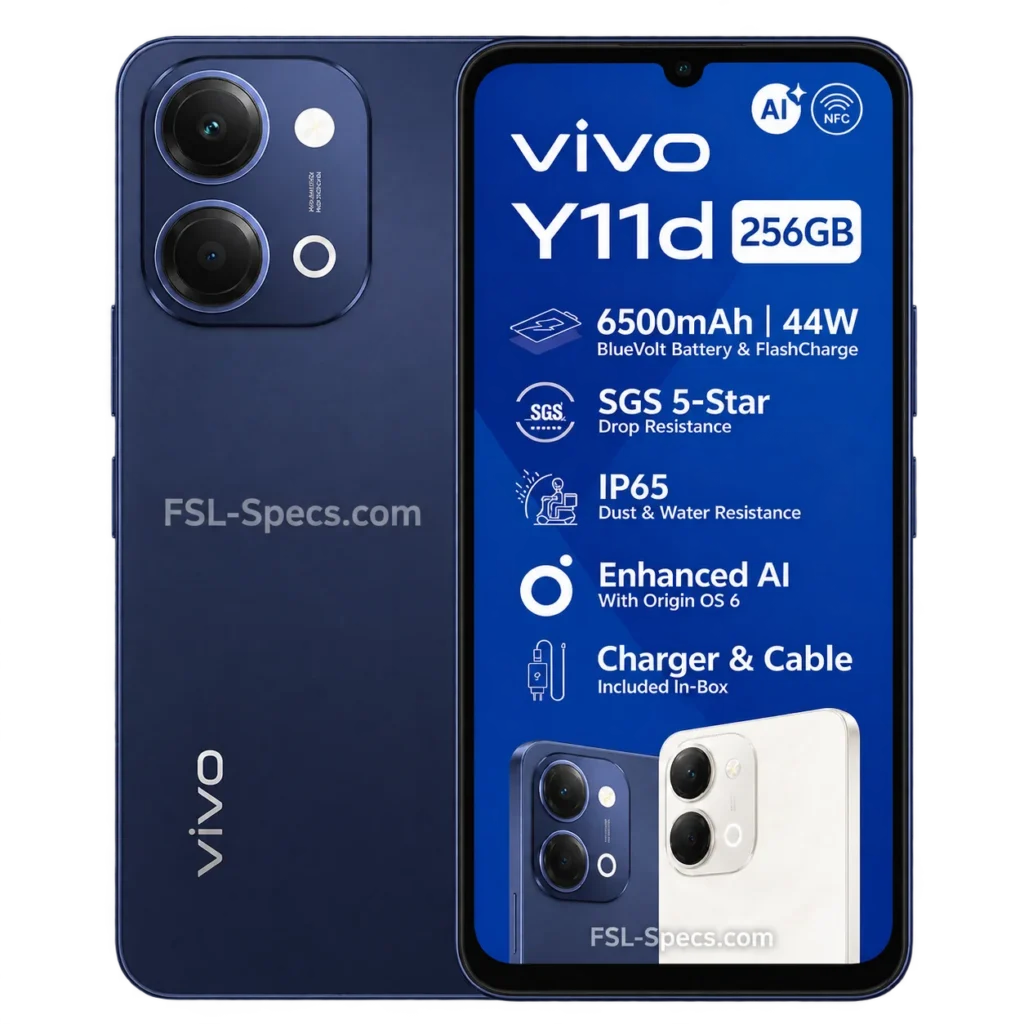
Quick Specs
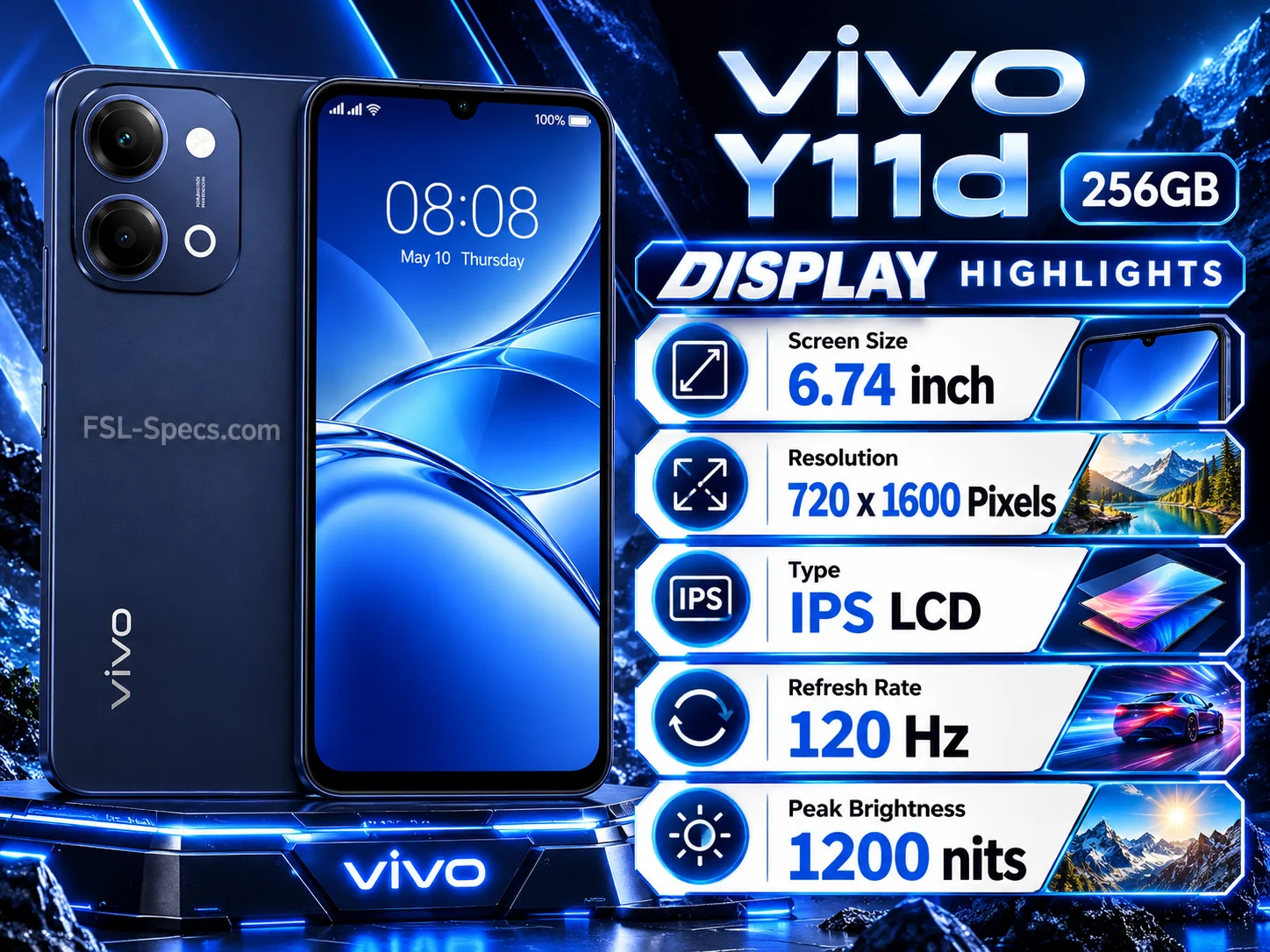
Display
6.74 inchIPS LCD120 Hz
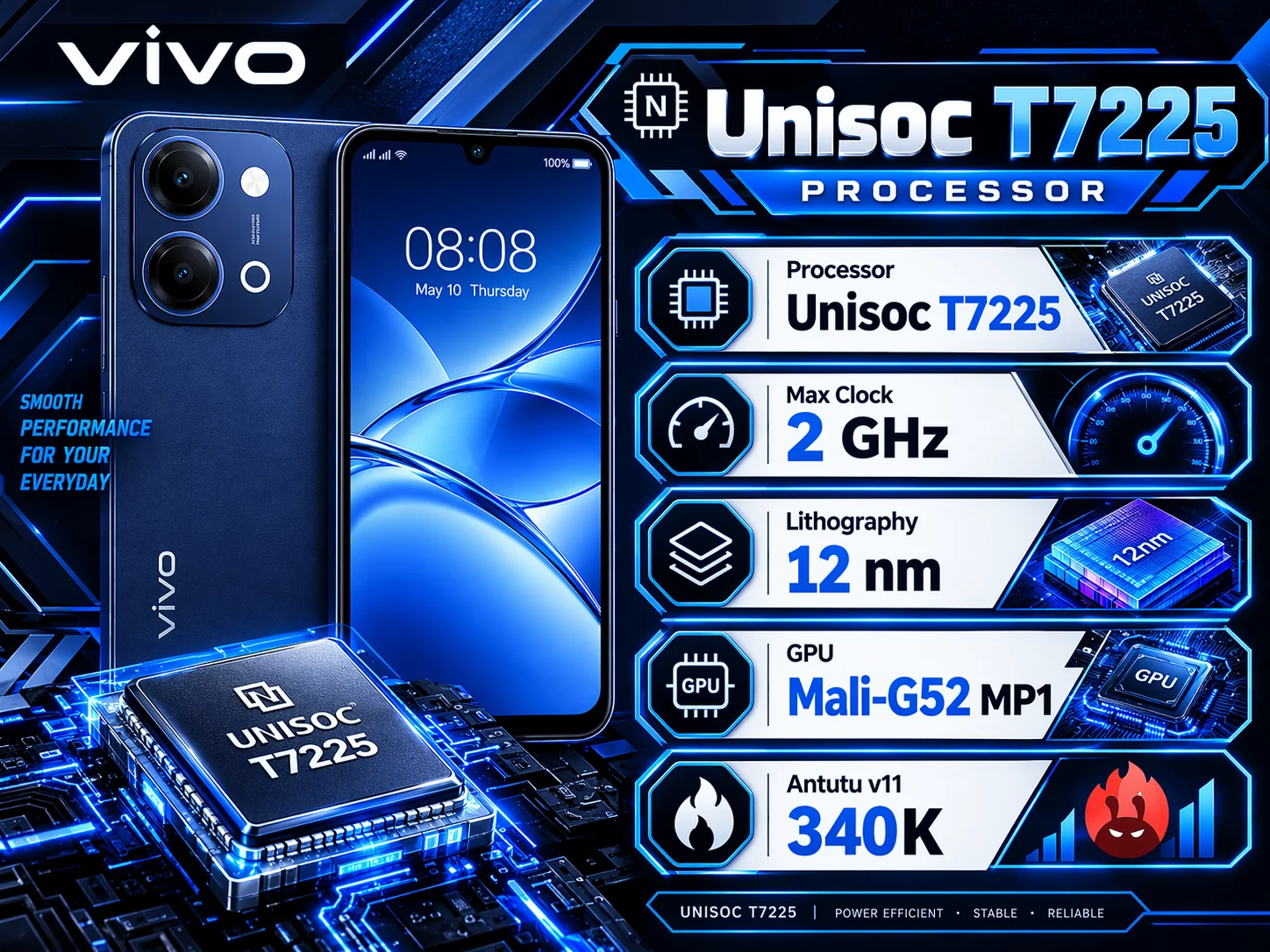
Processor
Unisoc T72252 GHz
RAM & Storage
6+128 GB
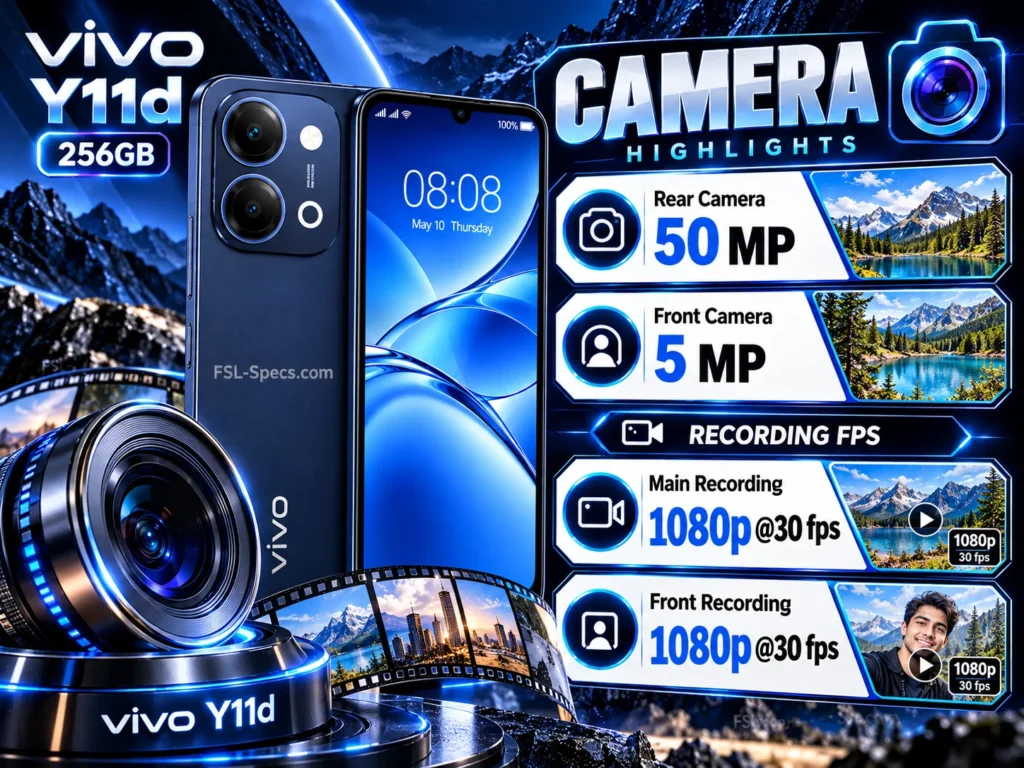
Rear Camera
50 MP
Front Camera
5 MP
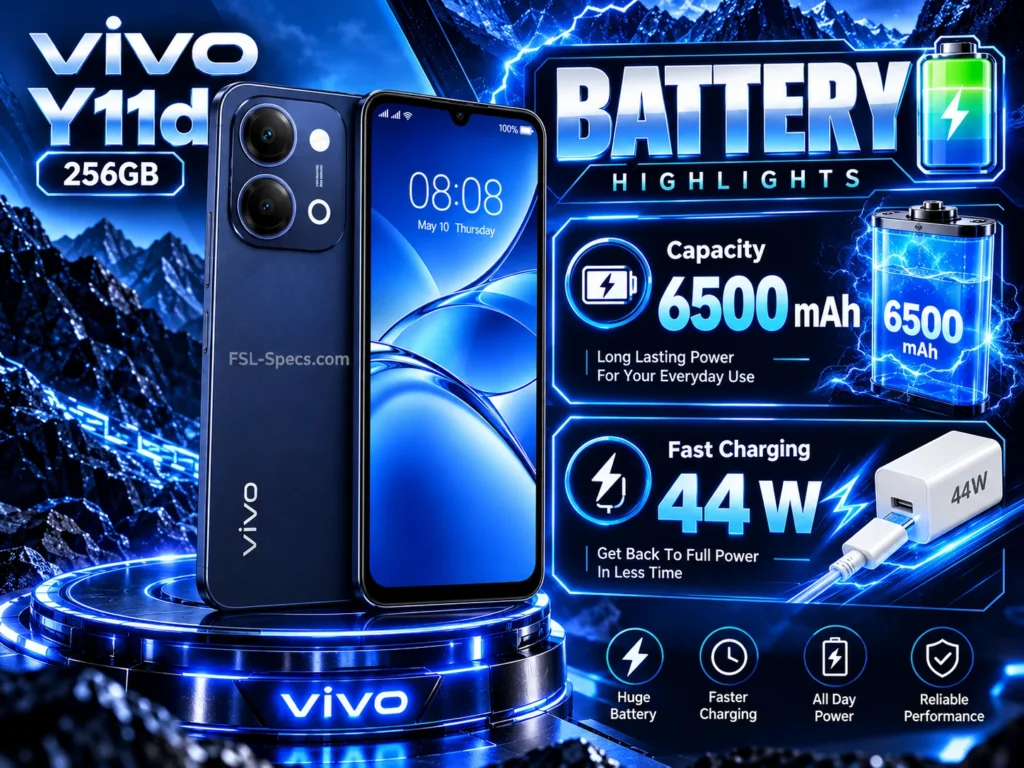
Battery & Charging
6500 mAh44 W

Full Specification

!
IMPORTANT INFORMATION

Specifications Disclaimer

NOTICE

Specifications are collected from official manufacturers and trusted sources. Actual details may vary by region, model variant, or software updates. We strive for accuracy but cannot guarantee error-free information.

Basic Info

Mobile
Vivo Y11d
Series
Vivo Y Series
Category
Budget
Release Date
1 June,2026
Year
2026

Connectivity

SIM
Nano-SIM + Nano-SIM
Network
4G
WiFi
Wi-Fi 5
Bluetooth
5.2
NFC
No
OS
Android 16

Body

Dimensions
167.4 x 77.1 x 8.4 mm
Build
Frame And Back (Plastic)
Weight
209 g
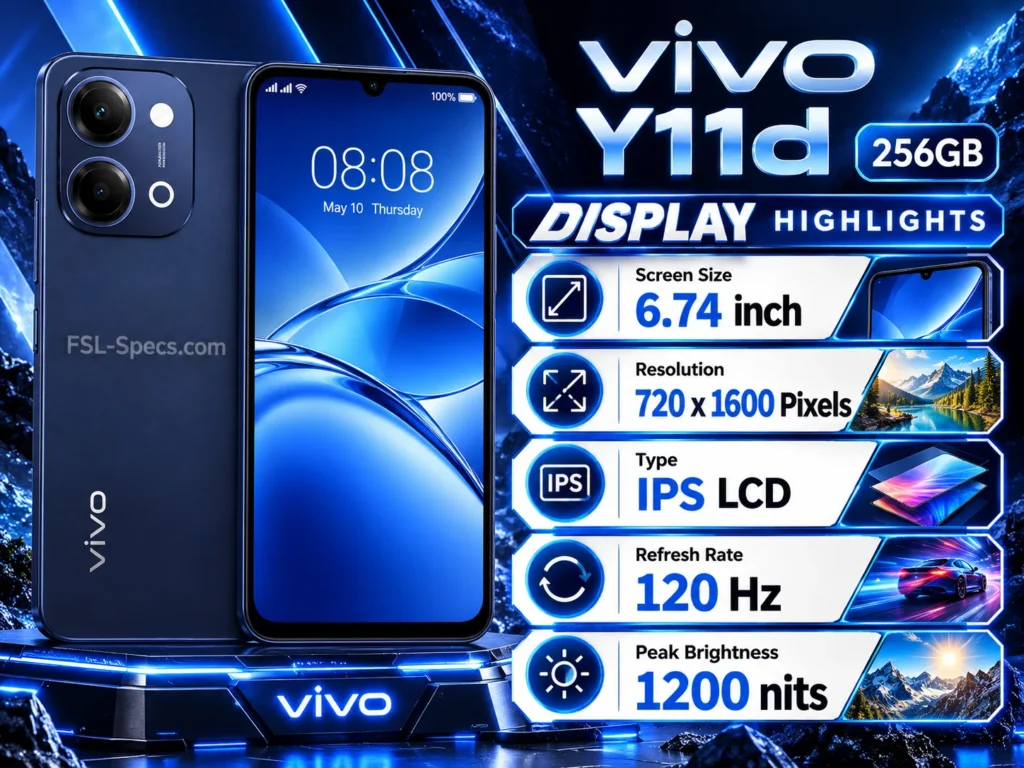
Screen Size
6.74 inch
Resolution
720 x 1600 Pixels
Type
IPS LCD
Refresh Rate
120 Hz
Peak Brightness
1200 nits
Processor Specs
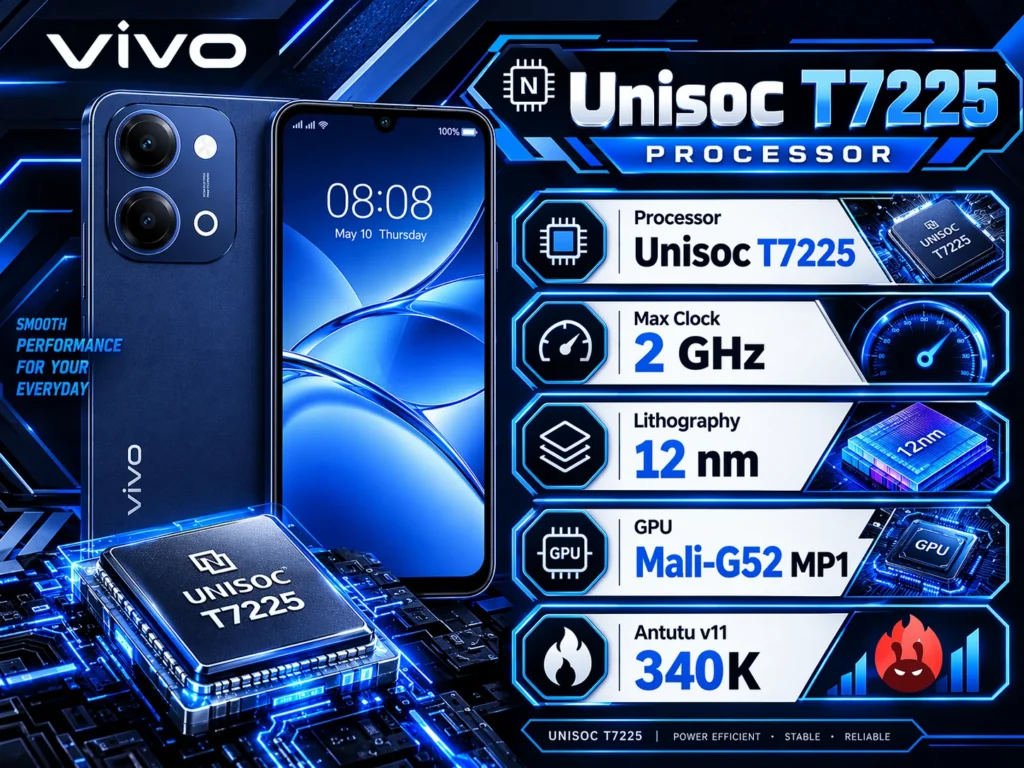
Processor
Unisoc T7225
Max Clock
2 GHz
Lithography
12 nm
GPU
Mali-G52 MP1
CPU Cores
8 Cores
Antutu v11
340K
Antutu v10
250K
Architecture
2 x 2.0 GHz Cortex-A75
6 x 1.8 GHz Cortex-A55
RAM & ROM Specs
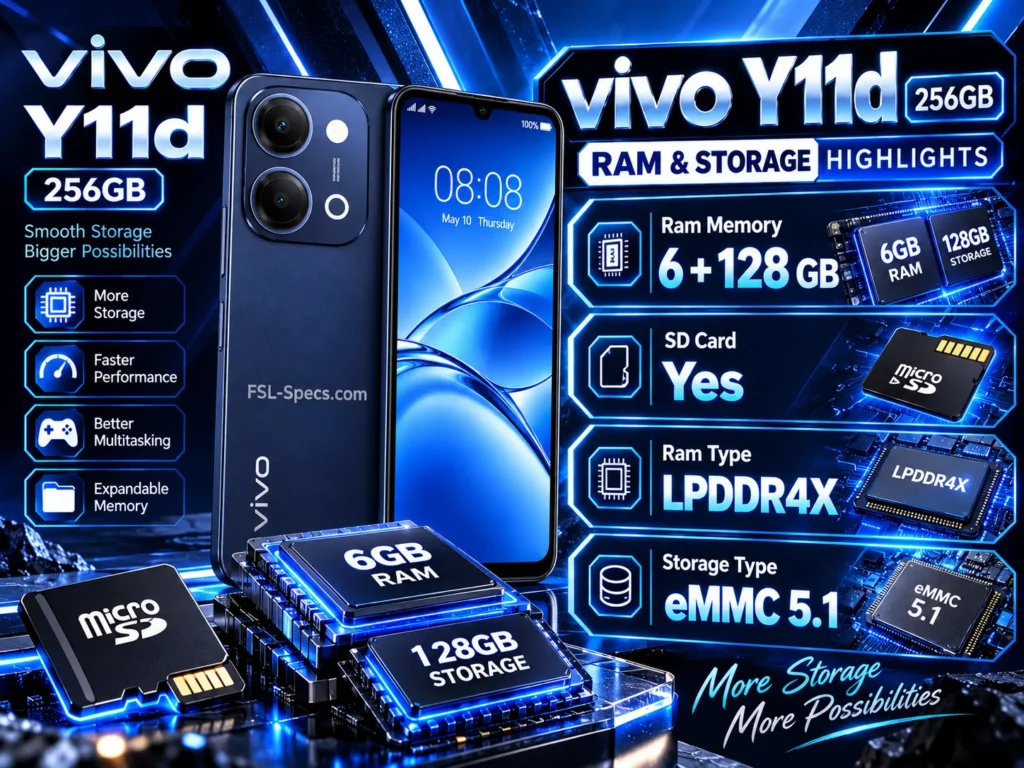
RAM Memory
6+128 GB
RAM Type
LPDDR4X
Storage Type
eMMC 5.1
SD Card
Yes
Variants
4 + 64 / 128 GB
6 + 128 GB
Camera Specs
MP
Rear Camera
50 MP
Front Camera
5 MP
Recording FPS
Main Recording
1080p @30 fps
Front Recording
1080p @30 fps
Flash
Flash
Dual LED
Battery Specs
Capacity
6500 mAh
Fast Charging
44 W
Reverse
Reverse Wired
Yes
Other Specs
Audio & Sensors
IP Rating
ip 65
Speaker
Dual Stereo Speaker
Fingerprint Sensor
Side Mounted
Other Sensors
Accelerometer
Gyroscope
Proximity
Compass
etc
BASIC INFO
Mobile
Vivo Y11d
Series
Vivo Y Series
Category
Budget
Release Date
1 June,2026
Year
2026
CONNECTIVITY
Sim
Nano-SIM + Nano-SIM
Network
4G
WiFi
Wi-Fi 5
Bluetooth
5.2
NFC
No
OS
Android 16
BODY
Dimensions
167.4 x 77.1 x 8.4 mm
Build
Frame And Back (Plastic)
Weight
209 g
Screen Size
6.74 inch
Resolution
720 x 1600 Pixels
Type
IPS LCD
Refresh Rate
120 Hz
Peak Brightness
1200 nits
Processor
Unisoc T7225
Max Clock
2 GHz
Lithography
12 nm
GPU
Mali-G52 MP1
CPU Cores
8 Cores
Antutu v11
340K
Antutu v10
250K
Architecture
2 x 2.0 GHz Cortex-A75
6 x 1.8 GHz Cortex-A55
Ram Memory
6+128 GB
SD Card
Yes
Ram Type
LPDDR4X
Storage Type
eMMC 5.1
Variants
4 + 64 / 128 GB
6 + 128 GB
MP
Rear Camera
50 MP
Front Camera
5 MP
RECORDING FPS
Main Recording
1080p @30 fps
Front Recording
1080p @30 fps
RESOLUTION
Main Resolution
8160 × 6144 pixels
FLASH
Flash
Dual LED
Capacity
6500 mAh
Fast Charging
44 W
REVERSE
Reverse Wired
Yes
PROTECTION
IP Rating
ip 65
AUDIO & SENSORS
Speaker
Dual Stereo Speaker
Fingerprint Sensor
Side Mounted
Other Sensors
Accelerometer Gyroscope Proximity Compass etc

Verify Mobile Specifications

Official information & trusted references

Official Manufacturer WebsiteExplore the original product information (opens in a new tab)

Trusted Specification Sources

Cross-reference · 4 sources

Links open third-party websites. The Purple ticks are a design marker only; they do not mean a source has verified these specifications or endorses FSL-Specs.

Last Time Update : 30 October, 2026

Highlights & Review Of Vivo Y11d

Display Highlights

Display Highlights

The Vivo Y11d is the only LCD in this group, with a 6.74-inch IPS LCD at 720 x 1600, 120Hz and 1200 nits peak brightness. Every rival uses an AMOLED panel at 1080p-class resolution, which gives them about 2.3 times the pixels of the Y11d. That puts the Y11d at roughly 260 ppi, against about 395 ppi on the Infinix GT 10 Pro and about 393 ppi on both the itel Super 26 Ultra and the Infinix Note 40 Pro Plus 5G. The Y11d is also the only phone in the group priced at PKR 62,000 with a 720p panel.

Brightness figures use different measurements, so they only compare within the same type. The itel Super 26 Ultra lists the highest peak at 4500 nits, 3.75 times the Vivo Y11d’s 1200 nits and 5 times the 900 nits peak of the Infinix GT 10 Pro. The Y11d’s peak is 33% above the GT 10 Pro’s, which is the one brightness comparison where the Y11d leads.

The Infinix Note 40 Pro Plus 5G lists only 1300 nits HBM, and the other three phones list no HBM figure, so its brightness can’t be ranked against theirs.

Refresh rate is level except for one phone. The Vivo Y11d, Infinix GT 10 Pro and Infinix Note 40 Pro Plus 5G all run at 120Hz, while the itel Super 26 Ultra reaches 144Hz. A 120Hz panel on a 720p LCD does mean smoother scrolling than the resolution suggests, but it doesn’t offset the sharpness gap.

Prices are retailer prices checked on 29 October 2026. The Vivo Y11d (6GB/128GB) and itel Super 26 Ultra (8GB/256GB) are new, at PKR 62,000 and PKR 60,000. The Infinix GT 10 Pro is used at PKR 63,000, and the Infinix Note 40 Pro Plus 5G is used at PKR 60,000.

SpecVivo Y11dInfinix GT 10 Proitel Super 26 UltraInfinix Note 40 Pro Plus 5G
PanelIPS LCDAMOLEDAMOLEDAMOLED
Size6.74-inch6.67-inch6.78-inch6.78-inch
Resolution720 x 16001080 x 24001080 x 24361080 x 2436
Refresh rate120Hz120Hz144Hz120Hz
Peak brightness1200 nits900 nits4500 nits–
HBM brightness–––1300 nits

Verdict: The itel Super 26 Ultra has the best display here at PKR 60,000 new, with an AMOLED panel, 1080 x 2436 resolution, 144Hz and 4500 nits peak brightness. The Vivo Y11d has the weakest panel on sharpness and type, and costs PKR 2,000 more than the itel, so its only display edge is a 1200 nits peak above the Infinix GT 10 Pro’s 900 nits.
Performance Highlights

Performance Highlights

The Infinix GT 10 Pro leads this group at 1,020,000 AnTuTu (v11) on its Dimensity 8050, three times the Vivo Y11d’s 340,000 AnTuTu (v11) on the Unisoc T7225, for PKR 1,000 more. The Infinix Note 40 Pro Plus 5G scores 575,000 AnTuTu (v11) on the Dimensity 7020, 69% above the Y11d, and the itel Super 26 Ultra scores 500,000 AnTuTu (v11) on the Unisoc T7300, 47% above it. v11 is the only version all four phones share.

The GT 10 Pro, Note 40 Pro Plus 5G and Y11d also list 725,000, 460,000 and 250,000 AnTuTu (v10) respectively, while the itel has no v10 score, which does not mean a lower result.

The Vivo Y11d is the slowest phone here, and the hardware explains why. It is the only phone on a 12nm process, while the other three use 6nm. Its two performance cores are older Cortex-A75 cores at 2.0GHz, against Cortex-A78 cores in all three rivals.

The GT 10 Pro has four Cortex-A78 cores, one at 3.0GHz and three at 2.6GHz, which is why its lead is so large. The Y11d also has the weakest GPU, a single-core Mali-G52 MP1, against a Mali-G77 MC9 on the GT 10 Pro and a Mali-G57 MP2 on the itel.

The Infinix Note 40 Pro Plus 5G and itel Super 26 Ultra use the same 2x 2.2GHz Cortex-A78 + 6x 2.0GHz Cortex-A55 layout, so the 15% gap in v11 between them comes from the chipset design rather than the cores. Prices are retailer prices checked on 29 October 2026. The Y11d at PKR 62,000 and the itel at PKR 60,000 are new, while the GT 10 Pro at PKR 63,000 and the Note 40 Pro Plus 5G at PKR 60,000 are used.

SpecVivo Y11dInfinix GT 10 Proitel Super 26 UltraInfinix Note 40 Pro Plus 5G
ChipsetUnisoc T7225Dimensity 8050Unisoc T7300Dimensity 7020
Process12nm6nm6nm6nm
CPU2x 2.0GHz A75 + 6x 1.8GHz A551x 3.0GHz A78 + 3x 2.6GHz A78 + 4x 2.0GHz A552x 2.2GHz A78 + 6x 2.0GHz A552x 2.2GHz A78 + 6x 2.0GHz A55
GPUMali-G52 MP1Mali-G77 MC9Mali-G57 MP2IMG BXM-8-256
AnTuTu v11340,0001,020,000500,000575,000
AnTuTu v10250,000725,000–460,000

Verdict: The Infinix GT 10 Pro is by far the fastest phone here at 1,020,000 AnTuTu (v11) and PKR 63,000 used. The Vivo Y11d is the slowest at 340,000 AnTuTu (v11) and costs PKR 2,000 more than the faster itel Super 26 Ultra and Infinix Note 40 Pro Plus 5G.

Memory & Storage Highlights

Memory & Storage Highlights

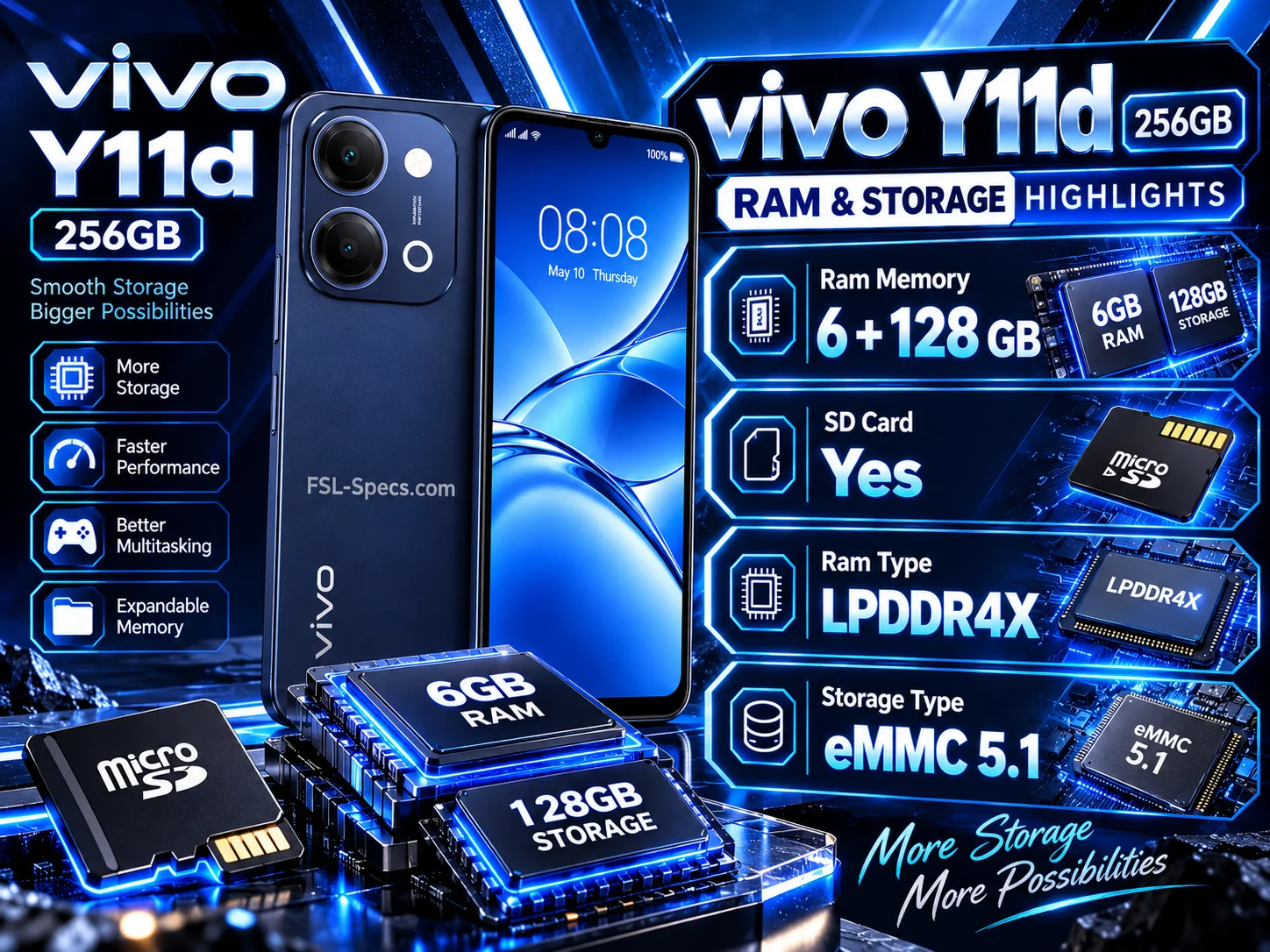
The Vivo Y11d in the 6GB/128GB variant has the smallest memory package in this group, at 6GB LPDDR4X RAM and 128GB eMMC 5.1 storage. The Infinix Note 40 Pro Plus 5G doubles that with 12GB RAM and 256GB storage, while the Infinix GT 10 Pro and itel Super 26 Ultra each have 8GB RAM, 33% more than the Y11d, and 256GB of storage.

All four phones use LPDDR4X RAM, so RAM generation doesn’t separate them. Storage type does. The Infinix GT 10 Pro uses UFS 3.1, the newest standard here, the itel Super 26 Ultra and Infinix Note 40 Pro Plus 5G use UFS 2.2, and the Vivo Y11d uses the slower eMMC 5.1.

Expandability is the key split. The Vivo Y11d, Infinix GT 10 Pro and itel Super 26 Ultra all list microSD support, but the Infinix Note 40 Pro Plus 5G lists no microSD slot. Its 256GB of built-in storage can’t be extended, which is a real limit next to the other three, even though it has the most RAM.

Price per gigabyte of built-in storage shows where the Y11d falls behind. The Vivo Y11d costs about PKR 484 per GB at PKR 62,000 new, roughly double the itel Super 26 Ultra at about PKR 234 per GB and PKR 60,000 new.

The Infinix Note 40 Pro Plus 5G costs about PKR 234 per GB at PKR 60,000 used, and the Infinix GT 10 Pro about PKR 246 per GB at PKR 63,000 used. Prices are retailer prices checked on 29 October 2026.

SpecVivo Y11dInfinix GT 10 Proitel Super 26 UltraInfinix Note 40 Pro Plus 5G
Variant compared6GB + 128GB8GB + 256GB8GB + 256GB12GB + 256GB
RAM typeLPDDR4XLPDDR4XLPDDR4XLPDDR4X
Storage typeeMMC 5.1UFS 3.1UFS 2.2UFS 2.2
microSDYesYesYesNo

Verdict: The Infinix GT 10 Pro has the best memory package here at PKR 63,000 used, with 8GB RAM, 256GB of UFS 3.1 storage and microSD support. The Infinix Note 40 Pro Plus 5G has the most RAM at 12GB, but no card slot. The Vivo Y11d is the weakest at 6GB RAM and 128GB of eMMC 5.1 storage, and costs PKR 2,000 more than the itel Super 26 Ultra, which has more of everything.

Camera Highlights

Camera Highlights

The Vivo Y11d has the weakest camera setup in this group, with a 50MP rear camera and a 5MP front camera, against 32MP front cameras on the Infinix GT 10 Pro, itel Super 26 Ultra and Infinix Note 40 Pro Plus 5G. That is 6.4 times the selfie resolution. The GT 10 Pro and Note 40 Pro Plus 5G also use 108MP main cameras, more than double the Y11d’s rear resolution. Video follows the same order.

The Y11d records only 1080p at 30fps on both cameras, while the GT 10 Pro reaches 4K at 30fps on the rear and 2K at 30fps on the front. The itel Super 26 Ultra and Note 40 Pro Plus 5G record 2K at 30fps on the rear.

Sensor confidence favors the Infinix pair. Both list a 108MP Samsung HM6 main sensor, and the Note 40 Pro Plus 5G also names its front sensor, a Hynix HI-1631Q. The Y11d and itel Super 26 Ultra name neither sensor, and the GT 10 Pro doesn’t name its front sensor. Aperture, sensor size and OIS are not listed for any phone, so low-light performance can’t be ranked.

The Note 40 Pro Plus 5G is the only phone with 3x optical zoom, and it lists stabilization. The itel Super 26 Ultra and GT 10 Pro list digital stabilization, and the itel adds 10x digital zoom. The Y11d lists no zoom and no stabilization. The Note 40 Pro Plus 5G also records front video at only 1080p at 60fps, below the 2K front video on the GT 10 Pro and itel. Prices are retailer prices checked on 29 October 2026.

SpecVivo Y11dInfinix GT 10 Proitel Super 26 UltraInfinix Note 40 Pro Plus 5G
Rear cameras50MP108 + 2 + 2MP50 + 2MP108 + 2 + 2MP
Main sensor–Samsung HM6–Samsung HM6
Front camera5MP32MP32MP32MP
Rear video1080p@304K@302K@302K@30
Front video1080p@302K@302K@301080p@60

Verdict: The Infinix Note 40 Pro Plus 5G has the best camera hardware here at PKR 60,000 used, with a named 108MP sensor, 3x optical zoom and a 32MP front camera, while the Infinix GT 10 Pro is the pick for video at 4K. The Vivo Y11d is the weakest at PKR 62,000, with a 5MP front camera and 1080p video only.

Battery & Charging Highlights

Battery & Charging Highlights

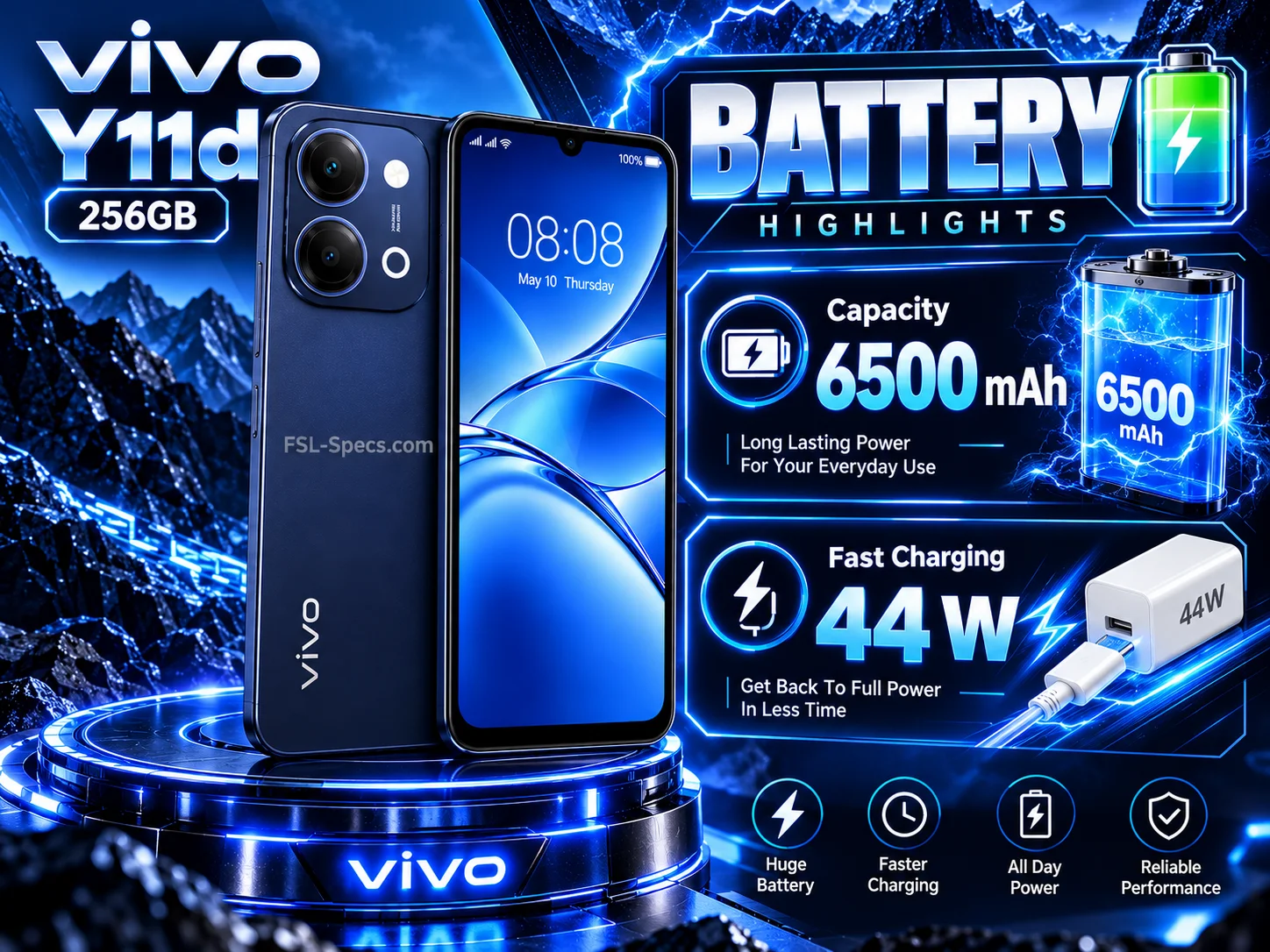
The Vivo Y11d has the largest battery in this group at 6500 mAh and still charges at 44W. The Infinix Note 40 Pro Plus 5G has the smallest cell at 4600 mAh, which is 41% less capacity, but charges at 100W, 2.3 times the Y11d’s speed. The itel Super 26 Ultra carries 6000 mAh, 8% below the Y11d, but charges at only 18W, so the Y11d charges 2.4 times faster on a larger cell. The Infinix GT 10 Pro has 5000 mAh and 45W, which is level with the Y11d on wattage (within 5%) but 23% smaller on capacity.

Charging features split the phones further. The Infinix Note 40 Pro Plus 5G is the only phone with 20W wireless charging, and the other three list no wireless charging. Reverse wired charging is listed on the Vivo Y11d and Infinix GT 10 Pro, but not on the itel Super 26 Ultra or Infinix Note 40 Pro Plus 5G, so neither can be assumed to support it.

Cell chemistry is listed for three phones. The GT 10 Pro and Note 40 Pro Plus 5G use lithium polymer, the itel Super 26 Ultra uses lithium polymer, and the Vivo Y11d doesn’t list its cell type.

The Y11d offers the best mix of capacity and speed, but it is not the cheapest. It costs PKR 2,000 more than the new itel Super 26 Ultra and the used Note 40 Pro Plus 5G, and PKR 1,000 less than the used GT 10 Pro. Prices are retailer prices checked on 29 October 2026. The Y11d at PKR 62,000 and the itel at PKR 60,000 are new, while the other two are used.

SpecVivo Y11dInfinix GT 10 Proitel Super 26 UltraInfinix Note 40 Pro Plus 5G
Capacity6500 mAh5000 mAh6000 mAh4600 mAh
Wired charging44W45W18W100W
Wireless charging–––20W

Verdict: The Vivo Y11d has the best balance of endurance and speed here, with the largest 6500 mAh cell and 44W charging at PKR 62,000. The Infinix Note 40 Pro Plus 5G is the pick for fast charging at 100W and the only one with 20W wireless, but its 4600 mAh cell is the smallest. The itel Super 26 Ultra charges slowest at 18W despite its 6000 mAh battery.

Final Verdict

The Infinix GT 10 Pro is the overall winner at PKR 63,000 used. It leads on performance with 1,020,000 AnTuTu (v11) and on memory with 8GB RAM and 256GB UFS 3.1 storage with microSD. It also has the best video of the four at 4K at 30fps. This verdict uses a balanced weighting across all five categories. Performance and camera count most, because a threefold AnTuTu gap changes daily use more than a PKR 2,000 price difference.

The Infinix Note 40 Pro Plus 5G takes second place by winning on camera with a named 108MP sensor and 3x optical zoom, and on charging with 100W and 20W wireless, though it has no microSD slot. It is also nearly level with the GT 10 Pro on value at PKR 60,000 used. The itel Super 26 Ultra is third, and wins display with 144Hz and 4500 nits peak. The Vivo Y11d finishes last, with the best endurance setup at 6500 mAh and 44W, but the weakest display, processor, memory and cameras.

Bottom line: Buy the Infinix GT 10 Pro for the strongest all-round package, or the Infinix Note 40 Pro Plus 5G if cameras and fast charging matter more than expandable storage. Choose the Vivo Y11d only if battery capacity is your priority.

Ranking:

  1. Infinix GT 10 Pro – PKR 63,000 (used)
  2. Infinix Note 40 Pro Plus 5G – PKR 60,000 (used)
  3. itel Super 26 Ultra – PKR 60,000 (new)
  4. Vivo Y11d – PKR 62,000 (new)

Display Highlights

Display Highlights

The Vivo Y11d is the only LCD in this group, with a 6.74-inch IPS LCD at 720 x 1600, 120Hz and 1200 nits peak brightness. Every rival uses an AMOLED panel at 1080p-class resolution, which gives them about 2.3 times the pixels of the Y11d. That puts the Y11d at roughly 260 ppi, against about 395 ppi on the Infinix GT 10 Pro and about 393 ppi on both the itel Super 26 Ultra and the Infinix Note 40 Pro Plus 5G. The Y11d is also the only phone in the group priced at PKR 62,000 with a 720p panel.

Brightness figures use different measurements, so they only compare within the same type. The itel Super 26 Ultra lists the highest peak at 4500 nits, 3.75 times the Vivo Y11d’s 1200 nits and 5 times the 900 nits peak of the Infinix GT 10 Pro. The Y11d’s peak is 33% above the GT 10 Pro’s, which is the one brightness comparison where the Y11d leads.

The Infinix Note 40 Pro Plus 5G lists only 1300 nits HBM, and the other three phones list no HBM figure, so its brightness can’t be ranked against theirs.

Refresh rate is level except for one phone. The Vivo Y11d, Infinix GT 10 Pro and Infinix Note 40 Pro Plus 5G all run at 120Hz, while the itel Super 26 Ultra reaches 144Hz. A 120Hz panel on a 720p LCD does mean smoother scrolling than the resolution suggests, but it doesn’t offset the sharpness gap.

Prices are retailer prices checked on 29 October 2026. The Vivo Y11d (6GB/128GB) and itel Super 26 Ultra (8GB/256GB) are new, at PKR 62,000 and PKR 60,000. The Infinix GT 10 Pro is used at PKR 63,000, and the Infinix Note 40 Pro Plus 5G is used at PKR 60,000.

SpecVivo Y11dInfinix GT 10 Proitel Super 26 UltraInfinix Note 40 Pro Plus 5G
PanelIPS LCDAMOLEDAMOLEDAMOLED
Size6.74-inch6.67-inch6.78-inch6.78-inch
Resolution720 x 16001080 x 24001080 x 24361080 x 2436
Refresh rate120Hz120Hz144Hz120Hz
Peak brightness1200 nits900 nits4500 nits–
HBM brightness–––1300 nits

Verdict: The itel Super 26 Ultra has the best display here at PKR 60,000 new, with an AMOLED panel, 1080 x 2436 resolution, 144Hz and 4500 nits peak brightness. The Vivo Y11d has the weakest panel on sharpness and type, and costs PKR 2,000 more than the itel, so its only display edge is a 1200 nits peak above the Infinix GT 10 Pro’s 900 nits.
Performance Highlights

Performance Highlights

The Infinix GT 10 Pro leads this group at 1,020,000 AnTuTu (v11) on its Dimensity 8050, three times the Vivo Y11d’s 340,000 AnTuTu (v11) on the Unisoc T7225, for PKR 1,000 more. The Infinix Note 40 Pro Plus 5G scores 575,000 AnTuTu (v11) on the Dimensity 7020, 69% above the Y11d, and the itel Super 26 Ultra scores 500,000 AnTuTu (v11) on the Unisoc T7300, 47% above it. v11 is the only version all four phones share.

The GT 10 Pro, Note 40 Pro Plus 5G and Y11d also list 725,000, 460,000 and 250,000 AnTuTu (v10) respectively, while the itel has no v10 score, which does not mean a lower result.

The Vivo Y11d is the slowest phone here, and the hardware explains why. It is the only phone on a 12nm process, while the other three use 6nm. Its two performance cores are older Cortex-A75 cores at 2.0GHz, against Cortex-A78 cores in all three rivals.

The GT 10 Pro has four Cortex-A78 cores, one at 3.0GHz and three at 2.6GHz, which is why its lead is so large. The Y11d also has the weakest GPU, a single-core Mali-G52 MP1, against a Mali-G77 MC9 on the GT 10 Pro and a Mali-G57 MP2 on the itel.

The Infinix Note 40 Pro Plus 5G and itel Super 26 Ultra use the same 2x 2.2GHz Cortex-A78 + 6x 2.0GHz Cortex-A55 layout, so the 15% gap in v11 between them comes from the chipset design rather than the cores. Prices are retailer prices checked on 29 October 2026. The Y11d at PKR 62,000 and the itel at PKR 60,000 are new, while the GT 10 Pro at PKR 63,000 and the Note 40 Pro Plus 5G at PKR 60,000 are used.

SpecVivo Y11dInfinix GT 10 Proitel Super 26 UltraInfinix Note 40 Pro Plus 5G
ChipsetUnisoc T7225Dimensity 8050Unisoc T7300Dimensity 7020
Process12nm6nm6nm6nm
CPU2x 2.0GHz A75 + 6x 1.8GHz A551x 3.0GHz A78 + 3x 2.6GHz A78 + 4x 2.0GHz A552x 2.2GHz A78 + 6x 2.0GHz A552x 2.2GHz A78 + 6x 2.0GHz A55
GPUMali-G52 MP1Mali-G77 MC9Mali-G57 MP2IMG BXM-8-256
AnTuTu v11340,0001,020,000500,000575,000
AnTuTu v10250,000725,000–460,000

Verdict: The Infinix GT 10 Pro is by far the fastest phone here at 1,020,000 AnTuTu (v11) and PKR 63,000 used. The Vivo Y11d is the slowest at 340,000 AnTuTu (v11) and costs PKR 2,000 more than the faster itel Super 26 Ultra and Infinix Note 40 Pro Plus 5G.

Memory & Storage Highlights

Memory & Storage Highlights

The Vivo Y11d in the 6GB/128GB variant has the smallest memory package in this group, at 6GB LPDDR4X RAM and 128GB eMMC 5.1 storage. The Infinix Note 40 Pro Plus 5G doubles that with 12GB RAM and 256GB storage, while the Infinix GT 10 Pro and itel Super 26 Ultra each have 8GB RAM, 33% more than the Y11d, and 256GB of storage.

All four phones use LPDDR4X RAM, so RAM generation doesn’t separate them. Storage type does. The Infinix GT 10 Pro uses UFS 3.1, the newest standard here, the itel Super 26 Ultra and Infinix Note 40 Pro Plus 5G use UFS 2.2, and the Vivo Y11d uses the slower eMMC 5.1.

Expandability is the key split. The Vivo Y11d, Infinix GT 10 Pro and itel Super 26 Ultra all list microSD support, but the Infinix Note 40 Pro Plus 5G lists no microSD slot. Its 256GB of built-in storage can’t be extended, which is a real limit next to the other three, even though it has the most RAM.

Price per gigabyte of built-in storage shows where the Y11d falls behind. The Vivo Y11d costs about PKR 484 per GB at PKR 62,000 new, roughly double the itel Super 26 Ultra at about PKR 234 per GB and PKR 60,000 new.

The Infinix Note 40 Pro Plus 5G costs about PKR 234 per GB at PKR 60,000 used, and the Infinix GT 10 Pro about PKR 246 per GB at PKR 63,000 used. Prices are retailer prices checked on 29 October 2026.

SpecVivo Y11dInfinix GT 10 Proitel Super 26 UltraInfinix Note 40 Pro Plus 5G
Variant compared6GB + 128GB8GB + 256GB8GB + 256GB12GB + 256GB
RAM typeLPDDR4XLPDDR4XLPDDR4XLPDDR4X
Storage typeeMMC 5.1UFS 3.1UFS 2.2UFS 2.2
microSDYesYesYesNo

Verdict: The Infinix GT 10 Pro has the best memory package here at PKR 63,000 used, with 8GB RAM, 256GB of UFS 3.1 storage and microSD support. The Infinix Note 40 Pro Plus 5G has the most RAM at 12GB, but no card slot. The Vivo Y11d is the weakest at 6GB RAM and 128GB of eMMC 5.1 storage, and costs PKR 2,000 more than the itel Super 26 Ultra, which has more of everything.

Camera Highlights

Camera Highlights

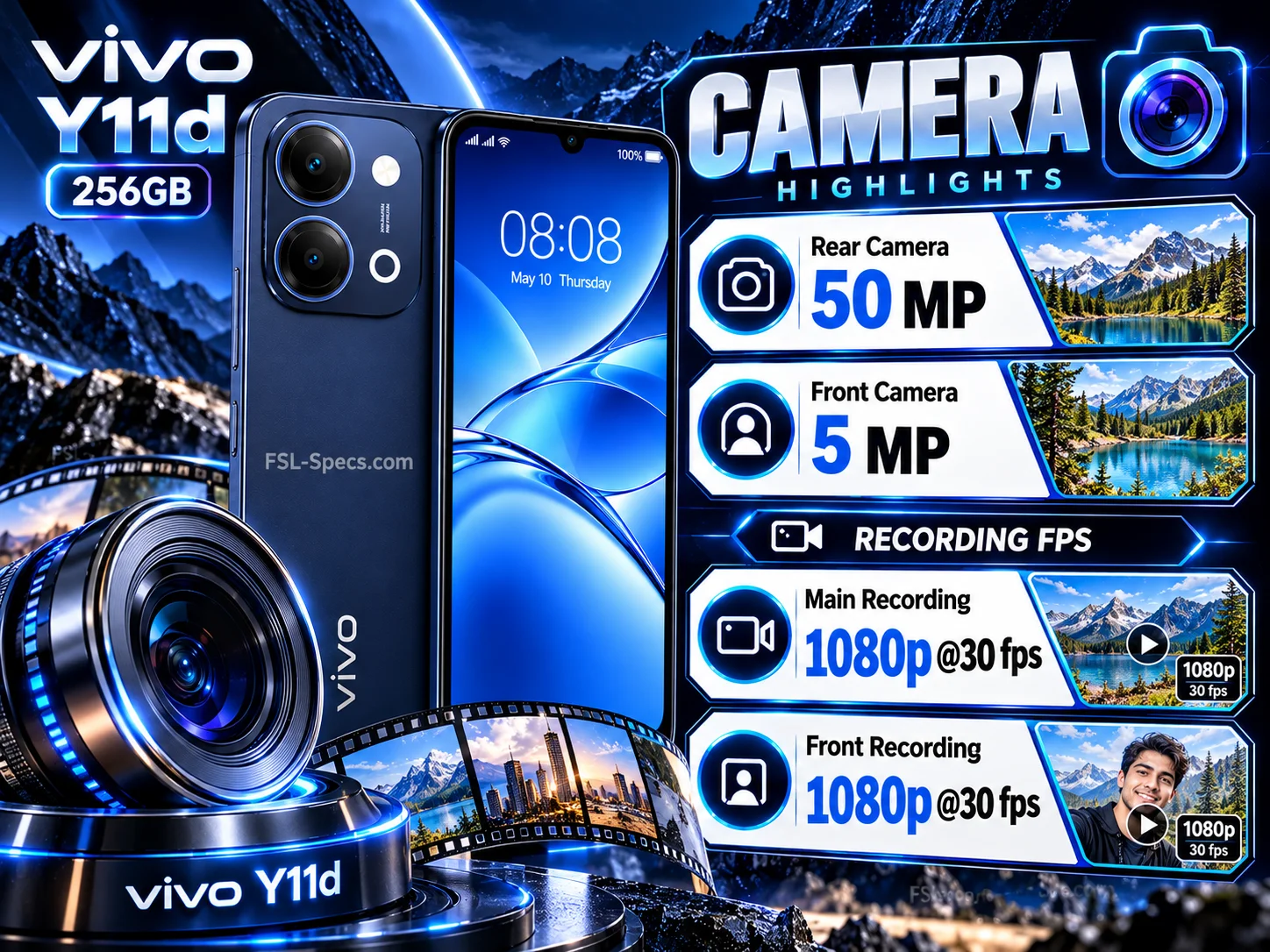
The Vivo Y11d has the weakest camera setup in this group, with a 50MP rear camera and a 5MP front camera, against 32MP front cameras on the Infinix GT 10 Pro, itel Super 26 Ultra and Infinix Note 40 Pro Plus 5G. That is 6.4 times the selfie resolution. The GT 10 Pro and Note 40 Pro Plus 5G also use 108MP main cameras, more than double the Y11d’s rear resolution. Video follows the same order.

The Y11d records only 1080p at 30fps on both cameras, while the GT 10 Pro reaches 4K at 30fps on the rear and 2K at 30fps on the front. The itel Super 26 Ultra and Note 40 Pro Plus 5G record 2K at 30fps on the rear.

Sensor confidence favors the Infinix pair. Both list a 108MP Samsung HM6 main sensor, and the Note 40 Pro Plus 5G also names its front sensor, a Hynix HI-1631Q. The Y11d and itel Super 26 Ultra name neither sensor, and the GT 10 Pro doesn’t name its front sensor. Aperture, sensor size and OIS are not listed for any phone, so low-light performance can’t be ranked.

The Note 40 Pro Plus 5G is the only phone with 3x optical zoom, and it lists stabilization. The itel Super 26 Ultra and GT 10 Pro list digital stabilization, and the itel adds 10x digital zoom. The Y11d lists no zoom and no stabilization. The Note 40 Pro Plus 5G also records front video at only 1080p at 60fps, below the 2K front video on the GT 10 Pro and itel. Prices are retailer prices checked on 29 October 2026.

SpecVivo Y11dInfinix GT 10 Proitel Super 26 UltraInfinix Note 40 Pro Plus 5G
Rear cameras50MP108 + 2 + 2MP50 + 2MP108 + 2 + 2MP
Main sensor–Samsung HM6–Samsung HM6
Front camera5MP32MP32MP32MP
Rear video1080p@304K@302K@302K@30
Front video1080p@302K@302K@301080p@60

Verdict: The Infinix Note 40 Pro Plus 5G has the best camera hardware here at PKR 60,000 used, with a named 108MP sensor, 3x optical zoom and a 32MP front camera, while the Infinix GT 10 Pro is the pick for video at 4K. The Vivo Y11d is the weakest at PKR 62,000, with a 5MP front camera and 1080p video only.

Battery & Charging Highlights

Battery & Charging Highlights

The Vivo Y11d has the largest battery in this group at 6500 mAh and still charges at 44W. The Infinix Note 40 Pro Plus 5G has the smallest cell at 4600 mAh, which is 41% less capacity, but charges at 100W, 2.3 times the Y11d’s speed. The itel Super 26 Ultra carries 6000 mAh, 8% below the Y11d, but charges at only 18W, so the Y11d charges 2.4 times faster on a larger cell. The Infinix GT 10 Pro has 5000 mAh and 45W, which is level with the Y11d on wattage (within 5%) but 23% smaller on capacity.

Charging features split the phones further. The Infinix Note 40 Pro Plus 5G is the only phone with 20W wireless charging, and the other three list no wireless charging. Reverse wired charging is listed on the Vivo Y11d and Infinix GT 10 Pro, but not on the itel Super 26 Ultra or Infinix Note 40 Pro Plus 5G, so neither can be assumed to support it.

Cell chemistry is listed for three phones. The GT 10 Pro and Note 40 Pro Plus 5G use lithium polymer, the itel Super 26 Ultra uses lithium polymer, and the Vivo Y11d doesn’t list its cell type.

The Y11d offers the best mix of capacity and speed, but it is not the cheapest. It costs PKR 2,000 more than the new itel Super 26 Ultra and the used Note 40 Pro Plus 5G, and PKR 1,000 less than the used GT 10 Pro. Prices are retailer prices checked on 29 October 2026. The Y11d at PKR 62,000 and the itel at PKR 60,000 are new, while the other two are used.

SpecVivo Y11dInfinix GT 10 Proitel Super 26 UltraInfinix Note 40 Pro Plus 5G
Capacity6500 mAh5000 mAh6000 mAh4600 mAh
Wired charging44W45W18W100W
Wireless charging–––20W

Verdict: The Vivo Y11d has the best balance of endurance and speed here, with the largest 6500 mAh cell and 44W charging at PKR 62,000. The Infinix Note 40 Pro Plus 5G is the pick for fast charging at 100W and the only one with 20W wireless, but its 4600 mAh cell is the smallest. The itel Super 26 Ultra charges slowest at 18W despite its 6000 mAh battery.

Final Verdict

The Infinix GT 10 Pro is the overall winner at PKR 63,000 used. It leads on performance with 1,020,000 AnTuTu (v11) and on memory with 8GB RAM and 256GB UFS 3.1 storage with microSD. It also has the best video of the four at 4K at 30fps. This verdict uses a balanced weighting across all five categories. Performance and camera count most, because a threefold AnTuTu gap changes daily use more than a PKR 2,000 price difference.

The Infinix Note 40 Pro Plus 5G takes second place by winning on camera with a named 108MP sensor and 3x optical zoom, and on charging with 100W and 20W wireless, though it has no microSD slot. It is also nearly level with the GT 10 Pro on value at PKR 60,000 used. The itel Super 26 Ultra is third, and wins display with 144Hz and 4500 nits peak. The Vivo Y11d finishes last, with the best endurance setup at 6500 mAh and 44W, but the weakest display, processor, memory and cameras.

Bottom line: Buy the Infinix GT 10 Pro for the strongest all-round package, or the Infinix Note 40 Pro Plus 5G if cameras and fast charging matter more than expandable storage. Choose the Vivo Y11d only if battery capacity is your priority.

Ranking:

  1. Infinix GT 10 Pro – PKR 63,000 (used)
  2. Infinix Note 40 Pro Plus 5G – PKR 60,000 (used)
  3. itel Super 26 Ultra – PKR 60,000 (new)
  4. Vivo Y11d – PKR 62,000 (new)

Pros and Cons

Pros

  • Huge 6,500mAh battery
  • Fast 44W wired charging
  • Smooth 120Hz display
  • Bright 1,200-nit outdoor screen
  • IP65 dust-water resistance
  • Expandable storage and headphone jack

Cons

  • Low HD+ resolution
  • Basic 5MP selfie camera
  • Entry-level Unisoc T7225
  • No 5G connectivity
  • No NFC payments

Who Is It Best For?

Best For

  • Battery-focused users
  • Basic daily tasks
  • Social media scrolling
  • Video streaming fans
  • Storage expansion seekers

Not Best For

  • Hardcore mobile gamers
  • Selfie-focused users
  • 5G network users
  • NFC payment users
  • Photography enthusiasts
  • Lightweight-phone seekers
Video Reviews & Tests
// hands-on videos for this phone

Unboxing

What's In The Box
Unboxing

PUBG Gaming Test

FPS & Heat Test
PUBG Gaming Test

Camera Test

Photo & Video Samples
Camera Test

Related Comparisions

VIVO Series Row
Picture of Faisal Ur Rehman

Faisal Ur Rehman

Faisal Rehman is the founder and editor of FSL Specs, where he publishes in-depth smartphone specifications, comparisons, buying guides, and technology insights. With extensive experience in mobile hardware research and technical analysis, he provides accurate and up-to-date information on Android smartphones, processors, displays, cameras, batteries, performance benchmarks, and software features. His goal is to simplify complex specifications and help readers choose the right device with confidence.

FAQs Questions

It has a 6.74-inch LCD at 720 × 1600 resolution with a 120Hz refresh rate and up to 1,200 nits of brightness. Scrolling feels smooth and the screen stays readable outdoors. The HD+ sharpness is basic.

It runs on the Unisoc T7225, a 12nm octa-core chip at 1.8GHz. The graphics are handled by a Mali-G57 GPU. That’s fine for calls, social media and video, but it’s built for light use, not heavy gaming

It has 4GB of LPDDR4X RAM with 128GB of storage that can be expanded up to 2TB with a memory card. That’s enough for everyday apps and light multitasking, and the card slot gives you room to grow

It has a 50MP f/1.8 main camera with a 0.08MP secondary sensor, plus a 5MP front camera. You get decent daylight photos and basic selfies. The tiny second sensor adds almost nothing, so treat it as a single-camera phone.

It has a 6,500mAh battery with 44W wired FlashCharge. That’s comfortably a full day or more, and it charges quickly for an entry-level phone

It carries an IP65 rating for dust and water resistance. That covers dust and splashes from rain or the kitchen sink, but it isn’t made for being dunked underwater

It doesn’t support 5G and works on 4G with dual nano SIMs. It runs Android 16, with Bluetooth 5.2, USB-C with OTG, and a side-mounted fingerprint sensor. It’s a simple, modern-software phone for people who don’t need 5G

Scroll to Top