




• Mobiles
  • Processors
  • Mobiles
  • Processors
  • Mobiles
  • Processors

✪ Vivo Y32 ✪

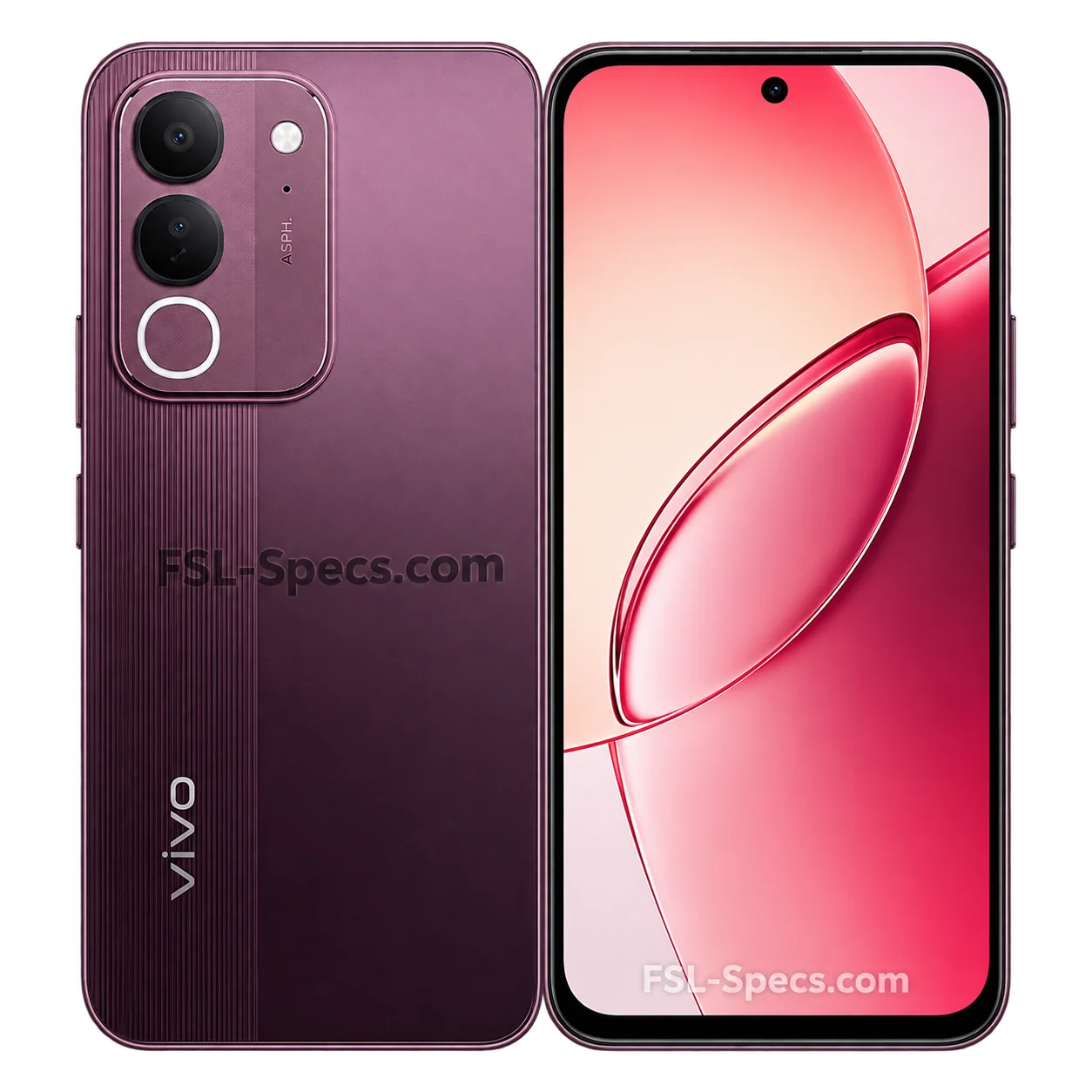
vivo y32
Last Time Update : 27 October, 2026
United States flag United States
$300 USD
…
Pakistan flag Pakistan (PKR)
92,000 PKR
India flag India (INR)
₹30,000 INR

✪ Vivo Y32 ✪

vivo y32
Quick Specs
Display
6.87 inchIPS LCD120 Hz
Processor
Unisoc T73002.2 GHz
RAM & Storage
6 + 256 GB
Rear Camera
50 + 2 MP
Front Camera
8 MP
Battery & Charging
8000 mAh44 W

Full Specification

!
IMPORTANT INFORMATION

Specifications Disclaimer

NOTICE

Specifications are collected from official manufacturers and trusted sources. Actual details may vary by region, model variant, or software updates. We strive for accuracy but cannot guarantee error-free information.

BASIC INFO
Mobile
Vivo Y32
Series
Vivo Y Series
Category
Mid-Range
Release Date
6 October,2026
Year
2026
CONNECTIVITY
Sim
Nano-SIM + Nano-SIM
Network
4G
WiFi
Wi-Fi 5
Bluetooth
5.4
NFC
Yes / region dependent
OS
Android 16
BODY
Dimensions
169.6 x 79.2 x 8.7 mm
Build
Frame And Back (Plastic)
KG Weight
229 g
Screen Size
6.87 inch
Resolution
720 x 1592 Pixels
Type
IPS LCD
Refresh Rate
120 Hz
Peak Brightness
1300 nits
HBM Brightness
1000 nits
Ram Memory
6 + 256 GB
Ram Type
LPDDR4X
Storage Type
UFS 2.2
SD Card
No
Variants
4/6 + 128 GB
6 + 256 GB
MP
Rear Camera
50 + 2 MP
Front Camera
8 MP
SENSORS
Camera Sensors
50 MP = Sony IMX882
RECORDING FPS
Main Recording
1080p @30 fps
Front Recording
1080p @30 fps
RESOLUTION
Main Resolution
8160 × 6144 pixels
FLASH
Flash
Dual LED
Capacity
8000 mAh
Fast Charging
44 W
Li Battery Type
Si/C Li-Ion
REVERSE
Reverse Wired
Yes
AUDIO & SENSORS
Speaker
Dual Stereo Speaker
Fingerprint Sensor
Side Mounted
Other Sensors
Accelerometer
Gyroscope
Proximity
Compass
etc
BASIC INFO
Mobile
Vivo Y32
Series
Vivo Y Series
Category
Mid-Range
Release Date
6 October,2026
Year
2026
CONNECTIVITY
Sim
Nano-SIM + Nano-SIM
Network
4G
WiFi
Wi-Fi 5
Bluetooth
5.4
NFC
Yes / region dependent
OS
Android 16
BODY
Dimensions
169.6 x 79.2 x 8.7 mm
Build
Frame And Back (Plastic)
KG Weight
229 g
Screen Size
6.87 inch
Resolution
720 x 1592 Pixels
Type
IPS LCD
Refresh Rate
120 Hz
Peak Brightness
1300 nits
HBM Brightness
1000 nits
Processor
Unisoc T7300
Max Clock
2.2 GHz
Lithography
6 nm
GPU
Mali-G57 MP2
CPU Cores
8 Cores
Antutu v11
650 K
Antutu v10
510 K
Architecture
2 x 2.2 GHz Cortex-A78
6 x 2.0 GHz Cortex-A55
Ram Memory
6 + 256 GB
SD Card
No
Ram Type
LPDDR4X
Storage Type
UFS 2.2
Variants
4/6 + 128 GB
6 + 256 GB
MP
Rear Camera
50 + 2 MP
Front Camera
8 MP
SENSORS
Main Camera Sensors
50 MP = Sony IMX882
RECORDING FPS
Main Recording
1080p @30 fps
Front Recording
1080p @30 fps
RESOLUTION
Main Resolution
8160 × 6144 pixels
FLASH
Flash
Dual LED
Capacity
8000 mAh
Fast Charging
44 W
Li Battery Type
Si/C Li-Ion
REVERSE
Reverse Wired
Yes
AUDIO & SENSORS
Speaker
Dual Stereo Speaker
Fingerprint Sensor
Side Mounted
Other Sensors
Accelerometer
Gyroscope
Proximity
Compass
etc

Verify Mobile Specifications

Official information & trusted references

Official Manufacturer WebsiteExplore the original product information (opens in a new tab)

Trusted Specification Sources

Cross-reference · 4 sources

Links open third-party websites. The Purple ticks are a design marker only; they do not mean a source has verified these specifications or endorses FSL-Specs.

Last Time Update : 27 October, 2026

Highlights & Review Of Vivo Y32

Display Highlights

The Vivo Y32 at PKR 92,000 (new) has a 6.87-inch IPS LCD at 720 x 1592. The Poco M8 5G costs the same PKR 92,000 (new) and has a 6.77-inch AMOLED at 1080 x 2392, about 2.3 times as many pixels. All prices are retailer listings.

All four phones run at 120 Hz, so smoothness does not separate them. The real gaps are panel type, resolution and brightness. The Vivo Y32 is the only LCD in this group. Its resolution spreads roughly 1.1 million pixels across the largest screen here, against about 3.5 million on the Vivo V40’s 6.78-inch AMOLED at 1260 x 2800. The Infinix Note Edge sits between them with a 6.78-inch AMOLED at 1208 x 2644.

Brightness widens the gap. The Vivo Y32 lists 1300 nits peak and 1000 nits HBM. The Infinix Note Edge and Vivo V40 both list 4500 nits peak, more than three times the Vivo Y32’s figure, with HBM at 1600 nits and 1500 nits. The Poco M8 5G lists 3200 nits peak, but its 800 nits HBM is the lowest in the group and 20% below the Vivo Y32’s. Its brightness lead over the Vivo Y32 therefore shows only in the peak figure.

The Infinix Note Edge costs PKR 95,000 (new), only PKR 3,000 more than the Vivo Y32, and brings an AMOLED panel with the highest HBM figure. The Vivo V40 costs the same PKR 95,000, but it is a used-market price.

PhoneSizeTypeResolutionRefreshPeakHBM
Vivo Y326.87 inchIPS LCD720 x 1592120 Hz1300 nits1000 nits
Poco M8 5G6.77 inchAMOLED1080 x 2392120 Hz3200 nits800 nits
Infinix Note Edge6.78 inchAMOLED1208 x 2644120 Hz4500 nits1600 nits
Vivo V406.78 inchAMOLED1260 x 2800120 Hz4500 nits1500 nits

Verdict: The Infinix Note Edge has the best display among the new phones at PKR 95,000, while the Vivo Y32 trails the Poco M8 5G at the same PKR 92,000 on resolution, panel type and peak brightness.

Performance Highlights

The Vivo Y32 on the Unisoc T7300 scores 650K AnTuTu (v11), while the Poco M8 5G at the same PKR 92,000 (new) scores 850K AnTuTu (v11) on the Snapdragon 6 Gen 3, about 31% higher. AnTuTu v11 is the only version all four phones share, so the ranking uses it.

The Vivo V40 leads at 1M (v11) on the Snapdragon 7 Gen 3, ahead of the Poco M8 5G and the Infinix Note Edge at 800K (v11) on the Dimensity 7100.

The Poco M8 5G leads the Infinix Note Edge by about 6% on v11, but the v10 scores reverse the order: 630K (v10) for the Infinix Note Edge against 550K (v10) for the Poco M8 5G. The Vivo V40 has no v10 result, which says nothing about its real speed. Because the versions disagree, the Poco M8 5G and Infinix Note Edge are close rivals with no clear winner.

Core layout explains part of the Vivo Y32’s gap. It has only 2 x 2.2 GHz Cortex-A78 performance cores plus 6 x 2.0 GHz Cortex-A55 cores, while the Poco M8 5G and Infinix Note Edge each have 4 x 2.4 GHz Cortex-A78 cores.

The Poco M8 5G and Vivo V40 are built on 4 nm, while the Vivo Y32 and Infinix Note Edge use 6 nm. These are spec-level implications, not measured results, but the Vivo Y32’s lower score and two-performance-core layout point to less headroom for heavy games and multitasking than the other three.

SpecVivo Y32Poco M8 5GInfinix Note EdgeVivo V40
ProcessorUnisoc T7300Snapdragon 6 Gen 3Dimensity 7100Snapdragon 7 Gen 3
Lithography6 nm4 nm6 nm4 nm
CPU cores8 coresOcta-core8 cores8 cores
Max clock2.2 GHz2.4 GHz2.4 GHz2.63 GHz
Architecture2 x 2.2 GHz Cortex-A78, 6 x 2.0 GHz Cortex-A554 x 2.4 GHz Cortex-A78, 4 x 1.8 GHz Cortex-A554 x 2.4 GHz Cortex-A78, 4 x 2.0 GHz Cortex-A551 x 2.63 GHz Cortex-A715, 3 x 2.4 GHz Cortex-A715, 4 x 1.8 GHz Cortex-A510
GPUMali-G57 MP2Adreno 710Mali-G610 MC2Adreno 720
AnTuTu v11650K850K800K1M
AnTuTu v10510K550K630K–

Verdict: The Vivo V40 is the fastest phone here at 1M AnTuTu (v11) but costs PKR 95,000 used, and among new phones the Poco M8 5G scores highest at the lowest price, PKR 92,000, while the other new phones score 23% to 31% above the Vivo Y32.

Memory & Storage Highlights

The Vivo Y32 offers 6 GB of LPDDR4X RAM with 256 GB of UFS 2.2 storage at PKR 92,000 (new), while the Poco M8 5G offers 8 GB of LPDDR4X RAM with the same 256 GB of UFS 2.2 at the same price. All prices are retailer listings, and the Vivo V40 price is from the used market. Storage capacity and type are identical across all four phones, so the differences come down to RAM size, RAM generation and expandability.

The Vivo V40 has the most RAM at 12 GB, double the Vivo Y32 and 50% above the 8 GB on the Poco M8 5G and the Infinix Note Edge. The Vivo Y32 has 25% less RAM than those two. Per gigabyte of RAM, the Vivo Y32 costs about PKR 15,333, against PKR 11,500 for the Poco M8 5G, PKR 11,875 for the Infinix Note Edge and PKR 7,917 for the Vivo V40.

The Infinix Note Edge is the only phone with LPDDR5X RAM, a newer memory generation than the LPDDR4X used by the other three. This is a spec-level advantage, not a measured result.

Expandability is the other real split. The Poco M8 5G and Infinix Note Edge both have a microSD slot, so their 256 GB can grow. The Vivo Y32 and Vivo V40 have no microSD slot, which locks both at 256 GB. That limit matters more on the Vivo Y32, which also has the least RAM in the group.

SpecVivo Y32Poco M8 5GInfinix Note EdgeVivo V40
Variant compared6 + 256 GB8 + 256 GB8 + 256 GB12 + 256 GB
RAM typeLPDDR4XLPDDR4XLPDDR5XLPDDR4X
Storage typeUFS 2.2UFS 2.2UFS 2.2UFS 2.2
microSD slotNoYesYesNo

Verdict: The Infinix Note Edge has the best memory setup among the new phones with 8 GB of LPDDR5X RAM and microSD, the Poco M8 5G matches it on capacity and expansion at PKR 92,000, and the Vivo Y32 is last on RAM and storage flexibility.

Camera Highlights

The Vivo Y32 pairs a 50 MP Sony IMX882 main sensor with a 2 MP secondary sensor and an 8 MP front camera at PKR 92,000 (new). The Poco M8 5G at the same price has a 50 MP OV50D40 Light Hunter 400 main sensor and a 20 MP front camera. Prices are retailer listings.

Sensor confidence differs. The Vivo V40 has every sensor named, with Samsung GNJ and Samsung S5KJN1 at the rear and the S5KJN1 on its 50 MP front camera. The Vivo Y32 and Poco M8 5G name only their main sensors, and the Poco M8 5G’s secondary sensor is unconfirmed.

The Infinix Note Edge names its GalaxyCore GC50D1 main sensor, but its 13 MP front sensor is unconfirmed. Unnamed sensors should be treated as unknown.

The front camera gap is the widest. The Vivo V40’s 50 MP is more than six times the Vivo Y32’s 8 MP, with the Poco M8 5G at 20 MP and the Infinix Note Edge at 13 MP. Video separates the phones in a similar way.

The Vivo V40 is the only phone with 4K @ 30 fps on both cameras. The Poco M8 5G records 4K @ 30 fps at the rear but only 1080p @ 30 fps at the front. The Infinix Note Edge records 2K @ 30 fps on both cameras. The Vivo Y32 stops at 1080p @ 30 fps on both.

Some features appear on only one or two phones. The Poco M8 5G lists 2x optical zoom and stabilization, though the stabilization type is not specified. The Vivo V40 lists 20x digital zoom and a ring light. The Infinix Note Edge and Poco M8 5G both list a screen flash for the front camera. The Vivo Y32 lists no zoom or stabilization.

SpecVivo Y32Poco M8 5GInfinix Note EdgeVivo V40
Rear camera50 + 2 MP50 + 2 + 0.8 MP50 MP50 + 50 MP
Rear sensors50 MP Sony IMX88250 MP OV50D40 Light Hunter 400, 8 MP not confirmed50 MP GalaxyCore GC50D150 MP Samsung GNJ, 50 MP Samsung S5KJN1
Front camera8 MP20 MP13 MP50 MP
Rear video1080p @ 30 fps4K @ 30 fps, HD @ 30/60/120/240 fps2K @ 30 fps, 1080p @ 30/60 fps4K @ 30 fps, 1080p @ 30/60 fps
Front video1080p @ 30 fps1080p @ 30 fps2K @ 30 fps, 1080p @ 30 fps4K @ 30 fps, 1080p @ 30/60 fps

Verdict: The Poco M8 5G has the strongest camera package among the new phones at PKR 92,000, the Vivo V40 leads overall but is a used PKR 95,000 phone, and the Vivo Y32 is last on front camera resolution, video resolution and listed features.

Battery & Charging Highlights

The Vivo Y32 carries an 8000 mAh battery at PKR 92,000 (new), while the Poco M8 5G at the same price carries 5520 mAh, so the Vivo Y32 has about 45% more capacity. Prices are retailer listings, and the Vivo V40 price comes from the used market.

The Infinix Note Edge is second on capacity at 6500 mAh, about 23% below the Vivo Y32 in reverse terms, meaning the Vivo Y32 has 23% more. The Infinix Note Edge is 18% above the Poco M8 5G. The Poco M8 5G and the Vivo V40 (5500 mAh) are within 1% of each other, so they are level on capacity. All four phones use silicon-carbon cells.

Charging speed reverses the capacity order. The Vivo Y32 (44 W), Poco M8 5G (45 W) and Infinix Note Edge (45 W) are effectively level, while the Vivo V40 charges at 80 W, about 78% above the 45 W phones. The Vivo Y32 pairs the largest cell with one of the slowest charge rates, so a full charge will take longer than on a smaller battery at the same wattage. That is an implication of the specs, not a measured result.

PCMark figures are listed for only two phones. The Poco M8 5G shows 18 hours, against about 12 hours for the Vivo V40, 50% higher on nearly identical capacity. The Vivo Y32 and Infinix Note Edge list no PCMark result, so their runtime advantage from capacity is a spec-level expectation only.

The Infinix Note Edge page states no wireless charging, and the other three pages list none. The Poco M8 5G lists 18 W reverse wired charging, and the other three list reverse wired charging without a wattage.

SpecVivo Y32Poco M8 5GInfinix Note EdgeVivo V40
Capacity8000 mAh5520 mAh6500 mAh5500 mAh
Battery typeSi/C Li-IonSilicon-carbonSi-carbon Li-IonSilicon-carbon
Wired charging44 W45 W45 W80 W

Verdict: The Vivo Y32 has the biggest battery of the four at the lowest new price of PKR 92,000, the Vivo V40 charges fastest at 80 W but is a used PKR 95,000 phone, and the Poco M8 5G has the strongest listed PCMark result at 18 hours.

Final Verdict

The Vivo V40 ranks first on a balanced weighting with 1M AnTuTu (v11) and 80 W charging at PKR 95,000 (used), while the Vivo Y32 ranks last at PKR 92,000 (new) with 650K AnTuTu (v11) and 44 W charging. Among new phones, the Infinix Note Edge ranks highest, with 4500 nits peak brightness, LPDDR5X RAM and a microSD slot at PKR 95,000.

The Poco M8 5G ranks third at PKR 92,000 (new) and has the best camera package among the new phones, with 2x optical zoom and 4K @ 30 fps rear video.

The Vivo Y32 wins the battery category outright with 8000 mAh. However, its 720 x 1592 IPS LCD panel and 6 GB of RAM without microSD cost it more in practice than the AnTuTu gaps among the middle three phones.

The ranking rests on all five categories (display, performance, RAM and memory, camera, battery), with performance and camera weighted most. Prices are retailer listings dated 27 October 2026.

Bottom line: The Vivo V40 is the strongest phone in this group at PKR 95,000 (used), the Infinix Note Edge is the best new phone at PKR 95,000, and the Vivo Y32 is worth considering only for its 8000 mAh battery.

Ranking:

  1. Vivo V40 – PKR 95,000 (used)
  2. Infinix Note Edge – PKR 95,000 (new)
  3. Poco M8 5G – PKR 92,000 (new)
  4. Vivo Y32 – PKR 92,000 (new)

Display Highlights

The Vivo Y32 at PKR 92,000 (new) has a 6.87-inch IPS LCD at 720 x 1592. The Poco M8 5G costs the same PKR 92,000 (new) and has a 6.77-inch AMOLED at 1080 x 2392, about 2.3 times as many pixels. All prices are retailer listings.

All four phones run at 120 Hz, so smoothness does not separate them. The real gaps are panel type, resolution and brightness. The Vivo Y32 is the only LCD in this group. Its resolution spreads roughly 1.1 million pixels across the largest screen here, against about 3.5 million on the Vivo V40’s 6.78-inch AMOLED at 1260 x 2800. The Infinix Note Edge sits between them with a 6.78-inch AMOLED at 1208 x 2644.

Brightness widens the gap. The Vivo Y32 lists 1300 nits peak and 1000 nits HBM. The Infinix Note Edge and Vivo V40 both list 4500 nits peak, more than three times the Vivo Y32’s figure, with HBM at 1600 nits and 1500 nits. The Poco M8 5G lists 3200 nits peak, but its 800 nits HBM is the lowest in the group and 20% below the Vivo Y32’s. Its brightness lead over the Vivo Y32 therefore shows only in the peak figure.

The Infinix Note Edge costs PKR 95,000 (new), only PKR 3,000 more than the Vivo Y32, and brings an AMOLED panel with the highest HBM figure. The Vivo V40 costs the same PKR 95,000, but it is a used-market price.

PhoneSizeTypeResolutionRefreshPeakHBM
Vivo Y326.87 inchIPS LCD720 x 1592120 Hz1300 nits1000 nits
Poco M8 5G6.77 inchAMOLED1080 x 2392120 Hz3200 nits800 nits
Infinix Note Edge6.78 inchAMOLED1208 x 2644120 Hz4500 nits1600 nits
Vivo V406.78 inchAMOLED1260 x 2800120 Hz4500 nits1500 nits

Verdict: The Infinix Note Edge has the best display among the new phones at PKR 95,000, while the Vivo Y32 trails the Poco M8 5G at the same PKR 92,000 on resolution, panel type and peak brightness.

Performance Highlights

The Vivo Y32 on the Unisoc T7300 scores 650K AnTuTu (v11), while the Poco M8 5G at the same PKR 92,000 (new) scores 850K AnTuTu (v11) on the Snapdragon 6 Gen 3, about 31% higher. AnTuTu v11 is the only version all four phones share, so the ranking uses it.

The Vivo V40 leads at 1M (v11) on the Snapdragon 7 Gen 3, ahead of the Poco M8 5G and the Infinix Note Edge at 800K (v11) on the Dimensity 7100.

The Poco M8 5G leads the Infinix Note Edge by about 6% on v11, but the v10 scores reverse the order: 630K (v10) for the Infinix Note Edge against 550K (v10) for the Poco M8 5G. The Vivo V40 has no v10 result, which says nothing about its real speed. Because the versions disagree, the Poco M8 5G and Infinix Note Edge are close rivals with no clear winner.

Core layout explains part of the Vivo Y32’s gap. It has only 2 x 2.2 GHz Cortex-A78 performance cores plus 6 x 2.0 GHz Cortex-A55 cores, while the Poco M8 5G and Infinix Note Edge each have 4 x 2.4 GHz Cortex-A78 cores.

The Poco M8 5G and Vivo V40 are built on 4 nm, while the Vivo Y32 and Infinix Note Edge use 6 nm. These are spec-level implications, not measured results, but the Vivo Y32’s lower score and two-performance-core layout point to less headroom for heavy games and multitasking than the other three.

SpecVivo Y32Poco M8 5GInfinix Note EdgeVivo V40
ProcessorUnisoc T7300Snapdragon 6 Gen 3Dimensity 7100Snapdragon 7 Gen 3
Lithography6 nm4 nm6 nm4 nm
CPU cores8 coresOcta-core8 cores8 cores
Max clock2.2 GHz2.4 GHz2.4 GHz2.63 GHz
Architecture2 x 2.2 GHz Cortex-A78, 6 x 2.0 GHz Cortex-A554 x 2.4 GHz Cortex-A78, 4 x 1.8 GHz Cortex-A554 x 2.4 GHz Cortex-A78, 4 x 2.0 GHz Cortex-A551 x 2.63 GHz Cortex-A715, 3 x 2.4 GHz Cortex-A715, 4 x 1.8 GHz Cortex-A510
GPUMali-G57 MP2Adreno 710Mali-G610 MC2Adreno 720
AnTuTu v11650K850K800K1M
AnTuTu v10510K550K630K–

Verdict: The Vivo V40 is the fastest phone here at 1M AnTuTu (v11) but costs PKR 95,000 used, and among new phones the Poco M8 5G scores highest at the lowest price, PKR 92,000, while the other new phones score 23% to 31% above the Vivo Y32.

Memory & Storage Highlights

The Vivo Y32 offers 6 GB of LPDDR4X RAM with 256 GB of UFS 2.2 storage at PKR 92,000 (new), while the Poco M8 5G offers 8 GB of LPDDR4X RAM with the same 256 GB of UFS 2.2 at the same price. All prices are retailer listings, and the Vivo V40 price is from the used market. Storage capacity and type are identical across all four phones, so the differences come down to RAM size, RAM generation and expandability.

The Vivo V40 has the most RAM at 12 GB, double the Vivo Y32 and 50% above the 8 GB on the Poco M8 5G and the Infinix Note Edge. The Vivo Y32 has 25% less RAM than those two. Per gigabyte of RAM, the Vivo Y32 costs about PKR 15,333, against PKR 11,500 for the Poco M8 5G, PKR 11,875 for the Infinix Note Edge and PKR 7,917 for the Vivo V40.

The Infinix Note Edge is the only phone with LPDDR5X RAM, a newer memory generation than the LPDDR4X used by the other three. This is a spec-level advantage, not a measured result.

Expandability is the other real split. The Poco M8 5G and Infinix Note Edge both have a microSD slot, so their 256 GB can grow. The Vivo Y32 and Vivo V40 have no microSD slot, which locks both at 256 GB. That limit matters more on the Vivo Y32, which also has the least RAM in the group.

SpecVivo Y32Poco M8 5GInfinix Note EdgeVivo V40
Variant compared6 + 256 GB8 + 256 GB8 + 256 GB12 + 256 GB
RAM typeLPDDR4XLPDDR4XLPDDR5XLPDDR4X
Storage typeUFS 2.2UFS 2.2UFS 2.2UFS 2.2
microSD slotNoYesYesNo

Verdict: The Infinix Note Edge has the best memory setup among the new phones with 8 GB of LPDDR5X RAM and microSD, the Poco M8 5G matches it on capacity and expansion at PKR 92,000, and the Vivo Y32 is last on RAM and storage flexibility.

Camera Highlights

The Vivo Y32 pairs a 50 MP Sony IMX882 main sensor with a 2 MP secondary sensor and an 8 MP front camera at PKR 92,000 (new). The Poco M8 5G at the same price has a 50 MP OV50D40 Light Hunter 400 main sensor and a 20 MP front camera. Prices are retailer listings.

Sensor confidence differs. The Vivo V40 has every sensor named, with Samsung GNJ and Samsung S5KJN1 at the rear and the S5KJN1 on its 50 MP front camera. The Vivo Y32 and Poco M8 5G name only their main sensors, and the Poco M8 5G’s secondary sensor is unconfirmed.

The Infinix Note Edge names its GalaxyCore GC50D1 main sensor, but its 13 MP front sensor is unconfirmed. Unnamed sensors should be treated as unknown.

The front camera gap is the widest. The Vivo V40’s 50 MP is more than six times the Vivo Y32’s 8 MP, with the Poco M8 5G at 20 MP and the Infinix Note Edge at 13 MP. Video separates the phones in a similar way.

The Vivo V40 is the only phone with 4K @ 30 fps on both cameras. The Poco M8 5G records 4K @ 30 fps at the rear but only 1080p @ 30 fps at the front. The Infinix Note Edge records 2K @ 30 fps on both cameras. The Vivo Y32 stops at 1080p @ 30 fps on both.

Some features appear on only one or two phones. The Poco M8 5G lists 2x optical zoom and stabilization, though the stabilization type is not specified. The Vivo V40 lists 20x digital zoom and a ring light. The Infinix Note Edge and Poco M8 5G both list a screen flash for the front camera. The Vivo Y32 lists no zoom or stabilization.

SpecVivo Y32Poco M8 5GInfinix Note EdgeVivo V40
Rear camera50 + 2 MP50 + 2 + 0.8 MP50 MP50 + 50 MP
Rear sensors50 MP Sony IMX88250 MP OV50D40 Light Hunter 400, 8 MP not confirmed50 MP GalaxyCore GC50D150 MP Samsung GNJ, 50 MP Samsung S5KJN1
Front camera8 MP20 MP13 MP50 MP
Rear video1080p @ 30 fps4K @ 30 fps, HD @ 30/60/120/240 fps2K @ 30 fps, 1080p @ 30/60 fps4K @ 30 fps, 1080p @ 30/60 fps
Front video1080p @ 30 fps1080p @ 30 fps2K @ 30 fps, 1080p @ 30 fps4K @ 30 fps, 1080p @ 30/60 fps

Verdict: The Poco M8 5G has the strongest camera package among the new phones at PKR 92,000, the Vivo V40 leads overall but is a used PKR 95,000 phone, and the Vivo Y32 is last on front camera resolution, video resolution and listed features.

Battery & Charging Highlights

The Vivo Y32 carries an 8000 mAh battery at PKR 92,000 (new), while the Poco M8 5G at the same price carries 5520 mAh, so the Vivo Y32 has about 45% more capacity. Prices are retailer listings, and the Vivo V40 price comes from the used market.

The Infinix Note Edge is second on capacity at 6500 mAh, about 23% below the Vivo Y32 in reverse terms, meaning the Vivo Y32 has 23% more. The Infinix Note Edge is 18% above the Poco M8 5G. The Poco M8 5G and the Vivo V40 (5500 mAh) are within 1% of each other, so they are level on capacity. All four phones use silicon-carbon cells.

Charging speed reverses the capacity order. The Vivo Y32 (44 W), Poco M8 5G (45 W) and Infinix Note Edge (45 W) are effectively level, while the Vivo V40 charges at 80 W, about 78% above the 45 W phones. The Vivo Y32 pairs the largest cell with one of the slowest charge rates, so a full charge will take longer than on a smaller battery at the same wattage. That is an implication of the specs, not a measured result.

PCMark figures are listed for only two phones. The Poco M8 5G shows 18 hours, against about 12 hours for the Vivo V40, 50% higher on nearly identical capacity. The Vivo Y32 and Infinix Note Edge list no PCMark result, so their runtime advantage from capacity is a spec-level expectation only.

The Infinix Note Edge page states no wireless charging, and the other three pages list none. The Poco M8 5G lists 18 W reverse wired charging, and the other three list reverse wired charging without a wattage.

SpecVivo Y32Poco M8 5GInfinix Note EdgeVivo V40
Capacity8000 mAh5520 mAh6500 mAh5500 mAh
Battery typeSi/C Li-IonSilicon-carbonSi-carbon Li-IonSilicon-carbon
Wired charging44 W45 W45 W80 W

Verdict: The Vivo Y32 has the biggest battery of the four at the lowest new price of PKR 92,000, the Vivo V40 charges fastest at 80 W but is a used PKR 95,000 phone, and the Poco M8 5G has the strongest listed PCMark result at 18 hours.

Final Verdict

The Vivo V40 ranks first on a balanced weighting with 1M AnTuTu (v11) and 80 W charging at PKR 95,000 (used), while the Vivo Y32 ranks last at PKR 92,000 (new) with 650K AnTuTu (v11) and 44 W charging. Among new phones, the Infinix Note Edge ranks highest, with 4500 nits peak brightness, LPDDR5X RAM and a microSD slot at PKR 95,000.

The Poco M8 5G ranks third at PKR 92,000 (new) and has the best camera package among the new phones, with 2x optical zoom and 4K @ 30 fps rear video.

The Vivo Y32 wins the battery category outright with 8000 mAh. However, its 720 x 1592 IPS LCD panel and 6 GB of RAM without microSD cost it more in practice than the AnTuTu gaps among the middle three phones.

The ranking rests on all five categories (display, performance, RAM and memory, camera, battery), with performance and camera weighted most. Prices are retailer listings dated 27 October 2026.

Bottom line: The Vivo V40 is the strongest phone in this group at PKR 95,000 (used), the Infinix Note Edge is the best new phone at PKR 95,000, and the Vivo Y32 is worth considering only for its 8000 mAh battery.

Ranking:

  1. Vivo V40 – PKR 95,000 (used)
  2. Infinix Note Edge – PKR 95,000 (new)
  3. Poco M8 5G – PKR 92,000 (new)
  4. Vivo Y32 – PKR 92,000 (new)

Pros and Cons

Pros

  • Massive 8,000mAh battery
  • Fast 44W wired charging
  • Smooth 120Hz display
  • IP68/IP69 water resistance
  • Bright 1,300-nit outdoor display
  • 50MP main camera

Cons

  • Entry-level Unisoc T7300
  • Low HD+ resolution
  • Basic 8MP selfie camera
  • Weak 2MP secondary camera
  • No 5G connectivity

Who Is It Best For?

Best For

  • Battery-focused users
  • Frequent travelers
  • Outdoor field workers
  • Video streaming fans
  • Basic daily tasks
  • Durable budget-phone seekers

Not Best For

  • Hardcore mobile gamers
  • Photography enthusiasts
  • Selfie-focused users
  • 5G network users
  • Premium display seekers
  • Heavy multitaskers
Video Reviews & Tests
// hands-on videos for this phone

Official Trailer

Launch Teaser
Official Trailer

Unboxing

What's In The Box
Unboxing

PUBG Gaming Test

FPS & Heat Test
PUBG Gaming Test

Camera Test

Photo & Video Samples
Camera Test

Related Comparisions

VIVO Series Row
Picture of Faisal Ur Rehman

Faisal Ur Rehman

Faisal Rehman is the founder and editor of FSL Specs, where he publishes in-depth smartphone specifications, comparisons, buying guides, and technology insights. With extensive experience in mobile hardware research and technical analysis, he provides accurate and up-to-date information on Android smartphones, processors, displays, cameras, batteries, performance benchmarks, and software features. His goal is to simplify complex specifications and help readers choose the right device with confidence.

FAQs Questions

The Y32 has a 6.87-inch LCD at 720 × 1592 resolution, with a 120Hz refresh rate and up to 1,300 nits of peak brightness. That makes scrolling and video feel smooth, and it stays readable outdoors

It runs on the Unisoc T7300, a 6nm chip with two Cortex-A78 cores at 2.2GHz and six Cortex-A55 cores at 2.0GHz. That’s enough for everyday apps, social media and video. Don’t expect smooth heavy gaming

You get 4GB or 6GB of LPDDR4X RAM with 128GB of UFS 2.2 storage, and a memory card can add more space. Space for photos and apps is rarely a problem.

There’s a 50MP main camera with a 2MP secondary sensor on the back, plus an 8MP front camera. It’s fine for daylight photos and video calls. The 2MP sensor adds little beyond depth data.

The Y32 packs an 8,000mAh battery with 44W wired fast charging. That should last well beyond a full day for most people, and the 44W charger shortens the wait

Yes, it carries both IP68 and IP69 ratings for dust and water resistance. That’s rare for a budget phone and handy for rain, spills and dusty conditions.

The listed networks stop at 4G LTE, so there’s no 5G. It runs Android 16 with OriginOS 6, and the side-mounted fingerprint sensor is built into the power button.

Scroll to Top