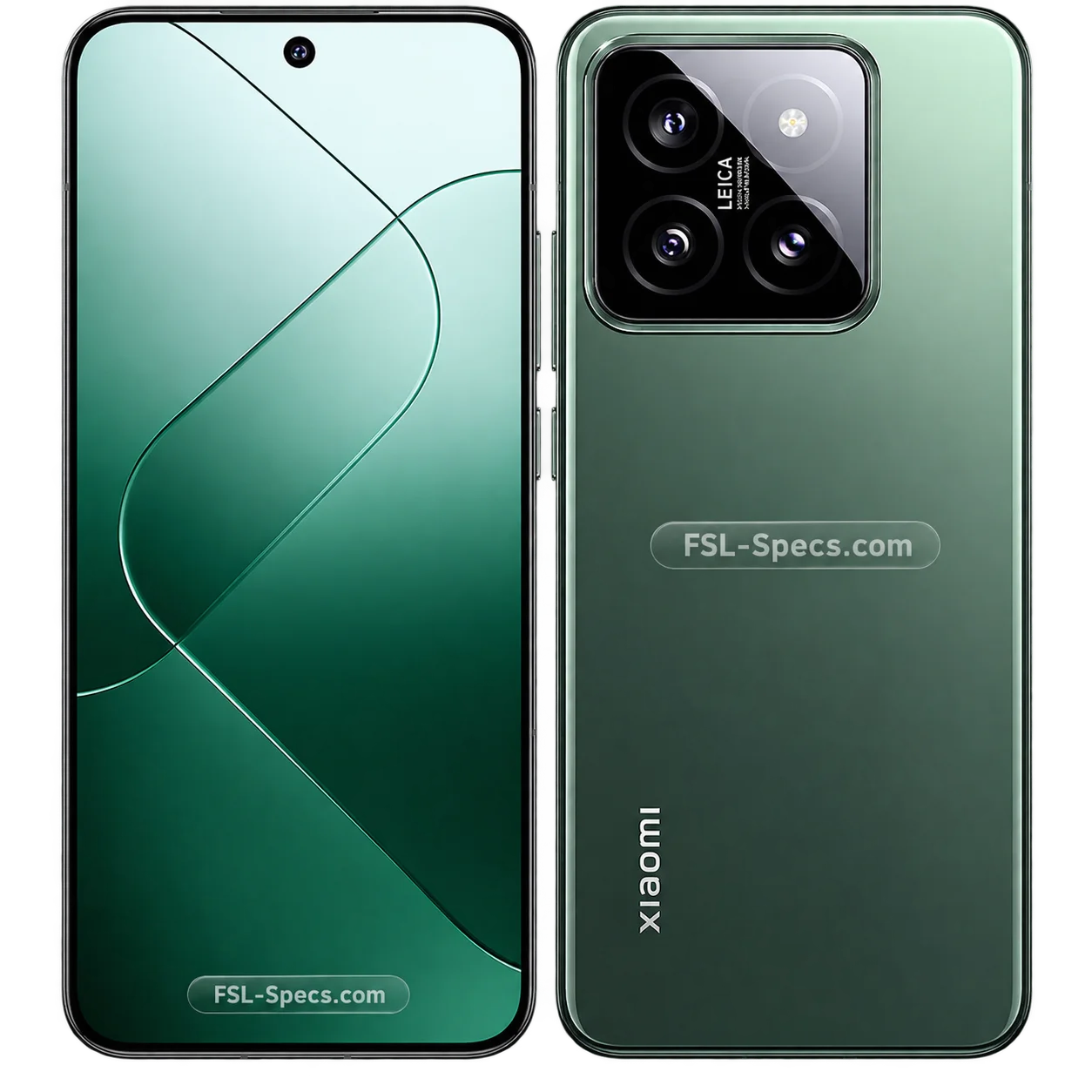
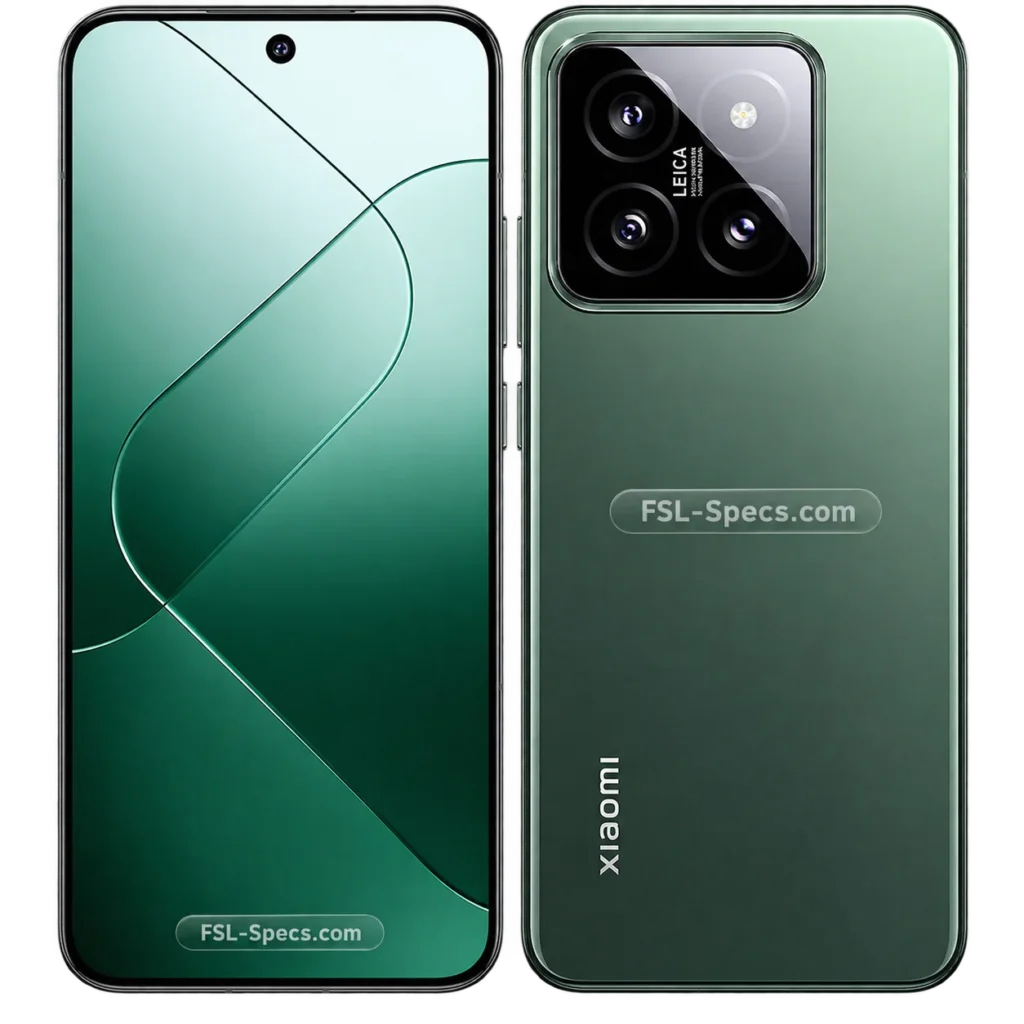
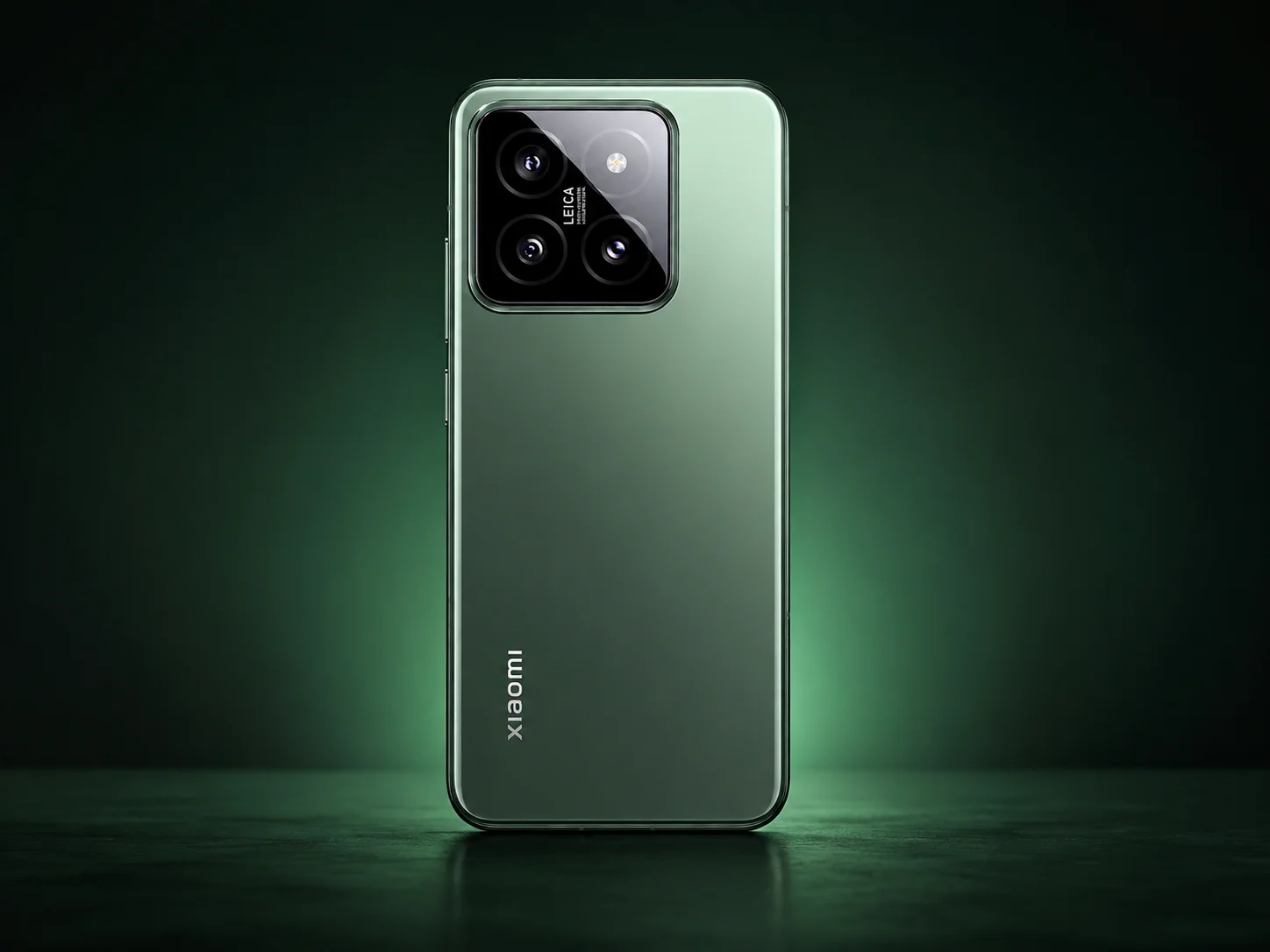
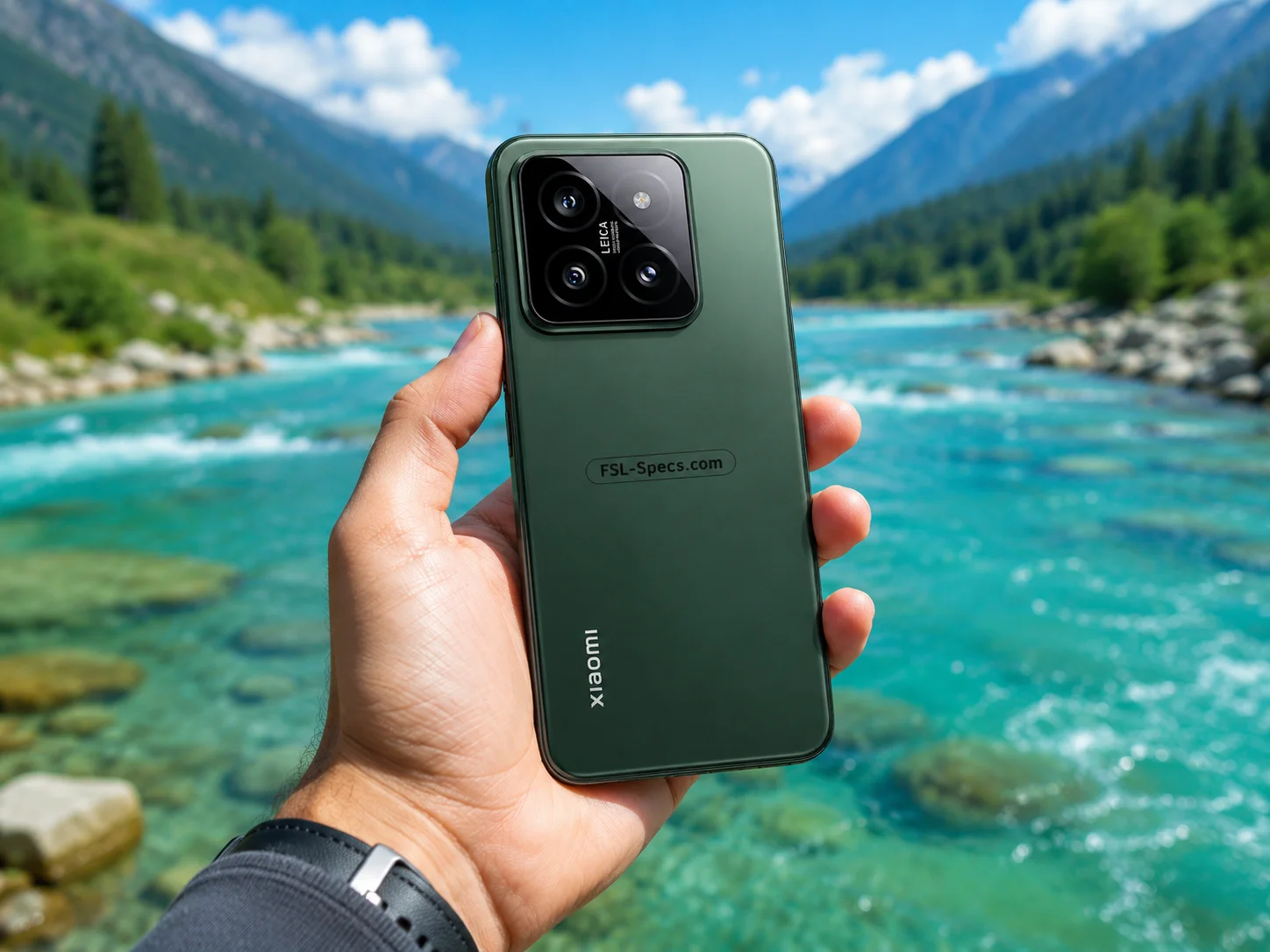
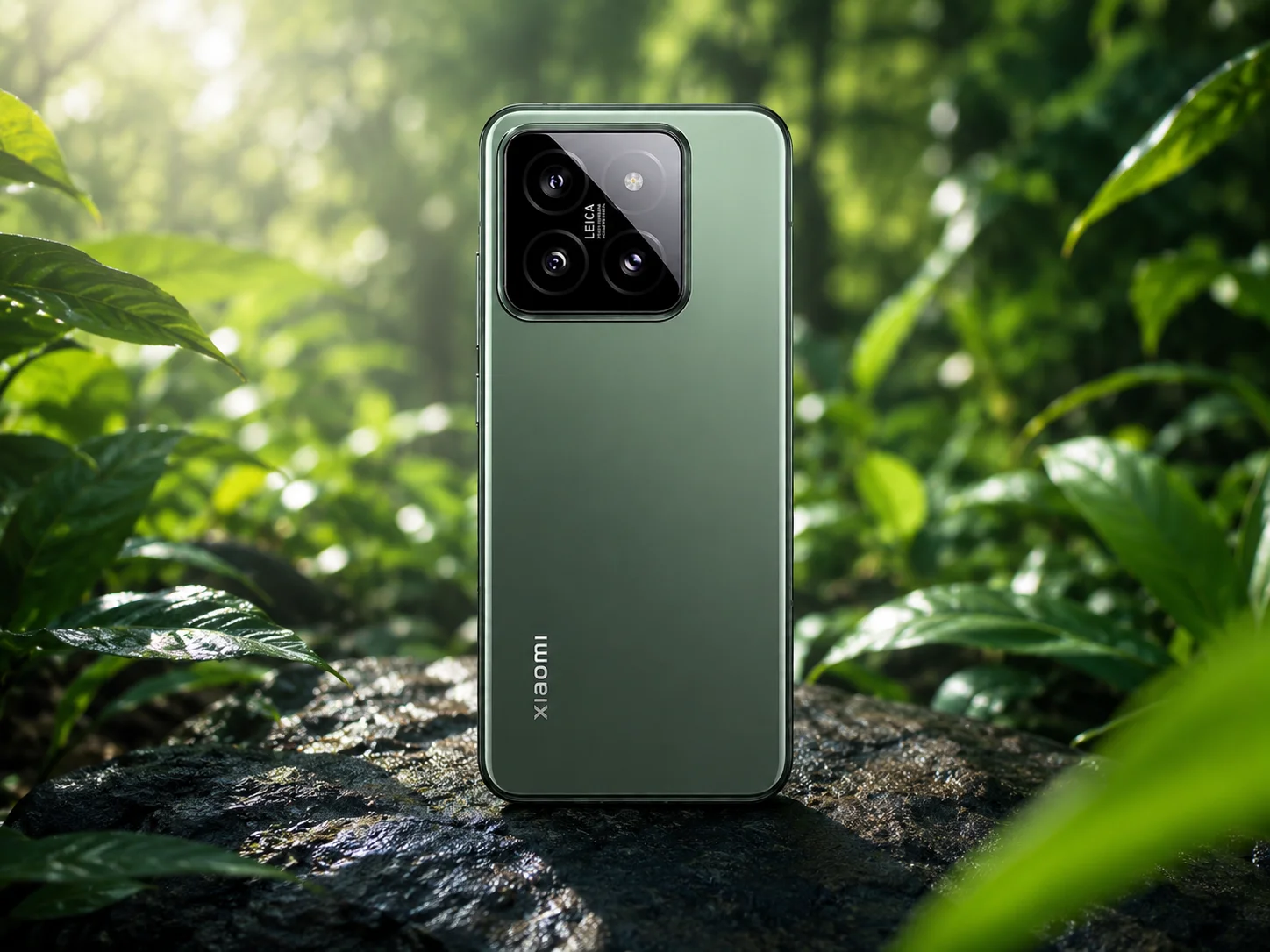
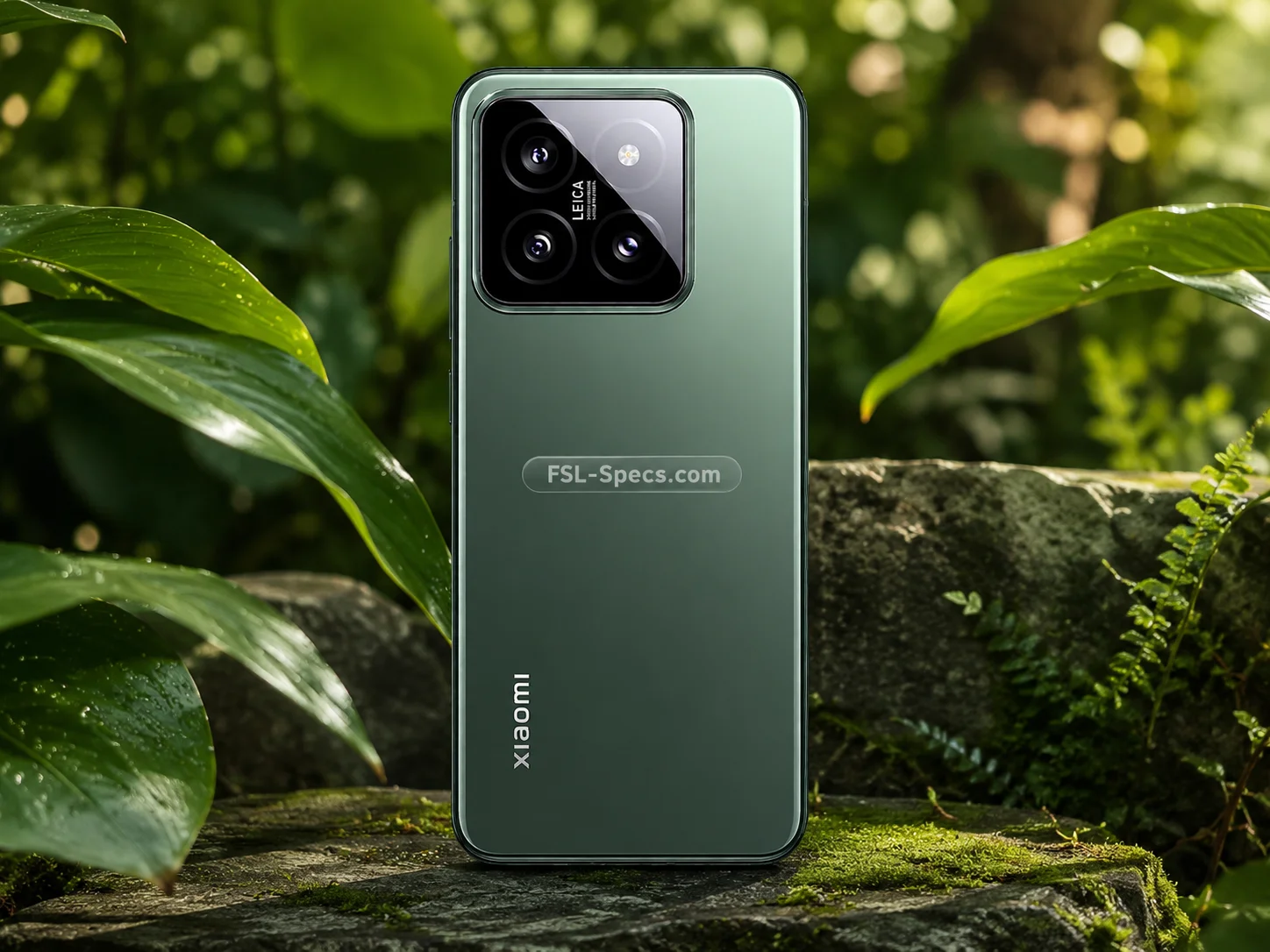













✪ Xiaomi 14 ✪

Xiaomi 14 Specs, Price, Camera, Battery & Best Review (2026)
United States flag United States
$750 USD
Pakistan flag Pakistan (PKR)
320,000 PKR
India flag India (INR)
₹78,000 INR

✪ Xiaomi 14 ✪

Xiaomi 14 Specs, Price, Camera, Battery & Best Review (2026)
Last Time Update : 26 August, 2026
0

Quick Specifications

LTPO Oled

Display Type

Snapdragon 8 Gen 3

Processor

12 + 512 GB

Ram And Memory

50+50+50 MP

Camera

4610 mAh

Battery

90 W

Fast Charging

Full Specification

BASIC INFO
Mobile
Xiaomi 14
Model
23127PN0CG
Series
Xiaomi Number
Category
Flagship
Release Date
1 November,2023
Year
2023
CONNECTIVITY
Sim
Nano-SIM / E-Sim ( Some Regions )
Network
4G / 4G+ / 5G
WiFi
Wi-Fi 7
Bluetooth
5.4
NFC
Yes / region dependent
OS
Android 14
BODY
Dimensions
152.8 × 71.5 × 8.2 mm
Build
Aluminum Frame And Back glass
KG Weight
193 g
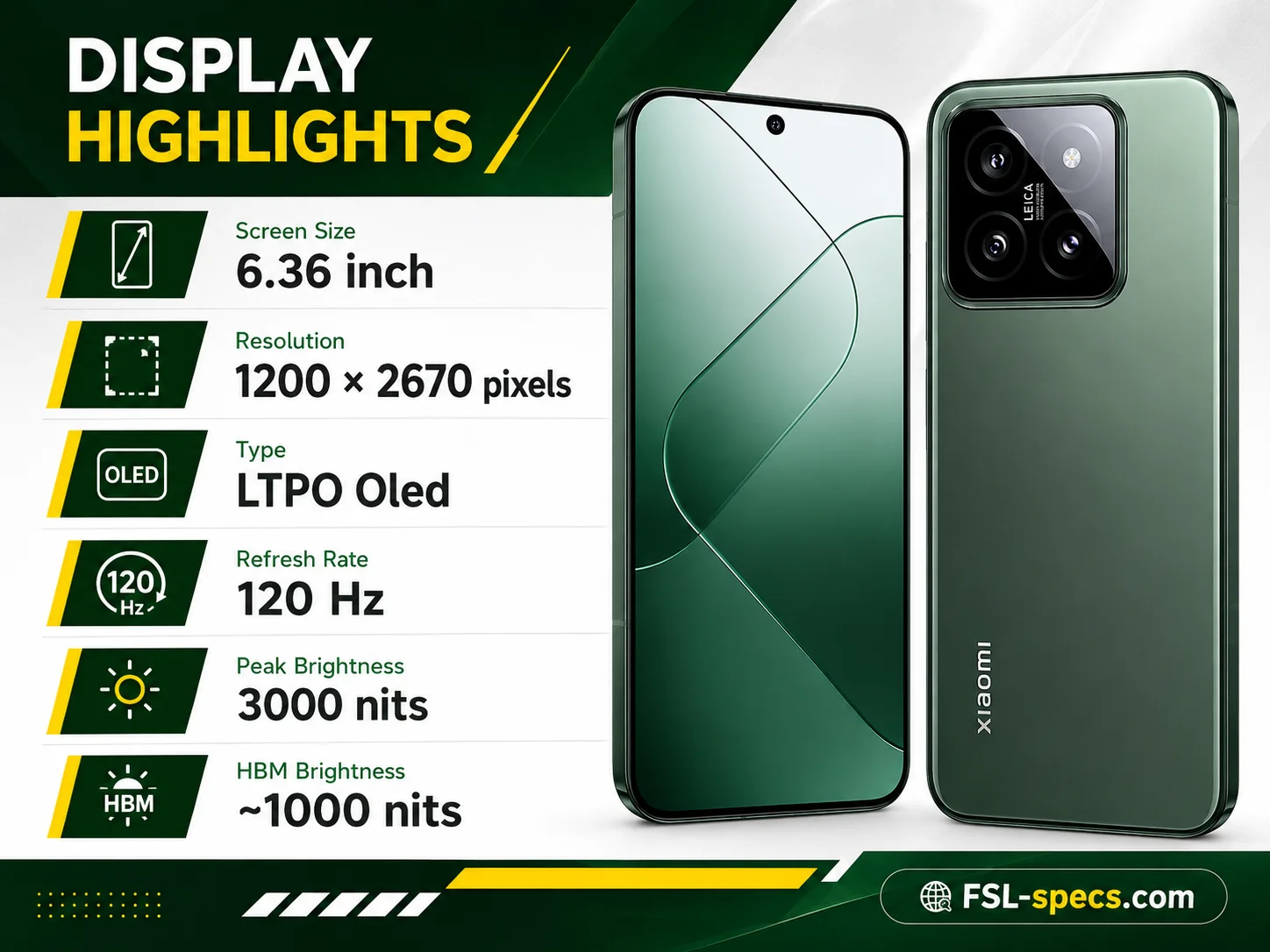
Screen Size
6.36 inch
Resolution
1200 × 2670 pixels
Type
LTPO Oled
Refresh Rate
120 Hz
Peak Brightness
3000 nits
HBM Brightness
~1000 nits
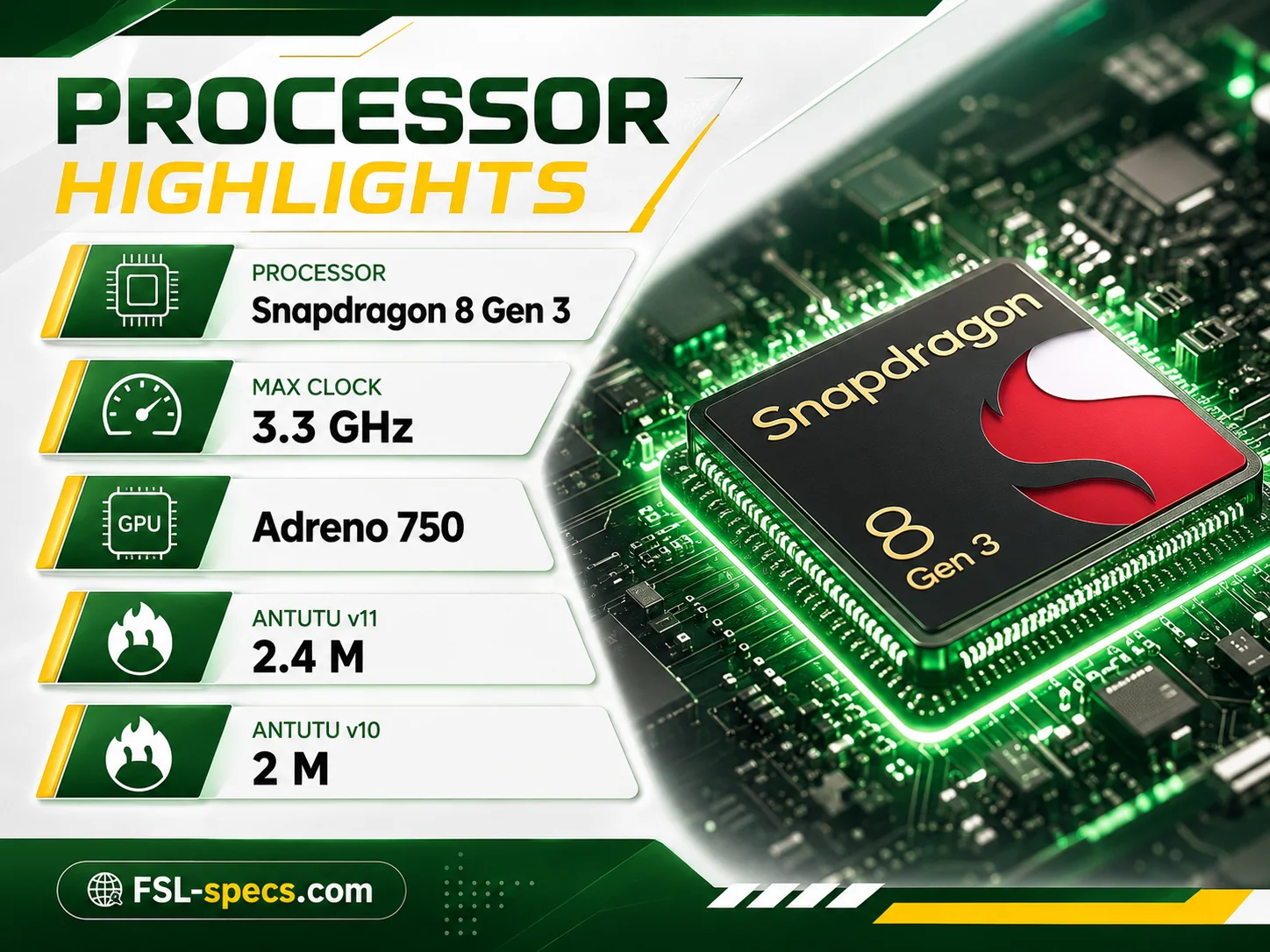
Processor
Snapdragon 8 Gen 3
Max Clock
3.3 GHz
Lithography
4 nm
GPU
Adreno 750
CPU Cores
Octa-core
Antutu v11
2.4 M
Antutu v10
2 M
Bootup Time
23s
Architecture
1× Cortex-X4
3× Cortex-A720
2× Cortex-A720
2× Cortex-A520
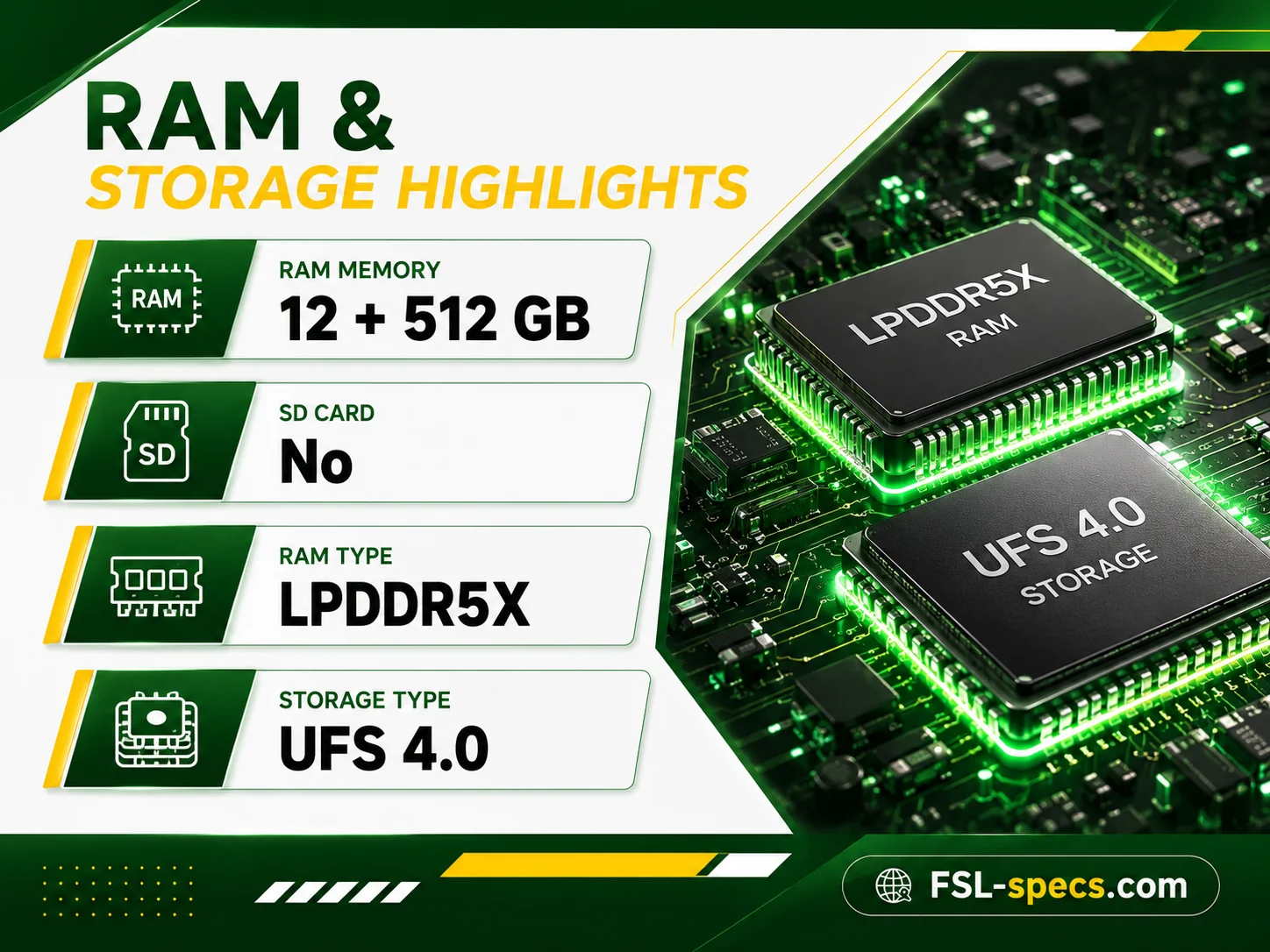
Ram Memory
12 + 512 GB
Ram Type
LPDDR5X
Storage Type
UFS 4.0
SD Card
No
Variants
8+ 256 GB
12 + 256 / 512 GB
16 + 512 GB / 1 TB
MP
Rear Camera
50+50+50 MP
Front Camera
32 MP
SENSORS
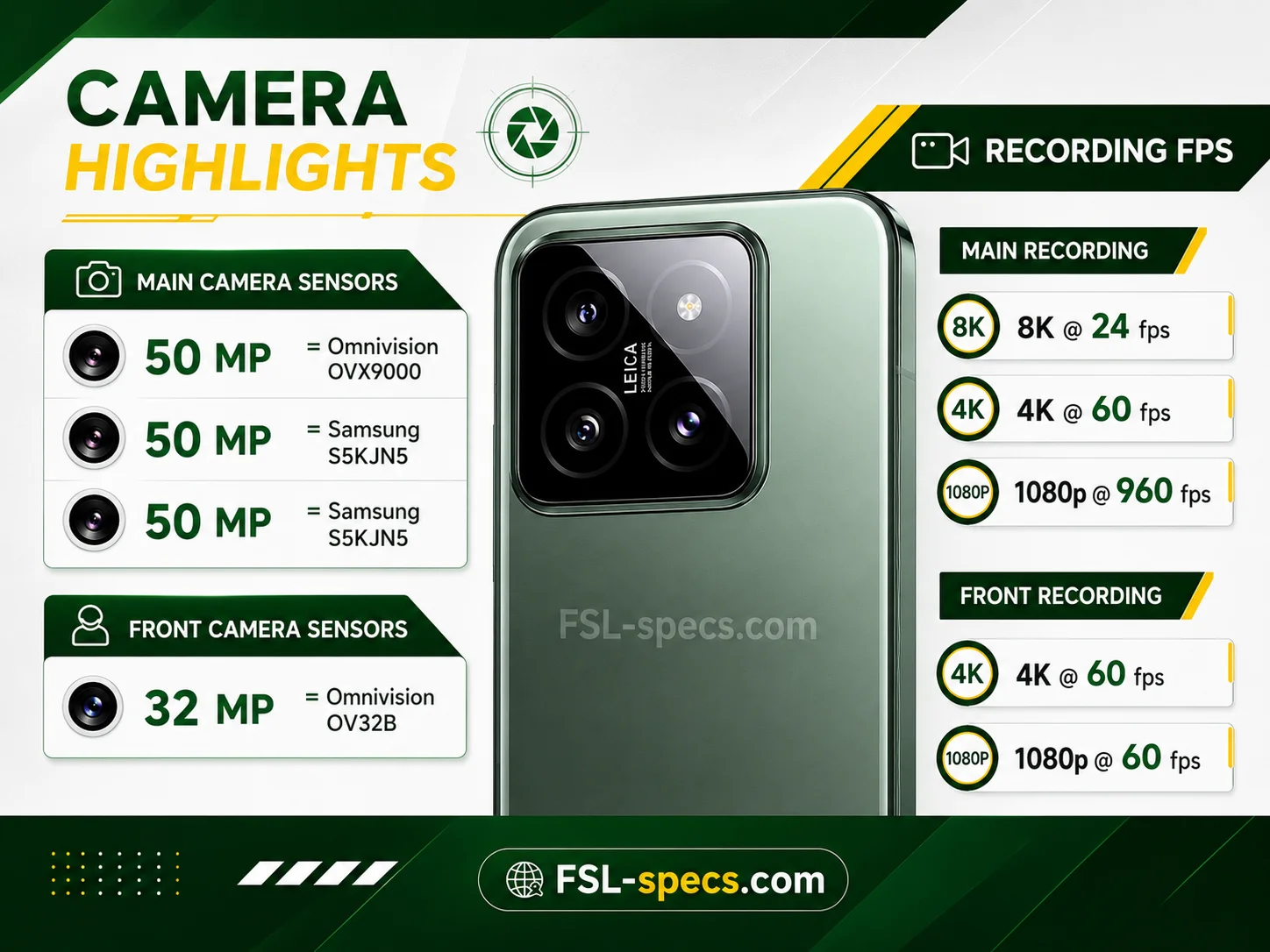
Camera Sensors
50 MP    = Omnivision OVX9000
50 MP    = Samsung S5KJN5
Front Sensors
32 MP = Omnivision OV32B
RECORDING FPS
Main Recording
8K@ 24 fps
4K @ 60 fps
1080p@ 960 fps
Front Recording
4K @ 60 fps
1080p@ 60 fps
RESOLUTION
Main Resolution
8150 x 6150 Pixels
Front Resolution
6528 × 4896 Pixels
ZOOM
Optical Zoom
3.2 x
D Digital Zoom
Not Confirm
Stabilization
Yes
FLASH
Flash
Dual LED
Front Flash
Screen Flash
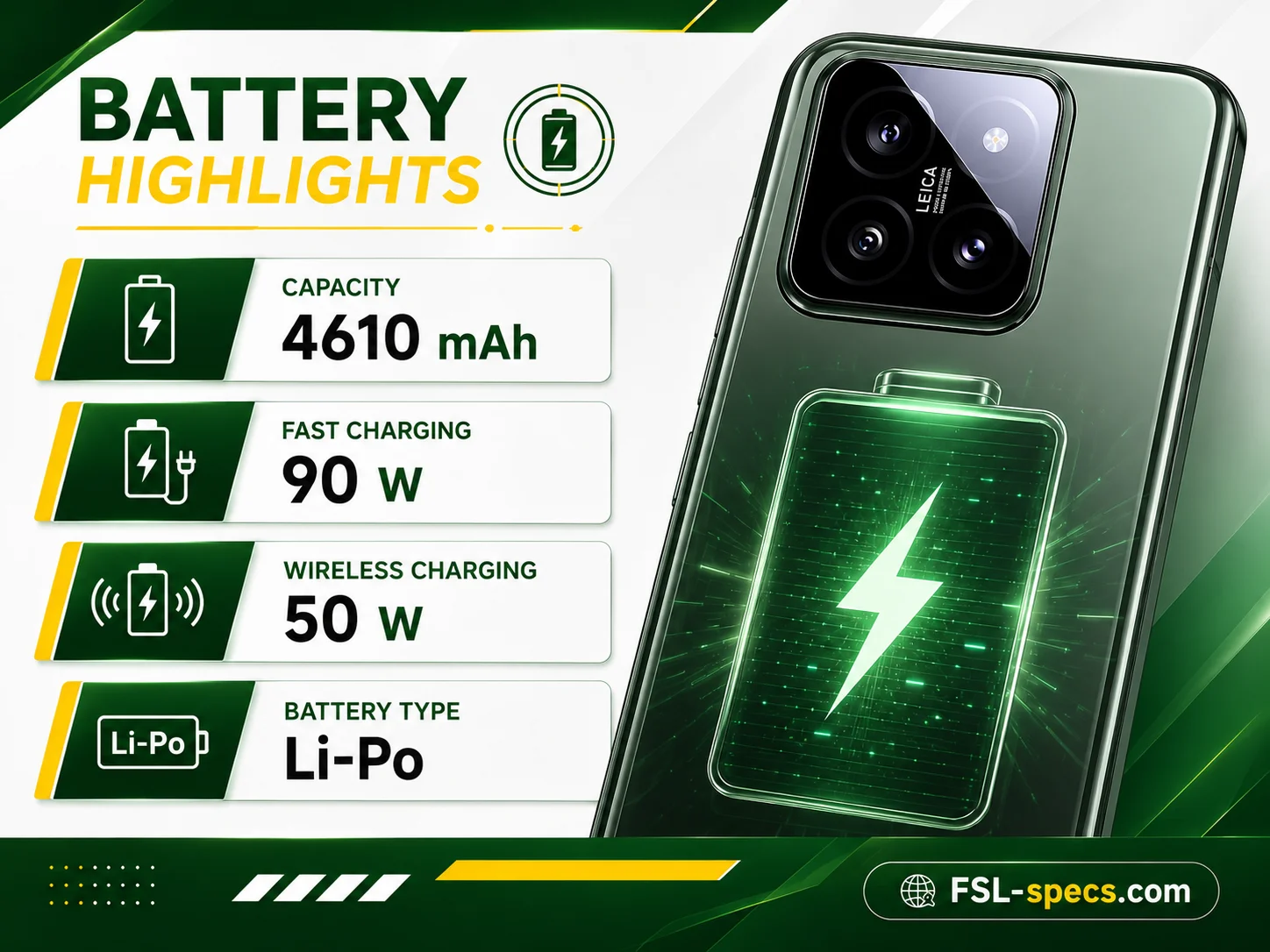
Capacity
4610 mAh
Fast Charging
90 W
Wireless Charging
50 W
Li Battery Type
Li-Po
REVERSE
Reverse Wired
10 W
Reverse Wireless
10 W
OTHER
Battery PC Marks
15 h 45 min
Charging Time
31 min / 35 min / 32 min 52 s depending on recorded test
AUDIO & SENSORS
Speaker
Dual Stereo Speaker
Fingerprint Sensor
Hyper Sonic Front Finger
Other Sensors
Proximity sensor
Gyroscope
Accelerometer
Ambient light sensor
Compass,
color spectrum sensor
BASIC INFO
Mobile
Xiaomi 14
Model
23127PN0CG
Series
Xiaomi Number
Category
Flagship
Release Date
1 November,2023
Year
2023
CONNECTIVITY
Sim
Nano-SIM / E-Sim ( Some Regions )
Network
4G / 4G+ / 5G
WiFi
Wi-Fi 7
Bluetooth
5.4
NFC
Yes / region dependent
OS
Android 14
BODY
Dimensions
152.8 × 71.5 × 8.2 mm
Build
Aluminum Frame And Back glass
KG Weight
193 g
Screen Size
6.36 inch
Resolution
1200 × 2670 pixels
Type
LTPO Oled
Refresh Rate
120 Hz
Peak Brightness
3000 nits
HBM Brightness
~1000 nits
Processor
Snapdragon 8 Gen 3
Max Clock
3.3 GHz
Lithography
4 nm
GPU
Adreno 750
CPU Cores
Octa-core
Antutu v11
2.4 M
Antutu v10
2 M
Bootup Time
23s
Architecture
1× Cortex-X4
3× Cortex-A720
2× Cortex-A720
2× Cortex-A520
Ram Memory
12 + 512 GB
SD Card
No
Ram Type
LPDDR5X
Storage Type
UFS 4.0
Variants
8+ 256 GB
12 + 256 / 512 GB
16 + 512 GB / 1 TB
MP
Rear Camera
50+50+50 MP
Front Camera
32 MP
SENSORS
Main Camera Sensors
50 MP    = Omnivision OVX9000
50 MP    = Samsung S5KJN5
Front Camera Sensors
32 MP = Omnivision OV32B
RECORDING FPS
Main Recording
8K@ 24 fps
4K @ 60 fps
1080p@ 960 fps
Front Recording
4K @ 60 fps
1080p@ 60 fps
RESOLUTION
Main Resolution
8150 x 6150 Pixels
Front Resolution
6528 × 4896 Pixels
ZOOM
Optical Zoom
3.2 x
D Digital Zoom
Not Confirm
Stabilization
Yes
FLASH
Flash
Dual LED
Front Flash
Screen Flash
Capacity
4610 mAh
Fast Charging
90 W
Wireless Charging
50 W
Li Battery Type
Li-Po
REVERSE
Reverse Wired
10 W
Reverse Wireless
10 W
OTHER
Battery Life PCMark
15 h 45 min
Charging Time
31 min / 35 min / 32 min 52 s depending on recorded test
AUDIO & SENSORS
Speaker
Dual Stereo Speaker
Fingerprint Sensor
Hyper Sonic Front Finger
Other Sensors
Proximity sensor
Gyroscope
Accelerometer
Ambient light sensor
Compass,
color spectrum sensor

Highlights & Review Of Xiaomi 14

Display Review:

The Xiaomi 14 uses a compact 6.36-inch LTPO AMOLED display with 2670 × 1200 resolution, 460 PPI, and a dynamic 1–120Hz refresh rate. Its 1000-nit HBM and 3000-nit peak brightness, together with Dolby Vision, HDR10+ and 68-billion-color support, make it a highly capable flagship screen. Xiaomi itself confirms these specifications, while NanoReview records strong display testing and a 1170-nit measured peak in auto mode.

At listed PKR 322,000, however, the Xiaomi 14 faces a serious challenge from the Samsung Galaxy S26 Plus, priced at PKR 345,000 for 12+512GB. Samsung offers a much larger 6.7-inch Dynamic AMOLED 2X panel with 1440 × 3120 resolution, 120Hz, 1400-nit HBM and 2600-nit peak brightness. That gives the S26 Plus a clear advantage in screen area, resolution and outdoor brightness, although Xiaomi’s LTPO panel offers the same maximum refresh rate while being considerably smaller and easier to use one-handed.

The Xiaomi 17T Pro, at your listed PKR 260,000, shifts the comparison toward value. Its 6.83-inch AMOLED display runs at 1280 × 2772, 144Hz, with 2000-nit HBM and 3500-nit peak brightness according to FSL-Specs data. It therefore offers a larger, smoother and brighter screen than the Xiaomi 14 while costing PKR 62,000 less.

The RedMagic 11 Pro, at PKR 300,000, goes even further for gaming with a 6.85-inch AMOLED, 2688 × 1216 resolution, 144Hz refresh rate and up to 1800 nits peak brightness. Its 144Hz panel is smoother for supported games, but Xiaomi 14 has the stronger HDR-focused display specification and a more compact flagship format.

Verdict: The Samsung Galaxy S26 Plus has the best overall display specification, while the Xiaomi 17T Pro is the strongest value choice; the Xiaomi 14 remains the better pick for buyers specifically wanting a compact 6.36-inch flagship display.

Processor Review:

The Xiaomi 14 is powered by the Snapdragon 8 Gen 3, built on a 4nm process, with a peak CPU frequency around 3.3GHz and Adreno 750 graphics. NanoReview’s current AnTuTu 11 average is approximately 2.37 million points, while 91mobiles recorded 1,982,613 in its benchmark testing. The difference highlights why benchmark version, software and test conditions matter, but the Snapdragon 8 Gen 3 remains a strong flagship platform for demanding apps and gaming.

At your listed PKR 322,000, however, the Xiaomi 14 is substantially behind the Xiaomi 17T Pro, which costs only PKR 260,000. The 17T Pro uses the newer 3nm MediaTek Dimensity 9500, featuring an all-big-core design with a 4.21GHz C1-Ultra core and Mali-G1 Ultra MP12 GPU. NanoReview records an AnTuTu 11 average of 3,323,591, around 40% higher than the Xiaomi 14’s current NanoReview result. Its Geekbench 6 scores of 3,099 single-core and 9,438 multi-core also demonstrate a major generational performance advantage.

The Samsung Galaxy S26 Plus is another major step forward. Its Exynos 2600 variant uses a 2nm process, a 3.8GHz C1-Ultra core and Xclipse 960 GPU. NanoReview records around 3.12 million AnTuTu 11 points, although Snapdragon-equipped S26 Plus models can reach approximately 3.73 million, so regional chipset differences are important when buying this phone.

The biggest performance threat is the RedMagic 11 Pro at PKR 300,000. Its Snapdragon 8 Elite Gen 5 reaches around 4.11 million AnTuTu 11 points, with 3,693 single-core and 11,818 multi-core Geekbench 6 scores. Its dedicated cooling system and gaming-focused hardware make it substantially better suited to sustained heavy gaming than the Xiaomi 14.

Verdict: At PKR 322,000, the Xiaomi 14 loses the performance battle decisively, with the Xiaomi 17T Pro offering much more performance for PKR 62,000 less and the RedMagic 11 Pro delivering the strongest gaming performance of all four.

Ram & Memory Review:

The Xiaomi 14 in your 12GB + 512GB configuration uses LPDDR5X RAM at 8533Mbps alongside UFS 4.0 storage. Xiaomi confirms that the 512GB model uses UFS 4.0 and that there is no microSD expansion, so the 512GB capacity is effectively the long-term storage limit. Xiaomi also offers Memory Extension options, but this uses internal storage rather than replacing physical RAM, so it should not be treated as an equivalent to having more than 12GB RAM.

At your listed PKR 322,000, the Xiaomi 14’s memory configuration is still competitive, but the Samsung Galaxy S26 Plus at PKR 345,000 offers the same 12GB RAM + 512GB storage capacity. Samsung’s Pakistan specification confirms 12GB RAM and 512GB storage, with around 480.6GB shown as available storage on its business specification page. The major limitation for a direct hardware comparison is that the Samsung source does not clearly identify the RAM and storage technologies in the retrieved specification, so it would be misleading to claim a specific LPDDR or UFS version.

The Xiaomi 17T Pro is much more interesting from a value perspective. At your listed PKR 260,000, its 12GB + 512GB configuration uses LPDDR5X 9600Mbps RAM and faster UFS 4.1 storage. That gives it a newer memory platform than the Xiaomi 14 while costing PKR 62,000 less.

The RedMagic 11 Pro at PKR 300,000 takes the lead in capacity, offering 16GB LPDDR5T RAM + 512GB UFS 4.1 Pro. That extra 4GB RAM is particularly valuable for heavy multitasking and gaming, while UFS 4.1 Pro is designed for faster loading and memory-intensive workloads.

Verdict: The RedMagic 11 Pro wins the memory category for power users, while the Xiaomi 17T Pro is the strongest value choice; the Xiaomi 14’s 12GB LPDDR5X + 512GB UFS 4.0 remains excellent, but it is difficult to justify paying more for it on memory hardware alone

Cameras Review:

The Xiaomi 14 has the most balanced camera hardware of these four phones. Its Leica-branded setup combines a 50MP main camera, 50MP ultrawide and 50MP 3.2x telephoto, plus a 32MP selfie camera. In real-world testing, the main camera produces strong detail, natural-looking colors and good low-light results, while the dedicated telephoto remains useful beyond the basic 1x shot. WIRED’s camera samples also found that 2x crops retain plenty of detail, while the 3.2x telephoto delivers genuinely useful optical zoom.

The Samsung Galaxy S26 Plus, at your listed PKR 345,000, uses a 50MP main + 12MP ultrawide + 10MP 3x telephoto system with a 12MP selfie camera. Real-world testing shows that the main camera is capable, but the results are not consistently class-leading. Tom’s Guide found Samsung’s photos sometimes looked darker or less colorful than the Pixel and iPhone, while the 12MP ultrawide produced softer, fuzzier results. Its 3x telephoto is also less flexible for distant subjects than phones using 5x optical zoom.

The Xiaomi 17T Pro, however, is the biggest camera challenger at only PKR 260,000. Its 50MP main + 50MP 5x periscope telephoto + 12MP ultrawide combination produces excellent results from the main and telephoto cameras. Independent testing particularly praises its 5x optical zoom, large 1/1.3-inch-class main sensor, Leica processing and strong daylight detail. The weakness is the 12MP ultrawide, which loses quality in low light and lacks autofocus.

The RedMagic 11 Pro, despite its 50MP main + 50MP ultrawide + 2MP macro hardware, is clearly designed around gaming rather than photography. Real testing found decent daylight images, but less natural colors, weaker ultrawide detail and a noticeably poor 16MP under-display selfie camera. Most importantly, it has no dedicated telephoto camera, making it substantially less versatile for portraits and distant subjects.

Verdict: The Xiaomi 14 delivers the most balanced photography system, but the Xiaomi 17T Pro is the smarter camera purchase at PKR 260,000, thanks to its excellent 5x periscope and strong main camera. The RedMagic 11 Pro should be chosen for gaming, not photography.

Battery Review:

The Xiaomi 14 packs a relatively compact 4,610mAh battery with 90W wired and 50W wireless charging. Despite having the smallest battery here, independent testing found its endurance to be good for a compact flagship, and Notebookcheck specifically rated its battery life as excellent while also highlighting the 90W charging. A real-world GSMArena user report described going from 100% at around 6:30am to roughly 25% by 8pm with moderate use.

The Samsung Galaxy S26 Plus, at PKR 345,000, has a much larger 4,900mAh battery but only 45W wired charging and 15W wireless charging according to PhoneArena’s testing. Its real-world endurance is respectable rather than exceptional: PhoneArena describes it as capable of handling a heavy-use day, but says users may be looking for a charger in the early evening. That makes the Samsung better for capacity than the Xiaomi 14, but considerably slower to recharge.

The Xiaomi 17T Pro is where the value equation changes dramatically. At your listed PKR 260,000, it carries a huge 7,000mAh silicon-carbon battery and 100W wired charging. Xiaomi claims 20.3 hours of continuous use and 30.7 hours of video playback, while its 100W PPS support gives it a major charging advantage over both the Xiaomi 14 and Galaxy S26 Plus.

The RedMagic 11 Pro, at PKR 300,000, is the endurance champion with a 7,500mAh silicon-carbon battery and 80W wired + 80W wireless charging. Real testing is particularly impressive: PhoneArena measured almost 26 hours of browsing, 15 hours of video playback and 14 hours of gaming. HotHardware also recorded 21 hours 59 minutes in its PCMark battery test while running at 144Hz.

Verdict: The RedMagic 11 Pro wins outright for battery endurance, while the Xiaomi 17T Pro is the best value battery package at PKR 260,000. The Xiaomi 14’s advantage is its compact body and excellent 90W + 50W wireless charging, but its 4,610mAh capacity makes it the weakest choice here for heavy users.

Final Verdict :

At the listed prices, the Xiaomi 14 12+512GB at PKR 322,000 is the hardest phone to recommend as the overall winner. It remains a premium compact flagship with a strong Snapdragon 8 Gen 3, LPDDR5X + UFS 4.0, Leica triple-camera system, 90W wired + 50W wireless charging, and an excellent 6.36-inch LTPO AMOLED display.

Xiaomi’s official specifications confirm the 12GB/512GB configuration and flagship hardware. However, its competitors expose a major value problem: you are paying PKR 62,000 more than the Xiaomi 17T Pro while receiving an older processor, smaller battery and less capable display hardware.

The Xiaomi 17T Pro at PKR 260,000 is the strongest overall value winner. Its Dimensity 9500, 12GB LPDDR5X + 512GB UFS 4.1, 6.83-inch 144Hz AMOLED, 7,000mAh battery and Leica 5x telephoto create an unusually complete package for the price. Xiaomi claims more than 3.57 million AnTuTu points, while the official specifications confirm 100W wired and 50W wireless charging.

The RedMagic 11 Pro 16+512GB at PKR 300,000 takes second place because it is the performance specialist. Its Snapdragon 8 Elite Gen 5, 16GB RAM, liquid cooling and 7,500mAh battery make it the clear choice for serious gaming, but its camera system is less versatile. The Samsung Galaxy S26 Plus 12+512GB at PKR 345,000 is third, but it is the better choice for buyers prioritizing Samsung’s software ecosystem, long-term support and a large QHD+ display. Samsung lists 12GB/512GB, a 6.7-inch QHD+ 120Hz AMOLED, and 31-hour rated video playback.

Verdict: For most buyers, Xiaomi 17T Pro is the best overall purchase, RedMagic 11 Pro is the best gaming phone, Galaxy S26 Plus is the best Samsung/all-round alternative, while Xiaomi 14 is best only if compact size and Leica photography are your priorities.

Best overall: Xiaomi 17T Pro
Best gaming: RedMagic 11 Pro
Best camera balance: Xiaomi 14
Best Samsung experience: Galaxy S26 Plus
Best battery: RedMagic 11 Pro
Best value: Xiaomi 17T Pro

Pros And Cons of Xiaomi 14

Pros of Mobile

Flagship Performance ⚡ — Snapdragon 8 Gen 3
Leica Cameras 📸 — Triple 50MP system
Ultra-Fast Charging 🔋 — 90W wired
Wireless Charging ⚡ — 50W wireless
Brilliant Display 🌟 — 3000-nit AMOLED
Compact Design 📱 — 6.36-inch body

Cons of Mobile

Bloatware Apps 📦 — Pre-installed apps
Inconsistent Portraits 📸 — Focus issues
Light Flare ✨ — Camera flare
Delayed Updates 🔄 — Slow rollout
Limited Screen Size 📱 — 6.36-inch display
Shorter Support 🛡️ — Four OS updates

Best For - Not Best For

Best For

Compact Flagship 📱
Mobile Photography 📸
Heavy Gaming 🎮
Fast Charging ⚡
One-Handed Use 👋
Premium Android ✨

Not Best For

Bloatware-Free Experience 🧹
Huge Displays 📱
Timely Updates 🔄
Casual Photography 📸
Simple Software ⚙️
Long-Term Support 🛡️

Trailer And Unboxing of Xiaomi 14

Disassembly Or Teardown And Gaming Test of Xiaomi 14

Camera Test Xiaomi 14

Xiaomi 15
Xiaomi 17T Pro
RedMagic 11 Pro
Samsung Galaxy S26 Plus

Xiaomi Series Row
Redmi Series Row
POCO Series Row
Picture of Faisal Ur Rehman

Faisal Ur Rehman

Faisal Rehman is the founder and editor of FSL Specs, where he publishes in-depth smartphone specifications, comparisons, buying guides, and technology insights. With extensive experience in mobile hardware research and technical analysis, he provides accurate and up-to-date information on Android smartphones, processors, displays, cameras, batteries, performance benchmarks, and software features. His goal is to simplify complex specifications and help readers choose the right device with confidence.

FAQs Questions

Yes, it handles gaming very well. It runs on the Snapdragon 8 Gen 3 (4nm) chipset with an Adreno 750 GPU, which is flagship-tier silicon built for demanding titles. Combined with 8GB to 16GB of RAM options, it comfortably runs games like Genshin Impact or COD Mobile at high settings without much slowdown.

It's genuinely one of its strongest points. The triple 50MP Leica-tuned setup includes a f/1.6 main sensor with OIS, a 50MP telephoto (3.2x optical, OIS), and a 50MP ultrawide, giving you real optical zoom instead of just digital cropping. For a compact flagship, this camera system punches well above phones twice its size.

Yes, and it's fast in both directions. It ships with 90W wired charging, reaching 100% in about 31 minutes, plus 50W wireless charging that gets you to full in roughly 46 minutes. There's also 10W reverse wireless charging if you need to top up earbuds or another phone.

The battery itself is 4610mAh, which sounds modest next to bigger 5000mAh+ phones, but the efficient 4nm chipset and LTPO display help it stretch further than the number suggests. It's not a two-day phone, but a full day of moderate use is realistic, and the fast charging makes topping it up quick and painless.

Definitely, this is one of its best specs on paper. It uses a 6.36-inch LTPO OLED panel at 1200 x 2670 resolution (460ppi), with 120Hz refresh rate, 3000 nits peak brightness, and support for both HDR10+ and Dolby Vision. That combination makes it genuinely excellent for streaming and outdoor visibility.

The base 8GB model will handle daily use fine, but if you're a heavy multitasker or keep a lot of apps running in the background, the 12GB variant is the safer pick. The 16GB option is mostly overkill unless you specifically want the largest storage tier that comes bundled with it.

No, unfortunately not. The Xiaomi 14 comes in 256GB, 512GB, and 1TB internal storage options with no card slot, so you'll need to pick your storage tier carefully at purchase since there's no way to add more later.

12 + 512 GB
₨320,000 | ₹78,000 | $750

Leave a Reply

Your email address will not be published. Required fields are marked *

Scroll to Top