



























✪ Redmi Note 15 Pro Plus ✪

Xiaomi Redmi Note 15 Pro Plus Specs, Price, Camera, Battery & Best Review (2026)
United States flag United States
$470 USD
Pakistan flag Pakistan (PKR)
155,000 PKR
India flag India (INR)
₹45,000 INR

✪ Redmi Note 15 Pro Plus ✪

Xiaomi Redmi Note 15 Pro Plus Specs, Price, Camera, Battery & Best Review (2026)
Last Time Update : 25 August, 2026
0

Quick Specifications

AMOLED

Display Type

Snapdragon 7s Gen 4

Processor

12 + 512 GB

Ram And Memory

200 + 8 + 2 MP

Camera

6500 mAh

Battery

100 W

Fast Charging

Full Specification

BASIC INFO
Mobile
Redmi Note 15 Pro Plus
Model
2510ERA8BG
Series
redmi Note
Category
Mid Range
Release Date
25 December,2025
Year
2025
CONNECTIVITY
Sim
Nano-SIM / E-Sim
Network
4G / 4G+ / 5G
WiFi
Wi-Fi 6 / Wi-Fi 6E
Bluetooth
5.4
NFC
Yes / region dependent
OS
Android 15 / HyperOS 2
BODY
Dimensions
163.3 × 78.3 × 8.2 / 8.5 mm
Build
Metal Frame And Back glass-fiber reinforced plastic
KG Weight
207 grams
Screen Size
6.83 inch
Resolution
1280 × 2772 Pixels
Type
AMOLED
Refresh Rate
120 Hz
Peak Brightness
3200 nits
HBM Brightness
1800 nits
Processor
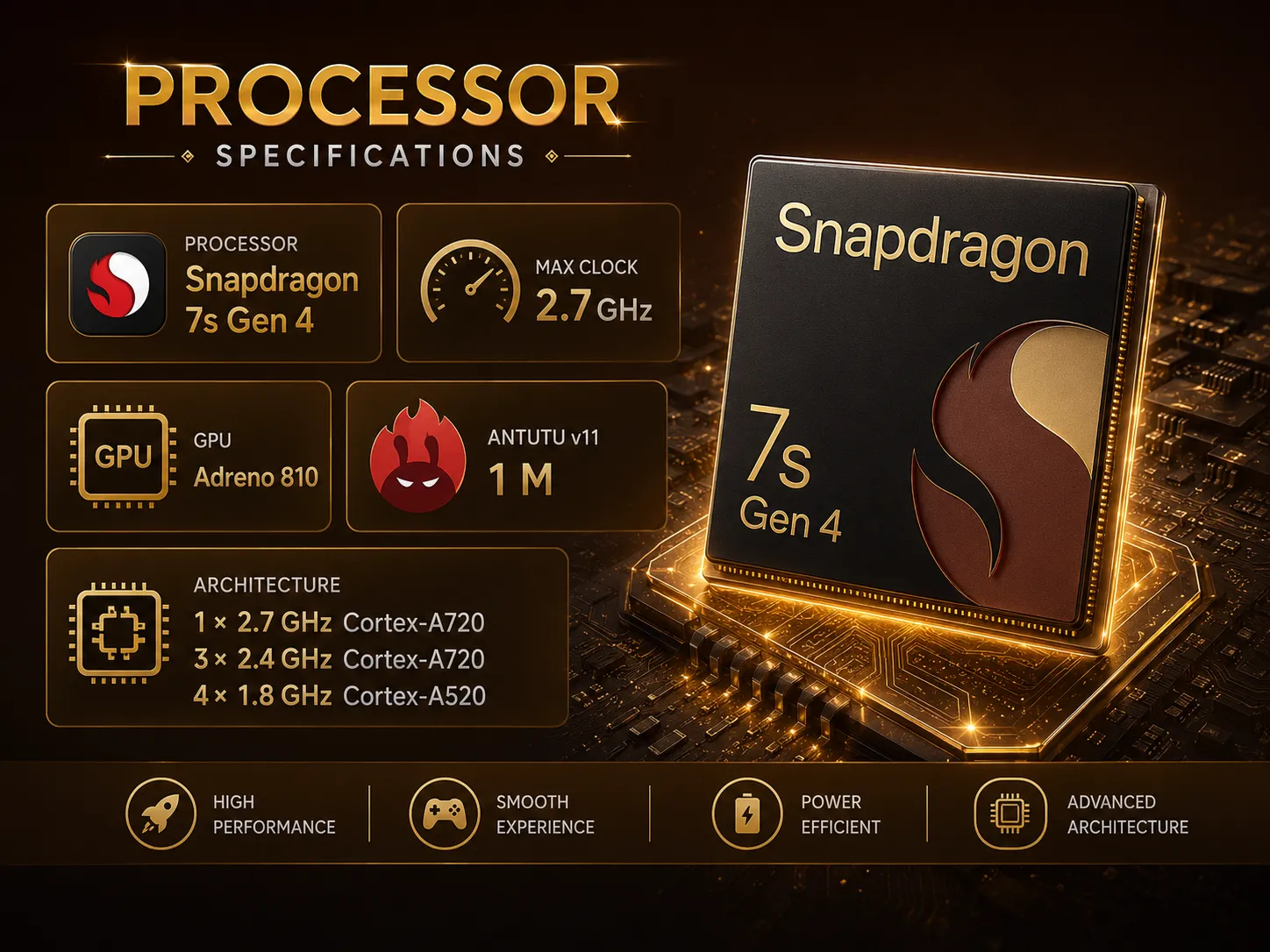
Snapdragon 7s Gen 4
Max Clock
2.7 GHz
Lithography
4 nm
GPU
Adreno 810
CPU Cores
Octa-core
Antutu v11
1 M
Bootup Time
24 s
Architecture
1×2.7 GHz Cortex-A720
3×2.4 GHz Cortex-A720
4×1.8 GHz Cortex-A520
Ram Memory
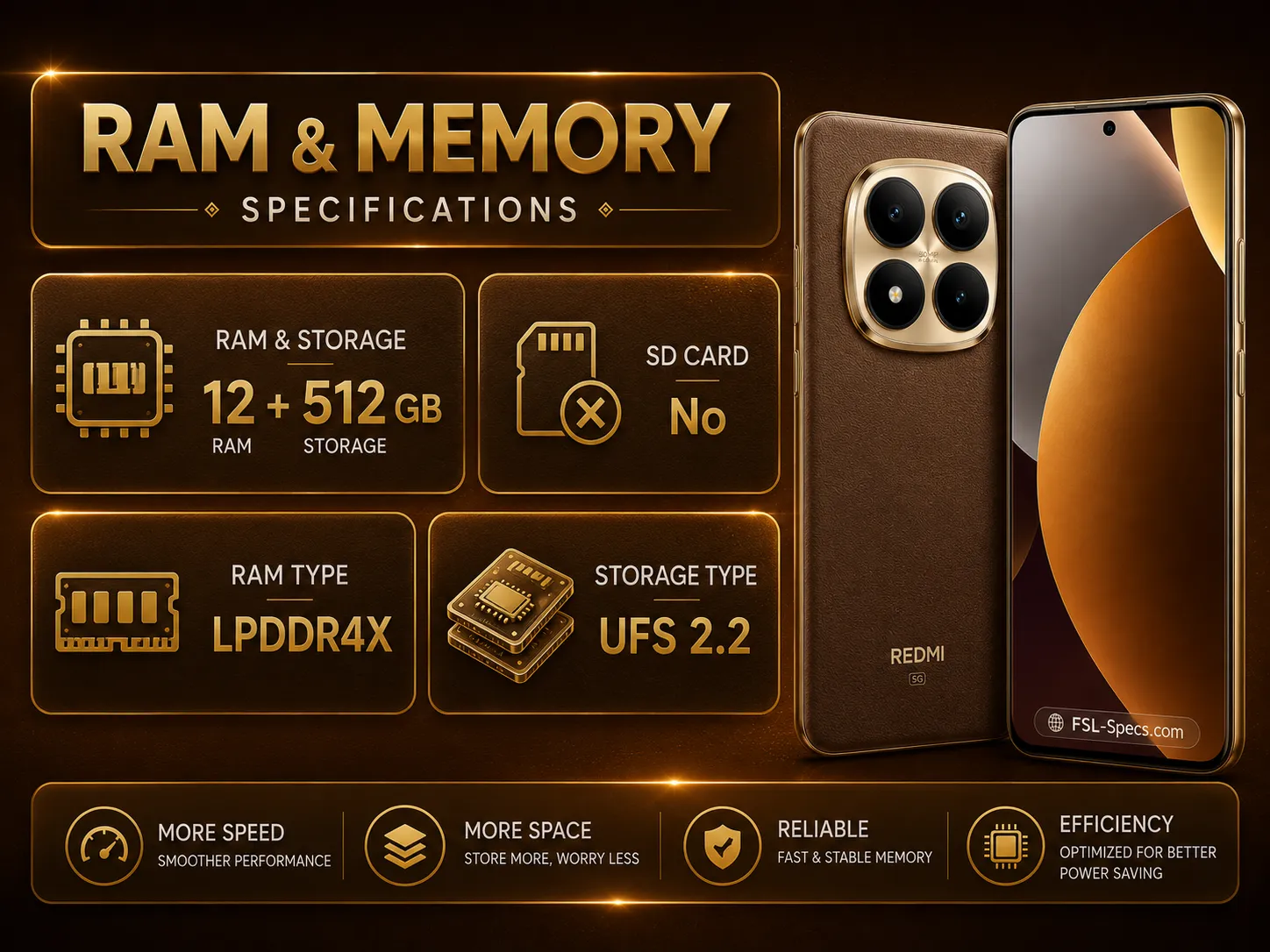
12 + 512 GB
Ram Type
LPDDR4X
Storage Type
UFS 2.2
SD Card
No
Variants
8 + 256 GB
12 + 256 GB
12 + 512 GB
MP
Rear Camera
200 + 8 + 2 MP
Front Camera
32 MP
SENSORS
Camera Sensors
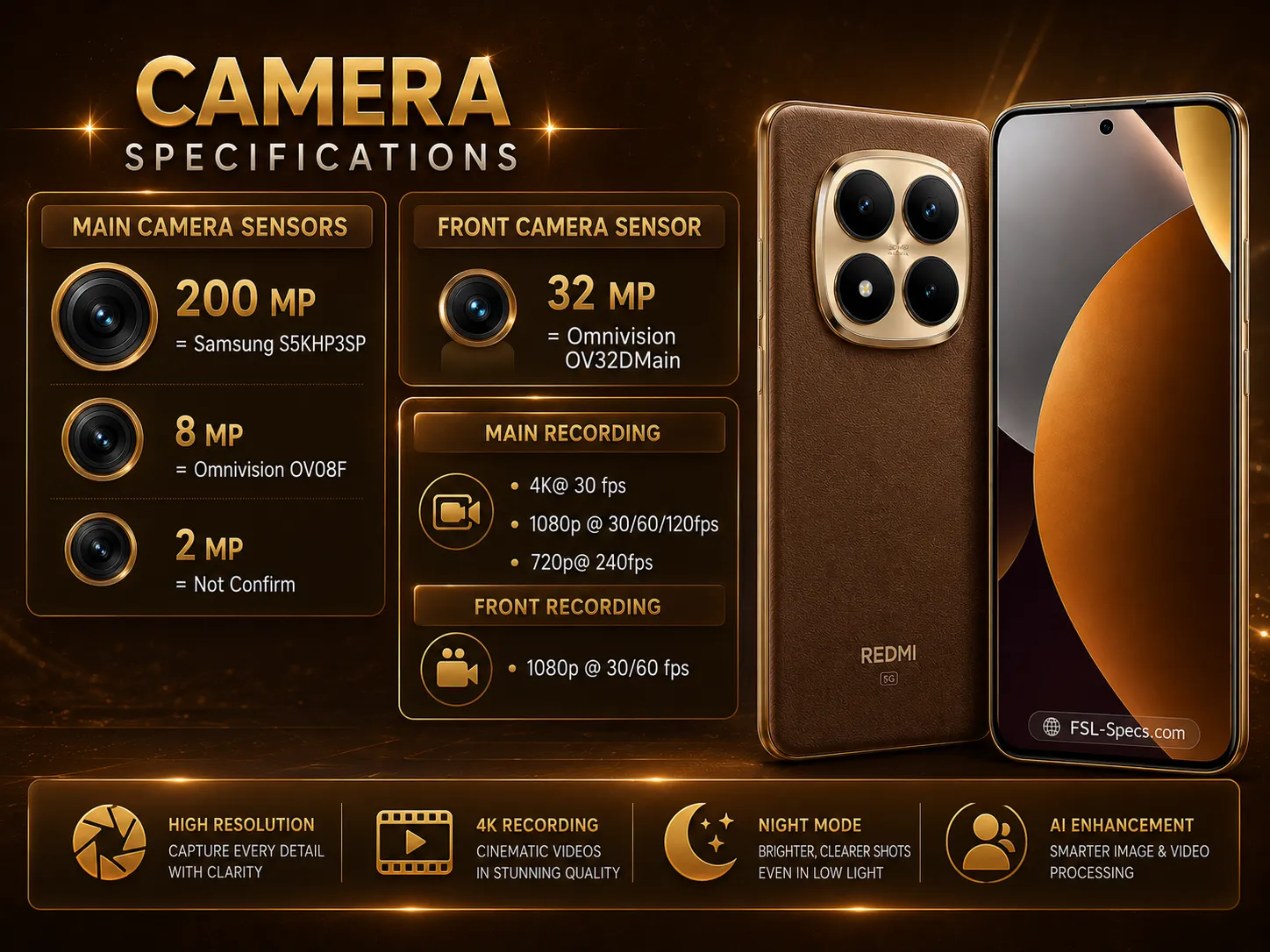
200 MP    = Samsung S5KHP3SP
8 MP    = Omnivision OV08F
2 MP    = Not Confirm
Front Sensors
32 MP = Omnivision OV32D
RECORDING FPS
Main Recording
4K@ 30 fps
1080p @ 30/60/120fps
720p@ 240fps
Front Recording
1080p @ 30/60 fps
RESOLUTION
Main Resolution
8150 x 6150 Pixels
ZOOM
Optical Zoom
-
D Digital Zoom
10 x
Stabilization
Yes
FLASH
Flash
LED
Front Flash
Screen Flash
Capacity
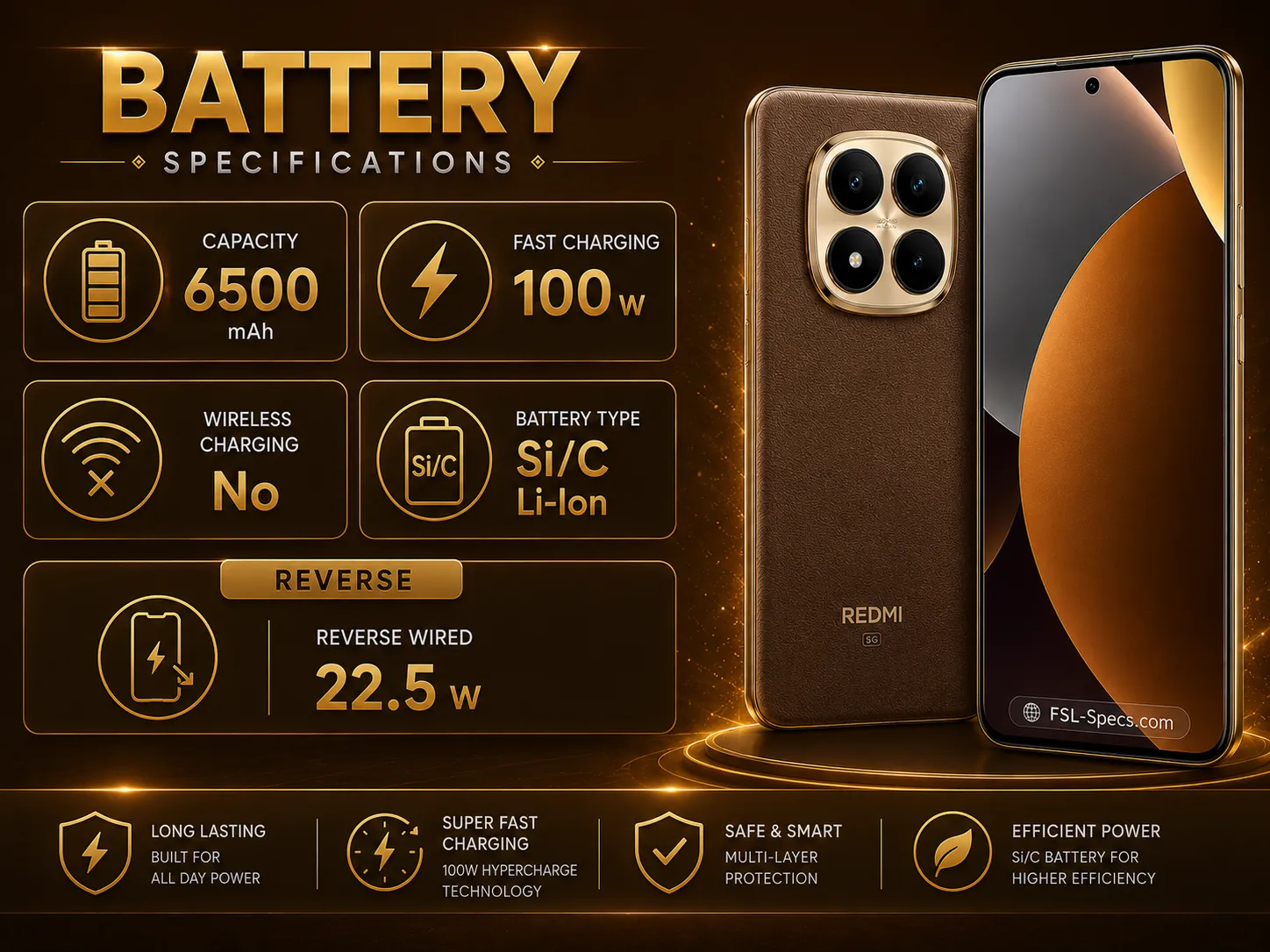
6500 mAh
Fast Charging
100 W
Wireless Charging
No
Li Battery Type
Si/C Li-Ion
REVERSE
Reverse Wired
22.5 W
Reverse Wireless
No
OTHER
Battery PC Marks
14 h
Charging Time
~35 min / 45 mins ( 0-100% )
AUDIO & SENSORS
Speaker
Dual Stereo Speaker
Fingerprint Sensor
Hyper Sonic Front Finger
Other Sensors
Proximity sensor
Gyroscope
Accelerometer
Ambient light sensor
Compass, etc
Special Features

Eco-leather back option (in addition to plastic back)
IP68/IP69/IP69K dust & water resistance
Dolby Vision + Dolby Atmos + Hi-Res Audio certified
Silicon-Carbon (Si/C) battery cell
100W wired fast charging with 22.5W reverse wired charging
Infrared port (region dependent)
1000-cycle rated battery health

BASIC INFO
Mobile
Redmi Note 15 Pro Plus
Model
2510ERA8BG
Series
redmi Note
Category
Mid Range
Release Date
25 December,2025
Year
2025
CONNECTIVITY
Sim
Nano-SIM / E-Sim
Network
4G / 4G+ / 5G
WiFi
Wi-Fi 6 / Wi-Fi 6E
Bluetooth
5.4
NFC
Yes / region dependent
OS
Android 15 / HyperOS 2
BODY
Dimensions
163.3 × 78.3 × 8.2 / 8.5 mm
Build
Metal Frame And Back glass-fiber reinforced plastic
KG Weight
207 grams
Screen Size
6.83 inch
Resolution
1280 × 2772 Pixels
Type
AMOLED
Refresh Rate
120 Hz
Peak Brightness
3200 nits
HBM Brightness
1800 nits
Processor
Snapdragon 7s Gen 4
Max Clock
2.7 GHz
Lithography
4 nm
GPU
Adreno 810
CPU Cores
Octa-core
Antutu v11
1 M
Bootup Time
24 s
Architecture
1×2.7 GHz Cortex-A720
3×2.4 GHz Cortex-A720
4×1.8 GHz Cortex-A520
Ram Memory
12 + 512 GB
SD Card
No
Ram Type
LPDDR4X
Storage Type
UFS 2.2
Variants
8 + 256 GB
12 + 256 GB
12 + 512 GB
MP
Rear Camera
200 + 8 + 2 MP
Front Camera
32 MP
SENSORS
Main Camera Sensors
200 MP    = Samsung S5KHP3SP
8 MP    = Omnivision OV08F
2 MP    = Not Confirm
Front Camera Sensors
32 MP = Omnivision OV32D
RECORDING FPS
Main Recording
4K@ 30 fps
1080p @ 30/60/120fps
720p@ 240fps
Front Recording
1080p @ 30/60 fps
RESOLUTION
Main Resolution
8150 x 6150 Pixels
ZOOM
Optical Zoom
-
D Digital Zoom
10 x
Stabilization
Yes
FLASH
Flash
LED
Front Flash
Screen Flash
Capacity
6500 mAh
Fast Charging
100 W
Wireless Charging
No
Li Battery Type
Si/C Li-Ion
REVERSE
Reverse Wired
22.5 W
Reverse Wireless
No
OTHER
Battery Life PCMark
14 h
Charging Time
~35 min / 45 mins ( 0-100% )
AUDIO & SENSORS
Speaker
Dual Stereo Speaker
Fingerprint Sensor
Hyper Sonic Front Finger
Other Sensors
Proximity sensor
Gyroscope
Accelerometer
Ambient light sensor
Compass, etc
Special Features

Eco-leather back option (in addition to plastic back)
IP68/IP69/IP69K dust & water resistance
Dolby Vision + Dolby Atmos + Hi-Res Audio certified
Silicon-Carbon (Si/C) battery cell
100W wired fast charging with 22.5W reverse wired charging
Infrared port (region dependent)
1000-cycle rated battery health

Highlights & Review Of Redmi Note 15 Pro Plus

Display Review:

The Xiaomi Redmi Note 15 Pro Plus 5G uses a 6.83-inch CrystalRes AMOLED display with 2772 × 1280 resolution, 120Hz refresh rate, 1800 nits HBM brightness and 3200 nits peak brightness. It also brings 12-bit colour depth, 447 PPI, Dolby Vision, HDR10+, and Gorilla Glass Victus 2. At your PKR 156,000 box-pack price, this is a strong display package, particularly for buyers who value resolution, colour depth and outdoor visibility.

The OPPO Reno 15 at PKR 159,000 uses a smaller 6.59-inch AMOLED panel with 1256 × 2760 resolution and 120Hz refresh rate. Its 1200 nits HBM brightness is 600 nits lower than the Redmi Note 15 Pro Plus, while the Redmi also offers the larger screen and higher 3200-nit peak figure.

The Realme 15 Pro, however, is the more interesting rival at just PKR 132,000. Its 6.8-inch AMOLED, 1280 × 2800 resolution and 144Hz refresh rate beat the Redmi’s 120Hz for motion smoothness, while its 1800 nits HBM matches the Redmi. Realme also lists 6500 nits peak brightness, although peak and HBM figures are not directly equivalent measurements.

The Infinix GT 50 Pro at PKR 160,000 offers a 6.78-inch AMOLED, 1208 × 2644 resolution and faster 144Hz refresh rate. Its listed 1600 nits HBM brightness is below Redmi’s 1800 nits, while its peak rating reaches 4500 nits.

Verdict: The Redmi Note 15 Pro Plus has the strongest overall display package, but the Realme 15 Pro offers the better display value at PKR 132,000, especially with its 144Hz panel.

Processor Review:

The Xiaomi Redmi Note 15 Pro Plus 5G is powered by the Snapdragon 7s Gen 4, a 4nm octa-core chipset clocked up to 2.7GHz with an Adreno GPU. NanoReview’s current AnTuTu 11 average puts the Redmi at 1,024,234 points. At PKR 156,000, that makes the Redmi’s processor capable for everyday multitasking and demanding apps, but it is clearly not the performance leader in this comparison.

The OPPO Reno 15, priced at PKR 159,000, uses the more powerful Snapdragon 7 Gen 4, also built on 4nm but reaching 2.8GHz with an Adreno 722 GPU. NanoReview records an AnTuTu 11 average of 1,394,716, around 36% higher than the Redmi’s current average. That gives the Reno 15 considerably more CPU and GPU headroom for gaming, sustained multitasking and demanding applications, despite costing only PKR 3,000 more.

The Realme 15 Pro is the biggest value challenge. Its Snapdragon 7 Gen 4 reaches 2.8GHz, and NanoReview’s current AnTuTu 11 average is 1,251,276, roughly 22% above the Redmi. More importantly, the Realme costs just PKR 132,000, making it PKR 24,000 cheaper while delivering substantially higher benchmark performance.

The Infinix GT 50 Pro changes the comparison completely. Its Dimensity 8400 Ultimate is a performance-focused 4nm chipset, and NanoReview reports an AnTuTu 11 average of 2,137,843, more than 2× the Redmi’s score. At PKR 160,000, the Infinix is only PKR 4,000 more expensive but offers dramatically higher raw performance.

Verdict: The Redmi Note 15 Pro Plus loses this processor comparison, with the Infinix GT 50 Pro offering the strongest performance by a huge margin and the Realme 15 Pro delivering the best performance-per-rupee value.

Ram & Memory Review:

The Xiaomi Redmi Note 15 Pro Plus 5G in your 12GB + 512GB box-pack configuration gives you plenty of capacity, but its memory hardware is the weakest point of this comparison. Xiaomi specifies 12GB LPDDR4X RAM paired with 512GB UFS 2.2 storage. At PKR 156,000, the 512GB capacity is excellent for large game libraries, photos and 4K video, but UFS 2.2 is an older storage standard compared with the faster solutions used by the rivals.

The OPPO Reno 15 at PKR 159,000 uses 12GB LPDDR5X RAM and 256GB UFS 3.1 storage in the configuration you’re comparing. OPPO officially confirms both memory technologies, and there is no microSD card support. This means the Reno 15 has considerably faster RAM and storage technology, which can benefit app loading, multitasking and file transfers, although the Redmi gives you 2× the storage capacity.

The Realme 15 Pro is particularly strong because its 12GB + 512GB configuration costs only PKR 132,000. It uses 12GB LPDDR4X RAM and 512GB UFS 3.1 storage, with up to 14GB Dynamic RAM available. Compared with the Redmi’s UFS 2.2, UFS 3.1 gives the Realme a clear storage-speed advantage while matching its RAM and capacity.

The Infinix GT 50 Pro, priced at PKR 160,000, combines 12GB LPDDR5X RAM with 256GB UFS 4.1 storage. That is the fastest memory combination here, although its 256GB capacity is half that of the Redmi and Realme.

Verdict: The Realme 15 Pro offers the best overall memory value with 12GB + 512GB UFS 3.1 at PKR 132,000, while the Infinix GT 50 Pro wins for memory technology and speed. The Redmi’s main advantage is its 512GB capacity, but UFS 2.2 makes it the weakest storage solution among these four.

Cameras Review:

The Xiaomi Redmi Note 15 Pro Plus 5G has the most ambitious main-camera hardware here, with a 200MP HPE main sensor, 1/1.4-inch sensor size, f/1.7 aperture and OIS, paired with an 8MP f/2.2 ultrawide. Xiaomi also uses its 200MP AI Engine and claims optical-level 2× and 4× zoom from the main sensor, giving the Redmi more flexibility for detailed crops and distant subjects than a conventional dual-camera setup. Its front camera is 32MP, while rear video reaches 4K at 30fps and front video reaches 1080p at 60fps.

The OPPO Reno 15, priced at PKR 159,000, takes a different approach and is arguably the most versatile camera system. It combines a 50MP f/1.8 main camera with OIS, a dedicated 50MP f/2.8 telephoto with OIS and 3.5× optical zoom, plus an 8MP ultrawide. Its 50MP front camera also supports 4K 60fps recording. For portraits and genuine optical zoom, the Reno 15 has a clear hardware advantage over the Redmi.

The Realme 15 Pro at just PKR 132,000 is also impressive. It uses a 50MP Sony IMX896 main camera with OIS, a 50MP ultrawide, and a 50MP front camera. More importantly for creators, Realme advertises 4K 60fps recording on all three cameras, giving it a major video-recording advantage over the Redmi’s front-camera limitation.

The Infinix GT 50 Pro at PKR 160,000 has a 50MP f/1.8 OIS main camera and 8MP ultrawide, but its 13MP front camera is substantially less ambitious than the other three. It supports rear 4K 60fps, but its camera hardware is clearly more gaming-focused than camera-focused.

Verdict: The Redmi Note 15 Pro Plus wins for main-camera hardware and high-resolution photography, while the OPPO Reno 15 is the strongest overall camera package because its dedicated 50MP telephoto and 50MP 4K selfie camera provide greater shooting versatility. The Realme 15 Pro is the camera value champion at PKR 132,000.

Battery Review:

The Xiaomi Redmi Note 15 Pro Plus 5G packs a 6500mAh silicon-carbon battery with 100W HyperCharge, making it one of the strongest wired-charging combinations in this comparison. Xiaomi claims up to 2 days of battery life, while its official FAQ lists around 40 minutes for a full charge under its testing conditions. It also supports 22.5W reverse wired charging, but there is no wireless charging.

The OPPO Reno 15, at PKR 159,000, also carries a 6500mAh battery, but charging drops to 80W SUPERVOOC. OPPO’s laboratory testing claims approximately 50 minutes from 1% to 100%. Therefore, the Redmi offers the same typical battery capacity with 20W more wired charging power, making it the stronger option for quick top-ups.

The Realme 15 Pro is the biggest battery-value threat. At only PKR 132,000, it provides a larger 7000mAh battery and 80W charging. Realme reports 0-50% in 25 minutes and approximately 61 minutes for a complete charge. Its battery is 500mAh larger than the Redmi’s, although the Redmi’s 100W system is faster on paper.

The Infinix GT 50 Pro, priced at PKR 160,000, uses a 6500mAh battery in some markets, with 45W wired and 30W wireless charging. This makes it the only phone here with wireless charging, although its wired charging is dramatically slower than the Redmi’s 100W system.

Verdict: The Redmi Note 15 Pro Plus wins for wired charging speed, while the Realme 15 Pro offers the best battery value with 7000mAh + 80W at PKR 132,000. The Infinix GT 50 Pro is the better choice if wireless charging matters more than wired charging speed.

Final Verdict :

At your stated box-pack prices, the Realme 15 Pro is the strongest overall value, while the Redmi Note 15 Pro Plus is the more balanced premium choice. The Redmi combines a 1.5K 120Hz AMOLED, 200MP OIS main camera, 12GB + 512GB storage and 6500mAh + 100W charging, but its Snapdragon 7s Gen 4 and UFS 2.2 are weaker than some rivals.

The Infinix GT 50 Pro is the clear performance winner, thanks to its Dimensity 8400 Ultimate and UFS 4.1, but it gives up camera versatility and storage capacity. The OPPO Reno 15 is the strongest camera-oriented alternative, particularly because of its dedicated 50MP 3.5× telephoto, but its 12GB + 256GB configuration limits storage compared with Redmi and Realme.

RankMobilePriceMain StrengthOverall
🥇 1Realme 15 ProPKR 132,000Best value + performance⭐⭐⭐⭐⭐
🥈 2Redmi Note 15 Pro PlusPKR 156,000Display + camera + charging⭐⭐⭐⭐½
🥉 3Infinix GT 50 ProPKR 160,000Gaming performance⭐⭐⭐⭐
4️⃣OPPO Reno 15PKR 159,000Camera versatility⭐⭐⭐⭐

Best overall value: Realme 15 Pro
Best display/camera balance: Redmi Note 15 Pro+
Best gaming: Infinix GT 50 Pro
Best camera versatility: OPPO Reno 15

Pros And Cons of Redmi Note 15 Pro Plus

Pros of Mobile

✅ Massive Battery (6500mAh) 🔋
✅ Fast Charging (100W) ⚡
✅ Bright Display (3200 nits) ☀️
✅ High-Res Camera (200MP OIS) 📸
✅ Gorilla Victus 2 (protection) 🛡️
✅ IP68/IP69K (water resistant) 💧

Cons of Mobile

❌ Older RAM (LPDDR4X) 🐌
❌ No Wireless Charging 🔌
❌ No Audio Jack 🎧
❌ Base Storage (UFS 2.2) 💾
❌ No Telephoto Lens 🔭
❌ Wi-Fi 6E Only 📶

Best For - Not Best For

Best For

🎯 Battery Heavy Users 🔋
🎯 Camera Enthusiasts 📸
🎯 Outdoor Bright Use ☀️
🎯 Fast Charging Fans ⚡
🎯 Durability Focused Buyers 🛡️
🎯 Mid-Range Value Seekers 💰

Not Best For

🚫 Wireless Charging Fans 🔌
🚫 Zoom Photography Lovers 🔭
🚫 Wired Audio Users 🎧
🚫 Flagship Performance Seekers 🚀
🚫 Gaming Benchmark Chasers 🎮

Trailer And Unboxing of Redmi Note 15 Pro Plus

Disassembly Or Teardown And Gaming Test of Redmi Note 15 Pro Plus

Camera Test Redmi Note 15 Pro Plus

OPPO Reno 15 5G
vivo V60
Infinix GT 50 Pro
Realme 15 Pro
Xiaomi Redmi Note 14 Pro Plus

Xiaomi Series Row
POCO Series Row
Redmi Series Row
Picture of Faisal Ur Rehman

Faisal Ur Rehman

Faisal Rehman is the founder and editor of FSL Specs, where he publishes in-depth smartphone specifications, comparisons, buying guides, and technology insights. With extensive experience in mobile hardware research and technical analysis, he provides accurate and up-to-date information on Android smartphones, processors, displays, cameras, batteries, performance benchmarks, and software features. His goal is to simplify complex specifications and help readers choose the right device with confidence.

FAQs Questions

It runs on the Qualcomm Snapdragon 7s Gen 4 chipset, built on a 4nm process. The octa-core setup includes one Cortex-A720 core clocked up to 2.7GHz, three more Cortex-A720 cores at 2.4GHz, and four efficiency-focused Cortex-A520 cores at 1.8GHz, paired with an Adreno 810 GPU. It's a solid mid-range performer, comfortable with everyday multitasking and most games at medium to high settings, though it's not built to compete with true flagship chipsets.

You get a 6.83-inch AMOLED panel with a 120Hz refresh rate and a resolution around 1280 x 2772 pixels, which works out to roughly 447 pixels per inch. Peak brightness goes up to 3200 nits, so visibility in direct sunlight isn't really an issue. It's also protected by Corning Gorilla Glass Victus 2, which adds a decent layer of scratch and drop resistance compared to older Redmi Note models.

The phone packs a 6500mAh silicon-carbon battery, which is noticeably larger than what you'd find on most phones in this segment while still keeping the body relatively slim. Charging is handled by 100W wired fast charging, so a full charge from empty takes around 30 to 40 minutes. There's no wireless charging support on this model, so it's wired only.

The main rear camera is a 200MP sensor with an f/1.7 aperture, optical image stabilization, and multidirectional phase-detection autofocus, using a 1/1.4-inch sensor size. It's paired with an 8MP ultrawide lens. On the front, there's a 32MP selfie camera. Video recording supports up to 4K at 24 or 30fps, along with 1080p at higher frame rates including slow motion options.

The Redmi Note 15 Pro Plus is available with up to 16GB of RAM and up to 512GB of internal storage using UFS 4.0, which is a notable jump in read and write speeds compared to older UFS 2.2 storage. There's no microSD card slot, so whatever storage variant you pick is fixed, with no option to expand it later.

Yes, it carries both IP68 and IP69K certification, meaning it's fully dust-tight and can survive both temporary submersion in water and exposure to high-pressure, high-temperature water jets. This dual rating is a step above what most phones in this price range typically offer, which usually stop at basic splash resistance.

It includes 5G support, Wi-Fi 6E, Bluetooth 5.4, and NFC for contactless payments. It runs Android 15 with Xiaomi's HyperOS 2 on top. The phone uses a dual Nano-SIM setup with no support for a hybrid SIM/SD card slot, and it also includes an under-display optical fingerprint sensor along with the usual accelerometer, gyroscope, compass, and proximity sensors.

12 + 256 GB
₨190,000 | ₹60,000 | $600

12 + 512 GB
₨218,000 | ₹64,000 | $670

Leave a Reply

Your email address will not be published. Required fields are marked *

Scroll to Top