
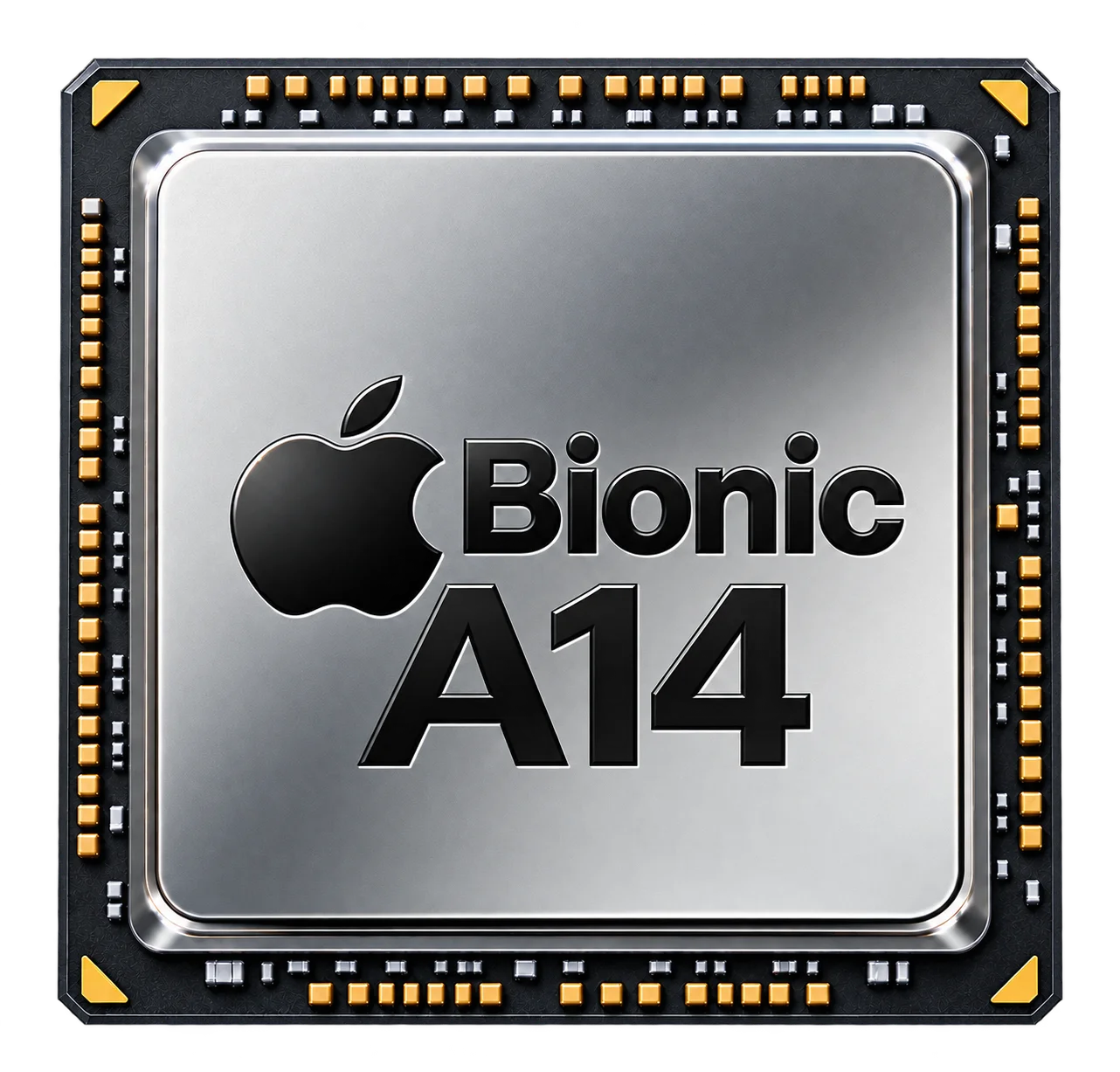
Apple A14 Bionic
Apple's 6-core flagship chipset, announced in September 2020 and manufactured on a 5nm process, with Firestorm and Icestorm CPU cores and an Apple A14 GPU.
Benchmarks
Benchmark results and sub-scores are taken from the supplied A14 Bionic dataset.
Overall AnTuTu score covering CPU, GPU, memory and UX performance.
Single-core and multi-core CPU performance with detailed workload results.
GPU compute performance using the Metal API.
3D graphics results from Solar Bay and Wild Life Extreme.
NanoReview Performance Ratings
Composite ratings out of 100 from the supplied dataset.
CPU & AI Performance
4× Icestorm up to 1.80 GHz
Graphics, Memory & Storage
Multimedia (Camera & ISP)
Connectivity
General Info
information About Apple A14
Introduction
The A14 Bionic vs Snapdragon 8 Gen 2 vs Dimensity 9200 comparison combines Apple’s 2020 flagship processor with Qualcomm and MediaTek Android flagship chipsets released in 2022.
Apple A14 Bionic launched in September 2020 using TSMC’s 5nm process. It features six custom CPU cores and an integrated Apple GPU. Snapdragon 8 Gen 2 arrived in November 2022 with a Cortex-X3 CPU and Adreno 740 graphics. MediaTek Dimensity 9200 launched in November 2022 with a Cortex-X3 CPU and Mali-G715 Immortalis MP11 GPU. Both Android processors use TSMC’s 4nm manufacturing process.
NanoReview rates Snapdragon 8 Gen 2 at 63 overall, while A14 Bionic and Dimensity 9200 each score 62. Their category results tell a more nuanced story: A14 Bionic remains highly competitive in CPU benchmarks, Dimensity 9200 is strongest in NanoReview’s gaming rating, and Snapdragon 8 Gen 2 has a broad range of modern flagship features.
Quick Answer
The Snapdragon 8 Gen 2 is the overall winner according to NanoReview, scoring 63 compared with 62 for Apple A14 Bionic and MediaTek Dimensity 9200. A14 Bionic leads CPU performance and battery ratings, Dimensity 9200 leads gaming, and Snapdragon 8 Gen 2 offers strong CPU performance, advanced video recording, Wi-Fi 7 and up to 24GB RAM. The best choice depends on the workload and smartphone platform.
Specification Comparison
| Specification | Apple A14 Bionic | Snapdragon 8 Gen 2 | Dimensity 9200 |
|---|---|---|---|
| Market class | Flagship | Flagship | Flagship |
| Announcement | September 2020 | November 2022 | November 2022 |
| Manufacturing | TSMC | TSMC | TSMC |
| Process | 5nm | 4nm | 4nm |
| CPU cores | 6 | 8 | 8 |
| Prime CPU core | Firestorm, 3.1GHz | Cortex-X3, 3.2GHz | Cortex-X3, 3.05GHz |
| Other CPU cores | 4× Icestorm, 1.8GHz | 2× A715 + 2× A710, 2.8GHz; 3× A510, 2.0GHz | 3× A715, 2.85GHz; 4× A510, 1.8GHz |
| L2 cache | 8MB | Not listed | Not listed |
| L3 cache | Not listed | 8MB | 8MB |
| GPU | Apple A14 GPU | Adreno 740 | Mali-G715 Immortalis MP11 |
| GPU frequency | 1278MHz | 680MHz | 981MHz |
| Theoretical GPU performance | 654.3 GFLOPS | 2089 GFLOPS | 2762.5 GFLOPS |
| AI hardware | Apple Neural Engine | Qualcomm Hexagon | MediaTek APU 690 |
| Listed NPU performance | 11 TOPS | Not listed | Not listed |
| Memory | LPDDR4X | LPDDR5X | LPDDR5X |
| Memory frequency | 2133MHz | 4200MHz | 4266MHz |
| Maximum bandwidth | 34.1GB/s | 67.2GB/s | 68.2GB/s |
| Maximum RAM | 6GB | 24GB | 24GB |
| Storage | NVMe | UFS 3.1/UFS 4.0 | UFS 3.1/UFS 4.0 |
| Maximum display resolution | 2732×2048 | 3840×2160 | 2960×1440 |
| Maximum camera resolution | Not listed | 200MP | 320MP |
| Video recording | 4K60 | 8K30, 4K120 | 8K30, 4K60 |
| Maximum 5G download | 7.5Gbps | 10Gbps | 7.9Gbps |
| Maximum 5G upload | 2.5Gbps | 3.5Gbps | 4.2Gbps |
| Wi-Fi | Wi-Fi 6 | Wi-Fi 7 | Wi-Fi 7 |
| Bluetooth | 5.0 | 5.3 | 5.3 |
Source: NanoReview’s individual processor pages. Missing values indicate that the relevant page does not list an equivalent specification.
CPU Architecture and Performance
A14 Bionic leads NanoReview’s CPU performance rating, despite having fewer cores and an older manufacturing process.
A14 Bionic uses two custom Apple Firestorm performance cores at 3.1GHz and four Icestorm efficiency cores at 1.8GHz. The six-core design is paired with an 8MB L2 cache and ARMv8.5-A instruction set. Its custom architecture differs fundamentally from the standard Cortex-X/A designs used by the two Android processors.
Snapdragon 8 Gen 2 combines one Cortex-X3 prime core at 3.2GHz, two Cortex-A715 cores at 2.8GHz, two Cortex-A710 cores at 2.8GHz and three Cortex-A510 efficiency cores at 2.0GHz. The eight-core design supports modern Android applications and demanding multithreaded workloads.
Dimensity 9200 also has eight cores: one Cortex-X3 at 3.05GHz, three Cortex-A715 cores at 2.85GHz and four Cortex-A510 cores at 1.8GHz. It has an 8MB L3 cache and supports ARMv9-A.
NanoReview rates CPU performance at 66 for A14 Bionic, 64 for Snapdragon 8 Gen 2 and 58 for Dimensity 9200. This demonstrates that custom CPU architecture and software optimization can help an older processor remain competitive in CPU tests.
GPU and Gaming Performance
Dimensity 9200 has the highest NanoReview gaming rating, while Snapdragon 8 Gen 2 and Dimensity 9200 provide substantially higher theoretical GPU compute figures than A14 Bionic.
A14 Bionic integrates Apple’s custom GPU, listed at 1278MHz and 654.3 GFLOPS. Snapdragon 8 Gen 2 uses Adreno 740 graphics with a theoretical performance of 2089 GFLOPS. Dimensity 9200 integrates Mali-G715 Immortalis MP11 at 981MHz, listed at 2762.5 GFLOPS.
NanoReview’s gaming ratings are:
| Processor | Gaming Score |
|---|---|
| A14 Bionic | 40 |
| Snapdragon 8 Gen 2 | 43 |
| Dimensity 9200 | 47 |
Dimensity 9200 is the clear winner under this particular gaming rating. Snapdragon 8 Gen 2 follows closely, while A14 Bionic’s score reflects its older graphics platform and different software ecosystem.
Theoretical FLOPS should not be mistaken for guaranteed gaming performance. GPU architecture, graphics APIs, drivers, game optimization and thermal management affect frame rates. Apple also benefits from a tightly integrated hardware and iOS ecosystem, which can help optimize games even when its theoretical GPU throughput is lower.
Manufacturing and Battery Efficiency
A14 Bionic leads NanoReview’s battery rating with 92 points, narrowly ahead of Snapdragon 8 Gen 2 and Dimensity 9200 at 91 each.
A14 Bionic uses TSMC’s 5nm process. Both Android rivals use TSMC’s 4nm process. NanoReview assigns battery scores of 92 to A14 Bionic and 91 to each Android chipset.
The A14’s higher rating shows that manufacturing node alone does not determine efficiency. CPU design, power management, software, display characteristics and sustained workload all influence power consumption.
The difference is only one point in NanoReview’s rating. It should not be interpreted as proof that every iPhone using A14 Bionic will last longer than every Android phone using either rival. Battery capacity, battery age and device-level optimization also matter.
RAM, Memory and Storage
Dimensity 9200 has the highest listed memory bandwidth, while Snapdragon 8 Gen 2 and Dimensity 9200 support much larger maximum RAM capacities than A14 Bionic.
A14 Bionic uses LPDDR4X memory at 2133MHz, with a maximum bandwidth of 34.1GB/s and a listed maximum memory size of 6GB. Its storage uses NVMe.
Snapdragon 8 Gen 2 supports LPDDR5X at 4200MHz, with 67.2GB/s bandwidth and up to 24GB RAM. Dimensity 9200 uses LPDDR5X at 4266MHz and reaches 68.2GB/s, also with up to 24GB RAM. Both list UFS 3.1 and UFS 4.0 support.
This gives both Android processors a substantial advantage in maximum memory bandwidth and capacity. However, A14 Bionic’s memory specification is designed around Apple’s integrated hardware and software, so capacity and bandwidth alone cannot be used to infer the speed of every application.
AI and NPU
A14 Bionic has a listed 11 TOPS Neural Engine, while Snapdragon 8 Gen 2 and Dimensity 9200 use dedicated AI accelerators without equivalent TOPS figures on NanoReview.
Apple’s A14 Neural Engine is listed at 11 TOPS. Snapdragon 8 Gen 2 uses Qualcomm’s Hexagon AI hardware, while Dimensity 9200 incorporates the MediaTek APU 690.
Because the source does not provide directly comparable TOPS figures for all three processors, a reliable numerical AI ranking cannot be established from these pages alone. Real-world AI performance also depends on model support, precision, application optimization and software-framework integration.
Camera, ISP and Video
Snapdragon 8 Gen 2 offers the strongest listed video-recording capability, while Dimensity 9200 supports the highest maximum camera resolution.
A14 Bionic is listed with 4K60 video recording. Snapdragon 8 Gen 2 supports video at 8K30 and 4K120, making it the strongest option for maximum capture capability in this comparison. Dimensity 9200 supports 8K30 and 4K60.
Dimensity 9200 supports cameras up to 320MP, compared with 200MP for Snapdragon 8 Gen 2. NanoReview does not list an equivalent maximum sensor resolution for A14 Bionic.
These figures describe chipset capabilities rather than the actual quality of phone cameras. Sensors, lenses, optical stabilization, ISP processing and software tuning play significant roles in final photos and videos.
Display and Connectivity
Snapdragon 8 Gen 2 has the highest listed 5G download speed, while Dimensity 9200 has the highest listed upload speed.
Snapdragon 8 Gen 2 supports displays up to 3840×2160 and offers listed peak 5G speeds of 10Gbps download and 3.5Gbps upload. Dimensity 9200 lists a maximum display resolution of 2960×1440, 7.9Gbps download and 4.2Gbps upload.
A14 Bionic supports displays up to 2732×2048 and lists 5G download speeds up to 7.5Gbps and upload speeds up to 2.5Gbps. It supports Wi-Fi 6 and Bluetooth 5.0, while both Android chips support Wi-Fi 7 and Bluetooth 5.3
These are theoretical maximum capabilities. Actual cellular performance depends on carrier networks, coverage, modem implementation and phone antennas.
Benchmark Comparison
Snapdragon 8 Gen 2 leads AnTuTu 11, A14 Bionic leads Geekbench CPU testing, and Dimensity 9200 leads NanoReview’s gaming rating.
| Benchmark or Rating | A14 Bionic | Snapdragon 8 Gen 2 | Dimensity 9200 |
|---|---|---|---|
| NanoReview overall score | 62 | 63 | 62 |
| CPU score | 66 | 64 | 58 |
| Gaming score | 40 | 43 | 47 |
| Battery score | 92 | 91 | 91 |
| AnTuTu 11 | 1,326,975 | 1,757,044 | 1,755,232 |
| Geekbench 6 single-core | 2,095 | 2,004 | 1,745 |
| Geekbench 6 multi-core | 5,297 | 5,311 | 4,351 |
| Geekbench GPU Compute | 16,822* | 9,254* | 9,909* |
| 3DMark Solar Bay | 2,767 | 5,312 | 5,571 |
| 3DMark Wild Life Extreme | 2,229 | 3,667 | 3,565 |
| 3DMark Steel Nomad Light | Not listed | 1,092 | 1,351 |
Source: NanoReview’s current individual and comparison pages. GPU Compute results use different APIs across platforms and should not be treated as a direct cross-platform ranking. (A14 Bionic vs Snapdragon 8 Gen 2, A14 Bionic vs Dimensity 9200)
AnTuTu results from Android and iOS are not directly comparable, as NanoReview itself notes. The AnTuTu difference therefore should not be used alone to conclude how much faster one chipset feels in daily use.
Geekbench tells a different story: A14 Bionic scores highest in single-core performance, while Snapdragon 8 Gen 2 narrowly leads multi-core performance. Dimensity 9200’s results place it behind the two in Geekbench CPU, despite its higher gaming rating.
The sample sizes also differ. NanoReview lists 132 Geekbench CPU tests for Snapdragon 8 Gen 2, 22 for A14 Bionic and only three for Dimensity 9200. Its Dimensity 9200 results should therefore be interpreted cautiously.
Real-World Performance
Snapdragon 8 Gen 2 is the strongest overall Android platform here, A14 Bionic remains competitive in CPU-intensive tasks, and Dimensity 9200 is especially compelling for gaming.
A14 Bionic remains impressive for an older chip because of its single-core performance and integration with iOS. It can deliver responsive performance in supported applications, though software support, battery health and device age matter for an actual phone.
Snapdragon 8 Gen 2 combines strong CPU performance with advanced video recording, high memory bandwidth and Wi-Fi 7. It is the most balanced option in NanoReview’s overall ranking.
Dimensity 9200 has the strongest gaming rating and theoretical GPU throughput. Its camera-resolution support, graphics capability and high memory bandwidth make it a strong alternative, although its reported CPU benchmarks are lower than those of the other two.
Strengths and Weaknesses
Apple A14 Bionic
Strengths
- Highest CPU rating in this comparison.
- Highest Geekbench 6 single-core result.
- Highest NanoReview battery score.
- Neural Engine rated at 11 TOPS.
- NVMe storage.
- Strong integration with Apple’s software ecosystem.
Weaknesses
- Older 5nm manufacturing process.
- Lower listed memory bandwidth.
- Maximum RAM listed at 6GB.
- No 8K video recording support.
- Wi-Fi 6 and Bluetooth 5.0.
Snapdragon 8 Gen 2
Strengths
- Highest overall NanoReview score.
- Strong CPU and gaming ratings.
- 8K30 and 4K120 video recording.
- Up to 24GB RAM and UFS 4.0 support.
- 10Gbps listed peak 5G download.
- Wi-Fi 7.
Weaknesses
- Battery score slightly below A14 Bionic.
- Lower theoretical GPU FLOPS than Dimensity 9200.
- Bluetooth 5.3 rather than newer Bluetooth versions.
Dimensity 9200
Strengths
- Highest NanoReview gaming rating.
- Highest theoretical GPU FLOPS figure.
- Up to 320MP camera support.
- 8K30 video recording.
- 68.2GB/s memory bandwidth.
- Highest listed 5G upload speed.
- Wi-Fi 7.
Weaknesses
- Lowest CPU score.
- Lower Geekbench CPU results.
- Lower maximum listed display resolution than Snapdragon 8 Gen 2.
- NanoReview’s Geekbench sample is limited.
Best Processor for Different Users
| Use Case | Best Choice | Reason |
|---|---|---|
| Overall NanoReview score | Snapdragon 8 Gen 2 | Highest overall rating |
| CPU rating | A14 Bionic | Highest CPU score |
| Gaming | Dimensity 9200 | Highest gaming rating |
| Battery rating | A14 Bionic | Score of 92 |
| AnTuTu 11 | Snapdragon 8 Gen 2 | Highest listed Android result |
| Geekbench single-core | A14 Bionic | Highest result |
| Geekbench multi-core | Snapdragon 8 Gen 2 | Highest result |
| Video recording | Snapdragon 8 Gen 2 | 8K30 and 4K120 |
| Camera resolution capability | Dimensity 9200 | Up to 320MP |
| 5G download | Snapdragon 8 Gen 2 | Up to 10Gbps |
| 5G upload | Dimensity 9200 | Up to 4.2Gbps |
| Wireless standards | Snapdragon 8 Gen 2 / Dimensity 9200 | Wi-Fi 7 |
Final Verdict and Ranking
Snapdragon 8 Gen 2 ranks first overall, while A14 Bionic and Dimensity 9200 tie for second in NanoReview’s overall score.
#1 Snapdragon 8 Gen 2
The Snapdragon 8 Gen 2 wins overall with a NanoReview score of 63. Its balanced CPU and gaming performance, 8K30 and 4K120 video support, high memory bandwidth and Wi-Fi 7 make it the strongest overall package in this comparison. It is the most suitable choice for users seeking a powerful Android flagship platform.
#2 Apple A14 Bionic and Dimensity 9200 — Tie
Both chips score 62, but their strengths are different. A14 Bionic leads CPU performance and battery ratings, and it remains competitive in Geekbench single-core testing despite its age. Dimensity 9200 leads gaming performance and supports higher maximum camera resolution, faster listed memory bandwidth and modern Android flagship connectivity.
Neither is the universal winner. A14 Bionic is particularly strong in CPU responsiveness and Apple’s software ecosystem, while Dimensity 9200 is better suited to graphics-intensive Android workloads.
Winner Summary
| Category | Winner |
|---|---|
| Overall | Snapdragon 8 Gen 2 |
| CPU rating | A14 Bionic |
| Gaming rating | Dimensity 9200 |
| Battery rating | A14 Bionic |
| AnTuTu 11 | Snapdragon 8 Gen 2, Android result |
| Geekbench single-core | A14 Bionic |
| Geekbench multi-core | Snapdragon 8 Gen 2 |
| GPU Compute | A14 Bionic on Metal, but not directly comparable |
| Video recording | Snapdragon 8 Gen 2 |
| Camera resolution capability | Dimensity 9200 |
| 5G download | Snapdragon 8 Gen 2 |
| 5G upload | Dimensity 9200 |
| Wireless standards | Snapdragon 8 Gen 2 / Dimensity 9200 |
Final Ranking
- Qualcomm Snapdragon 8 Gen 2 — 63
- Apple A14 Bionic — 62
- MediaTek Dimensity 9200 — 62
The central takeaway is that Snapdragon 8 Gen 2 provides the best overall feature and performance balance, A14 Bionic remains strong in CPU responsiveness and NanoReview’s battery rating, and Dimensity 9200 is the strongest gaming-oriented choice by NanoReview’s rating. Cross-platform AnTuTu and GPU Compute results should be interpreted carefully, and a smartphone’s cooling, software, battery condition and camera implementation can substantially affect real-world results.
Sources: NanoReview pages for Apple A14 Bionic, Snapdragon 8 Gen 2, and Dimensity 9200. Data checked October 10, 2026.
Images Of Apple A14
Trailer Of Apple A14

Author & Post Info
Faisal Ur Rehman
Faisal Rehman is the founder and editor of FSL Specs, where he publishes in-depth smartphone specifications, comparisons, buying guides, and technology insights. With extensive experience in mobile hardware research and technical analysis, he provides accurate and up-to-date information on Android smartphones, processors, displays, cameras, batteries, performance benchmarks, and software features. His goal is to simplify complex specifications and help readers choose the right device with confidence.
Explore FSL Specs
Questions About Apple A14
What are the main specifications of the Apple A14 Bionic chip?
The A14 Bionic is a 5nm chip with a 6-core CPU, 4-core GPU, 16-core Neural Engine, and 11.8 billion transistors. It was the first commercially available smartphone chip made on TSMC’s 5nm process, improving both speed and power efficiency.
How fast is the Apple A14 Bionic processor?
It uses two Firestorm performance cores at up to 3.1 GHz and four Icestorm efficiency cores at about 1.8 GHz. Apple says its CPU is up to 40% faster than the A12 Bionic, while its GPU is up to 30% faster
Is the A14 Bionic good for gaming?
Yes, its 4-core GPU handles most popular mobile games smoothly, including many graphics-heavy titles at medium to high settings. It supports Metal, but it does not have hardware-accelerated ray tracing, which arrived with the A17 Pro.
How powerful is the A14 Bionic Neural Engine?
The 16-core Neural Engine can perform up to 11 trillion operations per second (11 TOPS). It helps with Face ID, Night mode, Deep Fusion, Siri, Live Text, and other on-device machine-learning tasks
Which Apple devices use the A14 Bionic chip?
The A14 Bionic powers the iPhone 12 mini, iPhone 12, iPhone 12 Pro, iPhone 12 Pro Max, iPad Air (4th generation), and iPad (10th generation). iPhone 12 Pro models pair it with 6GB of RAM, while standard iPhone 12 models use 4GB.
Does the A14 Bionic support 5G, Wi-Fi 6, and Dolby Vision video?
Yes, it supports 5G sub-6 GHz and mmWave, Gigabit LTE, Wi-Fi 6, Bluetooth 5.0, and Ultra Wideband. It also enables Dolby Vision HDR video recording, with 4K recording available at up to 60fps