

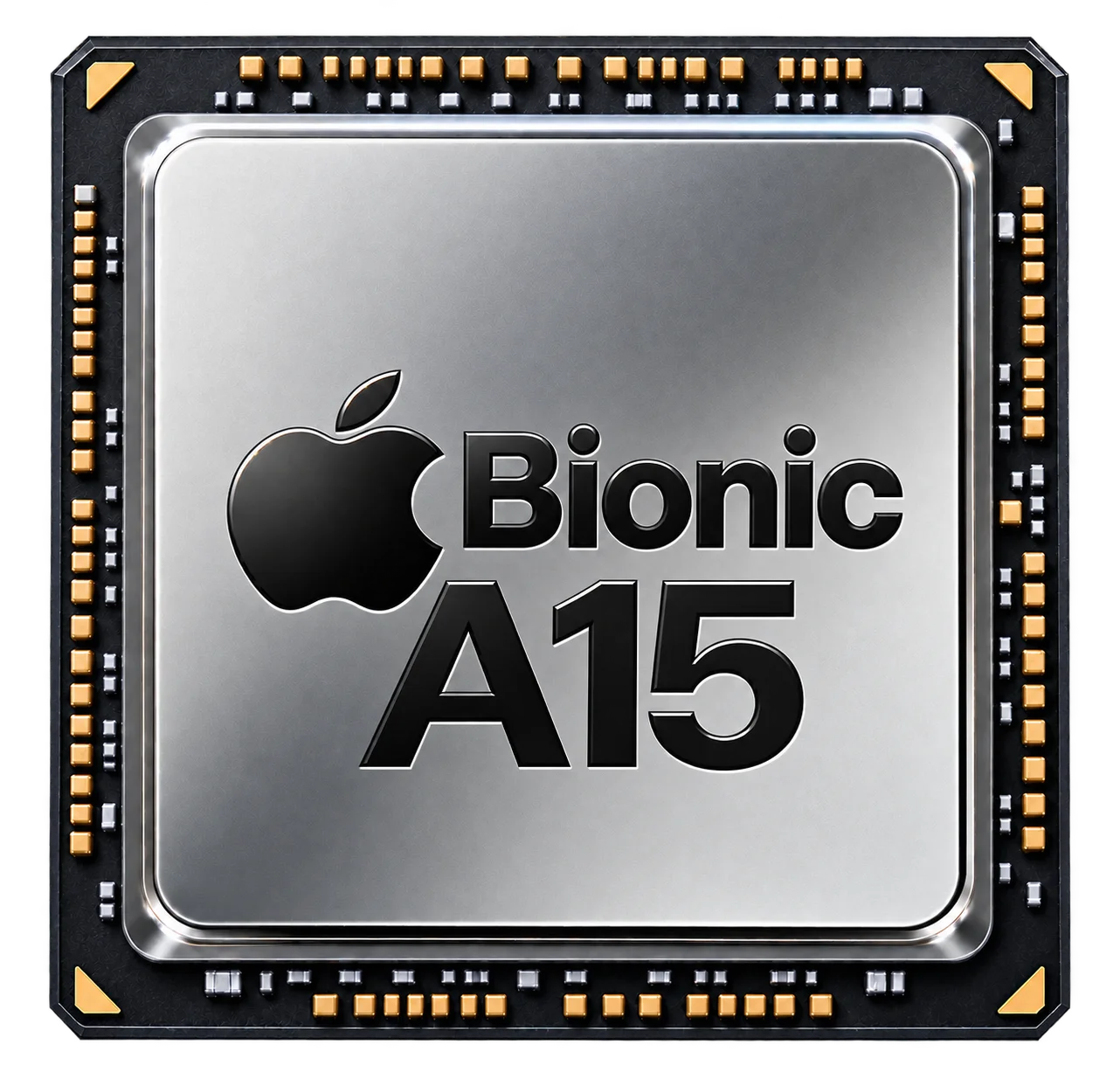
Apple A15 Bionic
Apple's 6-core flagship chipset, announced in September 2021 and manufactured using a 5-nanometer process, with Avalanche and Blizzard CPU cores and an Apple A15 GPU.
Benchmarks
Benchmark results and sub-scores are taken from the supplied A15 Bionic dataset.
Overall AnTuTu score covering CPU, GPU, memory and UX performance.
Single-core and multi-core CPU performance with detailed workload results.
GPU compute performance using the Metal API.
3D graphics results from the Solar Bay test.
NanoReview Performance Ratings
Composite ratings out of 100 from the supplied dataset.
CPU & AI Performance
4× Blizzard up to 2.02 GHz
Graphics, Memory & Storage
Multimedia (Camera & ISP)
Connectivity
General Info
information About Apple A15
Introduction
The A15 Bionic vs Dimensity 8450 vs A16 Bionic comparison brings together two Apple processors and a modern MediaTek chipset. The A15 Bionic launched in September 2021, the A16 Bionic in September 2022, and Dimensity 8450 in May 2025. Despite being newer, Dimensity 8450 does not lead NanoReview’s overall score.
According to NanoReview’s A15 Bionic page, Dimensity 8450 page and A16 Bionic page, their overall ratings are 67, 67 and 75, respectively.
A16 Bionic combines Apple’s custom CPU architecture with a 4nm process, while A15 uses a 5nm process. Dimensity 8450 uses TSMC’s 4nm process and eight Cortex-A725 cores. The result is a comparison between Apple’s tightly integrated mobile platforms and MediaTek’s newer, memory-rich Android chipset.
Quick Answer
The Apple A16 Bionic is the best overall processor in this comparison, scoring 75 on NanoReview. The A15 Bionic and MediaTek Dimensity 8450 both score 67, but they have different strengths: A15 leads CPU performance among those two, while Dimensity 8450 offers stronger gaming ratings, higher memory bandwidth and support for up to 24GB RAM. A16 leads all three in CPU, gaming and battery ratings.
Specification Comparison
| Specification | Apple A15 Bionic | Dimensity 8450 | Apple A16 Bionic |
|---|---|---|---|
| Class | Flagship | Mid-range | Flagship |
| Announcement | September 2021 | May 2025 | September 2022 |
| Manufacturing | TSMC | TSMC | TSMC |
| Process | 5nm | 4nm | 4nm |
| CPU cores | 6 | 8 | 6 |
| CPU architecture | 2× Avalanche + 4× Blizzard | 8× Cortex-A725 | 2× Everest + 4× Sawtooth |
| Maximum CPU clock | 3.23GHz | 3.25GHz | 3.46GHz |
| L2 cache | 12MB | 1MB | 16MB |
| L3 cache | Not listed | 6MB | Not listed |
| GPU | Apple A15 GPU | Mali-G720 MP7 | Apple A16 GPU |
| GPU frequency | 1338MHz | 1300MHz | 1398MHz |
| Theoretical GPU performance | 1712.6 GFLOPS | 2329.6 GFLOPS | 1789.4 GFLOPS |
| AI hardware | Apple Neural Engine | MediaTek NPU 880 | Apple Neural Engine |
| NPU performance | 15.8 TOPS | Not listed | 17 TOPS |
| Memory | LPDDR4X | LPDDR5X | LPDDR5 |
| Memory frequency | 2133MHz | 4266MHz | 3200MHz |
| Maximum bandwidth | 34.1GB/s | 68.2GB/s | 51.2GB/s |
| Maximum RAM | 6GB | 24GB | 6GB |
| Storage | NVMe | UFS 4.0 | NVMe |
| Maximum display resolution | 2732×2048 | 2960×1440 | 2796×1290 |
| Maximum camera resolution | Not listed | 320MP | 48MP |
| Video recording | 4K60 | 4K60 | 4K60 |
| Maximum 5G download | 7.5Gbps | 5.17Gbps | 7.5Gbps |
| Wi-Fi | Wi-Fi 6 | Wi-Fi 6 | Wi-Fi 6 |
| Bluetooth | 5.0 | 6.0 | 5.3 |
Source: NanoReview’s individual specification pages. Missing values indicate that NanoReview does not list an equivalent figure.
CPU Architecture and Performance
A16 Bionic has the strongest CPU performance, followed by A15 Bionic and then Dimensity 8450.
A15 Bionic uses two custom Avalanche performance cores running at 3.23GHz and four Blizzard efficiency cores at 2.02GHz. Its six-core CPU is paired with a large 12MB L2 cache. Apple designed this architecture around its own hardware and software ecosystem rather than using standard Cortex-X and Cortex-A CPU cores.
A16 Bionic improves the design with two Everest performance cores clocked at 3.46GHz and four Sawtooth efficiency cores at 2.02GHz. Its listed L2 cache increases to 16MB, and its manufacturing process moves to 4nm. These changes contribute to its higher CPU rating.
Dimensity 8450 uses eight Cortex-A725 cores: one at 3.25GHz, three at 3.0GHz and four at 2.1GHz. Unlike Apple’s processors, it uses the same core family across all eight CPU cores. The design is aimed at delivering consistent multi-core performance in performance-oriented mid-range smartphones.
NanoReview’s CPU scores are 72 for A15 Bionic, 66 for Dimensity 8450 and 81 for A16 Bionic. The A16’s higher-frequency custom cores and larger cache give it the strongest overall CPU position.
GPU and Gaming Performance
A16 Bionic leads NanoReview’s gaming rating, while Dimensity 8450 has the highest theoretical GPU FLOPS figure.
A15 Bionic uses Apple’s integrated GPU, listed at 1712.6 GFLOPS. A16 Bionic improves the theoretical figure to 1789.4 GFLOPS. Dimensity 8450 uses Mali-G720 MP7 graphics at 1300MHz, with 2329.6 GFLOPS listed by NanoReview.
Their gaming scores are:
| Processor | Gaming Score |
|---|---|
| A15 Bionic | 48 |
| Dimensity 8450 | 50 |
| A16 Bionic | 56 |
The A16 leads NanoReview’s gaming rating, but Dimensity 8450’s higher theoretical FLOPS figure shows why raw compute throughput cannot be interpreted as a direct gaming ranking. GPU architecture, drivers, graphics APIs, game optimization and sustained cooling all affect performance.
NanoReview’s 3DMark Solar Bay results also show Dimensity 8450 scoring 6549, compared with 4266 for A16 Bionic and 3765 for A15 Bionic. These results suggest strong graphics throughput for Dimensity 8450 in that workload, but cross-platform benchmark results and sample sizes should be interpreted cautiously. Apple’s GPU and software integration can produce different results in other applications.
Manufacturing and Battery Efficiency
A16 Bionic has the highest battery score at 95, followed by A15 Bionic at 92 and Dimensity 8450 at 91.
A15 Bionic is manufactured on TSMC’s 5nm process, while A16 Bionic and Dimensity 8450 use 4nm TSMC manufacturing. NanoReview gives the three processors battery scores of 92, 91 and 95, respectively.
A16’s higher rating indicates the strongest efficiency score in this comparison. However, a chipset score is not a guaranteed measure of phone runtime. Battery capacity, screen size, display refresh rate, mobile reception and software optimization all influence endurance.
RAM, Memory and Storage
Dimensity 8450 leads memory bandwidth and maximum RAM capacity, while both Apple processors use NVMe storage.
A15 Bionic supports LPDDR4X memory at 2133MHz, with a maximum listed bandwidth of 34.1GB/s and up to 6GB RAM. A16 Bionic upgrades to LPDDR5 at 3200MHz, providing 51.2GB/s bandwidth and up to 6GB RAM. Both list NVMe storage.
Dimensity 8450 supports LPDDR5X at 4266MHz, with 68.2GB/s maximum bandwidth and up to 24GB RAM. It uses UFS 4.0 storage. This provides a substantial specification advantage for memory-heavy Android workloads and multitasking.
The figures should be interpreted in context. iOS manages memory differently from Android, and memory capacity by itself does not determine the speed of every app. Nonetheless, Dimensity 8450 has the highest listed memory bandwidth and maximum RAM capacity.
AI and NPU
A16 Bionic has the highest published Apple Neural Engine rating, while Dimensity 8450 includes a dedicated NPU without a comparable TOPS value listed.
NanoReview lists A15 Bionic’s Apple Neural Engine at 15.8 TOPS and A16 Bionic’s at 17 TOPS. Dimensity 8450 includes the MediaTek NPU 880, but NanoReview does not publish an equivalent TOPS figure on the cited page.
A16 therefore leads among the available numerical specifications. Still, TOPS figures alone cannot establish a universal AI-performance ranking: model support, precision, software integration and memory access also determine how well a processor handles AI workloads.
Camera, ISP and Video
All three processors list 4K60 video recording, while Dimensity 8450 supports the highest stated maximum camera resolution.
NanoReview lists both A15 Bionic and A16 Bionic with 4K60 video capture. Dimensity 8450 also supports 4K60 and lists support for camera configurations up to 320MP. A16 Bionic’s page lists a maximum camera resolution of 48MP, while the A15 page does not give an equivalent maximum figure.
These are chipset-level capabilities, not direct measurements of image quality. Camera sensors, optics, stabilization, image signal processing and manufacturer software affect the final result.
Display and Connectivity
Dimensity 8450 offers the highest listed cellular speed is not universal, but A16 Bionic has the highest maximum listed 5G download speed tie with A15 Bionic.
A15 Bionic and A16 Bionic both list peak 5G download speeds of 7.5Gbps. Dimensity 8450 lists up to 5.17Gbps. For upload, NanoReview lists up to 3.0Gbps on A15, 3.5Gbps on A16, and does not list an equivalent maximum for Dimensity 8450.
Dimensity 8450 supports Wi-Fi 6 and Bluetooth 6.0, while the Apple chips list Wi-Fi 6 and Bluetooth 5.0 on A15 and 5.3 on A16. Its display capability is listed up to 2960×1440, compared with 2732×2048 for A15 and 2796×1290 for A16. These are maximum supported resolutions, not necessarily the actual screens used in every device.
Benchmark Comparison
A16 Bionic leads overall NanoReview ratings and Geekbench CPU performance, while Dimensity 8450 leads the listed AnTuTu 11 result.
| Benchmark or Rating | A15 Bionic | Dimensity 8450 | A16 Bionic |
|---|---|---|---|
| NanoReview overall score | 67 | 67 | 75 |
| CPU score | 72 | 66 | 81 |
| Gaming score | 48 | 50 | 56 |
| Battery score | 92 | 91 | 95 |
| AnTuTu 11 | 1,413,275 | 2,016,572 | 1,626,008 |
| Geekbench 6 single-core | 2,315 | 1,612 | 2,631 |
| Geekbench 6 multi-core | 5,753 | 6,210 | 6,602 |
| Geekbench GPU Compute | 20,400* | 12,321* | 22,851* |
| 3DMark Solar Bay | 3,765 | 6,549 | 4,266 |
| 3DMark Wild Life Extreme | 2,854 | Not listed | 3,335 |
| 3DMark Steel Nomad Light | Not listed | 1,467 | Not listed |
GPU Compute results use Metal for Apple processors and Vulkan for Dimensity 8450, so they are not directly comparable across these APIs. Source: NanoReview’s individual processor and comparison pages.
The results demonstrate why the overall winner is not necessarily the winner of every benchmark. A16 Bionic has the highest NanoReview score, CPU rating and Geekbench results. Dimensity 8450 records the highest AnTuTu 11 and Solar Bay results, but NanoReview cautions that AnTuTu scores from iOS and Android are not directly comparable.
Real-World Performance
A16 Bionic is the strongest balanced performer, A15 Bionic remains competitive in CPU responsiveness, and Dimensity 8450 offers higher memory capacity and promising graphics results.
For demanding CPU tasks, A16 Bionic has the strongest overall position. Its 16-billion-transistor design, 4nm process, 16MB L2 cache and faster Everest cores make it a meaningful upgrade over A15.
A15 Bionic still has a high CPU score and strong single-core performance. For supported iPhones, actual responsiveness also depends on software support, battery health and device condition.
Dimensity 8450 is attractive for modern Android phones. It offers eight Cortex-A725 cores, LPDDR5X memory, 68.2GB/s bandwidth, support for up to 24GB RAM and UFS 4.0 storage. Its high AnTuTu and Solar Bay results suggest strong throughput in those workloads, although its NanoReview CPU and gaming scores remain below A16 Bionic’s ratings.
Strengths and Weaknesses
Apple A15 Bionic
Strengths
- CPU score of 72.
- Strong Geekbench single-core performance.
- Battery score of 92.
- Apple Neural Engine rated at 15.8 TOPS.
- NVMe storage.
- Strong integration with Apple’s software platform.
Weaknesses
- Older 5nm manufacturing process.
- LPDDR4X memory and 34.1GB/s bandwidth.
- Maximum RAM listed at 6GB.
- No listed 8K capture capability.
MediaTek Dimensity 8450
Strengths
- 68.2GB/s memory bandwidth.
- Up to 24GB RAM.
- UFS 4.0 storage.
- High AnTuTu 11 and Solar Bay scores.
- 320MP maximum camera capability.
- Bluetooth 6.0.
Weaknesses
- Lower CPU score than both Apple chips.
- Battery score of 91.
- Lower overall NanoReview score than A16 Bionic.
- 4K60 maximum listed video recording.
Apple A16 Bionic
Strengths
- Highest overall, CPU, gaming and battery scores.
- Highest Geekbench single-core and multi-core results.
- 4nm manufacturing.
- Apple Neural Engine rated at 17 TOPS.
- 51.2GB/s memory bandwidth.
- Strong iOS hardware-software integration.
Weaknesses
- Maximum RAM listed at 6GB.
- Lower memory bandwidth than Dimensity 8450.
- NVMe storage, with no UFS 4.0 option listed.
- 4K60 maximum listed video capture.
Best Processor for Different Users
| Use Case | Best Choice | Reason |
|---|---|---|
| Overall performance | A16 Bionic | Highest NanoReview score |
| CPU performance | A16 Bionic | Highest CPU rating |
| Gaming rating | A16 Bionic | Score of 56 |
| Battery efficiency rating | A16 Bionic | Score of 95 |
| AnTuTu 11 | Dimensity 8450 | Highest listed result, with cross-platform caveat |
| Geekbench single-core | A16 Bionic | Highest score |
| Geekbench multi-core | A16 Bionic | Highest score |
| Memory bandwidth | Dimensity 8450 | 68.2GB/s |
| Maximum RAM | Dimensity 8450 | Up to 24GB |
| AI TOPS specification | A16 Bionic | 17 TOPS listed |
| Camera resolution capability | Dimensity 8450 | Up to 320MP |
| Bluetooth version | Dimensity 8450 | Bluetooth 6.0 |
Final Verdict and Ranking
Apple A16 Bionic ranks first, while A15 Bionic and Dimensity 8450 tie for second according to NanoReview’s overall scores.
#1 Apple A16 Bionic
The A16 Bionic is the clear winner with a score of 75. It leads CPU performance, gaming and battery ratings, and records the strongest Geekbench results. The move to a 4nm process, a 16MB L2 cache and faster custom CPU cores make it Apple’s strongest option in this comparison.
#2 Apple A15 Bionic and MediaTek Dimensity 8450 — Tie
Both processors score 67 overall, but their advantages differ. A15 Bionic leads the CPU rating and single-core Geekbench results, while Dimensity 8450 offers stronger listed memory bandwidth, higher maximum RAM capacity and higher AnTuTu 11 and Solar Bay results. Because AnTuTu results from iOS and Android are not directly comparable, the Android lead should not be treated as proof of universally faster performance.
Winner Summary
| Category | Winner |
|---|---|
| Overall | A16 Bionic |
| CPU rating | A16 Bionic |
| Gaming rating | A16 Bionic |
| Battery rating | A16 Bionic |
| AnTuTu 11 | Dimensity 8450, with cross-platform caveat |
| Geekbench single-core | A16 Bionic |
| Geekbench multi-core | A16 Bionic |
| Memory bandwidth | Dimensity 8450 |
| Maximum RAM | Dimensity 8450 |
| AI TOPS specification | A16 Bionic |
| Camera resolution capability | Dimensity 8450 |
| Bluetooth | Dimensity 8450 |
Final Ranking
- Apple A16 Bionic — 75
- Apple A15 Bionic — 67
- MediaTek Dimensity 8450 — 67
The central conclusion is that A16 Bionic is the strongest overall and most balanced processor in this comparison. A15 Bionic remains competitive in CPU performance despite its age, while Dimensity 8450 is attractive for Android users who need higher memory bandwidth, more RAM capacity and modern storage support. The best real-world choice still depends on device cooling, operating-system support, battery condition and price.
Sources: NanoReview pages for A15 Bionic, Dimensity 8450, and A16 Bionic. Data checked October 10, 2026.
Images Of Apple A15
Trailer Of Apple A15

Author & Post Info
Faisal Ur Rehman
Faisal Rehman is the founder and editor of FSL Specs, where he publishes in-depth smartphone specifications, comparisons, buying guides, and technology insights. With extensive experience in mobile hardware research and technical analysis, he provides accurate and up-to-date information on Android smartphones, processors, displays, cameras, batteries, performance benchmarks, and software features. His goal is to simplify complex specifications and help readers choose the right device with confidence.
Explore FSL Specs
Questions About Apple A15
What are the main specifications of the Apple A15 Bionic chip?
The A15 Bionic is a 5nm chip with a 6-core CPU, up to a 5-core GPU, 16-core Neural Engine, and 15 billion transistors. It includes a next-generation image signal processor and 32MB of system cache for faster app and camera performance
How fast is the Apple A15 Bionic processor?
It has two performance cores at up to 3.23 GHz and four efficiency cores at about 2.01 GHz. Apple says its CPU is up to 50% faster than competing smartphones at launch, while the 5-core GPU is up to 50% faster than the leading competition
Is the A15 Bionic good for gaming?
Yes, the 5-core GPU version is excellent for mobile gaming, AR apps, and high-frame-rate graphics. However, the iPhone 13 and 13 mini use a 4-core GPU version, so Pro models offer slightly better sustained gaming performance.
How powerful is the A15 Bionic Neural Engine?
Its 16-core Neural Engine delivers 15.8 trillion operations per second (15.8 TOPS). It powers Face ID, Live Text, Cinematic mode, photo analysis, Siri, and other on-device machine-learning features.
Which devices use the Apple A15 Bionic chip?
The A15 Bionic is used in the iPhone 13 series, iPhone SE (3rd generation), iPhone 14 and 14 Plus, iPad mini (6th generation), and Apple TV 4K (3rd generation). The GPU core count varies by device
Does the A15 Bionic support 5G, Wi-Fi 6, and ProRes video?
Yes, it supports 5G sub-6 GHz and mmWave, Gigabit LTE, Wi-Fi 6, Bluetooth 5.0, and Ultra Wideband. ProRes recording is available on iPhone 13 Pro models, with 4K Dolby Vision recording up to 60fps.