
Dimensity 8450
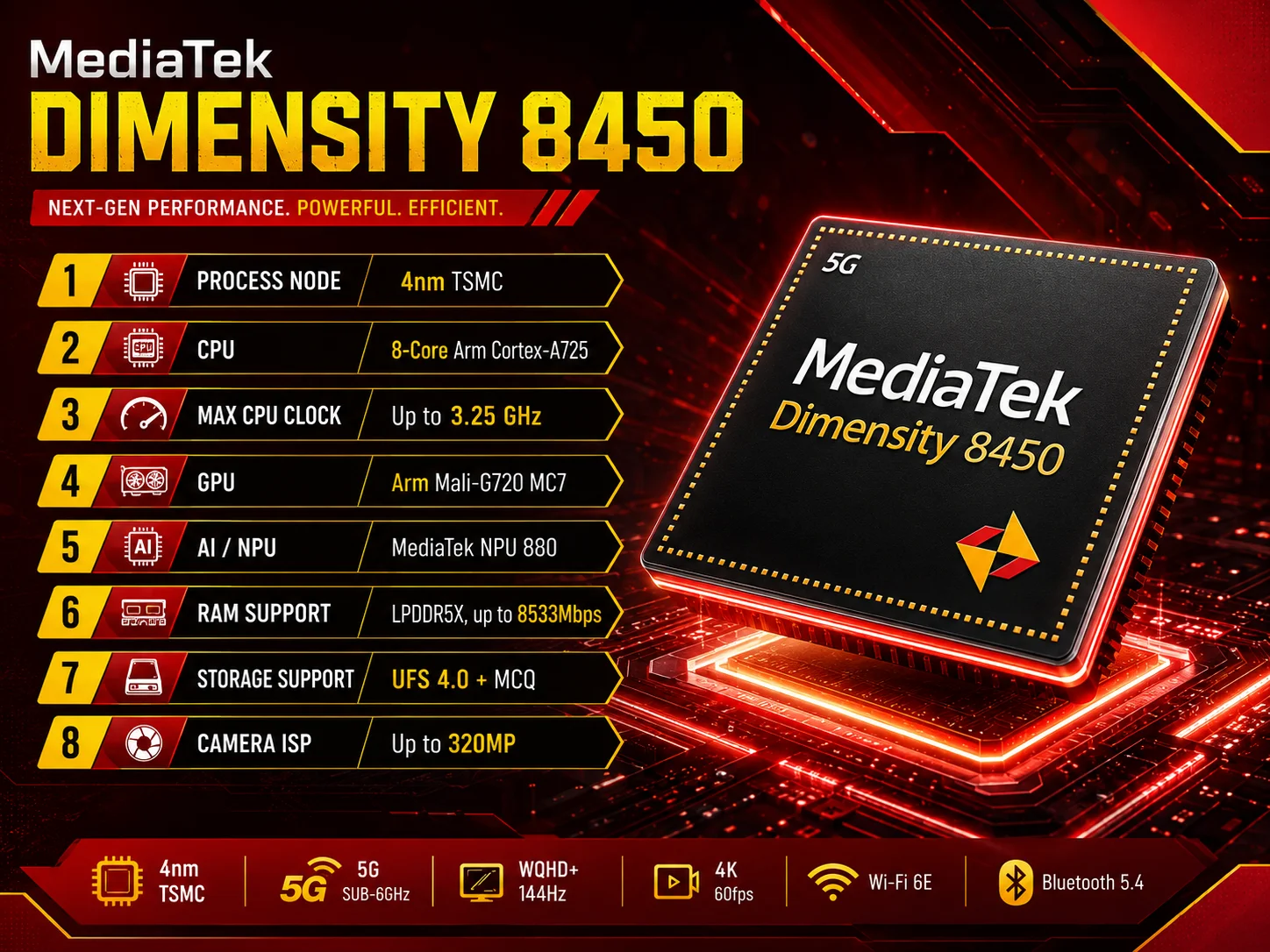
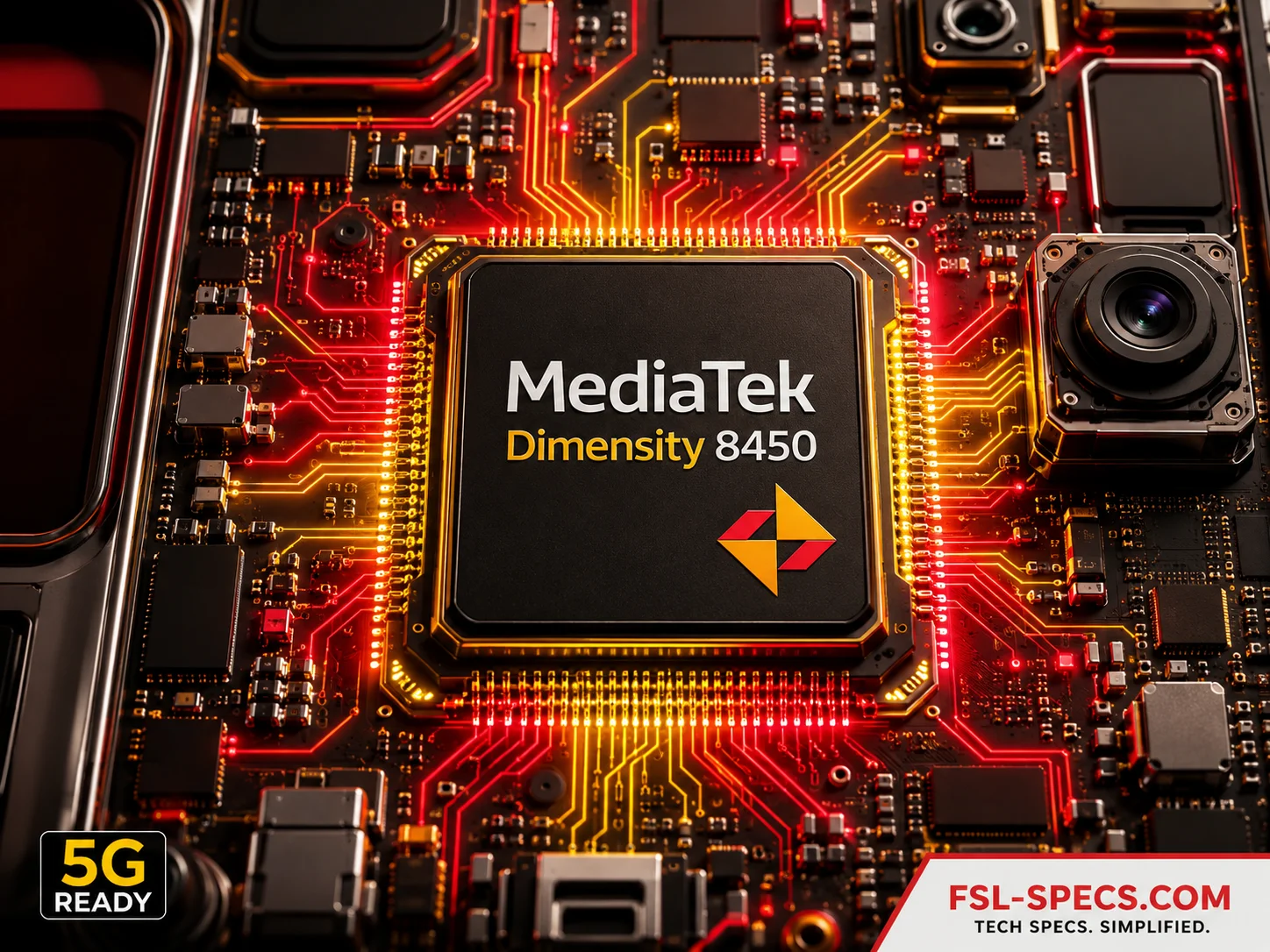
The MediaTek Dimensity 8450 is an upper mid‑range 5G chipset built on a 4nm process, using 1× Cortex‑A725 up to 3.25GHz, 3× Cortex‑A725 up to 3GHz, and 4× Cortex‑A725 up to 2.1GHz, paired with a Mali‑G720 MC7 GPU. With LPDDR5X memory, UFS 4.0 storage, the MediaTek NPU 880 for on-device AI, Wi‑Fi 6, and Bluetooth 6.0, it delivers strong performance for its class.
Benchmark Scores
Measures CPU, GPU, RAM, and I/O performance in different scenarios.
Shows raw single-threaded CPU performance across real-world workloads. Only category scores are published for this chipset — no overall headline total.
Cross-platform benchmark assessing graphics performance in Vulkan/Metal.
Evaluates overall system performance in everyday workloads. Only category scores are published for this chipset — no overall headline total.
CPU & AI Performance
3× Cortex‑A725 up to 3GHz
4× Cortex‑A725 up to 2.1GHz
Graphics, Memory & Storage
Multimedia (Camera, Display & ISP)
Connectivity
General Info
information About MediaTek Dimensity 8450
Introduction
Comparing a modern Android upper-mid-range chip against an older iPhone flagship processor raises an unusual question: does newer silicon always win? This Dimensity 8450 vs Dimensity 8500 vs Apple A15 Bionic comparison uses verified NanoReview specification and benchmark data to explain how these three chips perform in CPU work, gaming, AI, camera processing, and connectivity, and where each one actually has the edge.
1. Processor Overview
The Dimensity 8450, announced May 2025, is an 8-core chip built on TSMC’s 4nm process using an unusual all-performance-core layout: 1x Cortex-A725 at 3.25GHz, 3x Cortex-A725 at 3.0GHz, and 4x Cortex-A725 at 2.1GHz, with no dedicated efficiency cores, paired with a Mali-G720 MP7 GPU.
The Dimensity 8500, announced January 2026, shares the same core architecture and layout as the Dimensity 8450 but runs every tier faster: 1x Cortex-A725 at 3.4GHz, 3x at 3.2GHz, and 4x at 2.2GHz, with a larger Mali-G720 MP8 GPU.
The Apple A15 Bionic, the oldest chip here by several years (announced September 2021), uses a 6-core layout on TSMC’s older 5nm process: 2x Avalanche performance cores at 3.23GHz and 4x Blizzard efficiency cores at 2.02GHz, paired with Apple’s own 5-core GPU.
Despite its age, the A15 Bionic remains a relevant comparison point because it still ships in current-generation budget iPhones, putting it in direct competition with newer Android silicon like the Dimensity 8450 and 8500.
2. CPU Architecture & Processing Power
The Dimensity 8450 and Dimensity 8500 both use ARMv9.2-A Cortex-A725 cores in an all-performance-core configuration, with 1MB L2 and 6MB L3 cache. The A15 Bionic uses the older ARMv8.5-A instruction set with Apple’s custom Avalanche/Blizzard cores and 12MB of L2 cache; no L3 figure is disclosed for it.
In Geekbench 6 single-core, the A15 Bionic actually leads with 2315, about 30.4% higher than the Dimensity 8450 (1612) and roughly 32.9% higher than the Dimensity 8500 (1555). Apple’s custom core design continues to outperform newer ARM reference cores in single-threaded work even years after launch.
Multi-core tells a different story. The Dimensity 8500 leads with 6405, followed closely by the Dimensity 8450 at 6210 (about 3.1% lower), both ahead of the A15 Bionic’s 5753. The Dimensity 8450 leads the A15 Bionic here by about 7.9%. The two MediaTek chips’ 8-core all-performance layout gives them a real multi-threaded advantage despite losing badly in single-core.
For app launching and UI responsiveness, the A15 Bionic should feel notably snappier; for sustained multi-threaded work, the Dimensity chips pull ahead.
3. GPU & Gaming Performance
The Dimensity 8500’s Mali-G720 MP8 is the largest GPU of the three, with 8 pipelines, 1024 total shaders, and 3088.4 Gigaflops. The Dimensity 8450’s Mali-G720 MP7 follows with 7 pipelines, 896 shaders, and 2329.6 Gigaflops. The A15 Bionic’s 5-pipeline GPU is smallest on paper, at 640 shaders and 1712.6 Gigaflops.
Geekbench 6 GPU Compute tells a more complex story: the A15 Bionic actually leads at 20400, about 65.6% higher than the Dimensity 8500 (13461) and 65.6% higher than the Dimensity 8450 (12321) as well, despite its smaller GPU on paper. This suggests Apple’s GPU architecture converts its hardware into compute performance more efficiently in this specific test. The Dimensity 8500 leads the Dimensity 8450 by about 9.3% in this benchmark.
3DMark results use different sub-tests across the three chips, making some comparisons impossible. Where tests overlap: in 3DMark Solar Bay, the Dimensity 8450 scores 6549 versus the A15 Bionic’s 3765, a 74.0% lead for the Dimensity 8450. In 3DMark Wild Life Extreme, the Dimensity 8500 scores 4058 versus the A15 Bionic’s 2854, a 42.2% lead for the Dimensity 8500. No Wild Life Extreme score is supplied for the Dimensity 8450, and no Solar Bay score is supplied for the Dimensity 8500, so those specific comparisons cannot be made.
Overall, GPU performance is mixed depending on which benchmark is examined; no single chip dominates every graphics test. No exact frame-rate data is supplied beyond what these benchmarks report, so specific in-game FPS claims cannot be made.
4. Manufacturing Process & Efficiency
The Dimensity 8450 and Dimensity 8500 are both built on TSMC’s 4nm process, while the A15 Bionic uses an older 5nm node. A smaller node does not automatically guarantee better efficiency, and the disclosed TDP figures support that caution here: the Dimensity 8500 has the lowest TDP at 6W, tied with the A15 Bionic also at 6W, while the Dimensity 8450 runs highest at 7W despite sharing the same node as the 8500.
NanoReview’s battery-life sub-scores are close across all three: the A15 Bionic scores highest at 92, followed by the Dimensity 8450 and Dimensity 8500, both at 91. The differences here are minor and suggest all three chips are reasonably well optimized for sustained battery life relative to their performance class.
5. RAM, Memory & Storage Support
The Dimensity 8450 and Dimensity 8500 both use LPDDR5X memory, with the 8500 running at a higher frequency (4800MHz versus 4266MHz) and correspondingly higher bandwidth (76.8Gb/s versus 68.2Gb/s). Both support up to 24GB RAM. The A15 Bionic uses the older LPDDR4X standard at just 2133MHz, with far lower bandwidth (34.1Gb/s) and a maximum of only 6GB RAM, a direct consequence of its 2021 launch window.
Storage support also favors the newer chips: the Dimensity 8500 supports both UFS 4.0 and UFS 4.1, the Dimensity 8450 supports UFS 4.0 only, and the A15 Bionic uses Apple’s proprietary NVMe storage interface, which is not directly comparable to the UFS standards used on the MediaTek chips.
6. AI & NPU Capabilities
AI hardware disclosure is uneven. The A15 Bionic is the only chip with a supplied TOPS figure, at 15.8 TOPS via its Apple Neural Engine. Both the Dimensity 8450 and Dimensity 8500 use a named MediaTek NPU 880, but no TOPS figure is supplied for either, so a direct numeric AI comparison with the MediaTek chips cannot be made.
Because only one chip has a disclosed TOPS rating, no overall AI performance ranking can be established from the supplied data. All three are confirmed to include dedicated NPU hardware for tasks like image processing and on-device computation.
7. ISP, Camera & Video Capabilities
The Dimensity 8450 and Dimensity 8500 both support a maximum camera configuration of 1x 320MP plus 3x 32MP, considerably higher on paper than any figure disclosed for the A15 Bionic, which has no maximum camera resolution supplied in the data.
Video capability is identical across all three: 4K at 60FPS capture and playback. Codec support differs slightly, with the A15 Bionic adding Motion JPEG support alongside H.264, H.265, VP8, and VP9, while both Dimensity chips support H.264, H.265, AV1, and VP9, notably including AV1 decode, which the A15 Bionic’s supplied codec list does not include.
8. Display Support
The Dimensity 8450 and Dimensity 8500 both support a maximum display resolution of 2960 x 1440. The A15 Bionic supports a different maximum of 2732 x 2048, reflecting its use in iPhone panels with a different aspect ratio rather than a directly higher or lower resolution ceiling.
9. Modem, 5G & Connectivity
The Dimensity 8450 and Dimensity 8500 both support a theoretical 5G download speed of up to 5170 Mbps; no upload speed figure is supplied for either. The A15 Bionic discloses both figures, with a 5G download speed of up to 7500 Mbps and upload of up to 3000 Mbps, giving it the highest disclosed download ceiling of the three despite being the oldest chip.
Wi-Fi 6 is common to all three. Bluetooth clearly favors the newer MediaTek chips, both supporting Bluetooth 6.0, versus the A15 Bionic’s much older Bluetooth 5.0. GNSS support is broadest on the two Dimensity chips, which add NAVIC support alongside GPS, GLONASS, Beidou, Galileo, and QZSS; the A15 Bionic’s supplied list omits NAVIC. These are theoretical maximums; real-world network speeds depend on carrier infrastructure and will not always reach these ceilings.
10. Benchmark Comparison
All benchmark figures below use AnTuTu 11 and Geekbench 6 where available, so comparisons are apples-to-apples.
AnTuTu 11 Total:
- Dimensity 8500: 2,120,347
- Dimensity 8450: 2,016,572 (about 4.9% lower than the Dimensity 8500)
- Apple A15 Bionic: 1,413,275 (Dimensity 8450 leads by about 42.7%)
Geekbench 6 Single-Core: Apple A15 Bionic leads clearly with 2315, ahead of the Dimensity 8450 (1612, about 30.4% lower) and Dimensity 8500 (1555, about 32.9% lower).
Geekbench 6 Multi-Core: Dimensity 8500 leads with 6405, followed by the Dimensity 8450 (6210, about 3.1% lower) and Apple A15 Bionic (5753, about 10.2% lower than the Dimensity 8500).
Geekbench 6 GPU Compute: Apple A15 Bionic leads clearly at 20400, well ahead of the Dimensity 8500 (13461, about 34.0% lower) and Dimensity 8450 (12321, about 39.6% lower).
3DMark: Different sub-tests are supplied per chip. In Solar Bay, the Dimensity 8450 (6549) leads the A15 Bionic (3765) by about 74.0%. In Wild Life Extreme, the Dimensity 8500 (4058) leads the A15 Bionic (2854) by about 42.2%. No direct 3DMark comparison exists between the two Dimensity chips since they report different sub-tests.
PCMark 3.0: Only disclosed for the Dimensity 8450, at 17957. Not supplied for the Dimensity 8500 or A15 Bionic, so no comparison can be made in this category.
The overall picture is mixed: the Dimensity 8500 wins the composite AnTuTu score and multi-core, the A15 Bionic wins single-core and Geekbench GPU Compute by wide margins, and 3DMark results favor whichever Dimensity chip is being compared, depending on the sub-test available.
11. Real-World Performance
Everyday users browsing and using apps will likely notice the A15 Bionic’s single-core speed advantage in snappier day-to-day responsiveness, despite its older hardware.
Multitaskers benefit more from either Dimensity chip’s 8-core multi-threaded advantage, with the Dimensity 8500 offering the strongest multi-core throughput of the three.
Gamers face a mixed picture: the A15 Bionic’s Geekbench GPU Compute lead is substantial, but the Dimensity chips win their respective 3DMark comparisons, so no single chip is clearly the strongest across every gaming-relevant test supplied.
Content creators get identical 4K/60FPS video ceilings across all three, with the two Dimensity chips adding AV1 codec support the A15 Bionic’s supplied list does not include.
AI users cannot be meaningfully ranked here, since only the A15 Bionic has a disclosed TOPS figure (15.8), with no comparable number for either MediaTek chip.
Camera users benefit from the Dimensity chips’ higher disclosed maximum camera resolution (320MP plus 3x 32MP) versus no disclosed figure for the A15 Bionic.
Connectivity-focused users get the highest disclosed 5G download ceiling from the A15 Bionic, along with its uniquely disclosed upload speed figure.
12. Strengths & Weaknesses
MediaTek Dimensity 8450
- Strengths: Leads 3DMark Solar Bay by a wide margin; highest disclosed camera configuration tied with the Dimensity 8500; only chip with a disclosed PCMark score (17957); newest Bluetooth version tied with the Dimensity 8500 (6.0).
- Weaknesses: Trails the A15 Bionic by roughly 30% in Geekbench single-core and about 40% in GPU Compute; highest TDP of the three (7W); no disclosed NPU TOPS figure.
MediaTek Dimensity 8500
- Strengths: Highest AnTuTu 11 total score (2,120,347); leads Geekbench multi-core; leads 3DMark Wild Life Extreme by a wide margin; lowest TDP tied with the A15 Bionic (6W).
- Weaknesses: Lowest Geekbench single-core score of the three; trails the A15 Bionic by roughly 34% in GPU Compute; no disclosed NPU TOPS figure or PCMark score.
Apple A15 Bionic
- Strengths: Highest Geekbench single-core score by a wide margin; highest Geekbench GPU Compute score by a wide margin; only chip with disclosed 5G upload speed and NPU TOPS figure (15.8); highest NanoReview battery-life sub-score (92).
- Weaknesses: Lowest AnTuTu 11 total score, roughly 43% behind the Dimensity 8450; lowest max RAM support (6GB) and oldest memory standard (LPDDR4X); oldest Bluetooth version (5.0); no disclosed camera resolution.
13. Best Processor For Different Users
- Best for Gaming: Mixed; Apple A15 Bionic for GPU Compute, MediaTek chips for their respective 3DMark sub-tests
- Best for AI: Apple A15 Bionic (only chip with disclosed TOPS)
- Best for Efficiency: Apple A15 Bionic (tied with Dimensity 8500 on TDP, highest battery-life score)
- Best for Camera Processing: MediaTek Dimensity 8450 and Dimensity 8500 (tied)
- Best for Connectivity: Apple A15 Bionic
- Best for Balanced Performance: MediaTek Dimensity 8500
Final Verdict
This Dimensity 8450 vs Dimensity 8500 vs Apple A15 Bionic comparison shows no single chip winning every category, and the supplied data does not support automatically favoring the Primary Processor, the Dimensity 8450, which trails its own newer sibling in several benchmarks.
Final Verdict
1. MediaTek Dimensity 8500 — Best Overall It posts the highest AnTuTu 11 total score and leads Geekbench multi-core and 3DMark Wild Life Extreme, giving it the strongest composite result, even though it loses clearly to the A15 Bionic in single-core and GPU Compute.
2. Apple A15 Bionic — Best For Single-Core Speed and AI It leads Geekbench single-core and GPU Compute by wide margins and is the only chip with disclosed NPU TOPS and 5G upload speed figures, but it trails badly in AnTuTu total score and offers far less RAM headroom than either Dimensity chip.
3. MediaTek Dimensity 8450 — Best For 3DMark Solar Bay and PCMark It leads its specific 3DMark sub-test and is the only chip with a disclosed PCMark score, but it is outperformed by its own successor, the Dimensity 8500, in AnTuTu, multi-core, GPU Compute, and TDP efficiency.
Best for Gaming: Mixed between Apple A15 Bionic and the MediaTek Dimensity chips depending on the test Best for AI: Apple A15 Bionic Best for Efficiency: Apple A15 Bionic Best Balanced Choice: MediaTek Dimensity 8500
Bottom Line: The Dimensity 8500 is the strongest all-round pick based on its AnTuTu and multi-core lead, but the Apple A15 Bionic remains genuinely competitive years after launch, particularly in single-core speed and GPU compute efficiency, and it is the only chip here with disclosed AI TOPS and full 5G speed figures. The Dimensity 8450 is the weakest of the three overall, since its own successor beats it in most categories that matter for day-to-day use.
Images Of MediaTek Dimensity 8450
Trailer Of MediaTek Dimensity 8450

Author & Post Info
Faisal Ur Rehman
Faisal Rehman is the founder and editor of FSL Specs, where he publishes in-depth smartphone specifications, comparisons, buying guides, and technology insights. With extensive experience in mobile hardware research and technical analysis, he provides accurate and up-to-date information on Android smartphones, processors, displays, cameras, batteries, performance benchmarks, and software features. His goal is to simplify complex specifications and help readers choose the right device with confidence.
Explore FSL Specs
Questions About MediaTek Dimensity 8450
What is the MediaTek Dimensity 8450?
The MediaTek Dimensity 8450 is a premium 5G smartphone processor designed for strong performance, gaming, AI features, and efficient power consumption. It is aimed at powerful mid-range and upper-mid-range smartphones.
How powerful is the Dimensity 8450?
The Dimensity 8450 features an 8-core Arm Cortex-A725 CPU with a maximum clock speed of up to 3.25GHz. Its all-big-core design provides strong performance for multitasking, demanding apps, and intensive workloads.
Does Dimensity 8450 support 5G?
Yes, the Dimensity 8450 includes 5G connectivity with advanced modem features. This makes it suitable for fast mobile networks in markets such as Pakistan, India, and other Asian regions.
Does Dimensity 8450 support 5G?
Yes, the Dimensity 8450 includes 5G connectivity with advanced modem features. This makes it suitable for fast mobile networks in markets such as Pakistan, India, and other Asian regions.
How much RAM and storage does Dimensity 8450 support?
It supports LPDDR5X RAM up to 8533Mbps and UFS 4.0 storage with MCQ. This combination helps deliver faster app loading, smoother multitasking, and quicker file transfers.
What camera does Dimensity 8450 support?
The Dimensity 8450 supports camera sensors of up to 320MP and includes the MediaTek NPU 880 for AI-assisted imaging. Actual camera quality depends on the sensor, ISP tuning, and software used by the smartphone manufacturer.
What video recording does Dimensity 8450 support?
The Dimensity 8450 supports 4K video recording at up to 60fps with advanced image and video processing. The exact recording modes can vary depending on the smartphone manufacturer's implementation.