
Dimensity 8550
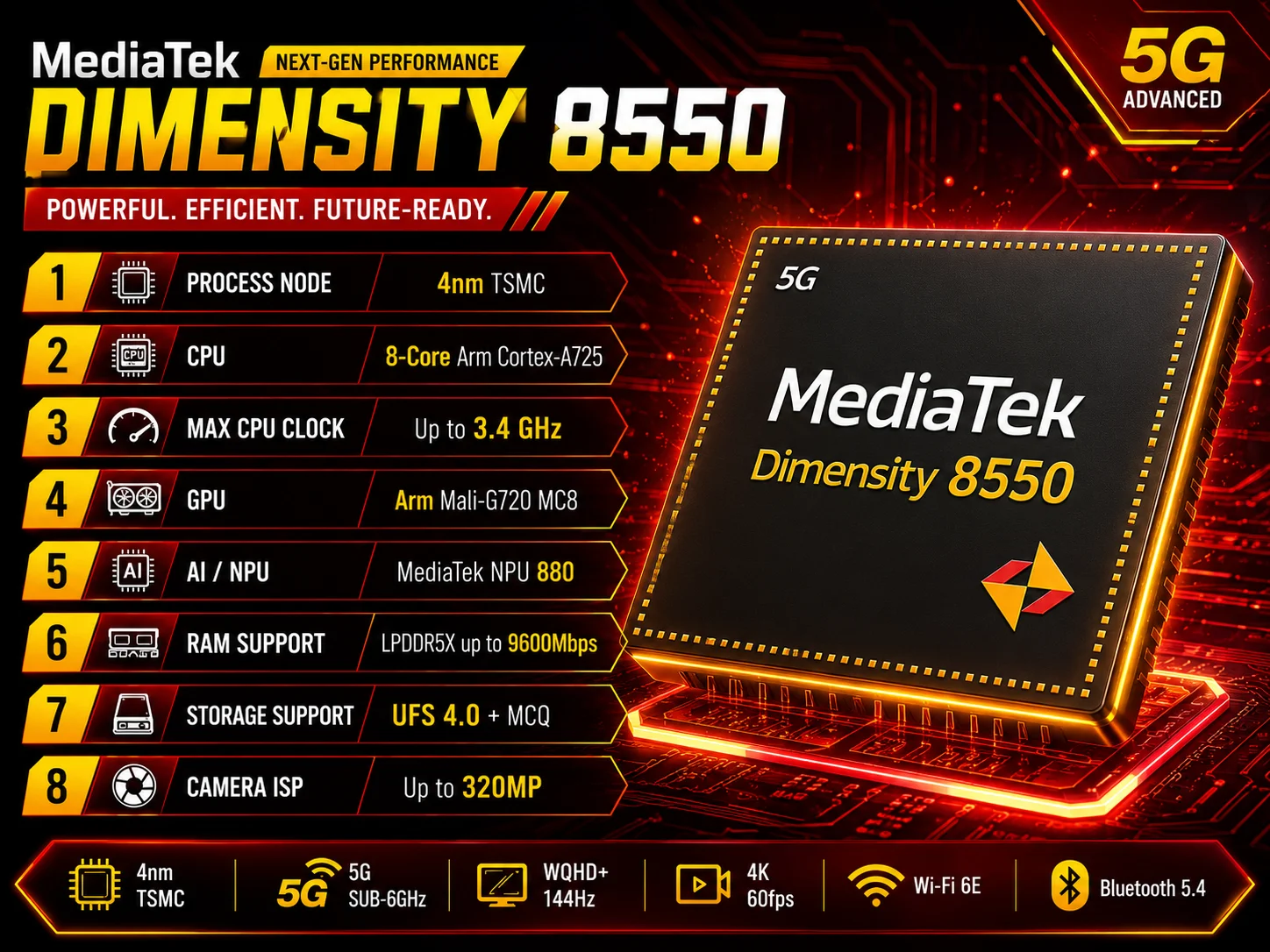
The MediaTek Dimensity 8550 is an upper mid‑range 5G chipset built on a 4nm process, using 1× Cortex‑A725 up to 3.4GHz, 3× Cortex‑A725 up to 3.2GHz, and 4× Cortex‑A725 up to 2.2GHz, paired with a Mali‑G720 MP8 GPU. With LPDDR5X memory, UFS 4.0/4.1 storage, the MediaTek NPU 880 for on-device AI, Wi‑Fi 6, and Bluetooth 6.0, it delivers strong performance for its class.
Benchmark Scores
Measures CPU, GPU, RAM, and I/O performance in different scenarios.
Shows raw single-threaded CPU performance across real-world workloads.
CPU & AI Performance
3× Cortex‑A725 up to 3.2GHz
4× Cortex‑A725 up to 2.2GHz
Graphics, Memory & Storage
Multimedia (Camera, Display & ISP)
Connectivity
General Info
information About MediaTek Dimensity 8550
Introduction
Choosing between a brand-new upper-mid-range MediaTek chip and two established Qualcomm flagship-class processors is not as simple as picking the newest silicon. This Dimensity 8550 vs Snapdragon 8s Gen 4 vs Snapdragon 8 Gen 3 comparison uses verified NanoReview specification and benchmark data to explain how each chip performs in CPU work, gaming, camera processing, and connectivity, and which one actually delivers the strongest overall package.
1. Processor Overview
The Dimensity 8550, announced May 2026, is an 8-core chip built on TSMC’s 4nm process using an all-performance-core layout: 1x Cortex-A725 at 3.4GHz, 3x Cortex-A725 at 3.2GHz, and 4x Cortex-A725 at 2.2GHz, with no dedicated efficiency cores, paired with a Mali-G720 MP8 GPU.
The Snapdragon 8s Gen 4, announced April 2025 and also on TSMC’s 4nm process, uses a four-tier Cortex layout: 1x Cortex-X4 at 3.21GHz, 3x Cortex-A720 at 3.0GHz, 2x Cortex-A720 at 2.8GHz, and 2x Cortex-A720 at 2.02GHz, paired with an Adreno 825 GPU.
The Snapdragon 8 Gen 3, the oldest of the three (announced October 2023) and also on TSMC 4nm, uses a similar four-tier layout: 1x Cortex-X4 at 3.3GHz, 3x Cortex-A720 at 3.15GHz, 2x Cortex-A720 at 2.96GHz, and 2x Cortex-A520 efficiency cores at 2.27GHz, paired with the larger Adreno 750 GPU.
Notably, the Dimensity 8550 is the only chip of the three with no dedicated efficiency cores, using eight identical performance-class cores instead, while both Snapdragon chips reserve at least two cores for lighter background tasks.
2. CPU Architecture & Processing Power
All three chips use ARMv9.2-A. The Dimensity 8550 uses Cortex-A725 cores throughout, while both Snapdragon chips use a Cortex-X4 prime core paired with Cortex-A720 performance cores; the Snapdragon 8 Gen 3 additionally uses Cortex-A520 efficiency cores, which the Snapdragon 8s Gen 4 and Dimensity 8550 both lack.
In Geekbench 6 single-core, the Snapdragon 8 Gen 3 leads clearly with 2203, ahead of the Snapdragon 8s Gen 4 (2072, about 5.9% lower) and the Dimensity 8550 (1558, about 29.3% lower than the Snapdragon 8 Gen 3). Qualcomm’s custom Cortex-X4 prime core clearly outpaces MediaTek’s highest-clocked Cortex-A725 core in single-threaded work.
Multi-core follows a similar pattern. The Snapdragon 8s Gen 4 leads with 6649, followed by the Snapdragon 8 Gen 3 (6511, about 2.1% lower) and the Dimensity 8550 (6283, about 5.5% lower than the Snapdragon 8s Gen 4). Despite its all-performance-core design, the Dimensity 8550 still trails both Snapdragon chips in raw multi-threaded throughput.
3. GPU & Gaming Performance
The Dimensity 8550’s Mali-G720 MP8 has the highest theoretical FLOPS rating on paper at 3088.4 Gigaflops, ahead of the Snapdragon 8 Gen 3’s Adreno 750 (2774 Gigaflops) and the Snapdragon 8s Gen 4’s Adreno 825 (2355.2 Gigaflops, the lowest of the three).
Geekbench 6 GPU Compute tells a different story: the Snapdragon 8s Gen 4 leads at 18498, ahead of the Snapdragon 8 Gen 3 (15378, about 16.9% lower) and the Dimensity 8550 (15146, about 18.1% lower than the Snapdragon 8s Gen 4), which is essentially tied with the Snapdragon 8 Gen 3 despite its higher theoretical Gigaflops figure.
3DMark results are only supplied for the two Snapdragon chips; no 3DMark figures are disclosed for the Dimensity 8550 in the supplied data. Between the two Snapdragon chips, the Snapdragon 8 Gen 3 leads Solar Bay (8190 versus 7641, about 7.2% higher) and Wild Life Extreme (4676 versus 3705, about 26.2% higher), while the Snapdragon 8s Gen 4 leads Steel Nomad Light (1688 versus 1652, about 2.2% higher). Because no 3DMark data exists for the Dimensity 8550, it cannot be directly compared to either rival in this specific benchmark.
For gaming, the theoretical GPU Gigaflops rating favors the Dimensity 8550, but the Geekbench GPU Compute results and the two 3DMark scores that are directly comparable both favor the Snapdragon chips, particularly the Snapdragon 8 Gen 3. No exact frame-rate data is supplied beyond what these benchmarks report, so specific in-game FPS claims cannot be made.
4. Manufacturing Process & Efficiency
All three chips share the same TSMC 4nm process node, so node size is not a differentiator here. TDP figures are only disclosed for two of the three: the Dimensity 8550 has the lowest at 6W, while the Snapdragon 8 Gen 3 is disclosed at 8W. No TDP figure is supplied for the Snapdragon 8s Gen 4.
NanoReview’s battery-life sub-scores are identical across all three at 91, suggesting comparable real-world battery behavior despite the underlying TDP differences. NanoReview’s overall composite score, however, favors the Snapdragon chips: the Snapdragon 8 Gen 3 scores highest at 77, followed by the Snapdragon 8s Gen 4 at 76, and the Dimensity 8550 lowest at 75.
5. RAM, Memory & Storage Support
All three chips use identical LPDDR5X memory at 4800MHz across a 4×16-bit bus, delivering the same 76.8Gb/s maximum bandwidth and the same 24GB maximum RAM support. Memory configuration is effectively a tie across the board.
Storage support differs slightly: the Dimensity 8550 and Snapdragon 8 Gen 3 both support UFS 4.0 and UFS 4.1, while the Snapdragon 8s Gen 4 supports UFS 4.0 only, a minor disadvantage for the Snapdragon 8s Gen 4 in this category.
6. AI & NPU Capabilities
All three chips confirm a dedicated NPU is present: the Dimensity 8550 uses a named MediaTek NPU 880, and both Snapdragon chips use Qualcomm’s Hexagon NPU. No TOPS figure is supplied for any of the three, so no numeric AI performance ranking can be established from the available data.
7. ISP, Camera & Video Capabilities
Camera resolution favors the Dimensity 8550 and Snapdragon 8s Gen 4, both supporting a maximum single sensor resolution of 320MP; the Snapdragon 8 Gen 3 is limited to 200MP. The Dimensity 8550 additionally supports 3x 32MP secondary sensors, a configuration not disclosed for either Snapdragon chip.
Video capability strongly favors the Snapdragon 8 Gen 3, which supports 8K capture at 30FPS and 4K capture at 120FPS, alongside 8K playback at 60FPS and 4K playback at 120FPS, the most complete video specification of the three. The Snapdragon 8s Gen 4 supports 4K capture at 60FPS with 8K and 4K playback at 60FPS. The Dimensity 8550 is limited to 4K at 60FPS for both capture and playback, the lowest video ceiling of the three. Codec support is broadest on the Snapdragon 8 Gen 3, which adds VP8 alongside H.264, H.265, AV1, and VP9; the other two support H.264, H.265, AV1, and VP9 only.
8. Display Support
Both Snapdragon chips support a maximum display resolution of 3840 x 2160, higher than the Dimensity 8550’s 2960 x 1440 ceiling. This gives both Snapdragon chips more headroom for very high-resolution display implementations.
9. Modem, 5G & Connectivity
The Snapdragon 8 Gen 3 has the strongest disclosed connectivity profile by a wide margin, with its Snapdragon X75 modem supporting a theoretical 5G download speed of up to 10000 Mbps and upload of 3500 Mbps. The Snapdragon 8s Gen 4, also using the Snapdragon X75 modem, is disclosed at a much lower 4200 Mbps download with no upload figure supplied. The Dimensity 8550 discloses only a 5170 Mbps download figure, also with no upload speed supplied.
Wi-Fi differs meaningfully: both Snapdragon chips support Wi-Fi 7, while the Dimensity 8550 supports the older Wi-Fi 6. Bluetooth favors the newer chips, with the Dimensity 8550 and Snapdragon 8s Gen 4 both at 6.0, ahead of the Snapdragon 8 Gen 3’s 5.4. GNSS support is identical across all three, including NAVIC. These are theoretical maximums; real-world network speeds depend on carrier infrastructure and will not always reach these ceilings.
10. Benchmark Comparison
All benchmark figures below use AnTuTu 11 and Geekbench 6, so comparisons are apples-to-apples where data exists.
AnTuTu 11 Total:
- Dimensity 8550: 2,429,134
- Snapdragon 8 Gen 3: 2,345,563 (Dimensity 8550 leads by about 3.6%)
- Snapdragon 8s Gen 4: 2,314,417 (Dimensity 8550 leads by about 5.0%)
Geekbench 6 Single-Core: Snapdragon 8 Gen 3 leads clearly with 2203, ahead of the Snapdragon 8s Gen 4 (2072, about 5.9% lower) and Dimensity 8550 (1558, about 29.3% lower than the Snapdragon 8 Gen 3).
Geekbench 6 Multi-Core: Snapdragon 8s Gen 4 leads with 6649, followed by the Snapdragon 8 Gen 3 (6511) and Dimensity 8550 (6283, about 5.5% lower than the Snapdragon 8s Gen 4).
Geekbench 6 GPU Compute: Snapdragon 8s Gen 4 leads at 18498, ahead of the Snapdragon 8 Gen 3 (15378, about 16.9% lower) and Dimensity 8550 (15146, about 18.1% lower than the Snapdragon 8s Gen 4).
3DMark: Not disclosed for the Dimensity 8550. Between the two Snapdragon chips, the Snapdragon 8 Gen 3 leads Solar Bay and Wild Life Extreme, while the Snapdragon 8s Gen 4 leads Steel Nomad Light.
PCMark 3.0: Not disclosed for the Dimensity 8550. The Snapdragon 8 Gen 3 leads the Snapdragon 8s Gen 4 (16318 versus 15335, about 6.4% higher).
The overall picture is mixed: the Dimensity 8550 wins the composite AnTuTu score by a modest margin over both rivals, but it loses clearly in single-core, multi-core, and GPU Compute to both Snapdragon chips, and has no disclosed 3DMark or PCMark data at all.
11. Real-World Performance
Everyday users should notice meaningfully snappier responsiveness on either Snapdragon chip given their single-core lead, particularly the Snapdragon 8 Gen 3.
Multitaskers benefit slightly more from the Snapdragon 8s Gen 4’s multi-core lead, though all three chips are within a fairly narrow band in this category.
Gamers get the most complete picture from the Snapdragon 8 Gen 3, which leads two of the three comparable 3DMark tests and has the widest video and codec support; the Dimensity 8550’s lack of disclosed 3DMark data makes a full gaming comparison against it incomplete.
Content creators benefit clearly from the Snapdragon 8 Gen 3’s 8K video capture support, well ahead of the Dimensity 8550’s 4K-only ceiling.
Camera users benefit from the Dimensity 8550’s and Snapdragon 8s Gen 4’s higher 320MP maximum resolution versus the Snapdragon 8 Gen 3’s 200MP limit, though the Dimensity 8550 uniquely adds secondary sensor support.
Connectivity-focused users should lean toward the Snapdragon 8 Gen 3, with the highest disclosed 5G download and upload speeds and Wi-Fi 7 support shared with the Snapdragon 8s Gen 4.
12. Strengths & Weaknesses
MediaTek Dimensity 8550
- Strengths: Highest AnTuTu 11 total score (2,429,134); highest theoretical GPU Gigaflops rating; highest disclosed camera resolution tied with the Snapdragon 8s Gen 4, plus unique secondary sensor support; lowest disclosed TDP (6W).
- Weaknesses: Lowest Geekbench single-core, multi-core, and GPU Compute scores of the three; no disclosed 3DMark or PCMark data; limited to Wi-Fi 6 and 4K/60FPS video, the lowest video ceiling of the three.
Snapdragon 8s Gen 4
- Strengths: Highest Geekbench multi-core and GPU Compute scores; leads 3DMark Steel Nomad Light; Wi-Fi 7 and Bluetooth 6.0 support; matches the Dimensity 8550’s 320MP camera resolution.
- Weaknesses: Lowest AnTuTu 11 total score of the three; lowest disclosed 5G download speed with no upload figure supplied; no disclosed TDP figure; lowest PCMark score between the two chips that report it.
Snapdragon 8 Gen 3
- Strengths: Highest Geekbench single-core score by a wide margin; leads 3DMark Solar Bay and Wild Life Extreme; highest disclosed 5G download and upload speeds; widest video and codec support including 8K capture; highest NanoReview composite score (77).
- Weaknesses: Lowest AnTuTu 11 total score of the three; lowest disclosed camera resolution (200MP); highest disclosed TDP (8W).
13. Best Processor For Different Users
- Best for Gaming: Qualcomm Snapdragon 8 Gen 3
- Best for AI: Not determinable from supplied data
- Best for Efficiency: MediaTek Dimensity 8550 (lowest disclosed TDP)
- Best for Camera Processing: MediaTek Dimensity 8550 and Snapdragon 8s Gen 4 (tied on resolution)
- Best for Connectivity: Qualcomm Snapdragon 8 Gen 3
- Best for Balanced Performance: Qualcomm Snapdragon 8 Gen 3
Final Verdict
This Dimensity 8550 vs Snapdragon 8s Gen 4 vs Snapdragon 8 Gen 3 comparison shows a genuinely split result. The Dimensity 8550, as the Primary Processor, wins the single most commonly cited benchmark, AnTuTu 11, but the supplied data does not support calling it the strongest chip overall.
Final Verdict
1. Qualcomm Snapdragon 8 Gen 3 — Best Overall Despite being the oldest chip here, it leads Geekbench single-core by a wide margin, wins two of three comparable 3DMark tests, has the fastest disclosed 5G speeds, the widest video support, and the highest NanoReview composite score of the three, making it the most complete performer even though it trails in AnTuTu total score.
2. Qualcomm Snapdragon 8s Gen 4 — Best For Multi-Core and GPU Compute It leads Geekbench multi-core and GPU Compute outright and shares the Snapdragon 8 Gen 3’s Wi-Fi 7 support, but its slower disclosed 5G speed and lower AnTuTu score keep it behind its older sibling overall.
3. MediaTek Dimensity 8550 — Best For AnTuTu Score and Camera Resolution It posts the highest AnTuTu 11 total score by a modest 3.6-5.0% margin and matches the best disclosed camera resolution, but it trails clearly in single-core, multi-core, and GPU Compute, and lacks disclosed 3DMark or PCMark data altogether.
Best for Gaming: Qualcomm Snapdragon 8 Gen 3 Best for AI: Not determinable from supplied data Best for Efficiency: MediaTek Dimensity 8550 Best Balanced Choice: Qualcomm Snapdragon 8 Gen 3
Bottom Line: The AnTuTu 11 total score favors the Dimensity 8550, which leads the Snapdragon 8 Gen 3 by roughly 3.6% and the Snapdragon 8s Gen 4 by roughly 5.0%. But AnTuTu is only one composite measure, and on nearly every other directly comparable benchmark, both Snapdragon chips outperform it, with the two-year-old Snapdragon 8 Gen 3 in particular still holding a clear lead in single-core speed, 3DMark, connectivity, and video capability. Buyers chasing the single highest AnTuTu number should note the Dimensity 8550, but those who want the strongest all-round chip based on the fuller benchmark picture should lean toward the Snapdragon 8 Gen 3, with the Snapdragon 8s Gen 4 as a solid middle option for multi-core and GPU compute work.
Images Of MediaTek Dimensity 8550
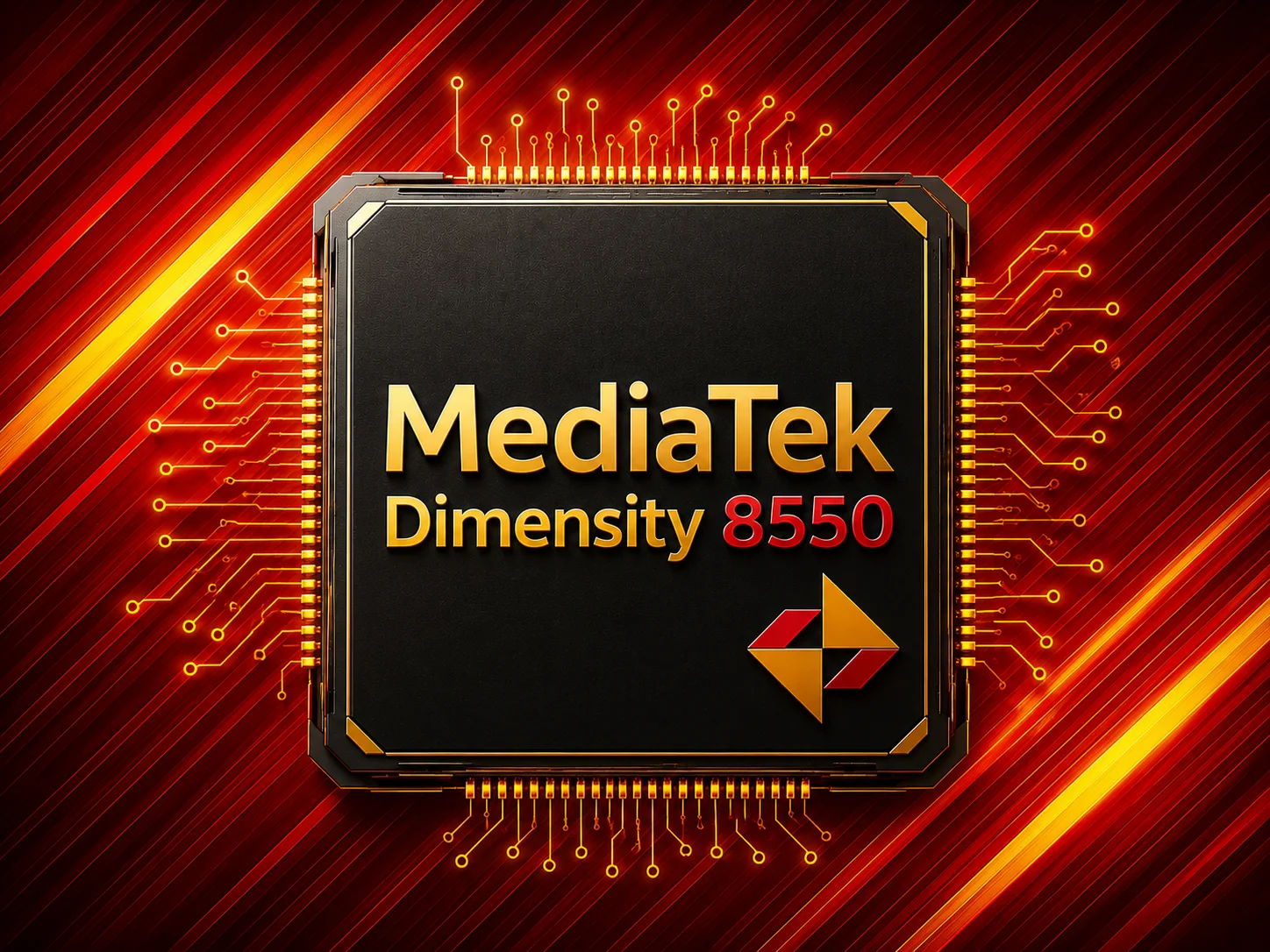
Trailer Of MediaTek Dimensity 8550

Author & Post Info
Faisal Ur Rehman
Faisal Rehman is the founder and editor of FSL Specs, where he publishes in-depth smartphone specifications, comparisons, buying guides, and technology insights. With extensive experience in mobile hardware research and technical analysis, he provides accurate and up-to-date information on Android smartphones, processors, displays, cameras, batteries, performance benchmarks, and software features. His goal is to simplify complex specifications and help readers choose the right device with confidence.
Explore FSL Specs
Questions About MediaTek Dimensity 8550
What is the MediaTek Dimensity 8550?
The MediaTek Dimensity 8550 is a premium 5G smartphone processor designed for strong performance, gaming, AI features, and efficient power consumption. It targets powerful mid-range and upper-mid-range devices.
How powerful is the Dimensity 8550?
The Dimensity 8550 features an 8-core Arm Cortex-A725 CPU with a maximum clock speed of up to 3.4GHz. Its all-big-core design is built for demanding apps, multitasking, and intensive workloads.
Is Dimensity 8550 good for gaming?
Yes, the Arm Mali-G720 MC8 GPU provides strong graphics performance for demanding mobile games. It is designed to deliver smooth gameplay while maintaining good power efficiency during longer gaming sessions.
Does Dimensity 8550 support 5G?
Yes, the Dimensity 8550 supports 5G connectivity with advanced modem capabilities. This makes it suitable for high-speed mobile networks in markets such as Pakistan, India, and other Asian regions.
How much RAM and storage does Dimensity 8550 support?
It supports LPDDR5X RAM up to 9600Mbps and UFS 4.0 storage with MCQ. This combination helps improve app loading, multitasking, gaming, and large-file transfer speeds.
What camera does Dimensity 8550 support?
The Dimensity 8550 supports camera sensors of up to 320MP and includes the MediaTek NPU 880 for AI-assisted imaging. Actual camera quality depends on the sensor, ISP tuning, and camera software used by the phone manufacturer.
What video recording does Dimensity 8550 support?
The Dimensity 8550 supports advanced 4K video recording at up to 60fps with powerful image and video processing. Available recording modes can vary depending on the smartphone manufacturer's implementation.
Which GPU powers the Snapdragon 8 Elite Gen 4?
It's powered by the Adreno 830 GPU, built on the Adreno 800 architecture with 512 shading units across 3 pipelines. With 1,536 total shaders and support for Vulkan 1.3 and OpenCL 3.0, it's a genuinely capable graphics engine for flagship gaming and media work.