

















✪ Motorola Edge 70 Max ✪

Motorola Edge 70 Max png image
United States flag United States
$600 USD
Pakistan flag Pakistan (PKR)
230,000 PKR
India flag India (INR)
₹58,000 INR

✪ Motorola Edge 70 Max ✪

Motorola Edge 70 Max png image
Last Time Update : 13 September, 2026
0

Quick Specifications

LTPO AMOLED

Display Type

Snapdragon 8 Gen 5

Processor

12 + 256 GB

Ram And Memory

50 + 8 MP

Camera

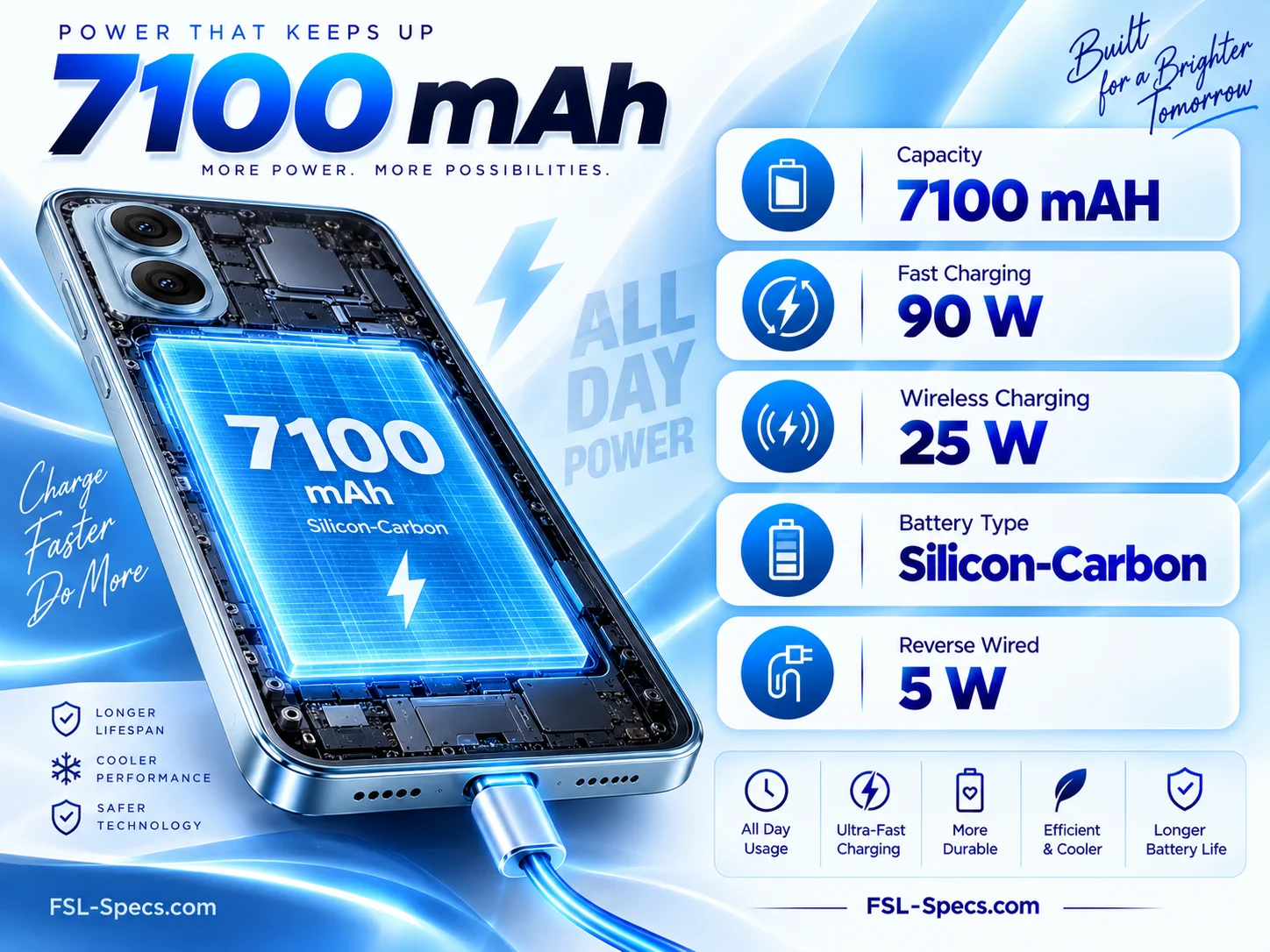
7100 mAH

Battery

90 W

Fast Charging

Full Specification

BASIC INFO
Mobile
Motorola Edge 70 Max
Series
Edge Series
Category
Mid-Premium
Release Date
20 July,2026
Year
2026
CONNECTIVITY
Sim
Nano-SIM / E-Sim
Network
4G / 4G+ / 5G/ 5G+
WiFi
Wi-Fi 7
Bluetooth
6.0
NFC
Yes
OS
Android 16, up to 3 major OS updates
BODY
Dimensions
164 x 77 x 8.3 mm
Build
aluminum frame, glass back
KG Weight
221 g
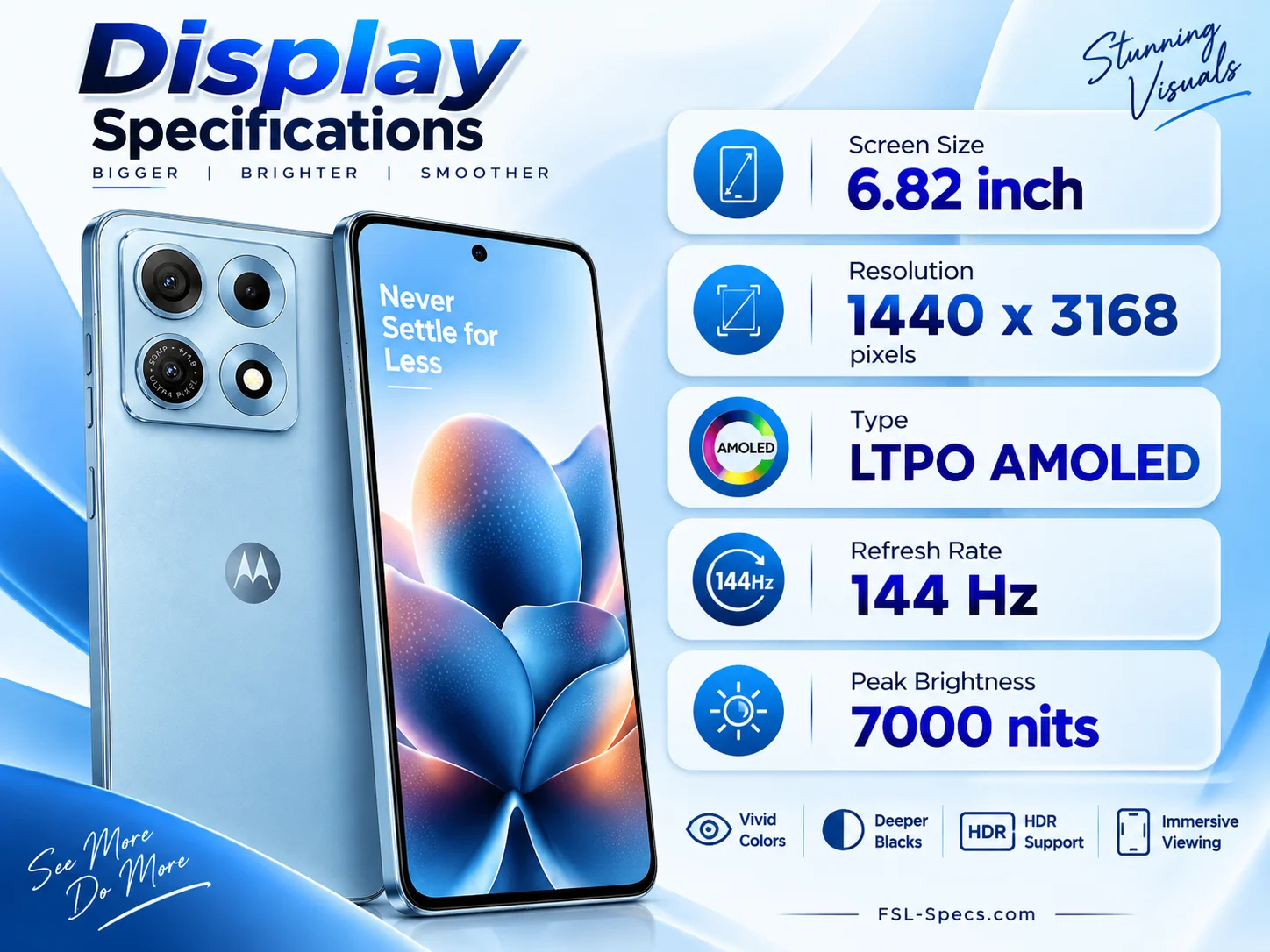
Screen Size
6.82 inch
Resolution
1440 x 3168 pixels
Type
LTPO AMOLED
Refresh Rate
144 Hz
Peak Brightness
7000 nits
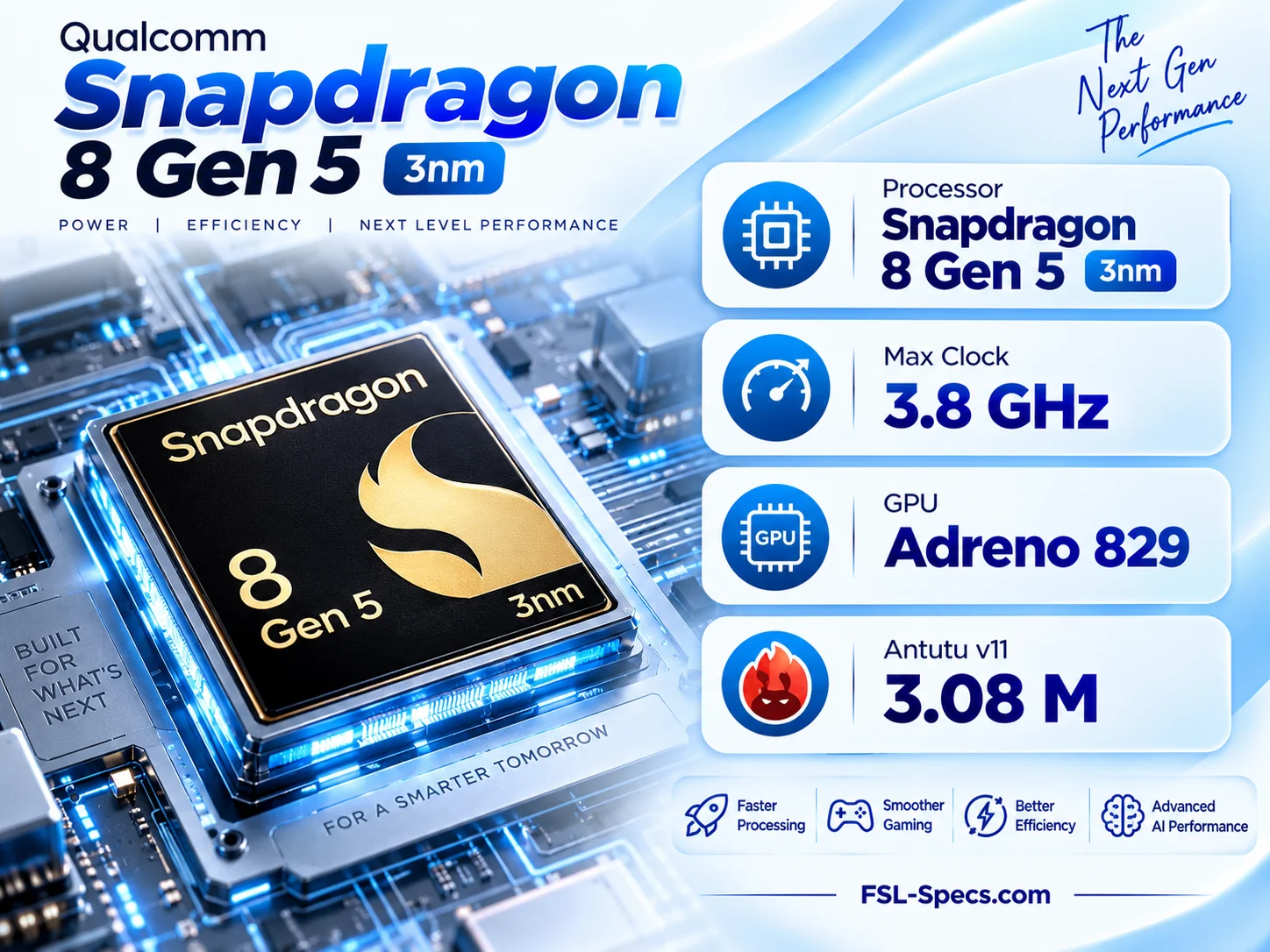
Processor
Snapdragon 8 Gen 5
Max Clock
3.8 GHz
Lithography
3 nm
GPU
Adreno 829
CPU Cores
8 Cores
Antutu v11
3.08 M
Bootup Time
16s
Architecture
2 x 3.8 GHz Oryon V3 Phoenix L
6 x 3.32 GHz Oryon V3 Phoenix M
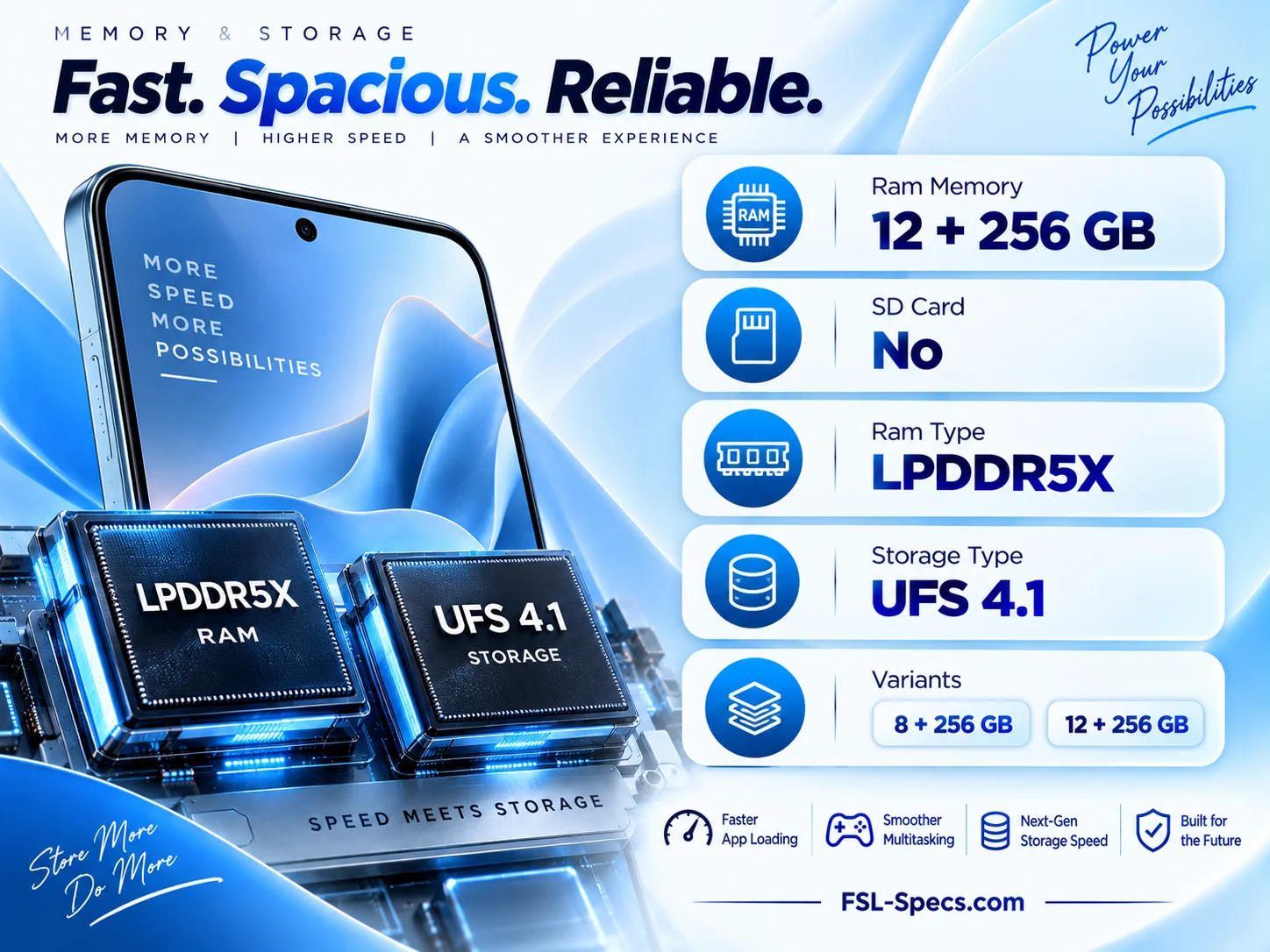
Ram Memory
12 + 256 GB
Ram Type
LPDDR5X
Storage Type
UFS 4.1
SD Card
No
Variants
8 + 256 GB
12 + 256 GB
MP
Rear Camera
50 + 8 MP
Front Camera
32 MP
SENSORS
Camera Sensors
50 MP =Sony LYT-710
RECORDING FPS
Main Recording
4K @ 60 fps
1080p @ 30/60/120/240 fps
RESOLUTION
Main Resolution
8150 x 6150 Pixels
ZOOM
D Digital Zoom
20 x
Stabilization
Yes
FLASH
Flash
LED Flash
Front Flash
Screen Flash
Capacity
7100 mAH
Fast Charging
90 W
Wireless Charging
25 W
Li Battery Type
Silicon-Carbon
REVERSE
Reverse Wired
5 W
OTHER
Battery PC Marks
16h 38m
Charging Time
57m
AUDIO & SENSORS
Speaker
Dual Stereo Speaker
Fingerprint Sensor
Hyper Sonic Front Finger
Other Sensors
Accelerometer
Gyroscope
Proximity
Ambient Light
E-Compass
BASIC INFO
Mobile
Motorola Edge 70 Max
Series
Edge Series
Category
Mid-Premium
Release Date
20 July,2026
Year
2026
CONNECTIVITY
Sim
Nano-SIM / E-Sim
Network
4G / 4G+ / 5G/ 5G+
WiFi
Wi-Fi 7
Bluetooth
6.0
NFC
Yes
OS
Android 16, up to 3 major OS updates
BODY
Dimensions
164 x 77 x 8.3 mm
Build
aluminum frame, glass back
KG Weight
221 g
Screen Size
6.82 inch
Resolution
1440 x 3168 pixels
Type
LTPO AMOLED
Refresh Rate
144 Hz
Peak Brightness
7000 nits
Processor
Snapdragon 8 Gen 5
Max Clock
3.8 GHz
Lithography
3 nm
GPU
Adreno 829
CPU Cores
8 Cores
Antutu v11
3.08 M
Bootup Time
16s
Architecture
2 x 3.8 GHz Oryon V3 Phoenix L
6 x 3.32 GHz Oryon V3 Phoenix M
Ram Memory
12 + 256 GB
SD Card
No
Ram Type
LPDDR5X
Storage Type
UFS 4.1
Variants
8 + 256 GB
12 + 256 GB
MP
Rear Camera
50 + 8 MP
Front Camera
32 MP
SENSORS
Main Camera Sensors
50 MP =Sony LYT-710
RECORDING FPS
Main Recording
4K @ 60 fps
1080p @ 30/60/120/240 fps
RESOLUTION
Main Resolution
8150 x 6150 Pixels
ZOOM
D Digital Zoom
20 x
Stabilization
Yes
FLASH
Flash
LED Flash
Front Flash
Screen Flash
Capacity
7100 mAH
Fast Charging
90 W
Wireless Charging
25 W
Li Battery Type
Silicon-Carbon
REVERSE
Reverse Wired
5 W
OTHER
Battery Life PCMark
16h 38m
Charging Time
57m
AUDIO & SENSORS
Speaker
Dual Stereo Speaker
Fingerprint Sensor
Hyper Sonic Front Finger
Other Sensors
Accelerometer
Gyroscope
Proximity
Ambient Light
E-Compass

Highlights & Review Of Motorola Edge 70 Max

Display Review:

The Motorola Edge 70 Max carries a 6.82-inch LTPO AMOLED panel at 1440 x 3168px (~510ppi) running up to 144Hz, the sharpest screen in this group and the only one pairing QHD+ resolution with a 144Hz ceiling. Motorola quotes a 7,000 nits peak brightness (manufacturer-stated), though GSMArena’s own lab measured a real-world 1,571 nits, still comfortable for outdoor use.

The vivo X300 FE (PKR 245,000, marketplace listing) uses a smaller 6.31-inch LTPO AMOLED at 1216 x 2640px (~461ppi), capped at 120Hz. Sources differ on its peak brightness: GSMArena’s spec sheet lists 5,000 nits, while GSMArena’s own review text says vivo advertises 4,500 nits; this hasn’t been independently confirmed, though lab testing measured 1,857 nits on a 10% patch.

The Xiaomi 17T Pro (PKR 262,000) matches the Edge 70 Max’s 144Hz refresh on a 6.83-inch AMOLED at 1280 x 2772px (~447ppi), the lowest pixel density of the four, with a confirmed 3,500 nits peak and 1,035 nits measured in auto mode. The OnePlus 15R (PKR 250,000-270,000, marketplace range) advertises the highest refresh rate on paper at 165Hz on its 6.83-inch AMOLED (1272 x 2800px, ~450ppi), but hands-on testing confirms the 165Hz mode only activates in a handful of approved games, meaning daily use tops out at 120Hz, just like the X300 FE, a gap between marketing and lived experience the spec sheet alone won’t reveal.

Verdict: On sharpness and a refresh rate that genuinely applies system-wide, the Motorola Edge 70 Max leads this group, the Xiaomi 17T Pro trails it only on resolution, and the OnePlus 15R’s 165Hz claim is the least representative of real daily use among the four.

Processor Review:

The Xiaomi 17T Pro posts the highest score in this group at 3,352,325 AnTuTu (v11) on its Dimensity 9500 chipset, about 9.6% ahead of the Motorola Edge 70 Max’s 3,057,494 (v11) on Snapdragon 8 Gen 5, and roughly 12% ahead of both the vivo X300 FE’s 3,006,390 (v11) and the OnePlus 15R’s 2,981,677 (v11), which run the identical Snapdragon 8 Gen 5 silicon. All four figures come from GSMArena’s own lab tests on the same AnTuTu version, so this comparison holds without a version mismatch to flag.

What stands out is that the Edge 70 Max, X300 FE, and OnePlus 15R share the exact same chipset yet post different graphics results in 3DMark Wild Life Extreme: the Edge 70 Max scores 5,324, ahead of the OnePlus 15R’s 5,016, while the compact-bodied X300 FE trails both at just 4,189, a gap that comes down to chassis thermal handling rather than the silicon itself. The Xiaomi 17T Pro leads GPU performance outright at 6,939, consistent with the Dimensity 9500’s known strength under sustained graphics load.

GeekBench multi-core scores stay tight across the board, from 9,315 to 9,766, so daily multitasking will feel similar on all four regardless of the AnTuTu spread. A few hundred thousand AnTuTu points between flagship chips barely registers outside sustained gaming sessions, which is why gaming headroom, not the raw combined score, carries more weight in this section.

Verdict: For outright performance and gaming headroom, the Xiaomi 17T Pro leads this comparison, while the Motorola Edge 70 Max is the strongest of the three Snapdragon 8 Gen 5 phones on account of noticeably better thermal handling of identical hardware.

Ram & Memory Review:

All four phones pair 12GB LPDDR5X RAM, but storage splits into two clear tiers: the Motorola Edge 70 Max and vivo X300 FE carry 256GB UFS 4.1 storage in the configuration compared here, while the Xiaomi 17T Pro and OnePlus 15R double that to 512GB UFS 4.1, at PKR 262,000 and PKR 250,000-270,000 respectively. None of the four support a microSD card, so buyers on any of these phones are locked into whatever storage tier they buy, which makes the 256GB versus 512GB gap matter more than it would on phones with expandable memory.

On paper, identical 12GB LPDDR5X RAM across all four should feel similar for everyday app-switching and background multitasking, since RAM generation and speed, not just capacity, decide how long apps stay cached in memory, so no meaningful gap is expected here between the group.

The real differentiator is storage headroom and upgrade flexibility. vivo does sell a 12+512GB X300 FE variant and the OnePlus 15R and Xiaomi 17T Pro both go up to 512GB and higher, but the Motorola Edge 70 Max tops out at 256GB with no 512GB option in any market, a genuine ceiling for buyers who shoot a lot of 4K or 8K video or keep large game libraries installed. For anyone choosing between the PKR 245,000 X300 FE and the still-unlaunched Edge 70 Max at a similar price, that storage ceiling is worth knowing upfront, not just the RAM number on the spec sheet.

Verdict: With RAM tied across the board, storage decides this section, the Xiaomi 17T Pro and OnePlus 15R’s 512GB tier offers real long-term headroom, while the Motorola Edge 70 Max’s hard 256GB ceiling is its clearest practical disadvantage against all three rivals.

Cameras Review:

Camera hardware transparency splits this group in two. Motorola’s own launch materials name the Motorola Edge 70 Max’s 50MP main sensor as a Sony LYTIA 710 [Confirmed], while the vivo X300 FE’s 50MP main (Sony IMX921) and 50MP telephoto (Sony IMX882) surface only through third-party teardowns rather than vivo’s own spec sheet, and neither Xiaomi nor OnePlus names a sensor model for the 17T Pro or 15R at all [Unconfirmed], leaving buyers to judge those two on aperture and sensor size alone.

On paper, the Xiaomi 17T Pro leads optical reach with a 50MP f/3.0 periscope telephoto offering 5x optical zoom and OIS, ahead of the vivo X300 FE’s 50MP f/2.7 telephoto at 3x optical zoom, also OIS-equipped. Neither the Motorola Edge 70 Max nor the OnePlus 15R carries a telephoto lens at all, pairing a 50MP f/1.8 OIS main camera with just an 8MP ultrawide, a real gap for anyone who zooms often, not merely a headline-spec footnote.

Ultrawide resolution favors the Xiaomi 17T Pro at 12MP against 8MP on the other three, though none of the four ultrawide units get OIS. The Edge 70 Max’s ultrawide is the only one with autofocus, useful for macro shots the rest can’t match.

Selfie autofocus appears on the vivo X300 FE’s 50MP front camera and the OnePlus 15R’s 32MP unit, while the Edge 70 Max and 17T Pro’s 32MP selfies are fixed-focus. Rear video tops out at 8K@30fps on both the X300 FE and 17T Pro, while the Edge 70 Max and 15R cap at 4K.

Verdict: The vivo X300 FE and Xiaomi 17T Pro are the stronger camera picks here on confirmed telephoto hardware and higher video ceilings, while the Motorola Edge 70 Max’s missing telephoto and less transparent sensor sourcing make it the weakest camera setup of the four despite matching main-camera aperture and OIS.

Battery Review:

The OnePlus 15R carries the largest cell in this group at 7,400mAh, ahead of the Motorola Edge 70 Max’s 7,100mAh and the Xiaomi 17T Pro’s 7,000mAh, with the compact vivo X300 FE trailing at 6,500mAh, still a large cell for its smaller 6.31-inch body. Capacity alone does not decide the winner here though, since charging speed and wireless support vary sharply across the four.

The Motorola Edge 70 Max charges at 90W wired, going 50% in 21 minutes and 100% in 51 minutes, and is the only phone in this group offering 25W magnetic wireless charging over Qi2.2, plus 5W reverse wired. The Xiaomi 17T Pro tops wired speed at 100W, with 50W wireless and 22.5W reverse wired charging, though GSMArena’s tested 0-100% time for this specific unit isn’t published in the source data, so that figure stays unconfirmed.

The vivo X300 FE supports 90W wired, with vivo quoting 100% in 55 minutes, though GSMArena’s own lab measured a faster 49-minute full charge, plus 40W wireless, reverse wired, reverse wireless, and bypass charging, the most flexible charging feature set of the four. The OnePlus 15R, despite the largest battery, charges at just 80W wired with no wireless charging at all, a real absence next to three rivals that all offer it, and one easy to miss if a buyer only looks at the 7,400mAh headline number.

Verdict: The vivo X300 FE offers the most well-rounded charging feature set relative to its smaller battery, the Motorola Edge 70 Max balances a large cell with genuine wireless charging, and the OnePlus 15R’s biggest-battery advantage is undercut by the slowest wired charging and no wireless option among the four.

Final Verdict :

Across all five comparison sections, the Xiaomi 17T Pro comes out on top of this four-way match-up, backed by the highest AnTuTu score in the group at 3,352,325 (v11), the only confirmed 5x optical telephoto camera, and a 512GB storage tier at PKR 262,000. Camera hardware and charging flexibility carry more real-world weight in this verdict than raw benchmark points or peak refresh rate claims, since a roughly 10% AnTuTu gap rarely changes daily use, while a missing telephoto lens or missing wireless charging genuinely does. On that basis, the vivo X300 FE (PKR 245,000) takes second place.

Its confirmed Sony IMX921 and IMX882 sensors, 3x telephoto, and the most flexible charging feature set of the four (wired, wireless, reverse wired, reverse wireless, and bypass) outweigh its smaller 6.31-inch display and weaker GPU scores. The Motorola Edge 70 Max, expected around PKR 230,000-250,000 once it launches in Pakistan, ranks third. It leads on display sharpness and matches the Xiaomi on real-world 144Hz refresh, but its total absence of a telephoto camera and hard 256GB storage ceiling with no upgrade path pull it below the X300 FE despite comparable performance.

The OnePlus 15R (PKR 250,000-270,000) finishes last in this group. It carries the largest battery at 7,400mAh, but the slowest wired charging at 80W and no wireless charging at all undercut that advantage, and it shares the Edge 70 Max’s lack of a telephoto lens without matching its display sharpness.

Bottom line: The Xiaomi 17T Pro is the strongest overall pick in this comparison, the vivo X300 FE is the best choice for camera-focused buyers on a smaller footprint, and the OnePlus 15R is the hardest of the four to recommend once its battery capacity is set aside.

Ranking:

  1. Xiaomi 17T Pro – PKR 262,000
  2. vivo X300 FE – PKR 245,000
  3. Motorola Edge 70 Max – PKR 230,000-250,000 (expected, unofficial pending Pakistan launch)
  4. OnePlus 15R – PKR 250,000-270,000

Pros And Cons of Motorola Edge 70 Max

Pros of Mobile

Snapdragon 8 Gen 5
7100mAh Battery 🔋
144Hz QHD+ AMOLED 📱
90W Fast Charging 🚀
IP69 Protection 🛡️
25W Qi2 Wireless 🔌

Cons of Mobile

8MP Ultrawide Camera 📸
No Telephoto Camera 🔭
Limited Software Support 🔄
Outdoor Visibility Issues ☀️
256GB Storage Only 💾

Best For - Not Best For

Best For

🎯 Heavy Gaming 🎮
🎯 Long Battery Life 🔋
🎯 Sharp Display 👀
🎯 Fast Charging
🎯 Media Consumption 🎬
🎯 Durable Build 🛡️

Not Best For

🚫 Zoom Photography 🔭
🚫 Lightweight Phone Fans ⚖️
🚫 One-Handed Use 🤳
🚫 Long-Term Updates 🔄

Trailer And Unboxing of Motorola Edge 70 Max

Disassembly Or Teardown And Gaming Test of Motorola Edge 70 Max

Camera Test Motorola Edge 70 Max

Vivo X300 FE
Xiaomi 17t Pro
Oneplus 15R
Redmi K90 Max
iQOO 13
POCO X8 Pro Max
Xiaomi Poco F8 Pro

Motorola Series Row
Picture of Faisal Ur Rehman

Faisal Ur Rehman

Faisal Rehman is the founder and editor of FSL Specs, where he publishes in-depth smartphone specifications, comparisons, buying guides, and technology insights. With extensive experience in mobile hardware research and technical analysis, he provides accurate and up-to-date information on Android smartphones, processors, displays, cameras, batteries, performance benchmarks, and software features. His goal is to simplify complex specifications and help readers choose the right device with confidence.

FAQs Questions

The Motorola Edge 70 Max is powered by the Snapdragon 8 Gen 5, making it a flagship-level phone for gaming, multitasking and demanding apps. Its CPU can reach up to 3.8GHz

The Edge 70 Max packs a huge 7,100mAh silicon-carbon battery, designed for long daily use. Motorola rates it for up to 73 hours of battery life under its testing conditions

Yes, it supports 90W TurboPower wired charging and 25W Qi2 magnetic wireless charging. Motorola says six minutes of wired charging can provide substantial extra battery life when using the compatible charger.

The phone features a 6.82-inch Quad HD+ Extreme AMOLED display with a 144Hz refresh rate and up to 7,000 nits peak brightness. It also supports 10-bit colour and 100% DCI-P3 coverage

Its main camera is a 50MP Sony LYTIA 710 sensor with OIS, while an 8MP ultrawide camera provides a 119° field of view. The main camera can record 4K HDR10+ video at 60fps.

The Snapdragon 8 Gen 5, 144Hz display and large 7,100mAh battery make the Edge 70 Max well suited to demanding mobile games. Motorola also lists up to 25 hours of continuous gaming in its battery testing

The Motorola Edge 70 Max carries IP68 and IP69 protection, giving it strong resistance against dust and water. Motorola also lists MIL-STD 810H durability certification for the model.

The official Motorola FAQ lists 12GB RAM and 256GB storage, while another regional specification page lists an 8GB/256GB configuration, so memory options can vary by market.

16 + 512 GB =  Unknown | 50,000 INR | Not Confirm
16 + 1TB       = ~500 $ | 55,000 INR | 170,000 PKR

Leave a Reply

Your email address will not be published. Required fields are marked *

Scroll to Top