
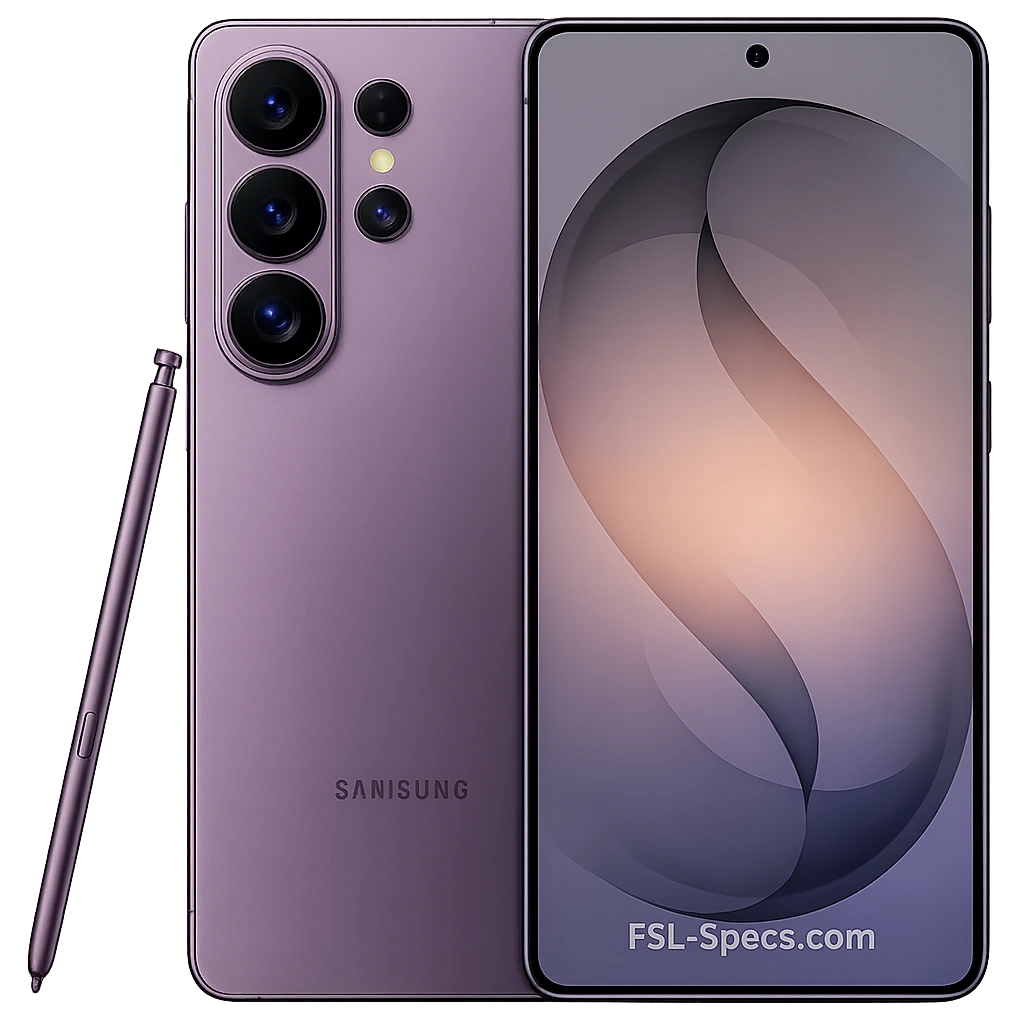
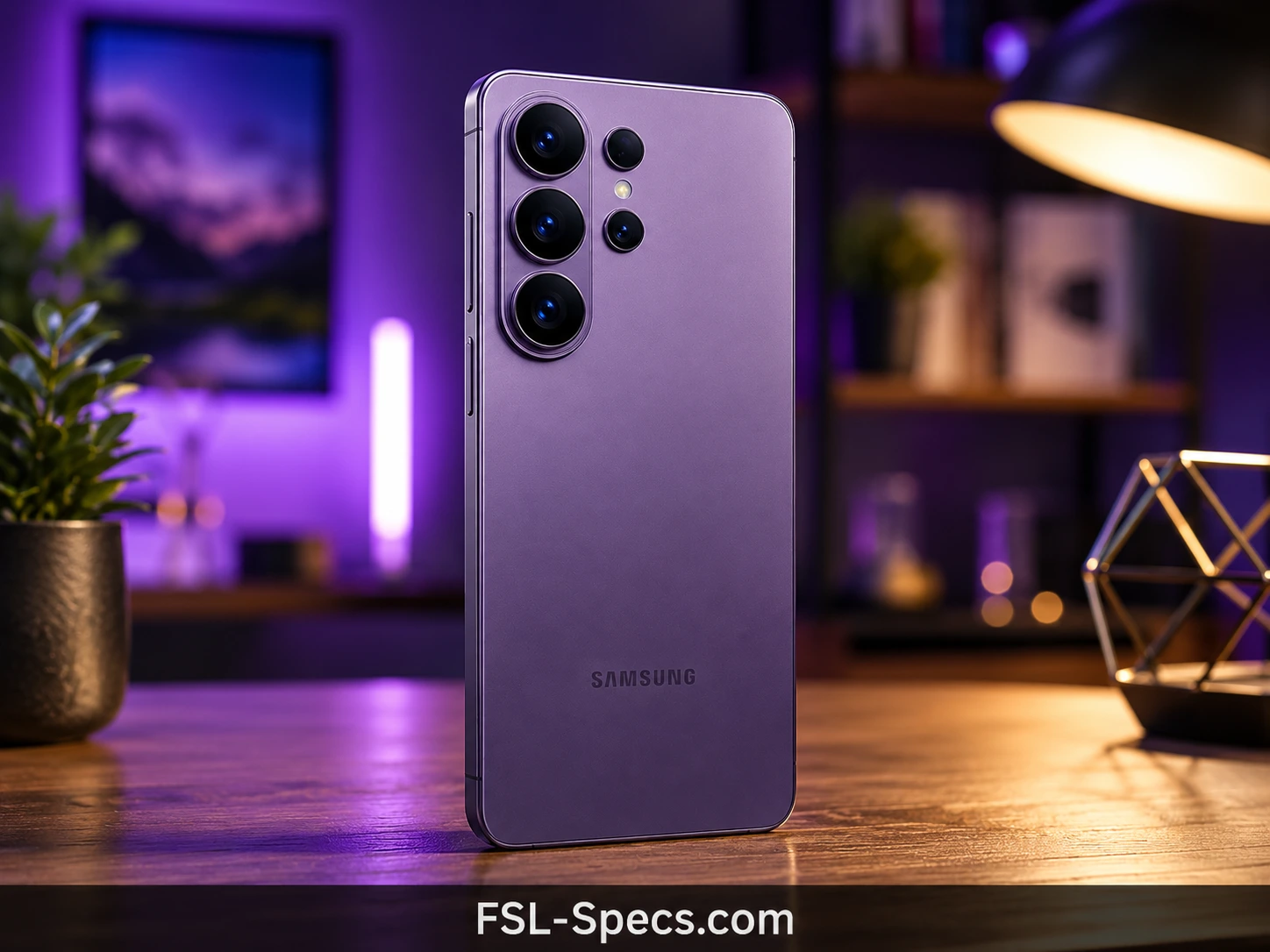
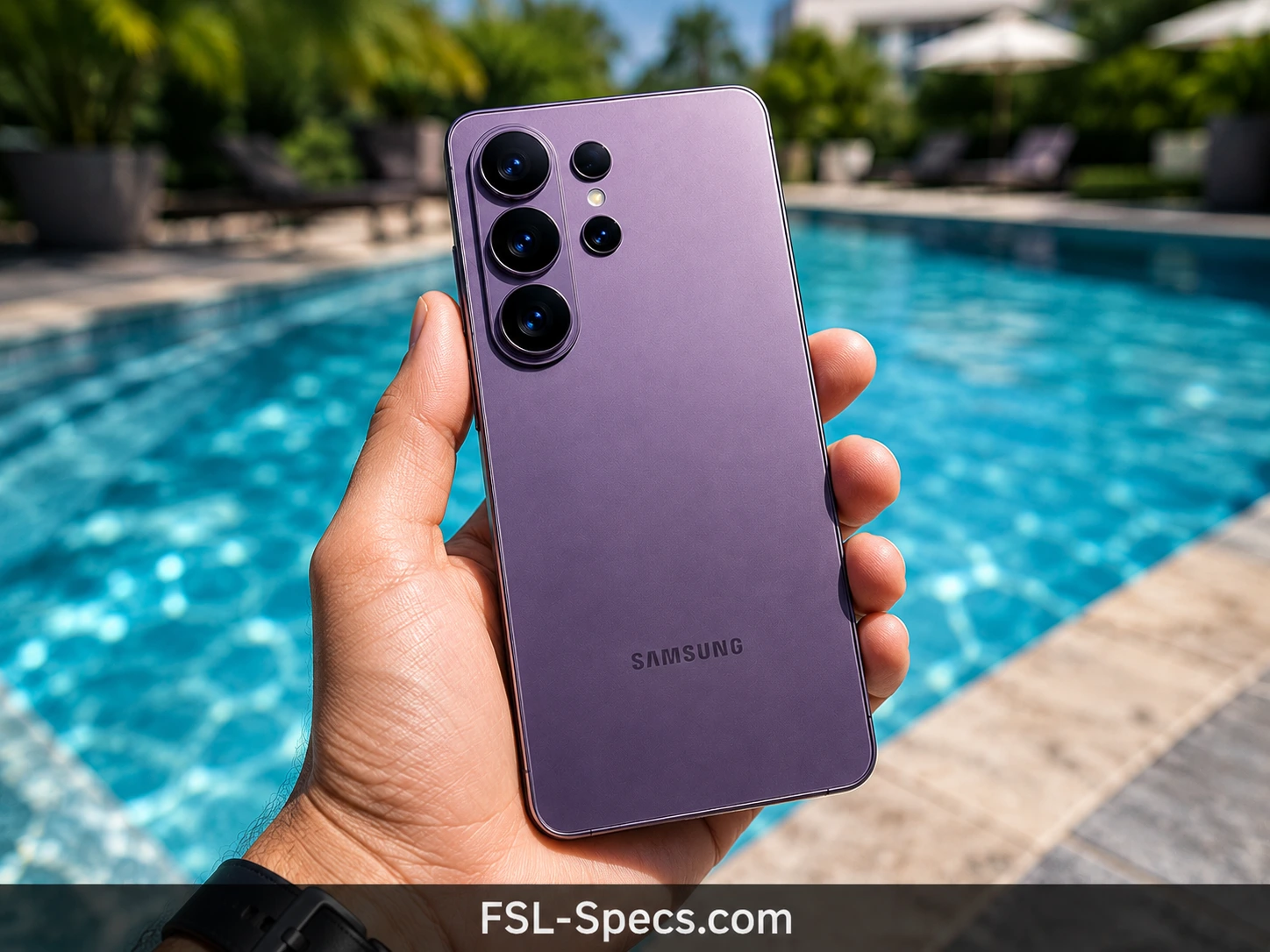
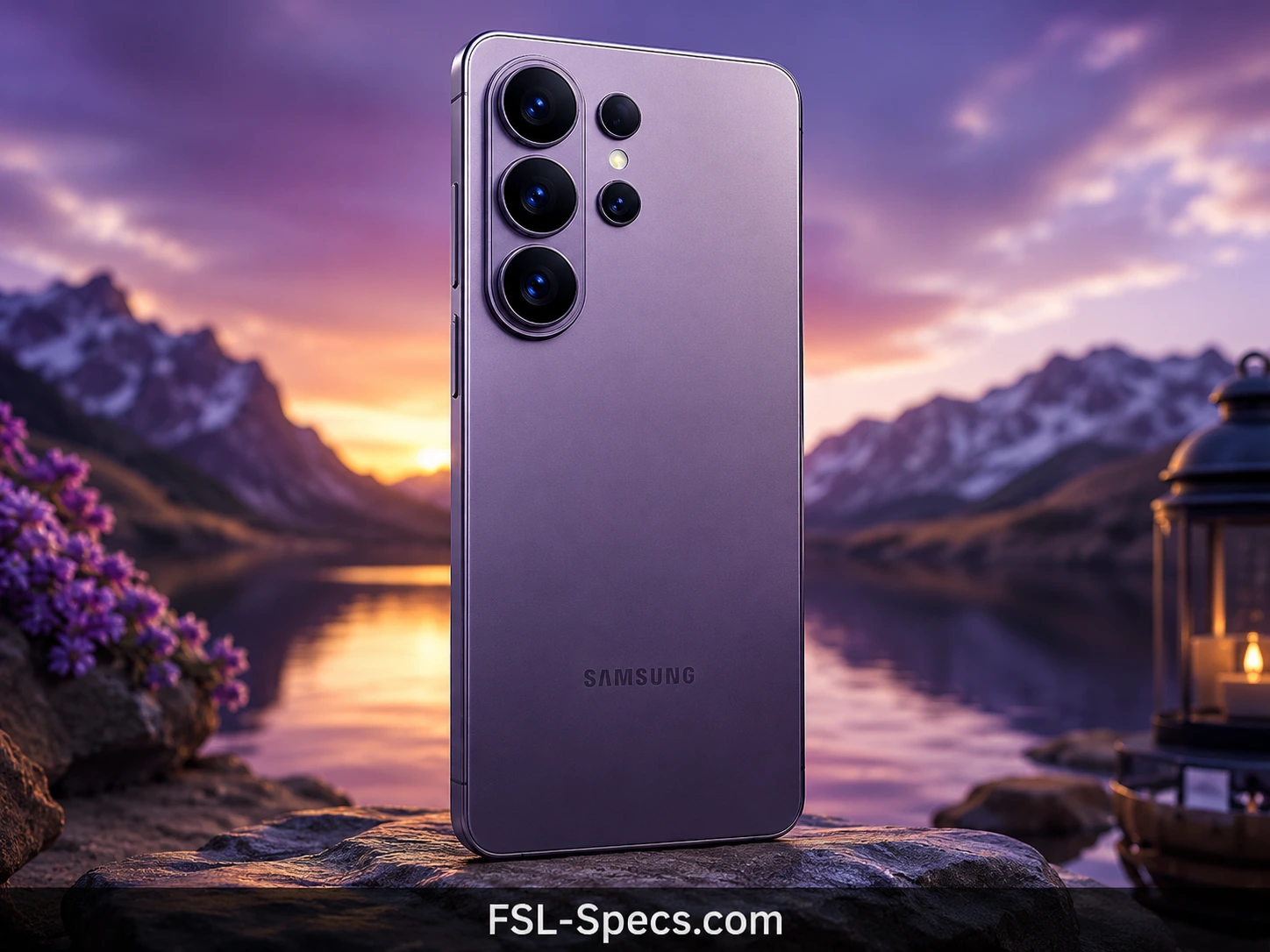










✪ Samsung Galaxy S26 Ultra ✪

Samsung Galaxy S26 Ultra Specs, Price, Pros and Cons
United States flag United States
$1,100 USD
Pakistan flag Pakistan (PKR)
450,000 PKR
India flag India (INR)
₹145,000 INR

✪ Samsung Galaxy S26 Ultra ✪

Samsung Galaxy S26 Ultra Specs, Price, Pros and Cons
Last Time Update : 18 July, 2026
0

Quick Specifications

Dynamic AMOLED 2X

Display Type

Snapdragon 8 Elite Gen 5

Processor

16 + 512 GB

Ram And Memory

200 + 50 + 50 + 10 MP

Camera

5000 mAh

Battery

60 W

Fast Charging

Full Specification

BASIC INFO
Mobile
Samsung Galaxy S26 Ultra
Model
SM-S948B
Series
S Series
Category
Flagship
Release Date
6 March,2026
Year
2025
CONNECTIVITY
Sim
Nano-SIM / E-Sim (USA)
Network
4G / 4G+ / 5G/ 5G+
WiFi
Wi-Fi 7
Bluetooth
v 6.0
NFC
Yes
OS
Android 17
BODY
Dimensions
163.6 x 78.1 x 7.9 mm
Build
Glass ( Back And Front ) + Frame ( Metal )
KG Weight
214 g
Screen Size
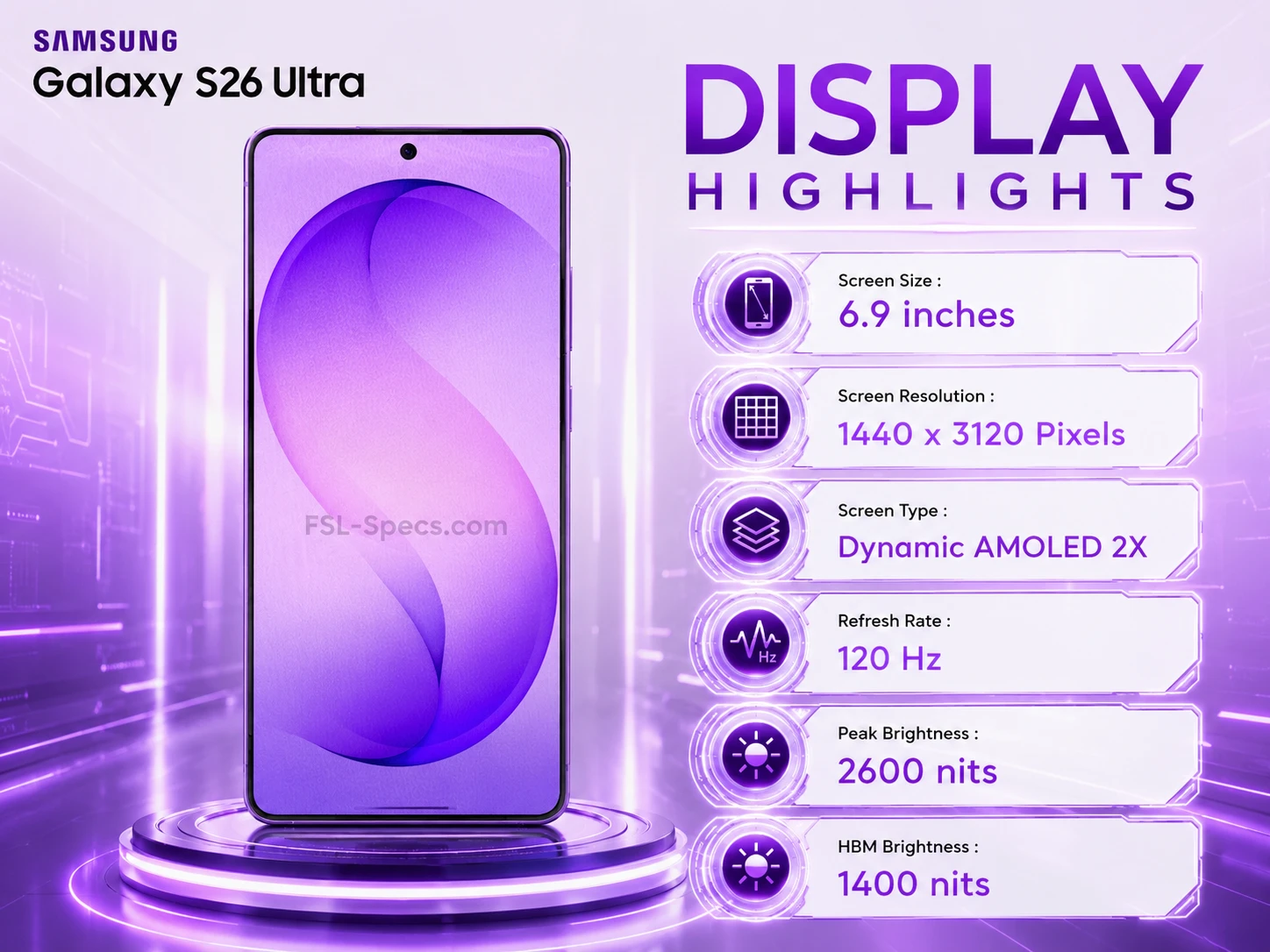
6.9 inches
Resolution
1440 x 3120 Pixels
Type
Dynamic AMOLED 2X
Refresh Rate
120 Hz
Peak Brightness
2600 nits
HBM Brightness
1400 nits
Processor
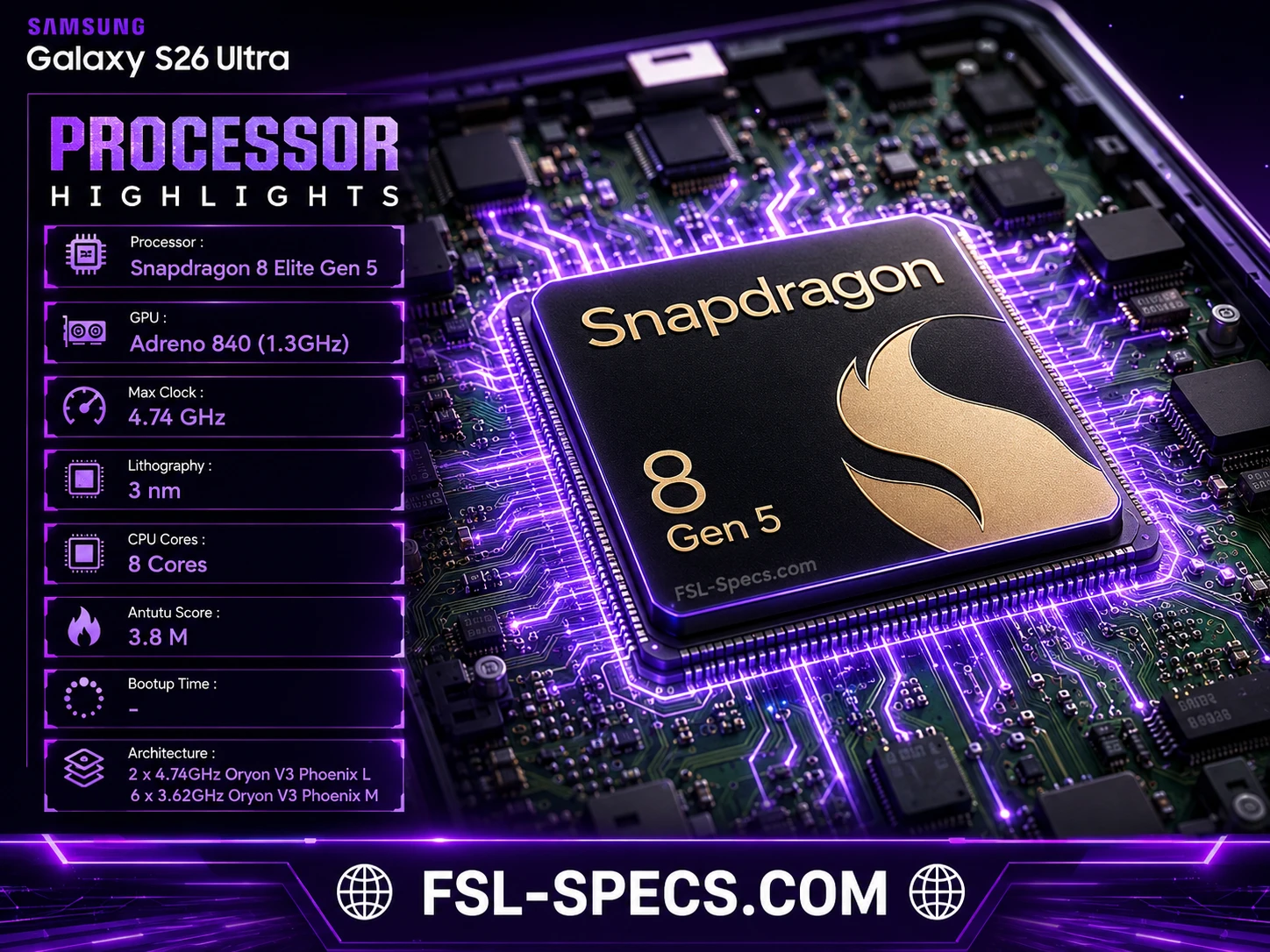
Snapdragon 8 Elite Gen 5
Max Clock
4.74 GHz
Lithography
3 nm
GPU
Adreno 840 (1.3GHz)
CPU Cores
8 Cores
Antutu v11
4 M
Antutu v10
2.6 M
Bootup Time
-
Architecture
2 x 4.74GHz Oryon V3 Phoenix L
 6 x 3.62GHz Oryon V3 Phoenix M
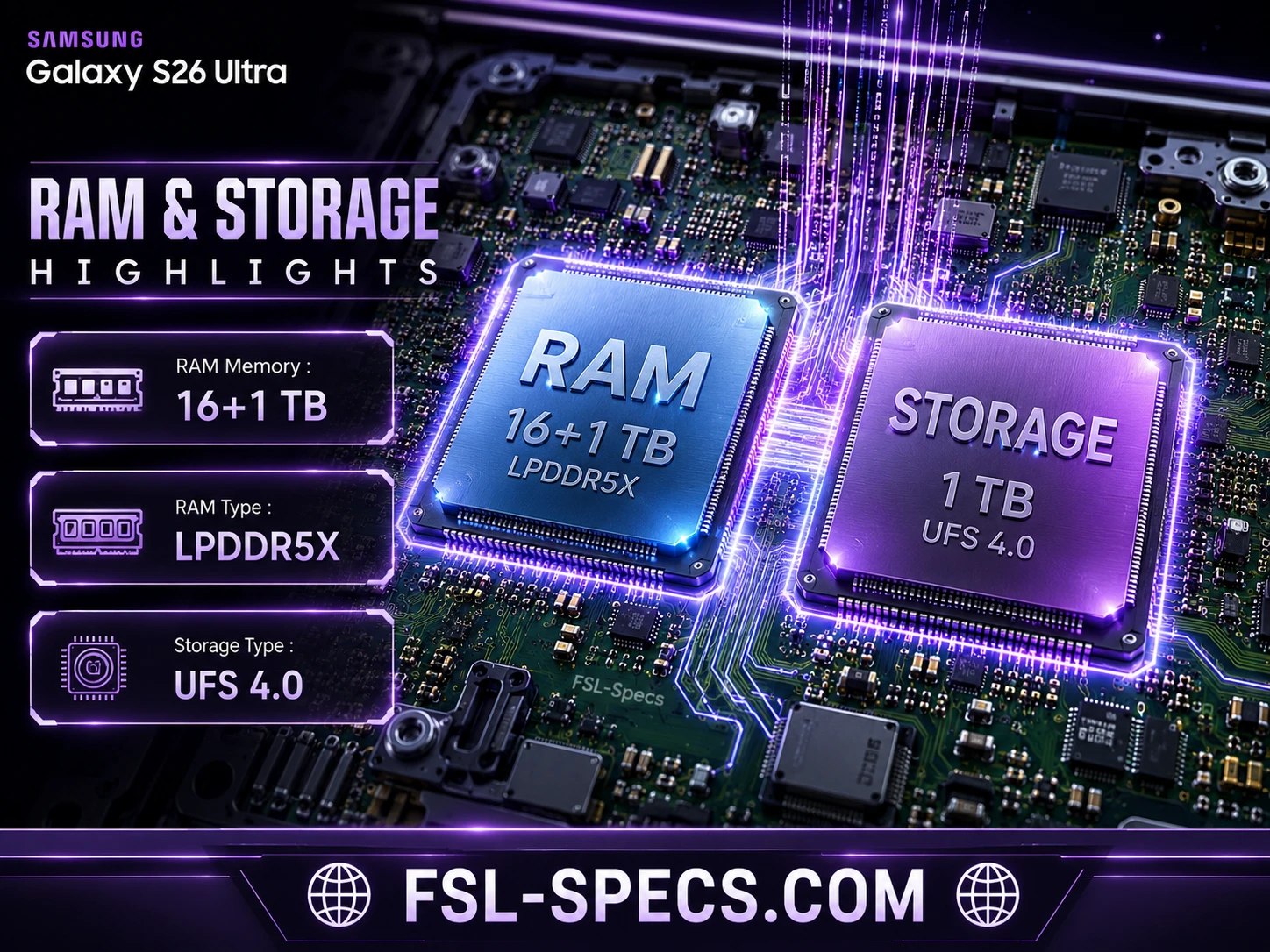
Ram Memory
16 + 512 GB
Ram Type
LPDDR5X
Storage Type
UFS 4.0
SD Card
No
Variants
12 + 256 GB
12 + 512 GB
16 + 1TB
MP
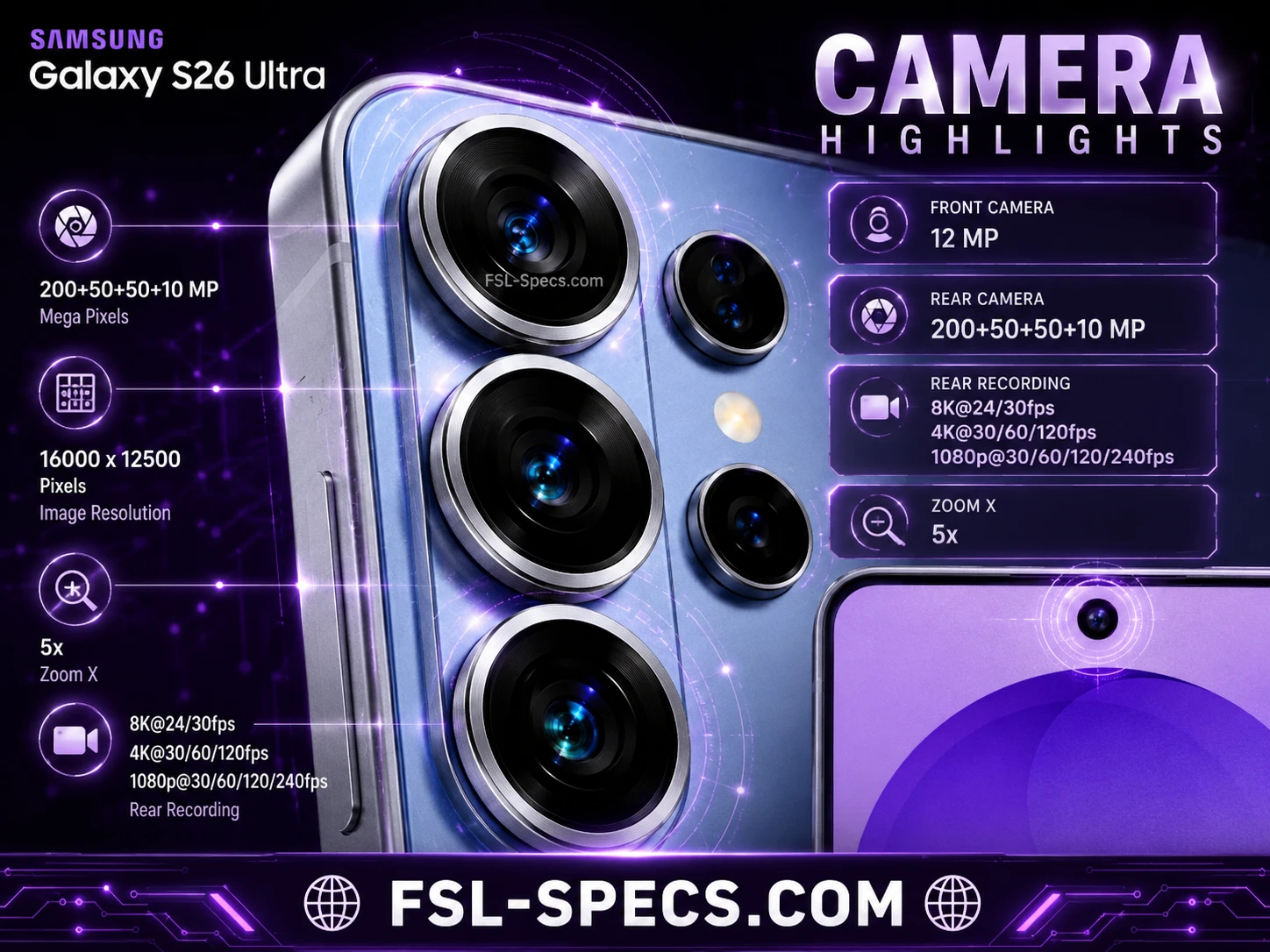
Rear Camera
200 + 50 + 50 + 10 MP
Front Camera
12 MP
SENSORS
Camera Sensors
200 MP = Samsung ISOCELL HP2 (Main)
50 MP = Samsung JN3 (Ultra-Wide)
10 MP = Sony IMX754 (Telephoto 3×)
50 MP = Sony IMX854 (Periscope Telephoto 5×)
Front Sensors
12MP=Samsung ISOCELL S5K3LU
RECORDING FPS
Main Recording
8K@24/30fps
4K@30/60/120fps
1080p@30/60/120/240fps
Front Recording
4K@30/60 fps
RESOLUTION
Main Resolution
16000 x 12500 Pixels
Front Resolution
4128 x 3096 Pixels
ZOOM
Optical Zoom
5 x
D Digital Zoom
100 x
FLASH
Flash
LED Flash
Front Flash
-
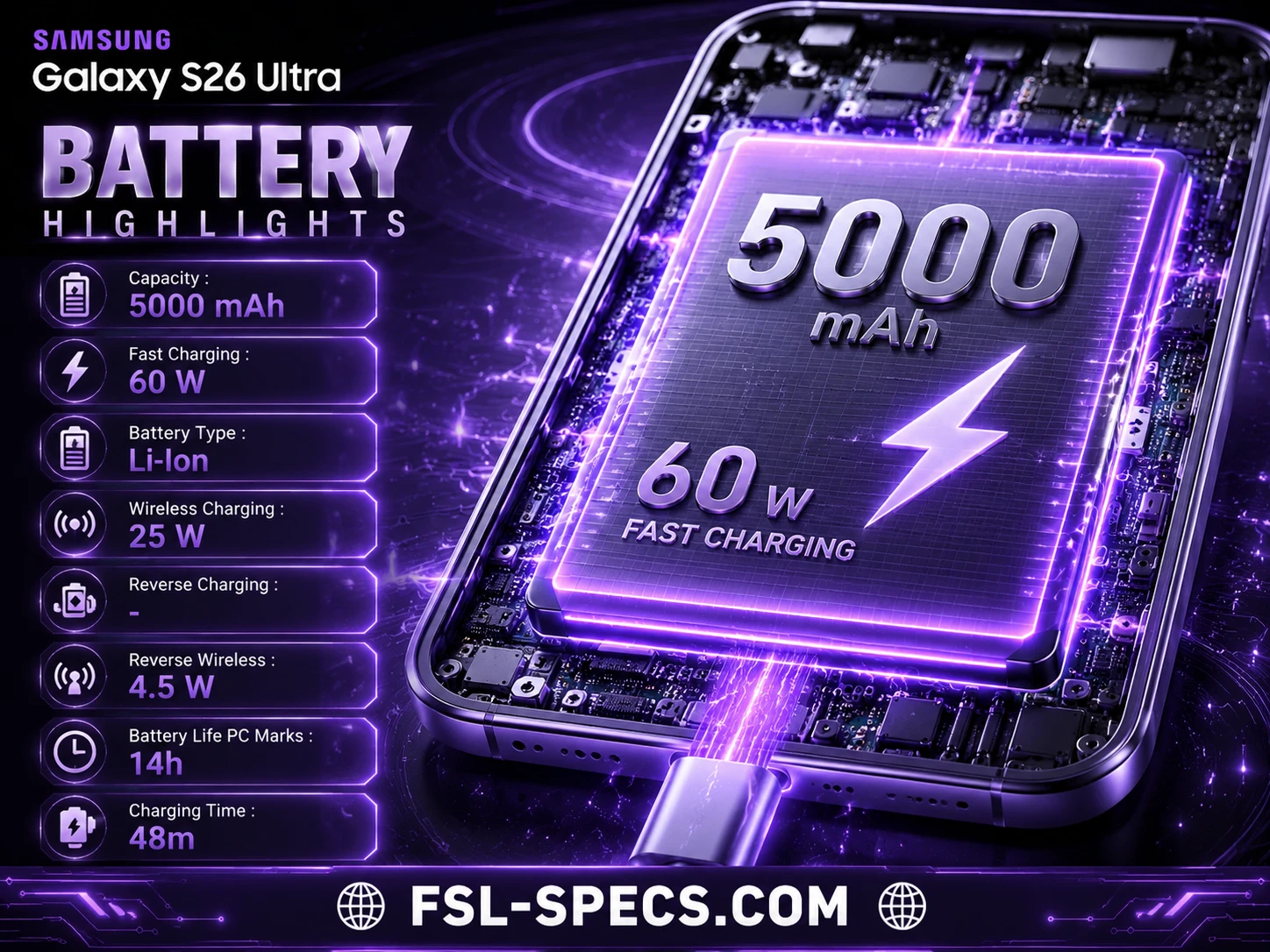
Capacity
5000 mAh
Fast Charging
60 W
Wireless Charging
25 W
Li Battery Type
Li-Ion
REVERSE
Reverse Wired
-
Reverse Wireless
4.5 W
OTHER
Battery PC Marks
14h
Charging Time
48m
AUDIO & SENSORS
Speaker
Dual Stereo Speaker
Fingerprint Sensor
Hyper Sonic Front Finger
Other Sensors
Accelerometer
gyro
proximity
compass
barometer
Special Features

Privacy Display
DX anti-reflective coating
Samsung DeX & Wireless DeX
UWB support, S Pen (Stylus)

BASIC INFO
Mobile
Samsung Galaxy S26 Ultra
Model
SM-S948B
Series
S Series
Category
Flagship
Release Date
6 March,2026
Year
2025
CONNECTIVITY
Sim
Nano-SIM / E-Sim (USA)
Network
4G / 4G+ / 5G/ 5G+
WiFi
Wi-Fi 7
Bluetooth
v 6.0
NFC
Yes
OS
Android 17
BODY
Dimensions
163.6 x 78.1 x 7.9 mm
Build
Glass ( Back And Front ) + Frame ( Metal )
KG Weight
214 g
Screen Size
6.9 inches
Resolution
1440 x 3120 Pixels
Type
Dynamic AMOLED 2X
Refresh Rate
120 Hz
Peak Brightness
2600 nits
HBM Brightness
1400 nits
Processor
Snapdragon 8 Elite Gen 5
Max Clock
4.74 GHz
Lithography
3 nm
GPU
Adreno 840 (1.3GHz)
CPU Cores
8 Cores
Antutu v11
4 M
Antutu v10
2.6 M
Bootup Time
-
Architecture
2 x 4.74GHz Oryon V3 Phoenix L
 6 x 3.62GHz Oryon V3 Phoenix M
Ram Memory
16 + 512 GB
SD Card
No
Ram Type
LPDDR5X
Storage Type
UFS 4.0
Variants
12 + 256 GB
12 + 512 GB
16 + 1TB
MP
Rear Camera
200 + 50 + 50 + 10 MP
Front Camera
12 MP
SENSORS
Main Camera Sensors
200 MP = Samsung ISOCELL HP2 (Main)
50 MP = Samsung JN3 (Ultra-Wide)
10 MP = Sony IMX754 (Telephoto 3×)
50 MP = Sony IMX854 (Periscope Telephoto 5×)
Front Camera Sensors
12MP=Samsung ISOCELL S5K3LU
RECORDING FPS
Main Recording
8K@24/30fps
4K@30/60/120fps
1080p@30/60/120/240fps
Front Recording
4K@30/60 fps
RESOLUTION
Main Resolution
16000 x 12500 Pixels
Front Resolution
4128 x 3096 Pixels
ZOOM
Optical Zoom
5 x
D Digital Zoom
100 x
FLASH
Flash
LED Flash
Front Flash
-
Capacity
5000 mAh
Fast Charging
60 W
Wireless Charging
25 W
Li Battery Type
Li-Ion
REVERSE
Reverse Wired
-
Reverse Wireless
4.5 W
OTHER
Battery Life PCMark
14h
Charging Time
48m
AUDIO & SENSORS
Speaker
Dual Stereo Speaker
Fingerprint Sensor
Hyper Sonic Front Finger
Other Sensors
Accelerometer
gyro
proximity
compass
barometer
Special Features

Privacy Display
DX anti-reflective coating
Samsung DeX & Wireless DeX
UWB support, S Pen (Stylus)

Highlights & Review Of Samsung Galaxy S26 Ultra

Display Review:

The Samsung Galaxy S26 Ultra uses a 6.9-inch Dynamic LTPO AMOLED 2X panel at 1440 x 3120 pixels (505 PPI), giving it the sharpest resolution among these four phones, with a 1-120Hz adaptive refresh rate and 2600 nits peak brightness.

Priced at PKR 450,000 (12+512GB) or PKR 395,000 (12+256GB), it also carries a unique Privacy Display feature that dims the screen at off-angles, something none of the rivals below offer.

The Xiaomi 17T Pro (PKR 216,000) counters with a 144Hz refresh rate against the S26 Ultra’s 120Hz, meaning scrolling and supported games will feel noticeably smoother on the Xiaomi, and its 3500 nits peak brightness with 2000 nits HBM outclasses the Samsung’s 1400 nits HBM, translating to better sustained outdoor visibility despite the lower 1280 x 2772 (447 PPI) resolution.

The Vivo X300 Pro (PKR 317,000) goes further still, reaching 4500 nits peak brightness and 1600 nits HBM on its 6.78-inch, 1260 x 2800 (453 PPI) LTPO AMOLED, meaning direct sunlight is even less of an issue than on the Galaxy.

The Xiaomi 15 Ultra (PKR 384,000) sits closest to the S26 Ultra on paper, with a 6.73-inch, 3200 x 1440 (521 PPI) AMOLED at 120Hz and 3200 nits peak brightness, again brighter than the Samsung, though resolution and sharpness are nearly identical between the two.

Verdict: The Samsung Galaxy S26 Ultra wins on resolution and exclusive privacy tech, but every rival here, including the much cheaper Xiaomi 17T Pro, beats it on peak and HBM brightness. Buyers who prioritize outdoor visibility and refresh smoothness over resolution should look at the Vivo X300 Pro or Xiaomi 17T Pro instead.

Processor Review:

The Samsung Galaxy S26 Ultra runs on the Snapdragon 8 Elite Gen 5 for Galaxy, an octa-core chip with cores clocked up to 4.74GHz, paired with an Adreno 840 GPU, and it scores 3,934,365 on AnTuTu v11, the highest of this group. At PKR 450,000 (12+512GB) or PKR 395,000 (12+256GB), that performance comes at a steep premium.

The Xiaomi 17T Pro (PKR 216,000) and Vivo X300 Pro (PKR 317,000) both use the MediaTek Dimensity 9500, an octa-core chip peaking at 4.21GHz with a Mali G1-Ultra GPU, and both post around 3,485,000 on AnTuTu v11, meaning either phone delivers roughly 89 percent of the S26 Ultra’s raw benchmark power at less than half to two-thirds the price. For gaming headroom specifically, the Dimensity 9500’s GPU has shown strong results against Snapdragon chips in several independent tests, so the gap in real-world gaming may be smaller than the AnTuTu numbers alone suggest.

The Xiaomi 15 Ultra (PKR 384,000) uses the older Snapdragon 8 Elite (not Gen 5), with an Adreno 830 GPU, scoring 3,030,376 on AnTuTu v11, the lowest of the four, meaning it trails the S26 Ultra by roughly 900,000 points despite costing PKR 66,000 less at the 512GB tier. All four scores here are drawn from AnTuTu v11 results, so the comparison is apples-to-apples across the board.

Verdict: The Samsung Galaxy S26 Ultra is the fastest chip in this comparison, but the Dimensity 9500 phones close most of that gap for dramatically less money, making the Xiaomi 17T Pro and Vivo X300 Pro the smarter picks for buyers chasing performance per rupee rather than the absolute top score.

Ram & Memory Review:

The Samsung Galaxy S26 Ultra comes in 12GB LPDDR5X / 512GB UFS 4.0 at PKR 450,000 or 12GB / 256GB at PKR 395,000, with no microSD support on either variant. The Xiaomi 17T Pro (PKR 216,000) matches the RAM at 12GB LPDDR5X paired with 512GB UFS 4.1 storage, meaning it offers the same 12GB multitasking headroom as the pricier Samsung while using the newer UFS 4.1 standard for storage read and write speeds, though it too skips microSD expansion.

The Vivo X300 Pro (PKR 317,000) steps up to 16GB LPDDR5X / 512GB UFS 4.1, giving it 4GB more RAM than the Galaxy for heavier app switching and background task retention, again with no expandable storage. The Xiaomi 15 Ultra (PKR 384,000) also runs 16GB LPDDR5X paired with 512GB UFS 4.1, so it matches the Vivo’s memory advantage over the S26 Ultra while sitting closer to the Samsung’s price point, and it likewise has no microSD slot.

In practical terms, the Samsung Galaxy S26 Ultra’s 12GB is enough for everyday multitasking and most flagship workloads, but both the Vivo X300 Pro and Xiaomi 15 Ultra give buyers a meaningful RAM buffer above it, useful for keeping more apps resident in memory during heavy multitasking or extended camera and gaming sessions. None of these four phones support microSD, so storage headroom depends entirely on the tier bought upfront.

Verdict: Xiaomi 17T Pro is the standout, matching the S26 Ultra’s 12GB RAM and UFS 4.1 storage at less than half the price, while the Vivo X300 Pro and Xiaomi 15 Ultra edge out the Galaxy on RAM size for buyers who want extra multitasking headroom.

Cameras Review:

The Samsung Galaxy S26 Ultra‘s main camera uses a confirmed Samsung ISOCELL HP2 sensor at 200MP, f/1.7, 1/1.3-inch, with OIS, backed by a 50MP periscope telephoto (Sony IMX854, f/3.4, 5.0x zoom, OIS) and a 12MP front camera, recording 8K at 30fps and 4K at 120fps on the rear.

At PKR 450,000/395,000, every sensor here is disclosed and verifiable. The Xiaomi 17T Pro (PKR 216,000) uses a smaller 50MP OmniVision Light Fusion 950, 1/1.31-inch, f/1.67, OIS main sensor, a 50MP periscope telephoto at f/3.0 with 5x optical zoom, and a 32MP front camera, matching the Galaxy’s zoom range at a fraction of the price, though its 12MP ultrawide has no OIS or autofocus.

The Vivo X300 Pro (PKR 317,000) steps up with a 50MP Sony LYT-828, 1/1.28-inch, f/1.57, OIS main sensor, brighter than the Samsung’s f/1.7, plus a 200MP periscope telephoto (Samsung ISOCELL HPB, f/2.67, 3.7x, OIS) and a 50MP autofocus front camera, well ahead of the S26 Ultra’s 12MP selfie shooter, with rear video reaching 8K at 30fps and 4K at 120fps.

The Xiaomi 15 Ultra (PKR 384,000) leads on main sensor size with a 1-inch Sony LYT-900 at f/1.63, OIS, plus dual telephotos, a 200MP periscope (Samsung HP9, f/2.6, 4.3x, OIS) and a 50MP floating tele (Sony IMX858, f/1.8, 3x, OIS), though its 32MP front camera trails the Vivo’s.

Verdict: The Galaxy S26 Ultra has a strong, fully disclosed camera system, but the Xiaomi 15 Ultra’s 1-inch main sensor and dual telephotos, and the Vivo X300 Pro’s larger periscope sensor and superior selfie camera, both arguably out-hardware it for less money, making either a stronger pick for photography-first buyers.

Battery Review:

The Samsung Galaxy S26 Ultra packs a 5000mAh battery with 60W wired charging and 25W wireless (Qi2) charging, reaching 0-75% in about 30 minutes and a full charge in roughly 60 minutes, plus roughly 5W reverse wireless. At PKR 450,000/395,000, it has the smallest battery and slowest wired charging of the four.

The Xiaomi 17T Pro (PKR 216,000) counters with a much larger 7000mAh silicon-carbon cell and 100W wired HyperCharge plus 50W wireless and 22.5W wired reverse charging, giving it 2000mAh more capacity than the Galaxy while charging nearly twice as fast on paper, though independent lab testing found its real-world charging curve slower than the rated wattage suggests, so an exact 0-100% figure isn’t firmly confirmed in available test data.

The Vivo X300 Pro (PKR 317,000) ships in Pakistan with a 6510mAh cell, 90W wired FlashCharge, 40W wireless charging, and supports both reverse wireless and reverse wired charging, unlike the Galaxy which only reverse-charges wirelessly; GSMArena’s lab test on the smaller 5440mAh EU variant hit a full charge in 29 minutes at 90W, though the exact time for the larger RoW cell sold locally hasn’t been independently confirmed.

The Xiaomi 15 Ultra (PKR 384,000) uses a 5410mAh battery with 90W wired and 80W wireless charging, reaching 0-100% in about 50 to 51 minutes, making it noticeably faster to top up than the Galaxy despite a similar-sized cell, with 10W reverse wireless as a bonus.

Verdict: The Galaxy S26 Ultra has the smallest battery and the slowest charging in this group, while the Xiaomi 17T Pro’s 7000mAh cell and the Vivo X300 Pro’s dual reverse-charging support both offer more practical battery flexibility for less than the Samsung’s price, making either a stronger daily-endurance pick.

Final Verdict :

Across five categories, the Samsung Galaxy S26 Ultra wins outright only on raw processor speed (3,934,365 AnTuTu) and display resolution (1440 x 3120, 505 PPI), while trailing every rival on brightness, battery capacity, and charging speed, and losing RAM parity to the Vivo X300 Pro and Xiaomi 15 Ultra‘s 16GB configurations.

At PKR 450,000/395,000, it’s also the most expensive phone in this comparison by a wide margin. The Xiaomi 17T Pro (PKR 216,000) is the standout value play, matching the Galaxy’s 12GB RAM and UFS 4.1 storage, nearly matching its AnTuTu score at 89 percent of the S26 Ultra’s power, and beating it on battery capacity (7000mAh) and rated charging speed (100W), all for less than half the price.

The Vivo X300 Pro (PKR 317,000) comes out as the strongest all-rounder: it outshines the Galaxy on brightness (4500 nits peak), RAM (16GB), telephoto sensor size (200MP, 1/1.4-inch), battery capacity (6510mAh), and reverse charging flexibility, while costing PKR 133,000 less.

The Xiaomi 15 Ultra (PKR 384,000) is the closest direct rival on price and wins on camera hardware with its 1-inch main sensor and dual telephoto system, plus noticeably faster charging (51 minutes vs the Galaxy’s ~60).

Bottom line: The Vivo X300 Pro delivers the best overall balance of display, camera, memory, and battery performance against the Galaxy S26 Ultra for significantly less money, making it the strongest all-around rival in this comparison, though buyers who specifically want the fastest chipset or the sharpest screen resolution should still lean toward the S26 Ultra.

Ranking (best value to weakest value):

  1. Vivo X300 Pro — best overall balance of specs vs price
  2. Xiaomi 17T Pro — best raw value, near-flagship performance for the least money
  3. Xiaomi 15 Ultra — best camera hardware, closest price to the S26 Ultra
  4. Samsung Galaxy S26 Ultra — fastest chip and sharpest display, but weakest value overall

Pros And Cons of Samsung Galaxy S26 Ultra

Pros of Mobile

✅ Stunning Display
✅ Elite Performance
✅ Pro Cameras
✅ Long Battery
✅ Fast Charging
✅ Premium Build

Cons of Mobile

❌ Premium Price
❌ Large Size
❌ No Charger
❌ No SD Card
❌ Heavy Weight
❌ No Headphone

Best For - Not Best For

Best For

✅ Mobile Gaming
✅ Professional Photography
✅ Video Recording
✅ Content Creation
✅ Heavy Multitasking
✅ Power Users

Not Best For

❌ Budget Buyers
❌ Compact Phones
❌ Expandable Storage
❌ Charger Included
❌ Lightweight Users
❌ Small Hands

Trailer And Unboxing of Samsung Galaxy S26 Ultra

Disassembly Or Teardown And Gaming Test of Samsung Galaxy S26 Ultra

Camera Test Samsung Galaxy S26 Ultra

Samsung Galaxy S26 Ultra
Xiaomi 15 Ultra
Xiaomi 17T Pro
Vivo X300 Pro
Xiaomi 17 Ultra

iphone 17 pro max

Samsung Mobile Series

Samsung Mobile Series

FAQs Questions

The Samsung Galaxy S26 Ultra features a 6.9-inch Dynamic AMOLED 2X display with up to 2600 nits peak brightness and a smooth 120Hz refresh rate.

The Galaxy S26 Ultra is powered by the Snapdragon 8 Elite processor with an Adreno 840 GPU, delivering flagship-level speed and efficiency.

It comes with 12GB/16GB LPDDR5X RAM and UFS 4.0 storage, ensuring fast multitasking, quick app launches, and high-speed data transfers.

The Galaxy S26 Ultra features a 200MP+50MP + 50MP + 10MP triple rear camera setup and a 12MP front camera with a 4000 × 3000 pixels (4:3) photo resolution.

The Galaxy S26 Ultra packs a 5,000mAh battery with 60W wired, 25W wireless, and 4.5W reverse wireless charging support.

12 + 256 GB
386,000 PKR | ₹124,000 | 950 $

_______________________________

12 + 512 GB
438,000 PKR | ₹144,000 | 1150 $

_______________________________

16 + 1 TB
500,000 PKR | ₹175,000 | 1450 $

Leave a Reply

Your email address will not be published. Required fields are marked *

Scroll to Top