






















✪ Honor X9d ✪

Honor X9d Specs, Price, Camera, Battery & Best Review (2026)
United States flag United States
$480 USD
Pakistan flag Pakistan (PKR)
140,000 PKR
India flag India (INR)
₹31,000 INR

✪ Honor X9d ✪

Honor X9d Specs, Price, Camera, Battery & Best Review (2026)
Last Time Update : 21 August, 2026
0

Quick Specifications

Amoled

Display Type

Snapdragon 6 Gen 4

Processor

12 + 256 GB

Ram And Memory

108 + 5 MP

Camera

8300 mAh

Battery

66 W

Fast Charging

Full Specification

BASIC INFO
Mobile
Honor X9d
Series
Number Series
Category
Mid Range
Release Date
9 October,2025
Year
2025
CONNECTIVITY
Sim
Nano-SIM + Nano-SIM
Network
4G / 4G+ / 5G
WiFi
WiFi 6
Bluetooth
5.3
NFC
Yes
OS
Android 15
BODY
Dimensions
161.9 x 76.1 x 7.8 mm
Build
Frame And Back ( Plastic )
KG Weight
193 g
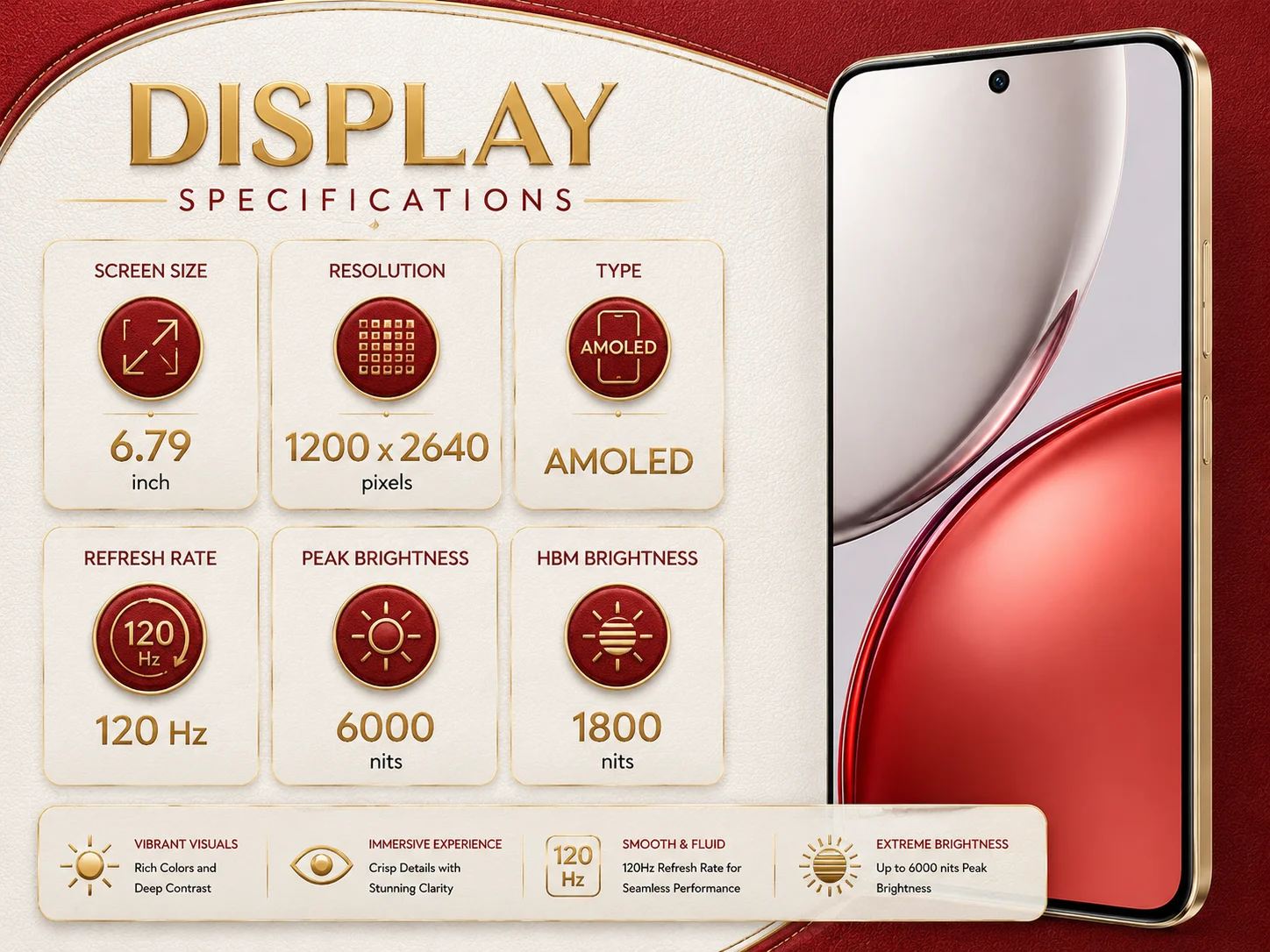
Screen Size
6.79 inch
Resolution
1200 x 2640 pixels
Type
Amoled
Refresh Rate
120 Hz
Peak Brightness
6000 nits
HBM Brightness
1800 nits
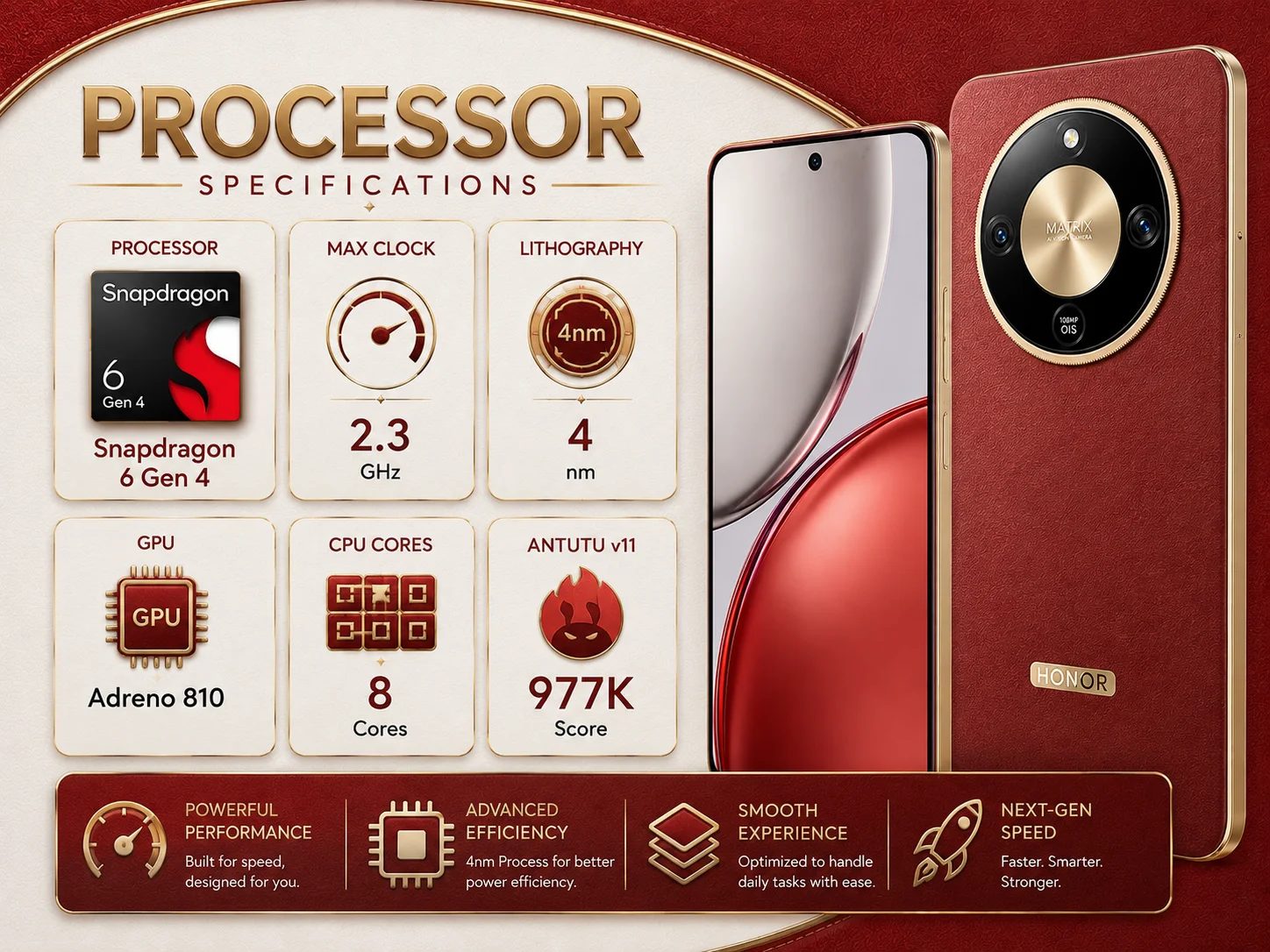
Processor
Snapdragon 6 Gen 4
Max Clock
2.3 GHz
Lithography
4 nm
GPU
Adreno 810
CPU Cores
8 Cores
Antutu v11
977 K
Antutu v10
775 K
Bootup Time
-
Architecture
1 x 2.3 GHz Cortex-A720s
3 x 2.2 GHz Cortex-A720s
4 x 1.8 GHz Cortex-A520s
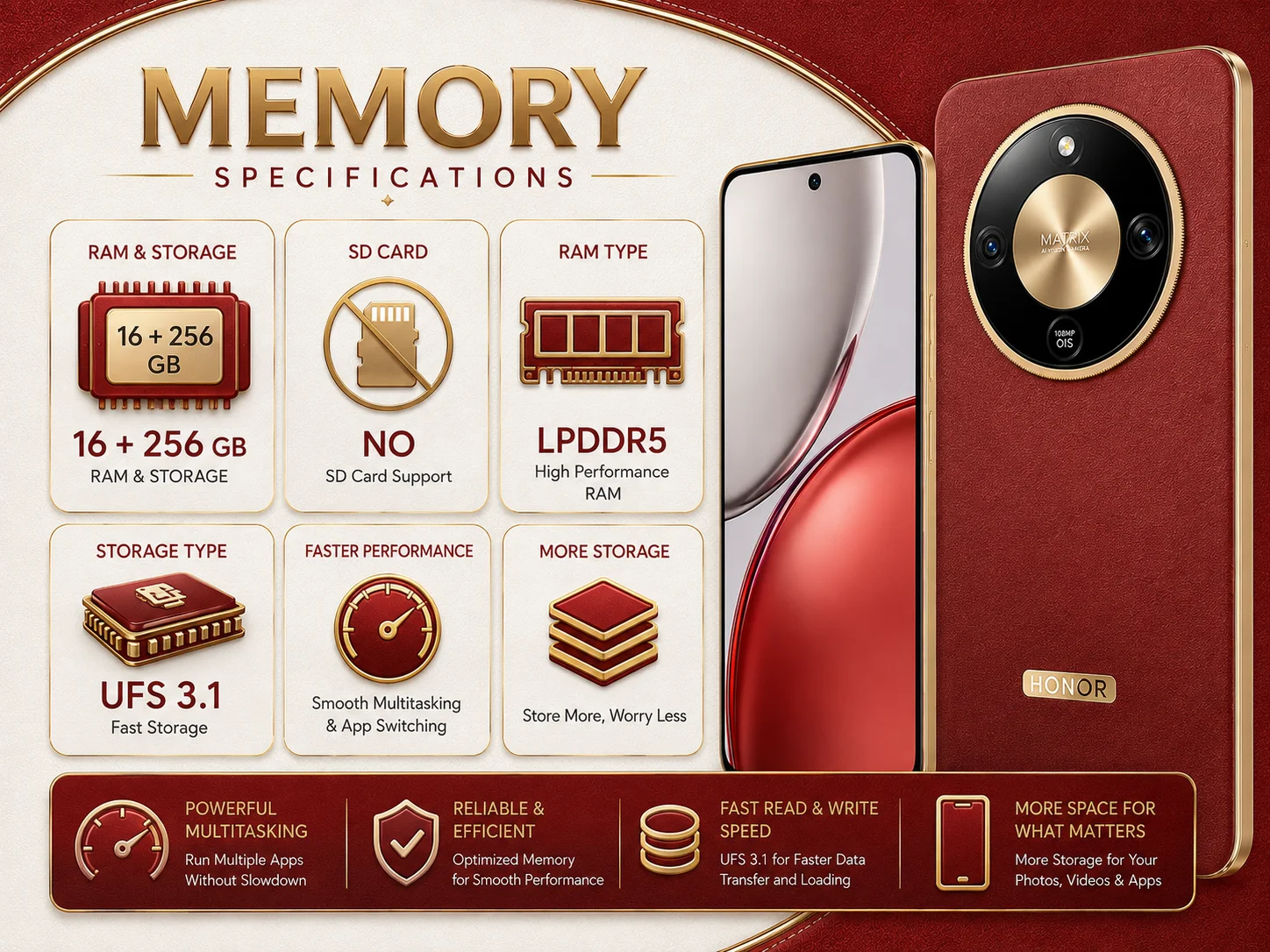
Ram Memory
12 + 256 GB
Ram Type
LPDDR5
Storage Type
UFS 3.1
SD Card
No
Variants
8 + 256 GB
12 + 256 GB
12 + 512 GB
MP
Rear Camera
108 + 5 MP
Front Camera
16 MP
SENSORS
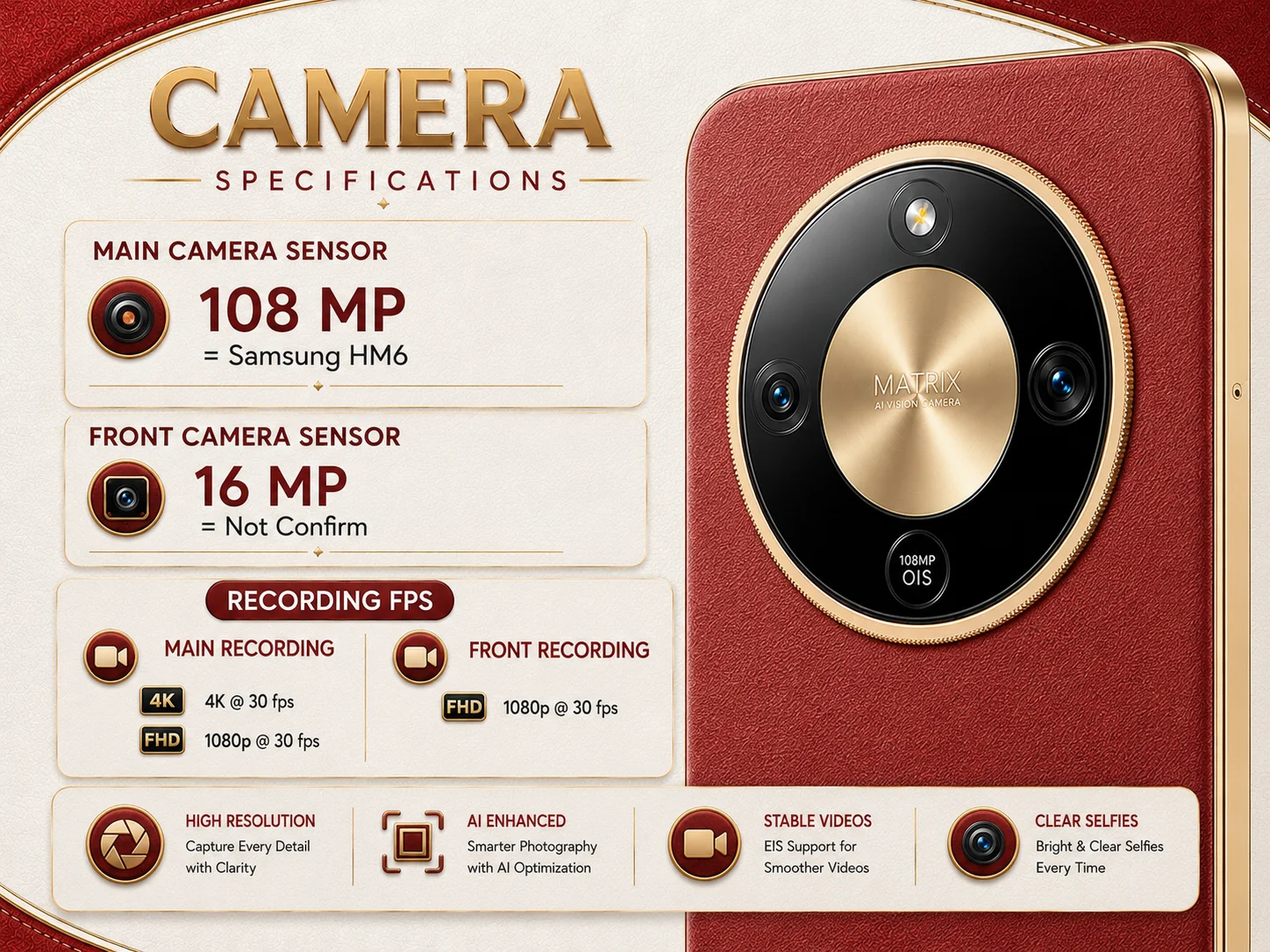
Camera Sensors
108 MP = Samsung HM6
Front Sensors
16 MP = Not Confirm
RECORDING FPS
Main Recording
4K @ 30 fps
1080p @ 30 fps
Front Recording
1080p @ 30 fps
RESOLUTION
Main Resolution
12,000 × 9,000 pixels
Front Resolution
4616 × 3462 Pixels
ZOOM
Optical Zoom
-
D Digital Zoom
-
Stabilization
Yes
FLASH
Flash
Yes
Front Flash
Screen Flash
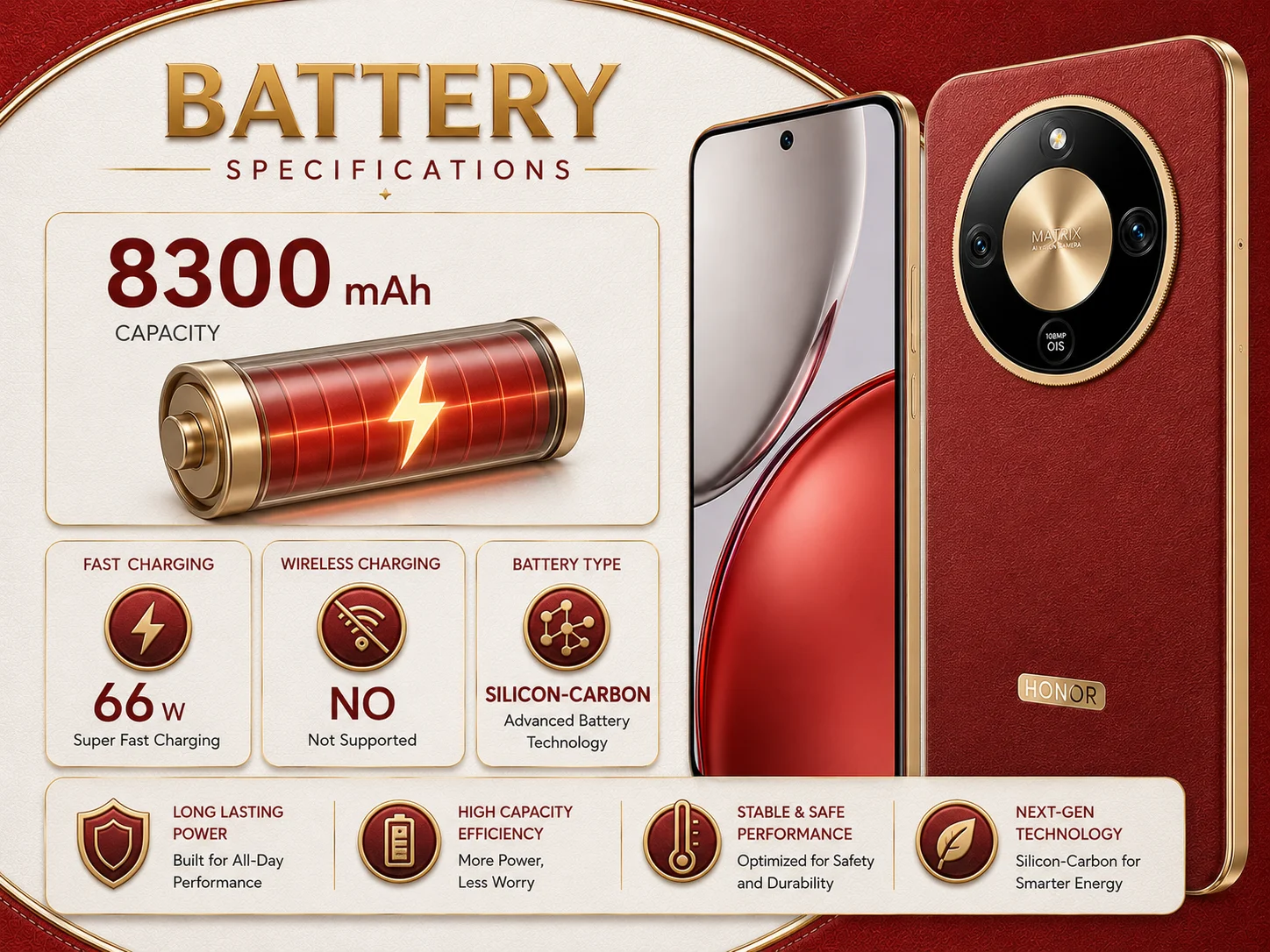
Capacity
8300 mAh
Fast Charging
66 W
Wireless Charging
No
Li Battery Type
Silicon-Carbon
REVERSE
Reverse Wired
7.5 W
Reverse Wireless
Not confirm
OTHER
Battery PC Marks
Not Confirm
Charging Time
Not Confirm
AUDIO & SENSORS
Speaker
Dual Stereo Speaker
Fingerprint Sensor
Front Finger
Other Sensors
Accelerometer
Gyroscope
Proximity
Compass
etc
BASIC INFO
Mobile
Honor X9d
Series
Number Series
Category
Mid Range
Release Date
9 October,2025
Year
2025
CONNECTIVITY
Sim
Nano-SIM + Nano-SIM
Network
4G / 4G+ / 5G
WiFi
WiFi 6
Bluetooth
5.3
NFC
Yes
OS
Android 15
BODY
Dimensions
161.9 x 76.1 x 7.8 mm
Build
Frame And Back ( Plastic )
KG Weight
193 g
Screen Size
6.79 inch
Resolution
1200 x 2640 pixels
Type
Amoled
Refresh Rate
120 Hz
Peak Brightness
6000 nits
HBM Brightness
1800 nits
Processor
Snapdragon 6 Gen 4
Max Clock
2.3 GHz
Lithography
4 nm
GPU
Adreno 810
CPU Cores
8 Cores
Antutu v11
977 K
Antutu v10
775 K
Bootup Time
-
Architecture
1 x 2.3 GHz Cortex-A720s
3 x 2.2 GHz Cortex-A720s
4 x 1.8 GHz Cortex-A520s
Ram Memory
12 + 256 GB
SD Card
No
Ram Type
LPDDR5
Storage Type
UFS 3.1
Variants
8 + 256 GB
12 + 256 GB
12 + 512 GB
MP
Rear Camera
108 + 5 MP
Front Camera
16 MP
SENSORS
Main Camera Sensors
108 MP = Samsung HM6
Front Camera Sensors
16 MP = Not Confirm
RECORDING FPS
Main Recording
4K @ 30 fps
1080p @ 30 fps
Front Recording
1080p @ 30 fps
RESOLUTION
Main Resolution
12,000 × 9,000 pixels
Front Resolution
4616 × 3462 Pixels
ZOOM
Optical Zoom
-
D Digital Zoom
-
Stabilization
Yes
FLASH
Flash
Yes
Front Flash
Screen Flash
Capacity
8300 mAh
Fast Charging
66 W
Wireless Charging
No
Li Battery Type
Silicon-Carbon
REVERSE
Reverse Wired
7.5 W
Reverse Wireless
Not confirm
OTHER
Battery Life PCMark
Not Confirm
Charging Time
Not Confirm
AUDIO & SENSORS
Speaker
Dual Stereo Speaker
Fingerprint Sensor
Front Finger
Other Sensors
Accelerometer
Gyroscope
Proximity
Compass
etc

Highlights & Review Of Honor X9d

Display Review:

The Honor X9d houses a 6.79-inch AMOLED panel at PKR 140,000, but its 1200 x 2640 FHD+ resolution is a step behind all three rivals. The Redmi Note 15 Pro+ (PKR 156,000) and Realme 15 Pro (PKR 132,000) both run 1.5K panels at 1280 x 2772 and 1280 x 2800 respectively, while the Infinix GT 50 Pro (PKR 158,000) matches at 1208 x 2644.

That resolution gap means text and fine detail will look noticeably softer on the Honor X9d next to any of these three, even though the difference won’t jump out during normal scrolling.

Refresh rate tells a similar story. The Honor X9d and Redmi Note 15 Pro+ both cap out at 120Hz, while the Realme 15 Pro and Infinix GT 50 Pro push 144Hz, giving those two an edge for fast scrolling and competitive gaming.

Brightness is where the X9d claws some ground back. Honor rates the X9d at 1800 nits HBM and 6000 nits peak, which actually beats the Redmi Note 15 Pro+’s 3200 nits peak and comes close to the Realme 15 Pro’s 6500 nits peak, both of which also share the X9d’s 1800 nits HBM rating.

The Infinix GT 50 Pro trails here at 1600 nits HBM and 4500 nits peak. Outdoor visibility should be strong across all four phones, with the Honor X9d and Realme 15 Pro likely leading in direct sunlight.

Verdict: The Honor X9d’s display holds its own on brightness but loses on sharpness and refresh rate to the Realme 15 Pro, which offers a 1.5K 144Hz panel at a lower price. Buyers who prioritize screen sharpness and smoothness should lean toward the Realme 15 Pro instead.

Processor Review:

The Honor X9d runs on the Snapdragon 6 Gen 4, an octa-core chipset paired with the Adreno 810 GPU, scoring around 985,714 on AnTuTu v11. At PKR 140,000, that puts it well behind all three rivals in raw power.

The Redmi Note 15 Pro+ (PKR 156,000) uses the Snapdragon 7s Gen 4 and scores roughly 1,050,000 on AnTuTu v11, giving it a meaningful edge over the X9d for multitasking and heavier apps. The Realme 15 Pro (PKR 132,000) steps up further with the Snapdragon 7 Gen 4, landing around 1,086,379 on AnTuTu v11, the strongest Qualcomm chip of the group and notably cheaper than the X9d.

The real gap, though, is the Infinix GT 50 Pro (PKR 158,000), which runs MediaTek’s Dimensity 8400 Ultimate paired with a Mali-G720 MC7 GPU and posts around 2,137,843 on AnTuTu v11, more than double the X9d’s score. That’s not a marginal difference, the GT 50 Pro is built specifically as a gaming phone with liquid cooling to sustain that performance, so the gap should hold up in extended sessions rather than throttle away.

For everyday use like social apps, browsing, and light multitasking, the X9d’s Snapdragon 6 Gen 4 will feel adequate. But for anyone running demanding games at high settings or wanting real multitasking headroom, the X9d clearly trails the Redmi Note 15 Pro+ and Realme 15 Pro, and it isn’t in the same class as the Infinix GT 50 Pro at all.

Verdict: The Honor X9d has the weakest processor in this group by a wide margin. Buyers focused on performance and gaming should go for the Infinix GT 50 Pro, while the Realme 15 Pro offers the best balance of price and power among the rest.

Ram & Memory Review:

The Honor X9d ships with 12GB of RAM and 256GB of storage at its PKR 140,000 price point, and there’s no card slot for expansion, a firm decision Honor has made across the X9d lineup. The storage’s UFS generation hasn’t been disclosed on GSMArena’s listing, so buyers can’t verify write speed claims against rivals directly.

The Xiaomi Redmi Note 15 Pro Plus (PKR 156,000) matches the 12GB RAM figure but doubles storage to 12GB+512GB on UFS 2.2, giving noticeably more headroom for apps and media, though UFS 2.2 is actually a step behind in raw throughput compared to newer standards. The Realme 15 Pro (PKR 132,000) also offers 12GB+512GB, but on UFS 3.1, which is faster than the Redmi’s UFS 2.2 despite costing PKR 8,000 less than the Honor. That makes the Realme the strongest specs-per-rupee pick here for anyone who wants more storage and quicker file transfers.

The Infinix GT 50 Pro (PKR 158,000) is the standout on raw speed, pairing 12GB LPDDR5X RAM with UFS 4.0/4.1 storage (GSMArena’s spec sheet lists UFS 4.0 while its review text cites UFS 4.1, so treat this as unconfirmed), though its 256GB capacity at this price matches the Honor rather than beating it. None of these four phones support microSD expansion, so storage tier at purchase is a permanent decision for every buyer in this comparison.

Verdict: The Honor X9d’s 256GB ceiling and undisclosed storage speed make it the weakest value here on memory alone. Buyers prioritizing storage should look at the Redmi Note 15 Pro Plus or Realme 15 Pro instead, with the Realme edging ahead on price-to-spec ratio.

Cameras Review:

The Honor X9d carries a dual rear setup of a 108MP f/1.8 main sensor with OIS and a 5MP f/2.2 ultrawide, backed by a 16MP f/2.5 front camera, all capped at 1080p@30fps on the front and 4K@30fps on the rear. At PKR 140,000, that’s the least ambitious camera spec of the four.

The Xiaomi Redmi Note 15 Pro Plus (PKR 156,000) jumps to a 200MP f/1.7 main sensor with a larger 1/1.4-inch sensor size and OIS, an 8MP f/2.2 ultrawide, and a 32MP front camera that also shoots 1080p at up to 60fps, meaning sharper crops and better low-light gathering than the Honor’s smaller sensor.

The Realme 15 Pro (PKR 132,000) takes a different route with a 50MP Sony IMX896 main sensor with OIS paired to a genuinely useful 50MP ultrawide, something none of the other three phones match, plus a 50MP front camera, its rear main tops out at 4K@30fps while the front records 4K@30fps too. For anyone who actually uses the ultrawide lens regularly, the Realme is the only phone here where that lens isn’t a throwaway spec.

The Infinix GT 50 Pro (PKR 158,000) sticks with a 50MP f/1.8 OIS main camera and 8MP ultrawide, but its main sensor size hasn’t been disclosed, so its low-light performance can’t be verified against the others on paper. Its 13MP front camera is the weakest selfie shooter of the group, though its rear video range of 4K@30/60fps and 1080p up to 240fps is the most versatile for slow-motion capture.

Verdict: The Honor X9d has the least confidence-inspiring camera setup of the four, its ultrawide and front camera trail every rival. The Realme 15 Pro is the strongest all-round shooter for the price, with the Redmi Note 15 Pro Plus a close second for main-sensor detail.

Battery Review:

The Honor X9d packs the largest cell here at 8300mAh (Si-C), but charging tops out at 66W wired with no wireless option and no reverse charging listed on its spec sheet. Charging time reports are inconsistent across testers, ranging from roughly 58 minutes to over 90 minutes for a full charge, so treat that figure with some caution until independently retested.

The Xiaomi Redmi Note 15 Pro Plus (PKR 156,000) has the smallest battery of the four at 6500mAh, but its 100W wired charging more than makes up for it, hitting 0-100% in just 48 minutes in GSMArena’s lab test, plus 22.5W reverse wired charging to top up accessories.

The Realme 15 Pro (PKR 132,000) sits in between with a 7000mAh cell and 80W wired charging, reaching full charge in about 61 minutes, and getting to 50% in just 25 minutes, though like the Honor and Redmi it skips wireless charging entirely.

The Infinix GT 50 Pro (PKR 158,000) is the only phone in this group with wireless charging, offering 6500mAh capacity with 45W wired, 30W wireless, and 10W reverse wired charging, though that slower wired speed means it takes the longest to fill up at 67 minutes in GSMArena’s testing. So the trade-off here is stark: the Honor wins on raw capacity but loses on charging speed and features, while the Redmi Note 15 Pro Plus wins comfortably on charging speed despite the smallest battery, and the Infinix is the only one that charges without a cable at all.

Verdict: The Redmi Note 15 Pro Plus offers the best overall charging experience for the price, combining a big enough battery with by far the fastest top-up speed. Buyers who specifically want wireless charging should look at the Infinix GT 50 Pro instead, since none of the other three phones offer it.

Final Verdict :

Across every category tested, the Honor X9d (PKR 140,000) is consistently the weakest performer despite not being the cheapest option, trailing on resolution, refresh rate, processor power, storage speed, camera hardware, and charging speed, its only real strength is raw battery capacity, though even that comes with inconsistently reported charging times.

The Xiaomi Redmi Note 15 Pro Plus (PKR 156,000) wins decisively on charging speed and holds a strong main camera sensor, but it’s also the most expensive phone here while running the smallest battery and an older UFS 2.2 storage standard.

The Infinix GT 50 Pro (PKR 158,000) dominates on raw processing power, doubling the X9d’s AnTuTu score, and is the only phone with wireless charging, making it the clear pick for gaming-first buyers, but its camera sensor sizes are undisclosed and it’s the priciest phone in the group.

The Realme 15 Pro (PKR 132,000), the cheapest phone of the four, wins the display comparison with its 144Hz 1.5K panel, offers the best storage value with UFS 3.1 and 512GB, has the most versatile camera setup with a genuinely usable 50MP ultrawide, and lands a strong second on both processor and charging speed, all while undercutting the Honor X9d by PKR 8,000.

Bottom line: The Realme 15 Pro is the strongest all-round value in this comparison, beating the pricier Honor X9d in nearly every category while costing less, though gaming-focused buyers should still consider the Infinix GT 50 Pro for its raw performance and wireless charging.

Overall Ranking:

  1. Realme 15 Pro (PKR 132,000) — best overall balance of display, camera, storage value, and price
  2. Infinix GT 50 Pro (PKR 158,000) — top pick for gaming performance and wireless charging, at the highest price
  3. Xiaomi Redmi Note 15 Pro Plus (PKR 156,000) — best charging speed and main camera, but priciest for its battery size
  4. Honor X9d (PKR 140,000) — trails on nearly every spec despite not being the cheapest, its main appeal is raw battery capacity

Pros And Cons of Honor X9d

Pros of Mobile

✅ 8300mAh massive battery🔋
✅ IP68/IP69K water resistant💧
✅ Drop resistant 2.5m🛡️
✅ 108MP OIS camera📸
✅ Slim, light body🪶

Cons of Mobile

❌ Only 66W charging⚡
❌ No wireless charging🚫🔌
❌ 5MP ultrawide weak🔍
❌ No microSD slot💾
❌ Plastic frame/back🧱
❌ Mid-tier Snapdragon 6⚙️

Best For - Not Best For

Best For

🎯 Outdoor/travel users🧳
🎯 Heavy battery users🔋
🎯 Drop-prone hands🤲
🎯 Water exposure jobs💦
🎯 Casual photography📷

Not Best For

🚫 Gaming enthusiasts🎮
🚫 Fast-charge lovers⚡
🚫 Wireless charging fans🔌
🚫 Storage expansion needs💾
🚫 Flagship camera seekers📸

Trailer And Unboxing of Honor X9d

Disassembly Or Teardown And Gaming Test of Honor X9d

Camera Test Honor X9d

Samsung Galaxy A56 5G
Redmi Note 15 Pro
OPPO Reno 14 5G
vivo V50
Infinix GT 50 Pro
Realme 15 Pro
Xiaomi Redmi Note 15 Pro Plus

Honor Series Row
Picture of Faisal Ur Rehman

Faisal Ur Rehman

Faisal Rehman is the founder and editor of FSL Specs, where he publishes in-depth smartphone specifications, comparisons, buying guides, and technology insights. With extensive experience in mobile hardware research and technical analysis, he provides accurate and up-to-date information on Android smartphones, processors, displays, cameras, batteries, performance benchmarks, and software features. His goal is to simplify complex specifications and help readers choose the right device with confidence.

FAQs Questions

It runs on the Qualcomm Snapdragon 6 Gen 4 chipset built on a 4nm process, paired with an Adreno 810 GPU. It's a solid mid-range performer suited for everyday use and moderate gaming.

It packs a massive 8300mAh silicon carbon battery with 66W wired charging and 7.5W reverse wired charging. This is genuinely one of the largest batteries in its class, easily good for two days of use

The rear camera is a dual setup with a 108MP f/1.8 main sensor featuring OIS, paired with a 5MP f/2.2 ultrawide lens, while the front camera is a single 16MP f/2.5 sensor. Video recording caps out at 4K30fps on the rear camera.

It's a 6.79-inch AMOLED panel with a 1200x2640 resolution, 120Hz refresh rate, and peak brightness up to 6000 nits. That brightness figure makes outdoor visibility genuinely excellent even in harsh sunlight.

It's available in 8GB or 12GB RAM configurations, paired with 256GB or 512GB of internal storage. There's no microSD card slot, so your storage choice at purchase is final.

Yes, it carries both IP68 and IP69K ratings, meaning it's dust-tight and can survive both immersion up to 6 meters and high-pressure water jets. It's also rated for drop resistance up to 2.5 meters, making it one of the more rugged phones in its segment

It measures 161.9 x 76.1 x 7.8mm and weighs 193 grams. That's impressively slim and light considering the massive battery packed inside it.

12+256 GB
140,000 PKR | 31,000 | 480 $12+256 GB

Leave a Reply

Your email address will not be published. Required fields are marked *

Scroll to Top