














• Mobiles
  • Processors
  • Mobiles
  • Processors
  • Mobiles
  • Processors

✪ Realme GT 7 Pro ✪

Realme GT 7 Pro Specs, Price, Camera, Battery & Best Review (2026)
United States flag United States
$650 USD
…
Pakistan flag Pakistan (PKR)
230,000 PKR
India flag India (INR)
₹65,000 INR

✪ Realme GT 7 Pro ✪

Realme GT 7 Pro Specs, Price, Camera, Battery & Best Review (2026)
Last Time Update : 7 October, 2026
0

Quick Specifications

AMOLED

Display Type

Snapdragon 8 Elite 4

Processor

16 + 512 GB

Ram And Memory

50+50 +8 MP

Camera

6500 mAH

Battery

120 W

Fast Charging

Full Specification

BASIC INFO
Mobile
Realme GT 7 Pro
Model
RMX5011
Series
GT Series
Category
Flagship
Release Date
4 November,2024
Year
2024
CONNECTIVITY
Sim
Nano-SIM + Nano-SIM
Network
4G / 4G+ / 5G/ 5G+
WiFi
Wi-Fi 7
Bluetooth
5.4 v
NFC
Yes
OS
Android 17 (Realme UI 7.0)
BODY
Dimensions
162.5 x 76.9 x 8.6 mm
Build
Glass Front, Aluminum Frame, Glass Back
KG Weight
223 g
Screen Size
6.78 inch
Resolution
1264 x 2780 Pixels
Type
AMOLED
Refresh Rate
120 Hz
Peak Brightness
6500 nits
HBM Brightness
2000 nits
Processor
Snapdragon 8 Elite 4
Processor Link
Max Clock
4.32 GHz
Lithography
3 nm
GPU
Adreno 830
CPU Cores
8 Cores
Antutu v11
2.6 M
Bootup Time
~18s
Architecture
2×4.32 GHz Oryon V2 Phoenix L
6×3.53 GHz Oryon V2 Phoenix M
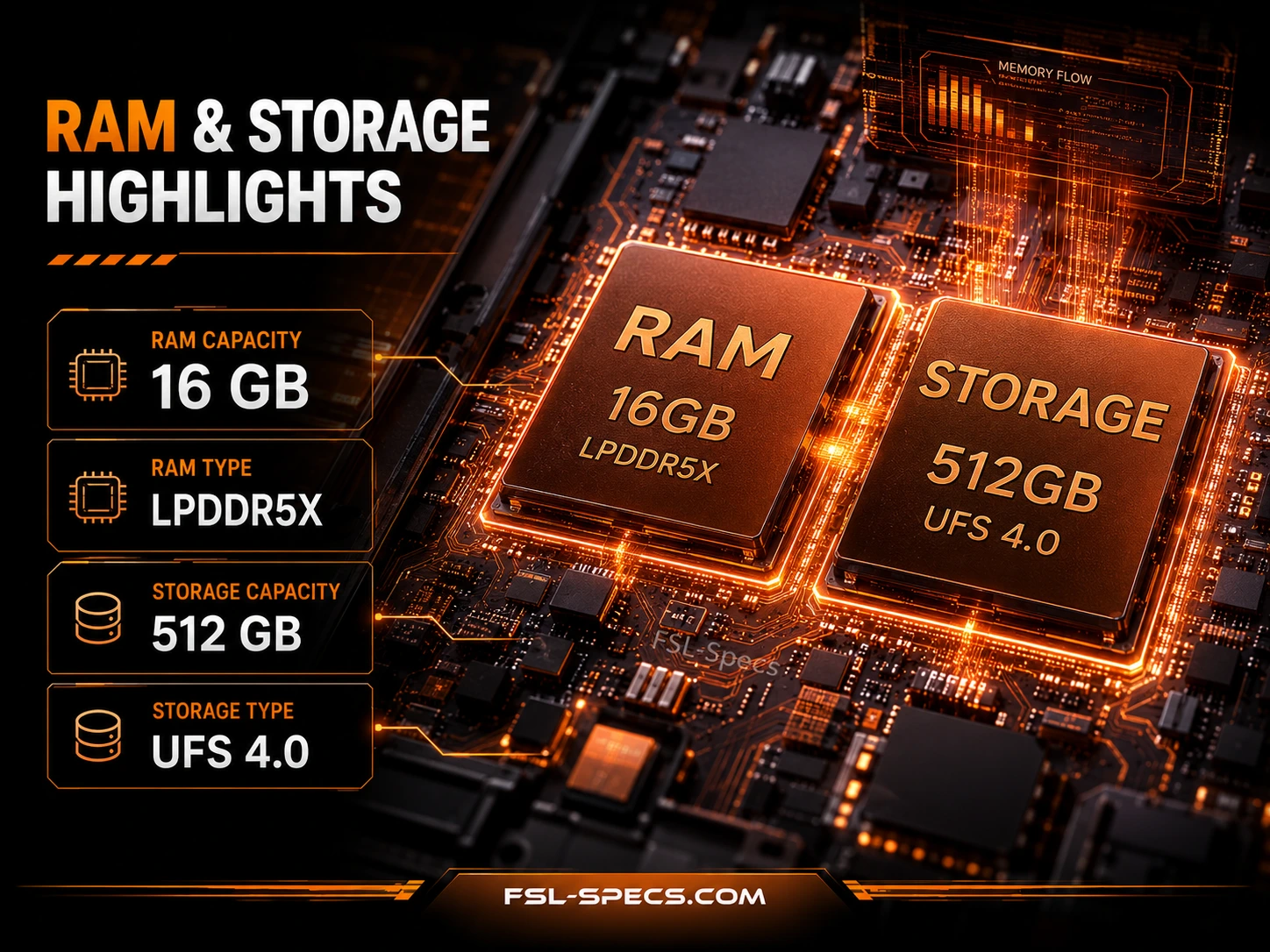
Ram Memory
16 + 512 GB
Ram Type
LPDDR5X
Storage Type
UFS 4.0
SD Card
No
Variants
12 + 256 / 512 GB
16 + 256 / 512 / 1024 GB
MP
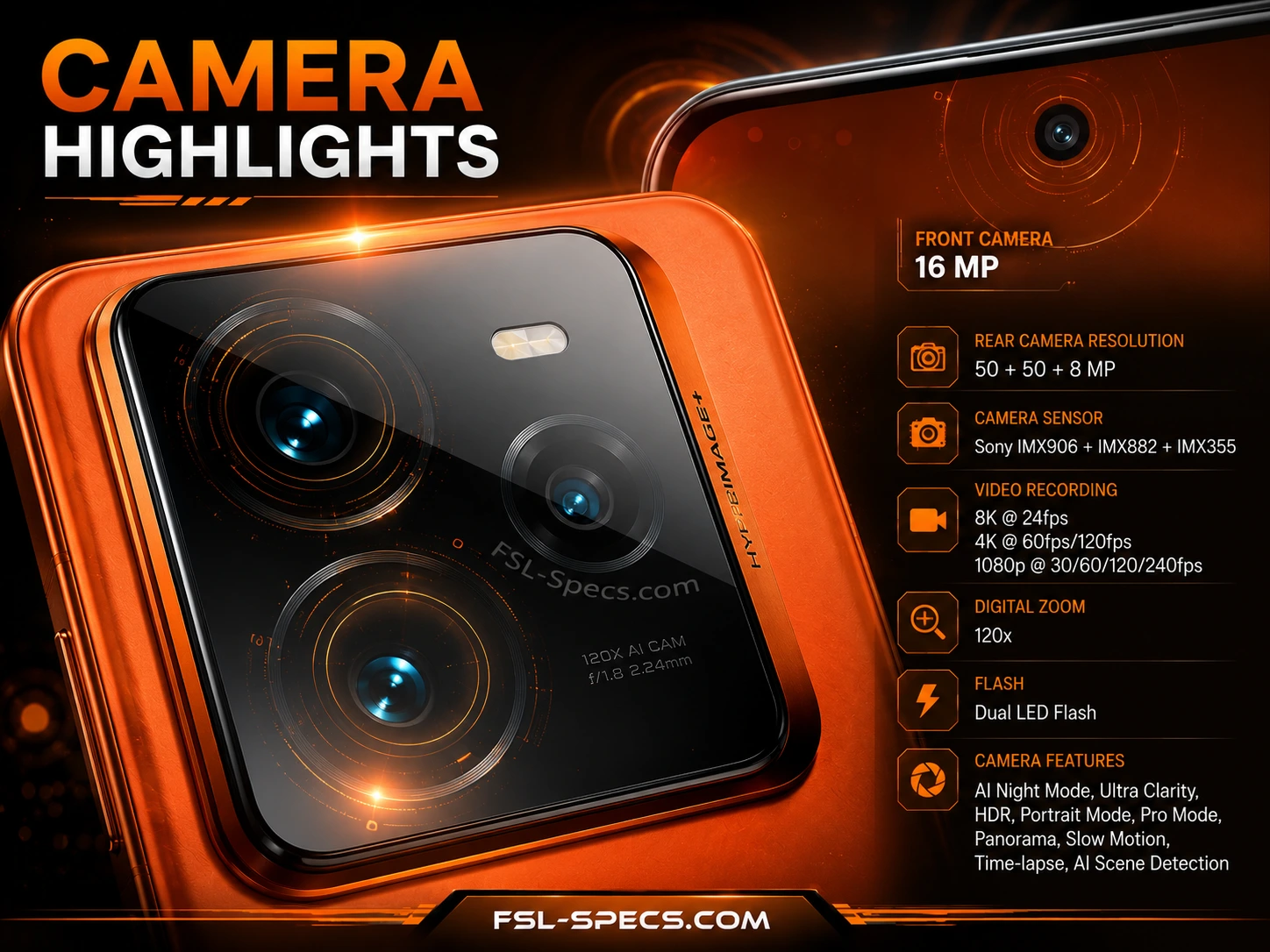
Rear Camera
50+50 +8 MP
Front Camera
16 MP
SENSORS
Camera Sensors
50 MP = Sony IMX906
50 MP = Sony IMX882
8 MP = Sony IMX355
Front Sensors
16 MP = Sony IMX480
RECORDING FPS
Main Recording
8K @ 24fps
4K @ 60fps/120fps
1080p @ 30/60/120/240fps
Front Recording
4K @ 60fps
1080p @ 30/60fps
RESOLUTION
Main Resolution
8192 × 6144 Pixels
Front Resolution
4608 × 3456 Pixels
ZOOM
Optical Zoom
3x
D Digital Zoom
120x
Stabilization
Yes
FLASH
Flash
Dual-LED Flash
Front Flash
Screen Flash
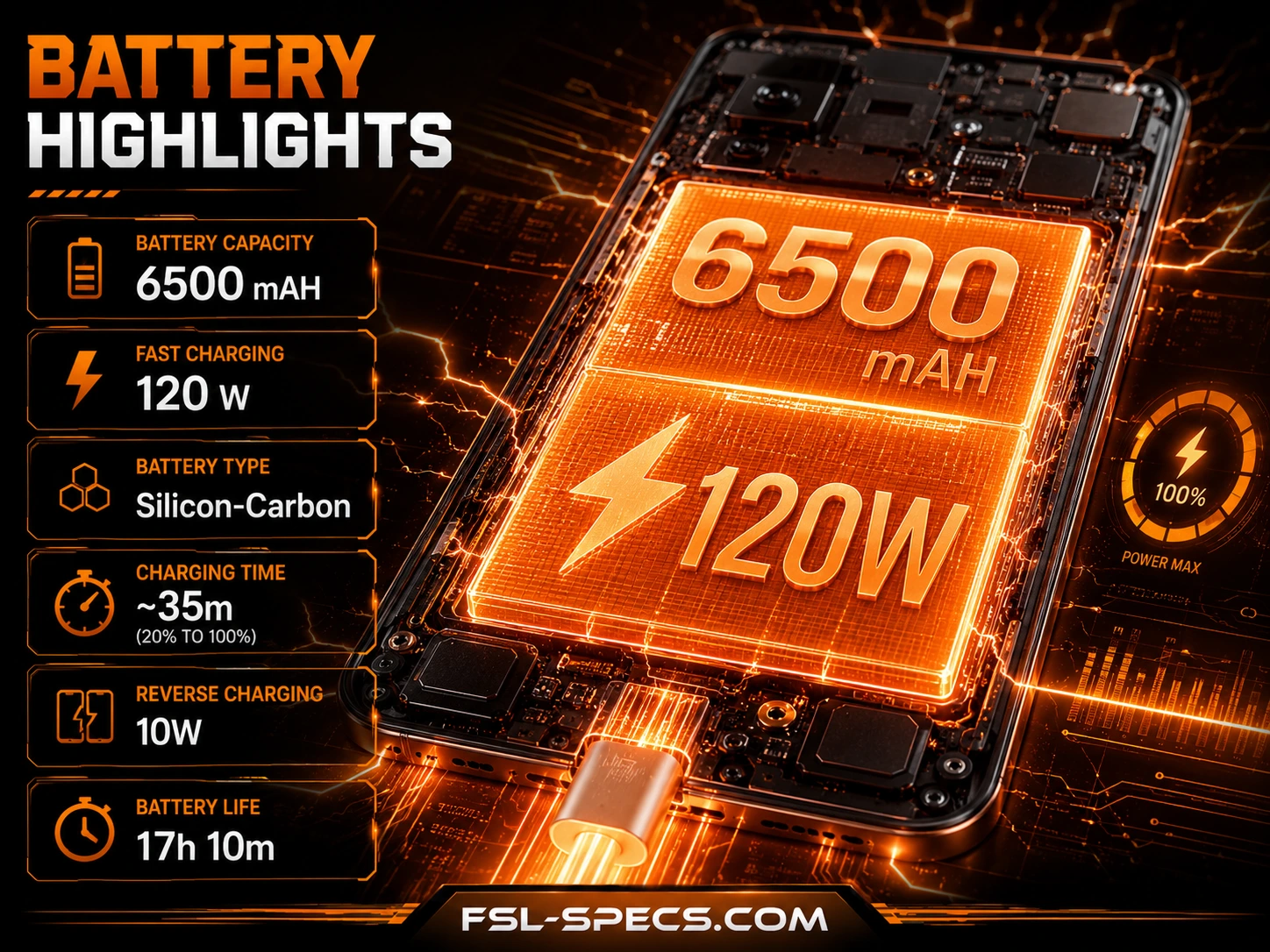
Capacity
6500 mAH
Fast Charging
120 W
Li Battery Type
Silicon-Carbon
REVERSE
Reverse Wired
10W
OTHER
Battery PC Marks
17h 10m
Charging Time
~35m (20% To 100%)
AUDIO & SENSORS
Speaker
Dual Stereo Speaker
Fingerprint Sensor
Hyper Sonic Front Finger
Other Sensors
Accelerometer
Gyroscope
Proximity Sensor
Ambient Light Sensor
Electronic Compass
Infrared (IR) Blaster
Flicker Sensor
X-Axis Linear Vibration Motor
Special Features

–

BASIC INFO
Mobile
Realme GT 7 Pro
Model
RMX5011
Series
GT Series
Category
Flagship
Release Date
4 November,2024
Year
2024
CONNECTIVITY
Sim
Nano-SIM + Nano-SIM
Network
4G / 4G+ / 5G/ 5G+
WiFi
Wi-Fi 7
Bluetooth
5.4 v
NFC
Yes
OS
Android 17 (Realme UI 7.0)
BODY
Dimensions
162.5 x 76.9 x 8.6 mm
Build
Glass Front, Aluminum Frame, Glass Back
KG Weight
223 g
Screen Size
6.78 inch
Resolution
1264 x 2780 Pixels
Type
AMOLED
Refresh Rate
120 Hz
Peak Brightness
6500 nits
HBM Brightness
2000 nits
Processor
Snapdragon 8 Elite 4
Processor Link
Max Clock
4.32 GHz
Lithography
3 nm
GPU
Adreno 830
CPU Cores
8 Cores
Antutu v11
2.6 M
Bootup Time
~18s
Architecture
2×4.32 GHz Oryon V2 Phoenix L
6×3.53 GHz Oryon V2 Phoenix M
Ram Memory
16 + 512 GB
SD Card
No
Ram Type
LPDDR5X
Storage Type
UFS 4.0
Variants
12 + 256 / 512 GB
16 + 256 / 512 / 1024 GB
MP
Rear Camera
50+50 +8 MP
Front Camera
16 MP
SENSORS
Main Camera Sensors
50 MP = Sony IMX906
50 MP = Sony IMX882
8 MP = Sony IMX355
Front Camera Sensors
16 MP = Sony IMX480
RECORDING FPS
Main Recording
8K @ 24fps
4K @ 60fps/120fps
1080p @ 30/60/120/240fps
Front Recording
4K @ 60fps
1080p @ 30/60fps
RESOLUTION
Main Resolution
8192 × 6144 Pixels
Front Resolution
4608 × 3456 Pixels
ZOOM
Optical Zoom
3x
D Digital Zoom
120x
Stabilization
Yes
FLASH
Flash
Dual-LED Flash
Front Flash
Screen Flash
Capacity
6500 mAH
Fast Charging
120 W
Li Battery Type
Silicon-Carbon
REVERSE
Reverse Wired
10W
OTHER
Battery Life PCMark
17h 10m
Charging Time
~35m (20% To 100%)
AUDIO & SENSORS
Speaker
Dual Stereo Speaker
Fingerprint Sensor
Hyper Sonic Front Finger
Other Sensors
Accelerometer
Gyroscope
Proximity Sensor
Ambient Light Sensor
Electronic Compass
Infrared (IR) Blaster
Flicker Sensor
X-Axis Linear Vibration Motor
Special Features

–

Highlights & Review Of Realme GT 7 Pro

Display Review:

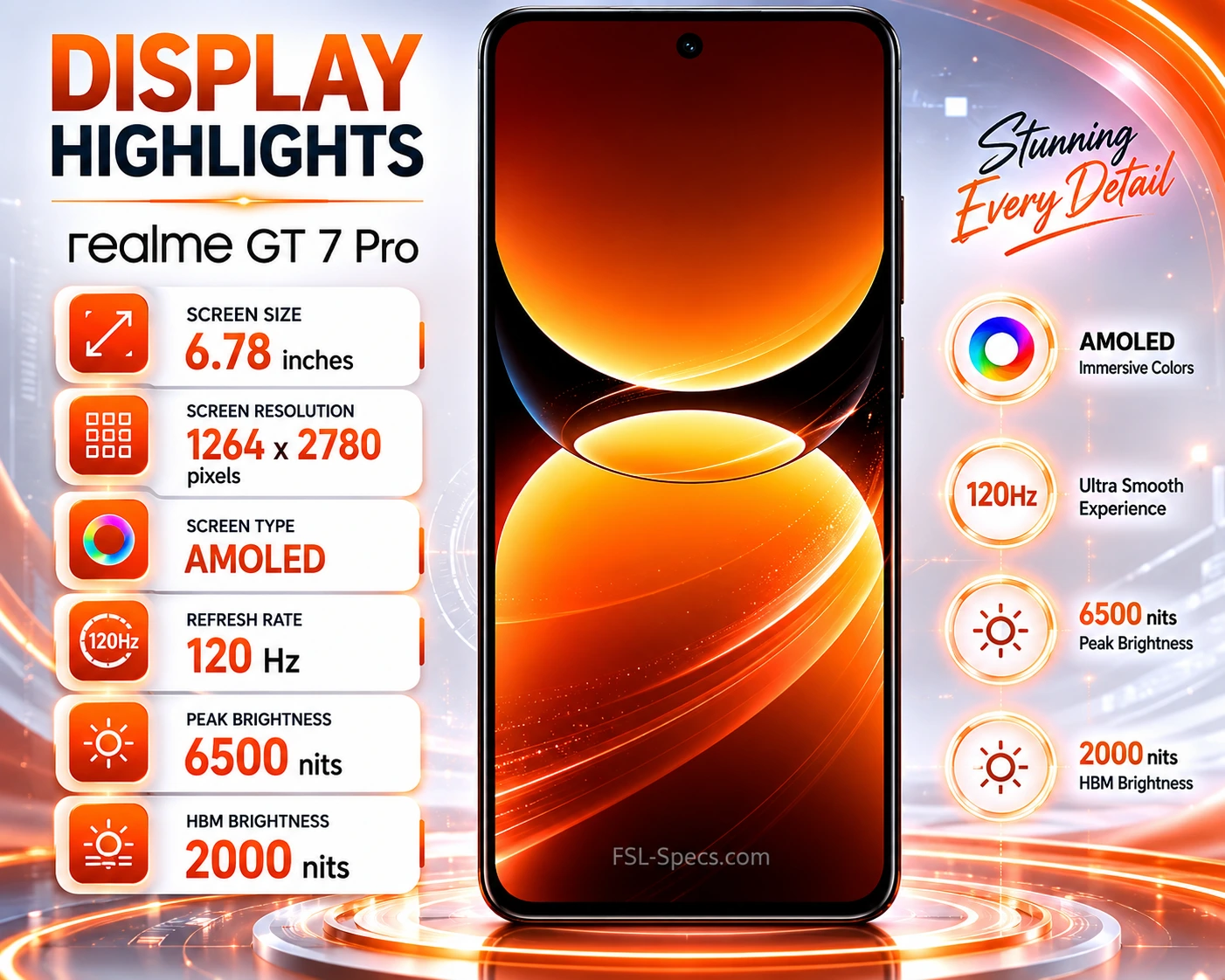
The Realme GT 7 Pro’s 6.78-inch LTPO AMOLED display hits a 6500 nits peak brightness, the highest figure in this comparison and well ahead of the Xiaomi 17T Pro’s 3500 nits. The iQOO 13 sits closer to the GT 7 Pro at 4500 nits peak with 1800 nits HBM, while the Poco F7 Ultra trails the group at 3200 nits peak and 1800 nits HBM.

On refresh rate, the Xiaomi 17T Pro and iQOO 13 both reach 144Hz, ahead of the Realme GT 7 Pro and Poco F7 Ultra, which top out at 120Hz. Resolution favors the Poco F7 Ultra’s 3200×1440 WQHD+ panel at 526 PPI, edging out the iQOO 13’s 3168×1440 panel at roughly 510 PPI, with the Realme GT 7 Pro’s 2780×1264 and Xiaomi 17T Pro’s 2772×1280 panels both landing lower, a gap that shows up mainly in close-up text sharpness rather than everyday scrolling.

A differentiator the headline numbers miss: the Realme GT 7 Pro and iQOO 13 both use LTPO panels that scale refresh rate down to 1Hz for static screens, while the Xiaomi 17T Pro and Poco F7 Ultra run fixed high-refresh panels without that adaptive range, meaning the two LTPO phones should draw less power on standby and reading despite similar or lower peak refresh figures.

All four phones use AMOLED technology with HDR10+ and Dolby Vision support. The Realme GT 7 Pro, Xiaomi 17T Pro, and Poco F7 Ultra are confirmed with Gorilla Glass 7i protection, while the exact cover glass on the iQOO 13’s display hasn’t been officially disclosed.

Verdict: For outdoor visibility and standby efficiency, the Realme GT 7 Pro’s 6500-nit peak and LTPO panel make it the strongest all-round display here, though buyers who prioritize faster motion clarity should note both the Xiaomi 17T Pro and iQOO 13 offer 144Hz against the GT 7 Pro’s 120Hz cap.

Processor Review:

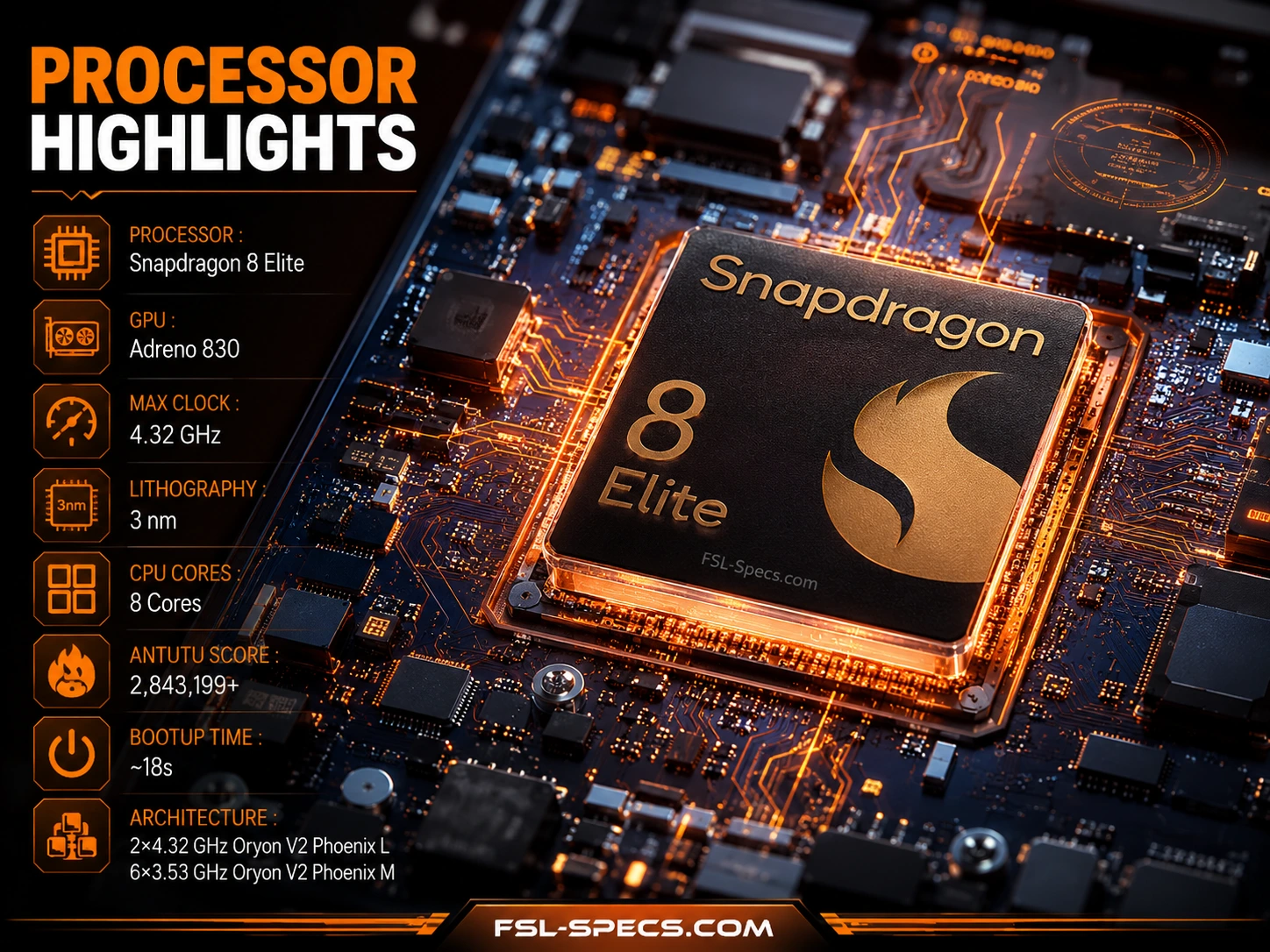
The Realme GT 7 Pro’s Snapdragon 8 Elite scores 2,746,604 on AnTuTu v10 (16GB/512GB unit, GSMArena test), a chipset it shares with the Poco F7 Ultra at 2,843,461 (POCO’s own v10 lab test) and the iQOO 13 at roughly 2,950,000 (aggregated v10 result), meaning all three phones run identical silicon with the score spread coming from software tuning and thermal management rather than hardware differences.

That puts the Poco F7 Ultra about 3.5% ahead of the Realme GT 7 Pro, and the iQOO 13 roughly 7.4% ahead of the GT 7 Pro and 3.7% ahead of the Poco F7 Ultra, a gap of only a few percentage points that is unlikely to be noticeable outside back-to-back benchmark runs. iQOO’s own marketing has claimed a higher 3,159,448 v10 score for the iQOO 13, while independent tests including GSMArena’s lab run came in lower at around 2.79 million, so the higher figure should be treated as a best-case result rather than typical.

The Xiaomi 17T Pro breaks from the pack with a MediaTek Dimensity 9500, a newer chipset generation benchmarked only on AnTuTu v11, where it averages 3,323,591, a version gap that makes a direct numeric comparison against the Snapdragon 8 Elite trio’s v10 scores unreliable.

GSMArena’s own testing describes the Dimensity 9500 as trading blows with current-generation Snapdragon 8 Elite Gen 5 silicon, putting it a tier above the older Snapdragon 8 Elite used in the other three phones here. In Geekbench 6, the Xiaomi 17T Pro also posts the group’s highest multi-core score at 10,348, ahead of the Realme GT 7 Pro’s 9,380.

Verdict: The Realme GT 7 Pro, Poco F7 Ultra, and iQOO 13 deliver near-identical Snapdragon 8 Elite performance within a 3 to 7% AnTuTu spread that won’t be felt in daily use, while the Xiaomi 17T Pro’s newer Dimensity 9500 gives it a genuine generational edge in raw benchmark and multi-core numbers, making it the pick for buyers chasing the highest performance ceiling rather than parity among three otherwise similar chips.

Ram & Memory Review:

All four phones in this comparison use LPDDR5X RAM, but the Realme GT 7 Pro pairs its 16GB RAM with UFS 4.0 storage, one generation behind the UFS 4.1 used in the Xiaomi 17T Pro’s 12GB configuration, the Poco F7 Ultra’s 16GB configuration, and the iQOO 13’s 16GB configuration.

UFS 4.1 offers faster sequential read and write speeds and better sustained performance under heavy file transfers than UFS 4.0, meaning the Realme GT 7 Pro could lag slightly behind the other three in large app installs and 4K video exports, though the gap is unlikely to show up in everyday tasks like opening apps or browsing. The iQOO 13 brands its memory as LPDDR5X Ultra, which iQOO says can reach up to 9,600 Mbps transfer speed, though this is still the same LPDDR5X standard as the other three phones rather than a distinct memory generation.

RAM capacity is where the Xiaomi 17T Pro breaks from parity: at 12GB, it carries 4GB less than the 16GB Realme GT 7 Pro, Poco F7 Ultra, and iQOO 13 at this price point, a real difference for users who keep many apps open simultaneously, even though 12GB is still comfortable for typical day-to-day use. One caveat worth flagging: Poco’s own spec sheet notes that UFS 4.1 on the F7 Ultra “will start to release via OTA” with rollout timing varying by region, so early units could initially ship running UFS 4.0 firmware until updated.

None of the four phones offer a microSD card slot, so buyers on any of them are locked into whatever internal storage they choose at purchase, with no path to cheap capacity expansion later.

Verdict: The Xiaomi 17T Pro’s newer UFS 4.1 storage is offset by 4GB less RAM than its rivals, making the Poco F7 Ultra and iQOO 13 the stronger overall memory packages here, since both pair 16GB LPDDR5X RAM with UFS 4.1 storage without the Realme GT 7 Pro’s older UFS 4.0 interface.

Cameras Review:

The iQOO 13 stands out as the only phone here with autofocus on its ultrawide camera, a 50MP Samsung ISOCELL JN1 unit, while the Realme GT 7 Pro’s 8MP Sony IMX355, the Xiaomi 17T Pro’s 12MP unit, and the Poco F7 Ultra’s 32MP Samsung KD1 ultrawide are all fixed-focus, meaning none of those three can lock focus for close-up ultrawide shots the way the iQOO 13 can.

On the main camera, the Xiaomi 17T Pro uses the largest sensor of the group, a 1/1.31-inch Light Fusion 950 paired with a f/1.67 aperture and OIS, ahead of the Poco F7 Ultra’s 1/1.55-inch Light Fusion 800 at f/1.6, the Realme GT 7 Pro’s 1/1.56-inch Sony IMX906 at f/1.8, and the iQOO 13’s 1/1.56-inch Sony IMX921 at f/1.9, with all four confirmed to carry OIS on the main lens. A larger sensor generally gathers more light per pixel, giving the Xiaomi 17T Pro a theoretical low-light edge despite the Poco F7 Ultra’s wider aperture number.

Zoom reach separates the four sharply: the Xiaomi 17T Pro’s 50MP periscope telephoto reaches 5x optical zoom (115mm), ahead of the Realme GT 7 Pro’s 3x (73mm), the Poco F7 Ultra’s 2.5x (60mm), and the iQOO 13’s 2x (50mm). The first three are confirmed with OIS on the telephoto lens, though OIS on the iQOO 13’s telephoto is inconsistently reported across sources and should be treated as unconfirmed. For video, the Xiaomi 17T Pro also leads with 4K at 120fps, while the other three cap out at 4K60fps, with 8K capture available on all four at either 24fps or 30fps depending on the phone.

Front cameras split into two tiers: the Xiaomi 17T Pro, Poco F7 Ultra, and iQOO 13 all use 32MP selfie sensors, while the Realme GT 7 Pro’s 16MP Sony IMX480 trails the group.

Verdict: The Xiaomi 17T Pro’s larger main sensor, longer 5x zoom, and 120fps 4K video make it the strongest all-round camera system here, while the iQOO 13’s autofocus ultrawide remains the one hardware advantage none of the other three phones can match.

Battery Review:

The Xiaomi 17T Pro carries the largest battery here at 7000mAh, ahead of the Realme GT 7 Pro’s 6500mAh (5800mAh on the India variant), the iQOO 13’s 6150mAh (6000mAh in India), and the Poco F7 Ultra’s smaller 5300mAh cell. Despite having the biggest battery, the Xiaomi 17T Pro is not the fastest to refill: its 100W wired charging peaks briefly near 83W before settling into a 40-60W range for most of the cycle, making it measurably slower to top up than the 120W systems on the other three phones, according to GSMArena’s testing.

On raw charging speed, the Realme GT 7 Pro and iQOO 13 both use 120W wired charging and reach full in roughly 30 to 40 minutes (the GT 7 Pro at 13 to 14 minutes to 50% and 37 to 40 minutes to 100%, the iQOO 13 a little over 30 minutes to 100%), while the Poco F7 Ultra’s 120W charging is the fastest of the four in testing, hitting 60% in 15 minutes and a full charge in just 30 minutes.

Wireless charging is where the group splits clearly: the Xiaomi 17T Pro and Poco F7 Ultra both support 50W wireless charging, while the Realme GT 7 Pro and iQOO 13 offer no wireless charging at all, a real differentiator for buyers who value charging without cables. Reverse charging tells a similar story: the Xiaomi 17T Pro confirms 22.5W reverse wired charging, while the Realme GT 7 Pro and iQOO 13 have none. The Poco F7 Ultra’s reverse charging support is inconsistently reported between retailer listings and GSMArena’s tested spec sheet, so it should be treated as unconfirmed.

Verdict: The Xiaomi 17T Pro offers the most complete charging package with its bigger battery plus wireless and reverse charging support, even though the Realme GT 7 Pro, Poco F7 Ultra, and iQOO 13 all charge faster over a cable thanks to their 120W wired systems.

Final Verdict :

Across five sections, the Xiaomi 17T Pro comes out on top, backed by a newer Dimensity 9500 chipset with a genuine generational lead in processing, the group’s strongest camera system with a larger main sensor and 5x optical zoom, and the most complete charging package with wireless and reverse charging on a 7000mAh battery, even though its 100W wired speed trails the 120W phones here.

The iQOO 13 lands second on the strength of a well-rounded spec sheet: a competitive Snapdragon 8 Elite AnTuTu score, the only autofocus-equipped ultrawide camera in the comparison, and native UFS 4.1 storage on its 16GB variant, though it gives up ground on camera zoom reach and charging versatility.

The Realme GT 7 Pro takes third, anchored by the standout display in this group at 6500 nits peak brightness and a genuinely capable 3x zoom camera system, but held back by older UFS 4.0 storage and no wireless charging. The Poco F7 Ultra rounds out the list; it is competitive on RAM, storage, and charging speed, but its weaker display peak brightness and shorter 2.5x zoom keep it from climbing higher, and it also carries the highest fixed price of the four at PKR 250,000.

Bottom line: the Xiaomi 17T Pro is the strongest all-round performer of this group, but buyers prioritizing display brightness or a lower price ceiling should look closely at the Realme GT 7 Pro instead.

Ranking:

  1. Xiaomi 17T Pro – PKR 262,000
  2. iQOO 13 – PKR 220,000-250,000
  3. Realme GT 7 Pro – PKR 220,000-250,000
  4. Poco F7 Ultra – PKR 250,000
Section1st2nd3rd4th
DisplayRealme GT 7 ProiQOO 13Xiaomi 17T ProPoco F7 Ultra
ProcessorXiaomi 17T ProiQOO 13Poco F7 UltraRealme GT 7 Pro
RAM & MemoryiQOO 13Poco F7 UltraXiaomi 17T ProRealme GT 7 Pro
CameraXiaomi 17T ProRealme GT 7 ProPoco F7 UltraiQOO 13
BatteryXiaomi 17T ProPoco F7 UltraRealme GT 7 ProiQOO 13
OverallXiaomi 17T ProiQOO 13Realme GT 7 ProPoco F7 Ultra

Pros And Cons of Realme GT 7 Pro

Pros of Mobile

✅ Snapdragon 8 Elite Gen 5
✅ 7000mAh battery
✅ 120W charging
✅ 200MP periscope camera
✅ 2K ,144Hz AMOLED display
✅ Ultrasonic fingerprint sensor
✅ 50W wireless charging
✅ Bright LTPO display
✅ IP69 water resistance

Cons of Mobile

❌Gorilla Glass 7i protection lags
❌Only four Android updates
❌No wireless charging
❌Average ultrawide camera
❌Bulky & heavy
❌Limited global availability

Best For - Not Best For

Best For

✅Heavy gamers
✅Power users
✅Budget flagship seekers
✅Long battery life
✅Fast charging fans
✅Outdoor use

Not Best For

❌Wireless charging lovers
❌Compact phone fans
❌Light users

Trailer And Unboxing of Realme GT 7 Pro

Disassembly Or Teardown And Gaming Test of Realme GT 7 Pro

Camera Test Realme GT 7 Pro

Xiaomi 17 Pro
Poco f7 Ultra
iqoo 13
Vivo X200 Pro
Xiaomi 15
Oneplus 13
Realme GT 7

Realme Mobile Series

Realme Mobile Series

FAQs Questions
Picture of Faisal Ur Rehman

Faisal Ur Rehman

Faisal Rehman is the founder and editor of FSL Specs, where he publishes in-depth smartphone specifications, comparisons, buying guides, and technology insights. With extensive experience in mobile hardware research and technical analysis, he provides accurate and up-to-date information on Android smartphones, processors, displays, cameras, batteries, performance benchmarks, and software features. His goal is to simplify complex specifications and help readers choose the right device with confidence.

The Realme GT 7 Pro uses a 6.78-inch LTPO AMOLED display with a 1264 x 2780 pixel resolution , 6500 Nits Brightness

The GT 7 Pro runs on the Qualcomm Snapdragon 8 Elite on a 3nm process the flagship chip from Qualcomm released in late 2024.

The GT 7 Pro uses LPDDR5X RAM in 12GB or 16GB configurations paired with UFS 4.0 storage ranging from 256GB up to 1TB.

Three rear cameras a 50MP Sony IMX906 main camera with f/1.8 aperture and OIS, a 50MP periscope telephoto with 3x optical zoom and OIS, and an 8MP 122-degree ultrawide lens. 16MP Front Camera

The global version of the GT 7 Pro carries a 6500mAh silicon-carbon Li-Ion battery With 120 W Fast Charging.

16 + 512 GB
₨230,000 | ~₹65,000 | ~$650

Scroll to Top