
Snapdragon 8 Elite Gen 4
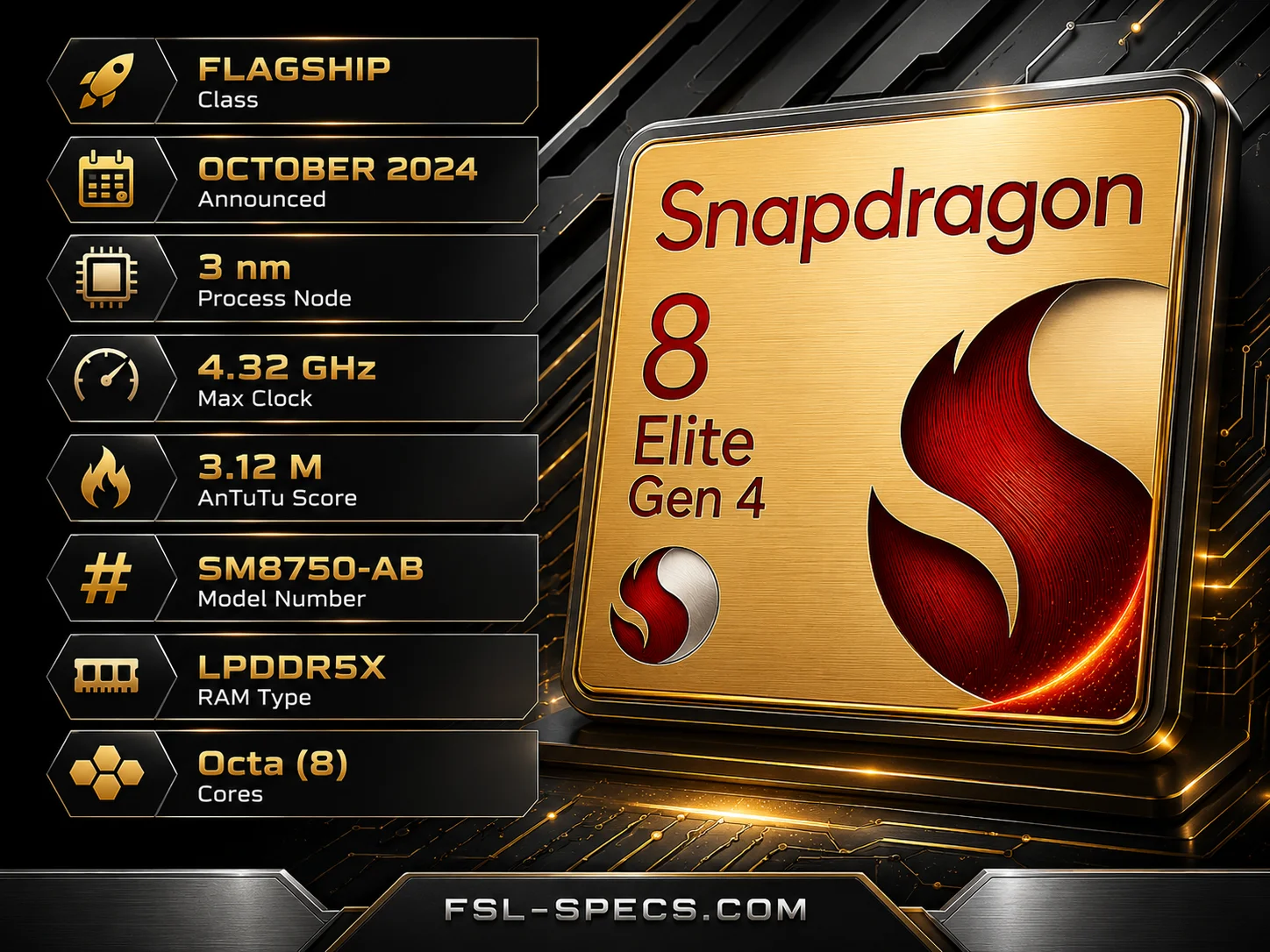
The Qualcomm Snapdragon 8 Elite Gen 4 is Qualcomm's flagship 5G chipset built on a 3nm process, using Qualcomm's custom 2× Oryon (Phoenix L) cores up to 4.32GHz and 6× Oryon (Phoenix M) cores up to 3.53GHz, paired with the Adreno 830 GPU. With LPDDR5X memory, UFS 4.0/4.1 storage, the Hexagon NPU for on-device AI, integrated Snapdragon X80 5G modem, Wi‑Fi 7, and Bluetooth 6.0, it's built for top-tier flagship performance.
Benchmark Scores
Measures CPU, GPU, RAM, and I/O performance in different scenarios.
Shows raw single-threaded CPU performance across real-world workloads.
Cross-platform benchmark assessing graphics performance in Vulkan/Metal.
Evaluates overall system performance in everyday workloads.
CPU & AI Performance
6× Oryon (Phoenix M) up to 3.53GHz
Graphics, Memory & Storage
Multimedia (Camera, Display & ISP)
Connectivity
General Info
information About Snapdragon 8 Elite Gen 4
Introduction
The Snapdragon 8 Elite, originally known during development as Snapdragon 8 Gen 4, represents Qualcomm’s major move away from conventional Arm CPU cores toward its custom Oryon architecture. It combines a 3nm process, an 8-core Oryon CPU, Adreno 830 graphics, a Hexagon NPU and Snapdragon X80 5G modem. Its two rivals here, the MediaTek Dimensity 9500S and Dimensity 9400+, take a different approach, using Arm’s all-big-core CPU architecture and Immortalis graphics.
This makes the comparison particularly interesting because the Snapdragon 8 Elite is not simply competing on clock speed. Qualcomm’s advantage comes from custom CPU design and strong GPU/software support, while MediaTek’s Dimensity chips emphasize high-performance Arm cores, large caches, advanced AI processing and strong graphics capabilities. The Dimensity 9500S is especially interesting because it uses essentially the same CPU configuration as the 9400+ but is positioned as a newer 3nm flagship-class chip.
Snapdragon 8 Elite vs Dimensity 9500S vs Dimensity 9400+: Processor Overview
The Snapdragon 8 Elite uses two high-performance Oryon cores clocked up to 4.32GHz and six Oryon performance cores reaching approximately 3.53GHz. It is manufactured on TSMC’s 3nm process and integrates the Adreno 830 GPU. Qualcomm also equips it with the Hexagon NPU, Spectra AI ISP and Snapdragon X80 modem.
The Dimensity 9500S uses an 1+3+4 CPU layout: one Cortex-X925 at up to 3.73GHz, three Cortex-X4 cores and four Cortex-A720 cores. It uses a 3nm manufacturing process and an Immortalis-G925 MC12 GPU. MediaTek lists 12MB L3 cache, 10MB system-level cache, LPDDR5X memory and UFS 4 storage.
The Dimensity 9400+ has essentially the same CPU structure, with one Cortex-X925 reaching 3.73GHz, three Cortex-X4 cores and four Cortex-A720 cores. It also features 12MB L3 cache, 10MB SLC, Immortalis-G925 MC12 graphics, LPDDR5X memory and UFS 4 storage.
On overall architecture, the Snapdragon is the most distinctive. The Dimensity processors rely on Arm’s all-big-core design, while Qualcomm uses its custom Oryon architecture.
CPU Architecture & Processing Power
CPU performance is where the Snapdragon 8 Elite establishes one of its clearest advantages. Its custom Oryon cores reach 4.32GHz, substantially higher than the 3.73GHz maximum clock of both MediaTek processors. More importantly, clock speed alone does not determine performance, and the Oryon architecture has demonstrated strong single-core and multi-core results.
In Geekbench 6 results compiled by NanoReview, the Snapdragon 8 Elite averages around 3,041 single-core and 9,494 multi-core, compared with approximately 2,729 and 8,430 for the Dimensity 9400+. That represents roughly an 11% single-core and 13% multi-core advantage for Qualcomm in that dataset.
The Dimensity 9500S is more complicated because available benchmark data is less mature and some early results are based on listings rather than extensive retail-device testing. One reported Geekbench 6 result puts it around 2,887 single-core and 9,257 multi-core, placing it close to the Dimensity 9400+ but below the Snapdragon 8 Elite’s established results.
For demanding applications, heavy multitasking and CPU-intensive workloads, the Snapdragon therefore has the strongest evidence-based advantage. The Dimensity chips remain extremely capable, but their lower peak CPU frequency and Arm Cortex configuration give Qualcomm an advantage in raw CPU performance.
GPU & Gaming Performance
Graphics is much closer.
The Snapdragon 8 Elite uses the Adreno 830, with Qualcomm’s redesigned sliced GPU architecture and hardware ray tracing. Qualcomm claimed up to a 40% GPU performance improvement over its predecessor while also targeting better power efficiency.
The Dimensity 9500S and 9400+ both use the Immortalis-G925 MC12 GPU. MediaTek supports advanced ray tracing and gaming technologies including Adaptive Gaming Technology and frame-generation-related technologies. The 9500S is specifically marketed for heavy gaming with advanced ray tracing and improved energy efficiency.
Benchmark evidence gives the Snapdragon a meaningful advantage in some GPU workloads. NanoReview’s comparison gives the Snapdragon 8 Elite around 24,111 versus 22,106 for the Dimensity 9400+ in its compute test, approximately a 9% advantage. Its ray-tracing result is also higher in that dataset.
However, this does not mean every phone with Snapdragon will automatically deliver higher FPS. Smartphone cooling, firmware, game optimization and sustained thermal limits can significantly affect gaming results.
Gaming winner: Snapdragon 8 Elite, particularly when emulator compatibility, graphics drivers and sustained high-end performance matter.
Manufacturing Process & Efficiency
All three processors are built around a 3nm-class manufacturing process, so there is no simple “3nm beats 3nm” argument here.
The Snapdragon 8 Elite’s efficiency advantage comes from the combination of the manufacturing process and Qualcomm’s Oryon CPU/GPU design. Qualcomm reported substantial efficiency improvements compared with the previous Snapdragon generation.
The Dimensity 9500S is also built on a flagship 3nm process and MediaTek specifically emphasizes energy efficiency through its CPU architecture and Adaptive Gaming Technology.
The Dimensity 9400+ likewise combines its all-big-core architecture with MediaTek’s power-management technologies. Its UltraSave 4.0 modem technology is designed to reduce 5G power consumption.
Therefore, efficiency is too close to call purely from the node. Real phone-level battery life depends heavily on thermal design, display, battery size and software.
Memory & Storage Support
All three processors support modern flagship memory technology. The Dimensity 9400+ supports LPDDR5X up to 10,667Mbps and UFS 4 + MCQ, while the Dimensity 9500S also supports LPDDR5X and UFS 4.
The Snapdragon 8 Elite supports LPDDR5X and UFS 4-class storage. Its memory subsystem is designed for flagship Android workloads, large applications and high-performance gaming.
The practical difference between these platforms is smaller than the CPU differences. All three provide enough memory bandwidth for demanding flagship phones. The exact phone implementation still matters because manufacturers can use different RAM capacities and storage configurations.
AI, NPU & On-Device Intelligence
AI is another important battleground.
The Snapdragon 8 Elite integrates a Hexagon NPU, which Qualcomm positioned as a major improvement for multimodal generative AI. Qualcomm reported a 45% faster NPU than its previous generation. Its AI ISP also enables extensive real-time image segmentation and computational photography.
The Dimensity 9400+ uses MediaTek’s NPU 890, supporting generative and agentic AI. MediaTek reports 20% faster agentic AI performance with its Speculative Decoding+ technology and support for on-device models such as DeepSeek-R1-Distill variants.
The Dimensity 9500S also uses MediaTek’s latest NPU, designed around generative reasoning and multimodal AI. MediaTek highlights AI photo editing, image outpainting, matting, object elimination and content summarization.
The AI winner is therefore not as obvious as CPU performance. Qualcomm has an extremely mature AI stack, while MediaTek’s newer NPU capabilities make the Dimensity chips highly competitive for on-device generative and agentic AI.
ISP, Camera & Video Capabilities
The Snapdragon 8 Elite’s imaging platform is one of its strongest features. Its Spectra ISP supports cameras up to 320MP, up to three 48MP cameras simultaneously in the documented configuration, advanced semantic segmentation and high-resolution computational photography. It supports up to 8K video and 4K at 120fps capability.
The Dimensity 9400+ also supports cameras up to 320MP and 8K60 video capture. MediaTek’s Imagiq ISP is paired with its NPU for computational photography and AI processing.
The Dimensity 9500S similarly supports up to 320MP camera sensors and 8K60 video capture, with MediaTek highlighting full-focus video, Dolby Vision HDR and AI-assisted imaging capabilities.
For pure video specification, MediaTek has an interesting advantage because both Dimensity chips support 8K60 capture in their supplied specifications, while the Snapdragon 8 Elite’s listed capture capability is 8K60 in some specification databases but Qualcomm platform implementations can vary by device. The important point is that SoC support does not guarantee that a particular smartphone will expose every camera capability.
Display & Connectivity
The Dimensity 9400+ supports displays up to WQHD+ at 180Hz, while also supporting tri-port MIPI for advanced multi-display configurations.
The Snapdragon 8 Elite supports flagship high-resolution displays and Wi-Fi 7, together with the Snapdragon X80 5G modem. The X80 supports theoretical download speeds up to 10Gbps, substantially above the Dimensity 9500S’s 7Gbps peak listed by MediaTek.
The Dimensity 9500S supports Wi-Fi 7 with peak Wi-Fi speeds of 6.5Gbps, while the 9400+ reaches up to 7.3Gbps according to MediaTek’s specifications. Both use Bluetooth 5.4 or newer platform support depending on implementation.
For maximum theoretical cellular throughput, Snapdragon has the stronger specification.
Benchmark Comparison
Benchmark evidence gives the Snapdragon 8 Elite the strongest overall position, especially in CPU tests.
NanoReview reports 3,041 vs 2,729 Geekbench 6 single-core for Snapdragon 8 Elite and Dimensity 9400+, while multi-core stands at 9,494 vs 8,430. Its AnTuTu v11 aggregate is also higher in the current dataset, around 3.12 million vs 2.88 million.
For the Dimensity 9500S, early Geekbench 6 results around 2,887 single-core and 9,257 multi-core show it operating close to the 9400+ rather than matching the Snapdragon 8 Elite in CPU performance. However, these early results should not be treated as equivalent to a large controlled retail-device sample.
The important conclusion is that Snapdragon has the stronger established CPU benchmark position, while MediaTek remains competitive in GPU, AI and multimedia capabilities.
Real-World Performance
For everyday use, all three processors are overkill for basic social media, browsing and video streaming. The differences become meaningful when the workload becomes sustained or computationally intensive.
For gaming, Snapdragon’s Adreno GPU, ray tracing and mature driver ecosystem make the 8 Elite the safest choice for demanding titles and Android emulation. The Dimensity 9400+ and 9500S remain powerful gaming platforms, particularly where their Immortalis-G925 GPU and MediaTek gaming technologies are properly optimized.
For content creators, all three offer flagship ISP and video capabilities. The MediaTek processors’ 8K60 support is particularly notable, while Snapdragon brings excellent computational photography and camera processing capabilities.
For AI, the competition is much closer. Snapdragon’s Hexagon platform is highly capable, but MediaTek’s NPU 890 and newer agentic-AI features give the Dimensity 9400+ and 9500S a legitimate advantage in some modern on-device AI workloads.
Strengths & Weaknesses
Snapdragon 8 Elite
Strengths: strongest CPU performance, excellent GPU, strong gaming ecosystem, powerful AI hardware, X80 modem, excellent camera processing and strong emulation compatibility.
Weaknesses: some MediaTek competitors offer stronger theoretical video/display specifications, and actual sustained performance depends heavily on phone cooling.
Dimensity 9500S
Strengths: 3nm design, all-big-core CPU, Immortalis-G925 MC12, strong AI capabilities, 8K60 video and modern connectivity.
Weaknesses: early benchmark evidence is less extensive, while CPU performance remains behind Snapdragon in available comparisons.
Dimensity 9400+
Strengths: strong all-big-core CPU, Immortalis-G925 MC12, NPU 890, LPDDR5X, UFS 4, 8K60 video and strong efficiency-focused features.
Weaknesses: CPU benchmark performance generally trails Snapdragon 8 Elite.
Best Processor For Different Users
- Best Overall: Snapdragon 8 Elite
- Best CPU Performance: Snapdragon 8 Elite
- Best Gaming: Snapdragon 8 Elite
- Best Android Emulation: Snapdragon 8 Elite
- Best AI Alternative: Dimensity 9400+
- Best 8K60 Video Capability: Dimensity 9500S / Dimensity 9400+
- Best Connectivity Throughput: Snapdragon 8 Elite
- Best MediaTek Alternative: Dimensity 9500S
Final Verdict & Ranking
1. Snapdragon 8 Elite Gen 4, Best Overall
The Snapdragon 8 Elite takes first place because it offers the strongest combination of custom Oryon CPU performance, Adreno 830 graphics, mature gaming support, powerful AI processing, advanced ISP capabilities and high-end connectivity. Its advantage is particularly convincing in CPU benchmarks, where it maintains a meaningful lead over the Dimensity 9400+.
2. Dimensity 9500S, Best Newer MediaTek Alternative
The Dimensity 9500S is an impressive flagship-class platform with 3nm manufacturing, Immortalis-G925 MC12, LPDDR5X, UFS 4, advanced AI and 8K60 video. Its biggest problem in this comparison is that available benchmark evidence does not establish it as faster than Snapdragon 8 Elite in CPU workloads.
3. Dimensity 9400+, Best Value-Oriented Flagship Alternative
The Dimensity 9400+ remains extremely powerful and offers a very competitive feature set, including 3.73GHz Cortex-X925, Immortalis-G925 MC12, NPU 890, LPDDR5X and UFS 4. Its CPU performance, however, generally trails Snapdragon 8 Elite in comparable benchmark data.
Best for Gaming: Snapdragon 8 Elite
Best for CPU Performance: Snapdragon 8 Elite
Best for AI Alternative: Dimensity 9400+
Best for 8K60 Video: Dimensity 9500S / Dimensity 9400+
Best Balanced Choice: Snapdragon 8 Elite
Bottom Line: The Snapdragon 8 Elite Gen 4 remains the strongest overall processor in this three-way comparison. The Dimensity 9500S is the most interesting newer MediaTek challenger, while the Dimensity 9400+ remains a highly capable flagship alternative. For maximum CPU performance, gaming, emulation and broad Android optimization, Snapdragon is the safest winner; for users prioritizing MediaTek’s AI, imaging and 8K60 capabilities, the Dimensity chips remain serious alternatives.
Images Of Snapdragon 8 Elite Gen 4
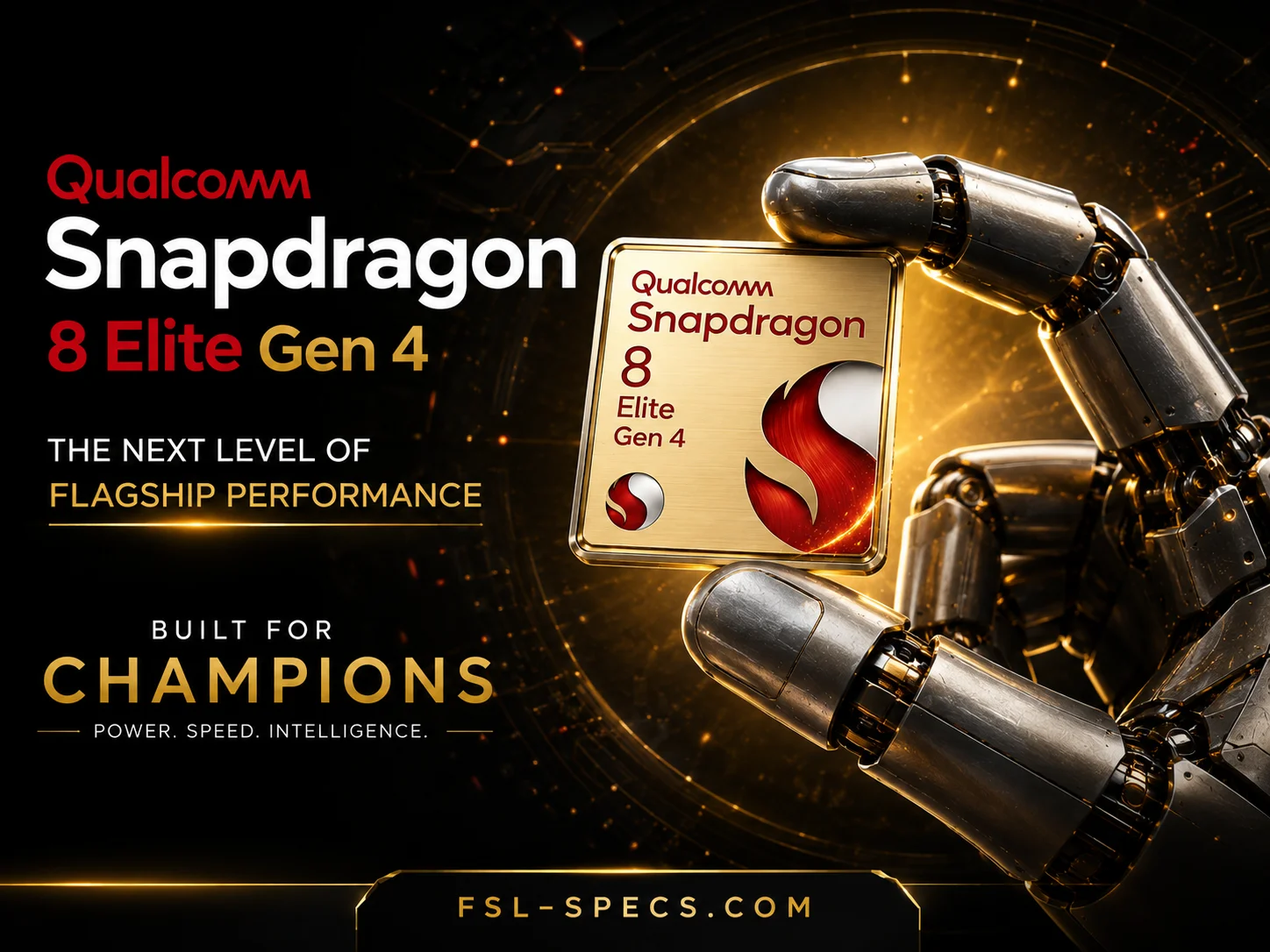
Trailer Of Snapdragon 8 Elite Gen 4

Author & Post Info
Faisal Ur Rehman
Faisal Rehman is the founder and editor of FSL Specs, where he publishes in-depth smartphone specifications, comparisons, buying guides, and technology insights. With extensive experience in mobile hardware research and technical analysis, he provides accurate and up-to-date information on Android smartphones, processors, displays, cameras, batteries, performance benchmarks, and software features. His goal is to simplify complex specifications and help readers choose the right device with confidence.
Explore FSL Specs
Questions About Snapdragon 8 Elite Gen 4
Is the Snapdragon 8 Elite Gen 4 good for gaming?
Absolutely, the Adreno 830 GPU (1100MHz, 1,536 shaders) pushes out around 3,379.2 GFLOPS, and its 3DMark Wild Life Extreme score of 10,874 (holding 41-47 FPS) proves it handles heavy titles without breaking a sweat. Vulkan 1.3 and DirectX 12.1 support mean it's ready for modern, graphics-heavy games too.
What is the AnTuTu score of the Snapdragon 8 Elite Gen 4 ?
It scores 3,119,308 points on AnTuTu v11, with the GPU leading the way at 1,112,775 and the CPU close behind at 899,884. That's a genuinely strong result that still holds up well even against newer chips.
Does the Snapdragon 8 Elite Gen 4 support high refresh rate displays?
Yes, it supports display resolutions up to 3840x2540, and with a GPU this capable, high refresh rate panels run silky smooth. Scrolling, gaming, and everyday animations all feel noticeably fluid.
What RAM does the Snapdragon 8 Elite Gen 4 support?
It supports LPDDR5X memory running at 5,300MHz, with configurations going all the way up to 24GB. That gives it 84.8 Gb/s of bandwidth, more than enough headroom for heavy multitasking.
Can the Snapdragon 8 Elite Gen 4 support a 200MP camera?
It goes well beyond that, the chip's ISP can handle a single sensor up to a massive 320MP. It also supports 8K video recording at 60fps and 4K at 120fps, making it a genuine powerhouse for mobile photography and video work.
Is the Snapdragon 8 Elite Gen 4 power efficient?
Yes, built on a 3nm TSMC process with an 8W sustained power limit, it's tuned to deliver flagship performance without draining the battery too fast. The 2+6 Oryon core setup (Phoenix L and Phoenix M cores) helps balance heavy workloads with everyday efficiency.
Is the Snapdragon 8 Elite Gen 4 a flagship processor?
Yes, it's officially classed as a flagship chip, announced in October 2024 under model number SM8750-AB. It served as Qualcomm's top-tier chip before being succeeded by the Snapdragon 8 Elite Gen 5.
Which GPU powers the Snapdragon 8 Elite Gen 4?
It's powered by the Adreno 830 GPU, built on the Adreno 800 architecture with 512 shading units across 3 pipelines. With 1,536 total shaders and support for Vulkan 1.3 and OpenCL 3.0, it's a genuinely capable graphics engine for flagship gaming and media work.