
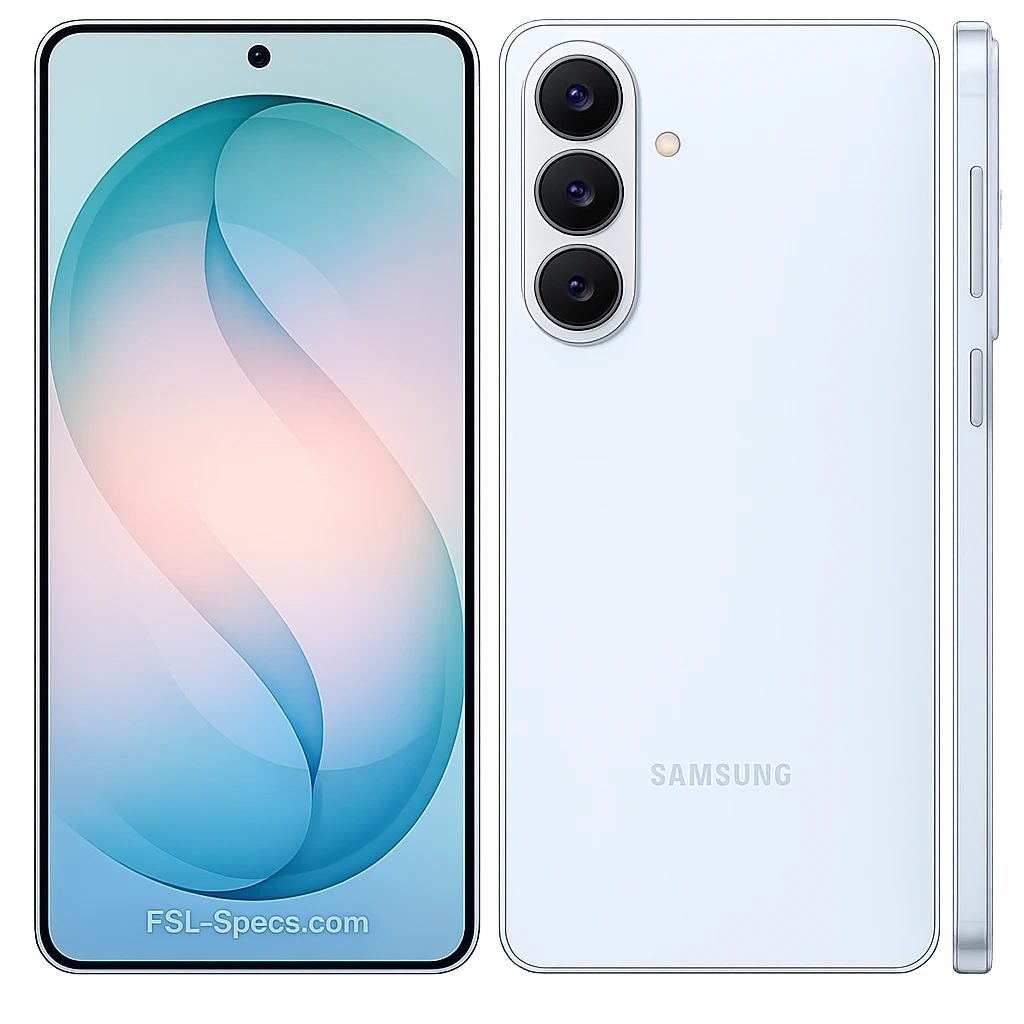
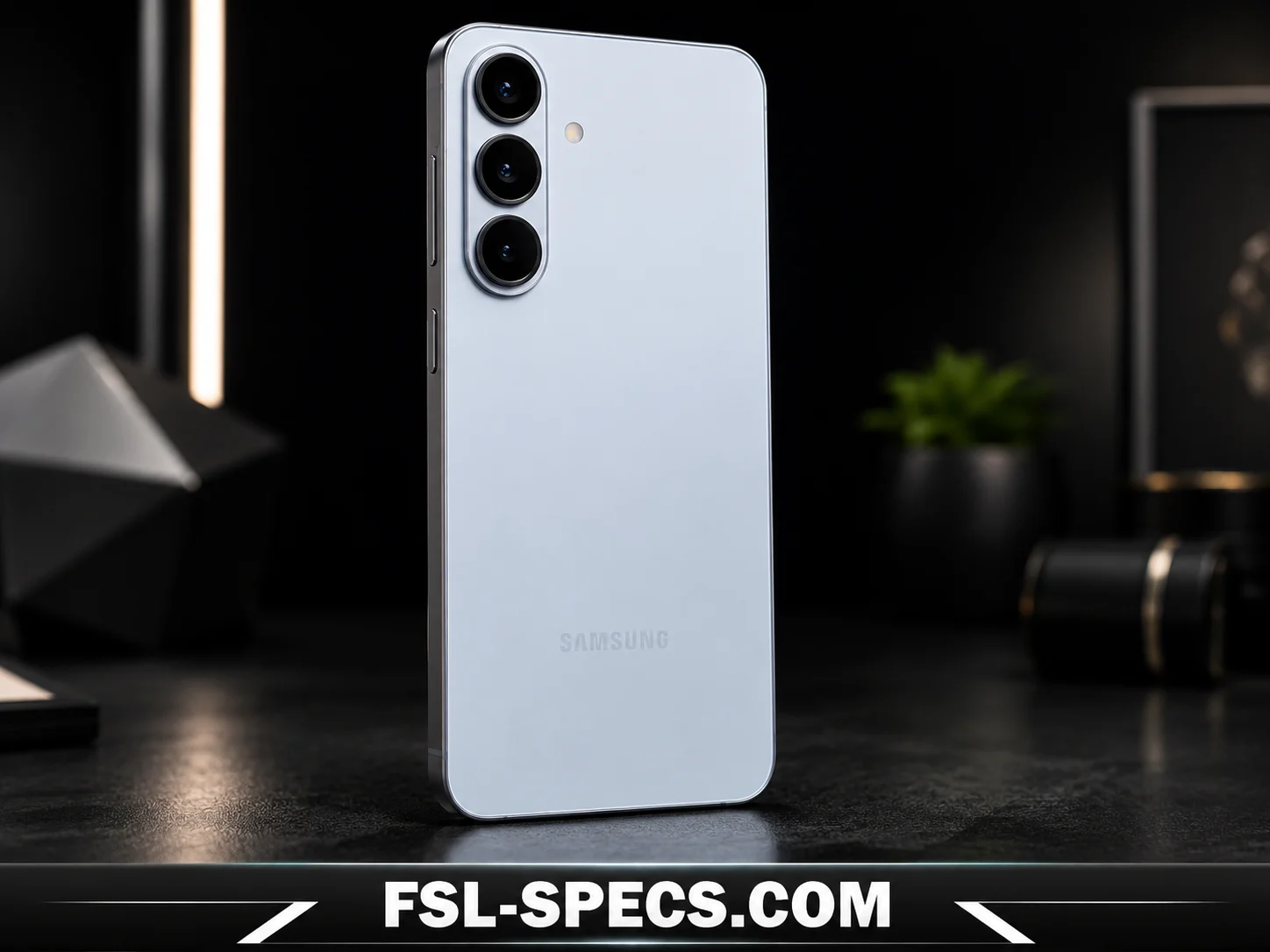
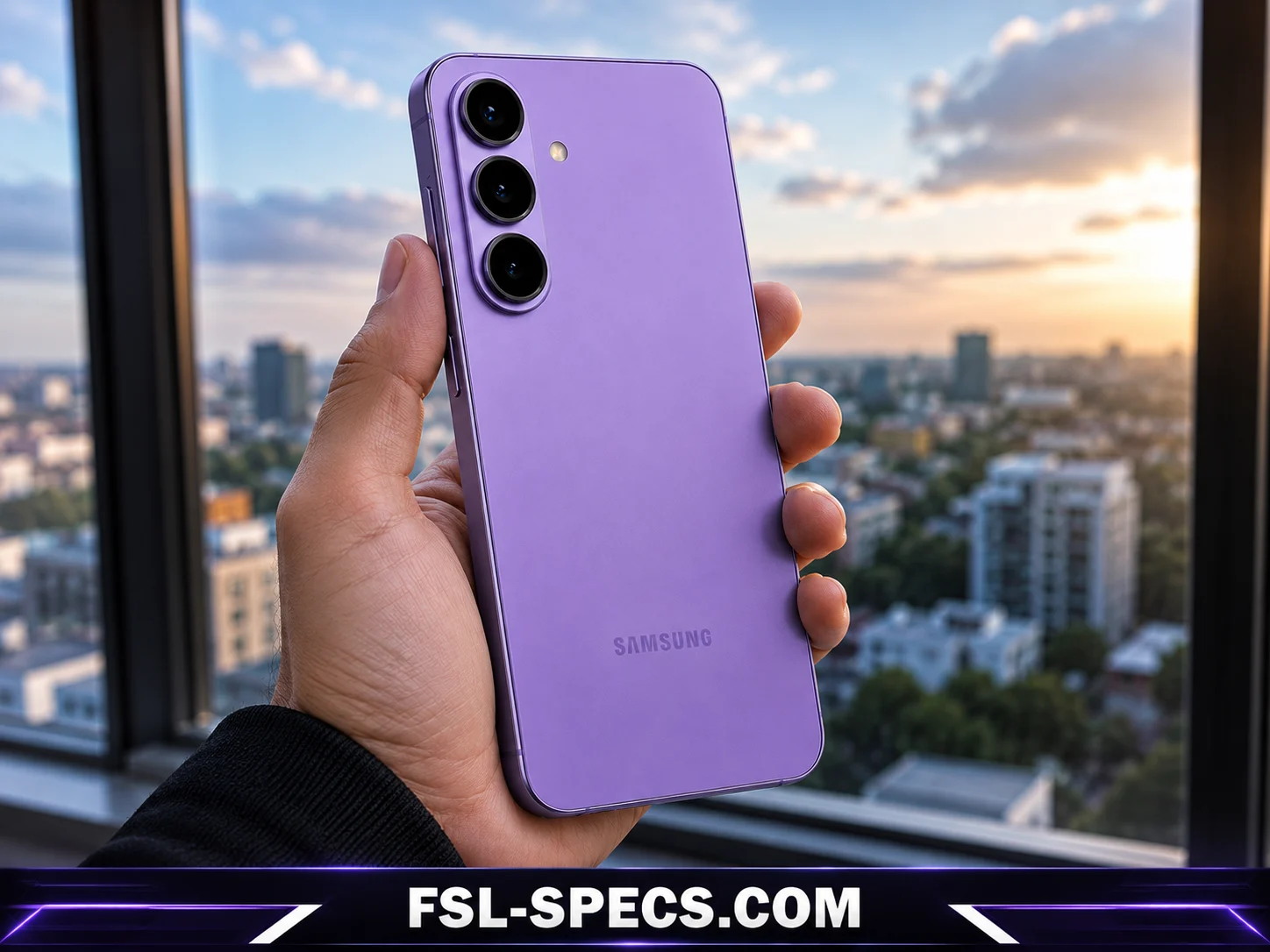
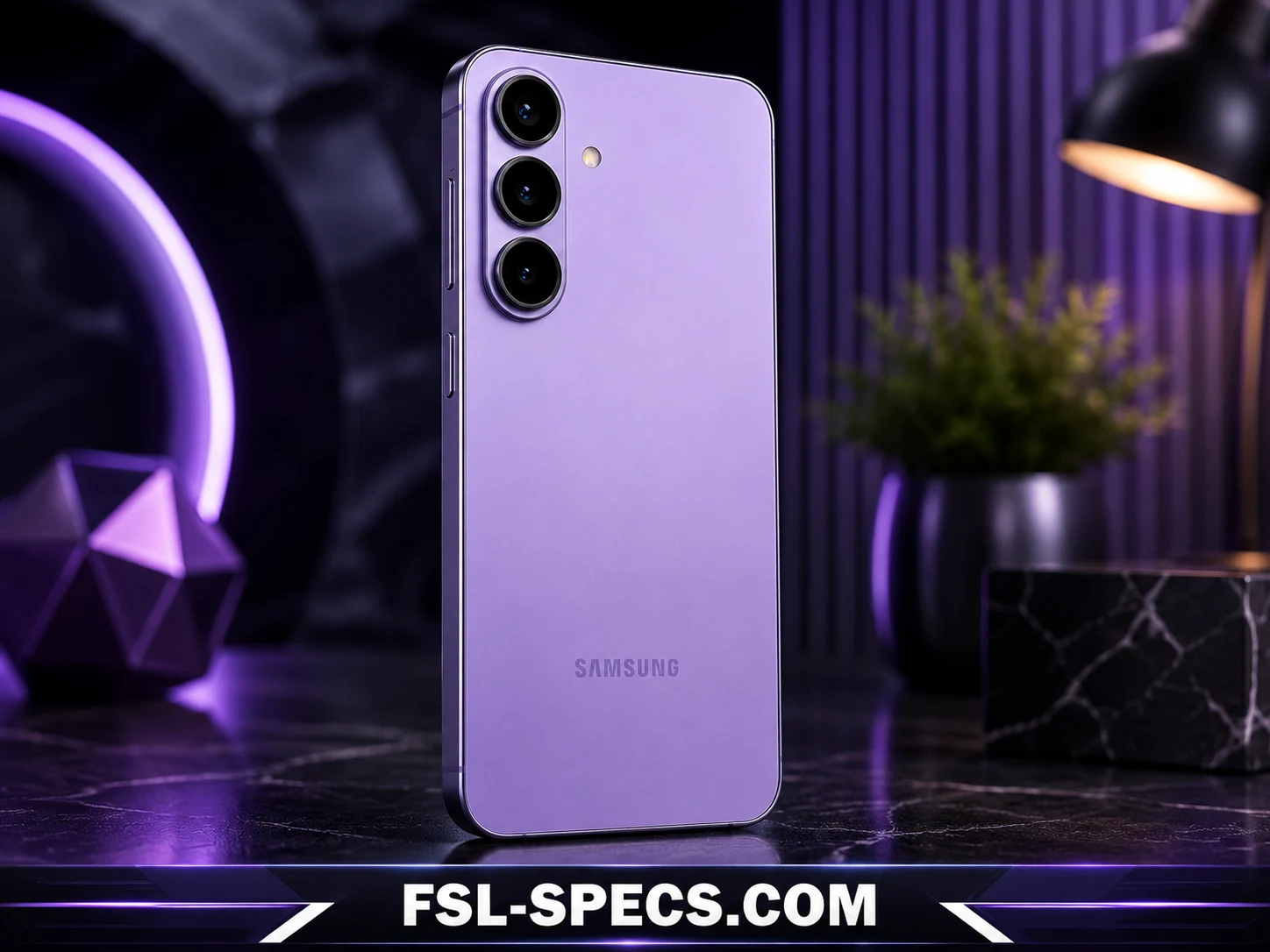











✪ Samsung Galaxy S26 Plus ✪

Samsung Galaxy S26 Plus Specs, Price, Camera, Battery & Best Review (2026)
United States flag United States
$1,020 USD
Pakistan flag Pakistan (PKR)
345,000 PKR
India flag India (INR)
₹100,000 INR

✪ Samsung Galaxy S26 Plus ✪

Samsung Galaxy S26 Plus Specs, Price, Camera, Battery & Best Review (2026)
Last Time Update : 19 July, 2026
0

Quick Specifications

Dynamic AMOLED 2X

Display Type

Snapdragon 8 Elite Gen 5

Processor

12 + 512 GB

Ram And Memory

50 + 12 + 10 MP

Camera

4,900 mAh

Battery

45 W

Fast Charging

Full Specification

BASIC INFO
Mobile
Samsung Galaxy S26 Plus
Model
SM-S947
Series
S Series
Category
Flagship
Release Date
6 March,2026
Year
2026
CONNECTIVITY
Sim
Nano-SIM + Nano-SIM / E-Sim
Network
4G / 4G+ / 5G/ 5G+
WiFi
Wi-Fi 7
Bluetooth
v 6.0
NFC
Yes
OS
Android 17
BODY
Dimensions
158.4 x 75.8 x 7.3 mm
Build
Gorilla Glass Victus 2 (Front/Back), Aluminum Frame
KG Weight
190 g
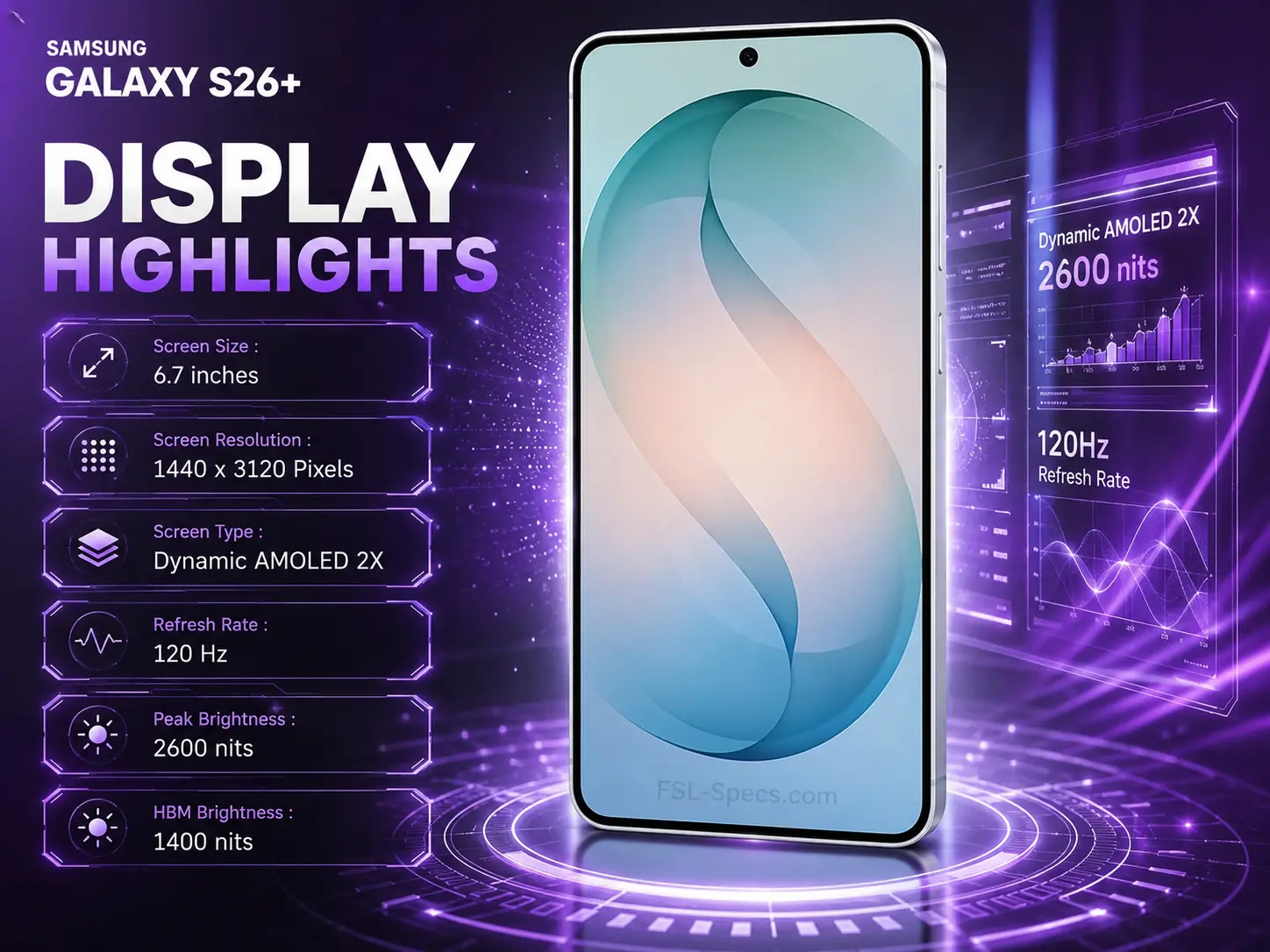
Screen Size
6.7 inches
Resolution
1440 x 3120 Pixels
Type
Dynamic AMOLED 2X
Refresh Rate
120 Hz
Peak Brightness
2600 nits
HBM Brightness
1400 nits
Processor
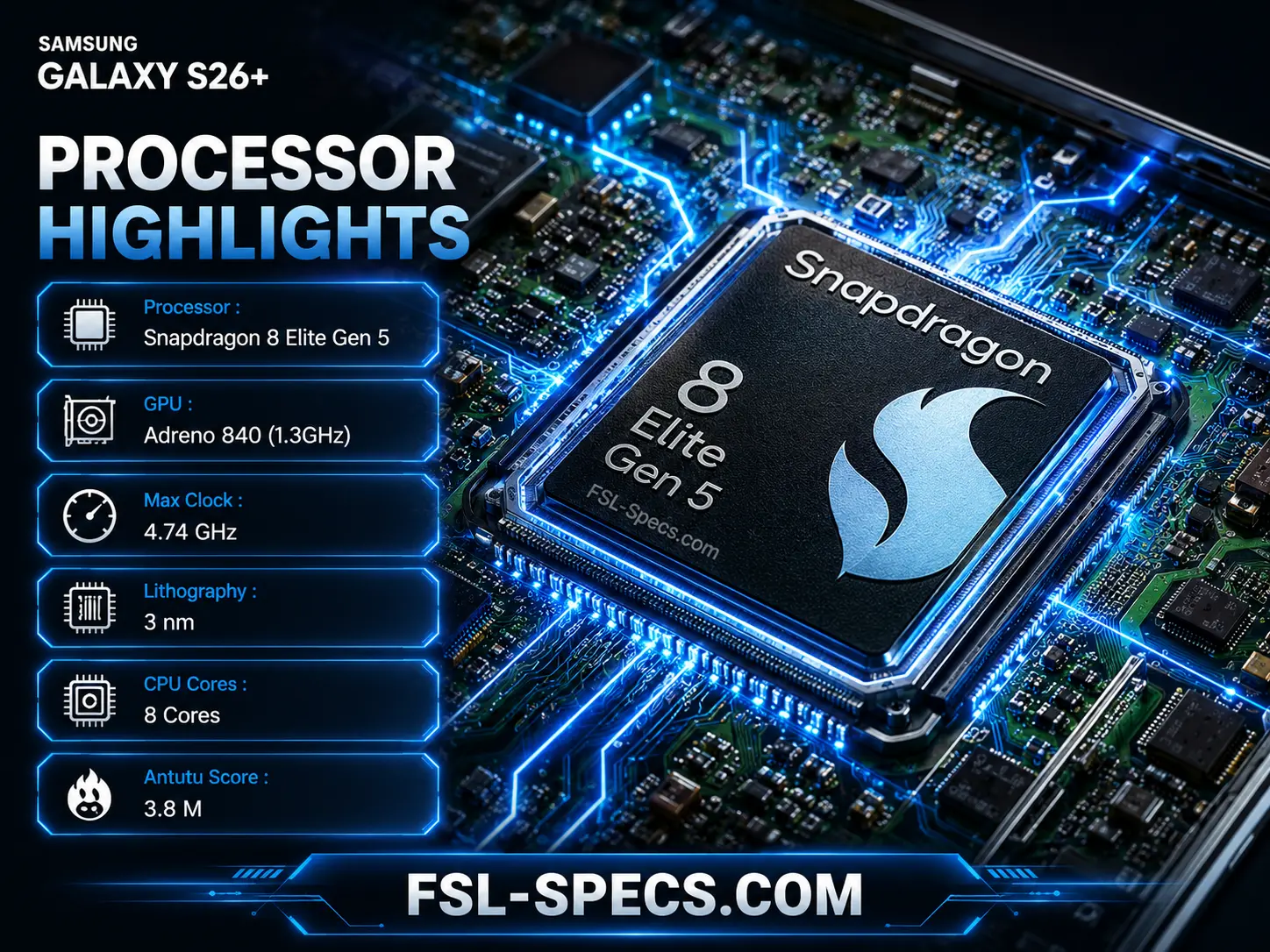
Snapdragon 8 Elite Gen 5
Max Clock
4.74 GHz
Lithography
3 nm
GPU
Adreno 840 (1.3GHz)
CPU Cores
8 Cores
Antutu v11
3.8 M
Bootup Time
-
Architecture
2 x 4.74 GHz Oryon V3 Phoenix L
6 x 3.62 GHz Oryon V3 Phoenix M 
Ram Memory
12 + 512 GB
Ram Type
LPDDR5X
Storage Type
UFS 4.0
SD Card
No
Variants
12 + 256 GB
12 + 512 GB
MP
Rear Camera
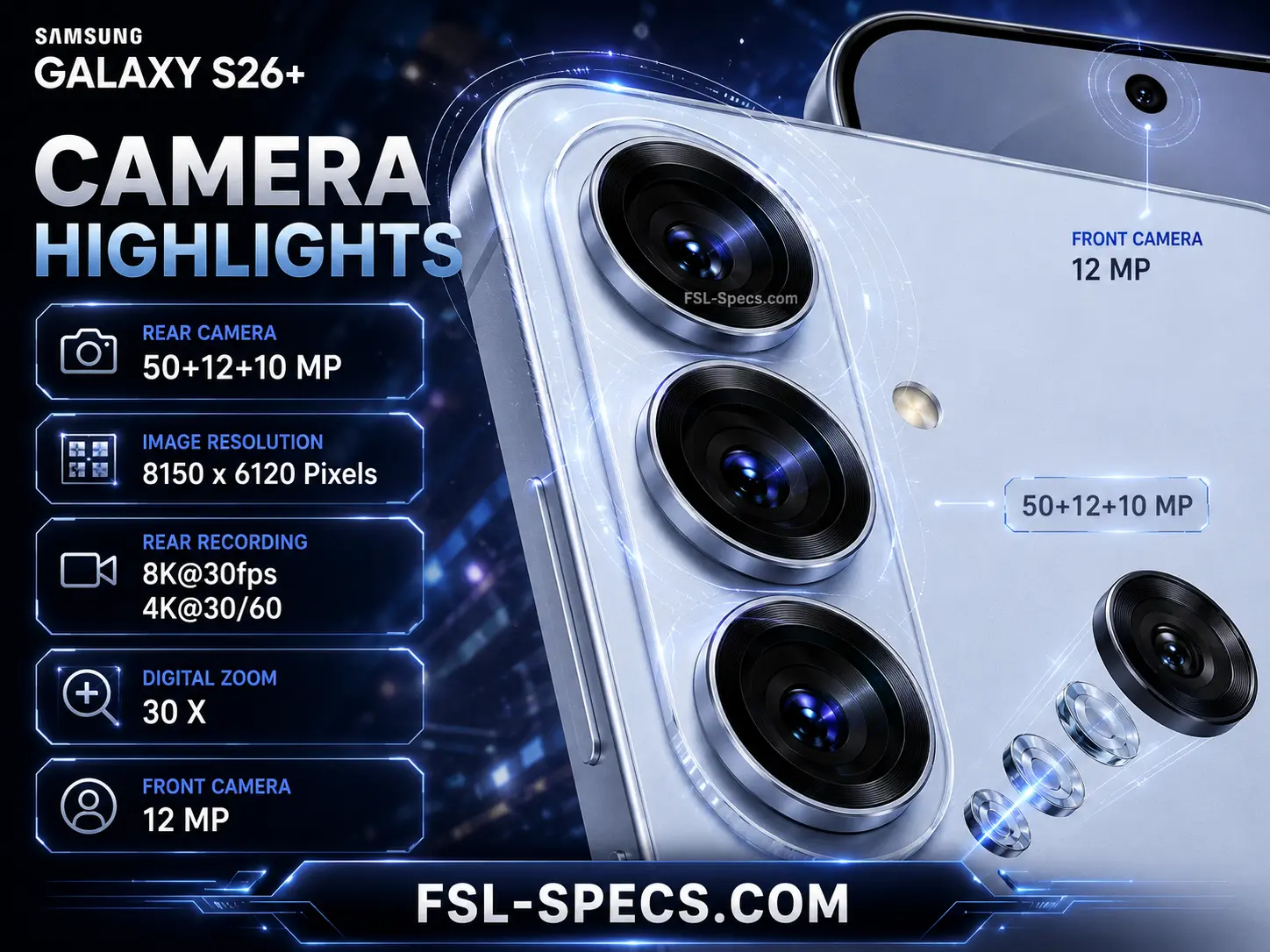
50 + 12 + 10 MP
Front Camera
12 MP
SENSORS
Camera Sensors
50 MP = Samsung ISOCELL S5KGNG
12 MP = Sony IMX564
10 MP = Samsung ISOCELL S5K3LD
Front Sensors
12 MP = Samsung ISOCELL S5K3LU
RECORDING FPS
Main Recording
8K@30fps
4K@30/60
Front Recording
4K@30/60
RESOLUTION
Main Resolution
8150 x 6120 Pixels
ZOOM
Optical Zoom
3x
D Digital Zoom
30 X
Capacity
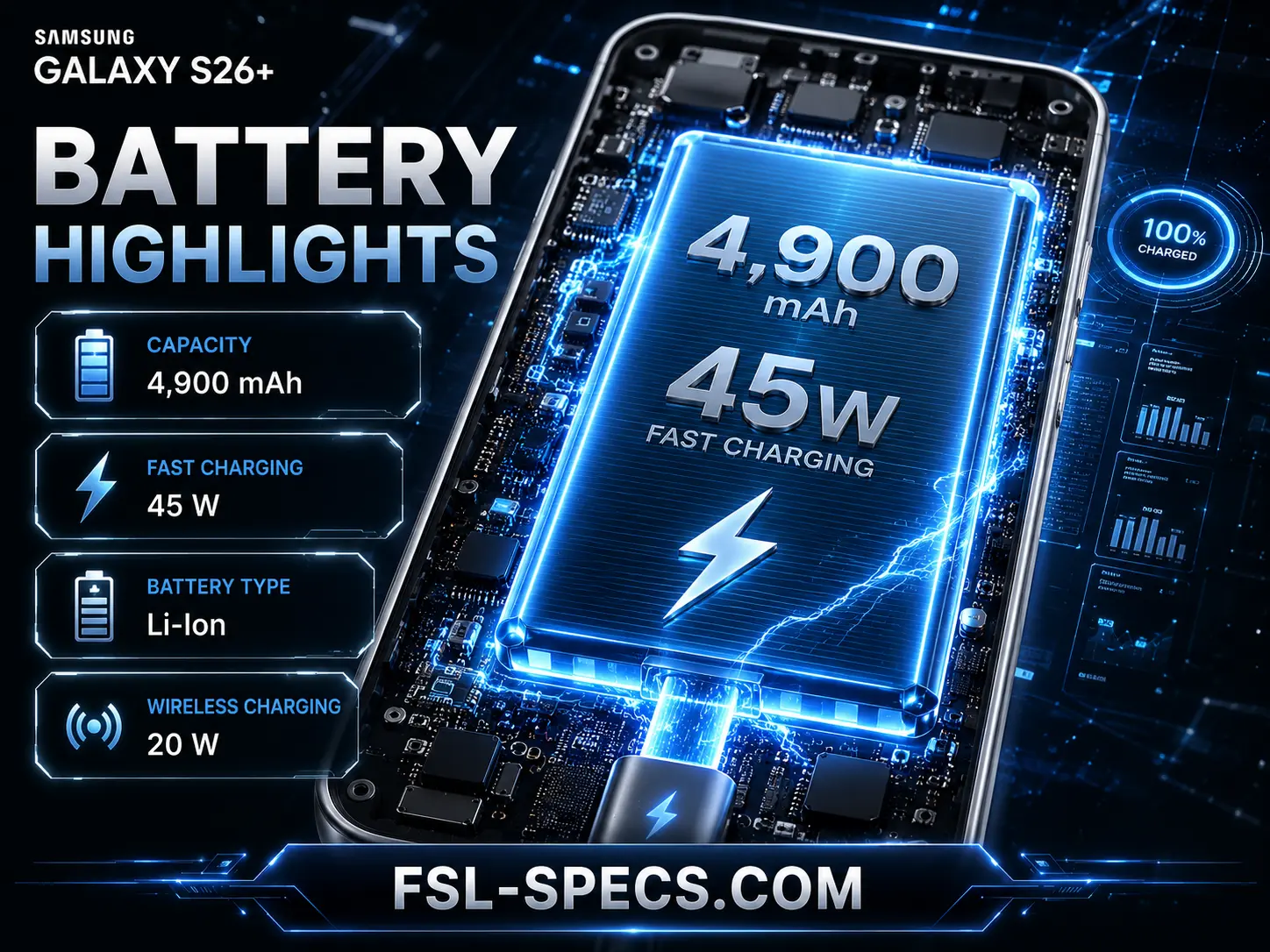
4,900 mAh
Fast Charging
45 W
Wireless Charging
20 W
Li Battery Type
Li-Ion
REVERSE
Reverse Wired
4.5 W
Reverse Wireless
Yes
OTHER
Battery PC Marks
-
Charging Time
-
AUDIO & SENSORS
Speaker
Dual Stereo Speaker
Fingerprint Sensor
Hyper Sonic Front Finger
Other Sensors
Accelerometer
gyro
proximity
compass
barometer
Special Features

UWB
IP68
Samsung DeX

BASIC INFO
Mobile
Samsung Galaxy S26 Plus
Model
SM-S947
Series
S Series
Category
Flagship
Release Date
6 March,2026
Year
2026
CONNECTIVITY
Sim
Nano-SIM + Nano-SIM / E-Sim
Network
4G / 4G+ / 5G/ 5G+
WiFi
Wi-Fi 7
Bluetooth
v 6.0
NFC
Yes
OS
Android 17
BODY
Dimensions
158.4 x 75.8 x 7.3 mm
Build
Gorilla Glass Victus 2 (Front/Back), Aluminum Frame
KG Weight
190 g
Screen Size
6.7 inches
Resolution
1440 x 3120 Pixels
Type
Dynamic AMOLED 2X
Refresh Rate
120 Hz
Peak Brightness
2600 nits
HBM Brightness
1400 nits
Processor
Snapdragon 8 Elite Gen 5
Max Clock
4.74 GHz
Lithography
3 nm
GPU
Adreno 840 (1.3GHz)
CPU Cores
8 Cores
Antutu v11
3.8 M
Bootup Time
-
Architecture
2 x 4.74 GHz Oryon V3 Phoenix L
6 x 3.62 GHz Oryon V3 Phoenix M 
Ram Memory
12 + 512 GB
SD Card
No
Ram Type
LPDDR5X
Storage Type
UFS 4.0
Variants
12 + 256 GB
12 + 512 GB
MP
Rear Camera
50 + 12 + 10 MP
Front Camera
12 MP
SENSORS
Main Camera Sensors
50 MP = Samsung ISOCELL S5KGNG
12 MP = Sony IMX564
10 MP = Samsung ISOCELL S5K3LD
Front Camera Sensors
12 MP = Samsung ISOCELL S5K3LU
RECORDING FPS
Main Recording
8K@30fps
4K@30/60
Front Recording
4K@30/60
RESOLUTION
Main Resolution
8150 x 6120 Pixels
ZOOM
Optical Zoom
3x
D Digital Zoom
30 X
Capacity
4,900 mAh
Fast Charging
45 W
Wireless Charging
20 W
Li Battery Type
Li-Ion
REVERSE
Reverse Wired
4.5 W
Reverse Wireless
Yes
OTHER
Battery Life PCMark
-
Charging Time
-
AUDIO & SENSORS
Speaker
Dual Stereo Speaker
Fingerprint Sensor
Hyper Sonic Front Finger
Other Sensors
Accelerometer
gyro
proximity
compass
barometer
Special Features

UWB
IP68
Samsung DeX

Highlights & Review Of Samsung Galaxy S26 Plus

Display Review:

The Samsung Galaxy S26 Plus (PKR 322,000) uses a 6.7-inch LTPO Dynamic AMOLED 2X panel at 1440 x 3120 (QHD+) with a 120Hz refresh rate and HDR10+ support. Real world testing shows around 1,498 nits in auto mode on a 75% window, climbing to 2,596 nits on smaller highlights, numbers that hold up well against pricier rivals.

The RedMagic 11 Pro (PKR 295,000) counters with a bigger 6.85-inch AMOLED screen at 1216 x 2688 and a smoother 144Hz refresh rate built for gaming, though its measured auto brightness of 1,569 nits sits behind the S26 Plus, and it skips native HDR certification entirely.

The Vivo X300 Pro (PKR 316,000) matches the S26 Plus on resolution with its 6.78-inch LTPO AMOLED at 1260 x 2800, but pushes further with a 144Hz refresh rate, HDR10+, HDR Vivid, Dolby Vision, and a claimed 4500 nits peak brightness, the highest rated figure of the group.

The Xiaomi 17T Pro (PKR 260,000), the cheapest phone here by a wide margin, still brings a 6.83-inch AMOLED at 1280 x 2772, 144Hz refresh rate, Dolby Vision and HDR10+, with a claimed 3500 nits peak (UHBM) that beats Samsung’s own brightness claim on paper terms alone.

For sharpness and outdoor sunlight readability, the S26 Plus and X300 Pro’s QHD+ resolution give them a slight edge over the 1.5K panels on the RedMagic and 17T Pro. But for smoothness and HDR content, the S26 Plus is the only phone here capped at 120Hz.

Verdict: The Vivo X300 Pro offers the most complete display package of the four, combining QHD+ sharpness, 144Hz smoothness, and full HDR support, while the Xiaomi 17T Pro is the smartest buy for anyone unwilling to spend flagship money on screen quality alone.

Processor Review:

The Samsung Galaxy S26 Plus (PKR 322,000) runs on the Snapdragon 8 Elite Gen 5, scoring an average of 3.81 million on AnTuTu v11 in its Snapdragon variant, with strong GPU and UX subscores that translate into smooth day to day handling and confident gaming headroom.

The RedMagic 11 Pro (PKR 295,000) uses the same Snapdragon 8 Elite Gen 5, but its dedicated cooling fan and liquid cooling system push it to a higher average AnTuTu v11 score of 4.1 million, the strongest raw number in this comparison, and the difference shows up in sustained performance during long gaming sessions rather than in short bursts.

The Vivo X300 Pro (PKR 316,000) switches to MediaTek’s Dimensity 9500, which posted a benchmark result of 3.96 million in early AnTuTu v11 testing, edging past Qualcomm’s chip in CPU, GPU, and memory subtests despite running slightly warmer under load.

The Xiaomi 17T Pro (PKR 260,000) shares that same Dimensity 9500 chipset, so its AnTuTu v11 numbers land in a similar 3.9 million range, giving it essentially the same raw compute muscle as the X300 Pro at a much lower price.

All four scores come from AnTuTu v11, so the comparison holds up fairly well across the board, though real-world thermal throttling separates the group more than the numbers suggest. The RedMagic 11 Pro’s fan-cooled chassis lets it hold peak clocks longer than the phone-shaped competition, while the S26 Plus and X300 Pro rely on passive cooling that dips under extended load.

Verdict: For raw sustained gaming performance, the RedMagic 11 Pro leads the pack, but the Xiaomi 17T Pro delivers nearly identical Dimensity 9500 performance to the Vivo X300 Pro at a significantly lower price, making it the smarter pick for anyone who does not need RedMagic’s gaming-specific cooling hardware.

Ram & Memory Review:

At PKR 322,000 for the 12GB+256GB variant or PKR 345,000 for 12+512GB, the Samsung Galaxy S26 Plus pairs 12GB of LPDDR5X RAM with UFS 4.0 storage. It is worth noting Samsung officially confirmed UFS 4.0 rather than the UFS 4.1 some early reports suggested, though real world transfer speeds land close enough that most users will not notice the difference.

The RedMagic 11 Pro (PKR 295,000, 12+512GB) uses 12GB of LPDDR5T RAM alongside UFS 4.1 Pro storage, a combination built specifically to sustain fast read and write speeds during extended gaming sessions without throttling.

The Vivo X300 Pro (PKR 316,000, 16+512GB) steps ahead with 16GB of LPDDR5X Ultra RAM, the highest capacity in this comparison, paired with UFS 4.1 storage, giving it a real edge in keeping more background apps alive during heavy multitasking.

The Xiaomi 17T Pro (PKR 260,000, 12+512GB) matches the S26 Plus and RedMagic on 12GB of LPDDR5X RAM but pairs it with UFS 4.1 storage, the same standard used by the pricier Vivo, despite costing tens of thousands of rupees less.

In day to day use, the extra 4GB on the Vivo X300 Pro means more apps stay resident in memory during multitasking, which matters for users who jump between camera, social apps, and games frequently. The Samsung’s UFS 4.0 storage is not a meaningful downgrade in practice, but it is the only phone here not running UFS 4.1.

Verdict: The Vivo X300 Pro offers the strongest RAM and memory configuration on paper, but the Xiaomi 17T Pro matching its UFS 4.1 storage standard and RAM capacity at a much lower price makes it the better memory value pick for most buyers.

Cameras Review:

The Samsung Galaxy S26 Plus carries a 50MP main camera (f/1.8, OIS), a 12MP ultrawide (f/2.2), and a 10MP telephoto with 3x optical zoom (f/2.4, OIS), with a 12MP front camera (f/2.2). Rear video tops out at 8K30fps on the main sensor and 4K60fps across all lenses, while the front camera records 4K.

The RedMagic 11 Pro sticks to a simpler dual setup, a 50MP main camera (f/1.9, OIS) and a 50MP ultrawide (f/2.2), both capable of 8K30fps video, but its 16MP under-display front camera (f/2.0) is capped at 1080p30fps, a clear trade-off for the bezel-less gaming design.

The Vivo X300 Pro is the strongest camera phone here on paper, pairing a 50MP main sensor (f/1.57, OIS) with a genuinely rare 200MP telephoto offering 3.5x optical zoom (f/2.67, OIS) and a 50MP ultrawide (f/2.0). Its 50MP front camera (f/2.0, autofocus) also outclasses every rival, and video specs match that ambition with 4K120fps on the main and telephoto lenses, 8K30fps, and 4K60fps selfie recording.

The Xiaomi 17T Pro offers a 50MP main camera (f/1.7, OIS) and an unusual 50MP periscope telephoto with 5x optical zoom (f/3.0, OIS), backed by a 12MP ultrawide (f/2.2) and a 32MP front camera (f/2.2). Rear video goes up to 8K30fps and 4K120fps, while the front camera manages 4K30fps.

For anyone who shoots selfies or vlogs often, the RedMagic 11 Pro is a clear step behind the rest of this group.

Verdict: The Vivo X300 Pro has the most well rounded and capable camera system of the four, with the Xiaomi 17T Pro’s 5x periscope telephoto offering a genuinely useful zoom option that neither the Samsung nor the RedMagic can match at this price.

Battery Review:

The Samsung Galaxy S26 Plus packs a 4,900mAh battery with 45W wired charging and 20W wireless charging, taking roughly 1 hour 4 minutes to go from empty to full, the slowest charging speed in this group by a wide margin.

The RedMagic 11 Pro counters with a much larger 7,500mAh battery, backed by 80W wired and 80W wireless charging plus reverse wireless charging support, reaching full charge in around 55 minutes despite its bigger capacity.

The Vivo X300 Pro offers a 6,510mAh battery (the EU version ships with a smaller 5,440mAh cell due to regional battery regulations), paired with 90W wired charging and 40W wireless charging with both reverse wired and reverse wireless support, and it is the fastest charger here, hitting full in about 29 minutes.

The Xiaomi 17T Pro brings the largest cell of the four at 7,000mAh, supporting 100W wired charging, 50W wireless charging, and 22.5W reverse wired charging, with real world testing showing a full charge in roughly 45 minutes.

For anyone who values fast top-ups between gaming sessions or long days, the trade-off is clear. The Samsung’s 4,900mAh cell is the smallest capacity here paired with the slowest charging speed, which stands out against three rivals offering 40 to 50 percent more battery capacity and noticeably faster charging.

Verdict: The Vivo X300 Pro wins on raw charging speed, but the Xiaomi 17T Pro’s combination of the largest battery capacity, strong 100W wired charging, and 50W wireless charging at a significantly lower price makes it the smarter all-round battery pick, while the Samsung Galaxy S26 Plus lags behind all three rivals in this category.

Final Verdict :

Across display, processor, memory, camera, and battery, the Vivo X300 Pro (PKR 316,000) comes out as the strongest all-round performer among these four phones, combining a 144Hz QHD+ display with 4500 nits peak brightness, a competitive Dimensity 9500 chipset scoring near 3.96 million on AnTuTu v11, the most versatile camera system with its 200MP 3.5x telephoto, and the fastest charging speed of the group at 29 minutes for a full battery.

The Samsung Galaxy S26 Plus (PKR 322,000 to 345,000) remains a dependable flagship with a bright, sharp display and Samsung’s software polish, but it is held back by the smallest battery here paired with the slowest charging speed, and its UFS 4.0 storage is a step behind three UFS 4.1 rivals.

The RedMagic 11 Pro (PKR 295,000) is built specifically for gamers, leading in sustained performance thanks to its active cooling fan, but its basic dual camera and 1080p-only selfie camera make it a weaker fit for anyone who also wants to shoot photos and video regularly. The Xiaomi 17T Pro (PKR 260,000) punches well above its price, matching the Vivo’s storage standard, nearly matching its processor, and offering the largest battery in this comparison with fast 100W charging.

Bottom line: Buyers chasing the most complete flagship experience should lean toward the Vivo X300 Pro, but the Xiaomi 17T Pro delivers 80 to 90 percent of that experience for tens of thousands of rupees less, making it hard to ignore.

Value For Money:

Judged strictly on price-to-spec ratio, the Xiaomi 17T Pro at PKR 260,000 is the clear value leader among these four phones. It matches the Vivo X300 Pro’s UFS 4.1 storage standard, runs the same Dimensity 9500 chipset with AnTuTu scores in the same range, offers a 144Hz AMOLED display with a class-leading 3500 nits peak brightness claim, and packs the largest battery in the comparison at 7,000mAh with 100W charging, all while costing PKR 56,000 to 85,000 less than the Samsung and Vivo options.

The RedMagic 11 Pro at PKR 295,000 offers strong value specifically for gaming, with the highest sustained AnTuTu scores and the biggest battery-to-price ratio, but its weaker camera system means it is not a universal value pick. The Vivo X300 Pro justifies its PKR 316,000 price with genuinely superior camera hardware and the fastest charging in the group, but that premium is hard to justify for buyers who do not prioritize photography. The Samsung Galaxy S26 Plus, starting at PKR 322,000, is the weakest value proposition of the four, asking flagship pricing while trailing in battery capacity, charging speed, and storage standard compared to cheaper rivals.

Verdict: For buyers prioritizing value for money, the Xiaomi 17T Pro is the strongest pick in this comparison, delivering near flagship-level specs across every category at a meaningfully lower price than the Samsung, Vivo, or RedMagic.

Pros And Cons of Samsung Galaxy S26 Plus

Pros of Mobile

✅ Stunning Display
✅ Flagship Performance
✅ Fast Charging
✅ Excellent Cameras
✅ Premium Build
✅ Wireless Charging

Cons of Mobile

❌ Premium Price
❌ No Charger
❌ No SD Card
❌ Limited Zoom
❌ Large Size
❌ No IR Blaster

Best For - Not Best For

Best For

✅ Mobile Gaming
✅ Content Streaming
✅ Photography Lovers
✅ Heavy Multitasking
✅ Power Users
✅ Daily Productivity

Not Best For

❌ Budget Buyers
❌ Compact Phones
❌ Zoom Photography
❌ Expandable Storage
❌ Charger Included
❌ Value Seekers

Trailer And Unboxing of Samsung Galaxy S26 Plus

Disassembly Or Teardown And Gaming Test of Samsung Galaxy S26 Plus

Camera Test Samsung Galaxy S26 Plus

Redmagic 11 Pro
Xiaomi 17T Pro
Vivo X300 Pro
Samsung Galaxy S25 Ultra

Samsung Mobile Series

Samsung Mobile Series

FAQs Questions

The Samsung Galaxy S26 plus features a Dynamic AMOLED 2X display with up to 2600 nits peak brightness and 1400 nits HBM brightness for excellent outdoor visibility.

The Samsung Galaxy S26 plus is powered by the Qualcomm Snapdragon 8 Elite chipset, delivering flagship-level performance for gaming, multitasking, and AI tasks.

The Samsung Galaxy S26 plus comes with 12GB LPDDR5X RAM and 512GB UFS 4.0 storage, ensuring faster app loading, smooth multitasking, and high-speed data transfer.

The Samsung Galaxy S26 plus features a 50MP + 12MP + 10MP triple rear camera setup and a 12MP front camera for high-quality photos, selfies, and video calls.

The Samsung Galaxy S26 plus packs a 4,900mAh Li-Ion battery with 45W wired and 20W wireless charging, providing reliable all-day battery life.

12 + 256 GB
265,000 PKR | ₹72,000| 720 $

_______________________________

12 + 512 GB
310,000 PKR | ₹100,000 | 1020$

_______________________________

Leave a Reply

Your email address will not be published. Required fields are marked *

Scroll to Top