
A18 Pro
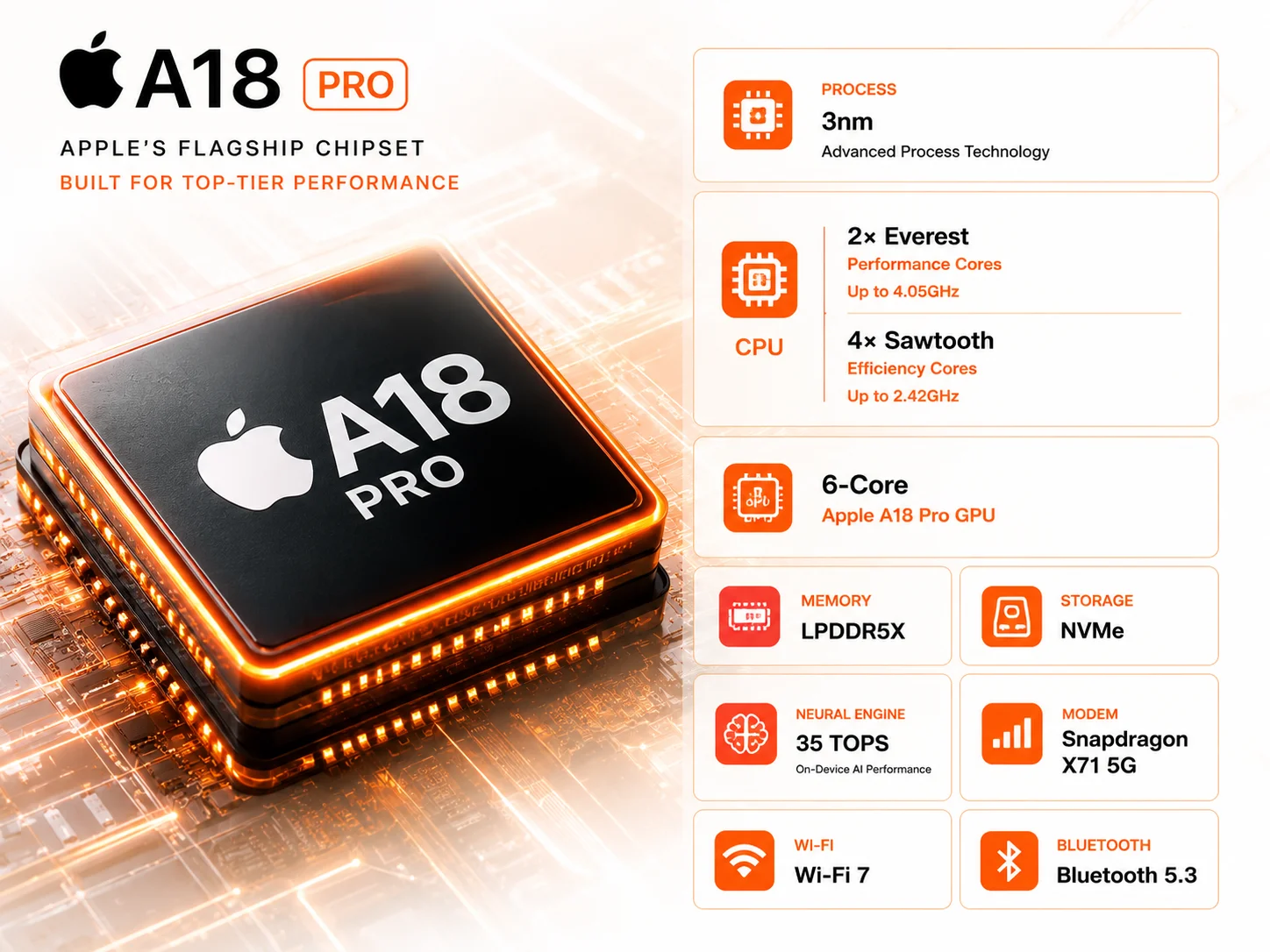
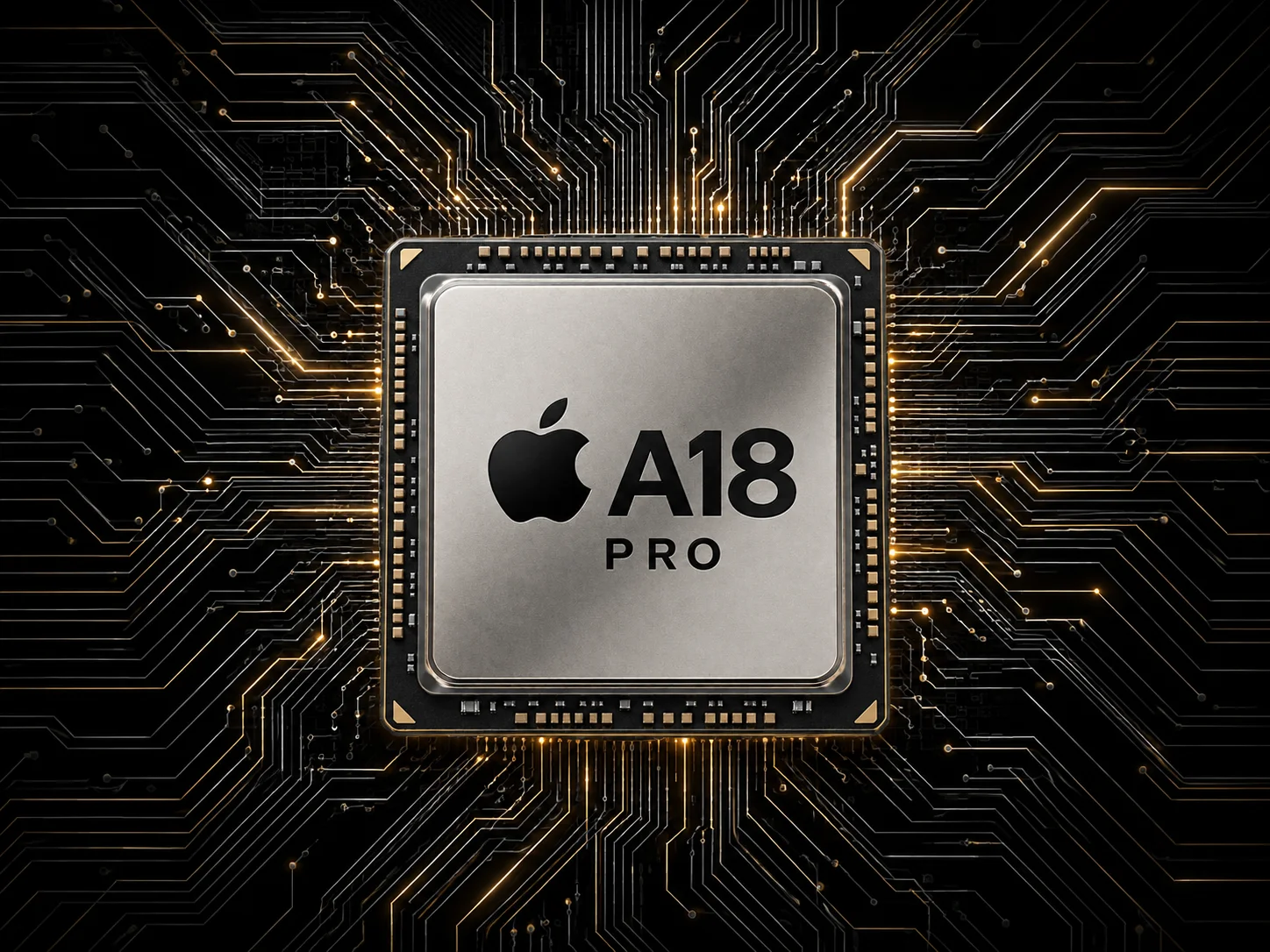
The Apple A18 Pro is Apple's flagship chipset built on a 3nm process, using 2× Everest performance cores up to 4.05GHz and 4× Sawtooth efficiency cores up to 2.42GHz, paired with a 6‑core Apple A18 Pro GPU. With LPDDR5X memory, NVMe storage, Apple's Neural Engine delivering 35 TOPS for on-device AI, a Snapdragon X71 5G modem, Wi‑Fi 7, and Bluetooth 5.3, it's built for top‑tier flagship performance.
Benchmark Scores
Measures CPU, GPU, RAM, and I/O performance in different scenarios.
Shows raw single-threaded CPU performance across real-world workloads. Headline score not confirmed in source data.
Cross-platform benchmark assessing graphics performance in Vulkan/Metal.
CPU & AI Performance
4× Sawtooth (Efficiency) up to 2.42GHz
Graphics, Memory & Storage
Multimedia (Camera, Display & ISP)
Connectivity
General Info
information About Apple A18 Pro
Introduction
The Apple A18 Pro, Apple A18, and MediaTek Dimensity 9400e represent three different approaches to high-end mobile chipset design. The Apple A18 Pro is Apple’s Pro-class silicon from the iPhone 16 Pro generation, the A18 powers the standard iPhone 16 family, while the Dimensity 9400e is an Android-focused sub-flagship chipset introduced in 2025.
At first glance, the Apple A18 Pro appears to have the advantage because it is Apple’s Pro-branded chip. However, benchmark data produces a much more interesting result. In 91mobiles testing, the Dimensity 9400e records 2,125,733 AnTuTu, compared with 1,774,620 for the Apple A18 Pro and 1,764,170 for the A18. NanoReview’s current AnTuTu 11 database also places the Dimensity 9400e considerably higher at 2,502,910, while the Apple A18 Pro scores 1,915,175 and the A18 scores 1,822,701.
That does not mean the Apple A18 Pro is simply “slow.” The picture changes dramatically when CPU performance is isolated. NanoReview gives the A18 Pro a 3,518 single-core and 8,950 multi-core Geekbench 6 result, while the Dimensity 9400e scores 2,233 and 7,478 respectively. The Apple chip therefore maintains a major single-core advantage and a smaller multi-core lead.
This comparison therefore needs more than a specification table. It needs to separate CPU strength, graphics capability, benchmark methodology, efficiency, memory, AI, multimedia and connectivity to determine where each chipset actually makes the most sense. This approach follows the FSL-Specs comparison framework, which prioritizes evidence, practical analysis and honest conclusions rather than automatically declaring the primary processor the winner.
1. Processor Overview
| Specification | A18 Pro | Apple A18 | Dimensity 9400e |
|---|---|---|---|
| Launch | September 2024 | September 2024 | May 2025 |
| CPU | 6-core | 6-core | 8-core |
| Maximum clock | 4.05 GHz | 4.05 GHz | 3.40 GHz |
| Process | 3nm | 3nm | 4nm |
| GPU | A18 Pro GPU | Apple A18 GPU | Immortalis-G720 MC12 |
| Memory | LPDDR5X | LPDDR5X | LPDDR5X |
| AnTuTu, 91mobiles | 1,774,620 | 1,764,170 | 2,125,733 |
| Geekbench Single, 91mobiles | 3,317 | 3,278 | 2,219 |
| Geekbench Multi, 91mobiles | 8,115 | 7,995 | 7,308 |
The fundamental distinction is architectural. Both Apple processors use six cores with two Everest performance cores at 4.05GHz and four Sawtooth cores at 2.42GHz. The Dimensity 9400e instead uses eight cores: one Cortex-X4 at 3.4GHz, three Cortex-X4 cores at 2.85GHz, and four Cortex-A720 cores at 2GHz.
The A18 Pro and A18 are consequently much closer to each other than either is to the Dimensity 9400e. The Pro model’s biggest differences are not its CPU clock or core count, because those are identical to the A18. Its differentiation comes primarily from the GPU configuration, cache configuration and the broader capabilities associated with the Pro chip. NanoReview gives the A18 Pro an overall score of 84, versus 81 for the A18, while its CPU-performance ratings are 89 and 87 respectively.
2. CPU Architecture & Processing Power
CPU performance is where the A18 Pro establishes its strongest case.
The Apple A18 Pro and A18 both reach 4.05GHz, compared with 3.4GHz for the Dimensity 9400e’s fastest core. More importantly, NanoReview’s Geekbench 6 data shows the A18 Pro at 3,518 single-core, versus 2,233 for the Dimensity 9400e. That is roughly a 58% advantage for the A18 Pro in the cited NanoReview result. In multi-core, the A18 Pro reaches 8,950, compared with 7,478, giving Apple roughly a 20% advantage.
This is important for everyday responsiveness. Single-core performance tends to be particularly relevant to workloads where a small number of CPU threads are doing demanding work. The A18 Pro’s much higher Geekbench single-core result suggests a strong advantage in CPU-intensive bursts such as certain application operations, complex calculations and workloads that do not scale efficiently across many cores.
The A18 is also extremely competitive in CPU performance. NanoReview records 3,291 single-core and 8,136 multi-core, while 91mobiles reports 3,278 and 7,995. The A18 therefore remains ahead of the Dimensity 9400e in both Geekbench CPU tests despite its lower overall AnTuTu score.
The gap between A18 Pro and A18 is surprisingly small in raw CPU terms. NanoReview’s figures put the Pro around 7% higher in single-core and 10% higher in multi-core, while 91mobiles’ figures show only about 1.2% and 1.5% differences. This reinforces an important conclusion: choosing A18 Pro over A18 is not primarily about getting a radically different CPU.
The Dimensity 9400e counters with eight CPU cores and a more heavily multi-core-oriented configuration. That additional core count does not translate into a Geekbench victory here, but it gives the chip a fundamentally different workload strategy.
CPU winner: Apple A18 Pro.
3. GPU & Gaming Performance
The GPU comparison is much more complicated than the CPU comparison.
The A18 Pro uses Apple’s A18 Pro GPU with a 1.49GHz reported clock, six pipelines, 768 total shaders and a listed 2,289 GFLOPS in NanoReview. The standard A18 has the A18 GPU with five pipelines, 640 total shaders and approximately 1,907 GFLOPS. The Dimensity 9400e uses the Immortalis-G720 MC12, clocked at 1.3GHz, with 12 pipelines, 1,536 shaders and approximately 3,993.6 GFLOPS.
These numbers should not be treated as a direct FPS prediction. Different GPU architectures, APIs, operating systems and device implementations mean theoretical compute figures do not translate linearly into gaming performance.
Nevertheless, the broader benchmark picture favors the Dimensity 9400e for graphics-heavy workloads. NanoReview gives the Dimensity 9400e a 65 gaming-performance rating, compared with 68 for A18 Pro and 62 for A18. This makes the A18 Pro slightly ahead in NanoReview’s composite gaming assessment, despite the Dimensity chip’s substantially higher theoretical FLOPS.
This is an excellent example of why specifications need context. The Dimensity 9400e has a much larger shader count and higher listed floating-point throughput, but Apple controls both its silicon and the software environment around it. The A18 Pro’s GPU therefore cannot be judged purely from shader count.
For the A18 Pro versus A18 comparison, the difference is clearer. NanoReview reports 68 versus 62 in gaming performance and identifies the Pro GPU as the stronger configuration. The A18 Pro also has six pipelines compared with five on the A18.
Gaming verdict: A18 Pro has the stronger evidence-based position among the two Apple chips, while Dimensity 9400e has impressive graphics hardware and the highest overall AnTuTu score of the three in both 91mobiles and NanoReview’s current datasets.
4. Manufacturing Process & Efficiency
The Apple A18 Pro and A18 are manufactured on a 3nm process, while the Dimensity 9400e uses 4nm manufacturing. All three are listed as TSMC-produced in the relevant source specifications.
A smaller manufacturing node can potentially improve transistor density and efficiency, but it should not automatically be interpreted as meaning that one processor will always consume less power. Device design, clock behavior, thermal limits, software optimization and workload characteristics all influence actual battery performance.
NanoReview gives the A18 Pro a battery-life/efficiency rating of 97, compared with 96 for the A18 and 91 for the Dimensity 9400e. Its sustained-power specification is listed at 10W on NanoReview, while the A18 is listed at 9W.
The practical conclusion is not that every A18 Pro phone will automatically last longer than every Dimensity 9400e phone. Instead, the available processor-level data gives the Apple chips a stronger efficiency profile, with the A18 Pro narrowly ahead of the A18 in NanoReview’s assessment.
Efficiency winner: Apple A18 Pro.
5. Memory & Storage Support
All three processors use LPDDR5X memory. The Apple chips are listed with a 60Gb/s maximum memory bandwidth, while the Dimensity 9400e reaches 76.8Gb/s. NanoReview lists the Dimensity chip with a 4 × 16-bit bus and up to 24GB supported memory, while the Apple chips are listed at up to 8GB.
The memory specifications therefore give Dimensity 9400e a clear hardware-level advantage in bandwidth and maximum supported capacity. That can be particularly useful for Android devices configured with large amounts of RAM and workloads that move substantial amounts of data.
However, Apple’s lower listed maximum should not be interpreted as a direct indication that an iPhone with A18 or A18 Pro will multitask worse. Apple’s hardware and operating system are designed as a tightly integrated platform, so raw maximum RAM support is not directly equivalent to user experience.
Storage also differs. NanoReview lists NVMe for the A18 Pro and A18, while the Dimensity 9400e supports UFS 4.0.
Memory hardware winner: Dimensity 9400e.
6. AI & NPU Capabilities
All three chips include dedicated neural-processing hardware. The A18 Pro and A18 use Apple’s Neural Engine, while the Dimensity 9400e uses MediaTek NPU 790. NanoReview lists the A18 Pro’s theoretical NPU performance at 35 TOPS.
The raw TOPS comparison should be handled carefully. AI acceleration is not measured solely by theoretical TOPS, because model architecture, software frameworks, memory access and developer optimization also affect real-world performance.
Based strictly on the supplied source data, the A18 Pro has the documented 35-TOPS figure, while the A18 shares the Neural Engine architecture but the cited comparison does not provide a separate TOPS figure. The Dimensity 9400e’s NPU 790 is explicitly identified, but the cited NanoReview specification does not provide a TOPS figure for it.
Therefore, declaring an absolute AI winner would go beyond the available evidence.
AI verdict: Apple A18 Pro has the strongest quantified source data, but a definitive real-world AI winner cannot be established from these specifications alone.
7. ISP, Camera & Video Capabilities
The A18 Pro and A18 are listed with maximum camera support of 48MP and maximum video capture of 4K at 120FPS. The Dimensity 9400e supports up to a 320MP camera sensor and 8K at 30FPS, as well as 4K at 60FPS.
On paper, the Dimensity 9400e clearly offers greater raw camera-input and video-resolution support. It also supports H.264, H.265, AV1 and VP9 video codecs.
The A18 Pro supports H.264, H.265, AV1, VP8 and VP9, with 4K/120FPS recording and playback. That 120FPS 4K capability is particularly relevant to high-frame-rate video capture and slow-motion workflows.
However, processor-supported camera resolution is not the same as actual smartphone camera quality. A phone’s sensor, lens, stabilization, ISP tuning and computational photography software determine the final output. The Dimensity 9400e’s 320MP figure should therefore be viewed as platform capability rather than a guarantee that an actual phone using it will produce better photographs.
Camera/video capability winner on specifications: Dimensity 9400e.
High-frame-rate 4K advantage: A18 Pro.
8. Display Support
The Dimensity 9400e is listed by 91mobiles with support for up to UHD resolution at 120Hz and a maximum refresh rate of 180Hz. The supplied 91mobiles data for the A18 Pro and A18 does not provide equivalent maximum display-resolution and refresh-rate figures.
That means the Dimensity 9400e has the stronger documented display-support specification in this comparison. Again, this is processor capability rather than a guarantee of what a specific smartphone manufacturer will implement.
9. 5G, Modem & Connectivity
The A18 Pro and A18 are listed with a Snapdragon X71 5G modem, up to 10Gbps download and 3.5Gbps upload, Wi-Fi 7 and Bluetooth 5.3. The Dimensity 9400e supports 5G, up to 7.3Gbps download, Wi-Fi 7 and Bluetooth 6.0.
For theoretical cellular speed, the Apple chips have the higher listed peak download and upload rates. The Dimensity 9400e, however, has the newer Bluetooth 6.0 specification in the cited data.
Real-world mobile-network performance will depend on the carrier, supported bands, signal quality, region and smartphone implementation. Therefore, theoretical modem numbers should not be confused with everyday download speeds.
Connectivity verdict:A18 Pro/A18 lead on the listed peak cellular speeds; Dimensity 9400e has the newer listed Bluetooth version.
10. Benchmark Comparison
Benchmarks reveal the biggest contradiction in this comparison, and it is important not to hide it.
91mobiles
- Dimensity 9400e: 2,125,733 AnTuTu
- A18 Pro: 1,774,620
- A18: 1,764,170
On these figures, Dimensity 9400e leads the A18 Pro by approximately 19.8% and the A18 by approximately 20.5% in total AnTuTu score.
But Geekbench tells a different story:
- A18 Pro: 3,317 / 8,115
- A18: 3,278 / 7,995
- Dimensity 9400e: 2,219 / 7,308
Here, both Apple chips lead in single-core and multi-core CPU testing.
NanoReview
NanoReview’s current AnTuTu 11 database reports:
- Dimensity 9400e: 2,502,910
- A18 Pro: 1,915,175
- A18: 1,822,701
That gives the Dimensity 9400e approximately a 30.7% lead over Apple A18 Pro and a 37.3% lead over A18 in this particular AnTuTu dataset.
NanoReview’s Geekbench 6 results again favor Apple:
- A18 Pro: 3,518 / 8,950
- A18: 3,291 / 8,136
- Dimensity 9400e: 2,233 / 7,478
This confirms that the benchmark category matters enormously.
The safest interpretation is that Dimensity 9400e has the stronger overall AnTuTu profile, while Apple A18 Pro has the stronger CPU-oriented Geekbench profile. Benchmark scores from different databases should not be merged into one artificial “master score,” because the tested devices and measurement samples can differ.
11. Real-World Performance
For everyday responsiveness and CPU-heavy applications, the A18 Pro has a compelling advantage. Its very high Geekbench single-core result suggests excellent burst performance, while its multi-core result also remains ahead of the Dimensity 9400e.
For heavily parallel Android workloads, however, the Dimensity 9400e’s eight-core design, higher memory bandwidth and higher overall AnTuTu result make it a serious competitor. Its 76.8Gb/s memory bandwidth is substantially above the Apple chips’ listed 60Gb/s.
For gaming, the answer is less straightforward. The Dimensity 9400e has significantly greater theoretical GPU compute capacity, but NanoReview’s gaming score actually places A18 Pro slightly ahead. That means users should avoid assuming that higher FLOPS automatically equals higher gaming performance.
For creators, the Dimensity 9400e offers broader raw video capabilities, including 8K/30FPS, while A18 Pro offers 4K/120FPS. The better choice depends on whether the workflow prioritizes resolution or high-frame-rate recording.
For efficiency, NanoReview gives A18 Pro the highest battery-life rating of the three. That makes it the strongest choice when processor-level efficiency is the priority, although actual phone battery life still depends heavily on the device.
12. Strengths & Weaknesses
Apple A18 Pro
Strengths
- Excellent single-core CPU performance
- Strong multi-core performance
- 3nm manufacturing
- Strong efficiency rating
- Strong Pro GPU configuration
- 4K/120FPS video capability
- Up to 10Gbps listed 5G download
Weaknesses
- Lower AnTuTu than Dimensity 9400e
- Lower listed memory bandwidth
- Lower maximum supported RAM
- Raw GPU compute figures trail Dimensity 9400e
Apple A18
Strengths
- Excellent CPU performance
- 3nm manufacturing
- Strong single-core score
- Strong multi-core score
- Wi-Fi 7
- 10Gbps listed peak download
Weaknesses
- Weaker GPU configuration than A18 Pro
- Lower NanoReview overall score than A18 Pro
- Lower AnTuTu than Dimensity 9400e
- Lower memory bandwidth than Dimensity 9400e
MediaTek Dimensity 9400e
Strengths
- Highest AnTuTu score among the three
- 8-core CPU
- Higher memory bandwidth
- Up to 24GB supported RAM
- UFS 4.0
- Strong theoretical GPU compute
- 8K/30FPS video support
- Wi-Fi 7 and Bluetooth 6.0
Weaknesses
- Lower Geekbench single-core performance
- Lower Geekbench multi-core performance
- 4nm rather than 3nm
- Lower NanoReview efficiency rating than Apple A18 Pro
13. Best Processor For Different Users
Best for CPU Performance: Apple A18 Pro
Best for Overall AnTuTu Performance: Dimensity 9400e
Best for Efficiency: Apple A18 Pro
Best for Memory Hardware: Dimensity 9400e
Best for High-Frame-Rate Video: Apple A18 Pro
Best for Raw Video Resolution: Dimensity 9400e
14. Final Verdict & Ranking
1. Apple A18 Pro — Best Overall Balanced Choice
The Apple A18 Pro is the most balanced processor in this three-way comparison when CPU performance, efficiency and platform-level capabilities are considered together. It does not win the AnTuTu race, but it delivers the strongest Geekbench CPU results, a higher NanoReview overall score than A18, a strong gaming rating and the best efficiency rating among these three chips.
2. MediaTek Dimensity 9400e — Best for Raw Overall Benchmark Performance
3. Apple A18 — Best Apple Value Within This Trio
Best for Gaming: Apple A18 Pro
Best for CPU Performance: Apple A18 Pro
Best for AnTuTu: Dimensity 9400e
Best for Efficiency: Apple A18 Pro
Best for Memory Hardware: Dimensity 9400e
Best for High-Resolution Video: Dimensity 9400e
Best Balanced Choice: Apple A18 Pro
Bottom Line
The Apple A18 Pro vs Apple A18 vs Dimensity 9400e comparison does not have one winner in every category. The A18 Pro is the strongest all-round choice if CPU performance, efficiency and a balanced premium platform matter most. The Dimensity 9400e is the more aggressive hardware design for users who care about AnTuTu performance, memory bandwidth, GPU compute potential and broad multimedia support. The standard A18 remains impressive because its CPU performance stays remarkably close to the Pro model, but the A18 Pro’s stronger GPU and overall NanoReview rating give it the edge within Apple’s pair.
The most important finding is that benchmark choice changes the story. AnTuTu strongly favors Dimensity 9400e, while Geekbench strongly favors Apple’s A18 family. Therefore, a serious processor comparison should never use one benchmark as the entire definition of performance. The better conclusion is that Apple A18 Pro is the strongest balanced processor, while Dimensity 9400e is the strongest raw Android-oriented benchmark competitor.
Images Of Apple A18 Pro
Trailer Of Apple A18 Pro

Author & Post Info
Faisal Ur Rehman
Faisal Rehman is the founder and editor of FSL Specs, where he publishes in-depth smartphone specifications, comparisons, buying guides, and technology insights. With extensive experience in mobile hardware research and technical analysis, he provides accurate and up-to-date information on Android smartphones, processors, displays, cameras, batteries, performance benchmarks, and software features. His goal is to simplify complex specifications and help readers choose the right device with confidence.
Explore FSL Specs
Questions About Apple A18 Pro
What CPU does the Apple A18 Pro use?
The A18 Pro uses a hexa-core design with 2 Everest performance cores up to 4.05GHz and 4 Sawtooth efficiency cores up to 2.42GHz. It is built on TSMC's 3nm process with a 16MB L2 cache. This lower core count compared to Android flagships is offset by Apple's much higher per-core performance.
Which GPU powers the Apple A18 Pro?
Graphics are handled by the Apple A18 Pro GPU, a 6-core design running at 1490MHz with 128 shading units and 768 total shaders, delivering 2289 GFLOPS of compute power. It uses Apple's own Bionic GPU architecture rather than a licensed Mali or Adreno design.
What RAM and storage does the A18 Pro support?
It supports LPDDR5X memory at up to 3750MHz across a 4x16-bit bus, giving 60GB/s of bandwidth and up to 8GB capacity. Storage is handled through NVMe. This is notably lower RAM capacity than most Android flagships, reflecting iOS's more memory-efficient software design.
What is the AnTuTu score of the Apple A18 Pro?
The A18 Pro scores around 1.9 million points on AnTuTu 11. The breakdown shows 583.6K for CPU, 581.2K for GPU, 178.3K for memory, and 572K for UX. Despite the lower overall AnTuTu score compared to top Android chips, the A18 Pro is known for leading single-core CPU performance.
Does the Apple A18 Pro have a dedicated NPU?
Yes, it uses Apple's Neural Engine, rated at 35 TOPS of theoretical performance. This powers on-device AI features across iOS, including Apple Intelligence tasks.
Does the A18 Pro support 5G and Wi-Fi 7?
Yes, it pairs with the Snapdragon X71 5G modem, delivering peak download speeds up to 10Gbps and upload speeds up to 3.5Gbps. It also includes Wi-Fi 7 and Bluetooth 5.3.
What camera and video capabilities does the A18 Pro support?
The ISP supports a single camera sensor up to 48MP. It handles video capture and playback at 4K @ 120FPS (UHD), with support for H.264, H.265, AV1, VP8, VP9, and Motion JPEG codecs.