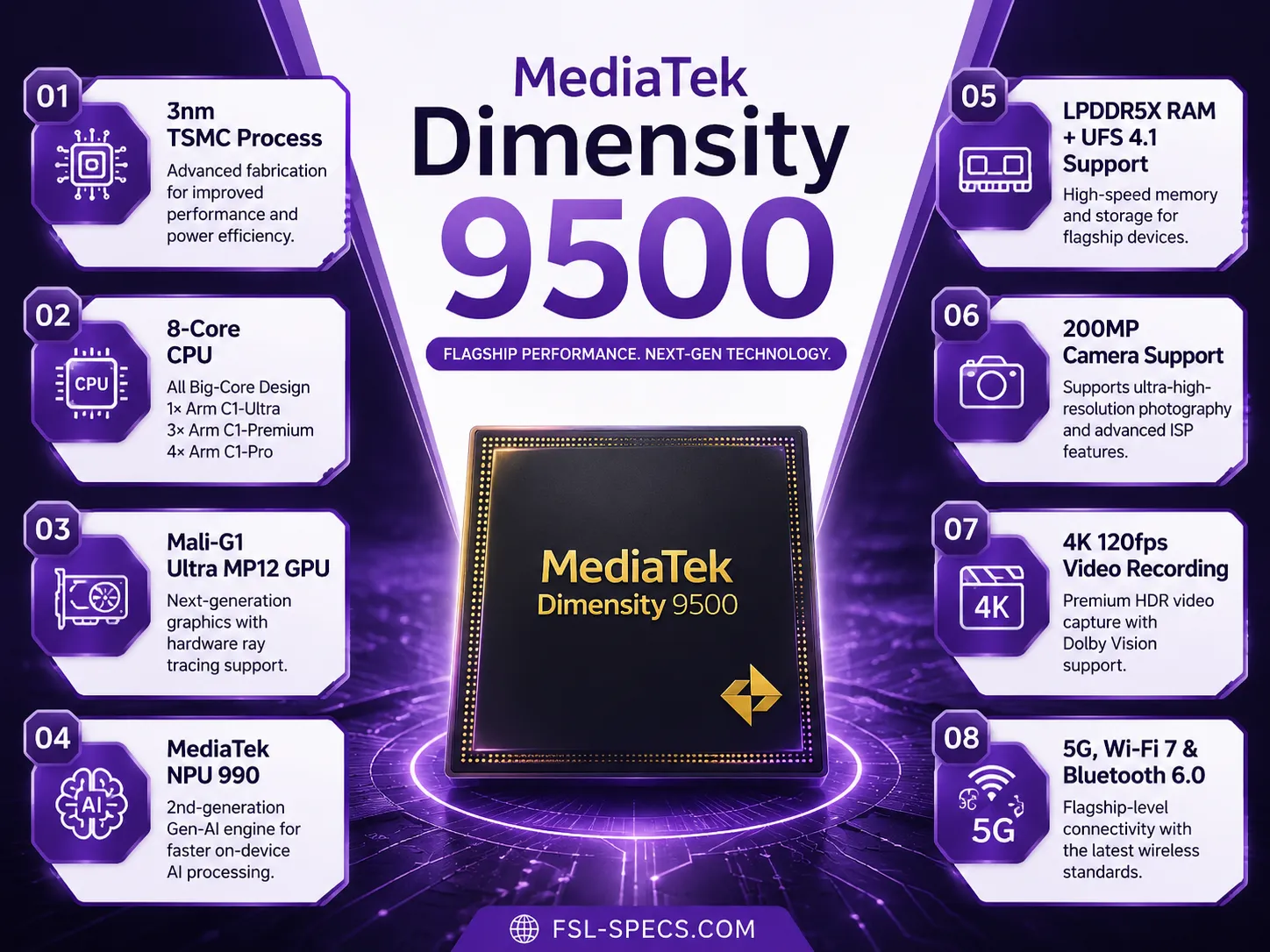
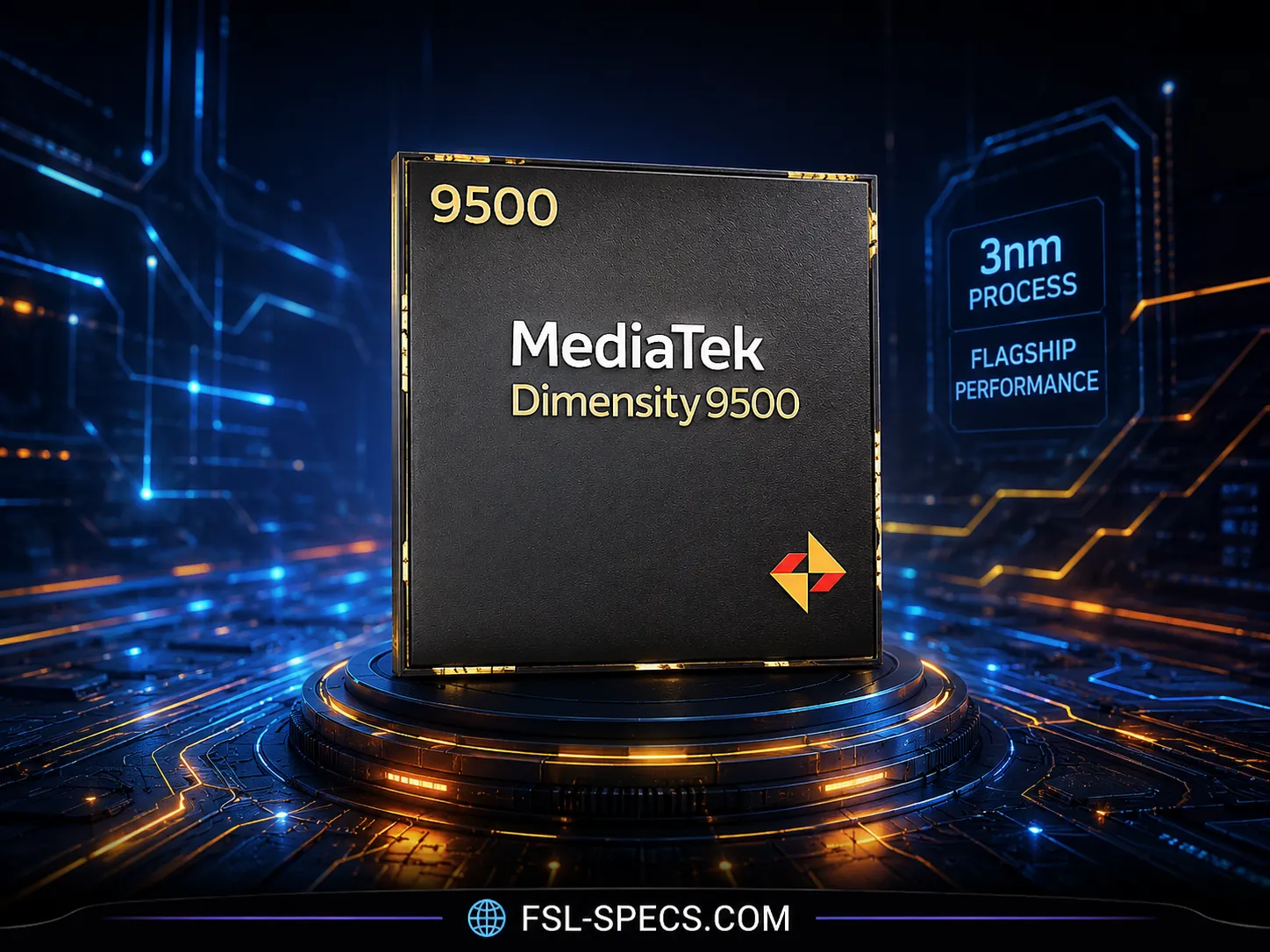
The MediaTek Dimensity 9500 is positioned as one of the most aggressive flagship mobile processors of its generation, and its specifications show why. It uses MediaTek’s third-generation all-big-core CPU design, a 3nm manufacturing process, the Arm C1-Ultra, C1-Premium and C1-Pro cores, the Mali-G1 Ultra GPU and the new NPU 990.
Its rivals in this comparison are Apple’s A19 Pro, Apple’s A19, and Samsung’s Exynos 2600. These four processors take very different approaches to flagship performance, making this a more interesting comparison than a simple benchmark battle.
The mediatek Dimensity 9500 is particularly interesting because MediaTek has pushed CPU performance, GPU ray tracing, AI processing, camera processing and storage technology simultaneously. The A19 Pro focuses heavily on Apple’s custom CPU/GPU architecture and tightly integrated hardware-software optimization, while the standard A19 offers much of Apple’s latest architecture in a lower-performance configuration.
Samsung takes another route with the Exynos 2600, combining a 2nm GAA process, a 10-core Armv9.3 CPU, Xclipse 960 graphics and an upgraded AI engine.
CPU Architecture and Processing Power
The Dimensity 9500’s CPU is its biggest architectural change. It uses eight all-performance-oriented cores: 1× C1-Ultra at 4.21GHz, 3× C1-Premium at 3.5GHz and 4× C1-Pro at 2.7GHz. It also includes 16MB L3 cache and 10MB system-level cache. MediaTek says the C1-Ultra provides a 10% IPC improvement over the previous generation, while the overall platform reaches up to 32% higher single-core and 17% higher multi-core performance than the Dimensity 9400.
The A19 Pro takes a very different approach with a 6-core CPU, consisting of 2 performance cores and 4 efficiency cores. Apple describes it as the fastest CPU in a smartphone, while the chip also receives a larger cache and more memory bandwidth than the previous generation. The A19 uses another 6-core CPU with 2 performance and 4 efficiency cores, but its GPU configuration is reduced compared with A19 Pro.
The Exynos 2600 uses the most CPU cores here, with a 10-core design consisting of one C1-Ultra core, three high-performance middle cores and six efficiency-focused middle cores. Samsung says this structure is designed to widen the performance envelope while improving efficiency, and its Armv9.3 architecture includes SME2 support for machine-learning workloads.
In Geekbench 6 results reported from launch comparisons, the mediatek Dimensity 9500 reached 4,007 single-core and 11,217 multi-core, compared with 3,895 and 9,746 for the A19 Pro. Against the standard A19, reported figures were 3,608 single-core and 8,810 multi-core. These results indicate that mediatek Dimensity 9500 can be highly competitive with Apple’s chips in multi-core workloads, although benchmark results vary by device, firmware and testing conditions.
GPU and Gaming Performance
Gaming is another major strength of the mediatek Dimensity 9500. It introduces the Arm Mali-G1 Ultra MC12 GPU and a new dynamic cache architecture shared across the CPU, GPU and NPU.
MediaTek claims up to 33% better GPU performance, up to 119% better ray-tracing performance, and 42% better power efficiency at peak performance compared with its previous generation. It also supports Vulkan ray tracing and native Unreal Engine 5.5+ technologies including Nanite and MegaLights.
The Mediatek Dimensity 9500 also targets extremely high-frame-rate gaming. MediaTek says it is the first mobile platform to support 120FPS ray-traced mobile gaming, while its MFRC technology can upgrade compatible 60FPS games to 120FPS output. That does not mean every game will run at 120FPS, but the hardware and software pipeline provide substantial headroom for flagship Android gaming.
A19 Pro uses a 6-core GPU with Neural Accelerators in every GPU core, plus hardware-accelerated ray tracing. Apple specifically positions the chip for AAA gaming and says the new architecture improves sustained performance when paired with the iPhone 17 Pro’s vapor-chamber cooling system. The standard A19 uses a 5-core GPU, also with Neural Accelerators and hardware ray tracing, placing it below A19 Pro in Apple’s own lineup.
The Exynos 2600 uses the Xclipse 960 GPU, and Samsung says its computing performance is twice that of the previous generation. It also adds improved ray tracing and Exynos Neural Super Sampling, which combines AI-based resolution upscaling and frame generation. Samsung claims the combined technology can make supported gaming experiences feel up to three times smoother, although actual results depend heavily on game support and device implementation.
Manufacturing Process and Efficiency
The Mediatek Dimensity 9500 is manufactured using a 3rd-generation 3nm process, while both Apple A19 and A19 Pro use third-generation 3nm technology. The Exynos 2600 takes the process-node lead on paper with Samsung’s 2nm GAA technology.
However, the smaller number alone does not automatically make Exynos 2600 the fastest or most efficient processor. Architecture, voltage, clock speeds, cache, cooling, software optimization and workload all affect real-world efficiency.
Samsung specifically designed the Exynos 2600’s power architecture and thermal system around its 2nm process, including a Heat Path Block that Samsung says reduces thermal resistance by up to 16% compared with its predecessor.
Mediatek Dimensity 9500 also emphasizes efficiency. MediaTek claims up to 55% lower ultra-core peak power consumption and up to 30% greater power efficiency while multitasking in certain workloads. These are manufacturer test claims, so they should be treated as directional rather than universal real-world results.
AI and NPU Capabilities
The Mediatek Dimensity 9500 introduces the MediaTek NPU 990, designed for generative and agentic AI. MediaTek says it is more than twice as fast as its previous NPU, with up to 56% reduced peak power use and more than 2× faster token generation. It also supports 4K text-to-image generation and a compute-in-memory architecture designed to improve AI efficiency.
A19 and A19 Pro integrate Apple’s 16-core Neural Engine. A19 also puts Neural Accelerators into every GPU core, while A19 Pro combines those accelerators with its 6-core GPU. Apple’s hardware is tightly integrated with Apple Intelligence and its software ecosystem, making the practical AI experience dependent not only on raw accelerator capability but also on Apple’s operating-system and application optimization.
Exynos 2600 is particularly strong on paper for on-device AI. Samsung says its NPU delivers a 113% improvement in generative AI performance compared with Exynos 2500, while supporting larger models and lower-latency AI tasks. It also supports ExecuTorch, helping developers deploy PyTorch-based models directly on devices.
Camera, ISP and Video Processing
Mediatek Dimensity 9500 uses MediaTek Imagiq 1190 and supports camera sensors up to 320MP. Its video pipeline supports up to 8K60 capture and 4K120 with EIS, while MediaTek highlights 4K60 cinematic video capabilities. This makes the processor particularly attractive for Android flagship phones focused on high-resolution and high-frame-rate video.
Exynos 2600 also supports cameras up to 320MP and adds AI-based Visual Perception System processing and Deep Learning Video Noise Reduction. Samsung says its VPS can recognize image and video elements in real time, while DVNR targets improved low-light video quality with lower power consumption.
Apple’s A19 and A19 Pro approach imaging differently. Their ISP, Neural Engine and dedicated camera processing work together with Apple’s Photonic Engine, Deep Fusion, Smart HDR and other computational photography technologies.
A19 Pro-powered iPhone 17 Pro adds a sophisticated multi-camera system and professional video features, demonstrating how processor capability and platform-level software can translate into camera results.
Memory, Storage and Connectivity
Mediatek Dimensity 9500 supports LPDDR5X 10667 memory and UFS 4.1 four-lane storage, giving it a very modern Android flagship memory and storage platform. UFS 4.1 is particularly important for large-game installation, application loading and large file transfers.
For connectivity, Mediatek Dimensity 9500 supports 5G, Wi-Fi 7 with a peak data rate of 7.3Gbps, Bluetooth 6.0, dual Bluetooth engines and a wide range of modern satellite-navigation systems. This makes it extremely well equipped for high-end Android devices.
Apple’s A19 family uses Apple’s own wireless architecture alongside the N1 wireless networking chip, which enables Wi-Fi 7, Bluetooth 6 and Thread in the iPhone 17 generation. The Exynos 2600’s detailed connectivity specifications are less completely disclosed in Samsung’s public processor overview, so a complete numerical comparison should not invent missing modem or memory figures.
Real-World Performance and Final Ranking
The Mediatek Dimensity 9500 is arguably the most balanced Android flagship processor in this comparison. Its combination of all-big-core CPU architecture, strong multi-core performance, Mali-G1 Ultra graphics, advanced ray tracing, NPU 990, UFS 4.1, Wi-Fi 7 and professional video support gives it very few obvious weaknesses on paper.
The A19 Pro remains exceptionally competitive, particularly in single-core CPU performance, GPU optimization, sustained iPhone performance and Apple’s tightly integrated hardware-software ecosystem. It is the strongest choice for users who specifically want iOS, Apple’s gaming ecosystem and professional camera/video workflows.
The standard A19 is less aggressive than A19 Pro but remains a premium processor. Apple’s own specifications place it below A19 Pro in GPU configuration, yet its 3nm design, Neural Engine and optimized iOS platform make it a powerful everyday and gaming chip.
The Exynos 2600 is the most technically interesting challenger. Its 2nm GAA manufacturing process, 10-core CPU, Xclipse 960 GPU, ENSS gaming technology, upgraded NPU and advanced camera processing make it a serious flagship contender. Its biggest question is not the specification sheet but how consistently retail devices translate that hardware into sustained performance.
Final Verdict
1. MediaTek Dimensity 9500 — Best Overall Android Flagship Processor
Its combination of CPU performance, gaming capability, AI hardware, UFS 4.1, camera processing and connectivity makes it the most complete all-round package here. MediaTek has clearly targeted not one category but the entire flagship experience.
2. Apple A19 Pro — Best for iOS Performance and Optimization
A19 Pro remains exceptionally strong in CPU performance, GPU acceleration, AI and sustained workloads, especially when combined with Apple’s hardware and software integration.
3. Samsung Exynos 2600 — Best for Advanced Process Technology and On-Device AI
Its 2nm GAA process, 10-core CPU, upgraded NPU and Xclipse 960 GPU give it a highly competitive technical foundation.
4. Apple A19 — Best Efficient Mainstream Flagship Apple Chip
A19 is still extremely capable, but its 5-core GPU and positioning below A19 Pro make it less ambitious than the three higher-end competitors in this comparison.
Best for Gaming: Mediatek Dimensity 9500
Best for iOS Optimization: A19 Pro
Best for On-Device AI: Dimensity 9500 / Exynos 2600
Best Manufacturing Process: Exynos 2600
Best Balanced Android Choice: Mediatek Dimensity 9500
Bottom Line: The Dimensity 9500 is the standout all-rounder because it combines very high CPU performance with serious GPU and ray-tracing capability, advanced generative AI, professional video processing, UFS 4.1 and Wi-Fi 7.
The A19 Pro remains the strongest alternative for Apple’s ecosystem and optimized sustained performance, while Exynos 2600 is the most technically ambitious challenger thanks to its 2nm GAA design. The standard A19 is powerful but occupies a lower tier within this particular four-way flagship comparison.