
Snapdragon 8 Gen 5
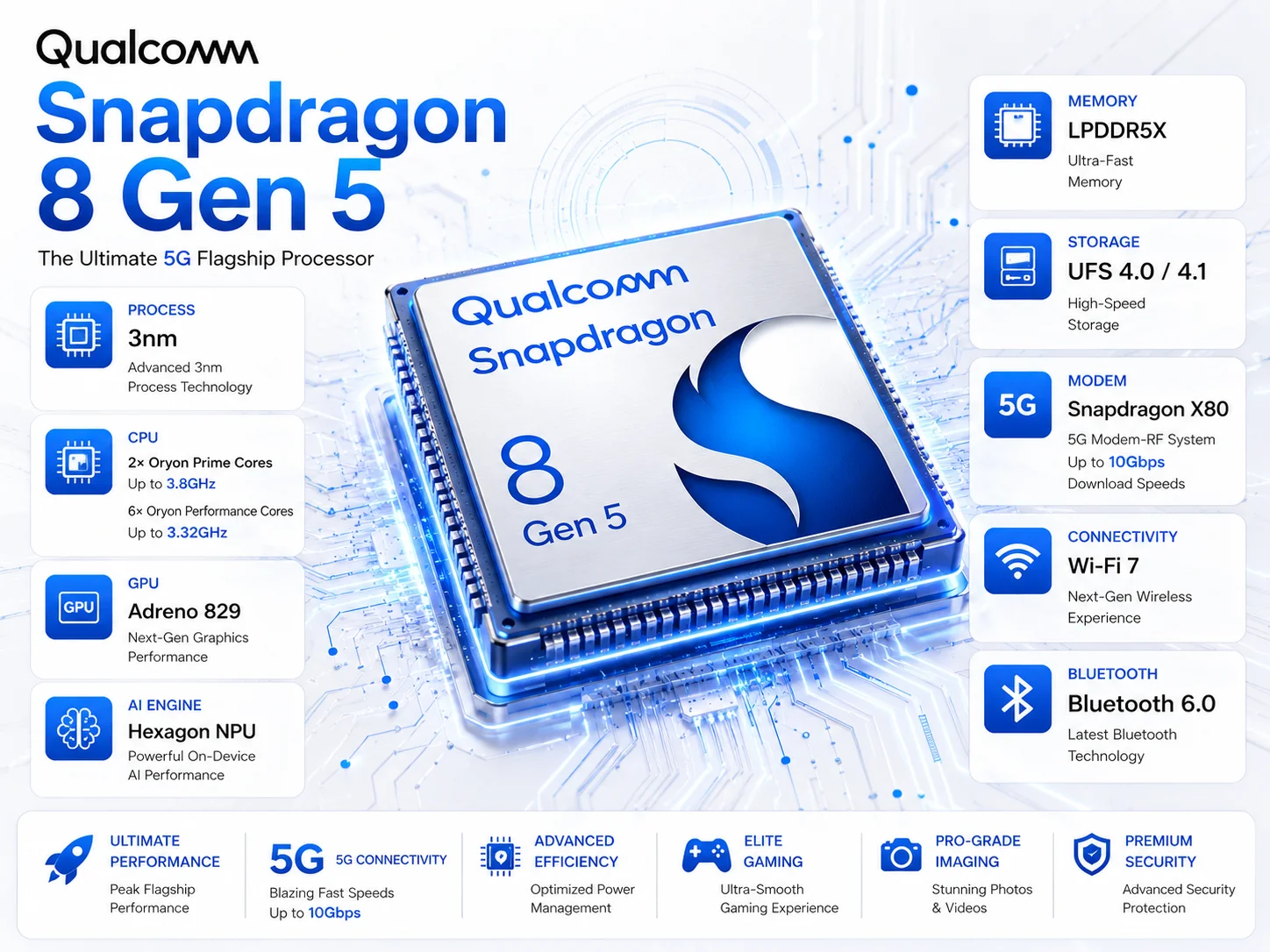
The Qualcomm Snapdragon 8 Gen 5 is Qualcomm's flagship 5G chipset built on a 3nm process, using 2× Oryon Prime cores up to 3.8GHz and 6× Oryon Performance cores up to 3.32GHz, paired with an Adreno 829 GPU. With LPDDR5X memory, UFS 4.0/4.1 storage, a Hexagon NPU for on-device AI, the Snapdragon X80 modem with up to 10Gbps download speeds, Wi‑Fi 7, and Bluetooth 6.0, it's built for top‑tier flagship performance.
Benchmark Scores
Measures CPU, GPU, RAM, and I/O performance in different scenarios.
Shows raw single-threaded CPU performance across real-world workloads.
Cross-platform benchmark assessing graphics performance in Vulkan/Metal.
Evaluates overall system performance in everyday workloads.
CPU & AI Performance
6× Oryon Performance up to 3.32GHz
Graphics, Memory & Storage
Multimedia (Camera, Display & ISP)
Connectivity
General Info
information About Qualcomm Snapdragon 8 Gen 5
Introduction
The Snapdragon 8 Gen 5 vs Xiaomi Xring O1 vs Apple A18 Pro comparison brings together three very different approaches to flagship smartphone processor design. Qualcomm’s Snapdragon 8 Gen 5 is a newer Android flagship-class platform built around Qualcomm’s Oryon CPU architecture and Adreno 829 graphics. Xiaomi’s Xring O1 takes a more aggressive multi-core approach with ten CPU cores and a Mali-G925 GPU, while Apple’s A18 Pro uses a compact six-core CPU design backed by Apple’s tightly integrated hardware and software ecosystem.
The interesting part is that there is no single specification that settles this comparison. The Xring O1 has ten CPU cores, higher theoretical memory bandwidth than the A18 Pro, and a 44-TOPS NPU according to NanoReview. The A18 Pro, meanwhile, produces the strongest Geekbench single-core result among the three in the available NanoReview data. Snapdragon 8 Gen 5 sits between these philosophies: it has fewer CPU cores than Xring O1 but combines two Oryon prime cores, six performance cores, LPDDR5X memory, Adreno 829 graphics, and a newer connectivity package.
Benchmark data makes the contest particularly interesting. NanoReview currently lists Snapdragon 8 Gen 5 at 3,068,952 AnTuTu 11, slightly ahead of Xring O1 at 2,998,904, while Xring O1 has a higher Geekbench 6 GPU compute result and a considerably higher theoretical floating-point result. Apple’s A18 Pro records 1,915,175 in AnTuTu 11 on NanoReview, although NanoReview correctly warns that AnTuTu results across Android and iOS should not be treated as perfectly equivalent.
91mobiles provides a different real-device testing picture. It records 3,098,258 AnTuTu and 2,889/9,583 Geekbench single/multi-core for Snapdragon 8 Gen 5, while its A18 Pro page reports 1,774,620 AnTuTu and 3,317/8,115 Geekbench. This highlights an important lesson: benchmark databases can use different devices, test conditions and methodologies, so the most useful comparison comes from looking at several indicators rather than treating one score as absolute truth.
Processor Overview
| Specification | Snapdragon 8 Gen 5 | Xiaomi Xring O1 | Apple A18 Pro |
|---|---|---|---|
| Launch | November 2025 | May 2025 | September 2024 |
| Process | 3nm | 3nm | 3nm |
| CPU Cores | 8 | 10 | 6 |
| Maximum Clock | 3.8GHz | 3.9GHz | 4.05GHz |
| GPU | Adreno 829 | Mali-G925 Immortalis MP16 | Apple A18 Pro GPU |
| Memory | LPDDR5X | LPDDR5T / LPDDR5X* | LPDDR5X |
| Max Bandwidth | 76.8GB/s | 76.8GB/s | 60GB/s |
| NPU | Hexagon | NPU | Neural Engine |
| NPU Performance | Not disclosed in supplied NanoReview data | 44 TOPS | 35 TOPS |
| Wi-Fi | Wi-Fi 7 | Wi-Fi 7 | Wi-Fi 7 |
| 5G | Yes | Yes | Yes |
*NanoReview lists LPDDR5T for Xring O1, while 91mobiles lists LPDDR5X. This difference should be treated as a source discrepancy rather than silently choosing one.
At a high level, Snapdragon 8 Gen 5 is the strongest overall package in the available data, but Xring O1 is much closer than its launch position might suggest. Apple’s A18 Pro remains extremely competitive in CPU-focused workloads, particularly single-core performance, but its older launch date and lower multi-core result place it behind the two newer Android-oriented competitors in this comparison.
CPU Architecture & Processing Power
CPU design is where these three chips become fundamentally different.
Snapdragon 8 Gen 5 uses eight Oryon CPU cores, consisting of two cores clocked at up to 3.8GHz and six performance cores reaching 3.32GHz. Xring O1 uses ten ARM cores: two Cortex-X925 cores at 3.9GHz, four Cortex-A725 cores at 3.4GHz, two additional Cortex-A725 cores at 1.9GHz, and two Cortex-A520 cores at 1.8GHz. Apple’s A18 Pro takes the most compact design with six cores: two Everest cores at 4.05GHz and four Sawtooth cores at 2.42GHz.
The headline clock-speed winner is therefore A18 Pro at 4.05GHz. But clock speed alone does not determine CPU performance. Snapdragon’s Oryon architecture and Xring O1’s additional cores demonstrate why core count and architecture must be evaluated together.
NanoReview’s Geekbench 6 data gives Snapdragon 8 Gen 5 a 2,903 single-core score and 9,602 multi-core, compared with Xring O1 at 2,746 and 8,431. That gives Snapdragon approximately a 5.7% single-core advantage and a 13.9% multi-core advantage over Xring O1 in that dataset.
The A18 Pro changes the picture. NanoReview records 3,518 single-core and 8,950 multi-core. Its single-core result is approximately 21.2% higher than Snapdragon 8 Gen 5’s 2,903, while Snapdragon’s multi-core result is approximately 7.3% higher than A18 Pro’s 8,950.
That means A18 Pro is exceptionally strong when the workload emphasizes individual CPU-thread performance. Tasks that benefit from rapid single-thread execution can therefore favor Apple’s processor. Snapdragon 8 Gen 5, however, demonstrates stronger multi-core throughput in the available NanoReview results.
91mobiles shows a similar pattern, although its numbers differ because they come from its own tested devices. Snapdragon 8 Gen 5 reaches 2,889 single-core and 9,583 multi-core, while A18 Pro is listed at 3,317 and 8,115. In other words, 91mobiles also shows A18 Pro ahead in single-core while Snapdragon leads multi-core.
This is one of the clearest conclusions in the entire comparison: A18 Pro remains a single-core specialist, Snapdragon 8 Gen 5 is stronger in multi-core throughput, and Xring O1 sits between them with a highly aggressive ten-core design.
For multitasking, sustained CPU-heavy workloads and applications that can distribute work across multiple threads, Snapdragon’s multi-core lead over A18 O1 is more meaningful than simply looking at maximum clock speed.
GPU & Gaming Performance
The GPU battle is more complicated because the architectures are completely different.
Snapdragon 8 Gen 5 uses Adreno 829, while Xring O1 uses Mali-G925 Immortalis MP16. A18 Pro uses Apple’s proprietary A18 Pro GPU. NanoReview lists Xring O1’s GPU at 1,392MHz, Snapdragon 8 Gen 5 at 1,225MHz, and A18 Pro at 1,490MHz.
Interestingly, a higher GPU frequency does not automatically produce higher overall graphics performance.
In NanoReview’s GPU compute test, Xring O1 records 21,512, narrowly ahead of Snapdragon 8 Gen 5 at 21,211. That is only about a 1.4% difference, meaning the two are effectively extremely close in this particular measurement.
Xring O1 also has 2,048 total shaders and 16 pipelines listed by NanoReview, while Snapdragon 8 Gen 5 has 1,024 shaders and two listed pipelines. These raw architectural figures should not be interpreted as direct FPS predictions because different GPU architectures can achieve very different amounts of work per execution unit.
The 3DMark data is more useful for sustained graphics assessment. NanoReview reports Xring O1 at 2,413 in 3DMark Steel Nomad Light compared with 1,732 for A18 Pro, while Solar Bay scores are 9,022 and 7,585 respectively. Xring O1 therefore has a substantial advantage in these particular cross-platform graphics tests.
Snapdragon’s advantage is not simply raw graphics hardware. The platform also has Vulkan 1.4, OpenCL 3.0 and DirectX 12.1 support in NanoReview’s specifications, whereas Xring O1 is listed with Vulkan 1.3, OpenCL 3.0 and DirectX 12.1.
For Android gaming, Snapdragon 8 Gen 5 therefore presents a very strong balance of CPU throughput and GPU capability. Xring O1 remains a serious graphics competitor and actually edges Snapdragon in NanoReview’s GPU compute result. A18 Pro is capable, but its cross-platform benchmark position is harder to compare directly because Apple’s Metal-based ecosystem differs from Android’s Vulkan environment.
The important conclusion is not that one chip will produce a fixed number of FPS. The data does not justify such a claim. Instead, the evidence indicates that Snapdragon 8 Gen 5 and Xring O1 are the more directly competitive Android gaming platforms, while A18 Pro remains highly capable but operates inside Apple’s different hardware/software environment.
Manufacturing Process & Efficiency
All three processors use a 3nm manufacturing process, with the supplied data identifying TSMC manufacturing for the chips where NanoReview provides that information.
Because all three are 3nm, there is no simple node-size winner. This is important because processor efficiency cannot be reduced to the number printed before “nm.”
NanoReview’s overall battery-efficiency ratings currently give Snapdragon 8 Gen 5 a 93, Xring O1 a 92, and A18 Pro a 97. These are platform-level scores rather than guarantees of battery life in every phone. A18 Pro therefore has the highest NanoReview efficiency rating, while Snapdragon is narrowly ahead of Xring O1.
This gives A18 Pro an important advantage for users prioritizing efficiency. However, actual smartphone battery life also depends heavily on display technology, battery capacity, thermal design, modem usage, software and power management. The processor comparison alone cannot predict how many hours a particular phone will last.
Memory & Storage Support
Memory bandwidth is an important differentiator.
NanoReview lists Snapdragon 8 Gen 5 with LPDDR5X, a 4×16-bit bus and maximum bandwidth of 76.8GB/s, while Xring O1 is listed with LPDDR5T, a 4×16-bit bus and the same 76.8GB/s bandwidth. A18 Pro uses LPDDR5X with 60GB/s maximum bandwidth.
That gives Snapdragon and Xring O1 a 28% higher theoretical memory bandwidth than A18 Pro.
This matters particularly for workloads involving large datasets, high-resolution graphics and intensive multitasking. More bandwidth can reduce the bottleneck between the processor and memory subsystem, although it does not automatically translate into a 28% improvement in everyday performance.
The maximum memory capacity is another major distinction. NanoReview lists Snapdragon 8 Gen 5 and Xring O1 at 24GB, compared with 8GB for A18 Pro in its processor specifications. 91mobiles also lists Xring O1 with a maximum memory size of 24GB.
That does not mean an iPhone with A18 Pro will behave like an Android phone with only 8GB of RAM. Apple’s operating system and memory management are different. Therefore, raw maximum RAM capacity should be interpreted as a platform specification rather than a direct measure of multitasking quality.
For Android manufacturers building high-RAM gaming or productivity phones, however, Snapdragon 8 Gen 5 and Xring O1 provide considerably more memory headroom on paper.
AI & NPU Capabilities
AI hardware is another category where Xring O1 has a clear numerical advantage in the available NanoReview data.
Xring O1 is listed with an NPU capable of 44 TOPS, while A18 Pro’s Neural Engine is listed at 35 TOPS. Snapdragon 8 Gen 5 is identified with a Hexagon AI accelerator, but NanoReview does not provide a directly comparable TOPS figure in the cited specification data.
Xring O1 therefore has a 25.7% higher theoretical AI throughput than A18 Pro based solely on these reported TOPS figures.
But TOPS is not a universal AI performance score. Different processors can execute different AI models with different precisions, software optimizations and memory requirements. A higher TOPS number does not guarantee faster performance in every generative-AI or camera-AI workload.
For Snapdragon 8 Gen 5, the lack of a directly comparable NanoReview TOPS figure means it would be inaccurate to declare it the AI winner from these sources alone.
The more defensible conclusion is that Xring O1 has the strongest disclosed theoretical NPU figure, A18 Pro has a lower disclosed TOPS figure but strong platform integration, and Snapdragon’s AI hardware cannot be fairly ranked by TOPS without an equivalent number.
ISP, Camera & Video Capabilities
Processor camera capabilities are especially important because the SoC determines how much image and video processing a smartphone can potentially perform.
Snapdragon 8 Gen 5 supports up to 320MP camera resolution according to NanoReview and can capture 8K at 60FPS or 4K at 120FPS. Xring O1 is listed for 8K at 30FPS and 4K at 120FPS. A18 Pro is listed with a maximum camera resolution of 48MP and 4K at 120FPS video capture.
This is one of Snapdragon’s clearest specification wins.
Compared with Xring O1, Snapdragon doubles the listed 8K recording frame rate from 30FPS to 60FPS. Both support 4K at 120FPS, which is important for high-frame-rate video and slow-motion applications.
A18 Pro’s 4K 120FPS capability remains impressive, but its processor specification shows a much lower maximum camera-resolution figure.
However, processor support should not be confused with what a particular smartphone actually implements. A phone manufacturer may use a lower-resolution sensor, limit recording modes or design its camera system around a specific configuration.
Therefore, the processor gives the phone a ceiling; the actual camera experience depends on the entire imaging system.
Display Support
NanoReview lists Snapdragon 8 Gen 5 with a maximum display resolution of 3840 × 2540. The cited Xring O1 and A18 Pro specification data does not provide an equivalent maximum display-resolution figure.
Because equivalent data is not available for all three, Snapdragon can only be identified as the processor with a disclosed maximum resolution in this dataset, not automatically as the universal display winner.
For buyers, this distinction matters. A processor’s maximum supported display resolution is a capability, not a guarantee that a smartphone using that chip will ship with a display at that resolution.
5G, Modem & Connectivity
Connectivity is an area where Snapdragon 8 Gen 5 has a particularly strong specification.
It uses the Snapdragon X80 modem, supports 5G, and has a theoretical maximum download speed of 10Gbps and upload speed of 3.5Gbps. It also supports Wi-Fi 7, Bluetooth 6.0, and multiple global navigation systems.
Xring O1 uses the MediaTek T800 modem, with theoretical maximum download of 7.9Gbps and upload of 4.2Gbps, alongside Wi-Fi 7 and Bluetooth 5.4.
That means Snapdragon has approximately 26.6% higher theoretical peak download bandwidth, while Xring O1 has approximately 20% higher theoretical peak upload bandwidth.
A18 Pro is listed with a Snapdragon X71 5G modem, up to 10Gbps download, 3.5Gbps upload, Wi-Fi 7 and Bluetooth 5.3.
The practical result is that Snapdragon 8 Gen 5 and A18 Pro have matching listed peak 5G download and upload figures, while Snapdragon has the newer Bluetooth 6.0 specification. Xring O1 remains competitive but trails Snapdragon in peak download speed.
Real-world network speeds will always depend on the carrier, spectrum, signal quality, modem implementation and network congestion.
Benchmark Comparison
The benchmark results provide the clearest numerical picture.
NanoReview AnTuTu 11
- Snapdragon 8 Gen 5: 3,068,952
- Xring O1: 2,998,904
- A18 Pro: 1,915,175
Snapdragon leads Xring O1 by approximately 2.3%, which is a surprisingly small difference considering the architectural differences between the two. A18 Pro trails Snapdragon by approximately 60.2% in this particular AnTuTu dataset.
However, NanoReview explicitly warns that AnTuTu scores from Android and iOS are not directly comparable. Therefore, the A18 Pro’s lower score should not be interpreted as meaning an iPhone will be 60% slower in everyday use.
NanoReview Geekbench 6
Single-core:
- A18 Pro: 3,518
- Snapdragon 8 Gen 5: 2,903
- Xring O1: 2,746
A18 Pro is the clear single-core leader.
Multi-core:
- Snapdragon 8 Gen 5: 9,602
- A18 Pro: 8,950
- Xring O1: 8,431
Snapdragon leads multi-core, followed by A18 Pro and then Xring O1.
91mobiles’ real-device results tell a similar story: Snapdragon 8 Gen 5 scores 3,098,258 AnTuTu and 2,889/9,583 Geekbench, while A18 Pro scores 1,774,620 AnTuTu and 3,317/8,115 Geekbench.
The benchmark evidence therefore supports a nuanced conclusion rather than a simplistic “fastest chip” label.
Real-World Performance
For everyday Android use, Snapdragon 8 Gen 5’s strong multi-core performance and high AnTuTu result make it a particularly powerful platform. App launching, multitasking and demanding workloads should have considerable processing headroom, although individual phone performance will also depend on software optimization and thermal design.
Xring O1 is not far behind. Its AnTuTu result is only about 2.3% below Snapdragon’s NanoReview score, while its GPU compute result actually edges Snapdragon by around 1.4%. This makes Xring O1 a much more serious competitor than a simple specification comparison might suggest.
A18 Pro is different. Its 3,518 Geekbench single-core score demonstrates exceptional per-core performance, while its 8,950 multi-core score remains very strong. Its biggest limitation in this comparison is not weak CPU performance; it is that the two newer Android-oriented chips deliver greater multi-core and overall AnTuTu throughput in the cited datasets.
For gaming, Snapdragon 8 Gen 5 and Xring O1 are the most compelling choices from the supplied cross-platform evidence. Xring O1’s 3DMark results are particularly strong, while Snapdragon delivers almost identical GPU compute performance and stronger CPU multi-core results.
For AI, Xring O1 has the highest disclosed theoretical NPU figure at 44 TOPS, but Snapdragon cannot be ranked lower simply because an equivalent TOPS figure is not disclosed in the cited data.
For efficiency, A18 Pro has the strongest NanoReview battery-efficiency rating at 97, compared with 93 for Snapdragon 8 Gen 5 and 92 for Xring O1.
Strengths & Weaknesses
Snapdragon 8 Gen 5
Strengths
- Highest NanoReview AnTuTu 11 score
- Strongest Geekbench multi-core score
- 8K 60FPS video capability
- 320MP maximum camera support
- Wi-Fi 7 and Bluetooth 6.0
- 10Gbps peak download
- 24GB maximum memory listed
Weaknesses
- Lower single-core score than A18 Pro
- Xring O1 slightly ahead in NanoReview GPU compute
- No directly comparable NPU TOPS figure supplied
Xiaomi Xring O1
Strengths
- Ten-core CPU design
- 3.9GHz maximum CPU clock
- Very strong AnTuTu score
- Slight GPU compute advantage over Snapdragon in NanoReview
- 44 TOPS NPU
- 76.8GB/s memory bandwidth
- 24GB maximum memory
- 7.9Gbps peak download
Weaknesses
- Lower Geekbench multi-core score than Snapdragon
- 8K video limited to 30FPS in cited data
- Bluetooth 5.4 versus Snapdragon’s 6.0
- Efficiency rating slightly below Snapdragon
Apple A18 Pro
Strengths
- Highest Geekbench single-core score
- Strong Geekbench multi-core performance
- Highest NanoReview efficiency rating
- 4.05GHz maximum CPU clock
- 4K 120FPS video
- 10Gbps peak download
- Mature Apple hardware/software integration
Weaknesses
- Lower multi-core result than Snapdragon
- Lower theoretical memory bandwidth
- 8GB maximum memory listed by NanoReview
- Lower disclosed NPU throughput than Xring O1
- Older September 2024 launch
Best Processor For Different Users
Best Overall: Snapdragon 8 Gen 5
It has the highest NanoReview AnTuTu score, strongest Geekbench multi-core score and an exceptionally broad combination of CPU, GPU, video and connectivity capabilities.
Best for Single-Core Performance: Apple A18 Pro
Best for Multi-Core Performance: Snapdragon 8 Gen 5
Best for Theoretical AI Throughput: Xiaomi Xring O1
Best for Efficiency: Apple A18 Pro
Best for Video Capability: Snapdragon 8 Gen 5
Its listed 8K 60FPS capture capability is ahead of Xring O1’s 8K 30FPS and A18 Pro’s 4K 120FPS maximum.
Best Connectivity Package: Snapdragon 8 Gen 5
Its Snapdragon X80 modem, 10Gbps download, Wi-Fi 7 and Bluetooth 6.0 make it the most advanced connectivity package in the supplied comparison.
Final Verdict & Ranking
1. Snapdragon 8 Gen 5 — Best Overall
Snapdragon 8 Gen 5 takes the overall victory because it offers the strongest combination rather than relying on a single standout specification. It leads the NanoReview AnTuTu 11 ranking, leads Geekbench multi-core, matches Xring O1’s 76.8GB/s memory bandwidth, offers 24GB maximum memory in the cited data, provides 8K 60FPS video, and has the strongest listed connectivity package.
Its most impressive advantage is balance. A18 Pro can beat it substantially in single-core Geekbench, while Xring O1 can challenge it in GPU compute and theoretical AI throughput. Yet Snapdragon consistently avoids having a major weakness across the categories examined.
2. Xiaomi Xring O1 — Strongest Rival
Xring O1 is the closest Android rival to Snapdragon 8 Gen 5 in this comparison. Its 2,998,904 AnTuTu 11 score is only around 2.3% below Snapdragon’s 3,068,952 on NanoReview. Its GPU compute score is also slightly higher, and its 44-TOPS NPU figure gives it an impressive theoretical AI position.
Its weakness is consistency across the complete benchmark set. Snapdragon leads both Geekbench single-core and multi-core, with the multi-core gap approaching 14%. Xring O1 also has the older Bluetooth 5.4 specification and lower listed 8K recording frame rate.
3. Apple A18 Pro — Best Efficiency & Single-Core Specialist
A18 Pro finishes third in this overall comparison, but that ranking should not be interpreted as saying it is a weak processor. It is actually the single-core winner and the efficiency winner according to the cited NanoReview data.
Its problem is that this is a comparison against two newer 2025 flagship-class Android platforms. Snapdragon 8 Gen 5 offers higher multi-core throughput, while Xring O1 delivers greater memory bandwidth and a higher disclosed NPU TOPS figure.
Bottom Line
Snapdragon 8 Gen 5 is the best overall processor of the three based on the available NanoReview and 91mobiles evidence. Its advantage is not overwhelming in every category, but it is the most complete package. Xring O1 is the strongest challenger and comes surprisingly close in overall benchmark performance, while A18 Pro remains the specialist for single-core CPU performance and efficiency.
The most important finding is that Snapdragon 8 Gen 5 does not dominate every test. A18 Pro wins single-core Geekbench, Xring O1 slightly leads Snapdragon in NanoReview GPU compute, and Xring O1 reports the highest theoretical NPU performance. Snapdragon wins because it combines strong results across CPU multi-core performance, overall benchmark performance, video capabilities, memory support and connectivity.
For a buyer choosing purely on overall processor capability, the ranking is therefore:
#1 Snapdragon 8 Gen 5 → #2 Xiaomi Xring O1 → #3 Apple A18 Pro
That ranking is supported by the supplied benchmark and specification evidence, while recognizing that cross-platform benchmarks, especially Android versus iOS, should never be treated as a perfect substitute for real-world device testing
Images Of Qualcomm Snapdragon 8 Gen 5
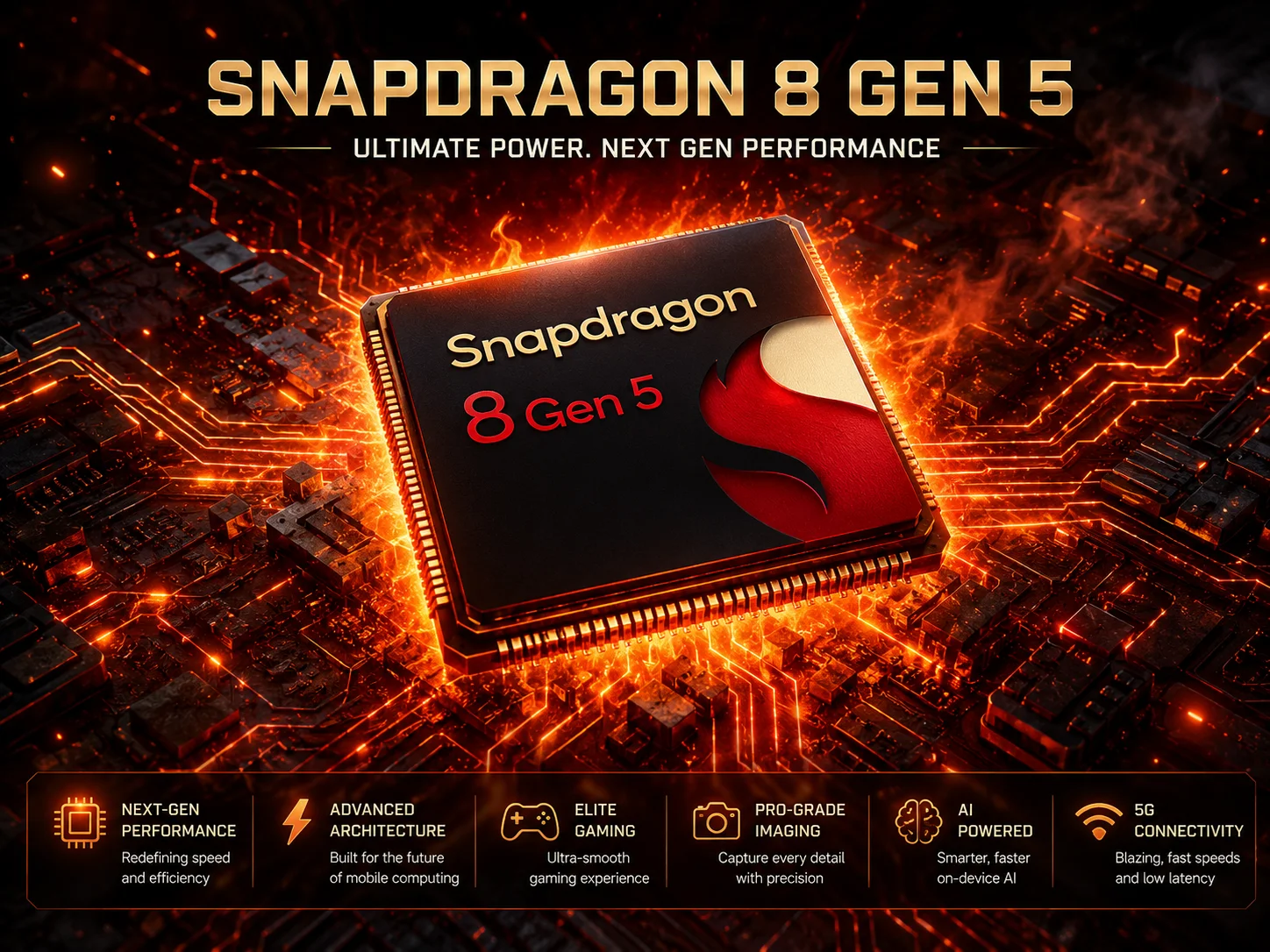
Trailer Of Qualcomm Snapdragon 8 Gen 5

Author & Post Info
Faisal Ur Rehman
Faisal Rehman is the founder and editor of FSL Specs, where he publishes in-depth smartphone specifications, comparisons, buying guides, and technology insights. With extensive experience in mobile hardware research and technical analysis, he provides accurate and up-to-date information on Android smartphones, processors, displays, cameras, batteries, performance benchmarks, and software features. His goal is to simplify complex specifications and help readers choose the right device with confidence.
Explore FSL Specs
Questions About Qualcomm Snapdragon 8 Gen 5
What CPU does the Qualcomm Snapdragon 8 Gen 5 use?
The Snapdragon 8 Gen 5 uses a custom octa-core Oryon design with 2 Prime cores up to 3.8GHz and 6 Performance cores up to 3.32GHz. It is built on a 3nm process with a 16MB L2 cache and a 9W sustained TDP. This marks Qualcomm's continued shift away from ARM reference cores toward fully custom Oryon architecture.
Which GPU powers the Snapdragon 8 Gen 5?
Graphics are handled by the Adreno 829, built on the Adreno 800 architecture. It runs at 1225MHz with 512 shading units and 1024 total shaders, delivering 2508.8 GFLOPS of compute power. It supports Vulkan 1.4 for the latest graphics API features.
What RAM and storage does the Snapdragon 8 Gen 5 support?
It supports LPDDR5X memory at up to 4800MHz across a 4x16-bit bus, giving 76.8GB/s of bandwidth and up to 24GB capacity. Storage is handled by UFS 4.0 or UFS 4.1. This combination is standard for 2025-2026 flagship-tier multitasking and app performance.
What is the AnTuTu score of the Snapdragon 8 Gen 5?
The Snapdragon 8 Gen 5 scores around 3.1 million points on AnTuTu 11. The breakdown shows 954.6K for CPU, 990.3K for GPU, 392.7K for memory, and 731.3K for UX. This places it among the very top flagship chipsets currently available.
Does the Snapdragon 8 Gen 5 support 5G and Wi-Fi 7?
Yes, it pairs with the Snapdragon X80 modem, delivering peak download speeds up to 10Gbps and upload speeds up to 3.5Gbps. It also includes Wi-Fi 7, Bluetooth 6.0, and GNSS support for GPS, GLONASS, BeiDou, Galileo, QZSS, and NAVIC.
What camera and video capabilities does the Snapdragon 8 Gen 5 support?
The ISP supports a single camera sensor up to 320MP. It handles video capture and playback at 8K @ 60FPS and 4K @ 120FPS, with support for H.264, H.265, AV1, VP8, and VP9 codecs. This gives it flagship-level photography and video recording capability.
What is the maximum display support of the Snapdragon 8 Gen 5?
The chip supports display resolutions up to 3840x2540. Combined with the Adreno 829 GPU, this allows for smooth high refresh rate performance on premium flagship panels.