Introduction
Choosing between Dimensity 9400+, Dimensity 9400, and Snapdragon 8 Gen 5 comes down to what each chip actually changes for daily use, not which name sounds newer. All three are 3nm, 8-core, ARMv9.2-A flagship chips, yet they differ in clocks, GPU design, memory bandwidth, and connectivity.
This Dimensity 9400+ vs Dimensity 9400 vs Snapdragon 8 Gen 5 comparison uses only verified specification and benchmark data to show where the 9400+ genuinely improves on the standard 9400, and where Snapdragon 8 Gen 5 pulls ahead or falls behind.
1. Processor Overview
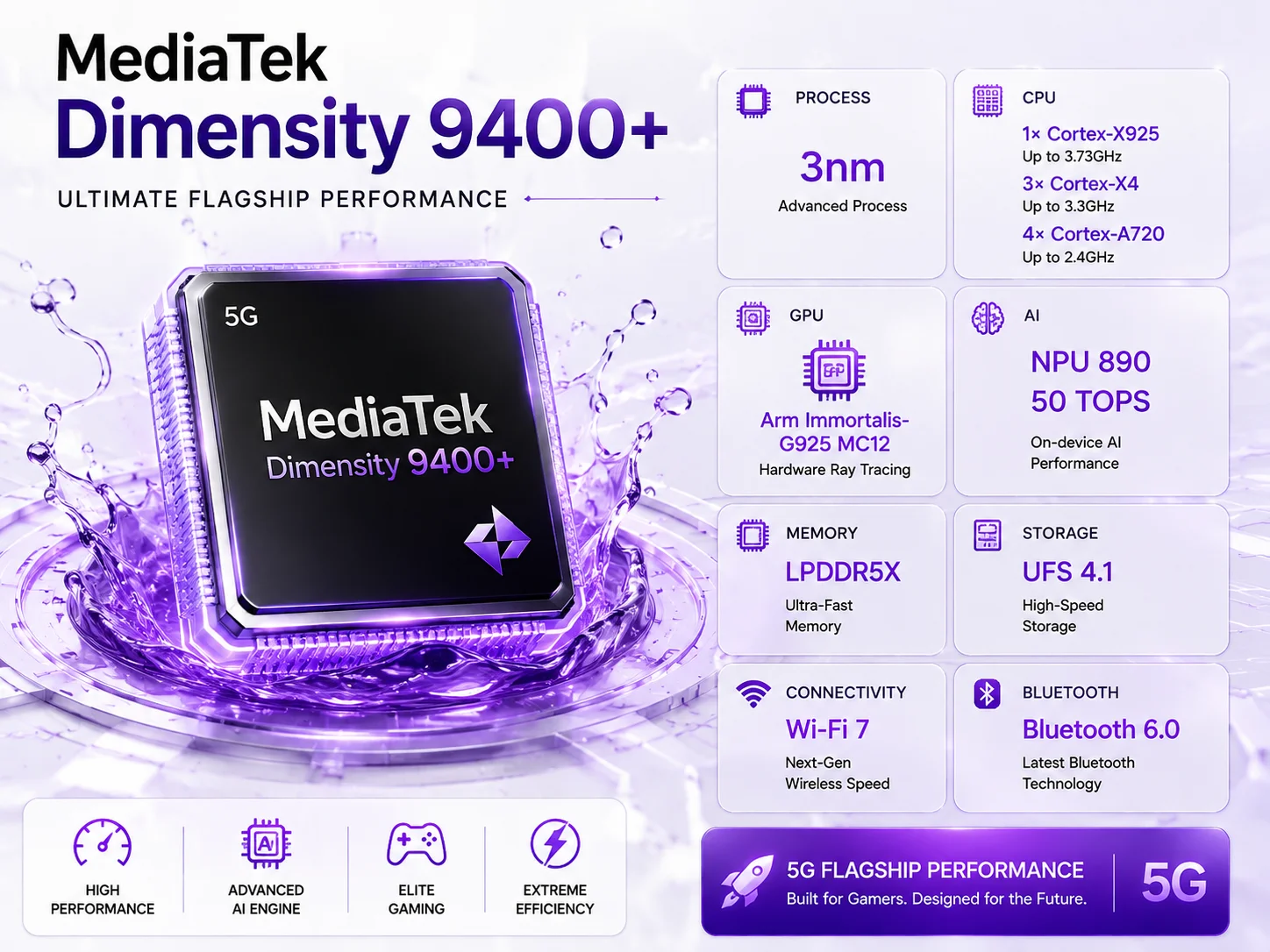
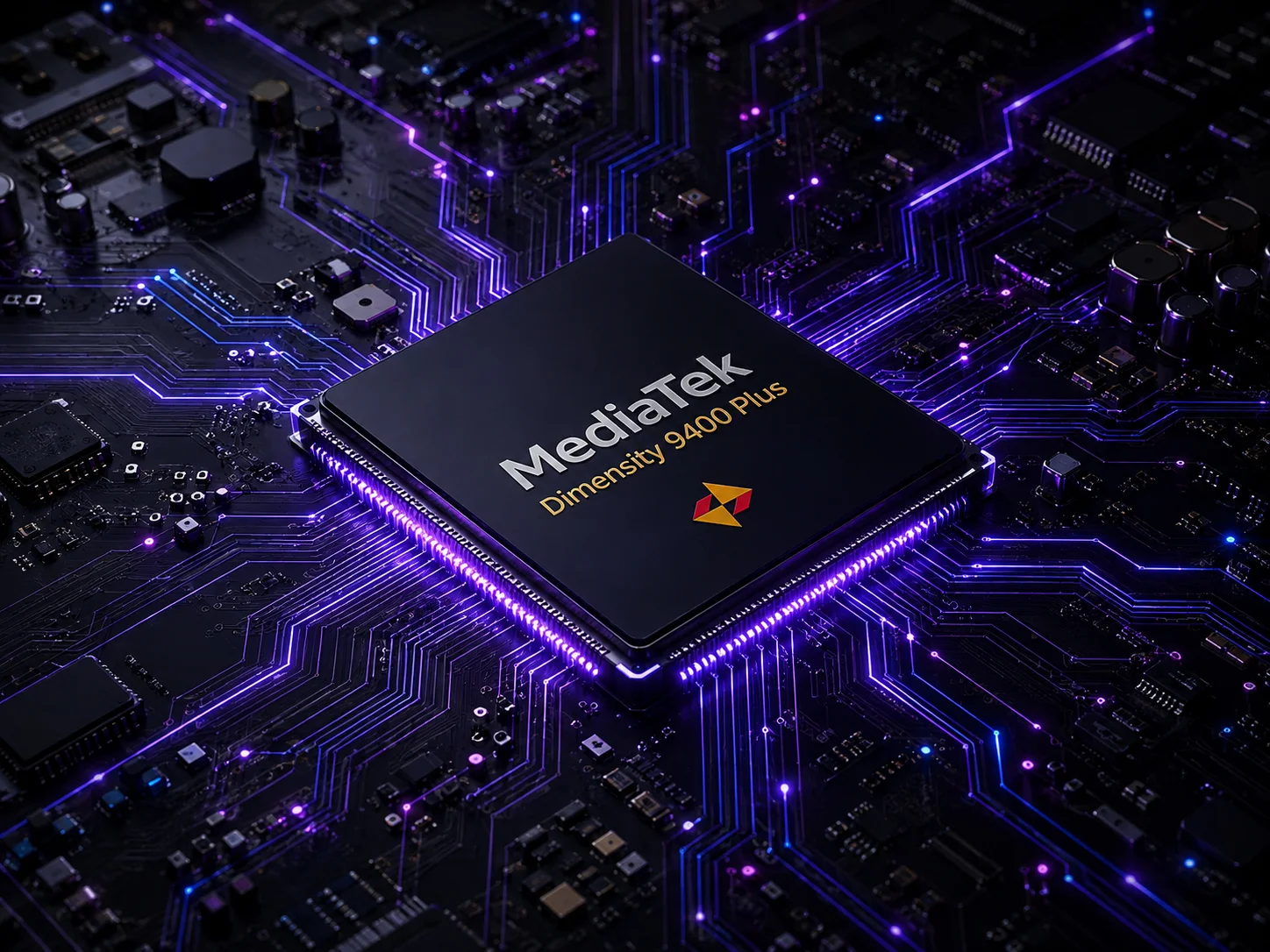
Dimensity 9400+ (April 2025, TSMC 3nm) uses 1x Cortex-X925 (3.73GHz) + 3x Cortex-X4 (3.3GHz) + 4x Cortex-A720 (2.4GHz), an Immortalis-G925 MC12 GPU, and the NPU 890 rated at 50 TOPS.
Dimensity 9400 (October 2024, TSMC 3nm) shares the same layout but the prime core runs at 3.62GHz. Same Immortalis-G925 MC12 GPU and NPU 890.
Snapdragon 8 Gen 5 (November 2025, TSMC 3nm) uses Qualcomm’s custom Oryon cores: 2x Oryon Prime (3.8GHz) + 6x Oryon Performance (3.32GHz), an Adreno 829 GPU, and the Hexagon NPU.
The core philosophy differs: MediaTek leans on one heavy “super core” plus three secondary cores, while Snapdragon spreads work across two strong primes and six performance cores, shaping single-thread versus sustained multi-core behavior.
2. CPU Architecture & Processing Power
All three use ARMv9.2-A and 8 cores. Dimensity 9400+ and 9400 both carry 128KB L1, 2MB L2, 12MB L3. Snapdragon 8 Gen 5 has 192KB L1, 12MB L2, 6MB L3.
The 9400+’s only CPU change over the 9400 is a 110MHz prime-core bump, a minor gain, not a generational leap.
NanoReview’s GeekBench 6 shows Snapdragon 8 Gen 5 ahead in multi-core (9602 vs 8430 for 9400+ and 8767 for 9400). Single-core is closer: 2903 (8 Gen 5), 2729 (9400+), 2797 (9400).
For light multitasking and app launching, the two Dimensity chips feel similar. For sustained multi-core work like video export, Snapdragon 8 Gen 5’s six performance cores and larger L2 give it a real edge, backed by its higher multi-core scores.
3. GPU & Gaming Performance
Dimensity 9400 plus and 9400 share the identical Immortalis-G925 MC12 GPU: 1612MHz, 12 pipelines, 1536 total shaders, 4952.1 Gigaflops FP32, Vulkan 1.3, OpenCL 3.0, DirectX 12.1.
Snapdragon 8 Gen 5 uses Adreno 829: 1225MHz, 2 pipelines, 1024 total shaders, 2508.8 Gigaflops FP32, Vulkan 1.4, OpenCL 3.0, DirectX 12.1.
Both Dimensity chips carry roughly double the theoretical FLOPS. NanoReview’s 3DMark confirms this: Steel Nomad Light shows 2377 (9400+) and 2371 (9400) versus 1823 (8 Gen 5). Solar Bay: 10715, 10747, versus 9094.
GeekBench Compute is much closer: 22106, 21574, 21211 — under a 5% spread. Different benchmarks stress GPUs differently, so raw FLOPS don’t translate one-to-one across workloads.
For high-frame-rate, graphics-heavy gaming, the data favors both Dimensity chips. For compute tasks, the three are much closer than FLOPS alone suggest. No actual in-game FPS data is supplied, so treat these as relative indicators only.
4. Manufacturing Process & Efficiency
All three share the same 3nm TSMC node. Dimensity 9400 Plus and Snapdragon 8 Gen 5 both list a 9W sustained TDP (not disclosed for the base 9400).
With node and TDP roughly matched, efficiency differences come down to core design rather than fabrication generation. The 9400+’s higher prime clock draws marginally more power for that one core; Snapdragon spreads load across more active cores at lower peaks, which can favor sustained efficiency in threaded tasks — though this isn’t confirmed by dedicated efficiency benchmarks in the supplied data. Actual battery life also depends on display and phone-level tuning, not the chipset alone.
5. Memory & Storage Support
Dimensity 9400+: LPDDR5X at 5333MHz, 85.3 Gb/s bandwidth, up to 24GB RAM, UFS 4.0/4.1 storage.
Dimensity 9400: identical memory spec, but storage is listed only as UFS 4.0.
Snapdragon 8 Gen 5: LPDDR5X at 4800MHz, 76.8 Gb/s bandwidth, up to 24GB RAM, UFS 4.0/4.1 storage.
Both Dimensity chips carry an ~11% bandwidth advantage over Snapdragon 8 Gen 5, useful for texture-heavy games and fast app-switching. The Dimensity 9400 Plus’s confirmed UFS 4.1 support over the base 9400 gives it a theoretical edge in file transfer speed, though actual storage speed depends on what the phone maker fits. All three share the same 24GB RAM ceiling.
6. AI & NPU Capabilities
Dimensity 9400 Plus and 9400 both use the NPU 890 (50 TOPS). The 9400+ adds documented software-level upgrades: MoE, MLA, MTP, FP8 inferencing, on-device DeepSeek-R1-Distill support, and a claimed 20% faster agentic AI via Speculative Decoding+ — same hardware, expanded capability.
Snapdragon 8 Gen 5’s Hexagon NPU has no disclosed TOPS figure in the supplied data.
The 9400+ has the most detailed AI feature set here. The base 9400 shares the same 50 TOPS hardware but lacks the confirmed MoE/MLA/MTP/DeepSeek feature set. Without a TOPS number for Snapdragon’s Hexagon NPU, a direct numeric AI comparison against it isn’t possible from this data.
7. ISP, Camera & Video Capabilities
Dimensity 9400 Plus and 9400 both support 320MP max camera resolution and 8K60/4K120 video capture and playback, with codecs H.264, H.265, AV1, VP9.
Snapdragon 8 Gen 5 also caps at 320MP and 8K60/4K120, adds VP8, and confirms FHD slow-motion at 480FPS, plus Dolby Vision, HDR10, HDR10+, HLG video formats via the named Qualcomm Spectra ISP at 20-bit.
No named ISP or HDR video format is confirmed for either Dimensity chip in the supplied data, so a direct ISP comparison isn’t possible. Where data does exist, Snapdragon 8 Gen 5 has the more complete documented camera feature set. Remember the ISP sets a ceiling — actual camera quality still depends on sensor and tuning choices per phone.
8. Display Support
Dimensity 9400 Plus and 9400: max resolution 3840×2160, max refresh 180Hz (per 91mobiles).
Snapdragon 8 Gen 5: max resolution 3840×2540, max refresh 240Hz, external display up to 8K@30Hz, confirmed HDR support at 10-bit.
Snapdragon 8 Gen 5 shows the strongest supplied display pipeline. This is a processor-level ceiling only — few phones actually ship 240Hz or 8K-output panels, so treat this as platform capability, not guaranteed real-world experience.
9. 5G, Modem & Connectivity
Dimensity 9400 Plus and 9400 both support LTE Cat. 24, 5G, download up to 7300 Mbps, Wi-Fi 7, Bluetooth 6.0, and full GNSS. Upload speed is not disclosed for either.
Snapdragon 8 Gen 5 uses the named Snapdragon X80 modem: download up to 10000 Mbps, upload up to 3500 Mbps, same Wi-Fi 7, Bluetooth 6.0, and GNSS suite.
Snapdragon’s download ceiling is roughly 37% higher, and it’s the only chip here with a disclosed upload figure. Real-world 5G speed depends on carrier infrastructure regardless of chipset, so treat these as theoretical maximums. Wi-Fi and Bluetooth capability is identical across all three.
10. Benchmark Comparison
Figures below are NanoReview (AnTuTu 11, GeekBench 6) for consistency; 91mobiles figures are noted separately since they come from different retail devices.
AnTuTu 11 (NanoReview): Dimensity 9400+ 2,876,004 | Dimensity 9400 2,820,364 | Snapdragon 8 Gen 5 3,068,952
Snapdragon leads overall by roughly 6.7% over 9400+ and 8.8% over 9400, driven by stronger CPU and UX sub-scores. Notably, the Dimensity 9400 Plus’s GPU sub-score (1,003,440) beats Snapdragon’s (990,288) even though Snapdragon wins overall.
GeekBench 6 (NanoReview): Single/Multi-Core — Dimensity 9400+ 2729/8430 | Dimensity 9400 2797/8767 | Snapdragon 8 Gen 5 2903/9602. Compute (GPU): 22106 / 21574 / 21211 — the closest metric of the three, within 4%.
3DMark (NanoReview): Steel Nomad Light — 2377 / 2371 / 1823. Solar Bay — 10715 / 10747 / 9094. Both Dimensity chips lead by 23-30% and 15-18% respectively.
91mobiles (real-device, reference only): AnTuTu — 9400+ 2,821,319 | 9400 2,537,181 | 8 Gen 5 3,098,258. GeekBench SC/MC — 9400+ 2675/8463, 8 Gen 5 2889/9583 (9400 not disclosed). These confirm the same pattern: Snapdragon leads AnTuTu/GeekBench, Dimensity leads dedicated GPU stress tests. The two data sets come from different devices, so read them as directionally consistent rather than merged numbers.
11. Real-World Performance
Everyday users: all three handle daily tasks easily; Snapdragon’s stronger multi-core/UX scores suggest an edge in heavy multitasking.
Multitasking: Snapdragon’s six-core layout and larger L2 point to better sustained throughput for background apps and split-screen use.
Gaming: Dimensity chips lead in dedicated 3DMark graphics tests, suggesting stronger raw GPU throughput for graphics-heavy titles; Snapdragon looks stronger in blended CPU+GPU workloads.
Content creators: Snapdragon’s confirmed 480FPS slow-motion and HDR10+/Dolby Vision give it the most complete supplied video feature set.
AI users: Dimensity 9400+ has the clearest documented AI advantage with its rated 50 TOPS NPU and LLM support; Snapdragon’s NPU lacks a disclosed TOPS figure.
Camera users: Snapdragon’s documented ISP and HDR pipeline is more complete in this dataset.
Heavy users: no single chip wins every metric. Prioritize Snapdragon 8 Gen 5 for multi-core throughput and connectivity; prioritize Dimensity 9400 Plus for GPU stress performance and memory bandwidth.
12. Strengths & Weaknesses
Dimensity 9400 Plus: Strengths — highest memory bandwidth (85.3 Gb/s), leads 3DMark Steel Nomad Light (2377), most detailed AI feature set, adds UFS 4.1. Weaknesses — trails Snapdragon in overall AnTuTu/GeekBench multi-core, lower download speed (7300 vs 10000 Mbps), no confirmed upload speed or named ISP.
Dimensity 9400: Strengths — nearly matches 9400+ specs at a lower tier, slightly higher GeekBench multi-core in NanoReview testing (8767 vs 8430). Weaknesses — lower prime clock (3.62GHz), lacks 9400+’s advanced AI feature set, no confirmed UFS 4.1.
Snapdragon 8 Gen 5: Strengths — leads overall AnTuTu (3,068,952) and GeekBench multi-core (9602), highest download/only disclosed upload speed, highest display resolution/refresh rate, most complete camera feature set. Weaknesses — trails both Dimensity chips in 3DMark graphics tests, lower memory bandwidth (76.8 Gb/s), no disclosed NPU TOPS figure.
13. Best Processor For Different Users
- Best for Gaming: Dimensity 9400 Plus (leads dedicated 3DMark graphics benchmarks)
- Best for AI: Dimensity 9400 Plus (rated 50 TOPS NPU, detailed feature set)
- Best for Efficiency: Not confirmed in the supplied data
- Best for Camera Processing: Snapdragon 8 Gen 5 (named ISP, confirmed HDR formats)
- Best for Connectivity: Snapdragon 8 Gen 5 (highest download/upload speeds)
- Best for Balanced Performance: Snapdragon 8 Gen 5 (leads overall AnTuTu/GeekBench)
14. Final Verdict & Ranking
Final Verdict
1. Snapdragon 8 Gen 5 — Best Overall Highest overall AnTuTu 11 (3,068,952) and strongest GeekBench multi-core (9602), backed by the fastest disclosed 5G speeds and the most complete camera/display feature set. The strongest all-round pick based on the evidence available.
2. Dimensity 9400 Plus — Best For Gaming and On-Device AI Leads dedicated GPU stress benchmarks and carries the most detailed AI feature set, plus the highest memory bandwidth. Loses out on overall AnTuTu/GeekBench multi-core and 5G download speed versus Snapdragon.
3. Dimensity 9400 — Best Value Within the Dimensity Lineup Nearly identical GPU, memory, and AI hardware to the 9400+ at a lower clock, and actually posts a slightly higher GeekBench multi-core score in NanoReview’s testing. Lacks the 9400+’s advanced AI software features and UFS 4.1 support.
Where Dimensity 9400 Plus wins: GPU-focused 3DMark benchmarks, memory bandwidth, breadth of AI features. Where Dimensity 9400+ loses: Overall AnTuTu, GeekBench multi-core, max 5G download speed, documented camera/display depth.
Best for Gaming: Dimensity 9400+ | Best for AI: Dimensity 9400+ | Best for Efficiency: Not confirmed in the supplied data | Best Balanced Choice: Snapdragon 8 Gen 5
Bottom Line: If graphics-heavy gaming or MediaTek’s broader on-device AI feature set matters most, the Dimensity 9400 Plus is the stronger pick, and a modest but real upgrade over the standard Dimensity 9400. If you want the most balanced chipset with the fastest 5G, the strongest documented camera pipeline, and the highest overall benchmarks, the Snapdragon 8 Gen 5 is the better choice based strictly on the specifications supplied here.