
Xring O3
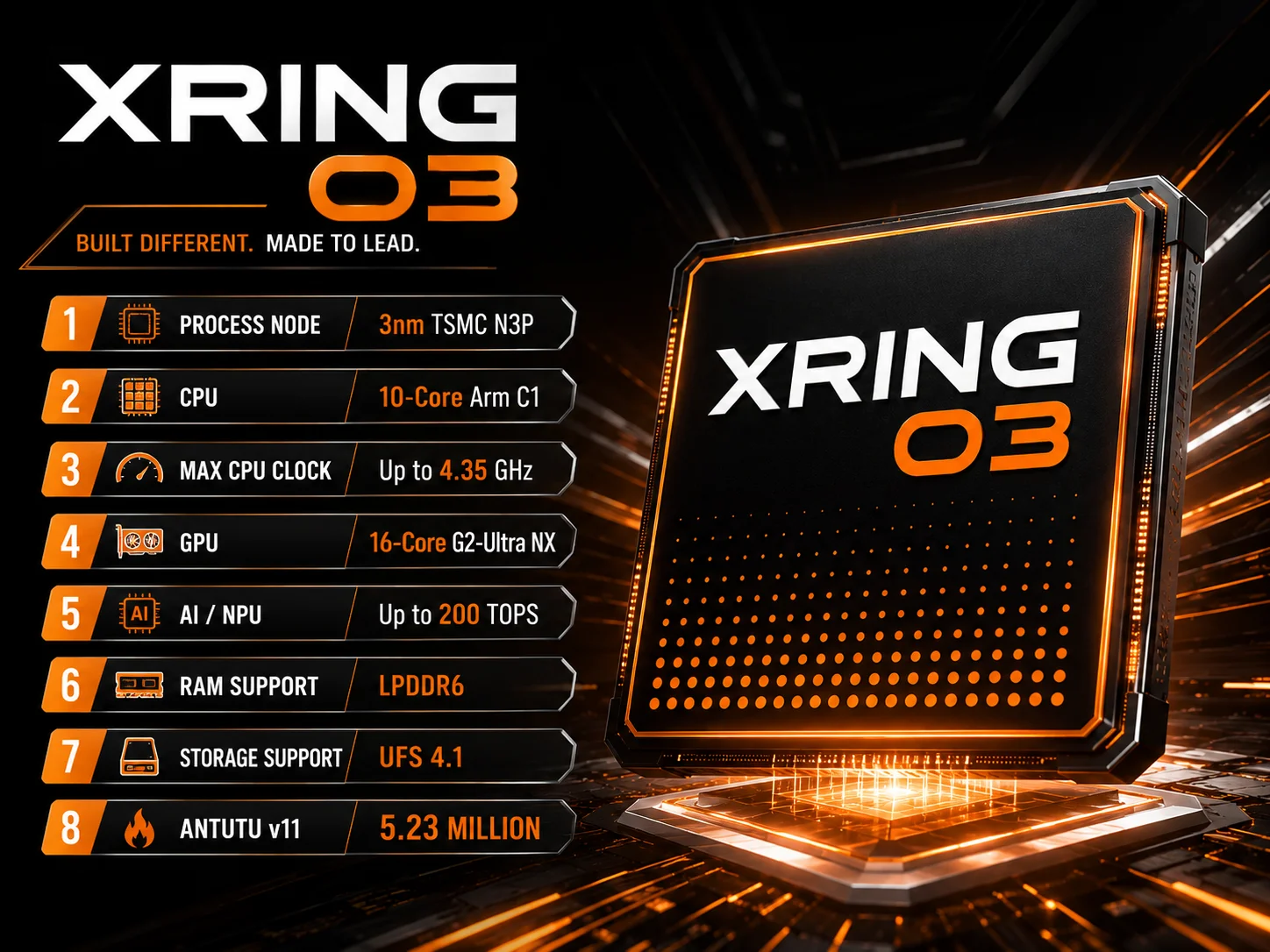
The Xiaomi Xring O3 is Xiaomi's next‑generation flagship 5G chipset announced in August 2026, using a 10‑core CPU with 2× C1‑Ultra up to 4.35GHz, 4× C1‑Premium up to 3.68GHz, and 4× C1‑Pro up to 3.15GHz, paired with a Mali‑G2 Ultra NX MP16 GPU (Valhall 6th gen). With LPDDR6 memory, UFS 4.1 storage, an NPU delivering 200 TOPS for on-device AI, Wi‑Fi 7, and Bluetooth 6.0, it represents Xiaomi's most advanced silicon to date.
Benchmark Scores
As a newly announced chip, only limited benchmark data is currently available from source. Geekbench 6 headline score is not yet published and is marked N/A rather than estimated.
Measures CPU, GPU, RAM, and I/O performance in different scenarios.
Shows raw single-threaded CPU performance across real-world workloads.
Cross-platform benchmark assessing graphics performance in Vulkan/Metal.
CPU & AI Performance
4× C1‑Premium up to 3.68GHz
4× C1‑Pro up to 3.15GHz
Graphics, Memory & Storage
Multimedia (Camera, Display & ISP)
Connectivity
General Info
information About Xiaomi Xring O3
Introduction
The flagship chipset race has a new entrant. This Xring O3 vs Snapdragon 8 Elite Gen 5 vs Dimensity 9500M comparison uses verified NanoReview specification and benchmark data to explain how Xiaomi’s newest in-house silicon stacks up against Qualcomm’s and MediaTek’s current top-tier chips in CPU power, gaming, AI, camera processing, and connectivity. The Xiaomi Xring O3 was announced on August 25, 2026, only days before this data was compiled, so its figures should be read as very early results rather than settled retail-device benchmarks.
1. Processor Overview
The Xring O3 is a 10-core chip built on TSMC’s 3nm process, using an unusual three-tier layout: 2x C1-Ultra cores at 4.35GHz, 4x C1-Premium cores at 3.68GHz, and 4x C1-Pro cores at 3.15GHz, paired with a large Mali-G2 Ultra NX MP16 GPU.
The Snapdragon 8 Elite Gen 5, announced September 2025 and also built on 3nm, uses Qualcomm’s custom Oryon Gen 3 cores: 2x Prime cores at 4.61GHz and 6x Performance cores at 3.63GHz, paired with an Adreno 840 GPU.
The Dimensity 9500M, announced August 2026 alongside the Xring O3 and also on 3nm, uses MediaTek’s own three-tier layout: 1x C1-Ultra at 4.21GHz, 3x C1-Premium at 3.5GHz, and 4x C1-Pro at 2.7GHz, paired with a Mali-G1 Ultra MP11 GPU.
All three are flagship-class 3nm chips with NPUs, but the Xring O3 stands apart with 10 total cores versus 8 on the other two, and a GPU roughly 33% larger by pipeline count than the Dimensity 9500M and over 5x larger than the Snapdragon 8 Elite Gen 5.
2. CPU Architecture & Processing Power
The Xring O3 and Dimensity 9500M both use the newer ARMv9.3-A instruction set, while the Snapdragon 8 Elite Gen 5 uses ARMv9.2-A with Qualcomm’s custom Oryon cores rather than licensed ARM designs.
In Geekbench 6 single-core, the Xring O3 leads with 3950, roughly 8.6% higher than the Snapdragon 8 Elite Gen 5 (3639) and 8.7% higher than the Dimensity 9500M (3633), which are effectively tied with each other. The Xring O3’s highest-clocked core at 4.35GHz outpaces both rivals’ top cores.
Multi-core shows an even larger gap. The Xring O3’s 10-core layout scores 15219 in Geekbench 6 multi-core, about 37.8% higher than the Snapdragon 8 Elite Gen 5 (11047) and 37.9% higher than the Dimensity 9500M (11035). The two extra C1-Premium/C1-Pro cores on the Xring O3 clearly convert into a measurable multi-threaded advantage over both 8-core rivals.
3. GPU & Gaming Performance
GPU hardware differs sharply. The Xring O3’s Mali-G2 Ultra NX MP16 has 16 pipelines and 2048 total shaders, rated at 6554 Gigaflops. The Dimensity 9500M’s Mali-G1 Ultra MP11 has 11 pipelines and 1408 total shaders at 4832.2 Gigaflops. The Snapdragon 8 Elite Gen 5’s Adreno 840 has only 3 pipelines but 512 shading units and 1536 total shaders, rated lowest at 3686.4 Gigaflops.
Geekbench 6 GPU Compute confirms this order: the Xring O3 leads at 38901, about 41.5% higher than the Snapdragon 8 Elite Gen 5 (27501) and 63.8% higher than the Dimensity 9500M (23753). In 3DMark Steel Nomad Light, the Xring O3 again leads by a wide margin at 4700, about 71.7% higher than the Snapdragon 8 Elite Gen 5’s 2737. No 3DMark figure is supplied for the Dimensity 9500M, so that specific comparison cannot be made.
For gaming, the Xring O3 has by far the largest GPU compute headroom of the three based on supplied synthetic scores, though these figures come from a chip announced only days ago and may shift once retail devices are widely tested. No exact frame-rate data is supplied, so specific FPS claims cannot be made for any of the three.
4. Manufacturing Process & Efficiency
All three chips share the same TSMC 3nm process node, so node size is not a differentiator here. Only the Dimensity 9500M has a disclosed TDP figure, at 9W; no TDP is supplied for the Xring O3 or the Snapdragon 8 Elite Gen 5, so a direct sustained-power comparison cannot be made numerically.
NanoReview’s battery-life sub-scores offer an indirect signal: the Xring O3 scores highest at 100, followed by the Dimensity 9500M at 93, and the Snapdragon 8 Elite Gen 5 at 92. Community comments accompanying the Xring O3 listing note its early benchmark figures may originate from a development board environment rather than a retail phone, which is a relevant caveat for efficiency claims at this stage.
5. RAM, Memory & Storage Support
The Xring O3 is the only chip of the three using next-generation LPDDR6 memory, running at 5333MHz across a wide 4×24-bit bus for a 120Gb/s maximum bandwidth, the highest of the group. The Snapdragon 8 Elite Gen 5 and Dimensity 9500M both use LPDDR5X at similar frequencies (5300MHz and 5333MHz respectively), with close bandwidth figures of 84.8Gb/s and 85.3Gb/s. All three support a maximum of 24GB RAM.
Storage support is close across the board: the Snapdragon 8 Elite Gen 5 and Dimensity 9500M both support UFS 4.0 and UFS 4.1, while the Xring O3 supports UFS 4.1 only. This difference is unlikely to matter much in practice since UFS 4.1 is the faster standard of the two.
6. AI & NPU Capabilities
AI hardware is one of the clearest differentiators. The Xring O3 has the highest disclosed NPU rating at 200 TOPS. The Dimensity 9500M follows with a named MediaTek NPU 990 rated at 100 TOPS, exactly half the Xring O3’s figure. The Snapdragon 8 Elite Gen 5 confirms a Hexagon NPU is present, but no TOPS figure is supplied for it, so it cannot be numerically compared to the other two.
Practically, higher disclosed TOPS ratings generally support faster on-device AI tasks like image enhancement, object recognition, and voice processing, though the supplied data does not confirm specific generative AI capabilities for any of the three chips.
7. ISP, Camera & Video Capabilities
The Snapdragon 8 Elite Gen 5 and Dimensity 9500M both support a maximum single camera resolution of 320MP; no maximum camera resolution is disclosed for the Xring O3 in the supplied data.
Video capability is close between two of the three. The Snapdragon 8 Elite Gen 5 and Dimensity 9500M both support 8K at 60FPS and 4K at 120FPS capture and playback. The Xring O3 is limited to 8K at 30FPS alongside the same 4K at 120FPS ceiling, a lower maximum 8K frame rate than both rivals. Codec support is broadest on the Snapdragon 8 Elite Gen 5, which adds VP8 alongside H.264, H.265, AV1, and VP9; the other two support H.264, H.265, AV1, and VP9 only.
8. Display Support
Only the Snapdragon 8 Elite Gen 5 has a disclosed maximum display resolution, at 3840 x 2540. No maximum display resolution is disclosed in the supplied data for the Xring O3 or Dimensity 9500M, so no comparison can be made for those two chips in this category.
9. Modem, 5G & Connectivity
The Snapdragon 8 Elite Gen 5 has the most complete disclosed connectivity profile, including its Snapdragon X85 modem with a theoretical 5G download speed of up to 12500 Mbps and upload of 3700 Mbps. The Dimensity 9500M discloses a download speed of up to 10700 Mbps, about 14.4% lower than the Snapdragon 8 Elite Gen 5, with no upload figure supplied. No download or upload speed figures are disclosed for the Xring O3 at all.
Wi-Fi 7 and Bluetooth 6.0 are common to all three chips. GNSS support is broadest on the Snapdragon 8 Elite Gen 5 and Dimensity 9500M, both listing GPS, GLONASS, Beidou, Galileo, QZSS, and NAVIC; the Xring O3’s supplied data lists GPS, GLONASS, Beidou, Galileo, and QZSS, without NAVIC. These are theoretical maximums; real-world network speeds depend on carrier infrastructure and will not always reach these ceilings.
10. Benchmark Comparison
All benchmark figures below use AnTuTu 11 and Geekbench 6, so comparisons are apples-to-apples where data exists for all three chips.
AnTuTu 11 Total:
- Xring O3: 5,228,014
- Snapdragon 8 Elite Gen 5: 3,950,082 (Xring O3 leads by about 32.4%)
- Dimensity 9500M: 3,579,952 (Xring O3 leads by about 46.0%)
Geekbench 6 Single-Core: Xring O3 leads with 3950, ahead of the Snapdragon 8 Elite Gen 5 (3639, about 8.6% lower) and Dimensity 9500M (3633, about 8.7% lower).
Geekbench 6 Multi-Core: Xring O3 leads clearly at 15219, about 37.8% higher than the Snapdragon 8 Elite Gen 5 (11047) and 37.9% higher than the Dimensity 9500M (11035).
Geekbench 6 GPU Compute: Xring O3 leads at 38901, about 41.5% higher than the Snapdragon 8 Elite Gen 5 (27501) and 63.8% higher than the Dimensity 9500M (23753).
3DMark Steel Nomad Light: Xring O3 leads at 4700, about 71.7% higher than the Snapdragon 8 Elite Gen 5 (2737). Not disclosed for the Dimensity 9500M.
PCMark 3.0: Only disclosed for the Snapdragon 8 Elite Gen 5, at 18833. Not disclosed for the Xring O3 or Dimensity 9500M, so no comparison can be made in this category.
The Xring O3 leads every benchmark for which comparable data exists, by wide margins in most cases. Given its announcement date is only days before this data was compiled, these figures should be treated as early results likely to be revised as more retail devices are tested.
11. Real-World Performance
Everyday users should see snappier app launches on the Xring O3 given its single-core lead, though the margin over the other two is modest compared to its multi-core and GPU advantages.
Multitaskers benefit most from the Xring O3’s 10-core layout, which posts a substantially higher multi-core score than either 8-core rival.
Gamers should note the Xring O3’s large lead in GPU Compute and 3DMark, though as a newly announced chip, game-specific driver and thermal optimization has not yet been demonstrated on retail hardware.
Content creators get the highest video ceiling from the Snapdragon 8 Elite Gen 5 and Dimensity 9500M, both supporting 8K/60FPS versus the Xring O3’s 8K/30FPS limit.
AI users benefit most from the Xring O3’s 200 TOPS NPU rating, double the Dimensity 9500M’s 100 TOPS; the Snapdragon 8 Elite Gen 5 cannot be compared here due to missing TOPS data.
Camera users get a clearer picture from the Snapdragon 8 Elite Gen 5 and Dimensity 9500M, both confirmed at 320MP maximum resolution, since no camera resolution is disclosed for the Xring O3.
Connectivity-focused users should lean toward the Snapdragon 8 Elite Gen 5, the only chip with both download and upload 5G speeds disclosed, and the highest of the two that are comparable.
12. Strengths & Weaknesses
Xiaomi Xring O3
- Strengths: Leads every comparable benchmark (AnTuTu, single-core, multi-core, GPU Compute, 3DMark); highest disclosed NPU rating (200 TOPS); first chip in this comparison using LPDDR6 memory with the highest bandwidth (120Gb/s); highest NanoReview battery-life sub-score (100).
- Weaknesses: No disclosed camera resolution, display resolution, 5G speed figures, or PCMark score; lower maximum 8K video frame rate (30FPS) than both rivals; extremely recent announcement means real-world retail validation is not yet available.
Snapdragon 8 Elite Gen 5
- Strengths: Only chip with fully disclosed 5G download and upload speeds (12500/3700 Mbps); highest disclosed display resolution (3840×2540); widest video codec support including VP8; only chip with a disclosed PCMark score (18833).
- Weaknesses: Lowest AnTuTu 11 total score of the three; weakest GPU Compute and 3DMark results; no disclosed NPU TOPS figure.
MediaTek Dimensity 9500M
- Strengths: Only chip with a disclosed TDP figure (9W); named 100 TOPS NPU; matches the Snapdragon 8 Elite Gen 5’s 320MP camera resolution and 8K/60FPS video ceiling.
- Weaknesses: Lowest disclosed AnTuTu total, GPU Compute score among chips with 3DMark or GPU data; no 3DMark or PCMark figures supplied; no 5G upload speed disclosed.
13. Best Processor For Different Users
- Best for Gaming: Xiaomi Xring O3
- Best for AI: Xiaomi Xring O3 (200 TOPS, highest disclosed figure)
- Best for Efficiency: Xiaomi Xring O3 (highest NanoReview battery-life sub-score, though TDP is undisclosed)
- Best for Camera Processing: Tied between Snapdragon 8 Elite Gen 5 and Dimensity 9500M (320MP each)
- Best for Connectivity: Qualcomm Snapdragon 8 Elite Gen 5
- Best for Balanced Performance: Xiaomi Xring O3
Final Verdict
This Xring O3 vs Snapdragon 8 Elite Gen 5 vs Dimensity 9500M comparison shows the Xring O3, as the Primary Processor, leading every benchmark category where comparable data exists, though buyers should weigh this against its very recent announcement and several undisclosed specifications.
Final Verdict
1. Xiaomi Xring O3 — Best Overall It leads AnTuTu 11 total score, Geekbench single-core, multi-core, GPU Compute, and 3DMark by wide margins, and carries the highest disclosed NPU rating and battery-life sub-score. Its newness means several specifications (camera resolution, display resolution, 5G speeds) are not yet disclosed, and its benchmark figures may shift once retail devices are tested.
2. Qualcomm Snapdragon 8 Elite Gen 5 — Best For Connectivity and Video It is the only chip with fully disclosed 5G upload and download speeds, the highest disclosed display resolution, and the widest video codec support, but it trails both rivals in every disclosed compute and graphics benchmark.
3. MediaTek Dimensity 9500M — Best For Disclosed Efficiency Data It is the only chip with a supplied TDP figure and matches the Snapdragon 8 Elite Gen 5 on camera and video ceilings, but posts the lowest AnTuTu total and GPU Compute scores among the three, with several benchmark categories left undisclosed.
Best for Gaming: Xiaomi Xring O3 Best for AI: Xiaomi Xring O3 Best for Efficiency: Xiaomi Xring O3 Best Balanced Choice: Xiaomi Xring O3
Bottom Line: Based purely on the supplied NanoReview data, the Xring O3 is the strongest performer in this comparison across every benchmark that can be directly compared, with a notable AnTuTu 11 lead of roughly 32% over the Snapdragon 8 Elite Gen 5 and 46% over the Dimensity 9500M. Buyers who prioritize confirmed 5G speeds, display specifications, or video codec breadth should still weigh the Snapdragon 8 Elite Gen 5, and those wanting a disclosed TDP figure alongside strong AI hardware may prefer the Dimensity 9500M, but as of this comparison the Xring O3’s numbers, while impressive, come from a chip announced only days earlier and warrant confirmation from independent retail-device testing.
Images Of Xiaomi Xring O3
Trailer Of Xiaomi Xring O3

Author & Post Info
Faisal Ur Rehman
Faisal Rehman is the founder and editor of FSL Specs, where he publishes in-depth smartphone specifications, comparisons, buying guides, and technology insights. With extensive experience in mobile hardware research and technical analysis, he provides accurate and up-to-date information on Android smartphones, processors, displays, cameras, batteries, performance benchmarks, and software features. His goal is to simplify complex specifications and help readers choose the right device with confidence.
Explore FSL Specs
Questions About Xiaomi Xring O3
What is the XRing O3 processor?
The XRing O3 is a flagship smartphone chipset designed for high-end performance, gaming, AI processing, and demanding everyday tasks. It targets premium Android smartphones.
How powerful is the XRing O3?
The XRing O3 delivers flagship-level performance with a multi-core Arm CPU and a powerful GPU. Its reported AnTuTu v11 score is around 5.23 million, putting it among the fastest mobile processors.
What CPU does the XRing O3 use?
The XRing O3 uses a 10-core Arm C1 CPU configuration, designed to balance peak performance with efficiency. Its top CPU clock can reach approximately 4.35 GHz.
Is XRing O3 good for gaming?
Yes, the XRing O3 is built for demanding mobile gaming, with a high-performance 16-core GPU and advanced graphics capabilities. It should handle high-frame-rate gaming and intensive 3D workloads comfortably.
Does XRing O3 support AI features?
Yes. The XRing O3 includes a dedicated AI/NPU architecture capable of delivering up to 200 TOPS of AI performance, helping with on-device AI tasks and computational photography.
Which phones use the XRing O3 processor?
The XRing O3 is aimed at flagship smartphones and is associated with high-end Xiaomi devices. Availability depends on the specific model and market, including regions such as China and potentially other markets.
What video recording does the XRing O3 support?
The XRing O3 supports advanced video recording capabilities, including up to 8K video recording. It is designed to deliver high-quality video processing with strong stabilization and AI-powered imaging features.