Introduction
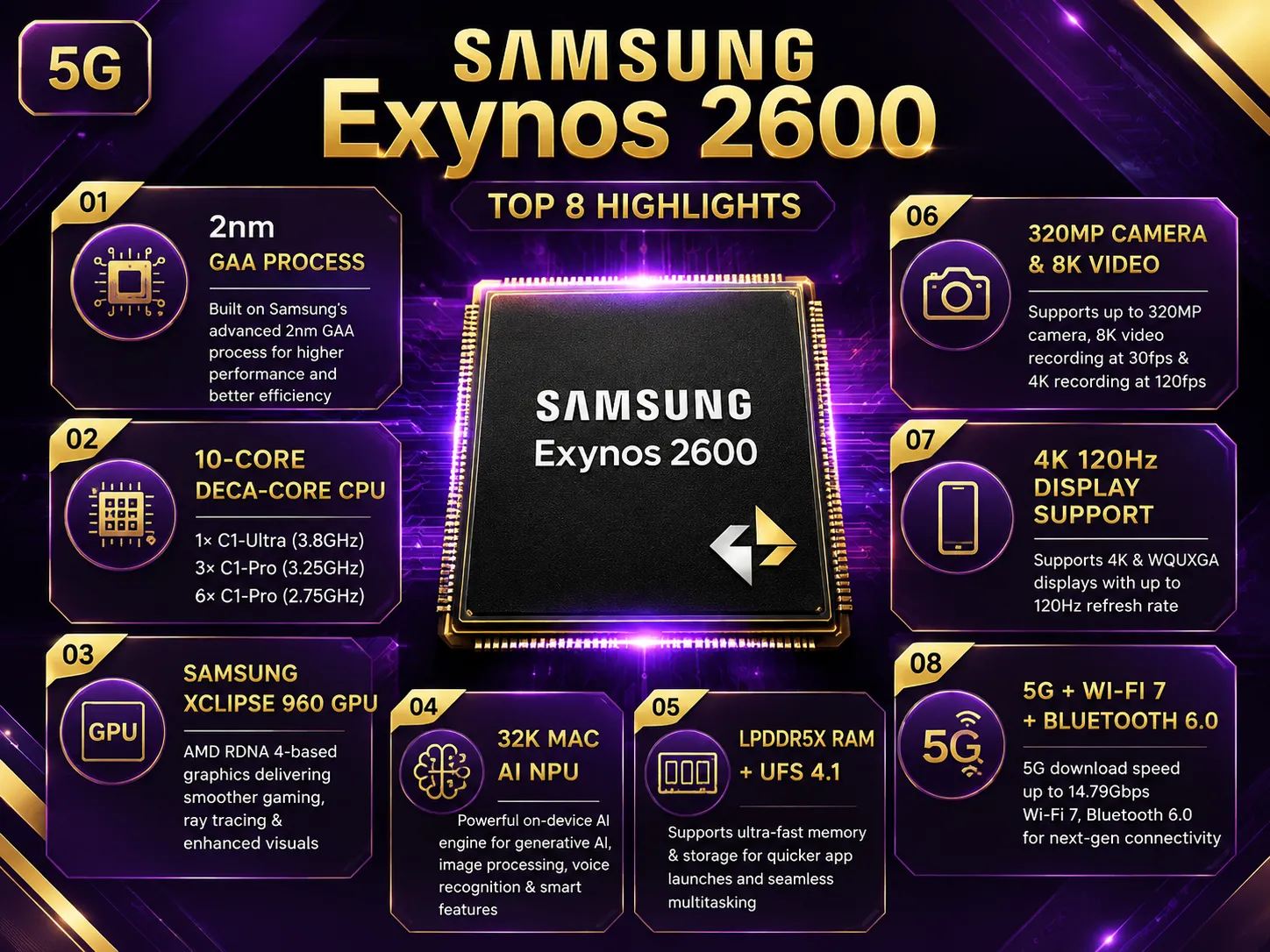
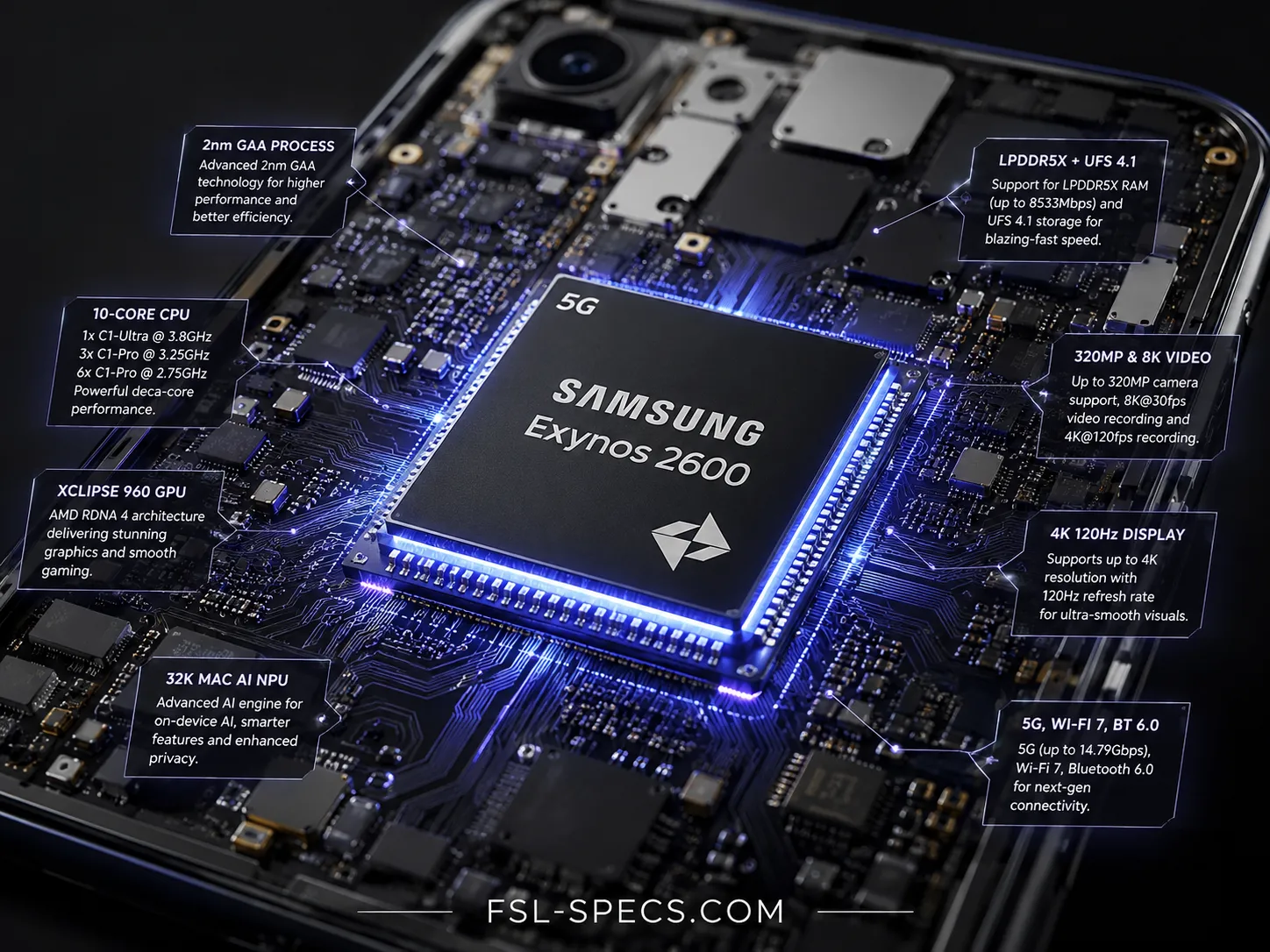
Samsung Exynos 2600 specs – it enters the flagship processor race with a major architectural change: Samsung’s 2nm GAA manufacturing process, a 10-core Arm v9.3 CPU, the new Xclipse 960 GPU, and a substantially upgraded NPU. Its rivals in this comparison represent three different approaches to mobile performance.
MediaTek’s Dimensity 9500 uses an all-big-core Arm design on 3nm, Qualcomm’s Snapdragon 8 Elite Gen 5 uses its custom Oryon CPU and Adreno GPU for high-end Android performance, while Apple’s A19 Pro combines a tightly integrated CPU, GPU and Neural Engine inside the iPhone ecosystem. Samsung Exynos 2600 improves CPU computing performance by up to 39% over its predecessor, doubles Xclipse 960 GPU computing performance, and improves generative-AI performance by 113% versus the previous Exynos generation.
CPU Architecture & Processing Power
The Exynos 2600 takes a different route from its rivals. Its 10-core CPU consists of one Arm C1-Ultra core, three high-performance C1-Pro cores and six efficiency-focused C1-Pro cores. Samsung says the design uses Armv9.3 and SME2 instructions, with the goal of improving both conventional computing and on-device machine-learning workloads.
The Dimensity 9500 has eight cores but uses MediaTek’s third-generation All Big Core design: one C1-Ultra, three C1-Premium and four C1-Pro cores. The flagship core reaches 4.21GHz, and MediaTek pairs the CPU with 16MB L3 cache and 10MB SLC. This is important because the Dimensity 9500 is not simply an eight-core chip competing against a 10-core Exynos. Its architecture deliberately prioritizes high-performance cores rather than maintaining a traditional big/mid/little arrangement.
The Snapdragon 8 Elite Gen 5 uses Qualcomm’s third-generation Oryon CPU. The product brief lists two prime cores up to 4.74GHz and six performance cores up to 3.62GHz, although Qualcomm also offers a 4.6GHz version depending on platform implementation. Qualcomm claims up to 20% CPU performance improvement over the previous Snapdragon 8 Elite.
The Apple A19 Pro takes the most different approach because Apple does not expose the same core configuration and clock-speed details as Android chipmakers. Apple describes its 6-core CPU as the fastest smartphone CPU and says the chip is designed for sustained performance, including gaming, video editing and large local language models.
Early Geekbench 6 results illustrate why benchmark context matters. A Galaxy S26 with Samsung Exynos 2600 has produced results ranging from roughly 3,000 to 3,484 single-core and 10,684 to 11,759 multi-core depending on the test run and device configuration. A Snapdragon 8 Elite Gen 5 Galaxy S26 Ultra review recorded 2,848 single-core and 10,323 multi-core, but those are different devices and implementations, so they should not be treated as laboratory-controlled processor-only results.
GPU & Gaming Performance
Samsung has made gaming one of the biggest priorities of the Exynos 2600. The Xclipse 960 GPU is claimed to deliver 2x the computing performance of its predecessor and up to 50% higher ray-tracing performance. More importantly, Samsung introduces Exynos Neural Super Sampling, or ENSS, which uses AI-based resolution upscaling and frame generation. Samsung says ENSS can make supported gaming experiences feel up to 3x smoother under limited power budgets.
The Dimensity 9500 uses the Arm Mali-G1 Ultra MC12 GPU and supports advanced flagship graphics. MediaTek also positions the chip for console-class gaming and provides hardware capable of 8K60 video capture, 4K120 with EIS, and high-refresh-rate displays.
The Snapdragon 8 Elite Gen 5 remains one of the strongest Android gaming platforms because of its latest Adreno GPU architecture. Qualcomm claims a 23% graphics-performance improvement over the previous Snapdragon 8 Elite while also improving GPU power efficiency. Real-world testing of Galaxy S26 Ultra hardware shows very strong graphics performance, with a 7,517 3DMark Wild Life Extreme result in one review.
The A19 Pro has a 6-core GPU with Neural Accelerators integrated into every GPU core. Apple also supports hardware-accelerated ray tracing and AAA gaming, while the iPhone 17 Pro’s vapor chamber was specifically designed to improve sustained performance.
For Android gaming, the Snapdragon 8 Elite Gen 5 is the safest overall performance choice based on current tested hardware. The Samsung Exynos 2600 is particularly interesting for ray tracing and AI-assisted frame generation, while the Dimensity 9500 is an extremely capable alternative. The A19 Pro remains highly competitive, but its gaming performance has to be judged inside Apple’s iOS and Metal ecosystem rather than directly against Android GPU benchmarks.
Manufacturing Process & Efficiency
The Samsung Exynos 2600’s biggest technological headline is its 2nm GAA manufacturing process. Samsung describes it as the industry’s first 2nm GAA process for a mobile processor and combines the node with a low-power design and new thermal-management technology. A smaller process does not automatically guarantee better real-world battery life, but it gives Samsung an important foundation for improving performance-per-watt.
The Dimensity 9500 is manufactured using TSMC’s 3nm-class process, while Qualcomm’s Snapdragon 8 Elite Gen 5 is also a 3nm-class flagship design. Apple’s A19 Pro is likewise built on Apple’s latest-generation silicon process. The more meaningful question is therefore not simply “2nm versus 3nm”, but how each company combines transistor technology, architecture, clocks, memory, GPU design and thermal management.
This is where Exynos 2600 becomes especially interesting. Samsung is attempting to use the 2nm advantage not merely for peak benchmark performance, but also for sustained AI and gaming workloads.
Memory, Storage & System Architecture
The Dimensity 9500 officially supports LPDDR5X-10667 memory and UFS 4.1 storage with a four-lane interface. Its 16MB L3 cache and 10MB SLC provide a substantial high-speed data path for demanding workloads.
The Snapdragon 8 Elite Gen 5 and Samsung Exynos 2600 are designed for flagship memory configurations, but exact memory support can vary by implementation. The Apple A19 Pro also benefits from Apple’s tightly integrated memory architecture, but direct RAM comparisons between iPhone and Android processors are not meaningful because the operating systems and memory-management approaches differ.
For raw Android storage technology, the Dimensity 9500’s UFS 4.1 support is a particularly strong specification. However, the actual speed experienced by a smartphone buyer still depends on the phone’s storage implementation.
AI & NPU Capabilities
AI is one of the most important differences between these four processors.
Samsung Exynos 2600’s NPU improves generative-AI performance by 113% compared with the previous generation. The chip is designed to run larger on-device models while reducing latency and power consumption. Samsung also highlights intelligent image editing and AI assistants, plus hardware-backed hybrid post-quantum cryptography.
The Dimensity 9500 uses the MediaTek NPU 990, with support for generative AI and agentic AI. MediaTek has also integrated AI into networking, claiming power and latency benefits from AI-based traffic prediction and network optimization.
Qualcomm’s Hexagon NPU is another major strength. Qualcomm claims 37% faster NPU performance than the previous Snapdragon 8 Elite and emphasizes personalized, on-device agentic AI that can understand information across applications while keeping processing on the device.
Apple’s A19 Pro combines its 16-core Neural Engine with Neural Accelerators built into every GPU core. Apple specifically positions this architecture for AI models, image processing, gaming and large local language models.
There is no scientifically fair single “AI winner” from these specifications alone because TOPS and vendor claims are not directly interchangeable. Software support and model optimization can be just as important as theoretical accelerator capability.
Camera, ISP & Video
The Exynos 2600 integrates Samsung’s advanced image-processing technologies, including DVNR and VPS. Its camera pipeline is designed to improve image processing and computational photography, while Samsung’s own smartphones can combine the processor with Galaxy-specific imaging software.
The Dimensity 9500 supports camera sensors up to 320MP and video capture up to 8K60, plus 4K120 with EIS. It also supports 8K60 10-bit video decoding and 8K30 10-bit encoding. On pure published video specifications, that is an exceptionally capable media platform.
Qualcomm gives the Snapdragon 8 Elite Gen 5 an important professional-video advantage. It is the first mobile platform announced with support for the Advanced Professional Video codec, designed for more professional recording and post-production workflows. Its AI-powered imaging pipeline also supports advanced computational video processing.
Apple’s A19 Pro has perhaps the most mature creator-focused video ecosystem here. iPhone 17 Pro supports 4K120, Dolby Vision HDR, ProRes Log, ACES, ProRes RAW, Log 2 and genlock. Apple also combines the processor with a redesigned image pipeline and Photonic Engine.
For professional mobile video, the A19 Pro has the strongest ecosystem advantage, while Dimensity 9500 and Snapdragon 8 Elite Gen 5 offer outstanding Android-side hardware capabilities.
Connectivity & Display Support
The Dimensity 9500 includes a Release-17 5G modem, up to 7.4Gbps sub-6GHz performance, Wi-Fi 7 up to 7.3Gbps, Bluetooth 6.0 and advanced GNSS support.
The Snapdragon 8 Elite Gen 5 uses Qualcomm’s latest modem and connectivity platform, while Qualcomm also emphasizes AI-optimized connectivity and reduced gaming latency.
The A19 Pro platform works with Apple’s N1 wireless chip, which supports Wi-Fi 7, Bluetooth 6 and Thread. This is a good example of why complete SoC comparisons should not always treat the application processor as the only component responsible for connectivity.
The Dimensity 9500 officially supports displays up to WQHD+ at 180Hz, making it especially strong on published display capability.
Benchmark Comparison & Real-World Performance
Current benchmark evidence suggests that the Exynos 2600 is much closer to the Android flagship leaders than previous Exynos generations. Geekbench 6 results around 3,300 single-core and 10,700-11,300 multi-core are credible examples from Galaxy S26 hardware, although scores vary between devices and test conditions.
The Dimensity 9500 has recorded around 3,315 Geekbench 6 single-core, 9,914 multi-core, and 3.33 million AnTuTu v11 in one independent test. These figures demonstrate that MediaTek is firmly in flagship territory.
The Snapdragon 8 Elite Gen 5 has demonstrated particularly strong Android performance, and current Galaxy S26 Ultra testing places its GPU performance at the top of that test group.
The A19 Pro cannot be ranked fairly using Android benchmark numbers alone because Apple devices use a different operating system, graphics API and memory architecture. Its strengths are especially visible in single-core performance, sustained workloads and professional video workflows, where Apple controls both the silicon and software stack. Apple itself claims the A19 Pro is the fastest smartphone CPU and says the new iPhone 17 Pro thermal design enables up to 40% better sustained performance versus the previous generation.
Final Verdict & Ranking
1. Snapdragon 8 Elite Gen 5 — Best Overall Android Performance
The Snapdragon takes the overall Android crown because it combines extremely strong CPU performance, a powerful Adreno GPU, mature gaming optimization, advanced AI, professional video features and excellent connectivity. Current real-device testing also gives it a strong advantage in flagship Android gaming.
2. Apple A19 Pro — Best CPU Efficiency & Pro Video Ecosystem
The A19 Pro is not simply an Android competitor in disguise. Its biggest advantage comes from Apple’s complete hardware-software integration, powerful single-core CPU, Neural Engine, GPU neural accelerators and exceptionally advanced video pipeline. For iPhone users, especially gamers, creators and video professionals, it remains one of the strongest mobile platforms available.
3. MediaTek Dimensity 9500 — Best Android Alternative
The Dimensity 9500 is arguably the most complete challenger to Snapdragon on paper. Its 4.21GHz C1-Ultra, all-big-core CPU design, 16MB L3 cache, UFS 4.1, Mali-G1 Ultra GPU, NPU 990 and 8K60 video capability make it an exceptionally strong flagship SoC.
4. Samsung Exynos 2600 — Most Technically Interesting
The Exynos 2600 is the most important comeback story in this comparison. Its 2nm GAA process, 10-core CPU, Xclipse 960, ENSS, upgraded NPU and Samsung-specific imaging technologies make it much more competitive than older Exynos chips. However, current evidence does not justify placing it above Snapdragon or A19 Pro overall.
Best for Gaming: Snapdragon 8 Elite Gen 5
Best for iPhone Performance & Video: Apple A19 Pro
Best Android Alternative: Dimensity 9500
Best 2nm Technology: Exynos 2600
Best AI Potential: Snapdragon 8 Elite Gen 5 / Exynos 2600, depending on software implementation
Best Balanced Android Choice: Snapdragon 8 Elite Gen 5
Bottom Line: The Snapdragon 8 Elite Gen 5 is the strongest overall Android processor in this four-way battle, while the Apple A19 Pro remains a formidable rival with exceptional CPU performance, sustained workloads and professional video capabilities. The Dimensity 9500 is the most serious Android alternative to Qualcomm, and the Exynos 2600 finally makes Samsung’s flagship silicon genuinely competitive again. Its 2nm GAA process and AI-focused architecture are impressive, but the Snapdragon currently offers the safer all-round choice for demanding Android gaming and flagship performance.