The Apple A19 takes a very different approach to flagship mobile processor design than the MediaTek Dimensity 9500s and Qualcomm Snapdragon 8 Elite, commonly referred to as the Snapdragon 8 Elite Gen 4. The A19 is a six-core Apple-designed SoC built on a 3nm process, while the Dimensity 9500s and Snapdragon 8 Elite use eight-core CPU designs aimed heavily at Android flagship performance.
The important point is that core count alone does not determine performance. Apple relies on tightly integrated hardware and software, while MediaTek and Qualcomm pursue broader multi-core performance, gaming capability, and Android platform flexibility.
CPU Architecture & Processing Power
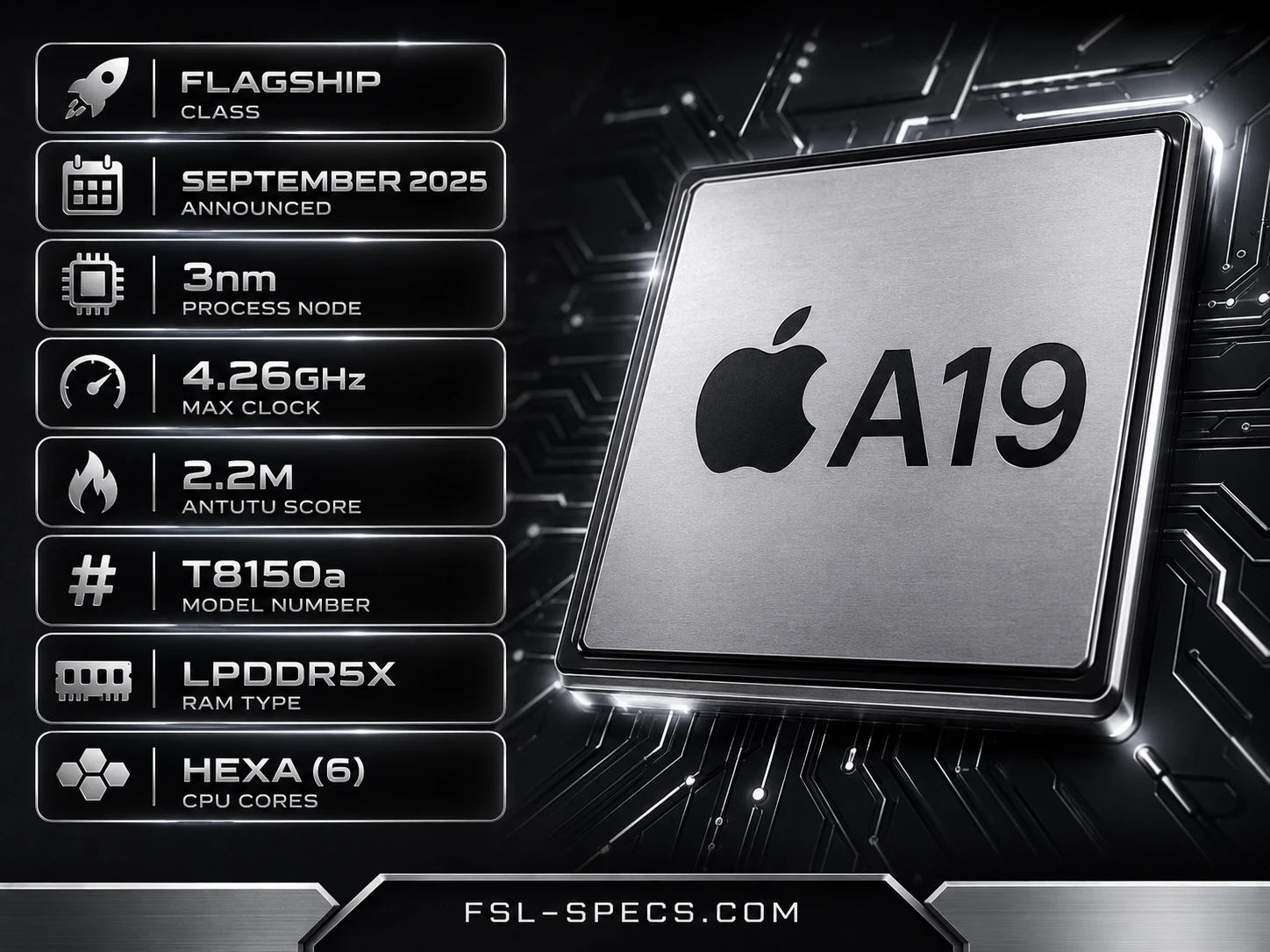
The Apple A19 uses a 6-core CPU with 2 performance cores and 4 efficiency cores, with the performance cores reaching around 4.26GHz. Its design is highly optimized for Apple’s operating system, allowing the chip to deliver very strong single-core performance despite having fewer CPU cores than its rivals. Current processor databases list the A19 at around 3,692 Geekbench 6 single-core and 9,454 multi-core, although benchmark results vary by device and test conditions.
The Dimensity 9500s takes a very different approach. It uses an 8-core CPU consisting of 1 Cortex-X925 at up to 3.73GHz, 3 Cortex-X4 cores and 4 Cortex-A720 cores. MediaTek describes it as an all-big-core design, prioritizing sustained flagship performance. The processor also has 12MB L3 cache plus 10MB system-level cache, giving it a substantial cache structure for demanding workloads.
The Snapdragon 8 Elite Gen 4, officially branded simply as Snapdragon 8 Elite, uses Qualcomm’s custom Oryon CPU architecture. It has 8 cores, with two high-performance cores reaching 4.32GHz and six performance cores reaching 3.53GHz on the standard version. Qualcomm builds the chip on a 3nm process and supports LPDDR5X memory up to 5300MHz.
For single-core responsiveness, the A19 is extremely competitive because of Apple’s high-performance custom cores. In multi-core workloads, however, the eight-core Android chips have more parallel CPU resources. NanoReview currently lists the A19 around 3,692/9,454 Geekbench 6, the Snapdragon 8 Elite around 3,041/9,494, and the Dimensity 9500s around 2,680/8,358. These figures should be treated as indicative rather than absolute because devices, cooling and software affect benchmark results.
CPU winner: Apple A19 for single-core performance, Snapdragon 8 Elite for the strongest overall multi-core balance.
GPU & Gaming Performance
Gaming changes the picture considerably.
The Apple A19 integrates a 5-core GPU in the standard iPhone 17 implementation and introduces hardware neural accelerators inside each GPU core. Apple has also improved the graphics architecture and ray-tracing capabilities.
The Dimensity 9500s uses the Arm Immortalis-G925 GPU, available with 11-core or 12-core configurations depending on the device. MediaTek specifically targets high-frame-rate gaming, advanced ray tracing and sustained graphics performance. Its Adaptive Gaming Technology 3.0 and frame-rate conversion technology are designed to improve performance-per-watt during demanding games.
The Snapdragon 8 Elite uses Qualcomm’s Adreno GPU and Snapdragon Elite Gaming technologies. Qualcomm supports advanced gaming features, high-refresh displays and hardware capabilities designed for flagship Android gaming. Its platform can support displays up to QHD+ at 240Hz, giving manufacturers considerable flexibility for gaming phones.
The critical difference is ecosystem. The A19 can produce excellent gaming performance because Apple controls the chip, operating system and graphics APIs together. Android’s Snapdragon and MediaTek chips offer broader hardware flexibility and, particularly in the Dimensity 9500s, extensive ray-tracing and high-refresh gaming features.
Gaming winner: Snapdragon 8 Elite overall, with Dimensity 9500s extremely competitive and A19 particularly strong in optimized iOS games.
Manufacturing Process & Efficiency
All three processors use advanced manufacturing, but the exact implementation matters.
The A19 uses 3nm TSMC technology, while the Snapdragon 8 Elite uses Qualcomm’s 3nm process. The Dimensity 9500s uses a second-generation TSMC 3nm process, which MediaTek specifically positions around efficiency and sustained performance.
Therefore, simply saying one chip is more efficient because all are 3nm would be misleading. Efficiency depends on CPU architecture, voltage, GPU design, software scheduling, memory subsystem and the phone’s cooling system.
Apple’s advantage comes from controlling the complete hardware/software stack. MediaTek’s Dimensity 9500s adds its second-generation Dimensity Scheduling Engine, while its UltraSave 4.0 system targets 5G power efficiency.
Efficiency winner: Apple A19 for platform-level optimization, with Dimensity 9500s particularly strong in sustained Android efficiency.
Memory, Cache & Storage
The A19 uses Apple’s tightly integrated memory architecture rather than the Android-style platform specification model. Current technical data lists the A19 with LPDDR5X memory, while the standard iPhone 17 configuration uses 8GB RAM.
The Dimensity 9500s supports LPDDR5X up to 10667Mbps and UFS 4 with MCQ, providing very high memory and storage capability for Android flagship devices. Its 19MB CPU cache and 10MB system cache are also major strengths.
The Snapdragon 8 Elite supports LPDDR5X up to 5300MHz, memory capacity up to 24GB, and UFS 4.0 storage. That gives Android manufacturers considerably more flexibility than Apple’s tightly controlled configurations.
Memory winner: Snapdragon 8 Elite and Dimensity 9500s for platform flexibility, while A19 benefits from Apple’s tightly integrated architecture.
AI & NPU Capabilities
AI is one of the most important differences between these chips.
The A19 introduces an updated 16-core Neural Engine and neural accelerators integrated into its GPU cores. These accelerators are designed to improve on-device AI workloads, including Apple’s newer intelligent features and local machine-learning operations.
The Dimensity 9500s includes a MediaTek NPU optimized for generative AI, multimodal models and agentic AI. MediaTek specifically positions it for camera processing, content creation and on-device reasoning.
Qualcomm’s Snapdragon 8 Elite combines its Hexagon NPU with Qualcomm’s AI software stack. Its advantage is the breadth of Android AI implementations and Qualcomm’s mature developer ecosystem.
There is no responsible way to declare one chip the universal AI winner from TOPS alone. AI performance varies heavily according to model, software framework, memory bandwidth and application optimization.
AI winner: A19 for Apple’s tightly integrated on-device AI ecosystem, while Dimensity 9500s and Snapdragon 8 Elite offer broader Android AI flexibility.
ISP, Camera & Video
The A19 benefits from Apple’s custom image-processing pipeline and updated ISP. This is important because smartphone photography depends not only on the ISP specification but also on Apple’s computational photography algorithms and camera software.
The Dimensity 9500s supports camera sensors up to 320MP, 108MP at 30fps, or three 36MP cameras at 30fps. It supports up to 8K60 video capture, 10-bit video decoding and advanced HDR-related processing.
The Snapdragon 8 Elite also provides an advanced Qualcomm imaging platform, with strong computational photography, HDR and video capabilities. Qualcomm’s platform supports high-end multimedia and external displays, including 8K external display output at 30Hz under specified conditions.
For actual phone cameras, however, the processor is only one part of the equation. Sensor quality, lenses, OIS, ISP tuning and software processing can completely change the final result.
Camera-processing winner: Dimensity 9500s for disclosed camera hardware capability, while A19 remains exceptionally strong in real-world computational photography.
Display & Connectivity
The A19 is designed around Apple’s controlled device ecosystem, whereas Android chips provide manufacturers with much broader display options.
The Snapdragon 8 Elite supports up to QHD+ at 240Hz, variable refresh rates from 240Hz to 1Hz, HDR10, HDR10+, HDR Vivid and Dolby Vision.
The Dimensity 9500s supports up to WQHD+ at 180Hz, making it particularly suitable for high-resolution flagship displays and gaming panels.
Connectivity is another strong Android advantage. The Dimensity 9500s supports Wi-Fi 7 with up to 6.5Gbps peak Wi-Fi data rate and 5G capabilities including carrier aggregation. The Snapdragon 8 Elite also offers advanced 5G, Wi-Fi and Bluetooth connectivity.
Connectivity/display winner: Snapdragon 8 Elite, with Dimensity 9500s close behind.
Benchmark & Real-World Performance
Current NanoReview data places the A19 around 2.16 million AnTuTu 11, the Snapdragon 8 Elite around 3.12 million, and the Dimensity 9500s around 3.04 million. Geekbench 6 figures similarly show the A19 with excellent single-core performance but a lower multi-core score than the two Android flagship chips.
This creates the most interesting result of the comparison. The A19 is not simply “slow” because it has fewer cores. Its single-core performance is excellent, and iOS optimization allows it to feel extremely fast in everyday applications. But in raw cross-platform multi-core and AnTuTu performance, the Snapdragon 8 Elite and Dimensity 9500s have a clear advantage.
For gaming, the Snapdragon 8 Elite and Dimensity 9500s offer more aggressive Android gaming hardware and higher theoretical graphics flexibility. For everyday iOS performance, the A19 remains highly competitive.
Final Verdict & Ranking
1. 🥇 Snapdragon 8 Elite Gen 4 — Best Overall Performance
The Snapdragon 8 Elite takes the overall win because it combines extremely strong CPU performance, powerful Adreno graphics, high-end gaming features, broad memory support, advanced connectivity and strong Android optimization. It is the most complete raw-performance package of these three.
2. 🥈 Apple A19 — Best Single-Core & Apple Optimization
The A19 is not the raw benchmark champion, but its 4.26GHz performance cores, 5-core GPU, 16-core Neural Engine and tightly integrated Apple ecosystem make it exceptionally fast in real-world iPhone use. Its biggest limitation in this comparison is raw multi-core and graphics throughput against the two Android flagship platforms.
3. 🥉 Dimensity 9500s — Best Android Alternative
The Dimensity 9500s is still a serious flagship processor, with an 8-core CPU, Immortalis-G925 GPU, 3nm process, LPDDR5X, UFS 4, advanced ray tracing, 8K60 capture and strong AI capabilities. Its main disadvantage here is that the Snapdragon 8 Elite currently has stronger overall benchmark positioning.
Best for Gaming: Snapdragon 8 Elite
Best for Single-Core Performance: Apple A19
Best for Apple/iOS Optimization: Apple A19
Best for Android Gaming Features: Snapdragon 8 Elite
Best for Camera/Video Hardware Support: Dimensity 9500s
Best Overall: Snapdragon 8 Elite
Bottom Line: The Snapdragon 8 Elite wins this three-way comparison for maximum overall processor performance and gaming capability, while the Apple A19 remains the strongest choice for users who value Apple’s tightly integrated CPU, GPU, AI and software ecosystem.
The Dimensity 9500s is the most compelling Android alternative, especially for users interested in high-end graphics, AI, camera processing and sustained flagship performance. The key lesson is that the A19 does not need eight CPU cores to feel fast, but when the comparison is based strictly on broad flagship compute and graphics capability, the Snapdragon 8 Elite has the stronger overall package.