
Dimensity 9400
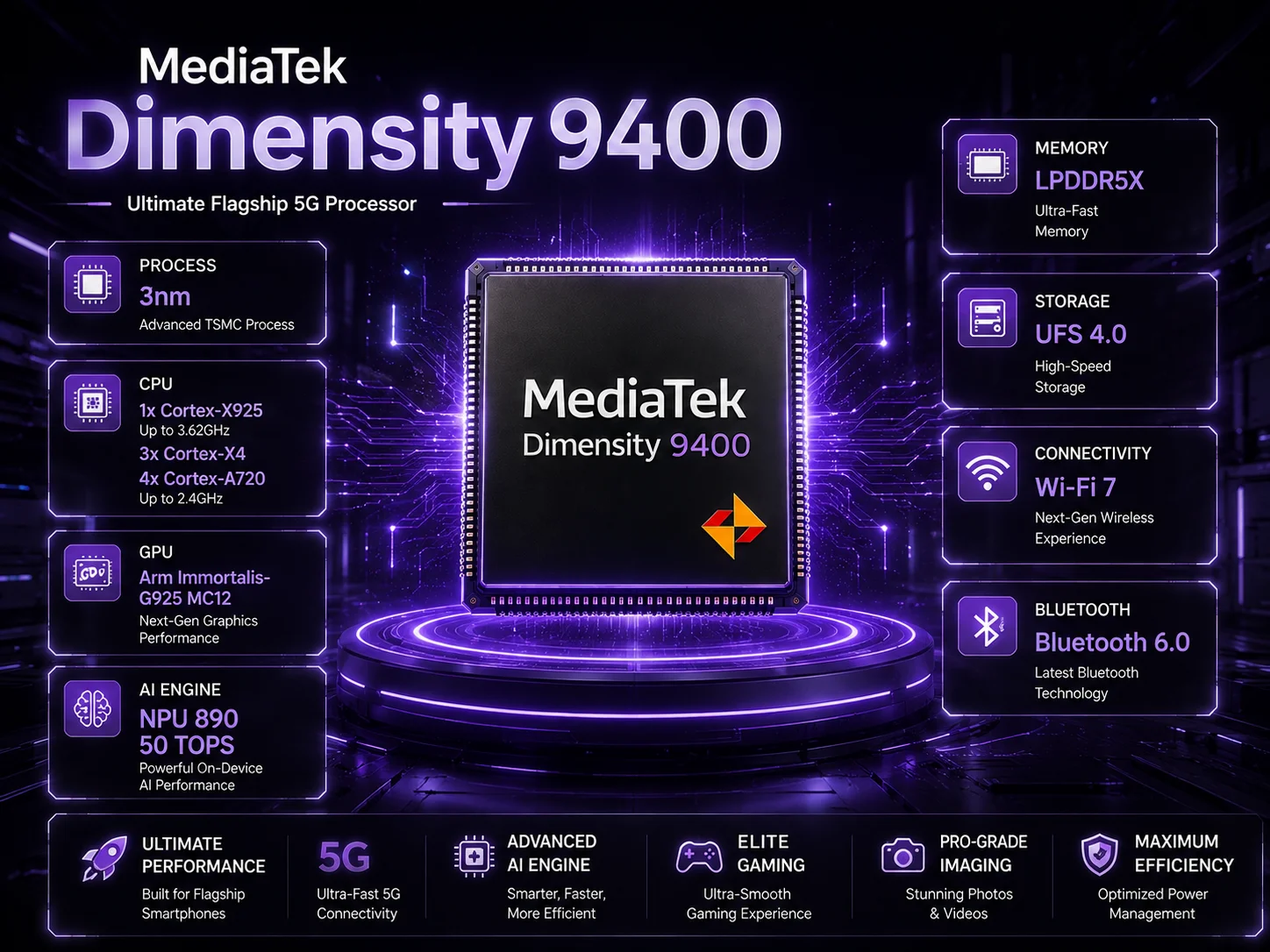
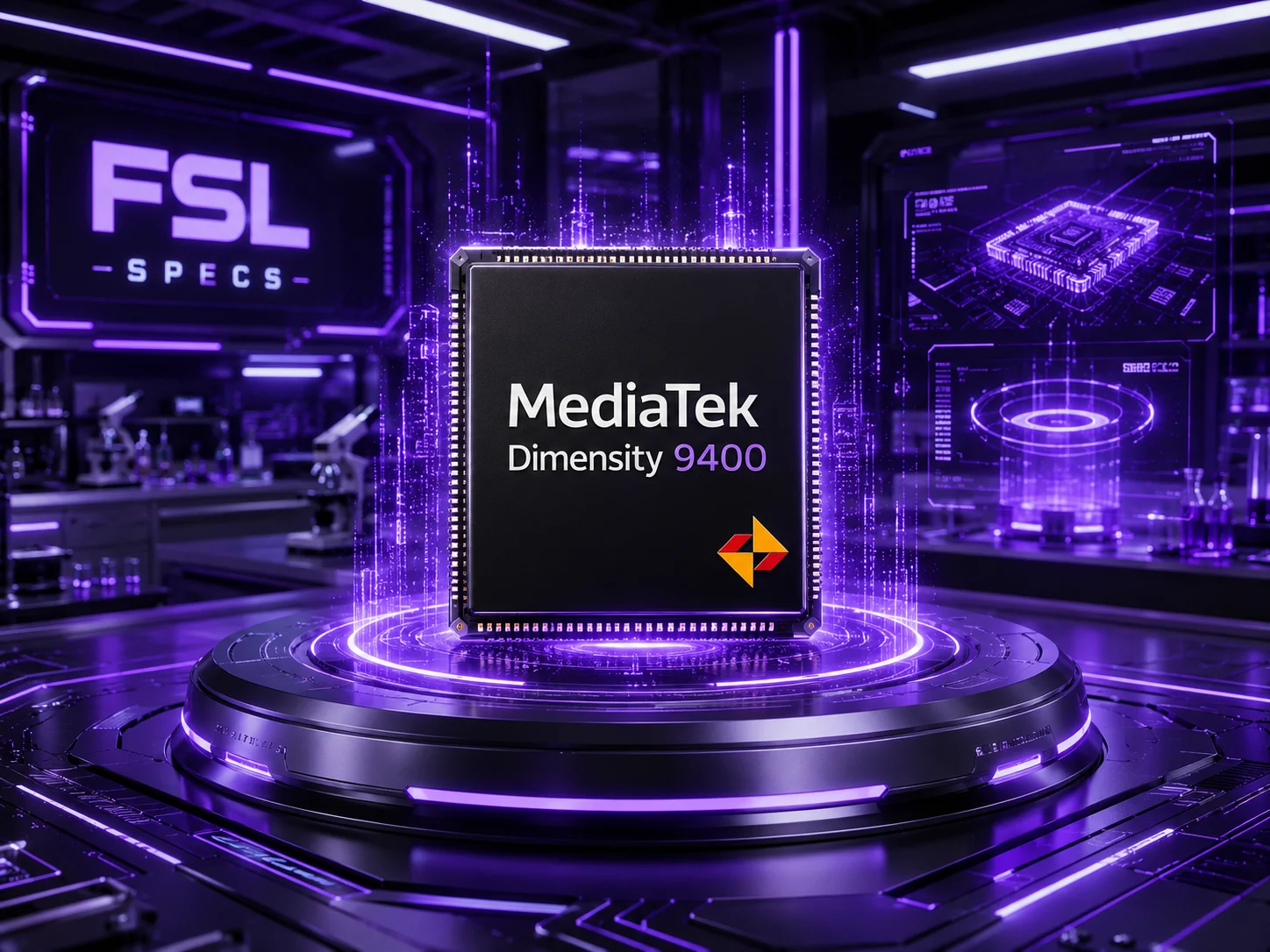
The MediaTek Dimensity 9400 is MediaTek's flagship 5G chipset built on a 3nm process, using 1× Cortex‑X925 up to 3.62GHz, 3× Cortex‑X4, and 4× Cortex‑A720 up to 2.4GHz, paired with an Arm Immortalis‑G925 MC12 GPU. With LPDDR5X memory, UFS 4.0 storage, the NPU 890 (50 TOPS) for on-device AI, Wi‑Fi 7, and Bluetooth 6.0, it's built for top‑tier flagship performance.
Benchmark Scores
Measures CPU, GPU, RAM, and I/O performance in different scenarios.
Shows raw single-threaded CPU performance across real-world workloads.
Cross-platform benchmark assessing graphics performance in Vulkan/Metal.
Evaluates overall system performance in everyday workloads.
CPU & AI Performance
3× Cortex‑X4 up to 3.3GHz
4× Cortex‑A720 up to 2.4GHz
Graphics, Memory & Storage
Multimedia (Camera, Display & ISP)
Connectivity
General Info
information About MediaTek Dimensity 9400
Introduction
Flagship silicon in 2025 to 2026 has become a genuine three way contest, and the Dimensity 9400 vs Xring O1 vs Snapdragon 8 Gen 5 matchup captures exactly why. MediaTek’s Dimensity 9400 opened the 3nm flagship era with an all big core design that briefly topped the charts. Xiaomi answered with the Xring O1, its first fully in house chipset, built with a 10 core layout that nobody else in the industry uses.
Qualcomm followed with the Snapdragon 8 Gen 5, a sub Elite flagship chip that borrows heavily from the Snapdragon 8 Elite Gen 5 while sitting one notch below it in price and positioning. All three chips are manufactured on 3 nanometer nodes, all three target flagship and near flagship phones, and all three take very different architectural paths to get there.
This comparison breaks down the CPU, GPU, manufacturing process, memory, AI performance, camera processing, display support, connectivity, and benchmark results of each chip, using only verified specifications, so smartphone buyers in Pakistan and beyond can understand what actually separates them.
Processor Overview
The Dimensity 9400 was announced in October 2024 and carries the model number MT6991. It uses an 8 core all big core CPU with one Cortex-X925 prime core at 3.62GHz, three Cortex-X4 cores at 3.3GHz, and four Cortex-A720 cores at 2.4GHz, built on TSMC’s N3E 3nm process. Its GPU is the Mali-G925 Immortalis MP12, and it pairs with an NPU 890 AI engine rated at 50 TOPS.
The Xring O1 is Xiaomi’s first self designed flagship chipset, announced in May 2025. It takes an unusual 10 core approach with two Cortex-X925 prime cores at 3.9GHz, four Cortex-A725 performance cores at 3.4GHz, two Cortex-A725 efficiency cores at 1.9GHz, and two Cortex-A520 cores at 1.8GHz, also fabricated on a TSMC 3nm process. Its GPU is a Mali-G925 Immortalis MP16, a 16 cluster configuration that is larger than the Dimensity 9400’s 12 cluster GPU, and it carries 19 billion transistors on a compact 109mm² die.
The Snapdragon 8 Gen 5 arrived in November 2025 as Qualcomm’s non Elite flagship, positioned just below the Snapdragon 8 Elite Gen 5. It uses Qualcomm’s custom Oryon cores in a 2 plus 6 layout, with two Oryon Prime cores at 3.8GHz and six Oryon Performance cores at 3.32GHz, on a 3nm TSMC process. Its GPU is the Adreno 829, and it uses a Hexagon NPU alongside an integrated Snapdragon X80 modem.
The immediate difference is core count and philosophy. The Dimensity 9400 and Snapdragon 8 Gen 5 both use 8 cores, while the Xring O1 uses 10, betting on core count and a large GPU cluster count rather than raw per core clock speed alone.
CPU Architecture and Processing Power
On paper clock speed, the Xring O1’s dual 3.9GHz Cortex-X925 prime cores lead the group, ahead of the Dimensity 9400’s single 3.62GHz Cortex-X925 and the Snapdragon 8 Gen 5’s Oryon Prime cores at 3.8GHz. Having two prime cores instead of one is architecturally significant for the Xring O1, since MediaTek and Qualcomm both rely on smaller clusters of secondary performance cores to fill in multi threaded workloads, while Xiaomi doubled up on its heaviest cores.
Real world Geekbench 6 results from NanoReview show the Snapdragon 8 Gen 5 posting the strongest single and multi core scores of the three, at 2903 single core and 9602 multi core. The Dimensity 9400 follows at 2797 single core and 8767 multi core, and the Xring O1 sits at 2746 single core and 8431 multi core.
This means that despite the Xring O1’s higher clock speed and extra cores on paper, the Snapdragon 8 Gen 5’s custom Oryon core design is currently extracting more real performance per clock. Independent testing from Gizmochina using retail devices, the OnePlus 15R for Snapdragon 8 Gen 5 and the Vivo X200 Pro for Dimensity 9400, found a similar pattern, with the Snapdragon chip roughly 4.5 percent faster in single core and 9 percent faster in multi core Geekbench results.
For app launching and everyday multitasking, this ranks the Snapdragon 8 Gen 5 slightly ahead, with the Dimensity 9400 close behind and the Xring O1 a step behind both despite its higher core count. For heavy sustained workloads, the story shifts. MediaTek’s cache heavy design gives the Dimensity 9400 12MB of L3 cache, more than double the Snapdragon 8 Gen 5’s 6MB L3 cache, which historically helps sustain performance in longer sessions without leaning as hard on system memory.
The Xring O1’s specification sheet from NanoReview does not list a separate L3 figure directly, though other sources describe a 16MB L3 shared across its 10 cores, larger cache generally being useful for multitasking heavy users who keep many apps open.
The instruction set architecture is identical across all three chips at ARMv9.2-A for the Dimensity 9400 and Xring O1, while the Snapdragon 8 Gen 5 uses custom Oryon cores also built to the ARMv9.2-A standard. This means none of the three chips has an instruction set advantage over the others, and the performance gap comes entirely from core design, clock strategy, and cache configuration rather than the underlying architecture generation.
GPU and Gaming Performance
Gaming performance is where the differences become most interesting. The Xring O1’s Mali-G925 Immortalis MP16 has the highest raw compute figure of the group at 5701.6 Gigaflops, followed by the Dimensity 9400’s Mali-G925 Immortalis MP12 at 4952.1 Gigaflops, and the Snapdragon 8 Gen 5’s Adreno 829 trailing at 2508.8 Gigaflops. The Xring O1 and Dimensity 9400 share the same underlying Mali-G925 Valhall 5th generation architecture, with the Xring O1 simply using four more GPU clusters, 16 versus 12.
However, raw Gigaflops numbers do not always translate cleanly into gaming FPS, and NanoReview’s own benchmark testing tells a more nuanced story. In 3DMark Steel Nomad Light, the Xring O1 scores 2413 versus 2371 for the Dimensity 9400, a narrow lead. But in 3DMark Solar Bay, the Dimensity 9400 pulls ahead with 10747 points against the Xring O1’s 9022.
The Snapdragon 8 Gen 5 posts the lowest Steel Nomad Light score at 1823, though its Solar Bay result of 9094 keeps it competitive with the Xring O1 in that particular test. GeekBench 6 GPU compute scores are actually closest of all here, with the Dimensity 9400 at 21574, the Xring O1 at 21512, and the Snapdragon 8 Gen 5 close behind at 21211, showing the gap in compute heavy tasks is much smaller than the Gigaflops figures suggest on their own.
Independent benchmark comparisons of retail phones back up the idea that the Dimensity 9400 has an edge in peak GPU and ray tracing workloads specifically, even against the newer Snapdragon 8 Gen 5, while the Snapdragon chip is described as more consistent over longer gaming sessions.
For gamers who play short, graphically intense bursts, the Dimensity 9400 and Xring O1’s larger GPU clusters and higher theoretical throughput matter more. For gamers who play extended sessions and value frame stability over peak numbers, the Snapdragon 8 Gen 5’s more efficient Adreno 829 and lower sustained TDP of 9W are the more relevant specifications.
All three chips support Vulkan, with the Snapdragon 8 Gen 5 supporting the newer Vulkan 1.4 standard against Vulkan 1.3 on both the Dimensity 9400 and Xring O1, plus universal support for DirectX 12.1 and OpenCL 3.0 across the group.
Manufacturing Process and Efficiency
All three chips are built on TSMC 3 nanometer nodes, but not the identical variant. The Dimensity 9400 uses TSMC’s N3E process, the same generation node referenced for the Xring O1, while the Snapdragon 8 Gen 5 uses a TSMC 3nm process as well, described by Qualcomm and industry reporting as the more refined N3P node shared with the Snapdragon 8 Elite Gen 5.
A more refined node generally improves performance per watt rather than making a chip automatically faster, and this appears consistent with NanoReview’s official battery life scores, where the Dimensity 9400 scores 93, the Snapdragon 8 Gen 5 scores 93, and the Xring O1 scores 92, putting all three within a single point of each other on efficiency.
The Snapdragon 8 Gen 5 is the only one of the three with a directly published sustained power limit of 9W, giving buyers a concrete figure for expected heat output under load. Neither the Dimensity 9400 nor Xring O1 specification sheets list a directly comparable TDP figure.
In real world usage, the Xring O1’s 10 core layout, combined with two large prime cores running at 3.9GHz, has drawn user reports on NanoReview describing it as more power hungry than its rivals, and reviewers have separately noted that Xiaomi’s early thermal management tuning has affected sustained performance on the Xiaomi 15S Pro, the phone that launched with this chip. This is a software and cooling design factor rather than a fault of the silicon itself, but it does affect real world efficiency outcomes for buyers.
Memory and Storage Support
Memory bandwidth slightly favors the Dimensity 9400. It supports LPDDR5X at 5333MHz, delivering 85.3 Gb/s of maximum bandwidth across a 4×16 bit bus, with support for up to 24GB of RAM. The Snapdragon 8 Gen 5 and Xring O1 both use LPDDR5X memory clocked lower at 4800MHz, giving both chips 76.8 Gb/s of maximum bandwidth, also topping out at 24GB.
This roughly 10 percent bandwidth advantage for the Dimensity 9400 can matter for large game asset streaming and heavy multitasking scenarios where data needs to move quickly between RAM and the processor, though the real world impact is often masked by how individual phone makers configure their RAM modules.
All three chips support the latest UFS 4.0 and UFS 4.1 storage standards, meaning storage read and write speeds will largely depend on which specific UFS revision and manufacturer a phone maker chooses to pair with the chipset, not the processor itself. None of the three data sheets list expanded storage support beyond onboard UFS.
AI and NPU Capabilities
AI performance is one area with a clear published number gap. The Dimensity 9400’s NPU 890 is rated at 50 TOPS, the highest disclosed AI performance figure among the three chips, while the Xring O1’s NPU is rated at 44 TOPS. The Snapdragon 8 Gen 5’s Hexagon NPU does not have a directly published TOPS figure in the supplied NanoReview data, so a direct numeric comparison against the other two is not possible from verified sources, and this figure should be treated as not disclosed rather than assumed to be lower or higher.
What is clear is that MediaTek has built its AI marketing heavily around the Dimensity 9400’s NPU 890, positioning it for on device generative AI tasks including image super resolution and AI powered photo enhancement. The Xring O1’s NPU is a fully custom Xiaomi design rather than a licensed ARM block, and independent teardown coverage has described its supporting cache as unusually large for an NPU, at around 10MB, suggesting Xiaomi engineered it for sustained AI workloads such as computational photography pipelines rather than short burst tasks alone.
For users specifically prioritizing on device generative AI features, camera AI processing, and voice assistant responsiveness, the Dimensity 9400’s disclosed 50 TOPS figure gives it the most concrete advantage on paper, while the Snapdragon 8 Gen 5’s AI capability remains only partially documented in available specification data.
ISP, Camera, and Video Capabilities
Camera processing specifications are closely matched between the Dimensity 9400 and Snapdragon 8 Gen 5. Both support a maximum single camera resolution of 320MP and both are capable of 8K video recording at 60FPS and 4K at 120FPS, with identical video codec support for H.264, H.265, AV1, and VP9. The Snapdragon 8 Gen 5 does hold a small display pipeline edge, supporting up to 3840×2540 resolution output versus the Dimensity 9400’s 3840×2160 maximum.
The Xring O1 is positioned slightly differently here. Its maximum video capture and playback specification is listed at 8K at 30FPS and 4K at 120FPS, meaning its top tier 8K recording is capped at 30 frames per second rather than the 60FPS that both the Dimensity 9400 and Snapdragon 8 Gen 5 support. For creators who specifically want smoother 8K footage, this is a meaningful difference, even though 4K120 slow motion capability remains identical across all three chips.
It’s worth noting that a chipset’s ISP capability defines what a phone can theoretically support, not what any individual phone using that chip will necessarily enable, since camera sensor quality and firmware tuning by the phone manufacturer also play a large role in final image and video output.
Display Support
The Snapdragon 8 Gen 5 supports the highest maximum display resolution of the three at 3840×2540, ahead of the Dimensity 9400’s 3840×2160 maximum. NanoReview’s specification data does not list a separate maximum display resolution figure for the Xring O1, so this should be treated as not disclosed rather than assumed absent.
All three chipsets are expected to support high refresh rate panels used in current flagship phones, though exact maximum refresh rate figures were not separately itemized in the supplied specification data for any of the three chips, and readers should confirm refresh rate support against the specific phone model rather than the chipset sheet alone.
5G, Modem, and Connectivity
Connectivity is where the Snapdragon 8 Gen 5 shows its clearest advantage. Its integrated Snapdragon X80 modem supports download speeds of up to 10,000 Mbps and upload speeds of up to 3,500 Mbps, the highest published figures of the three chips. The Dimensity 9400 follows with a maximum download speed of up to 7,300 Mbps, while the Xring O1, which relies on an external MediaTek T800 modem rather than an integrated one, supports up to 7,900 Mbps download and 4,200 Mbps upload, notably beating the Dimensity 9400 on upload speed despite its lower overall chipset tier positioning.
The Xring O1 relying on an external modem rather than an integrated one is a meaningful design distinction. Both the Dimensity 9400 and Snapdragon 8 Gen 5 have their 5G modems built directly into the main chip package, which typically helps with power efficiency and board space, while the Xring O1’s external modem setup, shared with high end Apple silicon designs that also use external modems, contributes to the chip’s compact 109mm² die size but adds a separate power draw source.
Wi-Fi support is identical across the Dimensity 9400 and Snapdragon 8 Gen 5, both offering Wi-Fi 7, while the Xring O1 also supports Wi-Fi 7 according to device level testing, though its Bluetooth version trails the other two at Bluetooth 5.4 versus Bluetooth 6.0 on both the Dimensity 9400 and Snapdragon 8 Gen 5.
For buyers who care about wireless accessory range and audio codec support, this Bluetooth generation gap could matter, since Bluetooth 6.0 generally offers improved connection stability and lower latency compared to 5.4. GNSS navigation support is broad across all three, covering GPS, GLONASS, Beidou, Galileo, and QZSS, with the Dimensity 9400 additionally listing NAVIC support.
Benchmark Comparison
NanoReview’s own AnTuTu 11 testing places the Snapdragon 8 Gen 5 on top with a total score of 3,068,952, ahead of the Xring O1 at 2,998,904, with the Dimensity 9400 trailing at 2,820,364. Breaking this down by category, the Snapdragon 8 Gen 5 leads in CPU score at 954,595 and in UX score at 731,345, a notably large UX lead over both rivals. The Xring O1 actually posts the highest GPU sub score at 1,006,500 and the highest memory sub score at 409,347, even though its overall total trails the Snapdragon 8 Gen 5.
Independent AnTuTu testing on retail devices, comparing the Snapdragon 8 Gen 5 in the OnePlus 15R against the Dimensity 9400 in the Vivo X200 Pro, found the two chips nearly tied in total score, with results in the 2.8 to 2.9 million range for both, underscoring that lab conditions and specific phone thermal designs can shift real world AnTuTu totals compared to NanoReview’s reference figures. This is an important caveat since these benchmark totals are influenced by cooling, software optimization, and even ambient temperature during testing, not purely by chipset hardware.
On GeekBench 6, the ranking by CPU performance holds consistently across sources, with the Snapdragon 8 Gen 5 leading in both single core and multi core, the Dimensity 9400 in second place, and the Xring O1 in third place despite its higher core count and clock speed on paper.
PCMark 3.0 overall system scores also favor the Snapdragon 8 Gen 5 at 18,388, ahead of the Xring O1 at 15,735 and the Dimensity 9400 at 15,020, suggesting the Snapdragon chip currently has an edge specifically in day to day workload benchmarks like web browsing, writing, and data manipulation tests. All three benchmark suites referenced here are on the same AnTuTu 11 and GeekBench 6 versions, so the comparisons above are directly comparable rather than requiring a version mismatch warning.
Real World Performance
For everyday users focused on app launching, social media, and general browsing, the Snapdragon 8 Gen 5’s consistently higher single core, multi core, and UX benchmark scores suggest it should feel the snappiest of the three in daily use, with the Dimensity 9400 close behind and generally competitive.
For gaming, the picture depends heavily on session length and game type. Short, graphically demanding sessions favor the Dimensity 9400 and Xring O1’s larger GPU clusters and higher theoretical Gigaflops output, particularly in ray tracing enabled titles where the Dimensity 9400 has shown an edge even against newer Snapdragon silicon in independent testing. Longer gaming sessions where thermal throttling becomes a factor tend to favor the Snapdragon 8 Gen 5’s documented 9W sustained power limit and its reputation, per multiple independent benchmarks, for more consistent frame delivery over time.
For AI focused users, the Dimensity 9400’s disclosed 50 TOPS NPU rating gives it the clearest documented advantage for on device generative AI and camera AI tasks, with the Xring O1’s 44 TOPS custom NPU close behind and architecturally built for sustained AI camera workloads. The Snapdragon 8 Gen 5’s AI performance figure was not disclosed in the available specification data, so its positioning versus the other two cannot be confirmed here.
For camera users, the Dimensity 9400 and Snapdragon 8 Gen 5 are essentially tied on paper with identical 320MP maximum resolution and 8K60 video support, while the Xring O1’s 8K video capture is capped at 30FPS, a real limitation for creators wanting smoother high resolution footage.
For heavy multitaskers, the Dimensity 9400’s higher memory bandwidth at 85.3 Gb/s and larger L3 cache give it a specification edge for keeping many apps and large games resident in memory, though the Xring O1’s 10 core layout offers more simultaneous execution threads for background tasks.
Strengths and Weaknesses
MediaTek Dimensity 9400
Strengths include the highest disclosed NPU rating at 50 TOPS, the highest memory bandwidth of the three chips at 85.3 Gb/s, a strong GPU with competitive Solar Bay and ray tracing results, and a large 12MB L3 cache that benefits sustained multitasking.
Weaknesses include the lowest raw AnTuTu total of the three in NanoReview’s reference testing, the lowest GeekBench 6 multi core score, and the lowest maximum modem download speed at 7,300 Mbps against the Snapdragon 8 Gen 5’s 10,000 Mbps.
Xiaomi Xring O1
Strengths include the highest theoretical GPU compute output at 5701.6 Gigaflops, the highest AnTuTu GPU and memory sub scores in NanoReview’s testing, and a 10 core CPU layout offering more simultaneous execution threads than either 8 core rival.
Weaknesses include the lowest GeekBench 6 single and multi core scores despite the highest paper clock speeds, an external modem design rather than an integrated one, the oldest Bluetooth version at 5.4, and an 8K video capture limit of 30FPS rather than 60FPS.
Qualcomm Snapdragon 8 Gen 5
Strengths include the highest AnTuTu total score, the highest GeekBench 6 single and multi core scores, the fastest published modem speeds at up to 10,000 Mbps download, the newest Vulkan 1.4 support, and a clearly documented 9W sustained power limit.
Weaknesses include the lowest 3DMark Steel Nomad Light score of the three chips and the lowest theoretical GPU Gigaflops figure at 2508.8, along with an undisclosed NPU TOPS rating that makes its AI performance harder to verify against its rivals.
Best Processor For Different Users
- Best for Gaming (short, intense sessions): MediaTek Dimensity 9400
- Best for Gaming (long, sustained sessions): Qualcomm Snapdragon 8 Gen 5
- Best for AI: MediaTek Dimensity 9400
- Best for Efficiency: Qualcomm Snapdragon 8 Gen 5
- Best for Camera Processing: MediaTek Dimensity 9400 and Qualcomm Snapdragon 8 Gen 5 (tied on paper)
- Best for Connectivity: Qualcomm Snapdragon 8 Gen 5
- Best for Raw GPU Compute: Xiaomi Xring O1
- Best for Balanced Performance: Qualcomm Snapdragon 8 Gen 5
Final Verdict and Ranking
1. Qualcomm Snapdragon 8 Gen 5 — Best Overall
2. MediaTek Dimensity 9400 — Best For AI and Sustained Multitasking
3. Xiaomi Xring O1 — Best For Raw GPU Compute Potential
Best for Gaming: MediaTek Dimensity 9400 for peak short session performance, Qualcomm Snapdragon 8 Gen 5 for sustained sessions Best for AI: MediaTek Dimensity 9400 Best for Efficiency: Qualcomm Snapdragon 8 Gen 5 Best Balanced Choice: Qualcomm Snapdragon 8 Gen 5
Bottom Line: The Snapdragon 8 Gen 5 currently delivers the strongest all around package among these three chips, backed by the highest benchmark scores across AnTuTu, GeekBench 6, and PCMark, plus the fastest modem on paper.
The Dimensity 9400 remains the smarter pick specifically for AI heavy users and gamers who prioritize peak GPU output over long session consistency, while the Xring O1, despite genuinely impressive engineering for a first generation in house chip, needs further software and thermal optimization from Xiaomi before it can consistently outperform its more established rivals in real world use.
Images Of MediaTek Dimensity 9400
Trailer Of MediaTek Dimensity 9400

Author & Post Info
Faisal Ur Rehman
Faisal Rehman is the founder and editor of FSL Specs, where he publishes in-depth smartphone specifications, comparisons, buying guides, and technology insights. With extensive experience in mobile hardware research and technical analysis, he provides accurate and up-to-date information on Android smartphones, processors, displays, cameras, batteries, performance benchmarks, and software features. His goal is to simplify complex specifications and help readers choose the right device with confidence.
Explore FSL Specs
Questions About MediaTek Dimensity 9400
What CPU does the MediaTek Dimensity 9400 use?
The Dimensity 9400 uses an all-big-core octa-core design with 1 Cortex-X925 prime core up to 3.62GHz, 3 Cortex-X4 cores up to 3.3GHz, and 4 Cortex-A720 cores up to 2.4GHz. It is built on TSMC's 3nm process with a 12MB L3 cache. This marks MediaTek's first chip to drop small efficiency cores entirely.
Which GPU powers the Dimensity 9400?
Graphics are handled by the Arm Immortalis-G925 MC12, built on the Valhall 5th Gen architecture. It runs at 1612MHz with 128 shading units and 1536 total shaders, delivering 4952.1 GFLOPS of compute power. It supports Vulkan 1.3 and OpenCL 3.0 for modern graphics-heavy games.
What RAM and storage does the Dimensity 9400 support?
It supports LPDDR5X memory at up to 5333MHz (10667Mbps effective) across a 4x16-bit bus, delivering 85.3GB/s of bandwidth and up to 24GB capacity. Storage is handled by UFS 4.0 with MCQ support. This combination gives it flagship-tier speed for multitasking and app loading.
What is the AnTuTu score of the Dimensity 9400?
The Dimensity 9400 scores around 2.8 million points on AnTuTu 11. The breakdown shows 883K for CPU, 956.8K for GPU, 363.9K for memory, and 616.7K for UX. This places it firmly among the top flagship chipsets of its generation.
Does the Dimensity 9400 have a dedicated NPU?
Yes, it includes the MediaTek NPU 890, built for generative and agentic AI tasks, rated at 50 TOPS of theoretical performance. This gives it strong on-device AI capability for tasks like image generation and real-time processing.
What is the maximum display and refresh rate support of the Dimensity 9400?
The chip supports up to 3840x2160 UHD resolution and refresh rates up to 180Hz at WQHD+. This makes it suitable for premium flagship displays with ultra-smooth animations and gaming.
Does the Dimensity 9400 support 5G and Wi-Fi 7?
Yes, it offers full 5G support with SA and NSA modes plus Dual SIM Dual Active, reaching peak download speeds up to 7.3Gbps. It also includes Wi-Fi 7, Bluetooth 6.0, and GNSS support for GPS, GLONASS, BeiDou, Galileo, QZSS, and NAVIC.