MediaTek Dimensity 9500s — Full Specifications | FSL Specs
MediaTek Dimensity 9500s chipset
MediaTek · Flagship 5G

MediaTek Dimensity 9500s

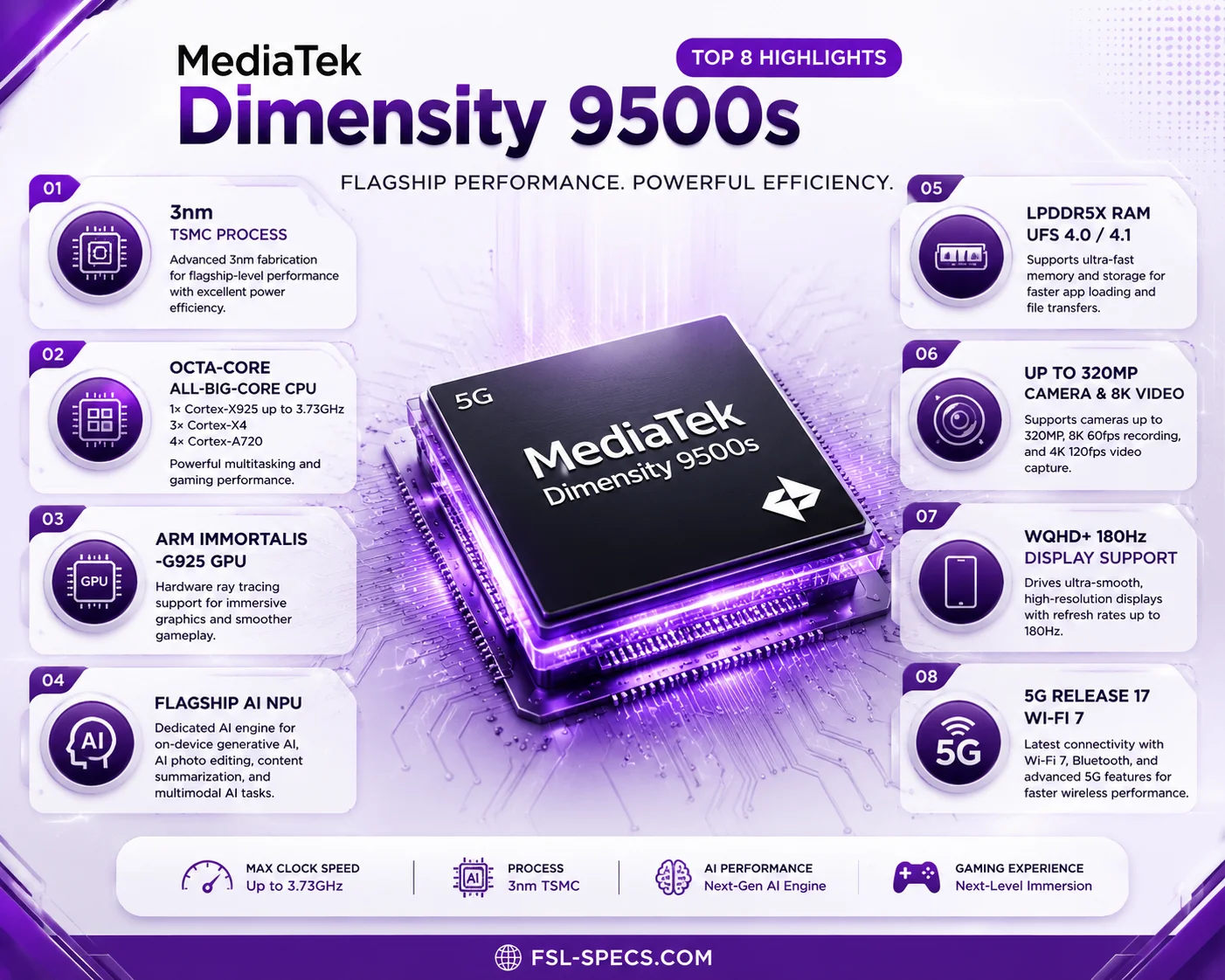
The MediaTek Dimensity 9500s is a flagship 5G chipset built on a 3nm process, using 1× Cortex‑X925 up to 3.73GHz, 3× Cortex‑X4 up to 3.3GHz, and 4× Cortex‑A720 up to 2.4GHz, paired with an Arm Immortalis‑G925 MP12 GPU. With LPDDR5X memory, UFS 4.1 storage, a dedicated MediaTek NPU for on-device generative AI, Wi‑Fi 7, and Bluetooth 5.4, it targets top-tier flagship performance with tri-fold display support.

FlagshipClass
January 2026Announced
3nmProcess Node
3.73GHzMax Clock
3MAnTuTu Score
MT6991ZModel Number
LPDDR5XRAM Type
Octa (8)Cores

Benchmark Scores

AnTuTu 11
3M

Measures CPU, GPU, RAM, and I/O performance in different scenarios.

CPU894.8K
GPU1.1M
Memory431.4K
UX649.2K
Geekbench 6
N/A

Shows raw single-threaded CPU performance across real-world workloads. Overall single-core score not confirmed in source data — sub-metrics below are verified.

Asset compression374.1 MB/s
HTML5 browser259.5 pg/s
PDF renderer301.7 Mpx/s
Image detection231.8 img/s
HDR267.6 Mpx/s
Background blur37.9 img/s
Photo processing86.8 img/s
Ray tracing10 Mpx/s

CPU & AI Performance

🧠 CPU
CPU Type(s)1× Cortex‑X925 up to 3.73GHz (2MB L2)
3× Cortex‑X4 up to 3.3GHz (1MB L2 each)
4× Cortex‑A720 up to 2.4GHz (512KB L2 each)
CoresOcta (8)
CPU Bit64-bit
Instruction SetARMv9.2‑A
CacheL1: 128KB · L2: 2MB · L3: 12MB · SLC: 10MB
Process / Manufacturing3nm (TSMC)
TDP (Sustained)9W
✨ AI Accelerator
Neural Processor (NPU)MediaTek NPU
AI CapabilitiesOn-device Generative AI, Agentic AI

Graphics, Memory & Storage

🎮 Graphics (GPU)
GPU TypeArm Immortalis‑G925 MP12
ArchitectureValhall 5th Gen
GPU Frequency1612 MHz
Pipelines12
Shading Units128
Total Shaders1536
Compute Power4952.1 GFLOPS
Vulkan / OpenCL / DirectXVulkan 1.3 / OpenCL 3.0 / DirectX 12.1
💾 Memory & Storage
Memory TypeLPDDR5X
Max Memory Frequency5333 MHz (10667 Mbps)
Memory Bus4× 16‑bit
Max Bandwidth85.3 GB/s
Max Memory Size24 GB
Storage TypeUFS 4.0 / UFS 4.1 (+MCQ)

Multimedia (Camera, Display & ISP)

📸 Multimedia (ISP)
Max Camera Resolution1× 320MP, or 1× 10⁸MP @30fps, or 3× 36MP @30fps
Max Video Capture8K60 (7680×4320)
Video Decode8K60, 10‑bit (HEVC/AVC/VP9/AV1)
Video Encode8K30 10‑bit (HEVC/AVC), 8K60 8‑bit HEVC
Max Refresh RateWQHD+ up to 180Hz
Max Display Resolution3840 × 2160 (4K UHD)
Display InterfaceTri-port MIPI (supports Tri-Fold Displays)
Video Capture / Playback8K @ 60 FPS, 4K @ 120 FPS
Video CodecsH.264, H.265, AV1, VP9
Audio CodecsAAC LC, FLAC, HE‑AACv1, HE‑AACv2, MP3

Connectivity

📡 Cellular & Networking
Cellular Technologies3GPP‑R17, Sub‑6GHz (FR1), 2G‑5G Multi-Mode, 5G‑CA, 4G‑CA, 5G FDD/TDD, 4G FDD/TDD, TD‑SCDMA, WCDMA, EDGE, GSM
5G Modes5G/4G Dual SIM Dual Active, Dual Data, SA & NSA (SA Option2, NSA Option3/3a/3x), NR FR1 TDD+FDD, DSS, 256QAM VoNR / EPS Fallback
DL FunctionsSub6 DL 4CC 300MHz, R17 Enhancement, LB DL 4×4 MIMO
4G SupportLTE Cat. 24
5G SupportYes
Peak Download SpeedUp to 7300 Mbps (7.3 Gbps)
GNSS / NavigationGPS L1CA+L5+L1C, BeiDou B1I+B1C+B2a+B2b, GLONASS L1OF, Galileo E1+E5a+E5b, QZSS L1CA+L5, NAVIC
Wi‑FiWi‑Fi 7 (802.11be)
Bluetooth5.4

General Info

AnnouncedJanuary 2026
ClassFlagship
Model NumberMT6991Z/SCZB, MT6991Z/ECZB
ManufacturerMediaTek (TSMC 3nm)
information About MediaTek Dimensity 9500s

MediaTek Dimensity 9500s Full Specs, Benchmarks & AnTuTu Score FSL Specs

Introduction

The MediaTek Dimensity 9500S is positioned as a flagship-class 3nm smartphone processor, but its name can make it sound newer and substantially different from the Dimensity 9400+. In reality, the comparison is more interesting than a simple generational upgrade. The MediaTek Dimensity 9500S uses an all-big-core CPU, a Cortex-X925 clocked up to 3.73GHz, an Immortalis-G925 GPU, LPDDR5X memory and UFS 4-class storage. MediaTek also highlights a large 19MB CPU cache and 10MB system cache for responsiveness and efficiency.

The MediaTek Dimensity 9400+ is the closest rival because it uses the same basic CPU configuration, including the 3.73GHz Cortex-X925, three Cortex-X4 cores and four Cortex-A720 cores. The older  MediaTek Dimensity 9400 keeps the same overall architecture but lowers the flagship Cortex-X925 to 3.62GHz.

The benchmark picture is therefore particularly important. Using current AnTuTu 11 results from NanoReview, the MediaTek Dimensity 9500S records 3,037,573, compared with 2,876,004 for the Dimensity 9400+ and 2,820,364 for the Dimensity 9400. That puts the 9500S approximately 5.6% ahead of the 9400+ and 7.7% ahead of the 9400 in this dataset.

CPU Architecture & Processing Power

The MediaTek Dimensity 9500S uses an eight-core all-big-core design consisting of 1× Cortex-X925 at up to 3.73GHz, 3× Cortex-X4 at up to 3.3GHz and 4× Cortex-A720 at up to 2.4GHz. This is a flagship architecture designed to avoid traditional low-performance CPU cores and provide strong processing throughout the core cluster.

The Dimensity 9400+ is remarkably close. Its CPU configuration is also 1× Cortex-X925 at 3.73GHz + 3× Cortex-X4 + 4× Cortex-A720. The Dimensity 9400 uses the same core arrangement but lowers the Cortex-X925 to 3.62GHz.

This explains why the MediaTek Dimensity 9500S does not produce a massive CPU performance jump over the 9400+. NanoReview’s current Geekbench 6 averages actually show the Dimensity 9400+ slightly ahead, at 2,729 single-core and 8,430 multi-core, versus 2,680 and 8,358 for the 9500S. That difference is small enough that normal users are unlikely to experience a dramatic CPU advantage from the 9500S alone.

Against the original Dimensity 9400, however, the MediaTek Dimensity 9500S has a clearer clock-speed advantage. The 9400’s X925 reaches 3.62GHz, compared with 3.73GHz on the 9500S. The result is a newer positioning and higher peak CPU frequency, although benchmark differences remain much smaller than the processor names might suggest.

CPU winner: Dimensity 9500S, but only narrowly over the 9400+.

GPU & Gaming Performance

Gaming is one of the strongest areas for all three processors. The Mediatek Dimensity 9500S integrates an Arm Immortalis-G925 GPU with hardware ray tracing, while MediaTek adds Adaptive Gaming Technology 3.0 and Frame Rate Converter 3.0 to improve performance and power efficiency. MediaTek says the platform can support 165 FPS gaming in supported titles and optimized 120+ FPS gameplay.

The Dimensity 9400+ also uses the Immortalis-G925, and MediaTek specifies a 12-core GPU. Its gaming features include hardware ray tracing and OMM technology for more realistic graphics.

The important point is that the Mediatek Dimensity 9500S is not dramatically ahead of the 9400+ in GPU hardware. NanoReview lists both with the same Immortalis-G925 MP12 configuration and identical GPU frequency in its comparison data. Gaming scores are also rated identically at 82/100 on that platform.

The Dimensity 9400 also uses the Immortalis-G925, giving it the same broad graphics generation, although the 9500S and 9400+ have higher CPU clocks and newer positioning. MediaTek’s 9400 platform supports advanced ray tracing and its second-generation all-big-core design.

Gaming winner: Mediatek Dimensity 9500S / 9400+ are effectively neck-and-neck on the supplied GPU data, while the 9400 remains slightly behind overall.

Manufacturing Process & Efficiency

All three processors are built around a 3nm-class process, giving them a strong efficiency foundation. The Mediatek Dimensity 9500S is specifically described by MediaTek as a flagship 3nm platform designed to deliver high performance while improving energy efficiency.

The 9400+ is also a 3nm flagship chipset, while the Dimensity 9400 was likewise built using a 3nm process. Therefore, there is no major fabrication-node advantage separating these three processors.

The efficiency difference instead comes from clock tuning, scheduling, GPU configuration and workload optimization. MediaTek specifically gives the 9500S its second-generation scheduling engine and MAGT 3.0, while the 9400+ uses MediaTek’s UltraSave and other platform-level optimizations.

Efficiency verdict: extremely close, with the 9400+ having a slight advantage in NanoReview’s battery-efficiency rating, while the 9500S brings newer platform tuning.

Memory, Cache & Storage

The Mediatek Dimensity 9500S supports LPDDR5X memory and UFS 4-class storage, with MediaTek listing memory speeds up to 10,667Mbps. It also provides 12MB L3 cache and 10MB SLC, while MediaTek markets a total 19MB CPU cache.

The Dimensity 9400+ also supports LPDDR5X up to 10,667Mbps and UFS 4 with MCQ. Its specification includes 12MB L3 cache and 10MB SLC, making the memory architecture extremely similar.

The Dimensity 9400 likewise supports LPDDR5X and up to 10.7Gbps memory, along with UFS 4-class storage.

This means the Mediatek Dimensity 9500S does not create a major memory-generation advantage over the 9400+. For demanding multitasking, large games and fast storage, all three remain flagship-class platforms.

Memory winner: Mediatek Dimensity 9500S and 9400+ are effectively tied.

AI, ISP, Camera & Video

The Mediatek Dimensity 9500S includes MediaTek’s NPU for generative AI, multimodal models and agent-based tasks. MediaTek highlights AI photo editing, live-photo processing and AI content summarization as examples of workloads the chipset is designed to handle locally.

The 9400+ uses the MediaTek NPU 890, with support for generative and agentic AI workloads, including DeepSeek-R1-Distill models and advanced inference techniques.

The Dimensity 9400 also features an 8th-generation NPU and MediaTek’s Agentic AI Engine, supporting on-device AI capabilities and advanced camera processing.

For imaging, the 9500S supports cameras up to 320MP, three 36MP cameras at 30fps, and video capture up to 8K at 60fps. It also supports 4K at 120fps.

The 9400+ supports up to 320MP cameras and 8K60 video, while the 9400 platform also supports flagship imaging features including 8K Dolby Vision HDR video recording.

AI and multimedia verdict: Dimensity 9500S and 9400+ are closely matched, while the 9400 remains surprisingly capable despite being older.

Display & Connectivity

The Dimensity 9500S supports displays up to WQHD+ at 180Hz, making it suitable for high-resolution flagship panels and high-refresh gaming. It also supports Wi-Fi 7 and up to 6.5Gbps downlink performance.

The Dimensity 9400+ supports WQHD+ at 180Hz, Wi-Fi 7 and up to 7.3Gbps Wi-Fi data rates. It also adds Bluetooth 6.0 in MediaTek’s official specification.

The 9400 supports Wi-Fi 7 and advanced 5G connectivity, including MediaTek’s flagship modem platform.

This is one area where the 9400+ can actually look stronger than the newer 9500S on paper, particularly in maximum Wi-Fi throughput and Bluetooth generation.

Connectivity winner: Dimensity 9400+.

AnTuTu 11 Comparison

The clearest measurable difference comes from AnTuTu 11:

ProcessorAnTuTu 11Difference vs 9500S
Dimensity 9500S3,037,573Winner
Dimensity 9400+2,876,0049500S +5.6%
Dimensity 94002,820,3649500S +7.7%

The Dimensity 9500S leads the 9400+ by 161,569 points, or approximately 5.6%, while its advantage over the Dimensity 9400 is 217,209 points, approximately 7.7%. These figures are based on the same AnTuTu 11 dataset, so unlike cross-version comparisons, they are reasonably comparable.

However, the AnTuTu lead should not be interpreted as the 9500S being 5.6% faster in every application. AnTuTu combines CPU, GPU, memory and UX measurements, and real-world performance depends on the phone’s cooling, software and power limits.

Real-World Performance

For everyday use, all three processors provide substantially more performance than most users need. App launches, multitasking, browsing and demanding applications should be excellent across the three.

Gaming is more interesting. The Dimensity 9500S has the newest positioning and strong Immortalis-G925 graphics, but the 9400+ is extremely close because it uses essentially the same CPU/GPU foundation. For a buyer choosing between phones, the cooling system and game optimization of the individual device may matter more than the small chipset difference.

For AI and camera processing, the 9500S and 9400+ are again closely matched. Both are designed around flagship AI acceleration and advanced image/video processing rather than being simple CPU upgrades.

The original Dimensity 9400 remains highly competitive. Its 2.82 million AnTuTu 11 result is only about 7.7% behind the 9500S, which is a surprisingly small gap considering the naming difference and release timing.

Strengths & Weaknesses

Dimensity 9500S

Strengths: 3nm process, 3.73GHz Cortex-X925, Immortalis-G925 graphics, flagship AI, 8K60 video, WQHD+ 180Hz support and the highest AnTuTu 11 score of these three.

Weaknesses: Its CPU and GPU architecture are extremely close to the 9400+, so the “9500S” name does not translate into a huge generational performance jump.

Dimensity 9400+

Strengths: Nearly identical CPU/GPU platform to the 9500S, 3.73GHz X925, strong AI, Wi-Fi 7, Bluetooth 6.0 and excellent gaming capability.

Weaknesses: Its AnTuTu 11 score trails the 9500S by approximately 5.6%.

Dimensity 9400

Strengths: Strong flagship CPU/GPU architecture, 3nm fabrication, advanced AI, ray tracing, Wi-Fi 7 and excellent camera/video capabilities.

Weaknesses: Lower 3.62GHz X925 clock and the lowest AnTuTu score among these three.

Best Processor for Different Users

  • Best Overall: Dimensity 9500S
  • Best Gaming: Dimensity 9500S / Dimensity 9400+
  • Best AI: Dimensity 9500S / Dimensity 9400+
  • Best Connectivity: Dimensity 9400+
  • Best Flagship Value: Dimensity 9400, if the phone is significantly cheaper
  • Best Balanced Performance: Dimensity 9500S

Final Verdict & Ranking

1. 🥇 MediaTek Dimensity 9500S — Best Overall
The 9500S takes first place because it combines a 3.73GHz Cortex-X925, 3nm fabrication, Immortalis-G925 graphics, flagship AI, advanced video capabilities and the highest 3,037,573 AnTuTu 11 score in this comparison. Its advantage is real, but it is not enormous.

2. 🥈 MediaTek Dimensity 9400+ — Extremely Close Second
The 9400+ is arguably the most interesting rival because its core CPU and GPU configuration is remarkably close to the 9500S. Its 2,876,004 AnTuTu 11 score is only 5.6% lower, and its Geekbench results can actually edge the 9500S in NanoReview’s current dataset.

3. 🥉 MediaTek Dimensity 9400 — Still a Flagship-Class Processor
The Dimensity 9400 remains powerful, with 2,820,364 AnTuTu 11 and a 3nm all-big-core architecture. Its 7.7% gap behind the 9500S is small enough that a substantially cheaper 9400 phone could offer better value.

Best for Gaming: Dimensity 9500S / 9400+
Best for AI: Dimensity 9500S / 9400+
Best for Connectivity: Dimensity 9400+
Best Value if cheaper: Dimensity 9400

Bottom Line: The Dimensity 9500S wins this comparison, but the victory is much narrower than its name suggests. Its AnTuTu 11 advantage is approximately 5.6% over the Dimensity 9400+ and 7.7% over the Dimensity 9400. The 9400+ is the real challenger because its CPU and GPU platform is extremely similar, while the older 9400 remains surprisingly close in overall performance. For a premium flagship phone, choose the 9500S; if a 9400+ device is considerably cheaper, it may deliver nearly the same performance for less money.

Images Of MediaTek Dimensity 9500s

Trailer Of MediaTek Dimensity 9500s

Author & Post Info

Picture of Faisal Ur Rehman

Faisal Ur Rehman

Faisal Rehman is the founder and editor of FSL Specs, where he publishes in-depth smartphone specifications, comparisons, buying guides, and technology insights. With extensive experience in mobile hardware research and technical analysis, he provides accurate and up-to-date information on Android smartphones, processors, displays, cameras, batteries, performance benchmarks, and software features. His goal is to simplify complex specifications and help readers choose the right device with confidence.

FSL Explore Section

Questions About MediaTek Dimensity 9500s

Definitely, the Arm Immortalis-G925 GPU (12-core, 1612MHz) handles demanding titles with ease and even supports ray tracing. Paired with the Cortex-X925 prime core at 3.73GHz, heavy games run smooth without much slowdown.

It scores around 3,037,573 points on AnTuTu v11, putting it firmly in flagship territory. That breaks down to roughly 894K for CPU and 1.06 million for GPU alone, both seriously strong numbers.

Yes, it supports up to WQHD+ resolution at a smooth 180Hz refresh rate. It even includes tri-port MIPI support, making it ready for next-gen tri-fold smartphone displays.

It supports LPDDR5X memory up to 24GB, running at 5333MHz across a 4x16-bit bus. That gives it up to 85.3 Gb/s of bandwidth, plenty for smooth multitasking and heavy apps.

It goes way beyond that, supporting a single sensor up to 320MP or a 108MP sensor at 30fps. It can also handle triple 36MP sensors simultaneously, plus 8K60 video capture.

Yes, built on TSMC's 3nm process with a 9W sustained power limit, it balances flagship performance with solid efficiency. The big.LITTLE-style core setup helps conserve battery during lighter everyday tasks too.

Yes, officially classed as a flagship chip, it launched in January 2026 as one of MediaTek's top-tier SoCs. It's built to compete directly with the best high-end processors on the market.

It's powered by the Arm Immortalis-G925 (Mali-G925 Immortalis MP12), built on the Valhall 5th-gen architecture. With 1536 shading units and support for ray tracing, it's a serious graphics powerhouse.

Scroll to Top