
Apple A19 Pro
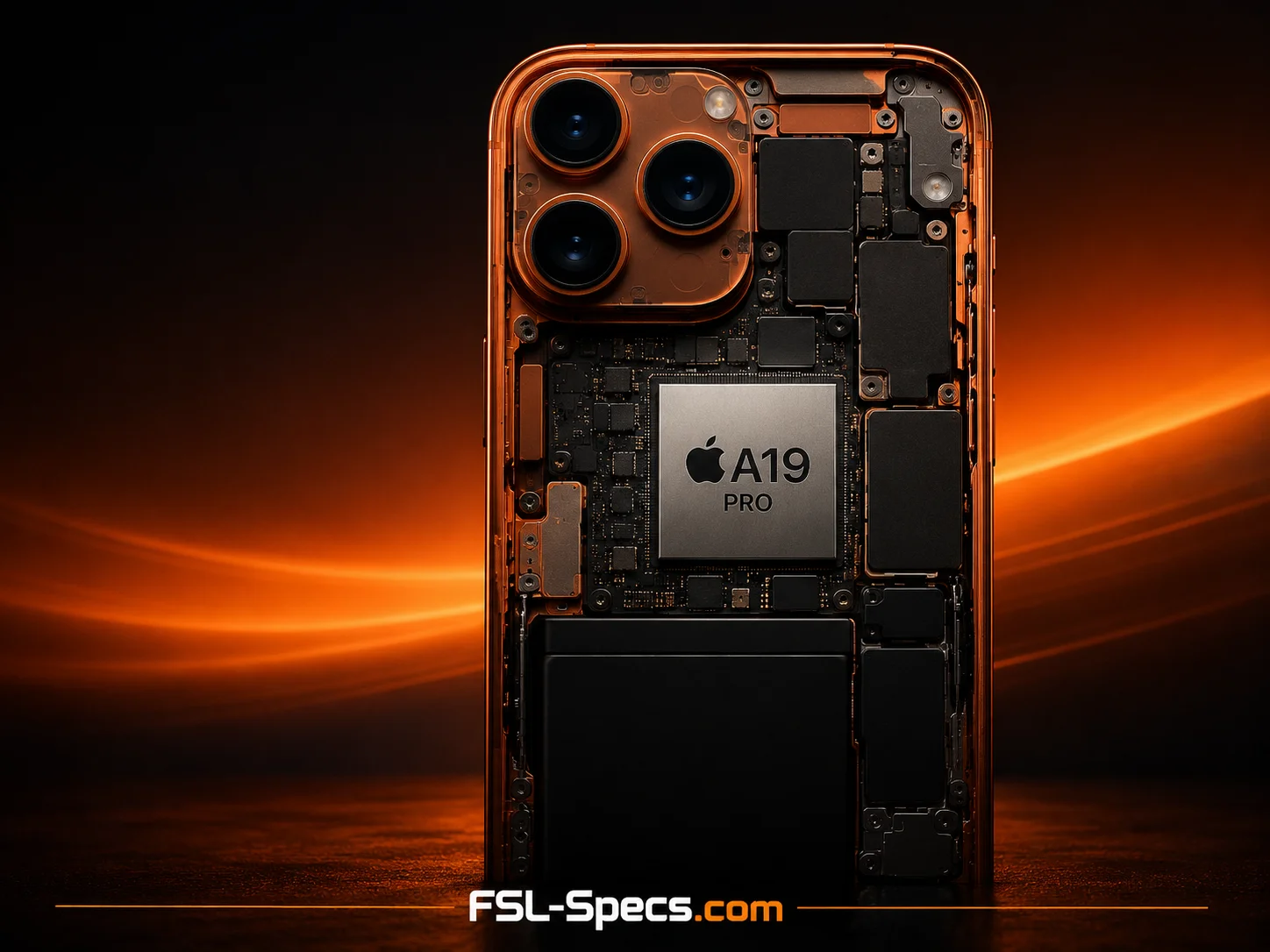
The Apple A19 Pro is Apple's flagship chipset built on a 3nm process, using 2× Everest performance cores up to 4.26GHz and 4× Sawtooth efficiency cores up to 2.6GHz, paired with the all-new 6-core Apple A19 Pro GPU. With LPDDR5X memory, NVMe storage, the Apple Neural Engine for on-device AI, a paired Snapdragon X80 5G modem, Wi‑Fi 7, and Bluetooth 6.0, it's built for top-tier flagship performance.
Benchmark Scores
Measures CPU, GPU, RAM, and I/O performance in different scenarios.
Shows raw single-threaded CPU performance across real-world workloads. Overall single-core score not confirmed in source data — sub-metrics below are verified.
Cross-platform benchmark assessing graphics performance in Vulkan/Metal.
CPU & AI Performance
4× Sawtooth (Efficiency) up to 2.6GHz
Graphics, Memory & Storage
Multimedia (Camera, Display & ISP)
Connectivity
General Info
information About Apple A19 Pro
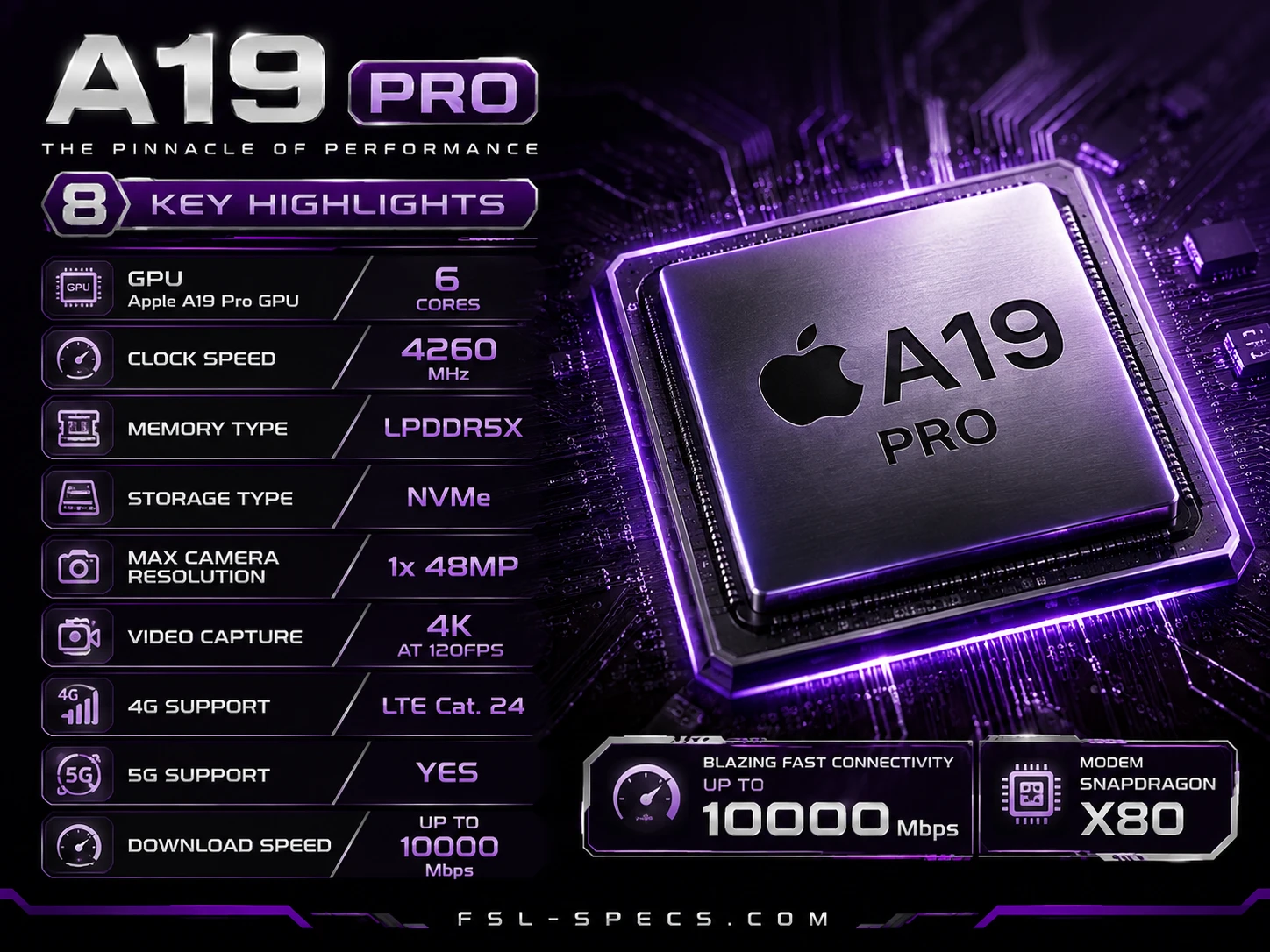
The Apple A19 Pro is the primary processor in this comparison, positioned above Apple’s standard A19 and competing directly with Qualcomm’s Snapdragon 8 Elite, also widely referred to as Snapdragon 8 Gen 4. This is an unusual three-way matchup because Apple and Qualcomm take very different approaches to mobile chip design. A19 Pro focuses heavily on custom CPU performance, GPU acceleration, efficiency, and tight hardware-software integration, while Snapdragon 8 Elite uses Qualcomm’s custom Oryon CPU, Adreno GPU and Hexagon NPU in a highly configurable Android platform. Apple’s A19 sits below the Pro version but retains the same six-core CPU structure, making it an important benchmark for how much extra performance the Pro silicon actually provides.
CPU Architecture & Processing Power
The A19 Pro uses a 6-core CPU with 2 performance cores and 4 efficiency cores, while the standard A19 uses the same 2+4 CPU arrangement. The major difference is that the Pro chip uses a more capable CPU implementation and additional cache resources. Apple’s A19 Pro is designed to deliver the highest CPU performance Apple has put into an iPhone, and independent Geekbench testing reported around 3,895 single-core and 9,746 multi-core points in Geekbench 6.5. The standard A19 also performs strongly, but testing places it below the Pro model, with roughly 8% lower single-core and 10.6% lower multi-core performance in one comparison.
The Snapdragon 8 Elite takes a completely different approach with 8 custom Oryon CPU cores, consisting of 2 prime cores and 6 performance cores. Qualcomm built the chip on a 3nm process and introduced its second-generation custom Oryon architecture for flagship smartphones. Its prime cores can reach up to approximately 4.32GHz, giving Qualcomm substantial raw CPU headroom.
In single-core workloads, A19 Pro has a measurable advantage in available Geekbench testing, while Snapdragon 8 Elite closes the gap significantly in multi-core workloads because of its additional CPU cores. One comparison recorded 3,895 vs 3,033 single-core for A19 Pro and Snapdragon 8 Elite respectively, while multi-core was 9,746 vs 9,271. That means A19 Pro’s advantage is much larger in single-threaded work than in multi-core workloads.
CPU winner: A19 Pro, especially for single-core performance. Snapdragon 8 Elite remains extremely competitive for multi-core workloads.
GPU & Gaming Performance
The graphics battle is more complicated. A19 Pro features a 6-core GPU with Neural Accelerators built into each GPU core, plus hardware-accelerated ray tracing. Apple specifically expanded the GPU architecture over the A19 and paired the Pro chip with a vapor-chamber cooling system in the iPhone 17 Pro models. Apple says this combination can deliver up to 40% better sustained performance than the previous generation.
The standard A19 has a 5-core GPU, also with Neural Accelerators and hardware-accelerated ray tracing. That single additional GPU core in A19 Pro is important because graphics workloads can use parallel processing heavily. The difference therefore matters more in demanding games, 3D rendering and GPU-accelerated creative applications than in ordinary scrolling or social media use.
Snapdragon 8 Elite uses Qualcomm’s Adreno GPU, which represents one of the biggest architectural changes in Qualcomm’s flagship platform. Qualcomm claims major GPU improvements over its previous generation and supports advanced gaming and hardware acceleration features. Independent comparisons generally show Snapdragon 8 Elite remaining extremely competitive or ahead in several graphics workloads, although results vary by benchmark and device cooling.
This makes the GPU verdict less straightforward than the CPU verdict. A19 Pro has an excellent GPU and benefits from Apple’s Metal ecosystem and tight hardware-software optimization. Snapdragon 8 Elite, however, has a very strong Adreno platform designed specifically for Android gaming, including Vulkan-based workloads.
GPU winner: Snapdragon 8 Elite for broad raw graphics capability, while A19 Pro remains the stronger integrated gaming platform on iOS.
Manufacturing Process & Efficiency
Both A19 Pro and A19 are built using Apple’s latest-generation 3nm technology, while Snapdragon 8 Elite also uses a 3nm process. The important point is that the process node alone does not determine efficiency or performance. Architecture, cache, clock speed, power management and software optimization all influence the final result. Qualcomm’s Snapdragon 8 Elite uses TSMC’s 3nm technology, while Apple describes A19 as being built on third-generation 3nm technology.
A19 Pro’s efficiency advantage is particularly important because Apple controls both the chip and iOS. That allows Apple to tightly coordinate processor scheduling, software frameworks and power management. The Snapdragon platform must serve a much broader Android ecosystem with different manufacturers, cooling systems and software implementations.
Efficiency winner: A19 Pro, particularly when considering the complete Apple hardware-software platform rather than the silicon node alone.
Memory, Cache & Storage
A19 Pro has a more substantial memory and cache configuration than the standard A19, supporting the Pro models’ heavier workloads. Apple’s unified-memory architecture also differs fundamentally from the Android approach. The processor, GPU and other components can work within a shared memory architecture rather than relying on the conventional discrete CPU/GPU memory model used in many Android SoCs.
Snapdragon 8 Elite supports high-speed LPDDR5X memory and modern UFS storage technologies in devices using the platform. Its large cache structure is another major part of its performance strategy, reducing the need to repeatedly access slower system memory.
The practical difference is most visible in demanding workloads such as video editing, gaming and large applications. For everyday social media and browsing, the three processors are already far beyond what most users require.
Memory/cache winner: A19 Pro for tightly integrated Apple workloads, while Snapdragon 8 Elite offers greater flexibility for high-end Android configurations.
AI & NPU Capabilities
A19 Pro combines its GPU Neural Accelerators with a 16-core Neural Engine, creating a dedicated hardware path for Apple’s on-device AI workloads. Apple specifically highlights local AI models, generative AI, image processing and other Apple Intelligence features.
A19 also includes a 16-core Neural Engine and Neural Accelerators in its 5-core GPU, so the standard chip is not dramatically stripped down in AI capability. The biggest difference is overall performance headroom rather than the absence of AI hardware.
Snapdragon 8 Elite uses Qualcomm’s Hexagon NPU, designed for on-device generative AI and multimodal workloads. Qualcomm specifically positioned the platform around private, on-device AI processing. Its broader Android ecosystem also gives manufacturers freedom to integrate AI features into cameras, assistants, image editing and other applications.
AI winner: A19 Pro for Apple’s tightly integrated AI ecosystem; Snapdragon 8 Elite is the stronger flexible Android AI platform.
ISP, Camera & Video Capabilities
A19 Pro’s processor is deeply integrated with Apple’s computational photography pipeline. Apple’s iPhone 17 Pro combines A19 Pro with a sophisticated camera system, Photonic Engine, Deep Fusion, Smart HDR and advanced video processing. This demonstrates an important distinction: the processor’s ISP capability matters, but final camera performance also depends heavily on the sensors, lenses and software.
The A19 also receives an updated display engine, ISP and Neural Engine, supporting Apple’s latest photographic processing and video features.
Snapdragon 8 Elite supports advanced camera and video pipelines and is designed for flagship Android camera systems. Qualcomm’s ISP and AI processing can be combined by manufacturers with different sensor configurations, allowing considerably more hardware variety than Apple’s controlled ecosystem.
Camera-processing winner: A19 Pro, mainly because Apple’s processor, camera hardware and software are developed as one tightly controlled system.
Display & Connectivity
A19 and A19 Pro support advanced display processing, with the iPhone 17 and iPhone 17 Pro offering 120Hz ProMotion displays. The A19 also supports Apple’s latest display engine and hardware-accelerated graphics.
For connectivity, Apple introduced its N1 wireless networking chip with the iPhone 17 generation, supporting Wi-Fi 7, Bluetooth 6 and Thread. This means connectivity is not handled entirely by the application processor itself.
Snapdragon 8 Elite integrates a flagship Qualcomm connectivity platform, including Qualcomm’s X80 5G modem-RF system and advanced wireless capabilities. Its major advantage is that Android manufacturers can pair the processor with different modem and antenna implementations depending on the device.
Connectivity winner: Snapdragon 8 Elite for platform flexibility, while Apple offers an extremely optimized integrated wireless solution.
Benchmark Comparison
Benchmarks need careful interpretation because iOS and Android versions, thermal systems and test environments can produce different results. Still, Geekbench provides a useful CPU comparison. One A19 Pro test recorded 3,895 single-core and 9,746 multi-core, compared with 3,033 single-core and 9,271 multi-core for Snapdragon 8 Elite. That represents roughly a 28% single-core advantage and a much smaller multi-core advantage for A19 Pro.
AnTuTu comparisons are much harder to interpret directly across iOS and Android, so they should not be treated as a universal ranking. NanoReview itself warns that AnTuTu results from iOS and Android are not directly comparable.
The A19 Pro also clearly separates itself from the standard A19. Independent Geekbench testing has placed A19 Pro approximately 8% ahead in single-core and 10.6% ahead in multi-core.
Benchmark winner: A19 Pro for CPU-focused testing, but Snapdragon 8 Elite remains highly competitive in overall Android performance and graphics.
Real-World Performance
For normal daily use, all three processors are excessive for basic tasks. The more meaningful differences appear in demanding workloads.
The A19 Pro is the strongest choice for users who want high single-core speed, optimized video editing, demanding iOS games, computational photography and long-term performance within Apple’s ecosystem. The Pro model’s additional GPU resources and vapor chamber are particularly important for sustained workloads.
The A19 delivers most of the same fundamental architecture at a lower performance tier. Its six-core CPU and five-core GPU make it an excellent flagship processor, but A19 Pro is the obvious choice when sustained graphics and heavy workloads matter.
The Snapdragon 8 Elite is the strongest alternative for Android users. Its eight-core Oryon CPU and Adreno GPU provide enormous performance headroom, while Qualcomm’s platform offers broad compatibility with high-end Android gaming, AI and connectivity features.
Strengths & Weaknesses
A19 Pro: Best single-core performance, excellent efficiency, powerful GPU, strong AI integration and outstanding software optimization. Its main limitation is that it exists within Apple’s closed hardware and software ecosystem.
A19: Excellent performance and efficiency with much of Apple’s latest architecture, but its five-core GPU places it below A19 Pro for demanding graphics workloads.
Snapdragon 8 Elite: Excellent multi-core performance, powerful Adreno graphics, flexible Android integration and strong AI/connectivity capabilities. Its real-world results can vary more between phones because manufacturers use different cooling systems and software.
Final Verdict & Ranking
1. Apple A19 Pro — Best Overall
A19 Pro wins this comparison because it combines class-leading CPU performance, a stronger six-core GPU, advanced AI acceleration, excellent efficiency and tight hardware-software optimization. Its advantage is especially clear in single-core CPU performance and sustained workloads on the iPhone 17 Pro platform.
2. Snapdragon 8 Elite — Best Android Flagship Processor
Snapdragon 8 Elite is the closest competitor. Its eight-core Oryon CPU, powerful Adreno GPU and Hexagon NPU make it an exceptional Android platform, particularly for users who prioritize gaming, multi-core workloads and hardware flexibility.
3. Apple A19 — Best Standard Flagship Option
A19 is still extremely powerful and retains the same six-core CPU structure and 16-core Neural Engine, but its five-core GPU and lower overall performance put it behind A19 Pro.
Best for CPU: A19 Pro
Best for Android Gaming: Snapdragon 8 Elite
Best for Efficiency: A19 Pro
Best for AI Integration: A19 Pro
Best Balanced Android Choice: Snapdragon 8 Elite
Best Standard Apple Chip: A19
Bottom Line: The Apple A19 Pro is the strongest overall processor in this three-way comparison, especially for CPU performance, efficiency, sustained workloads and tightly integrated AI and graphics. The Snapdragon 8 Elite is the closest rival and remains the better choice for users who want a powerful Android platform with broad hardware flexibility and excellent gaming performance. The A19 is not weak by any measure, but its smaller GPU configuration makes the A19 Pro the more compelling choice for demanding users. This comparison follows the FSL-Specs principle of prioritizing processor-specific analysis over simple specification repetition.
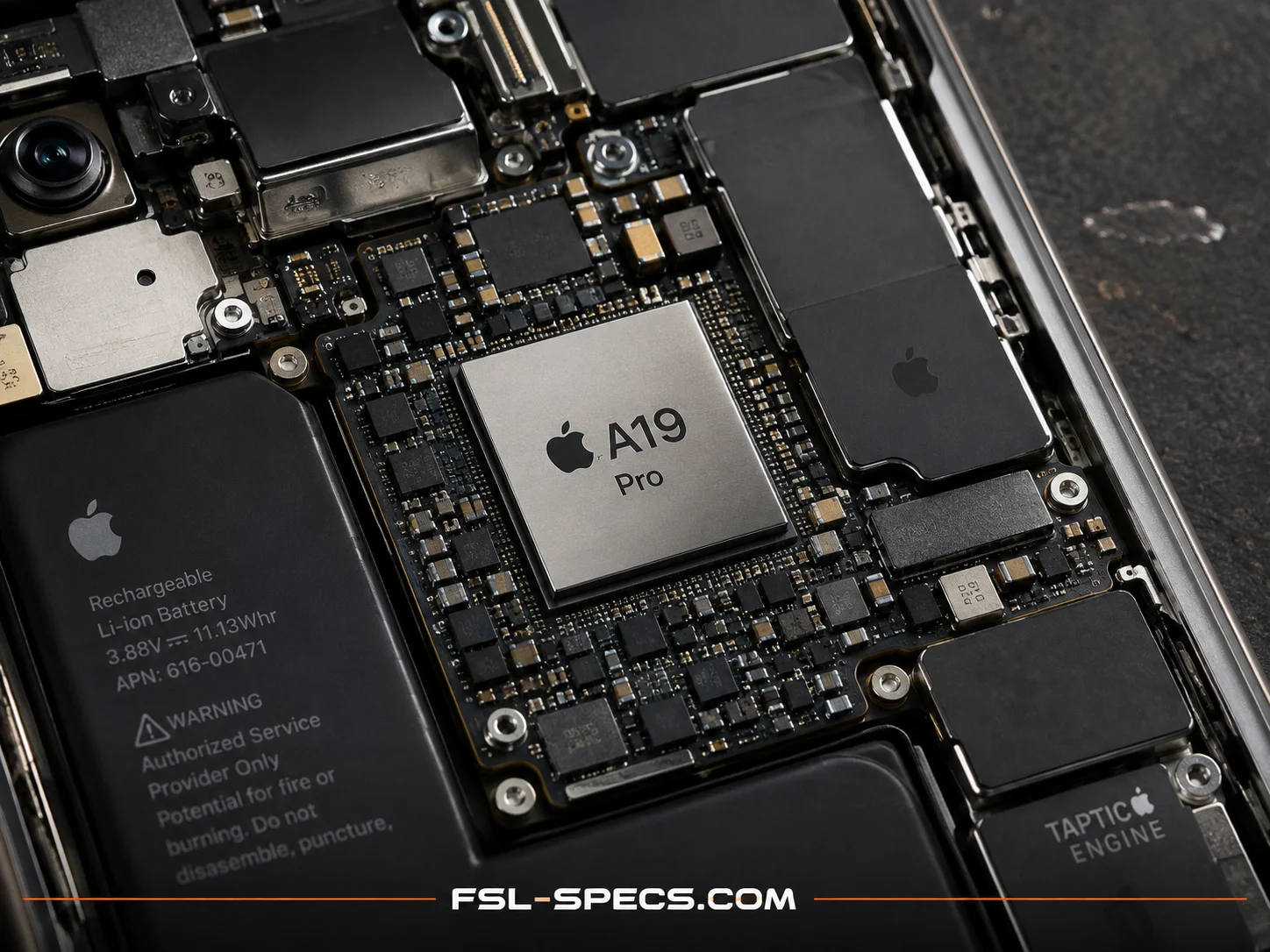
Images Of Apple A19 Pro
Trailer Of Apple A19 Pro

Author & Post Info

Faisal Ur Rehman
Faisal Rehman is the founder and editor of FSL Specs, where he publishes in-depth smartphone specifications, comparisons, buying guides, and technology insights. With extensive experience in mobile hardware research and technical analysis, he provides accurate and up-to-date information on Android smartphones, processors, displays, cameras, batteries, performance benchmarks, and software features. His goal is to simplify complex specifications and help readers choose the right device with confidence.
Explore FSL Specs
Questions About Apple A19 Pro
Is the Apple A19 Pro good for gaming?
Yes, the Apple A19 Pro GPU (6-core, 1620MHz) delivers around 2,488.3 GFLOPS of graphics power, more than enough for smooth mobile gaming. It also posted a 3DMark Steel Nomad Light score of 2,487, showing solid real-world graphics performance.
What is the AnTuTu score of the Apple A19 Pro?
t scores 2,568,709 points on AnTuTu v11, with the CPU alone contributing over 1 million points. That's a strong showing, with the GPU adding another 645,582 points to the total.
Does the Apple A19 Pro support high refresh rate displays?
While refresh rate ultimately comes down to the iPhone model itself, the GPU running at 1620MHz is more than capable of driving high refresh panels smoothly. Scrolling, animations, and gaming all stay fluid as a result.
What RAM does the Apple A19 Pro support?
It supports LPDDR5X memory running at 4,800 MHz, with configurations going up to 12GB. That gives it 75.8 Gb/s of bandwidth, plenty for smooth everyday multitasking.
Can the Apple A19 Pro support a 200 MP camera?
Not quite, its ISP is built to support up to a 48MP single camera sensor rather than anything higher-resolution. It still handles 4K video capture and playback at 120fps, so footage stays sharp and smooth.
Is the Apple A19 Pro power efficient?
Yes, built on a 3nm TSMC process with ARMv9.4-A architecture, it's designed to balance strong performance with battery-friendly efficiency. The 4x Sawtooth efficiency cores at 2.6GHz handle lighter tasks without draining the battery unnecessarily.
Is the Apple A19 Pro a flagship processor?
Yes, it's officially classed as a flagship chip, announced in September 2025 under model number T8150. It powers Apple's premium iPhone lineup and goes head-to-head with the best Android flagship chips.
Which GPU powers the Apple A19 Pro?
It's powered by the in-house Apple A19 Pro GPU, a 6-core design clocked at 1620MHz with 768 total shaders across 6 pipelines. It delivers around 2,488.3 GFLOPS of graphics performance, tuned specifically for Apple's own hardware and software.