
Xring O1
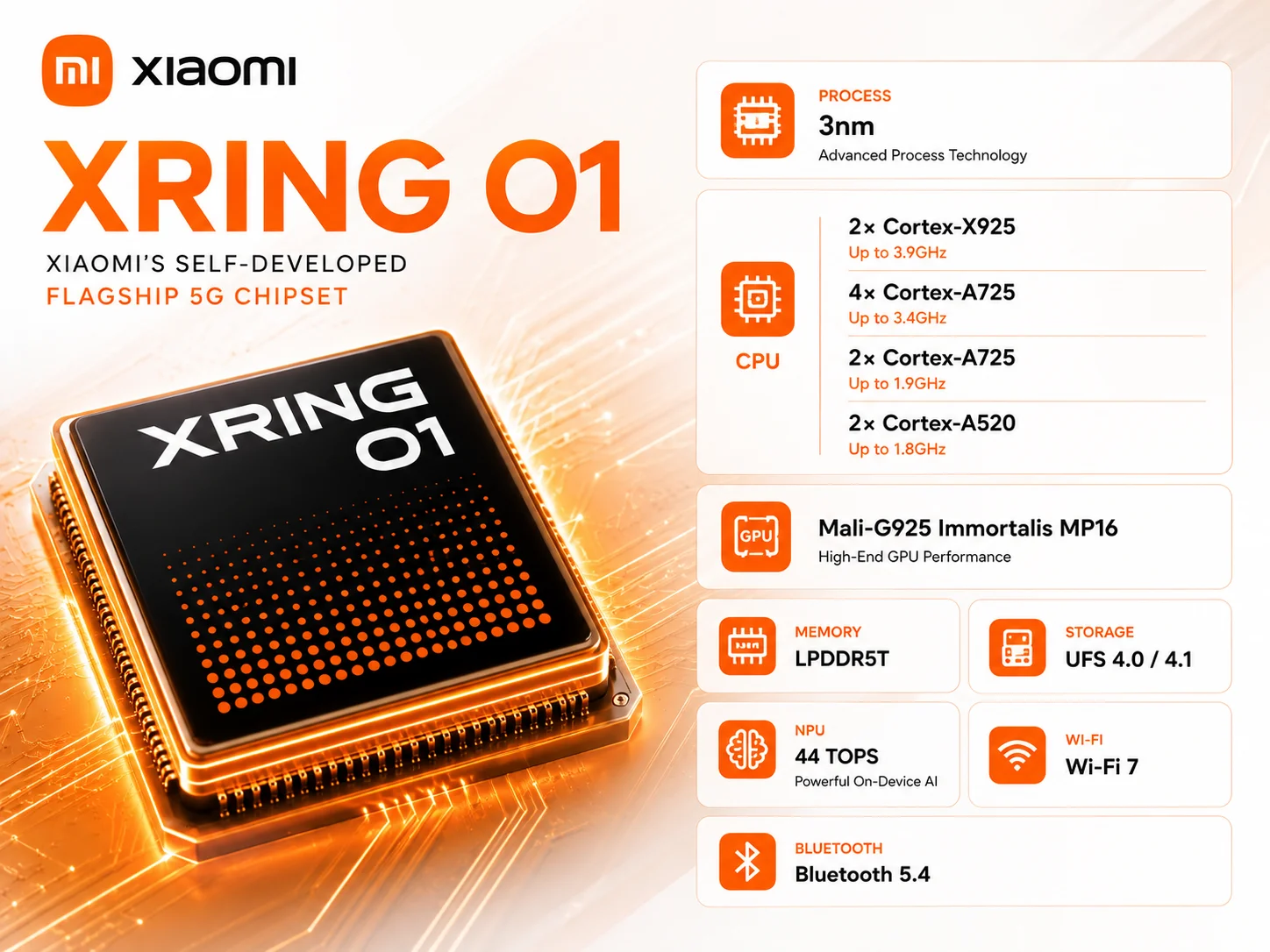
The Xiaomi Xring O1 is Xiaomi's self‑developed flagship 5G chipset built on a 3nm process, using 2× Cortex‑X925 up to 3.9GHz, 4× Cortex‑A725 up to 3.4GHz, 2× Cortex‑A725 up to 1.9GHz, and 2× Cortex‑A520 up to 1.8GHz, paired with a Mali‑G925 Immortalis MP16 GPU. With LPDDR5T memory, UFS 4.0/4.1 storage, an NPU delivering 44 TOPS for on-device AI, Wi‑Fi 7, and Bluetooth 5.4, it's built for top‑tier flagship performance.
Benchmark Scores
Measures CPU, GPU, RAM, and I/O performance in different scenarios.
Shows raw single-threaded CPU performance across real-world workloads.
Cross-platform benchmark assessing graphics performance in Vulkan/Metal.
Evaluates overall system performance in everyday workloads.
CPU & AI Performance
4× Cortex‑A725 up to 3.4GHz
2× Cortex‑A725 up to 1.9GHz
2× Cortex‑A520 up to 1.8GHz
Graphics, Memory & Storage
Multimedia (Camera, Display & ISP)
Connectivity
General Info
information About Xiaomi Xring O1
The Xiaomi Xring O1 vs Apple A18 vs Apple A18 Pro comparison is particularly interesting because these three chipsets represent two different approaches to flagship mobile processor design. Xiaomi’s Xring O1 is a 2025 flagship chipset built around a 10-core CPU and Mali-G925 Immortalis MP16 GPU, while Apple’s A18 and A18 Pro use six-core CPU designs optimized around Apple’s own silicon architecture.
According to NanoReview, the Xring O1 reaches an AnTuTu 11 score of 2,998,904, substantially above the A18 at 1,822,701 and the A18 Pro at 1,915,175. However, benchmark numbers should not be interpreted as a universal measure of real-world speed, especially when Android and iOS platforms are involved. NanoReview itself warns that AnTuTu results from Android and iOS are not directly comparable.
That makes this comparison more useful when we look beyond one benchmark. CPU design, GPU configuration, memory bandwidth, AI hardware, manufacturing technology and connectivity reveal where each processor has an advantage.
1. Processor Overview
The Xiaomi Xring O1 was announced in May 2025 and is manufactured on a 3nm TSMC process. NanoReview lists a 10-core configuration consisting of two Cortex-X925 cores at up to 3.9GHz, four Cortex-A725 cores at 3.4GHz, two additional Cortex-A725 cores at 1.9GHz, and two Cortex-A520 efficiency cores at 1.8GHz. Its GPU is the Mali-G925 Immortalis MP16.
The Apple A18 arrived in September 2024 and is also manufactured by TSMC using a 3nm process. It has six CPU cores: two Everest cores reaching 4.05GHz and four Sawtooth cores reaching 2.42GHz.
The A18 Pro uses the same broad CPU configuration, with two Everest cores at 4.05GHz and four Sawtooth cores at 2.42GHz, but pairs it with a more capable GPU configuration. NanoReview gives the A18 Pro a NanoReview Score of 84, compared with 81 for A18 and 86 for Xring O1.
91Mobiles also identifies the A18 and A18 Pro as 3nm chipsets, with the A18 categorized as a sub-flagship chipset and the A18 Pro as a flagship chipset. For Xring O1, 91Mobiles currently lists the processor in Xiaomi devices such as the Xiaomi Pad 7 Ultra and Xiaomi Pad 7S Pro, reporting processor frequencies of 3.7GHz and 3.4GHz respectively.
2. CPU Architecture & Processing Power
The CPU comparison is more complicated than simply looking at maximum clock speed.
Apple A18 has the highest advertised peak CPU frequency at 4.05GHz, compared with 3.9GHz for the Xring O1. The A18 Pro has the same 4.05GHz peak. Yet the Xring O1 contains 10 CPU cores, while both Apple processors have six.
This creates an important distinction. The A18’s design prioritizes a smaller number of high-performance cores, while Xring O1 distributes workloads across a larger CPU configuration. Its two Cortex-X925 cores provide the high-performance layer, followed by four high-speed Cortex-A725 cores, two lower-clocked A725 cores and two A520 efficiency cores.
NanoReview’s Geekbench 6 results show this difference clearly. Xring O1 records 2,746 single-core and 8,431 multi-core, while A18 reaches 3,291 single-core and 8,136 multi-core. A18 therefore has a substantial single-core lead in NanoReview’s results, while Xring O1 edges ahead in multi-core performance.
The A18 Pro moves further ahead in Geekbench 6, reaching 3,518 single-core and 8,950 multi-core. That makes A18 Pro the strongest of the three in NanoReview’s CPU benchmark data, particularly for workloads that benefit from strong individual-core performance.
The practical interpretation is important: Xring O1’s larger core count does not automatically make it faster everywhere. For highly parallel workloads, its configuration is highly competitive. For lightly threaded tasks, Apple’s high-performance cores demonstrate stronger benchmark results.
3. GPU & Gaming Performance
The GPU battle produces a different result.
Xring O1 uses the Mali-G925 Immortalis MP16, with 16 pipelines, 128 shading units and a listed GPU frequency of 1.392GHz. NanoReview reports approximately 5,701.6 GFLOPS for the GPU.
Apple A18 uses the Apple A18 GPU, listed at 1.49GHz, with five pipelines, 128 shading units and approximately 1,907 GFLOPS in NanoReview’s specifications. The A18 Pro uses a larger six-pipeline GPU configuration with 128 shading units and approximately 2,289 GFLOPS.
Benchmark results favor Xring O1 in the cross-platform 3DMark tests available from NanoReview. In Steel Nomad Light, Xring O1 scores 2,413, compared with 1,732 for A18 Pro and 1,579 for A18. In Solar Bay, Xring O1 records 9,022, versus 7,585 for A18 Pro and 6,750 for A18.
The result is impressive for Xiaomi’s first-generation flagship silicon. However, these figures should not be converted directly into expected game FPS. Game engines, operating-system optimization, thermal design and individual phone implementation all influence gaming performance.
Based strictly on the supplied benchmark evidence, Xring O1 has the strongest graphics benchmark position among these three.
4. Manufacturing Process & Efficiency
All three processors use a 3nm manufacturing process, so there is no simple process-node advantage here. Xring O1, A18 and A18 Pro are all listed as TSMC-manufactured 3nm chips.
NanoReview gives Xring O1 a battery-life score of 92, A18 a score of 96, and A18 Pro a score of 97. These are platform-level assessments rather than guarantees of battery endurance in every phone.
This is one area where Apple’s designs retain a meaningful advantage in the NanoReview scoring system. The Xring O1’s performance is exceptionally high, but its benchmark leadership does not automatically translate into the best energy efficiency.
The more interesting conclusion is that Xiaomi has reached extremely high performance without needing a newer process node than Apple. The contest therefore depends heavily on architecture and implementation rather than fabrication alone.
5. Memory & Storage Support
Memory bandwidth is one of Xring O1’s clearest technical advantages.
NanoReview lists Xring O1 with LPDDR5T, a 4×16-bit bus and maximum bandwidth of 76.8GB/s, with support for up to 24GB of memory. It also supports UFS 4.0 and UFS 4.1 storage.
The A18 uses LPDDR5X memory with a 4×16-bit bus and maximum bandwidth of 60GB/s, with a listed maximum memory size of 8GB. A18 Pro also uses LPDDR5X and 60GB/s bandwidth.
NanoReview calculates that Xring O1 provides approximately 28% more memory bandwidth than A18 Pro. That matters for workloads moving large quantities of data between memory and processing units, particularly demanding multitasking, graphics and some compute-heavy applications.
This is not proof that every Xring O1 phone will feel 28% faster. Memory bandwidth is only one component of total system performance. Still, on specification grounds, Xring O1 has the more expansive memory platform.
6. AI & NPU Capabilities
All three processors include dedicated neural processing hardware.
NanoReview lists the Xring O1 with an NPU offering 44 TOPS of theoretical performance. Apple A18 is listed with a Neural Engine rated at 35 TOPS.
This gives Xring O1 the higher published theoretical AI throughput in the supplied data.
However, TOPS should not be treated as a universal AI-performance score. Different architectures, software frameworks and AI models can produce very different results even when two processors have similar theoretical throughput.
For on-device AI, the Xring O1 therefore has a strong hardware specification advantage, while Apple’s Neural Engine remains an important part of the A18 platform. Without identical AI benchmark testing across the same operating environment, it would be inappropriate to declare a definitive real-world AI winner solely from TOPS.
7. ISP, Camera & Video Capabilities
The multimedia specifications show another clear difference.
Xring O1 supports video capture and playback up to 8K at 30fps and 4K at 120fps, according to NanoReview. It supports H.264, H.265, AV1 and VP9 video codecs.
A18 and A18 Pro are listed with maximum video capture and playback of 4K at 120fps. Both support major formats including H.264, H.265, AV1 and VP9.
NanoReview lists maximum camera resolution at 48MP for both A18 and A18 Pro, while Xring O1’s supplied specification page does not provide an equivalent maximum camera-sensor figure.
The important distinction is that processor capability does not guarantee identical camera results. Sensor quality, lenses, stabilization and manufacturer image-processing software remain critical.
For creators who specifically care about processor-level video capability, Xring O1 has the more ambitious specification because of its 8K/30fps support.
8. Display Support
The supplied NanoReview processor pages do not provide enough directly comparable maximum display-resolution and refresh-rate information for all three chips to make a reliable winner.
That limitation is worth stating rather than filling the gap with assumptions. Processor display capability is also different from the display installed in a smartphone or tablet.
91Mobiles’ current device listings demonstrate that Xring O1 is being used in high-end Xiaomi tablets, including the Xiaomi Pad 7 Ultra with a 120Hz OLED display and the Xiaomi Pad 7S Pro with a 144Hz IPS LCD display. These are device specifications rather than proof of the processor’s universal maximum display capability.
9. 5G, Modem & Connectivity
Xring O1 integrates a MediaTek T800 modem, with NanoReview listing 5G support, up to 7.9Gbps download and 4.2Gbps upload, alongside Wi-Fi 7 and Bluetooth 5.4.
A18 and A18 Pro are listed with the Snapdragon X71 5G modem, supporting up to 10Gbps download and 3.5Gbps upload, Wi-Fi 7 and Bluetooth 5.3.
This produces a split result. Xring O1 has the higher listed peak upload speed and newer Bluetooth version, while Apple’s chips have the higher theoretical peak download figure.
In actual use, network coverage, carrier configuration, supported bands, signal conditions and device antennas will matter far more than theoretical peak numbers.
10. Benchmark Comparison
NanoReview’s AnTuTu 11 results put Xring O1 clearly ahead:
| Processor | AnTuTu 11 |
|---|---|
| Xiaomi Xring O1 | 2,998,904 |
| Apple A18 Pro | 1,915,175 |
| Apple A18 | 1,822,701 |
Xring O1 is approximately 56.6% higher than A18 Pro and 64.5% higher than A18 using these NanoReview figures.
However, 91Mobiles reports different AnTuTu results for the Apple chips: 1,774,620 for A18 and 1,774,620 for A18 Pro on their respective processor pages. Their A18 Pro-versus-A18 comparison gives A18 Pro a slightly higher result of 1,774,620 versus 1,764,170.
This difference illustrates why benchmark sources should not be mixed into one artificial ranking. Testing methodology and device configurations can change results.
Geekbench also provides a more nuanced picture. A18 has the strongest NanoReview single-core result among the three at 3,291, followed by A18 Pro at 3,518 and Xring O1 at 2,746. Actually, A18 Pro is the clear single-core leader, while Xring O1 leads A18 Pro in multi-core only in the broader NanoReview comparison? The supplied figures show A18 Pro at 8,950, Xring O1 at 8,431, and A18 at 8,136, so A18 Pro leads multi-core as well.
That is a crucial finding: Xring O1 dominates the AnTuTu and 3DMark results, but A18 Pro leads the Geekbench CPU tests.
11. Real-World Performance
For everyday performance, all three are high-end processors, but their strengths are different.
Xring O1 is particularly interesting for users who prioritize high overall system throughput, graphics performance and memory bandwidth. Its 10-core CPU, 76.8GB/s memory bandwidth, 44 TOPS NPU and strong 3DMark results create a broad hardware platform.
Apple A18 focuses more strongly on efficient high-performance CPU execution. Its 4.05GHz peak CPU frequency and strong Geekbench single-core result make it particularly competitive for workloads where individual-core performance matters.
Apple A18 Pro is the most balanced Apple option in this comparison. It improves on A18 in NanoReview’s CPU, gaming and overall scores, while maintaining the same 3nm manufacturing process and 60GB/s memory bandwidth.
For gaming, the available 3DMark evidence gives Xring O1 the strongest position. Its Steel Nomad Light score is about 39% higher than A18 Pro, while Solar Bay is approximately 19% higher.
For CPU-focused workloads, A18 Pro is more impressive than its AnTuTu score alone suggests. Its Geekbench 6 scores of 3,518/8,950 exceed both Xring O1 and A18 in the supplied NanoReview data.
For efficiency, NanoReview’s scoring favors A18 Pro, followed by A18 and then Xring O1.
12. Strengths & Weaknesses
Xiaomi Xring O1
Strengths
- 10-core CPU design
- Strong AnTuTu 11 result
- Strong 3DMark graphics scores
- 76.8GB/s memory bandwidth
- 44 TOPS NPU
- 8K video support
- Wi-Fi 7 and Bluetooth 5.4
Weaknesses
- Lower Geekbench CPU scores than A18 Pro
- Lower NanoReview battery-life score than both Apple chips
- Cross-platform benchmark comparisons require caution
- Camera maximum resolution is not disclosed in the supplied NanoReview data
Apple A18
Strengths
- Excellent single-core performance
- 3nm manufacturing
- Strong efficiency score
- 4K/120fps video capability
- Wi-Fi 7
- 35 TOPS Neural Engine
Weaknesses
- Lower AnTuTu score than Xring O1
- Lower 3DMark scores than Xring O1
- 60GB/s memory bandwidth
- Lower overall NanoReview score than A18 Pro
Apple A18 Pro
Strengths
- Best Geekbench CPU scores of the three
- Higher NanoReview overall score than A18
- Strong efficiency rating
- Stronger GPU configuration than A18
- 4K/120fps video support
- Wi-Fi 7
Weaknesses
- Lower AnTuTu result than Xring O1
- Lower 3DMark results than Xring O1
- 60GB/s memory bandwidth
- Lower theoretical NPU throughput than Xring O1
13. Best Processor For Different Users
Best for Overall Benchmark Performance: Xiaomi Xring O1
Best for CPU Performance: Apple A18 Pro
Best for Gaming Benchmark Performance: Xiaomi Xring O1
Best for Efficiency: Apple A18 Pro
Best for Memory Bandwidth: Xiaomi Xring O1
Best for Theoretical AI Throughput: Xiaomi Xring O1
Best for Video Capability: Xiaomi Xring O1, based on its listed 8K/30fps support
Best Balanced Apple Chip: Apple A18 Pro
Final Verdict & Ranking
1. Xiaomi Xring O1 — Best Overall Hardware Performance
The Xiaomi Xring O1 takes the overall first position when the comparison is based on the supplied NanoReview hardware and benchmark data. Its combination of a 10-core CPU, Mali-G925 Immortalis MP16 GPU, 76.8GB/s memory bandwidth, 44 TOPS NPU and very high AnTuTu and 3DMark results gives it the strongest overall performance profile.
Its biggest achievement is not simply the AnTuTu number. Xring O1 also demonstrates strong graphics performance and a more expansive memory subsystem. That makes Xiaomi’s first major flagship silicon effort remarkably competitive against Apple’s established A18 family.
2. Apple A18 Pro — Best CPU & Efficiency Balance
The Apple A18 Pro ranks second overall, but this position should not be interpreted as meaning it is simply slower in every situation.
It actually leads the three processors in NanoReview’s Geekbench 6 CPU results, reaching 3,518 single-core and 8,950 multi-core. It also receives the highest NanoReview battery-life score of 97 and a higher overall NanoReview score than the standard A18.
For users prioritizing CPU responsiveness, efficiency and Apple’s tightly integrated hardware-software environment, A18 Pro remains a highly compelling platform.
3. Apple A18 — Best Efficient Flagship Alternative
The Apple A18 takes third place in this particular three-way hardware comparison. It is still an extremely capable processor, with a 3nm process, 4.05GHz peak CPU frequency, strong Geekbench performance and a NanoReview battery-life score of 96.
Its biggest disadvantage is that A18 Pro improves the same fundamental architecture while delivering higher Geekbench and NanoReview scores.
Bottom Line
The Xiaomi Xring O1 wins this comparison for overall performance, graphics benchmarks, memory bandwidth and theoretical AI throughput. It is the most aggressive hardware design of the three and demonstrates that Xiaomi can compete directly with Apple’s flagship silicon in several measurable areas.
The Apple A18 Pro, however, is the stronger choice when CPU benchmark performance and efficiency are prioritized. Its Geekbench results and NanoReview efficiency score show that Apple’s smaller six-core design can still outperform the larger Xring O1 in important CPU-focused measurements.
The Apple A18 remains highly capable but sits behind both rivals in this specific comparison because A18 Pro offers a stronger version of Apple’s architecture while Xring O1 delivers substantially higher overall benchmark and graphics results.
For FSL-Specs readers, the most accurate conclusion is therefore not simply that one chip destroys the others. Xring O1 is the performance leader, A18 Pro is the CPU-and-efficiency specialist, and A18 is the efficient standard flagship option. The most important caveat is that benchmark numbers from Android and iOS should be interpreted carefully rather than treated as perfectly equivalent measurements.
Images Of Xiaomi Xring O1
Trailer Of Xiaomi Xring O1

Author & Post Info
Faisal Ur Rehman
Faisal Rehman is the founder and editor of FSL Specs, where he publishes in-depth smartphone specifications, comparisons, buying guides, and technology insights. With extensive experience in mobile hardware research and technical analysis, he provides accurate and up-to-date information on Android smartphones, processors, displays, cameras, batteries, performance benchmarks, and software features. His goal is to simplify complex specifications and help readers choose the right device with confidence.
Explore FSL Specs
Questions About Xiaomi Xring O1
What CPU does the Xiaomi Xring O1 use?
The Xring O1 uses a 10-core design with 2 Cortex-X925 prime cores up to 3.9GHz, 4 Cortex-A725 performance cores up to 3.4GHz, 2 more Cortex-A725 cores up to 1.9GHz, and 2 Cortex-A520 efficiency cores up to 1.8GHz. It is built on TSMC's 3nm process with roughly 19 billion transistors. This is Xiaomi's first self-developed flagship chipset.
Which GPU powers the Xiaomi Xring O1?
Graphics are handled by the Mali-G925 Immortalis MP16, built on the Valhall 5th Gen architecture. It runs at 1392MHz with 128 shading units and 2048 total shaders, delivering 5701.6 GFLOPS of compute power. This makes it one of the most powerful mobile GPUs on the market.
What RAM and storage does the Xring O1 support?
It supports LPDDR5T memory at up to 4800MHz across a 4x16-bit bus, giving 76.8GB/s of bandwidth and up to 24GB capacity. Storage is handled by UFS 4.0 or UFS 4.1. This combination delivers flagship-level multitasking and fast app loading.
What is the AnTuTu score of the Xiaomi Xring O1?
The Xring O1 scores around 3.0 million points on AnTuTu 11. The breakdown shows 956.8K for CPU, 1M for GPU, 409.3K for memory, and 626.3K for UX. This places it at the very top of the flagship performance tier.
Does the Xring O1 support 5G and Wi-Fi 7?
Yes, it pairs with the MediaTek T800 modem for 5G, delivering peak download speeds up to 7.9Gbps and upload speeds up to 4.2Gbps. It also includes Wi-Fi 7 and Bluetooth 5.4, plus GNSS support for GPS, GLONASS, BeiDou, Galileo, and QZSS.
Does the Xiaomi Xring O1 have a dedicated NPU?
Yes, it includes a custom AI accelerator rated at 44 TOPS of theoretical performance. This NPU is built in-house by Xiaomi rather than using a standard ARM design, giving it dedicated horsepower for on-device AI tasks.
What video recording capabilities does the Xring O1 support?
It supports video capture and playback at 8K @ 30FPS and 4K @ 120FPS, with support for H.264, H.265, AV1, and VP9 codecs. This gives it high-end video capabilities suited for flagship-level content creation.