
A18
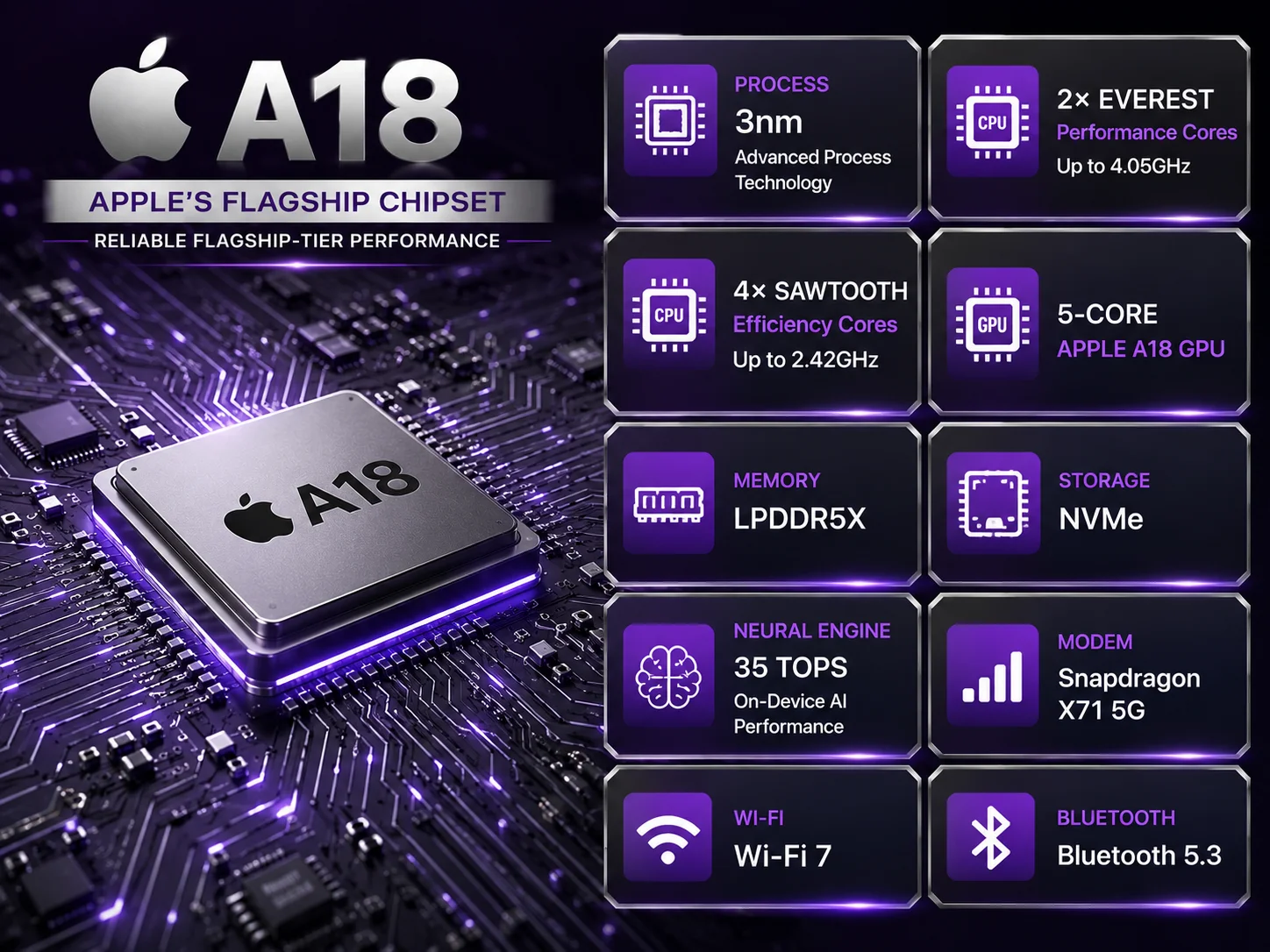
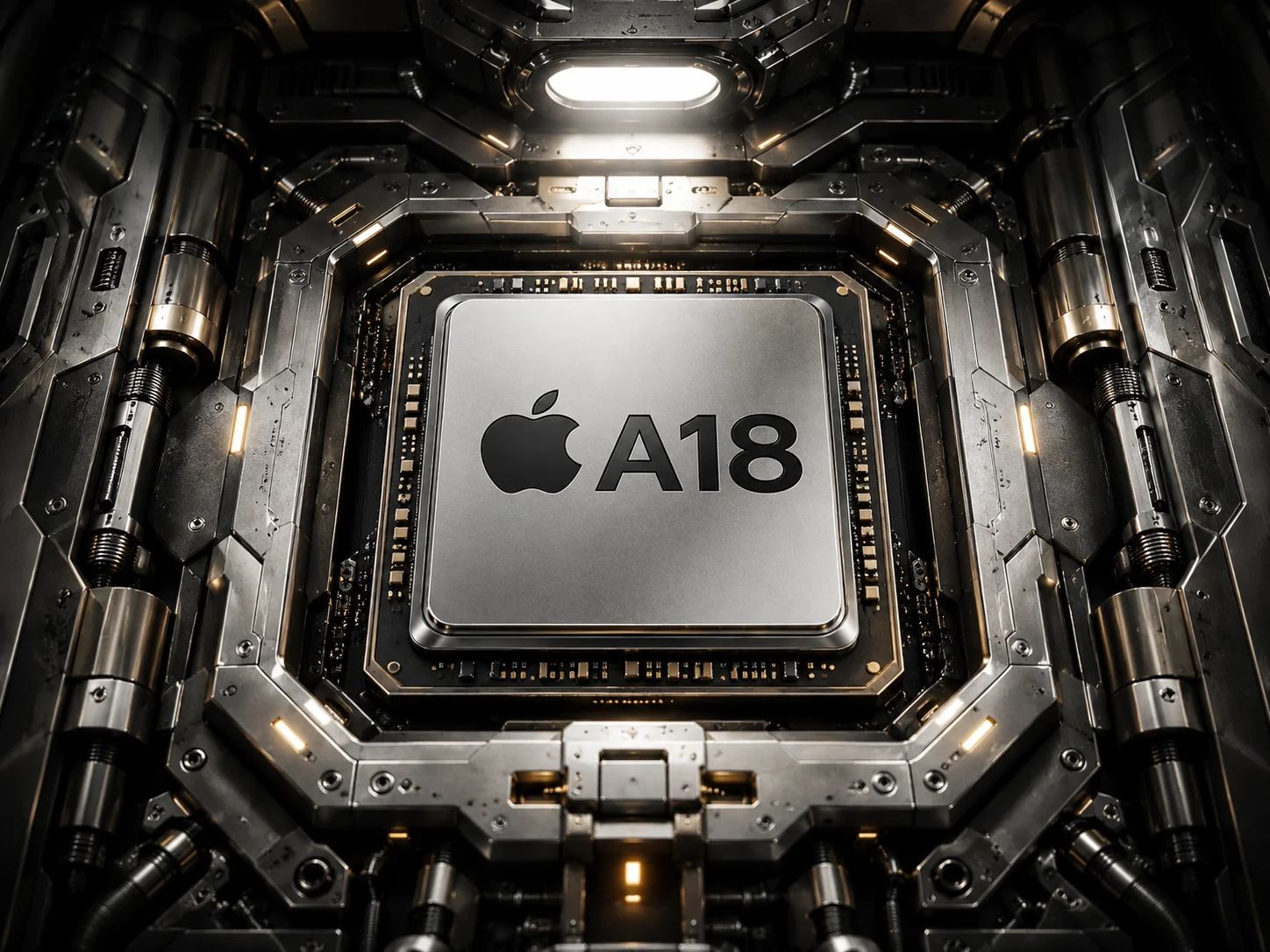
The Apple A18 is Apple's flagship chipset built on a 3nm process, using 2× Everest performance cores up to 4.05GHz and 4× Sawtooth efficiency cores up to 2.42GHz, paired with a 5‑core Apple A18 GPU. With LPDDR5X memory, NVMe storage, Apple's Neural Engine delivering 35 TOPS for on-device AI, a Snapdragon X71 5G modem, Wi‑Fi 7, and Bluetooth 5.3, it delivers reliable flagship‑tier performance.
Benchmark Scores
Measures CPU, GPU, RAM, and I/O performance in different scenarios.
Shows raw single-threaded CPU performance across real-world workloads. Headline score not confirmed in source data.
Cross-platform benchmark assessing graphics performance in Vulkan/Metal.
CPU & AI Performance
4× Sawtooth (Efficiency) up to 2.42GHz
Graphics, Memory & Storage
Multimedia (Camera, Display & ISP)
Connectivity
General Info
information About Apple A18
Introduction
The Apple A18 vs Dimensity 9400e vs Dimensity 9300 Plus comparison is more interesting than the processor names suggest. Apple’s A18 takes a different approach with a six-core CPU and a highly optimized 3nm design, while MediaTek’s Dimensity 9400e and Dimensity 9300 Plus use eight-core configurations built around Cortex-X4 and Cortex-A720 cores.
On paper, the A18 has several advantages that are traditionally associated with premium smartphone processors: a 3nm manufacturing process, 4.05GHz maximum CPU clock, strong Geekbench performance, and a 35 TOPS Neural Engine according to NanoReview. Meanwhile, the Dimensity chips bring substantially higher memory bandwidth, larger maximum RAM support, powerful Immortalis-G720 graphics, and higher AnTuTu scores in the available datasets.
The important point is that no single benchmark tells the whole story. 91mobiles’ testing places both MediaTek processors ahead of the Apple A18 in AnTuTu, while the Apple A18 has a very large advantage in Geekbench single-core and a smaller advantage in Geekbench multi-core. NanoReview similarly shows the A18 leading in single-core performance but the MediaTek processors delivering stronger overall AnTuTu results.
So, which processor is actually better? The answer depends heavily on whether the priority is CPU responsiveness, gaming, memory-heavy workloads, camera/video capability, efficiency, or overall Android-style performance.
1. Processor Overview
The three processors occupy slightly different positions.
The Apple A18 was announced in September 2024 and is manufactured using TSMC’s 3nm process. It features six CPU cores: two Everest performance cores reaching 4.05GHz and four Sawtooth cores reaching 2.42GHz. NanoReview gives it a CPU Performance score of 87, Gaming Performance score of 62, Battery Life score of 96, and an overall NanoReview Score of 81.
The Dimensity 9300 Plus arrived earlier, in May 2024. It uses a 4nm TSMC process and has eight cores: one Cortex-X4 at 3.4GHz, three Cortex-X4 cores at 2.85GHz, and four Cortex-A720 cores at 2GHz. NanoReview rates its CPU Performance at 80, Gaming Performance at 65, Battery Life at 91, and overall score at 78.
The Dimensity 9400e follows the same basic CPU configuration as the 9300 Plus. It also uses a 4nm process, with one Cortex-X4 at 3.4GHz, three Cortex-X4 cores at 2.85GHz, and four Cortex-A720 cores at 2GHz. NanoReview gives it a CPU Performance score of 82, Gaming Performance of 65, Battery Life of 91, and overall score of 79.
This immediately creates an important distinction: the Aple A18 is newer than the 9300 Plus but uses a very different CPU design, while the 9400e is remarkably close to the 9300 Plus in CPU configuration.
2. CPU Architecture & Processing Power
CPU performance is where the Apple A18 makes its strongest case.
The Apple A18’s two Everest performance cores reach 4.05GHz, significantly higher than the 3.4GHz maximum frequency of both MediaTek processors. Its four efficiency-oriented Sawtooth cores operate at 2.42GHz. The Dimensity 9400e and 9300 Plus instead use four Cortex-X4 performance cores at different frequencies and four Cortex-A720 cores.
The difference becomes particularly obvious in Geekbench.
91mobiles records the A18 at 3,278 single-core and 7,995 multi-core, compared with 2,219/7,308 for the Dimensity 9400e and 2,238/7,101 for the Dimensity 9300 Plus.
That gives the A18 a roughly 48% single-core advantage over the 9400e and about 46% over the 9300 Plus using the 91mobiles figures. Its multi-core lead is much smaller: approximately 9% over the 9400e and 13% over the 9300 Plus.
This distinction matters. Single-core performance is especially relevant to workloads that depend heavily on individual CPU threads, including many app-launching and interactive tasks. Multi-core performance becomes more important when workloads can distribute work across multiple CPU cores.
The MediaTek processors compensate with eight cores rather than six. The 9400e therefore remains competitive in multi-core testing despite its lower maximum clock speed.
NanoReview’s Geekbench 6 data tells a similar story, although the exact numbers differ from 91mobiles: the A18 scores 3,291/8,136, the 9400e 2,233/7,478, and the 9300 Plus 2,250/7,315 for single-core and multi-core respectively.
CPU winner: Apple A18.
3. GPU & Gaming Performance
Gaming changes the picture considerably.
The A18 uses the Apple A18 GPU, clocked at 1.49GHz according to 91mobiles. NanoReview lists five pipelines, 128 shading units, 640 total shaders and approximately 1,907 GFLOPS.
Both MediaTek chips use the Mali-G720 Immortalis MP12 at 1.3GHz. NanoReview lists 12 pipelines, 128 shading units, 1,536 total shaders and approximately 3,993.6 GFLOPS.
The raw GPU specifications therefore give the MediaTek chips significantly more theoretical graphics throughput.
NanoReview reflects that difference in its gaming assessment. The Dimensity 9400e and 9300 Plus both receive a 65 Gaming Performance score, compared with 62 for the A18.
The comparison should not be interpreted as a promise that every Android phone using a MediaTek chip will automatically outperform every iPhone using A18. Smartphone cooling, software optimization, game engines, display resolution and power limits all affect actual gaming results.
Nevertheless, the supplied processor-level data gives the Dimensity chips a stronger graphics specification and a clear advantage in theoretical GPU throughput.
Gaming hardware winner: Dimensity 9400e / Dimensity 9300 Plus.
Between the two MediaTek options, the 9400e has the higher NanoReview AnTuTu GPU component, with 816,650 versus 760,965 for the 9300 Plus.
4. Manufacturing Process & Efficiency
Apple’s biggest architectural advantage is the manufacturing node.
The Apple A18 uses 3nm, while both Dimensity 9400e and Dimensity 9300 Plus use 4nm processes. All three are manufactured by TSMC according to the supplied data.
A smaller process node can provide transistor-density and efficiency advantages, but it does not automatically make a processor faster. The complete architecture, clock targets, power limits and software implementation matter.
NanoReview gives the A18 a Battery Life score of 96, compared with 91 for both MediaTek chips.
That makes the Apple A18 the clear efficiency leader according to NanoReview’s overall assessment. However, these scores should be viewed as platform-level indicators rather than a guaranteed battery-life result for every smartphone.
Efficiency winner: Apple A18.
5. Memory & Storage Support
Memory is one of the biggest advantages for the MediaTek processors.
All three support modern LPDDR-family memory, but their maximum bandwidth differs substantially.
NanoReview lists the A18 with LPDDR5X, 3,750MHz memory, a 4×16-bit bus and maximum bandwidth of 60GB/s, with maximum supported memory listed at 8GB.
The Dimensity 9400e supports LPDDR5X at 4,800MHz with maximum bandwidth of 76.8GB/s and up to 24GB memory. The 9300 Plus has similar bandwidth and maximum memory capacity, although NanoReview identifies its memory type as LPDDR5T.
This gives both MediaTek processors a 28% higher maximum memory bandwidth than the A18 based on NanoReview’s figures.
The difference becomes meaningful in memory-heavy workloads, large applications, multitasking and high-end Android configurations. It also allows manufacturers to build phones with much higher RAM capacities.
Storage support is another major distinction. The MediaTek processors support UFS 4.0, while the A18 is listed with NVMe storage.
Memory flexibility winner: Dimensity 9400e / 9300 Plus.
6. AI & NPU Capabilities
The A18 has a clearly identified Neural Engine, with NanoReview listing theoretical AI performance of 35 TOPS.
The MediaTek processors are listed with MediaTek NPU 790, but the supplied NanoReview pages do not provide a directly comparable TOPS figure for either the 9400e or 9300 Plus.
Therefore, it would be inaccurate to declare a definitive AI performance winner based purely on TOPS.
What can be said confidently is that the A18 has a published 35 TOPS Neural Engine figure, while MediaTek’s NPU 790 is explicitly present in the processor specifications. Actual AI performance also depends on software frameworks, model optimization and the applications being used.
AI hardware comparison: Apple A18 has the clearer quantified specification.
7. ISP, Camera & Video Capabilities
The MediaTek processors offer substantially broader camera specifications on paper.
The Dimensity 9400e and 9300 Plus are listed with support for camera sensors up to 320MP, while the A18 is listed at 48MP. The MediaTek chips also support 8K video at 30FPS and 4K at 60FPS, whereas the A18 is listed for 4K at 120FPS.
This is an important example of why processor specifications must be interpreted carefully.
A higher maximum sensor resolution does not mean a smartphone will produce better photographs. The actual camera sensor, lenses, image processing, software tuning and manufacturer implementation remain critical.
For video creators, the A18’s 4K 120FPS capability is particularly notable because high-frame-rate 4K recording can be useful for slow-motion workflows. Meanwhile, the MediaTek processors provide an advantage in maximum supported recording resolution through 8K.
Camera flexibility winner: Dimensity 9400e / 9300 Plus.
High-frame-rate 4K advantage: Apple A18.
8. Display Support
The MediaTek processors again provide more explicitly documented display capability.
NanoReview lists both the 9400e and 9300 Plus with maximum display resolution of 3840 × 2160. The 91mobiles comparison lists the 9400e at UHD resolution and up to 180Hz refresh rate.
The A18’s maximum display resolution and refresh-rate specifications are not disclosed in the 91mobiles comparison data used here.
This means the MediaTek processors have the stronger documented display-support specification, although processor support does not mean every phone using that processor will implement the maximum capability.
Display-support winner: MediaTek processors.
9. 5G, Modem & Connectivity
Connectivity is another category where the comparison becomes nuanced.
The A18 is listed with a Snapdragon X71 5G modem, 5G support, theoretical peak download speed of 10Gbps, upload speed of 3.5Gbps, Wi-Fi 7 and Bluetooth 5.3.
The Dimensity 9400e supports 5G, Wi-Fi 7 and Bluetooth 6.0, with maximum download speed listed at 7.3Gbps.
The Dimensity 9300 Plus uses the MediaTek T830 modem, supports up to 7.9Gbps download and 4.2Gbps upload, Wi-Fi 7 and Bluetooth 5.4.
Therefore, the A18 has the highest listed peak download speed, while the MediaTek processors have newer Bluetooth versions.
These are theoretical modem capabilities, not guaranteed real-world internet speeds.
Connectivity winner: Apple A18 for peak download; MediaTek chips for Bluetooth generation.
10. Benchmark Comparison
The benchmark results reveal the biggest disagreement between the processors.
AnTuTu
91mobiles reports:
- Dimensity 9400e: 2,125,733
- Dimensity 9300 Plus: 1,981,630
- Apple A18: 1,764,170
On this dataset, the 9400e is approximately 20.5% ahead of the A18, while the 9300 Plus is approximately 12.3% ahead.
NanoReview’s AnTuTu 11 figures are higher for all three:
- Apple A18: 1,822,701
- Dimensity 9400e: 2,502,910
- Dimensity 9300 Plus: 2,351,914
NanoReview explicitly warns that AnTuTu results from iOS and Android are not directly comparable, so these numbers should not be treated as a perfect cross-platform measurement.
Geekbench
Here the A18 clearly wins.
91mobiles gives the A18 3,278 single-core / 7,995 multi-core, compared with 2,219 / 7,308 for the 9400e and 2,238 / 7,101 for the 9300 Plus.
NanoReview’s Geekbench 6 results show the same general trend: A18 at 3,291 / 8,136, 9400e at 2,233 / 7,478, and 9300 Plus at 2,250 / 7,315.
Benchmark verdict: MediaTek wins AnTuTu; Apple wins Geekbench, particularly single-core.
11. Real-World Performance
For everyday responsiveness, the A18’s Geekbench single-core advantage is significant. Its higher single-threaded score suggests a particularly strong foundation for interactive workloads where individual CPU-core performance matters.
For heavily parallel workloads, the MediaTek processors remain highly competitive because they combine eight cores with substantial memory bandwidth.
Gaming is a different story. The Immortalis-G720 MP12 provides substantially higher theoretical graphics throughput than the A18 GPU in the supplied NanoReview data. That gives the 9400e and 9300 Plus strong hardware headroom for demanding graphics workloads.
Multitasking is another area where the MediaTek architecture has a practical advantage. Supporting up to 24GB of memory gives Android manufacturers considerably more flexibility than the A18’s listed 8GB maximum.
For video creators, the choice is more complicated. The MediaTek chips offer 8K recording capability, while the A18 supports 4K at 120FPS. The better option depends on whether maximum resolution or high-frame-rate 4K is more important.
12. Strengths & Weaknesses
Apple A18
Strengths
- Strongest Geekbench single-core performance
- Highest listed CPU clock
- 3nm manufacturing process
- Higher NanoReview efficiency score
- 35 TOPS Neural Engine specification
- 4K 120FPS video capability
- Highest listed peak 5G download speed
Weaknesses
- Lower AnTuTu score
- Lower memory bandwidth
- Lower maximum RAM support
- Lower theoretical GPU throughput
- Lower maximum camera sensor specification
Dimensity 9400e
Strengths
- Highest AnTuTu score among these three in both cited datasets
- Strong Immortalis-G720 GPU
- 76.8GB/s memory bandwidth
- Up to 24GB RAM support
- UFS 4.0 storage
- 320MP camera support
- Wi-Fi 7 and Bluetooth 6.0
Weaknesses
- Lower Geekbench single-core score than A18
- 4nm rather than 3nm
- Lower maximum CPU clock
- Lower listed peak download speed than A18
Dimensity 9300 Plus
Strengths
- Strong AnTuTu performance
- Immortalis-G720 graphics
- 76.8GB/s memory bandwidth
- Up to 24GB RAM
- UFS 4.0
- 320MP camera support
- 8K video capability
Weaknesses
- Older 4nm platform
- Lower CPU single-core performance than A18
- Lower multi-core score than A18 in 91mobiles data
- Older Bluetooth 5.4 than 9400e
13. Best Processor For Different Users
Best for CPU performance: Apple A18
Its Geekbench single-core score is substantially higher, while its multi-core result also leads both MediaTek rivals in the 91mobiles dataset.
Best for Gaming Hardware: Dimensity 9400e
Its Immortalis-G720 GPU and higher AnTuTu GPU result give it the strongest graphics-oriented profile among the three in the supplied data.
Best for Efficiency: Apple A18
NanoReview gives it a Battery Life score of 96 versus 91 for both MediaTek processors.
Best for Memory: Dimensity 9400e / Dimensity 9300 Plus
Both support up to 24GB RAM and 76.8GB/s bandwidth in NanoReview’s specifications.
Best for Camera Hardware Flexibility: Dimensity 9400e / Dimensity 9300 Plus
Their listed 320MP maximum camera support is significantly higher than the A18’s 48MP specification.
Best for High-Frame-Rate Video: Apple A18
Its listed 4K 120FPS capture capability is particularly strong for high-frame-rate recording.
Final Verdict & Ranking
1. Dimensity 9400e — Best Overall Performance Package
The Dimensity 9400e takes the first position because it combines a very strong AnTuTu result with powerful graphics, high memory bandwidth, 24GB maximum RAM support, UFS 4.0 storage and broad camera/display capabilities. NanoReview also places it above the 9300 Plus with an overall score of 79 versus 78.
Its biggest weakness is CPU single-core performance. The A18 is substantially faster in Geekbench single-core testing.
2. Apple A18 — Best CPU & Efficiency
The Apple A18 is the processor to choose when CPU responsiveness and efficiency are the priorities. Its 3nm process, 4.05GHz performance cores, 3,278 Geekbench single-core score and 96 NanoReview Battery Life score create a very compelling CPU-focused package.
It loses ground in AnTuTu, memory bandwidth, maximum RAM, theoretical GPU throughput and maximum camera sensor support.
3. Dimensity 9300 Plus — Still Highly Capable
The Dimensity 9300 Plus remains a powerful chipset despite being the oldest of the three. Its eight-core CPU, Immortalis-G720 GPU, 76.8GB/s memory bandwidth and 24GB maximum RAM support make it highly competitive.
However, the 9400e delivers a higher NanoReview overall score and higher AnTuTu performance while retaining a very similar CPU configuration.
Bottom Line
The Apple A18 is not the outright winner in every category. It is the clear CPU single-core and efficiency specialist, while the Dimensity 9400e is the stronger all-round Android-oriented performance package based on the available benchmark and specification data. The Dimensity 9300 Plus remains competitive but sits behind the 9400e.
For CPU-focused users, choose Apple A18. For gaming hardware, memory capacity and broad platform capabilities, Dimensity 9400e is the stronger choice. If the goal is maximum overall performance from these three based on the cited datasets, the Dimensity 9400e ranks first.
Source methodology: Processor specifications and benchmark data were cross-checked using NanoReview and 91mobiles. Benchmark figures can differ by testing methodology, device, operating system and benchmark version, so cross-platform results should be interpreted as directional rather than absolute. The comparison also follows the supplied FSL Specs content framework, which prioritizes evidence, original analysis and avoids unsupported claims.
Images Of Apple A18
Trailer Of Apple A18

Author & Post Info
Faisal Ur Rehman
Faisal Rehman is the founder and editor of FSL Specs, where he publishes in-depth smartphone specifications, comparisons, buying guides, and technology insights. With extensive experience in mobile hardware research and technical analysis, he provides accurate and up-to-date information on Android smartphones, processors, displays, cameras, batteries, performance benchmarks, and software features. His goal is to simplify complex specifications and help readers choose the right device with confidence.
Explore FSL Specs
Questions About Apple A18
What CPU does the Apple A18 use?
The A18 uses a hexa-core design with 2 Everest performance cores up to 4.05GHz and 4 Sawtooth efficiency cores up to 2.42GHz. It is built on TSMC's 3nm process with an 8MB L2 cache. This is the same CPU core layout as the A18 Pro, just with a smaller cache.
Which GPU powers the Apple A18?
Graphics are handled by the Apple A18 GPU, a 5-core design running at 1490MHz with 128 shading units and 640 total shaders, delivering 1907 GFLOPS of compute power. This is one core fewer than the A18 Pro's 6-core GPU.
What RAM and storage does the A18 support?
It supports LPDDR5X memory at up to 3750MHz across a 4x16-bit bus, giving 60GB/s of bandwidth and up to 8GB capacity. Storage is handled through NVMe, matching the A18 Pro's memory configuration.
What is the AnTuTu score of the Apple A18?
The A18 scores around 1.8 million points on AnTuTu 11. The breakdown shows 591.9K for CPU, 575.9K for GPU, 149.8K for memory, and 505.2K for UX. This is close to the A18 Pro's score, with the main gap coming from the smaller GPU.
Does the Apple A18 have a dedicated NPU?
Yes, it uses Apple's Neural Engine, rated at 35 TOPS of theoretical performance, the same rating as the A18 Pro. This powers on-device AI tasks including Apple Intelligence features.
Does the A18 support 5G and Wi-Fi 7?
Yes, it pairs with the Snapdragon X71 5G modem, delivering peak download speeds up to 10Gbps and upload speeds up to 3.5Gbps. It also includes Wi-Fi 7, Bluetooth 5.3, and GNSS support for GPS, GLONASS, BeiDou, Galileo, QZSS, and NAVIC.
What camera and video capabilities does the A18 support?
The ISP supports a single camera sensor up to 48MP. It handles video capture and playback at 4K @ 120FPS (UHD), with support for H.264, H.265, AV1, VP8, VP9, and Motion JPEG codecs, matching the A18 Pro's multimedia specs.
Which GPU powers the Snapdragon 8 Elite Gen 4?
It's powered by the Adreno 830 GPU, built on the Adreno 800 architecture with 512 shading units across 3 pipelines. With 1,536 total shaders and support for Vulkan 1.3 and OpenCL 3.0, it's a genuinely capable graphics engine for flagship gaming and media work.