Introduction
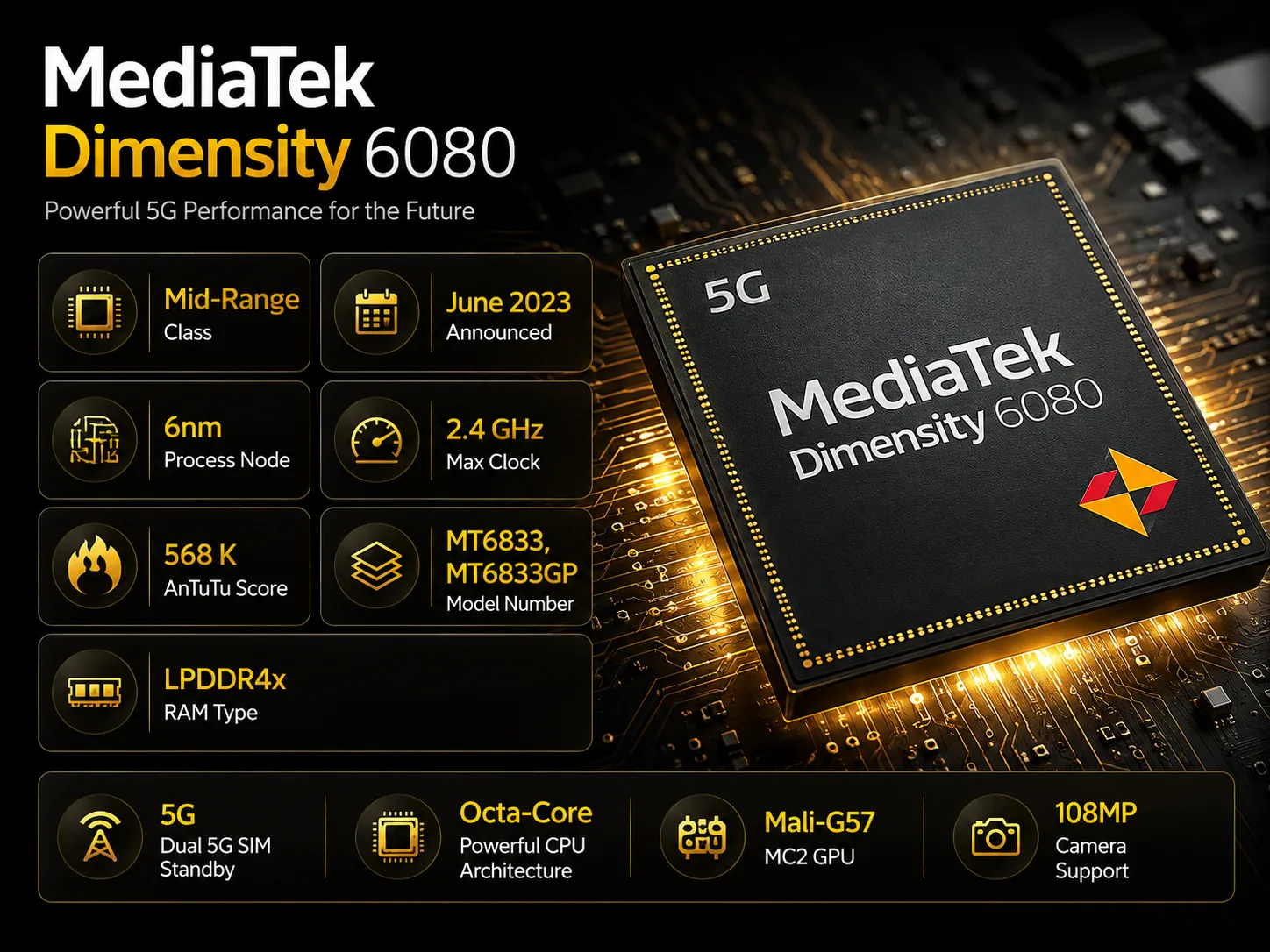
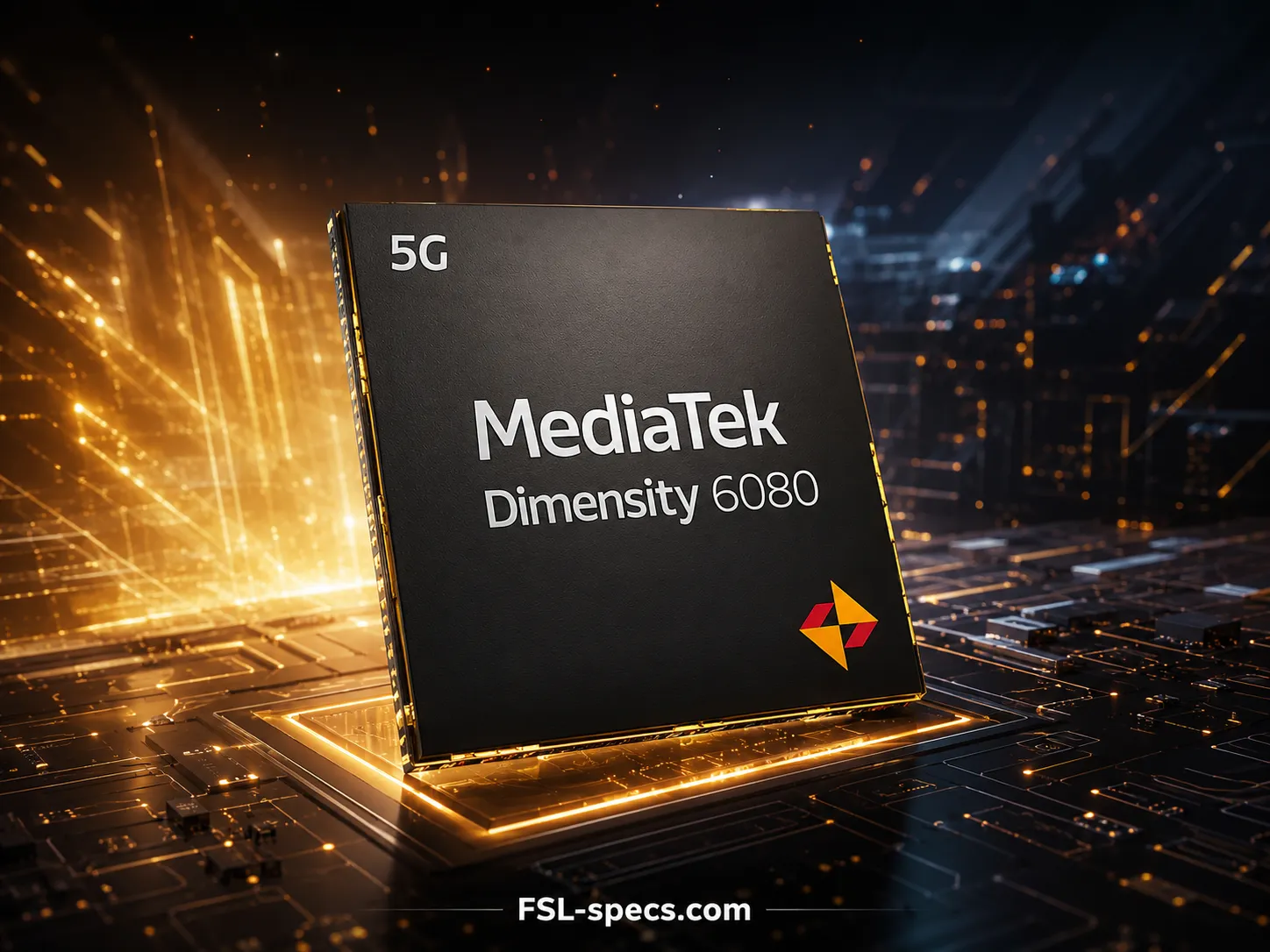
The MediaTek Dimensity 6080 is an entry-level to lower-midrange 5G chipset announced in June 2023. It uses a 6nm manufacturing process, an octa-core CPU with two Cortex-A76 cores at up to 2.4GHz and six Cortex-A55 cores at up to 2.0GHz, alongside a Mali-G57 MP2 GPU. NanoReview currently gives it an overall score of 31 and an AnTuTu 11 score of 567,996.
For this comparison, the Mediatek Dimensity 6080 is matched against three closely positioned processors: the Qualcomm Snapdragon 4 Gen 2, MediaTek Dimensity 6100+, and MediaTek Helio G100. The comparison is particularly interesting because all four processors sit close together in overall benchmark territory, but they take different approaches to CPU performance, manufacturing efficiency, graphics and connectivity.
According to current NanoReview data, the Mediatek Dimensity 6080 scores 567,996 in AnTuTu 11. The Snapdragon 4 Gen 2 reaches 560,863, the Dimensity 6100+ reaches 513,809, while the Helio G100 records 576,015.
That means the Mediatek Dimensity 6080 remains highly competitive, but it is not automatically the winner in every category.
Processor Overview
The Mediatek Dimensity 6080 and Dimensity 6100+ are particularly close because both use an 8-core CPU arrangement with Cortex-A76 performance cores and Cortex-A55 efficiency cores. However, the 6080 runs its performance cores at 2.4GHz, while the 6100+ reaches 2.2GHz. NanoReview also reports the 6080 with a higher current AnTuTu 11 result.
The Snapdragon 4 Gen 2 takes a different route. It uses two Cortex-A78 cores at 2.2GHz and six Cortex-A55 cores at 2.0GHz, while being manufactured on a smaller 4nm process. Its current NanoReview AnTuTu 11 score is 560,863, just below the Mediatek Dimensity 6080.
The Helio G100 is the strongest AnTuTu performer of these four according to the current NanoReview figures, reaching 576,015, about 1.4% higher than the Mediatek Dimensity 6080.
CPU Architecture & Processing Power
The Mediatek Dimensity 6080 features 2× Cortex-A76 at 2.4GHz + 6× Cortex-A55 at 2.0GHz. Its higher 2.4GHz performance-core clock gives it an advantage over the Dimensity 6100+, whose two Cortex-A76 cores reach 2.2GHz. NanoReview’s Geekbench 6 figures also show the 6080 ahead of the 6100+, with 750 single-core and 2,020 multi-core, compared with 689 and 1,884 respectively.
The Snapdragon 4 Gen 2 is more interesting from a CPU perspective. Its Cortex-A78 performance cores are newer than the Cortex-A76 cores used by the Mediatek Dimensity 6080. NanoReview records 923 single-core and 2,249 multi-core Geekbench 6 results for the Snapdragon, considerably above the Mediatek Dimensity 6080’s 750 and 2,020.
Therefore, raw CPU benchmarks favor the Snapdragon 4 Gen 2, even though the Dimensity 6080 has a higher AnTuTu total. This shows why a single benchmark should not be treated as the complete picture of processor performance.
The Helio G100 produces 727 single-core and 2,014 multi-core in NanoReview’s Geekbench 6 data. The Mediatek Dimensity 6080 therefore has a small single-core advantage and an almost identical multi-core result.
GPU & Gaming Performance
The Mediatek Dimensity 6080 uses the Mali-G57 MP2, while the Dimensity 6100+ also uses the Mali-G57 MP2. The 6080 has the higher GPU frequency, which helps explain why NanoReview gives it stronger graphics-related results in the direct comparison.
The Helio G100 is extremely close in AnTuTu GPU performance. NanoReview records 48,086 GPU points for the G100 versus 47,947 for the Dimensity 6080. That is effectively a very small difference in this benchmark.
The Snapdragon 4 Gen 2 has a different balance. Its AnTuTu GPU component is 31,221, substantially below the Mediatek Dimensity 6080’s 47,947, although its CPU component is much stronger.
For gaming, this makes the Dimensity 6080 a particularly balanced option among these four. However, actual gaming performance still depends on the phone’s cooling system, software optimization, RAM configuration and game settings.
Manufacturing Process & Efficiency
The Snapdragon 4 Gen 2 has the clearest manufacturing advantage with its 4nm process, compared with the Mediatek Dimensity 6080’s 6nm process. NanoReview also rates the Snapdragon 4 Gen 2’s battery-life category higher, with a score of 91, while the Dimensity 6080 is rated 87.
The Dimensity 6080’s 6nm process is nevertheless competitive for its performance class. The smaller process of the Snapdragon should provide an efficiency advantage, but node size alone does not determine actual battery life because the complete smartphone design matters.
Memory & Storage
The Dimensity 6080 supports LPDDR4X memory, with NanoReview listing a maximum memory bandwidth of 17.07GB/s. The Dimensity 6100+ is similarly listed with LPDDR4X and the same 17.07GB/s maximum bandwidth.
The Snapdragon 4 Gen 2 has a major advantage in this area, with NanoReview reporting 25.6GB/s memory bandwidth. Its higher bandwidth can benefit workloads that are sensitive to memory throughput.
This gives the Snapdragon a technical memory advantage, even though the Dimensity 6080 achieves a higher total AnTuTu score.
AI, Camera & Video Capabilities
The supplied comparison source data does not provide enough processor-specific AI, NPU and ISP information to make a complete evidence-based ranking of these four chips in AI photography or on-device generative AI. Following the FSL-Specs comparison rules, these categories should therefore not be filled with unsupported claims.
The same rule applies to detailed camera and video conclusions. Processor-supported camera resolution or video capability should not automatically be interpreted as the camera quality of a particular phone. The smartphone manufacturer can implement only part of a chipset’s available capabilities.
5G & Connectivity
One major distinction is connectivity positioning. The Dimensity 6080 is a 5G chipset, while the Dimensity 6100+ is also a 5G platform. The 6100+ supports theoretical download speeds of up to 3.3Gbps, with Wi-Fi 5 and Bluetooth 5.2 listed by NanoReview.
The Snapdragon 4 Gen 2 is also a 5G processor and benefits from its newer platform design. For users choosing between phones based on connectivity, however, the actual modem implementation, supported bands and carrier configuration should be checked rather than relying only on the chipset name.
The Helio G100 is the notable exception in this group because it is a 4G-oriented chipset. That makes the Dimensity 6080 more attractive for buyers specifically looking for an affordable 5G phone.
Benchmark Comparison
Current NanoReview AnTuTu 11 results give this ranking:
| Processor | AnTuTu 11 | Difference vs Dimensity 6080 |
|---|
| Helio G100 | 576,015 | +1.4% |
| Dimensity 6080 | 567,996 | Baseline |
| Snapdragon 4 Gen 2 | 560,863 | -1.3% |
| Dimensity 6100+ | 513,809 | -9.5% |
These percentages are calculated from the current NanoReview AnTuTu 11 figures. NanoReview itself reports the Helio G100 at about 1% above the Dimensity 6080, while the Snapdragon 4 Gen 2 is extremely close at about 1% below it. The Dimensity 6100+ trails by about 9%.
The important takeaway is that the AnTuTu differences between the top three are small. A 1% to 1.4% difference should not be treated as a dramatic real-world performance gap.
Real-World Performance
For everyday use, all four processors belong to a similar general performance class, but their strengths differ. The Snapdragon 4 Gen 2 has the strongest Geekbench CPU numbers, while the Dimensity 6080 combines a higher clock speed with stronger AnTuTu GPU and memory components.
For gaming, the Dimensity 6080 is particularly interesting because its AnTuTu GPU score is substantially higher than the Snapdragon 4 Gen 2’s. The Helio G100 is almost identical to the 6080 in the AnTuTu GPU component.
For efficiency, the Snapdragon 4 Gen 2 has the strongest case because of its 4nm process and NanoReview’s higher battery-life rating.
For 5G affordability, the Dimensity 6080 remains attractive because it combines 5G connectivity with performance that is still extremely close to the newer-feeling Snapdragon 4 Gen 2 and slightly below the Helio G100 in current AnTuTu 11 results.
Strengths & Weaknesses
MediaTek Dimensity 6080
Strengths
- Strong 567,996 AnTuTu 11 score.
- Higher CPU clock than the Dimensity 6100+.
- Strong GPU component.
- 5G connectivity.
- Excellent balance between CPU, GPU, memory and UX performance.
Weaknesses
- Uses an older 6nm process than Snapdragon 4 Gen 2.
- CPU Geekbench results trail Snapdragon 4 Gen 2.
- Memory bandwidth is lower than Snapdragon 4 Gen 2.
Snapdragon 4 Gen 2
Strengths
- 4nm manufacturing.
- Strong Geekbench CPU performance.
- Higher memory bandwidth.
- Excellent efficiency potential.
Weaknesses
- Lower AnTuTu total than Dimensity 6080.
- Significantly lower AnTuTu GPU component.
Dimensity 6100+
Strengths
- 5G connectivity.
- Similar core configuration to Dimensity 6080.
- 6nm process.
- Same Mali-G57 MP2 GPU family.
Weaknesses
- Lower 513,809 AnTuTu 11 score.
- Lower CPU clock than Dimensity 6080.
- Current benchmark results put it roughly 9.5% behind the 6080.
Helio G100
Strengths
- Highest current AnTuTu 11 score of the four.
- Extremely close GPU result to Dimensity 6080.
- Competitive CPU performance.
Weaknesses
- 4G rather than 5G positioning makes it less attractive for buyers specifically wanting 5G.
Best Processor For Different Users
Best Overall Balance: MediaTek Dimensity 6080
Best CPU Performance: Qualcomm Snapdragon 4 Gen 2, based on current Geekbench 6 results.
Best AnTuTu Performance: MediaTek Helio G100, with 576,015 versus 567,996 for Dimensity 6080.
Best Efficiency Potential: Qualcomm Snapdragon 4 Gen 2, supported by its 4nm process and NanoReview battery-life rating.
Best 5G Choice: MediaTek Dimensity 6080, particularly when GPU performance and overall balance are priorities.
Final Verdict & Ranking
1. MediaTek Dimensity 6080 — Best Overall Balance
The Dimensity 6080 is the strongest all-round choice in this particular comparison when CPU, GPU, memory, AnTuTu performance and 5G are considered together. Its 567,996 AnTuTu 11 score puts it only slightly behind the Helio G100 while remaining ahead of the Snapdragon 4 Gen 2 and clearly ahead of the Dimensity 6100+.
2. MediaTek Helio G100 — Best AnTuTu Score
The Helio G100 technically takes the AnTuTu lead with 576,015, only around 1.4% above the Dimensity 6080. However, its 4G positioning means the Dimensity 6080 can be the more attractive option for users who specifically require 5G.
3. Qualcomm Snapdragon 4 Gen 2 — Best CPU & Efficiency
The Snapdragon 4 Gen 2 is not the AnTuTu winner, but its 4nm process, higher Geekbench CPU scores and higher memory bandwidth make it a serious rival. Its current AnTuTu result is only around 1.3% below the Dimensity 6080, so the difference is small.
4. MediaTek Dimensity 6100+ — Closest Family Alternative
The Dimensity 6100+ shares much of the Dimensity 6080’s platform characteristics but currently trails it by around 9.5% in AnTuTu 11. Its lower 2.2GHz performance-core clock is also a disadvantage against the 6080’s 2.4GHz configuration.
Bottom Line: The MediaTek Dimensity 6080 remains a very competitive budget 5G chipset. The Helio G100 has the highest current AnTuTu 11 score, the Snapdragon 4 Gen 2 has the strongest CPU and efficiency-oriented hardware, and the Dimensity 6100+ sits behind the 6080 in current benchmark performance. For a balanced affordable 5G smartphone, the Dimensity 6080 is the most convincing overall choice.