
Dimensity 6300
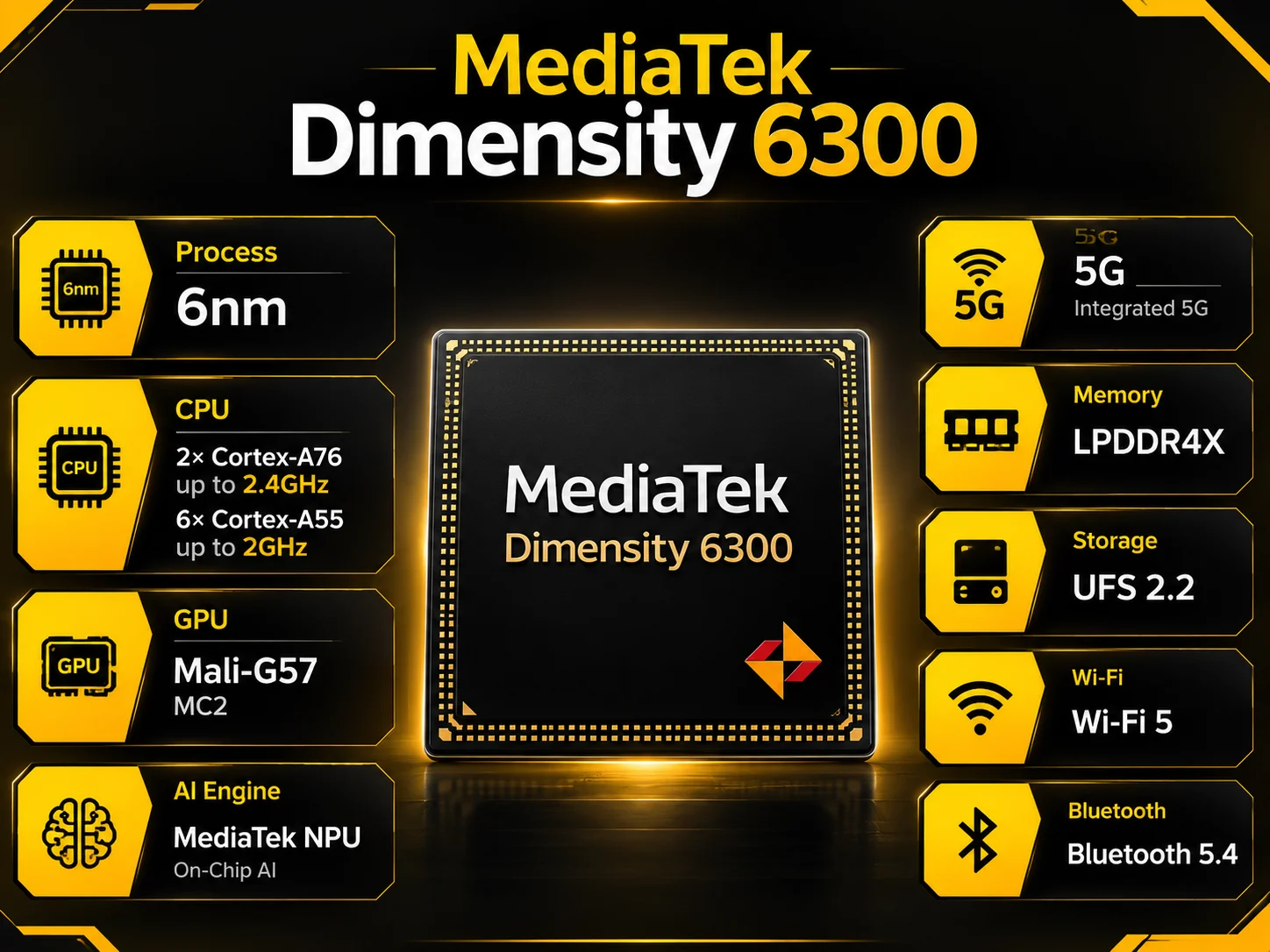
The MediaTek Dimensity 6300 is a mid‑range 5G chipset built on a 6nm process, using 2× Cortex‑A76 cores up to 2.4GHz and 6× Cortex‑A55 cores up to 2GHz, paired with a Mali‑G57 MC2 GPU. With LPDDR4X memory, UFS 2.2 storage, an on‑chip MediaTek NPU for everyday AI tasks, Wi‑Fi 5, and Bluetooth 5.4, it's built for reliable everyday performance and efficiency.
Benchmark Scores
Measures CPU, GPU, RAM, and I/O performance in different scenarios.
Shows raw single-threaded CPU performance across real-world workloads. Headline score not confirmed in source data.
Cross-platform benchmark assessing graphics performance in Vulkan/Metal.
Evaluates overall system performance in everyday workloads. Headline score not confirmed in source data.
CPU & AI Performance
6× Cortex‑A55 up to 2GHz
Graphics, Memory & Storage
Multimedia (Camera, Display & ISP)
Connectivity
General Info
information About MediaTek Dimensity 6300
Introduction
Entry-level 5G smartphones frequently ship with one of three familiar chips: the MediaTek Dimensity 6300, the Unisoc T760, or the older MediaTek Dimensity 6100 Plus. This Dimensity 6300 vs Unisoc T760 vs Dimensity 6100 Plus comparison uses verified NanoReview specification and benchmark data to explain how each chip behaves in everyday use, light gaming, camera processing, and connectivity, and which one actually offers the better value.
1. Processor Overview
The Dimensity 6300, announced in April 2024, is an 8-core chip built on TSMC’s 6nm process. It pairs 2x Cortex-A76 cores at 2.4GHz with 6x Cortex-A55 efficiency cores at 2.0GHz, alongside a Mali-G57 MP2 GPU.
The Unisoc T760, announced July 2024 and also built on a 6nm TSMC process, takes a different core layout: 4x Cortex-A76 at 2.2GHz plus 4x Cortex-A55 at 2.0GHz, paired with a larger Mali-G57 MP4 GPU.
The Dimensity 6100 Plus, the oldest of the three (July 2023), shares the Dimensity 6300’s 2+6 core layout and Mali-G57 MP2 GPU, but runs its performance cores slower at 2.2GHz, essentially making it a lower-clocked sibling of the Dimensity 6300.
Right away, the core configuration split matters: the Dimensity 6300 and 6100 Plus use a light 2+6 layout favoring single-core speed, while the Unisoc T760 uses a heavier 4+4 layout that should favor multi-core and sustained work.
2. CPU Architecture & Processing Power
The Dimensity 6300 and Dimensity 6100 Plus both use ARMv8.2-A Cortex-A76/A55 cores with 512KB L1, 1MB L2, and 2MB L3 cache. The Unisoc T760 uses the slightly older ARMv8-A instruction set, and no cache figures are disclosed for it in the supplied data.
In Geekbench 6 single-core, the Dimensity 6300 leads with 771, ahead of the Unisoc T760 (735, about 4.9% lower) and the Dimensity 6100 Plus (688, about 12.1% lower). Its 2.4GHz clock, the highest of the three, explains this lead in single-threaded tasks like app launches and UI responsiveness.
Multi-core reverses the order. The Unisoc T760’s 4-performance-core layout produces a Geekbench 6 multi-core score of 2318, about 14.6% higher than the Dimensity 6300 (1980) and 22% higher than the Dimensity 6100 Plus (1900). The Dimensity 6300 still edges out its older sibling by roughly 4.2% in multi-core, reflecting its higher clock speed advantage even with the same core count.
For heavier apps and background multitasking, the Unisoc T760’s four performance cores give it a real, measurable edge over both MediaTek chips.
3. GPU & Gaming Performance
The Unisoc T760 has the largest graphics configuration of the group: a Mali-G57 MP4 with 4 pipelines and 128 total shaders, versus the Mali-G57 MP2 used in both MediaTek chips, which has only 2 pipelines and 64 total shaders. Despite running at a lower GPU clock (650MHz versus 1072MHz on the Dimensity 6300 and 962MHz on the Dimensity 6100 Plus), the T760’s extra shader count wins out in FLOPS, at 166.4 Gigaflops against 137.2 for the Dimensity 6300 and 123.1 for the Dimensity 6100 Plus.
Geekbench 6 GPU Compute confirms this: the Unisoc T760 leads clearly at 2113, roughly 33% higher than the Dimensity 6300 (1414) and 67% higher than the Dimensity 6100 Plus (1263). In 3DMark Steel Nomad Light, the T760 again leads (172), ahead of the Dimensity 6300 (151, about 12% lower) and the Dimensity 6100 Plus (134, about 22% lower than the T760).
For gaming, the Unisoc T760 has the clearest graphics headroom of the three, the Dimensity 6300 sits in the middle, and the Dimensity 6100 Plus is the weakest GPU performer. No exact frame-rate data is supplied, so specific FPS claims cannot be made for any of them.
4. Manufacturing Process & Efficiency
All three chips are manufactured on the same TSMC 6nm process, so node size is not a differentiator here. Efficiency differences instead come from clock speed and core layout choices. No TDP figures are disclosed for any of the three chips in the supplied data, so sustained power draw cannot be directly compared numerically.
NanoReview’s battery-life sub-scores give an indirect signal: both the Dimensity 6300 and Dimensity 6100 Plus score 87, while the Unisoc T760 scores lower at 83. This suggests the T760’s heavier 4-core performance cluster and larger GPU may draw more power under load, even on the same node, though this is a scored estimate rather than a hard efficiency measurement.
5. RAM, Memory & Storage Support
All three chips use the same memory technology: LPDDR4X at 2133MHz, with virtually identical bandwidth (17Gb/s for the Dimensity 6300, 17Gb/s for the T760, 17.07Gb/s for the Dimensity 6100 Plus). The real difference is maximum supported RAM. The Unisoc T760 supports up to an unusually high 32GB, well above the Dimensity 6300 and Dimensity 6100 Plus, which both cap at 12GB. In practice, most phones using any of these chips ship with far less RAM, but the T760’s higher ceiling gives device makers more configuration flexibility.
Storage support also favors the T760, which supports eMMC 5.1, UFS 2.2, and UFS 3.1, the widest range of the three. The Dimensity 6300 and Dimensity 6100 Plus are limited to UFS 2.2 only, which is slower for app loading and file transfers than UFS 3.1.
6. AI & NPU Capabilities
All three chips confirm the presence of a dedicated NPU, but none of the supplied data includes a TOPS figure or named AI engine for any of them. Because no comparable AI performance numbers exist, no ranking can be made in this category. Based on the supplied information, none of the three chips is confirmed to support generative AI workloads.
7. ISP, Camera & Video Capabilities
Camera and video capability is one of the sharpest differentiators here. The Unisoc T760 supports 4K video capture and playback at 60FPS, while both the Dimensity 6300 and Dimensity 6100 Plus are limited to 2K at 30FPS, a meaningful gap for anyone recording video. All three support H.264, H.265, and VP9 codecs.
Maximum camera resolution favors the MediaTek chips slightly on paper: both the Dimensity 6300 and Dimensity 6100 Plus support 1x 10⁸MP plus 2x 16MP sensors, while the Unisoc T760 supports 1x 10⁸MP only, without the dual 16MP secondary sensor support. Actual photo quality still depends on the sensor hardware a phone maker chooses, not the processor specification alone.
8. Display Support
The Dimensity 6300 and Dimensity 6100 Plus both support a maximum display resolution of 2520 x 1080. No maximum display resolution is disclosed in the supplied data for the Unisoc T760, so no comparison can be made for that chip in this category.
9. Modem, 5G & Connectivity
Connectivity is where the MediaTek chips clearly outperform the Unisoc chip. The Dimensity 6300 and Dimensity 6100 Plus both support a theoretical 5G download speed of up to 3300 Mbps, far ahead of the Unisoc T760’s 1000 Mbps. Upload speed is disclosed only for the Dimensity 6300, at 1250 Mbps; it is not supplied for the Dimensity 6100 Plus, and the Unisoc T760 is rated much lower at 150 Mbps.
Wi-Fi 5 is common across all three, an older standard than Wi-Fi 6 used in higher-tier chips. Bluetooth differs: the Dimensity 6300 supports the newest version at 5.4, followed by the Dimensity 6100 Plus at 5.2, and the Unisoc T760 at the oldest, 5.0. These are theoretical maximums; real-world network speeds depend on carrier infrastructure and will not always reach these ceilings.
10. Benchmark Comparison
All benchmark figures below use AnTuTu 11 and Geekbench 6, so comparisons are apples-to-apples.
AnTuTu 11 Total:
- Unisoc T760: 628,581
- Dimensity 6300: 528,398 (about 15.9% lower than the T760)
- Dimensity 6100 Plus: 513,809 (Dimensity 6300 leads this comparison by about 2.8%)
Geekbench 6 Single-Core: Dimensity 6300 leads with 771, ahead of the Unisoc T760 (735, about 4.9% lower) and Dimensity 6100 Plus (688, about 12.1% lower).
Geekbench 6 Multi-Core: Unisoc T760 leads clearly at 2318, ahead of the Dimensity 6300 (1980, about 14.6% lower) and Dimensity 6100 Plus (1900, about 22% lower).
Geekbench 6 GPU Compute: Unisoc T760 leads at 2113, well ahead of the Dimensity 6300 (1414, about 33% lower) and Dimensity 6100 Plus (1263, about 67% lower than the T760).
3DMark Steel Nomad Light: Unisoc T760 leads (172), followed by Dimensity 6300 (151) and Dimensity 6100 Plus (134).
PCMark 3.0 (everyday workloads): Unisoc T760 leads clearly (12,044), ahead of Dimensity 6300 (10,205, about 15% lower) and Dimensity 6100 Plus (8,983, about 25% lower than the T760).
The overall picture: the Unisoc T760 wins the composite AnTuTu score, multi-core, GPU, and everyday-workload benchmarks by wide margins, while the Dimensity 6300 wins only single-core speed. The Dimensity 6100 Plus trails both rivals across nearly every test, confirming it as the weakest of the three.
11. Real-World Performance
Everyday users browsing and messaging will notice the Dimensity 6300’s single-core lead in slightly snappier app launches, though the Unisoc T760 is close behind.
Multitaskers clearly benefit more from the Unisoc T760’s 4-performance-core layout, which posts a meaningfully higher multi-core score than either MediaTek chip.
Gamers should lean toward the Unisoc T760, which leads GPU Compute and 3DMark by wide margins; the Dimensity 6300 is a distant second, and the Dimensity 6100 Plus is the weakest graphics performer of the three based on supplied scores.
Content creators benefit substantially from the Unisoc T760’s 4K/60FPS video ceiling, double the frame rate of the 2K/30FPS limit on both MediaTek chips.
Camera users get a slight edge from the MediaTek chips’ dual 16MP secondary sensor support, though the Unisoc T760’s higher video frame-rate ceiling may matter more for many users.
AI users cannot be differentiated here since no TOPS figures are disclosed for any of the three.
Connectivity-focused users should choose either MediaTek chip, since both support dramatically faster theoretical 5G download speeds than the Unisoc T760.
12. Strengths & Weaknesses
MediaTek Dimensity 6300
- Strengths: Highest Geekbench 6 single-core score (771); fastest theoretical 5G download tied with Dimensity 6100 Plus (3300 Mbps); newest Bluetooth version (5.4); dual 16MP secondary camera support.
- Weaknesses: Trails the Unisoc T760 by roughly 16% in AnTuTu 11 total score; limited to 2K/30FPS video versus the T760’s 4K/60FPS; capped at UFS 2.2 storage.
Unisoc T760
- Strengths: Highest AnTuTu 11 total score (628,581); clear multi-core and GPU Compute lead; supports 4K/60FPS video; widest storage support (eMMC 5.1, UFS 2.2, UFS 3.1); highest max RAM support (32GB).
- Weaknesses: Slowest theoretical 5G download (1000 Mbps) and upload (150 Mbps) of the three; oldest Bluetooth version (5.0); lowest NanoReview battery-life sub-score (83); no dual secondary camera support disclosed.
MediaTek Dimensity 6100 Plus
- Strengths: Matches the Dimensity 6300’s dual 16MP secondary camera support and 3300 Mbps 5G download ceiling; shares the same 87 battery-life sub-score as the Dimensity 6300.
- Weaknesses: Lowest scores in nearly every benchmark category, including AnTuTu 11, Geekbench single-core, multi-core, GPU Compute, 3DMark, and PCMark; oldest chip of the three, launched a year before the Dimensity 6300.
13. Best Processor For Different Users
- Best for Gaming: Unisoc T760
- Best for AI: Not determinable from supplied data
- Best for Efficiency: MediaTek Dimensity 6300 (tied with Dimensity 6100 Plus on battery-life score)
- Best for Camera Processing: Unisoc T760 (video), MediaTek Dimensity 6300 (secondary sensor support)
- Best for Connectivity: MediaTek Dimensity 6300
- Best for Balanced Performance: Unisoc T760
Final Verdict
This Dimensity 6300 vs Unisoc T760 vs Dimensity 6100 Plus comparison shows the Unisoc T760 as the clear benchmark leader, even though it is not the Primary Processor. The supplied data does not support making the Dimensity 6300 the automatic winner.
Final Verdict
1. Unisoc T760 — Best Overall It leads AnTuTu 11 total score, Geekbench multi-core, GPU Compute, 3DMark, and PCMark by wide margins, and it is the only chip of the three confirmed to support 4K/60FPS video, making it the strongest all-round performer despite its slower theoretical 5G speeds.
2. MediaTek Dimensity 6300 — Best For Single-Core Speed and Connectivity It leads Geekbench single-core performance and matches the fastest theoretical 5G download speed of the group, with the newest Bluetooth version, but falls well behind the T760 in every multi-threaded and graphics benchmark.
3. MediaTek Dimensity 6100 Plus — Best For Nothing Decisive As the oldest and slowest-clocked of the three, it trails both rivals in nearly every benchmark category, offering no clear advantage over the newer Dimensity 6300 beyond matching its camera and connectivity specifications.
Best for Gaming: Unisoc T760 Best for AI: Not determinable from supplied data Best for Efficiency: MediaTek Dimensity 6300 Best Balanced Choice: Unisoc T760
Bottom Line: The Unisoc T760 is the strongest overall performer in this group, backed by a clear AnTuTu, multi-core, and GPU lead plus 4K/60FPS video support, even though its 5G speeds and Bluetooth version lag behind. The Dimensity 6300 remains the better pick specifically for single-core responsiveness and fast 5G connectivity, while the Dimensity 6100 Plus offers no meaningful advantage over its newer MediaTek sibling and should generally be avoided if the Dimensity 6300 is available at a similar price.
Images Of MediaTek Dimensity 6300
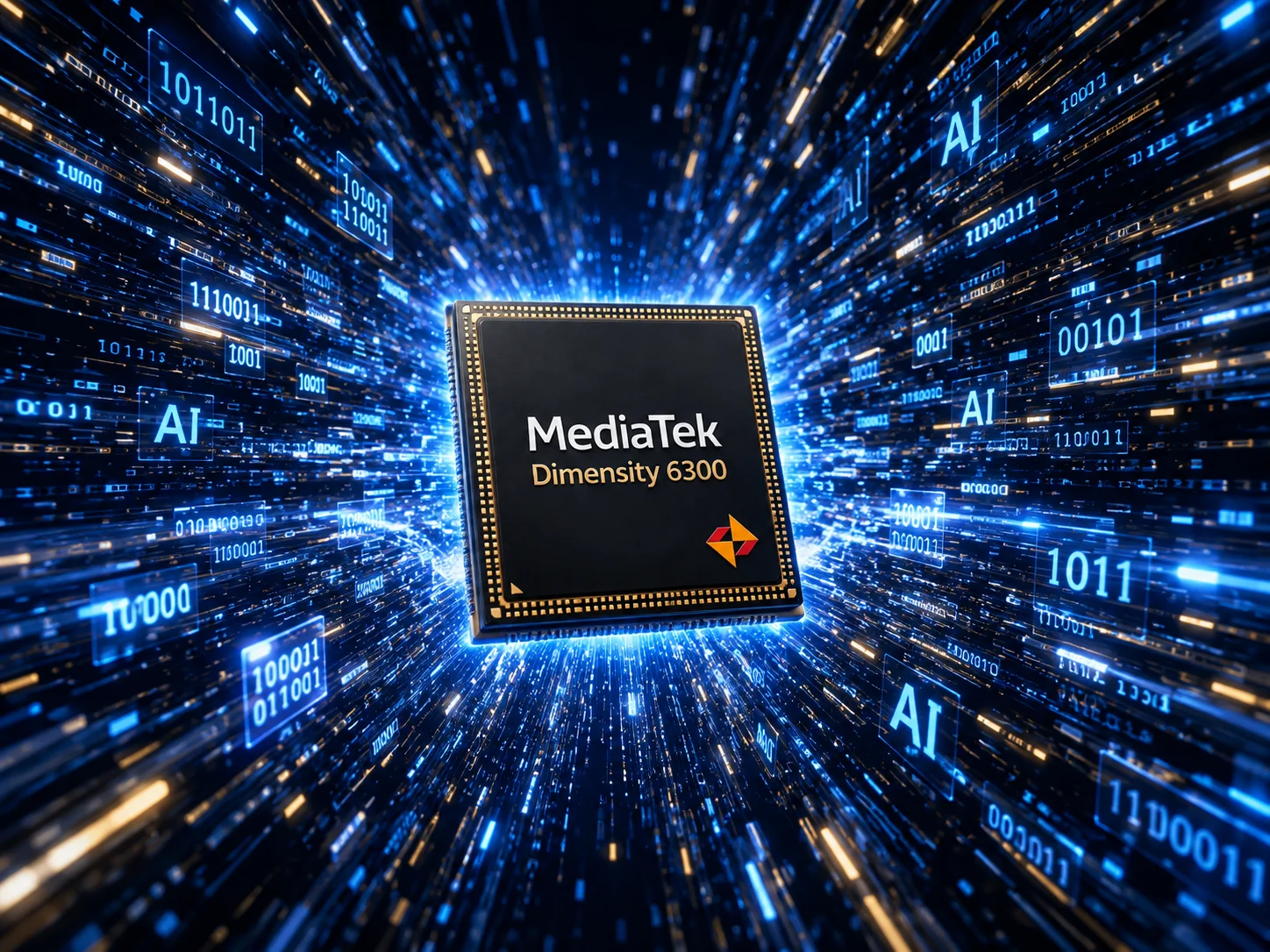
Trailer Of MediaTek Dimensity 6300

Author & Post Info
Faisal Ur Rehman
Faisal Rehman is the founder and editor of FSL Specs, where he publishes in-depth smartphone specifications, comparisons, buying guides, and technology insights. With extensive experience in mobile hardware research and technical analysis, he provides accurate and up-to-date information on Android smartphones, processors, displays, cameras, batteries, performance benchmarks, and software features. His goal is to simplify complex specifications and help readers choose the right device with confidence.
Explore FSL Specs
Questions About MediaTek Dimensity 6300
What CPU does the MediaTek Dimensity 6300 use?
The Dimensity 6300 uses an octa-core setup with 2 Cortex-A76 cores clocked at 2.4GHz and 6 Cortex-A55 efficiency cores clocked at 2.0GHz. It is built on a 6nm process by TSMC. This is essentially an overclocked version of the Dimensity 6100+.
Which GPU powers the Dimensity 6300?
Graphics are handled by the Mali-G57 MC2 GPU. MediaTek claims up to 50% faster GPU performance compared to the Dimensity 6100+. It is suitable for casual gaming but struggles with heavier titles at high settings.
What type of RAM and storage does the Dimensity 6300 support?
The chipset supports LPDDR4X memory with a maximum frequency of 2133MHz. For storage, it is limited to UFS 2.2, which is slower than the UFS 2.2+ or UFS 3.1 found on higher-tier chips. This combination is standard for budget 5G phones.
Does the Dimensity 6300 support 5G?
Yes, it includes an integrated 5G modem compliant with the 3GPP Release 16 standard. It delivers a maximum downlink speed of up to 3.3Gbps through 2CC carrier aggregation. It also supports dual 5G SIM functionality on select devices.
What is the maximum display support of the Dimensity 6300?
The chip supports FHD+ resolution up to 2520x1080 pixels with a refresh rate of up to 120Hz. It also supports 1.07 billion colors through 10-bit color depth. This makes it capable of smooth scrolling on budget displays.
What camera specifications does the Dimensity 6300 support?
It supports single cameras up to 108MP with multi-frame noise reduction technology. It can also handle dual ISP setups for improved low-light imaging. This is paired with MediaTek's Imagiq image signal processor for better photo processing.
What is the AnTuTu score of the Dimensity 6300?
AnTuTu scores vary by device and typically range between 375,000 to 630,000 depending on RAM, cooling, and software optimization. Geekbench 6 scores average around 720 to 770 single-core and 1,800 to 1,980 multi-core. This places it firmly in the entry-level 5G segment.