

















✪ Motorola Edge 70 Fusion ✪

Motorola Edge 70 Fusion
United States flag United States
$330 USD
Pakistan flag Pakistan (PKR)
134,000 PKR
India flag India (INR)
₹33,000 INR

✪ Motorola Edge 70 Fusion ✪

Motorola Edge 70 Fusion
Last Time Update : 12 September, 2026
0

Quick Specifications

AMOLED

Display Type

Snapdragon 7s Gen 3

Processor

12 + 256 GB

Ram And Memory

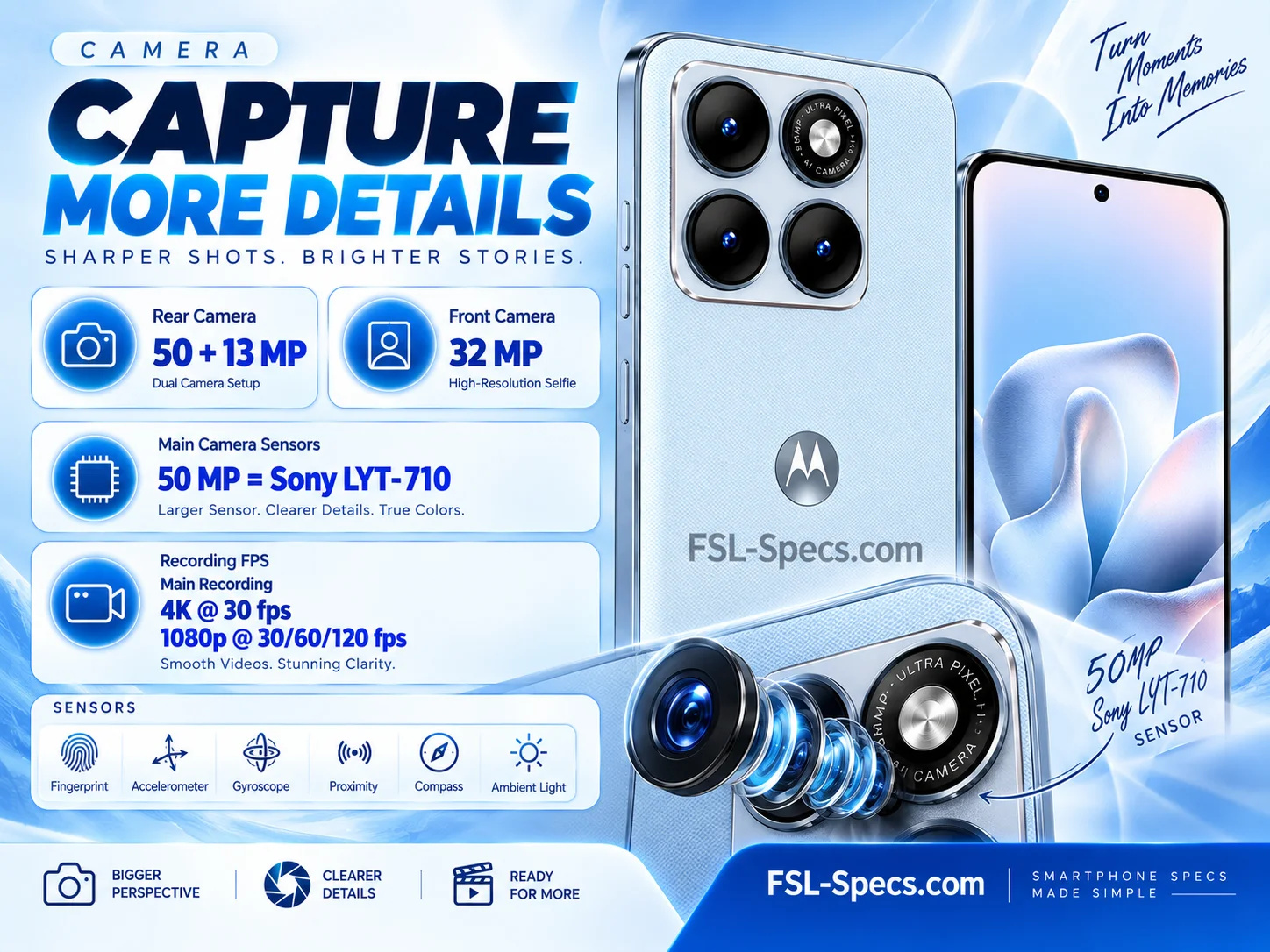
50 + 13 MP

Camera

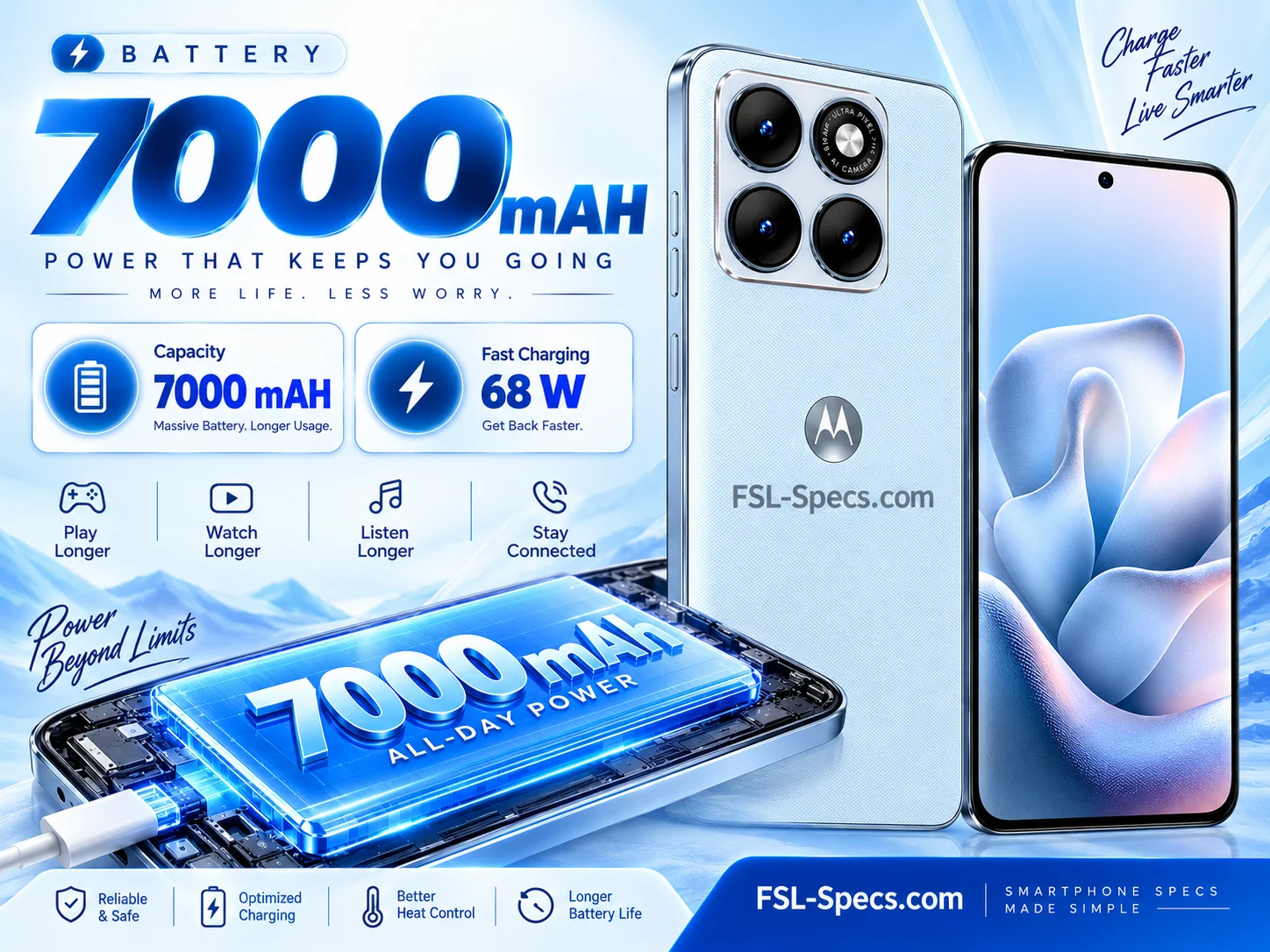
7000 mAH

Battery

68 W

Fast Charging

Full Specification

BASIC INFO
Mobile
Motorola Edge 70 Fusion
Model
XT2605-1, XT2605-2, XT2605-4
Series
Edge Series
Category
Mid-Premium
Release Date
2 March,2026
Year
2026
CONNECTIVITY
Sim
Nano-SIM / E-Sim
Network
4G / 4G+ / 5G
WiFi
Wi-Fi 6E
Bluetooth
6.0
NFC
Yes
OS
Android 16, up to 3 major OS updates
BODY
Dimensions
162.8 x 75.6 x 7.2 mm or 8 mm
Build
aluminum frame
KG Weight
177 g or 193 g
Screen Size
6.78 inch
Resolution
1272 x 2772 pixels
Type
AMOLED
Refresh Rate
144 Hz
Peak Brightness
5200 Nits
HBM Brightness
1500 nits
Processor
Snapdragon 7s Gen 3
Max Clock
2.5 GHz ( 2.7 Ghz india )
Lithography
4 nm
GPU
Adreno 810
CPU Cores
8 Cores
Antutu v11
1.15 M
Antutu v10
1.05 M
Bootup Time
18 s
Architecture
1 x 2.7 GHz Cortex-A720 – India
1 x 2.5 GHz Cortex-A720 – International
3 x 2.4 GHz Cortex-A720
4 x 1.8 GHz Cortex-A520
Ram Memory
12 + 256 GB
Ram Type
LPDDR5X
Storage Type
UFS 3.1
SD Card
No
Variants
8 + 128 / 256 GB
12 + 256 / 512 GB
MP
Rear Camera
50 + 13 MP
Front Camera
32 MP
SENSORS
Camera Sensors
50 MP =Sony LYT-710
RECORDING FPS
Main Recording
4K @ 30 fps
1080p @ 30/60/120 fps
Front Recording
4K @ 30 fps
1080p @ 30/60/120 fps
RESOLUTION
Main Resolution
8150 x 6150 Pixels
ZOOM
D Digital Zoom
20 x
Stabilization
Yes
FLASH
Flash
LED Flash
Front Flash
Screen Flash
Capacity
7000 mAH
Fast Charging
68 W
Wireless Charging
No
Li Battery Type
Si/C Li-Ion
REVERSE
Reverse Wired
No
Reverse Wireless
No
OTHER
Battery PC Marks
17h 34m
Charging Time
49m
AUDIO & SENSORS
Speaker
Dual Stereo Speaker
Fingerprint Sensor
Front Finger
Other Sensors
Accelerometer
Gyroscope
Proximity
Ambient Light
E-Compass
BASIC INFO
Mobile
Motorola Edge 70 Fusion
Model
XT2605-1, XT2605-2, XT2605-4
Series
Edge Series
Category
Mid-Premium
Release Date
2 March,2026
Year
2026
CONNECTIVITY
Sim
Nano-SIM / E-Sim
Network
4G / 4G+ / 5G
WiFi
Wi-Fi 6E
Bluetooth
6.0
NFC
Yes
OS
Android 16, up to 3 major OS updates
BODY
Dimensions
162.8 x 75.6 x 7.2 mm or 8 mm
Build
aluminum frame
KG Weight
177 g or 193 g
Screen Size
6.78 inch
Resolution
1272 x 2772 pixels
Type
AMOLED
Refresh Rate
144 Hz
Peak Brightness
5200 Nits
HBM Brightness
1500 nits
Processor
Snapdragon 7s Gen 3
Max Clock
2.5 GHz ( 2.7 Ghz india )
Lithography
4 nm
GPU
Adreno 810
CPU Cores
8 Cores
Antutu v11
1.15 M
Antutu v10
1.05 M
Bootup Time
18 s
Architecture
1 x 2.7 GHz Cortex-A720 – India
1 x 2.5 GHz Cortex-A720 – International
3 x 2.4 GHz Cortex-A720
4 x 1.8 GHz Cortex-A520
Ram Memory
12 + 256 GB
SD Card
No
Ram Type
LPDDR5X
Storage Type
UFS 3.1
Variants
8 + 128 / 256 GB
12 + 256 / 512 GB
MP
Rear Camera
50 + 13 MP
Front Camera
32 MP
SENSORS
Main Camera Sensors
50 MP =Sony LYT-710
RECORDING FPS
Main Recording
4K @ 30 fps
1080p @ 30/60/120 fps
Front Recording
4K @ 30 fps
1080p @ 30/60/120 fps
RESOLUTION
Main Resolution
8150 x 6150 Pixels
ZOOM
D Digital Zoom
20 x
Stabilization
Yes
FLASH
Flash
LED Flash
Front Flash
Screen Flash
Capacity
7000 mAH
Fast Charging
68 W
Wireless Charging
No
Li Battery Type
Si/C Li-Ion
REVERSE
Reverse Wired
No
Reverse Wireless
No
OTHER
Battery Life PCMark
17h 34m
Charging Time
49m
AUDIO & SENSORS
Speaker
Dual Stereo Speaker
Fingerprint Sensor
Front Finger
Other Sensors
Accelerometer
Gyroscope
Proximity
Ambient Light
E-Compass

Highlights & Review Of Motorola Edge 70 Fusion

Display Review:

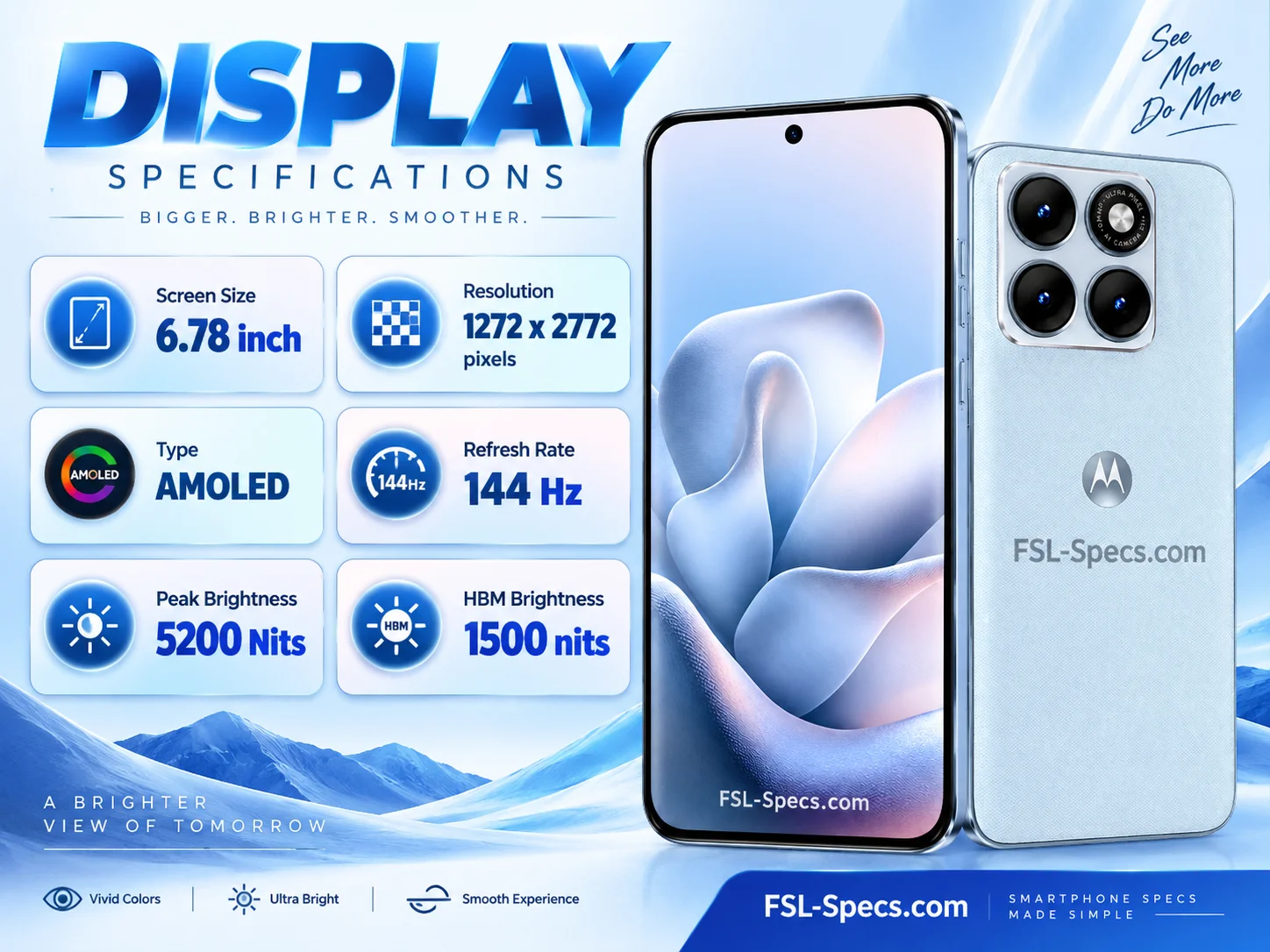
The Motorola Edge 70 Fusion runs a 6.78-inch quad-curved AMOLED at 1272 x 2772 with a 144Hz refresh rate and a manufacturer-claimed 5,200 nits peak brightness, while the Realme 15 Pro matches its 144Hz refresh on a 6.8-inch OLED panel rated at 1,800 nits (HBM) and 6,500 nits peak, the highest brightness figure in this group.

Motorola’s 5,200-nit number sits between the two, but independent lab testing has measured the Edge 70 Fusion at closer to 1,270 to 1,300 nits in strong outdoor light, well below its marketing figure and also below the Realme 15 Pro’s tested 1,862 nits, so the on-paper gap between these two is smaller in real use than the spec sheet suggests.

The Realme 15 Pro also adds 4,608Hz PWM dimming for reduced eye strain at low brightness, a feature Motorola doesn’t list for the Edge 70 Fusion. Dropping to 120Hz, the Vivo V70 FE offers a larger 6.83-inch AMOLED at 1260 x 2800 with a single quoted 1,900 nits maximum brightness figure, and vivo hasn’t published a separate peak rating the way Realme and Samsung have.

The Samsung Galaxy A57 trails the group on sharpness with a 6.7-inch Super AMOLED at just 1080 x 2340 (385ppi against 449 to 453ppi elsewhere), though its 1,200 nits (HBM) and 1,900 nits peak keep it usable outdoors despite the lower resolution. All four panels support HDR10+, and Gorilla Glass Victus+ on the Galaxy A57 is a tougher cover glass than the Gorilla Glass 7i used on the Edge 70 Fusion and Realme 15 Pro.

Verdict: The Realme 15 Pro has the strongest display on paper and in measured brightness, but the Motorola Edge 70 Fusion’s 144Hz panel and sharper resolution than the Galaxy A57 or Vivo V70 FE still make it a solid second pick at its price.

Processor Review:

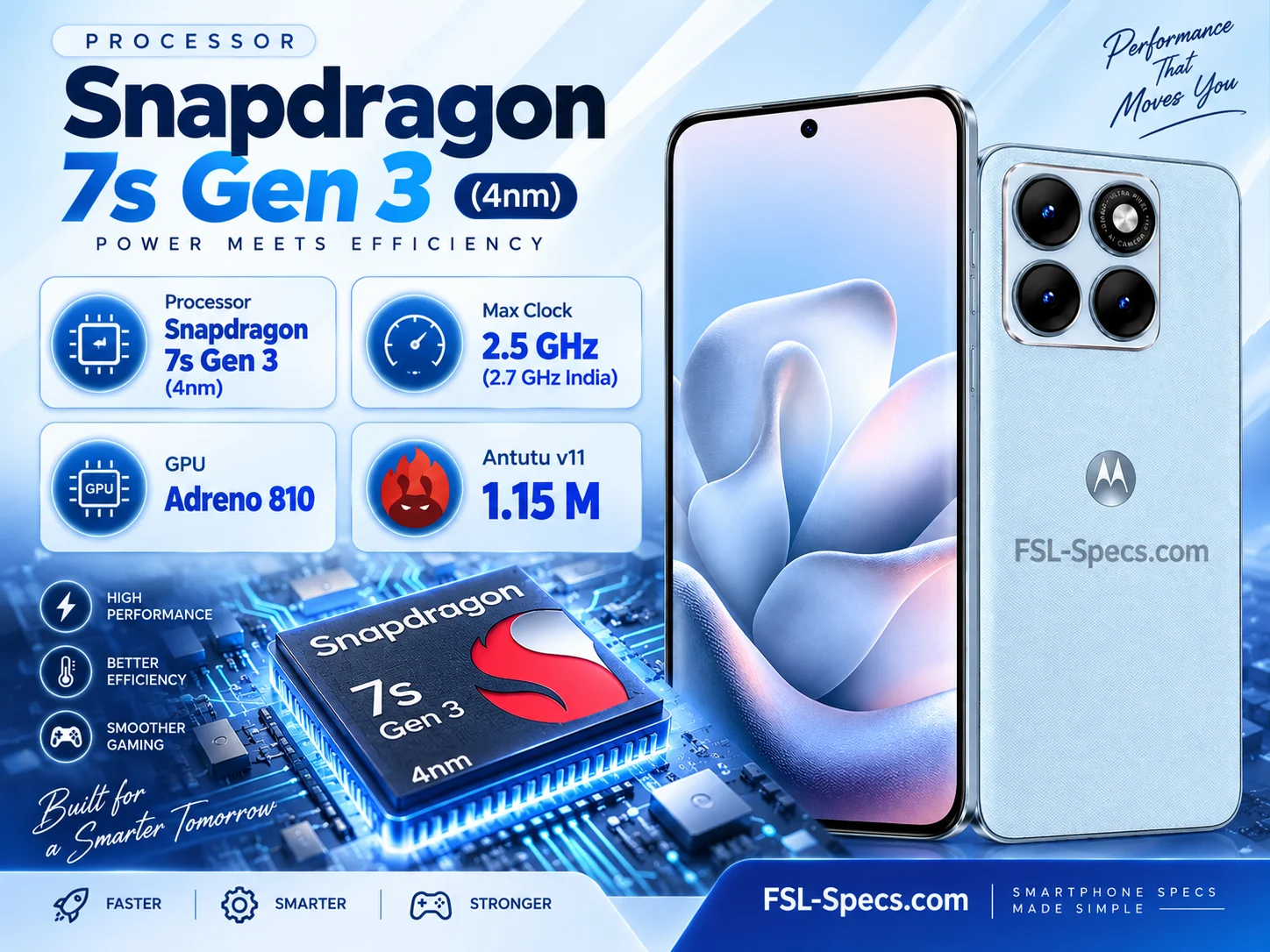
The Motorola Edge 70 Fusion runs on the Snapdragon 7s Gen 3, though several trackers mislabel the chip as the newer Snapdragon 7s Gen 4, and the Motorola Edge 70 Fusion posts an AnTuTu 11 score of 1,149,292 (CPU 427,431, GPU 199,135). That sits close to the Samsung Galaxy A57, whose Exynos 1680 shows unusually inconsistent AnTuTu 11 results across outlets, from 1,120,000 up to 1,422,456 depending on the test unit and software build, a wider spread than any other phone in this group.

The Realme 15 Pro‘s Snapdragon 7 Gen 4 is officially rated at “exceeding 1.1 million” on AnTuTu without a stated version, and independent retests have landed anywhere from 1,023,340 to over 1,100,000, a range that still points to the Realme 15 Pro edging out the Motorola Edge 70 Fusion in raw compute. One AnTuTu v10 listing shows an identical 1,015,000 score for both the Edge 70 Fusion and the Realme 15 Pro despite their different chipsets, which reads as a tracking error rather than a genuine tie and isn’t reliable.

The Vivo V70 FE‘s Dimensity 7360 Turbo is essentially a rebadged Dimensity 7300, and its AnTuTu 11 result is similarly disputed: fsl-specs.com’s earlier testing recorded 1,183,301, while an independently tested retail unit scored just 961,227, the weakest of the four either way. Reviewers note the Vivo V70 FE’s compound AnTuTu total flatters its actual CPU output, since fast RAM and storage prop up the score while sustained CPU tasks trail the Snapdragon and Exynos chips here. For gaming, the Realme 15 Pro’s 30% GPU uplift over its predecessor gives it the clearest edge, ahead of the Motorola Edge 70 Fusion and Samsung Galaxy A57, with the Vivo V70 FE bringing up the rear on real-world processing despite its competitive-looking benchmark total.

Verdict: The Realme 15 Pro’s Snapdragon 7 Gen 4 is the strongest and most consistently benchmarked chip of the four, while the Vivo V70 FE’s Dimensity 7360 Turbo is the weakest performer once you look past its compound AnTuTu score.

Ram & Memory Review:

At 12GB, the Motorola Edge 70 Fusion matches the RAM on offer from the Realme 15 Pro, but the Realme 15 Pro doubles the storage at 512GB against the Edge 70 Fusion’s 256GB, the single biggest memory-tier gap in this comparison. Both use UFS 3.1 storage, and Motorola pairs its RAM with LPDDR5X, though some retailer listings for lower-tier Edge 70 Fusion configurations mention LPDDR4X instead, an inconsistency worth flagging rather than resolving in the phone’s favor.

The Realme 15 Pro’s RAM type is similarly unsettled across sources, with some listing LPDDR5 and others LPDDR4X for the same 512GB unit, so buyers chasing peak multitasking speed shouldn’t treat either figure as fully locked down. The Samsung Galaxy A57 and Vivo V70 FE both come in at 8GB RAM with 256GB of UFS 3.1 storage, putting them a full RAM tier behind the Motorola Edge 70 Fusion and Realme 15 Pro on paper, though the Vivo V70 FE’s LPDDR5 and the Galaxy A57’s LPDDR5X are at least consistently reported.

None of these four phones includes a microSD slot, so storage headroom depends entirely on the tier bought at checkout, and the Realme 15 Pro’s 512GB option is the only one here that meaningfully cushions against running low on space. For heavy multitasking and split-screen use, the extra 4GB of RAM on the Motorola Edge 70 Fusion and Realme 15 Pro should keep more background apps alive than the 8GB Samsung Galaxy A57 or Vivo V70 FE, though the practical difference will be modest for most everyday users rather than power users juggling many apps at once.

Verdict: The Realme 15 Pro is the strongest memory pick here on storage headroom alone, with the Motorola Edge 70 Fusion a close second on RAM parity, while the Samsung Galaxy A57 and Vivo V70 FE’s 8GB/256GB configurations are adequate but the least future-proof of the four.

Cameras Review:

The Motorola Edge 70 Fusion pairs a 50MP Sony LYT-710 main sensor (f/1.8, OIS) with a 13MP ultrawide that doubles as an autofocus macro camera, the only ultrawide in this group confirmed to carry its own autofocus rather than a fixed-focus lens. The Samsung Galaxy A57 goes wider on paper with three rear cameras, a 50MP Sony IMX906 main sensor (f/1.8, OIS, PDAF) plus a 12MP fixed-focus ultrawide and a 5MP macro lens, though Samsung’s own materials and independent testing agree the ultrawide and the 12MP selfie camera both lack autofocus.

The Realme 15 Pro matches resolution on both rear cameras with a 50MP Sony IMX896 main sensor (f/1.8, OIS, 2x in-sensor zoom) and a 50MP ultrawide (f/2.0, 116°), the highest-resolution ultrawide of the four, and its 50MP selfie camera also leads the front-camera count outright. The Vivo V70 FE leans on raw resolution instead, with a 200MP Samsung ISOCELL HP5 main sensor (f/1.88, OIS, PDAF) but only an 8MP ultrawide, the lowest ultrawide resolution here, and reviewers note the ultrawide has no autofocus.

None of the four phones includes a dedicated telephoto lens, so zoom shots across the whole group rely on digital cropping rather than optical magnification. For selfies, the Realme 15 Pro’s 50MP sensor and the Vivo V70 FE’s 32MP sensor both outresolve the Motorola Edge 70 Fusion’s 32MP unit on paper,

while the Samsung Galaxy A57’s 12MP front camera is the lowest-resolution selfie shooter of the four despite Samsung’s Super HDR processing. All four rear main cameras carry OIS, so stabilization isn’t a differentiator here, but the Motorola Edge 70 Fusion’s autofocus ultrawide is a genuine practical edge for close-up and macro shots that the Galaxy A57, Realme 15 Pro, and Vivo V70 FE don’t clearly offer.

Verdict: The Realme 15 Pro has the most balanced and highest-resolution camera set of the four, but the Motorola Edge 70 Fusion’s autofocus ultrawide gives it a real everyday advantage for macro shooting that its higher-megapixel rivals lack.

Battery Review:

The Samsung Galaxy A57 is the outlier on capacity with a 5,000mAh cell, well behind the 7,000mAh batteries in the Motorola Edge 70 Fusion, Realme 15 Pro, and Vivo V70 FE, though its 45W wired charging still gets it to full in 69 minutes in GSMArena’s lab test, faster on paper than its actual battery deficit would suggest.

That said, independent testing from TechARP found the Samsung Galaxy A57 barely benefits from a genuine 45W charger over a 25W one, a gap of just 2 minutes, which raises real doubts about whether the phone fully uses its rated wattage. Among the three 7,000mAh phones, charging speed separates them clearly: the Vivo V70 FE‘s 90W FlashCharge hits 100% in 60 minutes by vivo’s own spec, the Realme 15 Pro‘s 80W SuperVOOC charges to around two-thirds in 30 minutes and finishes in just under an hour, and the Motorola Edge 70 Fusion‘s 68W TurboPower is the slowest of the three, with GSMArena’s hands-on test clocking 50% in 28 minutes and 100% in 1 hour 7 minutes.

The Motorola Edge 70 Fusion and Vivo V70 FE both support reverse wired charging for topping up accessories, a feature not confirmed for the Realme 15 Pro or the Samsung Galaxy A57. None of the four phones offers wireless charging, so that’s a level playing field rather than a differentiator.

For anyone prioritizing raw capacity over charging speed, the Motorola Edge 70 Fusion, Realme 15 Pro, and Vivo V70 FE all offer a meaningful buffer over the Samsung Galaxy A57’s smaller cell, but the Vivo V70 FE and Realme 15 Pro get that same capacity back into a usable state noticeably faster than the Motorola Edge 70 Fusion does.

Verdict: The Vivo V70 FE and Realme 15 Pro offer the best combination of large capacity and fast charging, while the Samsung Galaxy A57’s smaller 5,000mAh battery and questionable real-world 45W charging leave it the weakest of the four on this front.

Final Verdict :

Across display, processor, memory, camera, and battery, the Realme 15 Pro comes out on top in nearly every section covered here, and at PKR 129,000 it undercuts the Motorola Edge 70 Fusion’s PKR 134,000 while still delivering a brighter 144Hz display, a stronger Snapdragon 7 Gen 4 chipset, double the storage at 512GB, and a more balanced camera setup. That combination of lower price and better specs across the board makes it the clear overall winner of this comparison, not by a slim margin but by a meaningful one.

The Motorola Edge 70 Fusion takes second place: it matches the Realme 15 Pro’s 12GB of RAM and 144Hz refresh rate, and its autofocus ultrawide camera is a genuine practical advantage none of the other three phones can claim, but its Snapdragon 7s Gen 3 trails the Realme 15 Pro’s chip and its 68W charging is the slowest of the three 7,000mAh phones here.

The Vivo V70 FE lands third. Its 90W charging and 7,000mAh battery are the fastest-charging combination in the group, and at PKR 120,000 it’s the cheapest phone here, but the weak Dimensity 7360 Turbo and an 8MP ultrawide with no autofocus hold back its overall standing despite the aggressive price. The weighting here favors real-world usability over raw numbers: a phone’s CPU ceiling and camera versatility matter more day to day than a compound AnTuTu score, which is why the Vivo V70 FE’s inflated benchmark total doesn’t lift it past the Motorola Edge 70 Fusion.

The Samsung Galaxy A57 finishes last. At PKR 148,000, it’s the most expensive phone in this comparison while offering the smallest battery, the lowest-resolution display, and 8GB of RAM against the 12GB found on two rivals, a mismatch between price and hardware that’s hard to justify against the other three options.

Bottom line: The Realme 15 Pro is the strongest all-around pick in this comparison, and the Samsung Galaxy A57 is the weakest value given what it charges for what it offers.

RankDisplayProcessorRAM & MemoryCameraBattery
1Realme 15 ProRealme 15 ProRealme 15 ProRealme 15 ProVivo V70 FE
2Motorola Edge 70 FusionSamsung Galaxy A57Motorola Edge 70 FusionMotorola Edge 70 FusionRealme 15 Pro
3Vivo V70 FEMotorola Edge 70 FusionSamsung Galaxy A57Samsung Galaxy A57Motorola Edge 70 Fusion
4Samsung Galaxy A57Vivo V70 FEVivo V70 FEVivo V70 FESamsung Galaxy A57

Ranking:

  1. Realme 15 Pro – PKR 129,000
  2. Motorola Edge 70 Fusion – PKR 134,000
  3. Vivo V70 FE – PKR 120,000
  4. Samsung Galaxy A57 – PKR 148,000

Pros And Cons of Motorola Edge 70 Fusion

Pros of Mobile

✅ Massive battery — 7000mAh 🔋
✅ Autofocus ultrawide — macro-capable 📷
✅ Smooth display — 144Hz panel 🖥️
✅ Generous RAM — 12GB LPDDR5X 💾
✅ Rugged build — IP68/IP69 🛡️
✅ Reverse charging — power-share 🔌

Cons of Mobile

❌ Slow charging — 68W only ⚡
❌ No wireless charging — wired-only 🚫🔌
❌ No microSD — fixed 256GB 💾
❌ Dated chipset — Snapdragon 7s Gen3 🧠
❌ No telephoto — digital zoom 🔍

Best For - Not Best For

Best For

🎯 Battery-life seekers 🔋
🎯 Macro photography fans 🌸
🎯 Outdoor screen use ☀️
🎯 Durability-focused buyers 🛡️
🎯 Multitasking scrollers 🖥️

Not Best For

🚫 Heavy gamers 🎮
🚫 Fast-charging fans ⚡
🚫 Zoom photographers 🔭
🚫 Storage hoarders 💾
🚫 Wireless charging users 🔌

Trailer And Unboxing of Motorola Edge 70 Fusion

Disassembly Or Teardown And Gaming Test of Motorola Edge 70 Fusion

Camera Test Motorola Edge 70 Fusion

Vivo V70 FE
Realme 15 Pro
Motorola Edge 70
Samsung Galaxy A57
Infinix Note 60 Pro

Motorola Series Row
Picture of Faisal Ur Rehman

Faisal Ur Rehman

Faisal Rehman is the founder and editor of FSL Specs, where he publishes in-depth smartphone specifications, comparisons, buying guides, and technology insights. With extensive experience in mobile hardware research and technical analysis, he provides accurate and up-to-date information on Android smartphones, processors, displays, cameras, batteries, performance benchmarks, and software features. His goal is to simplify complex specifications and help readers choose the right device with confidence.

FAQs Questions

It runs on the Snapdragon 7s Gen 3 internationally, or the Snapdragon 7s Gen 4 in the India variant, both paired with Adreno 810 graphics. Either way, it's a genuine step up over the previous Edge 60 Fusion in raw performance.

It has a large 6.78-inch AMOLED screen with 1272 x 2772 resolution, a 144Hz refresh rate, and up to 5200 nits peak brightness. That brightness rating alone puts it among the best outdoor-visible screens in its price class.

The main camera is a 50MP Sony sensor with OIS and multi-directional PDAF, paired with a 13MP ultra-wide lens that also has autofocus. The front camera is a 32MP shooter capable of 4K video, giving it a genuinely well-rounded setup for the price.

The India version gets a large 7,000mAh silicon-carbon battery, while some other regions ship with a smaller 5,200mAh unit — so it's worth checking which variant you're buying. Both support 68W wired fast charging.

It comes in 8GB and 12GB RAM options with 128GB, 256GB, or 512GB storage, though it isn't expandable via microSD in most markets. The 12GB/256GB combo is generally the sweet spot for most buyers.

Yes, it carries dust and water resistance, which is a genuinely nice inclusion for a phone at this price point. It adds real peace of mind for everyday accidents like rain or spills.

It ships with Android 16 and Motorola's near-stock software, backed by up to three major Android upgrades. That's a solid, if not class-leading, update commitment for the segment.

The Motorola Edge 70 Fusion 8+256 is priced at approximately PKR 134,000, ₹33000 , and $330 USD, although prices may vary by region and retailer.

Leave a Reply

Your email address will not be published. Required fields are marked *

Scroll to Top