



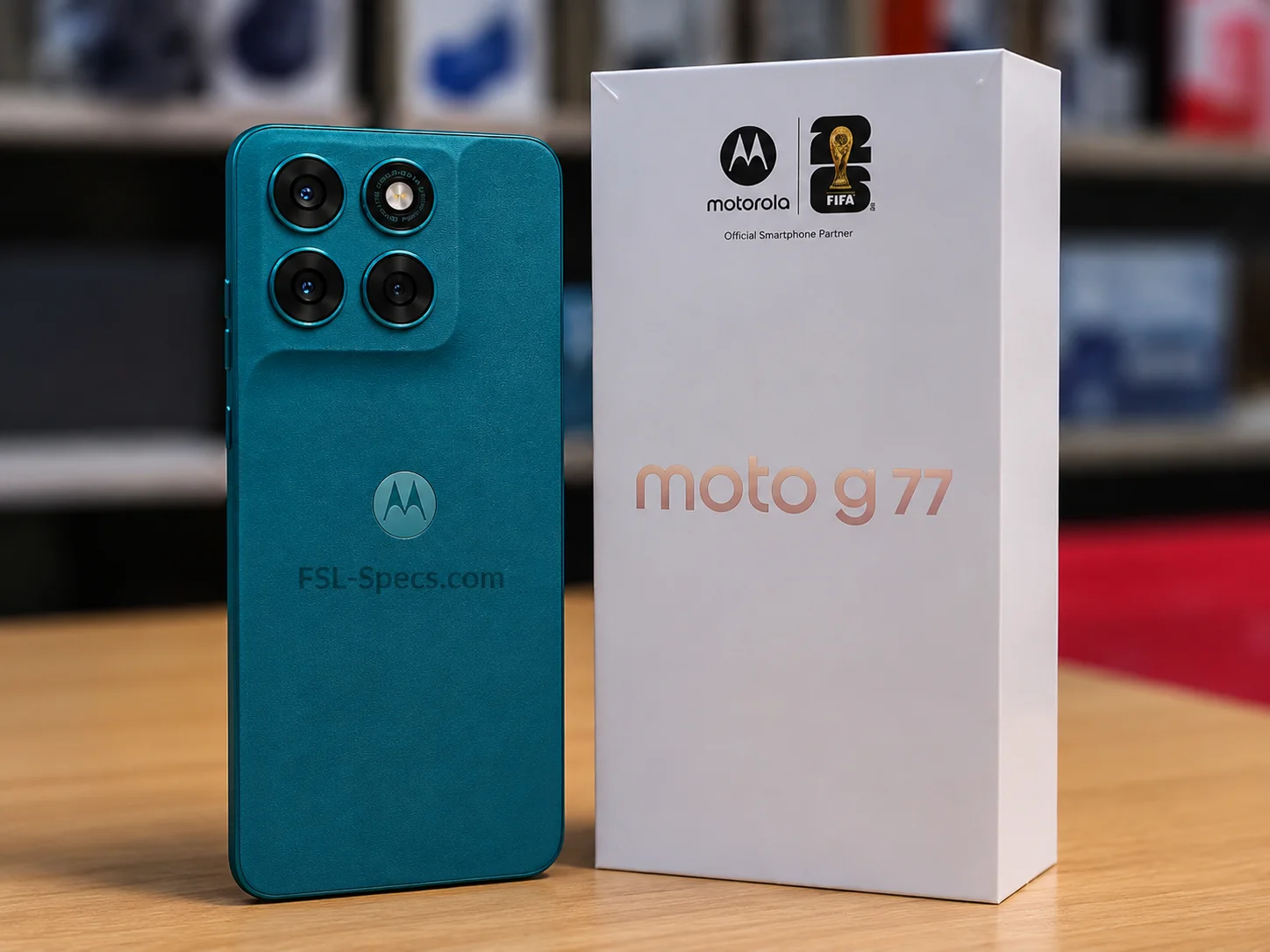

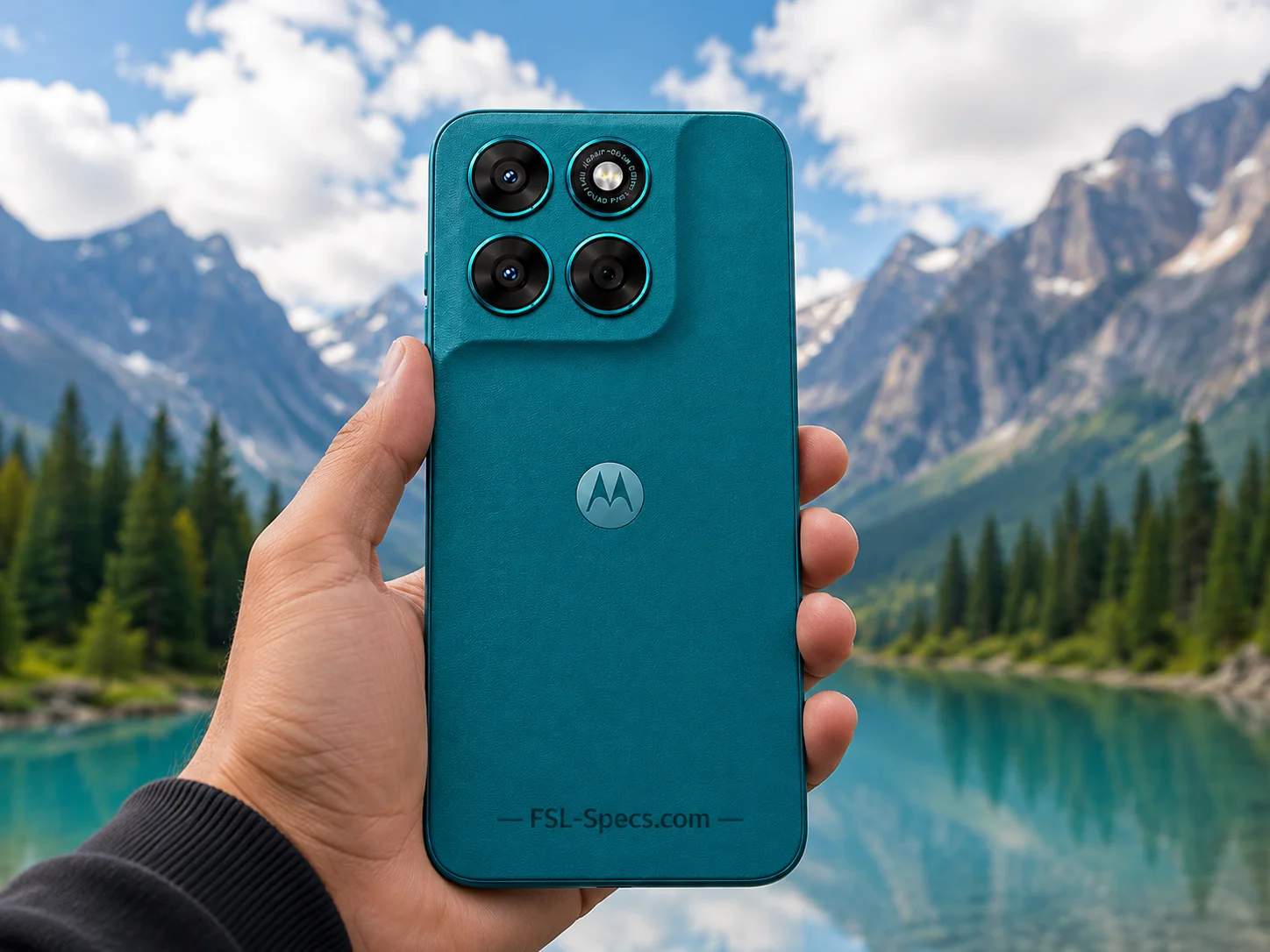


















✪ Motorola Moto G77 Power ✪

Motorola Moto G77 Power Specs, Camera, Battery & Best Review (2026)
United States flag United States
$240 USD
Pakistan flag Pakistan (PKR)
80,000 PKR
India flag India (INR)
₹22,000 INR

✪ Motorola Moto G77 Power ✪

Motorola Moto G77 Power Specs, Camera, Battery & Best Review (2026)
Last Time Update : 13 August, 2026
0

Quick Specifications

IPS LCD

Display Type

Dimensity 6400

Processor

8+128 GB

Ram And Memory

50+ 8 MP

Camera

7000 mAh

Battery

30 W

Fast Charging

Full Specification

BASIC INFO
Mobile
Motorola Moto G77 Power
Model
PBDV0007IN
Series
Moto Series
Category
Mid-range
Release Date
13 January,2026
Year
2026
CONNECTIVITY
Sim
Dual SIM, Nano-SIM
Network
4G / 4G+ / 5G
WiFi
Wi-Fi 5 (802.11 a/b/g/n/ac)
Bluetooth
5.4
NFC
Yes
OS
Android 16, up to 1 major OS updates
BODY
Dimensions
166.2 x 76.5 x 8.9 mm
Build
si-polymer (eco leather) back, plastic frame
KG Weight
215 g
Screen Size
6.72 inch
Resolution
1080 x 2400 pixels
Type
IPS LCD
Refresh Rate
120 Hz
Peak Brightness
Not Confirm
HBM Brightness
1000 Nits
Processor
Dimensity 6400
Max Clock
2.5 GHz
Lithography
6 nm
GPU
Mali-G57 MC2
CPU Cores
8 Cores
Antutu v11
590 K
Antutu v10
450 K
Bootup Time
Not
Architecture
2 x 2.5 GHz Cortex-A76
6 x 2.0 GHz Cortex-A55
Ram Memory
8+128 GB
Ram Type
LPDDR4X
Storage Type
UFS 2.2
SD Card
Yes
Variants
4+128 GB
8+128 GB
MP
Rear Camera
50+ 8 MP
Front Camera
32 MP
SENSORS
Camera Sensors
50 MP = Sony LYTIA 600
Front Sensors
32 MP = Not Confirm
RECORDING FPS
Main Recording
2K@30 FPS
1080p @ 60 FPS
Front Recording
2K@30 FPS
1080p @ 30 FPS
RESOLUTION
Main Resolution
8150 x 6150 pixels
Front Resolution
6,532 × 4,899 pixels
ZOOM
Optical Zoom
-
D Digital Zoom
10 x
Stabilization
Digital
FLASH
Flash
LED Flash
Front Flash
Screen Flash
Capacity
7000 mAh
Fast Charging
30 W
Wireless Charging
No
Li Battery Type
Li-Polymer
REVERSE
Reverse Wired
6 W
Reverse Wireless
No
OTHER
Battery PC Marks
Not Confirm
Charging Time
Not Confirm
AUDIO & SENSORS
Speaker
Dual Stereo Speaker
Fingerprint Sensor
Front Finger
Other Sensors
– Proximity sensor
– Gyroscope
– Accelerometer
– Ambient light sensor
– Compass
– Fingerprint
Special Features

BASIC INFO
Mobile
Motorola Moto G77 Power
Model
PBDV0007IN
Series
Moto Series
Category
Mid-range
Release Date
13 January,2026
Year
2026
CONNECTIVITY
Sim
Dual SIM, Nano-SIM
Network
4G / 4G+ / 5G
WiFi
Wi-Fi 5 (802.11 a/b/g/n/ac)
Bluetooth
5.4
NFC
Yes
OS
Android 16, up to 1 major OS updates
BODY
Dimensions
166.2 x 76.5 x 8.9 mm
Build
si-polymer (eco leather) back, plastic frame
KG Weight
215 g
Screen Size
6.72 inch
Resolution
1080 x 2400 pixels
Type
IPS LCD
Refresh Rate
120 Hz
Peak Brightness
Not Confirm
HBM Brightness
1000 Nits
Processor
Dimensity 6400
Max Clock
2.5 GHz
Lithography
6 nm
GPU
Mali-G57 MC2
CPU Cores
8 Cores
Antutu v11
590 K
Antutu v10
450 K
Bootup Time
Not
Architecture
2 x 2.5 GHz Cortex-A76
6 x 2.0 GHz Cortex-A55
Ram Memory
8+128 GB
SD Card
Yes
Ram Type
LPDDR4X
Storage Type
UFS 2.2
Variants
4+128 GB
8+128 GB
MP
Rear Camera
50+ 8 MP
Front Camera
32 MP
SENSORS
Main Camera Sensors
50 MP = Sony LYTIA 600
Front Camera Sensors
32 MP = Not Confirm
RECORDING FPS
Main Recording
2K@30 FPS
1080p @ 60 FPS
Front Recording
2K@30 FPS
1080p @ 30 FPS
RESOLUTION
Main Resolution
8150 x 6150 pixels
Front Resolution
6,532 × 4,899 pixels
ZOOM
Optical Zoom
-
D Digital Zoom
10 x
Stabilization
Digital
FLASH
Flash
LED Flash
Front Flash
Screen Flash
Capacity
7000 mAh
Fast Charging
30 W
Wireless Charging
No
Li Battery Type
Li-Polymer
REVERSE
Reverse Wired
6 W
Reverse Wireless
No
OTHER
Battery Life PCMark
Not Confirm
Charging Time
Not Confirm
AUDIO & SENSORS
Speaker
Dual Stereo Speaker
Fingerprint Sensor
Front Finger
Other Sensors
– Proximity sensor
– Gyroscope
– Accelerometer
– Ambient light sensor
– Compass
– Fingerprint
Special Features

Highlights & Review Of Motorola Moto G77 Power

Display Review:

The Motorola Moto G77 Power runs a 6.72-inch FullHD+ LCD display at 2400×1080, a 120Hz refresh rate, and up to 1050 nits HBM brightness, protected by Corning Gorilla Glass 7i. It’s a competent panel, but the choice of LCD over AMOLED is already a step behind where most rivals in this bracket have moved.

Against the Infinix Note Edge 5G (85,000 PKR): the gap is immediate. The Note Edge runs a 6.78-inch AMOLED panel at 1208×2644, the same 120Hz refresh rate, but with a massively higher 4500-nit peak brightness (1600 nits HBM, 700 nits typical) against the Motorola Moto G77 Power 1050-nit HBM ceiling. AMOLED alone gives the Note Edge deeper contrast and better outdoor visibility, and it isn’t close.

Against the Xiaomi Redmi Note 15 Pro (90,000 PKR): this is the sharpest display in the entire comparison. Its 6.83-inch 1.5K CrystalRes AMOLED panel runs at 2772×1280 with a 3200-nit peak brightness, nearly triple the Moto’s HBM figure, plus a 480Hz touch sampling rate for far more responsive gaming and scrolling. The Redmi’s Gorilla Glass Victus 2 also outclasses the Moto’s 7i for scratch resistance. At the top of this bracket, it earns its price with genuinely flagship-tier display hardware.

Against the realme 14 5G (85,000 PKR): even the smallest-screened rival here beats the Moto on panel type. The realme’s 6.67-inch AMOLED runs 1080×2400 FHD+ with a 2000-nit peak brightness, still roughly double the Moto’s HBM ceiling, at 120Hz with a fast 180Hz touch sampling (1500Hz instant touch in gaming mode).

What this means day to day: every single rival in this bracket uses AMOLED, the Motorola Moto G77 Power is the only LCD panel among the four. That means noticeably weaker contrast, worse outdoor visibility, and a less vivid viewing experience across the board, regardless of which rival you compare it against.

The honest verdict: display is a clear, consistent weakness for the Motorola Moto G77 Power in this bracket. All three rivals beat it decisively, the Redmi Note 15 Pro by the widest margin with its 3200-nit AMOLED. If display quality matters to your buying decision, and it should at this price point, any of the three rivals is the stronger pick, and it’s also part of why the Motorola Moto G77 Power likely hasn’t made it to the Pakistani market at all.

Processor Review:

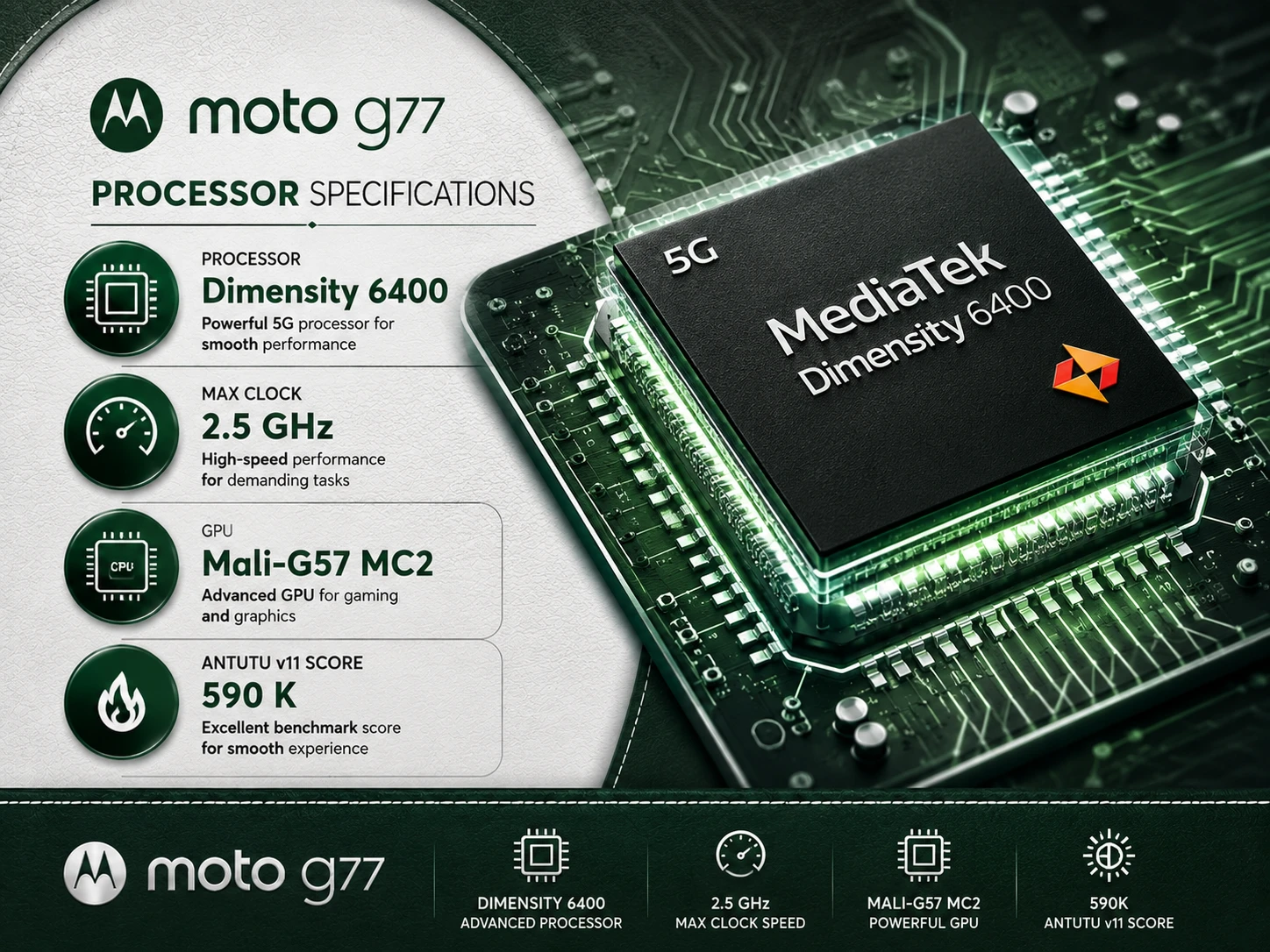
The Motorola Moto G77 Power uses the MediaTek Dimensity 6400, an octa-core 6nm chipset with a maximum clock speed of 2.5GHz and Mali-G57 MP2 GPU. In AnTuTu 11, the Motorola Moto G77 Power has been recorded around 550,018 points, although individual phone tests can vary.

The Infinix Note 60 Edge 5G has a major performance advantage with its MediaTek Dimensity 7100. AnTuTu 11 results for the Dimensity 7100 reach around 835,566 points, while the Note Edge has also produced results around 772,498 points. Using the latter phone result, the Infinix is approximately 40.4% faster than the Moto G77 Power in AnTuTu.

The Redmi Note 15 Pro 4G uses the MediaTek Helio G200-Ultra, with a 6nm process, 2.2GHz performance cores and Mali-G57 MP2 graphics. Its AnTuTu 11 score is around 591,254, giving it roughly a 7.5% performance advantage over the Moto G77 Power. This is a relatively small gap, so everyday performance should be fairly close, although Redmi has a measurable benchmark lead.

The biggest performance winner here is the realme 14 5G, powered by the 4nm Snapdragon 6 Gen 4. realme itself reports an AnTuTu score above 760,000, while NanoReview’s current average is approximately 980,508 in AnTuTu 11. Using the latter figure, the realme is around 78.3% faster than the Motorola Moto G77 Power, giving it substantially more CPU and GPU headroom for gaming and demanding multitasking.

Verdict: The Motorola Moto G77 Power’s Dimensity 6400 is the weakest processor here, with the realme 14 5G clearly leading performance, followed by the Infinix Note 60 Edge 5G, while the Redmi Note 15 Pro is only modestly ahead of Motorola.

Ram & Memory Review:

The Motorola Moto G77 Power comes with 8GB LPDDR4X RAM and 128GB UFS 2.2 storage, with support for a microSD card up to 1TB. This is a balanced memory configuration for the PKR 80,000–90,000 target price, but the 128GB internal storage is clearly its biggest limitation when compared with all three rivals. Motorola officially confirms both the LPDDR4X RAM and UFS 2.2 storage.

The Infinix Note 60 Edge 5G offers 8GB LPDDR4X RAM and 256GB UFS 2.2 storage. That gives Infinix the same RAM capacity and RAM generation as Motorola, but 2× the internal storage, making it considerably better for users who keep large games, videos and photos on the phone. Published specifications also list the 8GB/256GB combination with LPDDR4X and UFS 2.2.

The Redmi Note 15 Pro also uses 8GB LPDDR4X RAM + 256GB UFS 2.2 in the configuration being compared. Xiaomi officially confirms this memory combination, while also offering higher variants. It therefore matches the Infinix for both RAM and storage technology while giving users 100% more storage capacity than the Motorola Moto G77 Power.

The realme 14 5G is the clear capacity winner with 12GB RAM and 512GB storage. realme officially lists the 12GB + 512GB maximum configuration, giving it 50% more physical RAM and 4× the storage of the Motorola Moto G77 Power.

Verdict: The Motorola Moto G77 Power has the weakest memory package here. Its 8GB LPDDR4X + 128GB UFS 2.2 setup is usable, but the Infinix Note 60 Edge 5G and Redmi Note 15 Pro double the storage, while the realme 14 5G dominates with 12GB + 512GB.

Cameras Review:

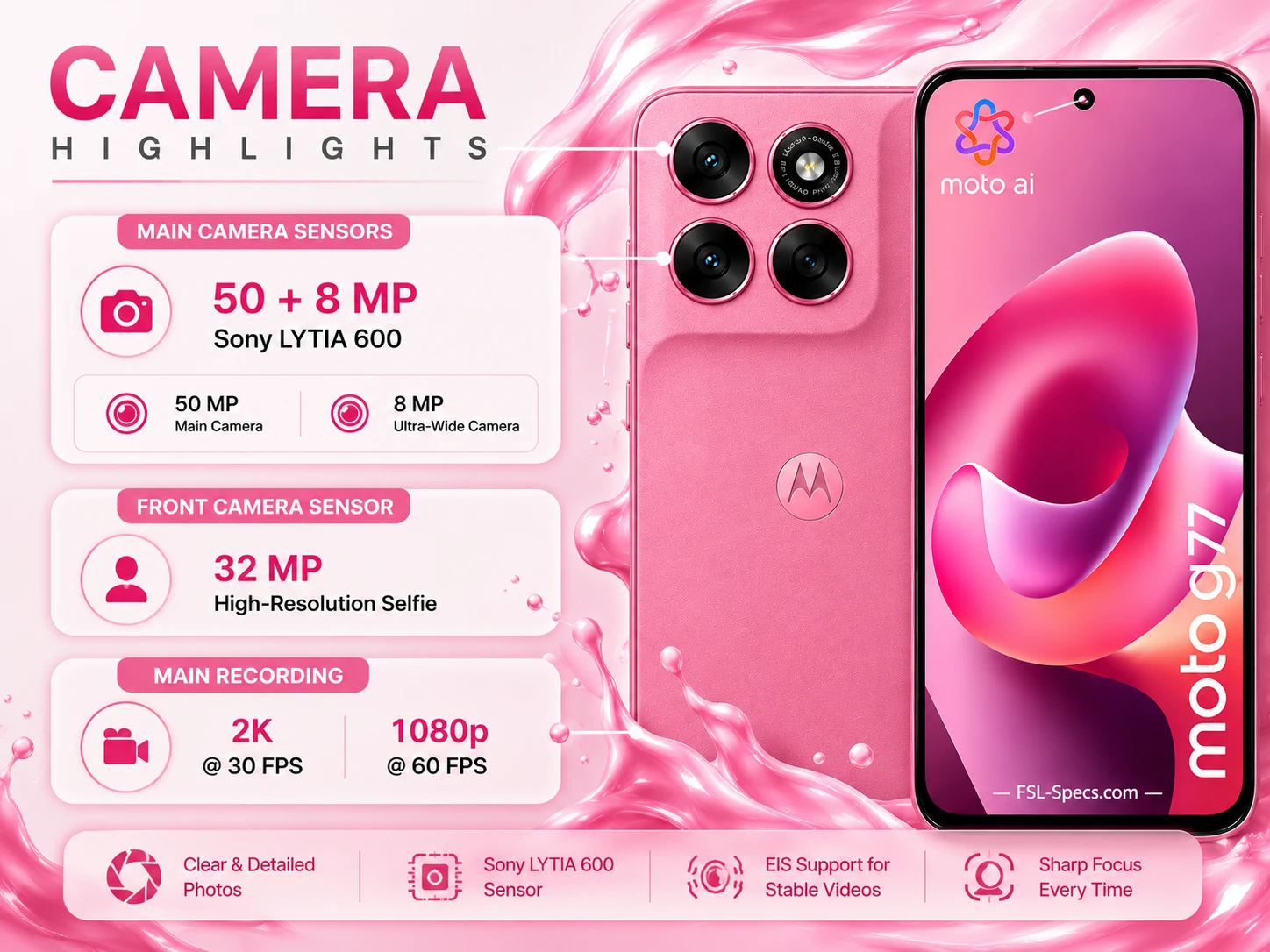
The Motorola Moto G77 Power has a 50MP Sony LYTIA 600 main camera with an f/1.8 aperture, PDAF and a 1/2-inch-class sensor, paired with an 8MP ultra-wide camera offering a 120° field of view. Its 32MP f/2.2 front camera is also one of the stronger selfie specifications in this comparison. Motorola confirms 2K video at 30fps from the main and front cameras, while the rear camera also supports 1080p at 60fps.

The Infinix Note 60 Edge 5G is listed with a 50MP main camera with OIS and a 13MP front camera. The available specifications show the Infinix main camera using autofocus, while video recording is listed up to 1440p at 30fps. This gives Infinix an important advantage in stabilization because the Moto G77 Power’s official specification lists EIS, not OIS, for its main camera.

The Redmi Note 15 Pro is the biggest camera upgrade on paper. It features a 200MP main camera with OIS, a large 1/1.4-inch sensor, f/1.7 aperture, and a 2.24μm effective binned pixel size, alongside an 8MP ultra-wide camera. Its 32MP front camera also matches Motorola’s selfie resolution. Redmi’s main sensor is therefore substantially larger and offers OIS, giving it a stronger hardware foundation for detailed photography and low-light shooting.

The realme 14 5G uses a 50MP OIS main camera with f/1.8 aperture and supports 4K video at 30fps. Its 16MP front camera records up to 1080p at 30fps, so Motorola has the higher-resolution selfie camera, while realme has the stronger rear-video specification.

Verdict: The Redmi Note 15 Pro wins the camera hardware comparison with its 200MP 1/1.4-inch OIS sensor, while the Moto G77 Power offers a respectable Sony LYTIA 600 main camera and the strongest 32MP selfie camera among these rivals.

Battery Review:

The Motorola Moto G77 Power has the largest battery in this comparison, with a 7,000mAh rated battery, while Motorola lists 6,790mAh as the rated capacity and supports 30W TurboPower wired charging. Motorola also rates the phone for up to 59 hours of battery life and supports 6W wired reverse charging. This gives the Moto G77 Power a 7.7% larger typical capacity than the 6,500mAh batteries used by the Infinix and Redmi rivals, but its 30W charging is 33.3% lower in charging power than their 45W systems.

The Infinix Note 60 Edge 5G packs a 6,500mAh battery with 45W charging and 10W reverse charging. Although its battery is smaller than Motorola’s by about 7.1%, its charging system is significantly faster. Infinix states that the phone can reach 50% in 27 minutes, making it more convenient when you need a quick top-up.

The Redmi Note 15 Pro also uses a 6,500mAh battery and 45W turbo charging, plus up to 18W reverse wired charging. Xiaomi reports approximately 92.4 minutes for a full charge in its internal testing. Therefore, Redmi gives up some battery capacity compared with Motorola but offers 50% higher charging power and substantially stronger reverse-charging capability.

The realme 14 5G comes with a 6,000mAh battery and 45W SUPERVOOC charging. Its battery is approximately 14.3% smaller than the Moto G77 Power’s 7,000mAh unit, but realme claims up to 10.5 hours of gameplay on a single charge.

Verdict: The Moto G77 Power wins for maximum battery capacity, while the Infinix Note 60 Edge 5G and Redmi Note 15 Pro offer a better balance of battery size and faster 45W charging.

Final Verdict :

Pros And Cons of Motorola Moto G77 Power

Pros of Mobile

✅ Massive battery 🔋 (7000mAh)
✅ Fast charging ⚡ (30W TurboPower)
✅ Smooth display 🖥️ (120Hz, FHD+)
✅ Durable build 🛡️ (MIL-STD-810H)
✅ Water resistant 💧 (IP64 rating)
✅ Headphone jack 🎧 (3.5mm)

Cons of Mobile

❌ Weaker chipset ⚙️ (Dimensity 6400)
❌ Short OS support 📱 (1 major update)
❌ LCD not AMOLED 🖥️
❌ Limited global reach 🌍 (India-first launch)

Best For - Not Best For

Best For

🎯 Heavy phone users 🔋
🎯 Budget conscious buyers 💰
🎯 Outdoor rugged use 🛡️
🎯 Wired audio fans 🎧
🎯 Travelers no charger 🔌
🎯 Long battery seekers 🔋

Not Best For

🚫 Mobile gamers 🎮
🚫 Slim design lovers 📏
🚫 AMOLED screen fans 🖥️
🚫 Camera enthusiasts 📸
🚫 Premium flagship seekers 💎
🚫 Latest software chasers 📱

Trailer And Unboxing of Motorola Moto G77 Power

Disassembly Or Teardown And Gaming Test of Motorola Moto G77 Power

Camera Test Motorola Moto G77 Power

Xiaomi Redmi Note 15 Pro
Infinix Note Edge 5G
realme 14 5G
Motorola Series Row

FAQs Questions

Picture of Faisal Ur Rehman

Faisal Ur Rehman

Faisal Rehman is the founder and editor of FSL Specs, where he publishes in-depth smartphone specifications, comparisons, buying guides, and technology insights. With extensive experience in mobile hardware research and technical analysis, he provides accurate and up-to-date information on Android smartphones, processors, displays, cameras, batteries, performance benchmarks, and software features. His goal is to simplify complex specifications and help readers choose the right device with confidence.

The Motorola Moto G77 Power is powered by the MediaTek Dimensity 6400, built on a 6nm process. It has an octa-core CPU clocked up to 2.5GHz and uses the Arm Mali-G57 MP2 GPU.

The 8GB + 128GB variant uses LPDDR4X RAM and UFS 2.2 storage. The phone also supports a microSD card up to 1TB, giving users a practical way to expand storage beyond the built-in 128GB

The Dimensity 6400 and Mali-G57 MP2 are suitable for everyday gaming and mainstream titles, but this is not a high-end gaming chipset. The 120Hz display can also make supported games and scrolling feel smoother.

The Moto G77 Power has a 7,000mAh battery, with Motorola listing a 6,790mAh rated capacity. Motorola claims up to 59 hours of battery life, making battery capacity one of the phone's strongest specifications.

Yes. It supports 30W TurboPower wired charging and also offers 6W wired reverse charging, allowing the phone to provide power to another compatible device

The rear setup consists of a 50MP Sony LYTIA 600 main camera with f/1.8 aperture, PDAF and EIS, plus an 8MP 120° ultra-wide camera. The front camera is 32MP f/2.2, and the main rear camera can record up to 2K at 30fps or 1080p at 60fps.

It features a 6.72-inch Full HD+ LCD with 2400 × 1080 resolution, 120Hz refresh rate, 391ppi and a High Brightness Mode reaching up to 1,050 nits.

For your comparison, you are positioning the 8GB + 128GB Moto G77 Power around PKR 80,000–90,000 and treating it as not officially launched in Pakistan. Motorola's official specification page confirms the 8GB + 128GB configuration, but availability and specifications can vary by market.

Leave a Reply

Your email address will not be published. Required fields are marked *

Scroll to Top