





✪ OnePlus Ace 6 Ultra ✪

OnePlus Ace 6 Ultra
Last Time Update : 22 October, 2026
United States flagUnited States
800USD
…iPrice NoteYour Country price depends on USD. Prices may be different in your region due to taxes and duties.
Pakistan flagPakistan (PKR)
250000PKR
India flagIndia (INR)
75000INR

✪ OnePlus Ace 6 Ultra ✪

OnePlus Ace 6 Ultra
Quick Specs
Display
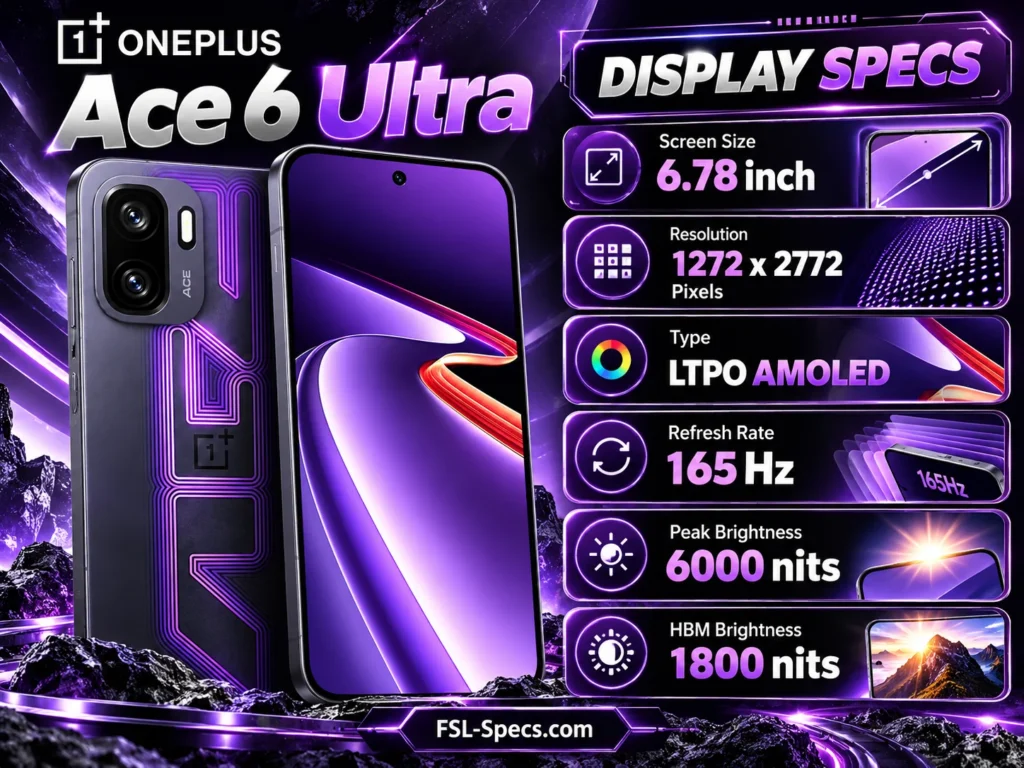
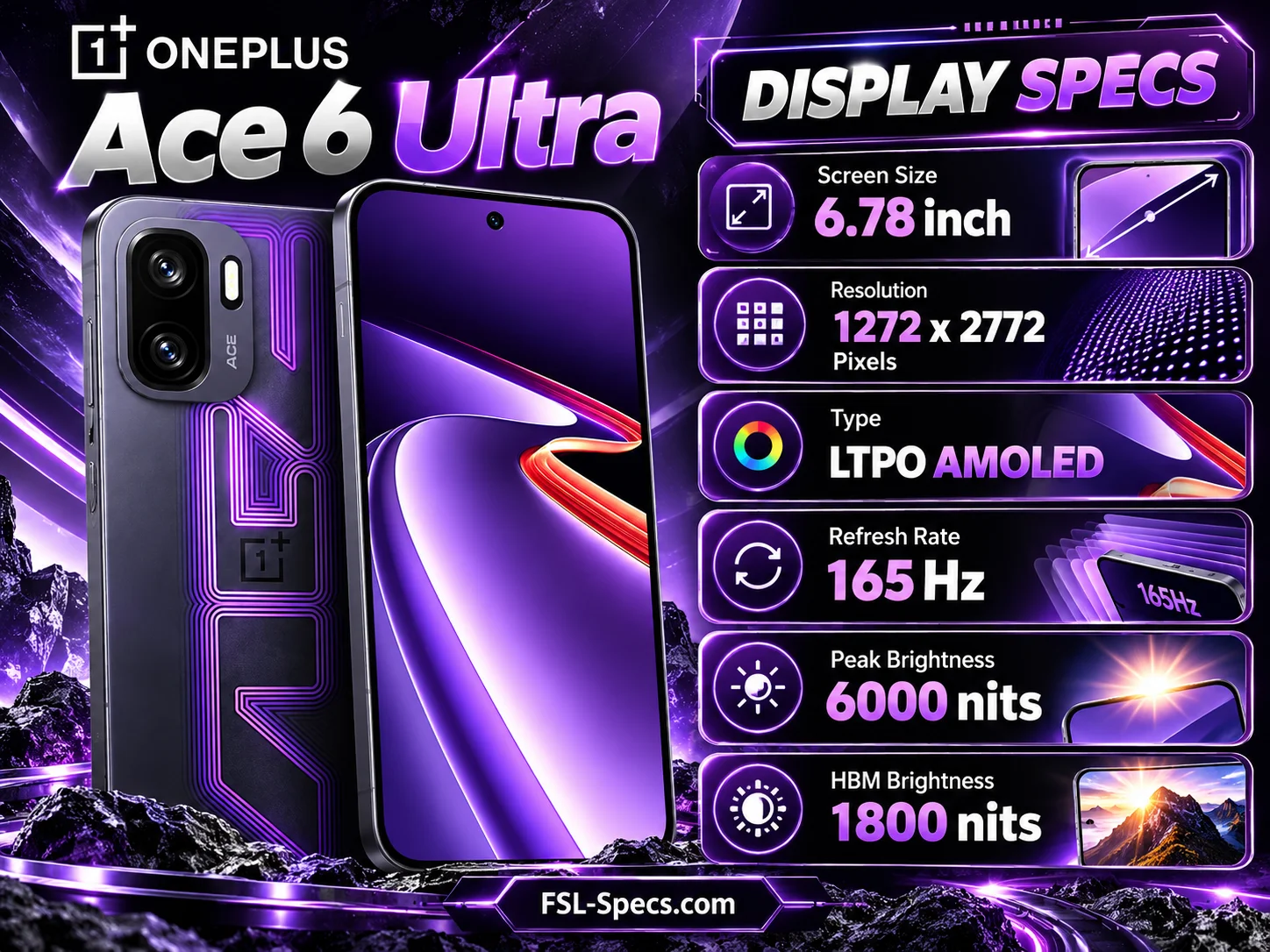
6.78 inchLTPO AMOLED165 Hz
Processor
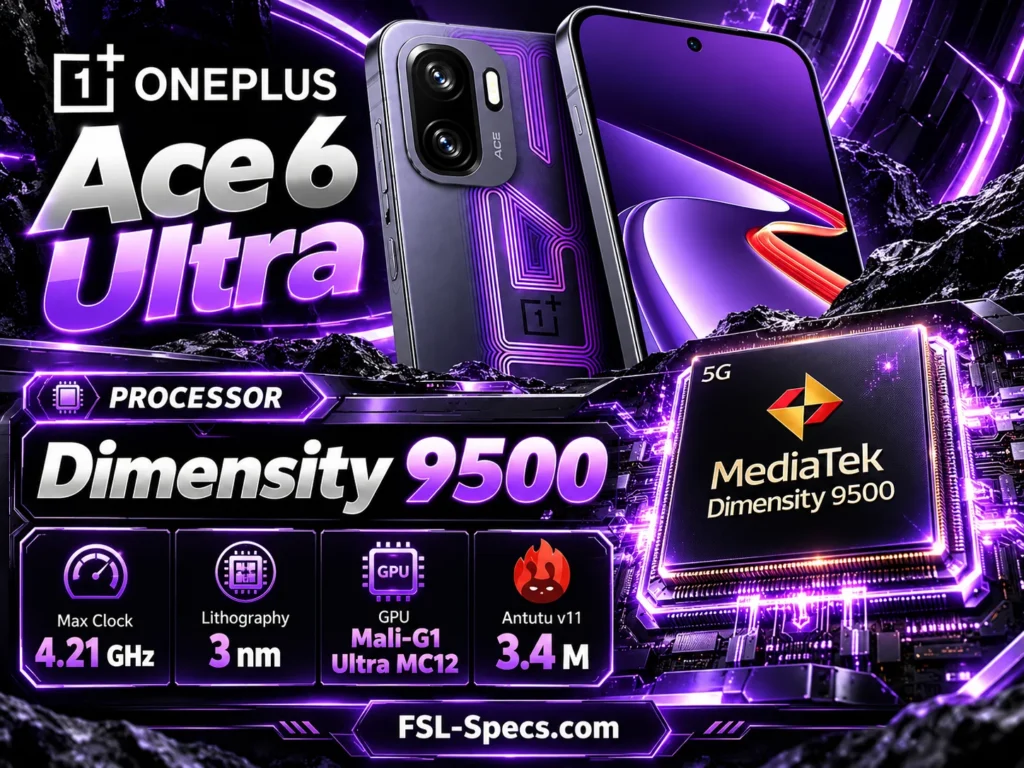
Dimensity 95004.21 GHz
RAM & Storage
16 + 512 GB
Rear Camera
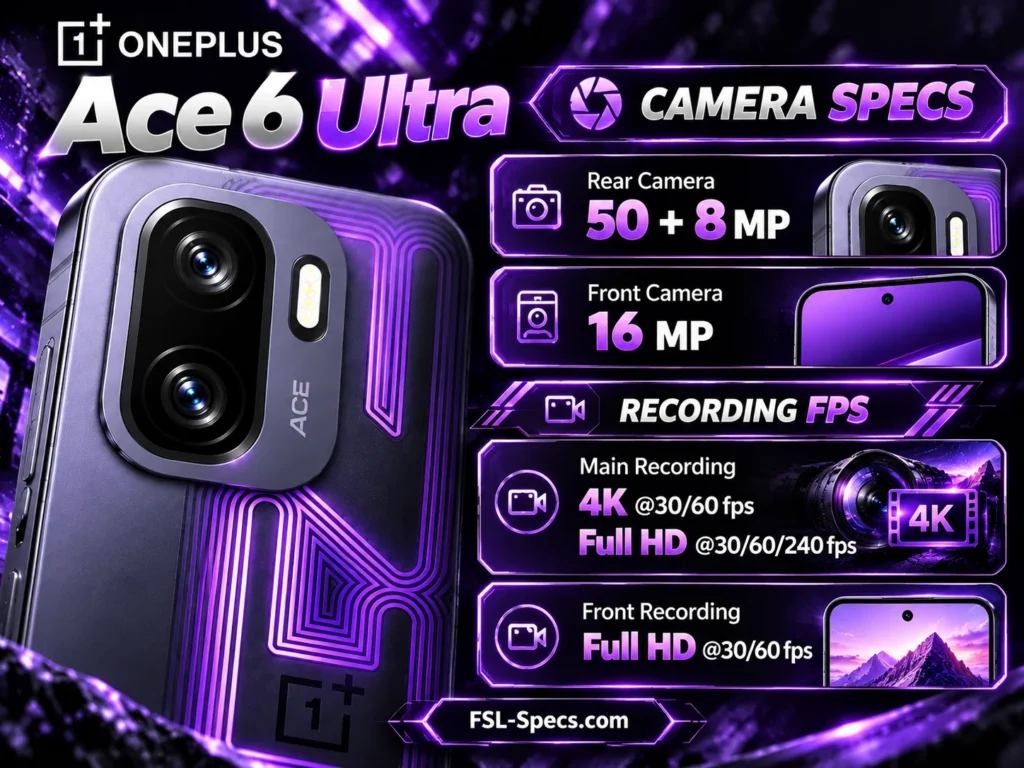
50 +8 MP
Front Camera
16 MP
Battery & Charging
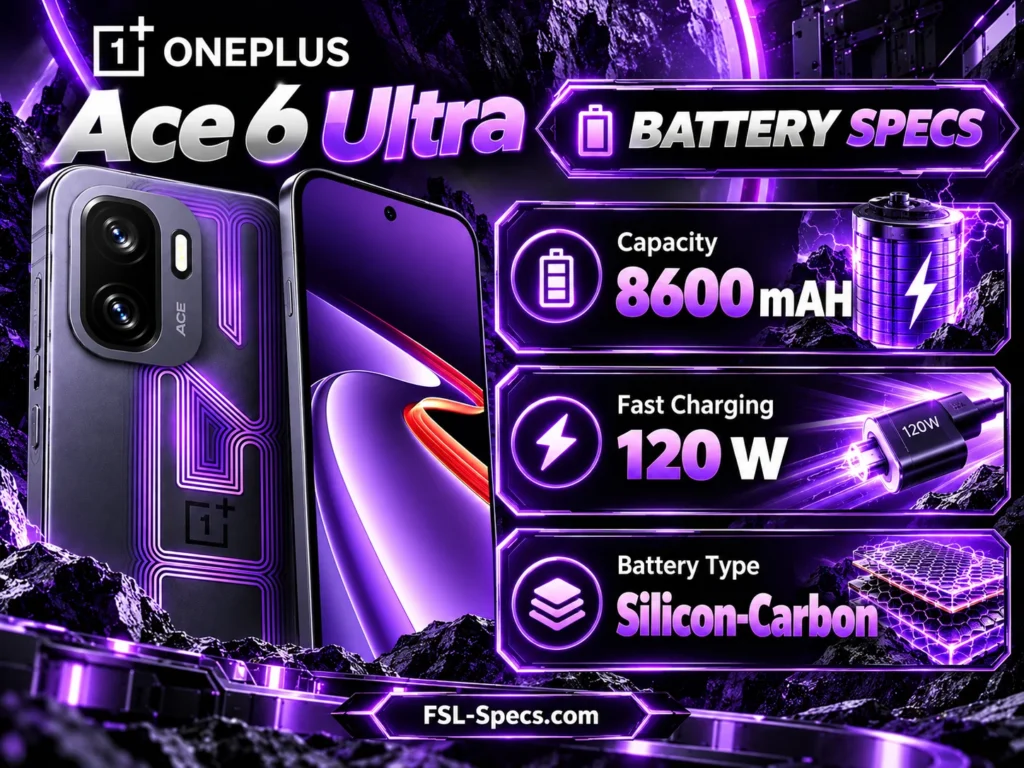
8600 mAH120 W

Full Specification

!
IMPORTANT INFORMATION

Specifications Disclaimer

NOTICE

Specifications are collected from official manufacturers and trusted sources. Actual details may vary by region, model variant, or software updates. We strive for accuracy but cannot guarantee error-free information.

Basic Info

Mobile
OnePlus Ace 6 Ultra
Model
800
Series
OnePlus Ace
Category
Flagship
Release Date
28 April,2026
Year
2026

Connectivity

SIM
Nano-SIM / E-Sim
Network
4G / 4G+ / 5G/ 5G+
WiFi
WiFi 7
Bluetooth
6.0
NFC
Yes / region dependent
OS
Android 16

Body

Dimensions
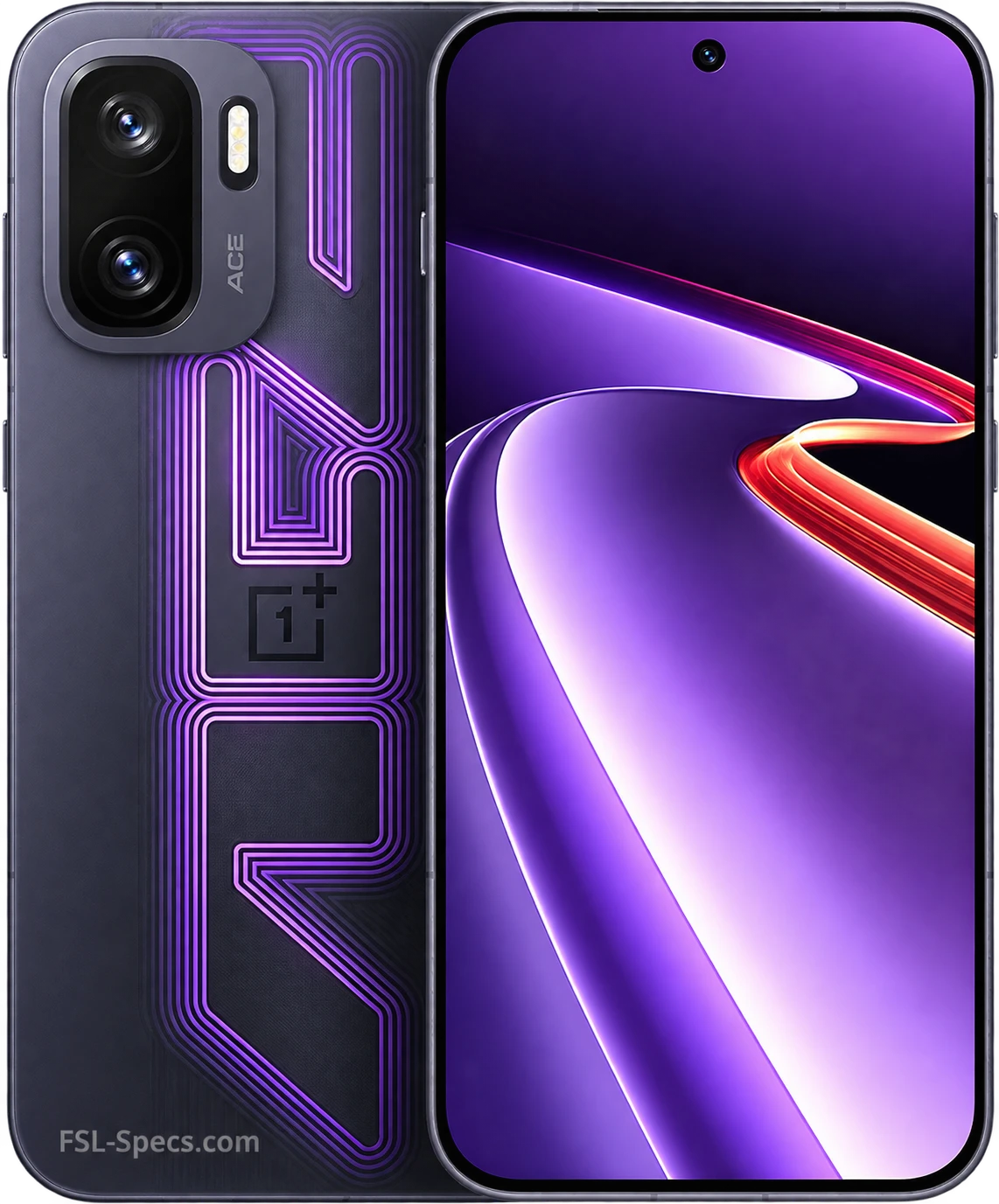
162.5 x 77.5 x 8.5 mm
Build
aluminum frame, glass back
Weight
217 grams
Screen Size
6.78 inch
Resolution
1272 x 2772 Pixels
Type
LTPO AMOLED
Refresh Rate
165 Hz
Peak Brightness
6000 nits
HBM Brightness
1800 nits
Processor Specs
Processor
Dimensity 9500
Processor Link
Max Clock
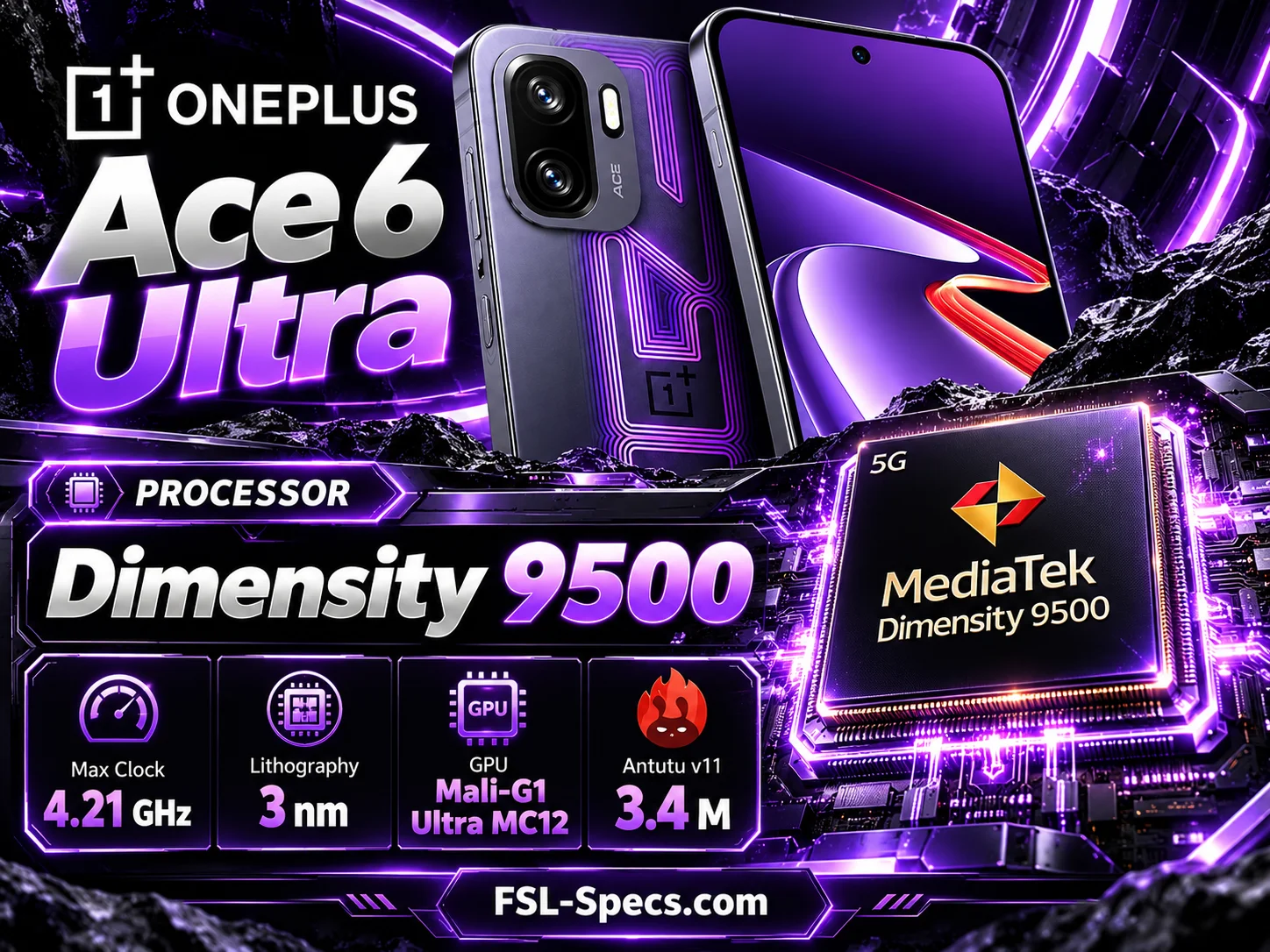
4.21 GHz
Lithography
3 nm
GPU
Mali-G1 Ultra MC12
CPU Cores
8 Cores
Antutu v11
3.4 M
Architecture
4 cores at 2.7 GHz: C1-Pro
3 cores at 3.5 GHz: C1-Premium
1 core at 4.21 GHz: C1-Ultra
RAM & ROM Specs
RAM Memory
16 + 512 GB
RAM Type
LPDDR5X
Storage Type
UFS 4.1
SD Card
No
Variants
12 + 256 / 512 GB
16 + 256 / 512 GB
16 + 1 TB
Camera Specs
MP
Rear Camera
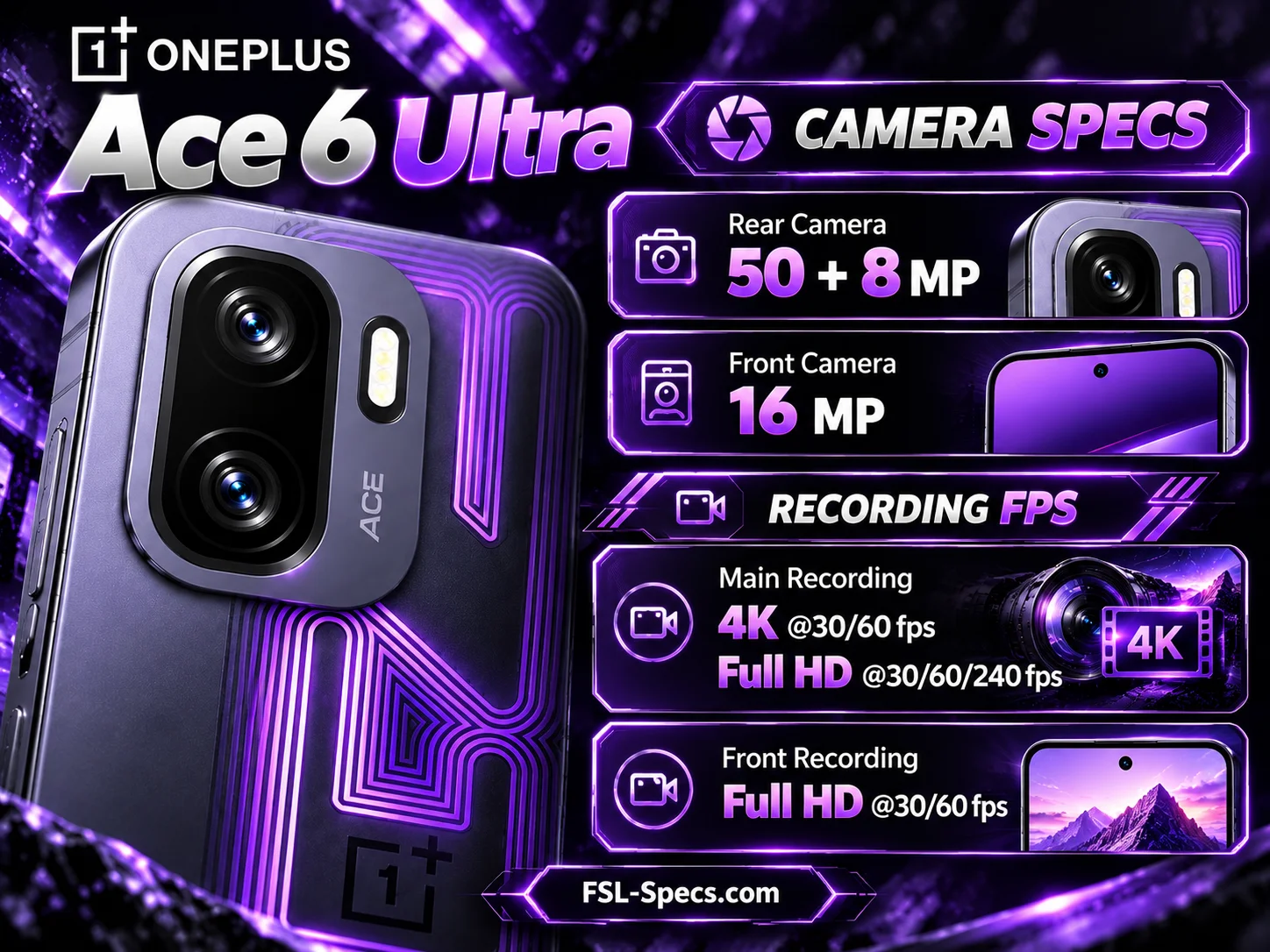
50 +8 MP
Front Camera
16 MP
Recording FPS
Main Recording
4k @30/60 fps
Full HD @30/60/240 fps
Front Recording
Full HD @30/60 fps
Stabilization
Yes
Flash
Flash
LED Flash
Front Flash
Screen Flash
Battery Specs
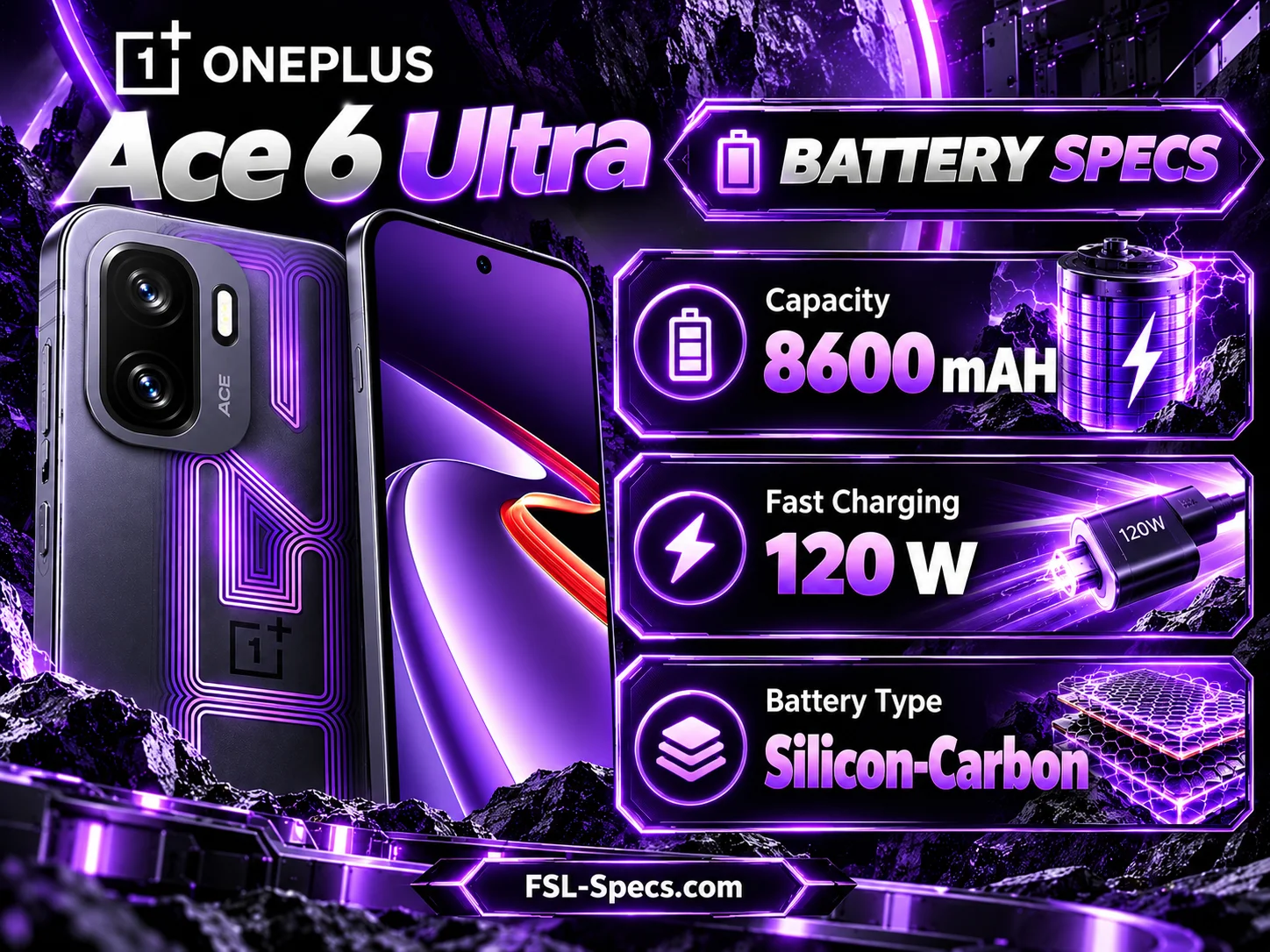
Capacity
8600 mAH
Fast Charging
120 W
Battery Type
Silicon-Carbon
Reverse
Reverse Wired
Yes
Other Specs
Audio & Sensors
Speaker
Dual Stereo Speaker
Fingerprint Sensor
Hyper Sonic Front Finger
Other Sensors
Accelerometer
Gyroscope
Proximity Sensor
Ambient Light Sensor
Electronic Compass (Magnetometer)
Gravity Sensor
Pedometer
IR Blaster
BASIC INFO
Mobile
OnePlus Ace 6 Ultra
Model
800
Series
OnePlus Ace
Category
Flagship
Release Date
28 April,2026
Year
2026
CONNECTIVITY
Sim
Nano-SIM / E-Sim
Network
4G / 4G+ / 5G/ 5G+
WiFi
WiFi 7
Bluetooth
6.0
NFC
Yes / region dependent
OS
Android 16
BODY
Dimensions
162.5 x 77.5 x 8.5 mm
Build
aluminum frame, glass back
Weight
217 grams
Screen Size
6.78 inch
Resolution
1272 x 2772 Pixels
Type
LTPO AMOLED
Refresh Rate
165 Hz
Peak Brightness
6000 nits
HBM Brightness
1800 nits
Processor
Dimensity 9500
Processor Link
Max Clock
4.21 GHz
Lithography
3 nm
GPU
Mali-G1 Ultra MC12
CPU Cores
8 Cores
Antutu v11
3.4 M
Architecture
4 cores at 2.7 GHz: C1-Pro
3 cores at 3.5 GHz: C1-Premium
1 core at 4.21 GHz: C1-Ultra
Ram Memory
16 + 512 GB
SD Card
No
Ram Type
LPDDR5X
Storage Type
UFS 4.1
Variants
12 + 256 / 512 GB
16 + 256 / 512 GB
16 + 1 TB
MP
Rear Camera
50 +8 MP
Front Camera
16 MP
RECORDING FPS
Main Recording
4k @30/60 fps
Full HD @30/60/240 fps
Front Recording
Full HD @30/60 fps
RESOLUTION
Main Resolution
8160 × 6144 Pixels
Stabilization
Yes
FLASH
Flash
LED Flash
Front Flash
Screen Flash
Capacity
8600 mAH
Fast Charging
120 W
Battery Type
Silicon-Carbon
REVERSE
Reverse Wired
Yes
AUDIO & SENSORS
Speaker
Dual Stereo Speaker
Fingerprint Sensor
Hyper Sonic Front Finger
Other Sensors
Accelerometer Gyroscope Proximity Sensor Ambient Light Sensor Electronic Compass (Magnetometer) Gravity Sensor Pedometer IR Blaster

Verify Mobile Specifications

Official information & trusted references

Official Manufacturer WebsiteExplore the original product information (opens in a new tab)

Trusted Specification Sources

Cross-reference · 4 sources

Links open third-party websites. The Purple ticks are a design marker only; they do not mean a source has verified these specifications or endorses FSL-Specs.

Last Time Update : 22 October, 2026

Highlights & Review Of OnePlus Ace 6 Ultra

Display Highlights

Display Highlights

The OnePlus Ace 6 Ultra offers a 6.78-inch, 1.5K AMOLED display with a 165Hz refresh rate, while the Xiaomi 17T Pro features a larger 6.83-inch, 1.5K AMOLED panel with 144Hz refresh. The vivo X200 Ultra prioritizes resolution with its 6.82-inch, 2K AMOLED display, whereas the foldable Motorola Razr 60 Ultra provides a 7.0-inch internal LTPO AMOLED display with a 165Hz refresh rate. At the supplied Pakistan retailer prices of PKR 250,000, PKR 270,000, PKR 260,000 and PKR 290,000, respectively, each phone targets a different display preference.

The OnePlus Ace 6 Ultra uses a 2,772 × 1,272 resolution panel with 10.7 billion colours, 100% DCI-P3 colour coverage, and advertised peak brightness of 3,600 nits at 25% APL. Its 3,840Hz PWM dimming and gaming-focused high refresh rate are designed to support comfortable viewing and responsive gameplay. OnePlus also states that selected supported games can run at 165Hz, while the display intelligently switches between available refresh rates.

The Xiaomi 17T Pro provides 2,772 × 1,280 resolution, 447 ppi, 12-bit colour, Dolby Vision and HDR10+. Its advertised peak brightness reaches 3,500 nits at 25% APL, with separately specified 2,000-nit HBM brightness. The 144Hz refresh rate offers smooth scrolling and gaming, while its larger screen is well suited to streaming and productivity

The vivo X200 Ultra delivers the sharpest conventional display here with 3,168 × 1,440 resolution, approximately 510 ppi, 10.7 billion colours and an adaptive 1–120Hz refresh rate. Its advertised local peak brightness reaches 4,500 nits, making it an impressive option for detailed imagery and HDR content.

The Motorola Razr 60 Ultra offers a 2,992 × 1,224 internal display, 464 ppi, LTPO technology and a 165Hz refresh rate, with advertised peak brightness of 4,500 nits. Its 4.0-inch external pOLED display has 1,272 × 1,080 resolution, 417 ppi, up to 165Hz refresh and a 3,000-nit peak-brightness rating. Its foldable design provides a larger unfolded workspace, though it is a different form factor from the other three phones.

Display verdict: vivo X200 Ultra wins for resolution and pixel density, while the OnePlus Ace 6 Ultra and Motorola Razr 60 Ultra lead on advertised refresh rate. The Xiaomi 17T Pro offers the largest conventional flat-screen experience. Peak-brightness ratings use different measurement conditions, so they should not be interpreted as directly comparable real-world brightness results.

Performance Highlights

Performance Highlights

The OnePlus Ace 6 Ultra leads this comparison with 3,429,868 points in AnTuTu v11, followed by the Xiaomi 17T Pro at 3,323,591, the vivo X200 Ultra at 3,092,340, and the Motorola Razr 60 Ultra at 2,962,094. These figures are listed by NanoReview, but the available test samples differ between models, so the ranking should be treated as indicative rather than a controlled comparison of the exact Pakistani retail variants.

The OnePlus Ace 6 Ultra is powered by the MediaTek Dimensity 9500, a flagship 3nm chipset with a maximum CPU clock speed of 4.21GHz. Its octa-core CPU consists of one C1-Ultra core at up to 4.21GHz, three C1-Premium cores at up to 3.5GHz, and four C1-Pro cores at up to 2.7GHz. Graphics processing is handled by the Mali-G1 Ultra MP12 GPU, while the MediaTek NPU 990 handles AI-related workloads. This hardware makes the Ace 6 Ultra well suited to demanding games, intensive multitasking and graphics-heavy applications. NanoReview lists 3,429,868 in AnTuTu v11, including 1,011,104 CPU points and 1,311,664 GPU points. However, the page currently shows no submitted AnTuTu v11 community results for this model, so its listed score should not be treated as a well-established retail average.

The Xiaomi 17T Pro also uses the Dimensity 9500, with the same listed CPU architecture and Mali-G1 Ultra MP12 GPU. Its NanoReview AnTuTu v11 score is 3,323,591, approximately 3.10% lower than the OnePlus Ace 6 Ultra’s listed score. Both phones therefore share the same underlying chipset platform, and their actual performance differences may depend on cooling, software optimization, power limits and benchmark conditions.

The vivo X200 Ultra uses the Qualcomm Snapdragon 8 Elite, manufactured using a 3nm process. Its CPU features two Oryon prime cores reaching 4.32GHz and six performance cores reaching 3.53GHz, paired with the Adreno 830 GPU. NanoReview lists 3,092,340 in AnTuTu v11, approximately 9.84% lower than the OnePlus Ace 6 Ultra’s listed score. The vivo remains a high-performance flagship, and its benchmark result should not be interpreted as a direct measure of camera performance or sustained gaming stability.

The Motorola Razr 60 Ultra also uses the Snapdragon 8 Elite, with a maximum listed CPU clock speed of 4.32GHz and the Adreno 830 GPU. Its AnTuTu v11 score is 2,962,094, approximately 13.64% lower than the OnePlus Ace 6 Ultra’s listed result. The Razr’s foldable design prioritizes portability and a large internal screen, whereas OnePlus emphasizes conventional flagship performance. NanoReview’s Motorola figure is based on a single submitted AnTuTu v11 result, so it offers less statistical confidence than a larger sample.

Quick Processor & AnTuTu Ranking

RankPhoneProcessorAnTuTu v11 scoreDifference vs OnePlus
1OnePlus Ace 6 UltraDimensity 95003,429,868Reference
2Xiaomi 17T ProDimensity 95003,323,5913.10% lower
3vivo X200 UltraSnapdragon 8 Elite3,092,3409.84% lower
4Motorola Razr 60 UltraSnapdragon 8 Elite2,962,09413.64% lower

Source: NanoReview’s AnTuTu v11 listings. These are model-level figures, not verified benchmark results for each exact RAM/storage variant. The OnePlus page currently has no submitted AnTuTu v11 community results, while the Motorola figure has only one listed submission.

Performance verdict: OnePlus Ace 6 Ultra ranks first by NanoReview’s listed AnTuTu v11 score. The Xiaomi 17T Pro is its closest rival because it uses the same Dimensity 9500 platform. The vivo X200 Ultra and Motorola Razr 60 Ultra remain powerful Snapdragon 8 Elite phones, but the listed scores are lower. A controlled test using retail units would be needed to determine which phone maintains the highest performance during extended gaming sessions.

Memory & Storage Highlights

Memory & Storage Highlights

The OnePlus Ace 6 Ultra, vivo X200 Ultra and Motorola Razr 60 Ultra offer 16GB RAM and 512GB storage in the specified variants, while the Xiaomi 17T Pro provides 12GB RAM and 512GB storage. All four offer substantial internal storage, but their memory technologies and device designs differ.

The OnePlus Ace 6 Ultra (16GB/512GB) uses LPDDR5X RAM and UFS 4.1 storage. This combination provides high memory bandwidth and fast internal storage for demanding games, large applications and high-resolution video files. The phone also comes in other configurations, so buyers should confirm that the retailer is supplying the exact 16GB/512GB version. The specified model does not support microSD storage expansion.

The Xiaomi 17T Pro (12GB/512GB) features LPDDR5X RAM rated at up to 9,600Mbps and UFS 4.1 storage. Although it has 4GB less physical RAM than the other specified variants, its memory configuration remains suitable for demanding applications, multitasking and gaming. Its main advantage is that it offers the same 512GB storage capacity as its rivals.

The vivo X200 Ultra (16GB/512GB) uses LPDDR5X Ultra RAM with a four-channel configuration and UFS 4.1 storage. This combination is designed for high-performance workloads, including demanding photography processing and multitasking. Its 16GB physical RAM capacity matches OnePlus and Motorola, while its 512GB storage provides ample space for photos, videos and applications.

The Motorola Razr 60 Ultra (16GB/512GB) uses 16GB LPDDR5X RAM. Motorola’s official regional specification pages identify 512GB internal storage, but the listed storage interface differs: some pages state UFS 4.0, while another regional listing states UFS 2.2. This discrepancy has not been independently resolved, so the exact storage interface should be confirmed for the Pakistani retail variant before assigning it an advantage.

Quick RAM & Storage Comparison

PhoneRAM + StorageRAM TypeStorage Type
OnePlus Ace 6 Ultra16GB + 512GBLPDDR5XUFS 4.1
Xiaomi 17T Pro12GB + 512GBLPDDR5XUFS 4.1
vivo X200 Ultra16GB + 512GBLPDDR5X Ultra, quad-channelUFS 4.1
Motorola Razr 60 Ultra16GB + 512GBLPDDR5XUFS 4.0 or UFS 2.2 listed regionally; verify

RAM and memory verdict: The OnePlus Ace 6 Ultra and vivo X200 Ultra provide the strongest confirmed combination of 16GB RAM and UFS 4.1 storage. The Motorola matches them in physical RAM and storage capacity, but its storage-interface discrepancy requires clarification. The Xiaomi 17T Pro remains competitive with 12GB RAM and 512GB UFS 4.1 storage; additional RAM does not automatically translate into faster performance in every application.

Camera Highlights

Camera Highlights

The vivo X200 Ultra offers the most advanced camera hardware in this comparison, combining a 50MP main camera, 200MP periscope telephoto and 50MP ultra-wide camera, with optical image stabilization across all three rear cameras. The Xiaomi 17T Pro features a 50MP main camera and 50MP 5x periscope telephoto, while the OnePlus Ace 6 Ultra uses a simpler 50MP main and 8MP ultra-wide setup. The Motorola Razr 60 Ultra provides dual 50MP rear cameras in a foldable design.

The OnePlus Ace 6 Ultra (16GB/512GB) uses a 50MP main camera with a 1/1.55-inch sensor, f/1.8 aperture and OIS. Its secondary camera is an 8MP ultra-wide lens with an f/2.2 aperture and a 112°–approximately 120° class field of view, depending on the specification listing. There is no dedicated telephoto camera, so zoom relies on digital cropping. NanoReview lists a 16MP front camera and rear video recording up to 4K at 120fps.

The Xiaomi 17T Pro (12GB/512GB) has a 50MP Light Fusion 950 main sensor, measuring 1/1.31 inches, with an f/1.67 aperture and OIS. Its 50MP Leica 115mm periscope telephoto supports 5x optical zoom and OIS, while the 12MP ultra-wide camera provides a 120° field of view. The 32MP front camera and rear video recording up to 8K at 30fps and 4K at 120fps make it versatile for photography and content creation.

The vivo X200 Ultra (16GB/512GB) takes camera hardware further with a 50MP Sony LYT-818 main sensor, a 200MP Samsung HP9 periscope telephoto with a 1/1.4-inch sensor and 3.7x optical zoom, and a 50MP ultra-wide camera. All three rear cameras support OIS and autofocus. Its 50MP front camera and rear video recording up to 8K make it particularly attractive to photographers who shoot portraits, landscapes and distant subjects.

The Motorola Razr 60 Ultra (16GB/512GB) features a 50MP main camera with OIS and a 50MP ultra-wide camera with a 122° field of view and macro capability. Its foldable design allows users to frame selfies using the rear cameras and external display. Motorola advertises a triple-50MP camera system in its launch material, but its US support page lists a 16MP internal selfie camera, so the exact front-camera specification should be confirmed for the Pakistani retail variant. Rear video supports up to 8K at 30fps and 4K at 60fps.

Camera verdict: vivo X200 Ultra wins on camera hardware versatility. Its large-sensor main camera, 200MP periscope telephoto, 50MP ultra-wide and OIS across all three rear cameras give it the strongest photographic specification package. The Xiaomi 17T Pro is a strong alternative for 5x optical zoom and advanced video, while the OnePlus Ace 6 Ultra is less camera-focused because it lacks a dedicated telephoto lens.

Quick Camera Comparison

Camera SpecificationOnePlus Ace 6 UltraXiaomi 17T Provivo X200 UltraMotorola Razr 60 Ultra
Main Camera50MP, f/1.8, OIS50MP Light Fusion 950, OIS50MP Sony LYT-818, OIS50MP, OIS
Main Sensor Size1/1.55-inch1/1.31-inch1/1.28-inch1/1.56-inch
Telephoto CameraNone50MP periscope200MP periscopeNone
Optical ZoomNo dedicated optical zoom5x3.7xNo dedicated telephoto
Ultra-wide Camera8MP12MP, 120°50MP, 14mm50MP, 122° with macro
Front Camera16MP (NanoReview)32MP50MPRegional specification varies
Maximum Rear Video4K at 120fps8K at 30fps; 4K at 120fpsUp to 8K8K at 30fps; 4K at 60fps
Camera StrengthOIS main camera5x optical zoom and videoLarge sensors and 200MP telephotoFoldable selfie framing and 50MP ultra-wide

Sources: OnePlus, Xiaomi, vivo, Motorola. Video features and front-camera specifications can vary by mode or regional version.

Quick winner: vivo X200 Ultra for overall camera hardware and zoom flexibility; Xiaomi 17T Pro for 5x optical zoom and advanced video recording; Motorola Razr 60 Ultra for creative foldable-camera use. Actual image quality still depends on image processing and real-world testing, not megapixel counts alone.

Battery & Charging Highlights

Battery & Charging Highlights

The OnePlus Ace 6 Ultra leads this comparison with an 8,600mAh battery and 120W wired charging, while the Xiaomi 17T Pro combines a 7,000mAh battery with 100W wired and 50W wireless charging. The vivo X200 Ultra offers a 6,000mAh battery with 90W wired and 40W wireless charging, whereas the foldable Motorola Razr 60 Ultra has a 4,700mAh battery with 68W wired and up to 30W wireless charging in its Indian specification.

The OnePlus Ace 6 Ultra (16GB/512GB) uses a dual-cell silicon-carbon battery with 8,600mAh typical equivalent capacity and 120W SUPERVOOC wired charging. OnePlus specifies a combined rated capacity equivalent to 8,380mAh. Its laboratory charging results indicate approximately 49 minutes to reach 100%, starting at 1% with the screen off and the supplied 120W adapter. The phone also supports bypass charging, which can direct power to the system during gaming to reduce battery stress. Wireless charging is not supported according to NanoReview.

The Xiaomi 17T Pro has a 7,000mAh typical-capacity silicon-carbon battery, 100W wired HyperCharge, 50W wireless HyperCharge and 22.5W wired reverse charging. Xiaomi advertises approximately 48 minutes for a full wired charge under its laboratory conditions. Its combination of substantial capacity and wireless charging makes it the most versatile option for people who charge both at a desk and on the move.

The vivo X200 Ultra features a 6,000mAh typical-capacity lithium-ion battery and supports 90W wired FlashCharge, 40W wireless charging and OTG reverse charging. Its wireless charging is useful, although its capacity is lower than both OnePlus and Xiaomi.

The Motorola Razr 60 Ultra uses a 4,700mAh battery, 68W wired charging, 30W wireless charging and 5W reverse charging according to Motorola’s Indian specification page. Some regional Motorola pages list different wireless-charging limits, so the Pakistani retail variant should be checked before relying on the 30W figure. Its smaller battery is the main disadvantage against the other three phones.

Battery verdict: The OnePlus Ace 6 Ultra wins for battery capacity and wired charging speed. The Xiaomi 17T Pro is the best all-round charging option because it combines a large battery, fast wired charging, wireless charging and wired reverse charging. The vivo X200 Ultra offers a useful alternative with wireless charging, while the Motorola’s smaller battery reflects its foldable design.

Quick Battery & Charging Comparison

SpecificationOnePlus Ace 6 UltraXiaomi 17T Provivo X200 UltraMotorola Razr 60 Ultra
Battery capacity8,600mAh7,000mAh6,000mAh4,700mAh
Battery typeSilicon-carbon, dual-cellSilicon-carbonLithium-ionNot confirmed here
Wired charging120W100W90W68W
Wireless chargingNo50W40WUp to 30W*
Reverse chargingSupported; power not confirmed22.5W wiredOTG supported; power not confirmed5W wired
Bypass chargingYesNot confirmed hereNot confirmed hereNot confirmed here
Advertised full-charge time~49 minutes~48 minutes wiredNot confirmed hereNot confirmed here
Main advantageLargest battery and fastest wired chargingBest charging versatilityWireless charging and large batteryWireless charging in a foldable design

The Motorola wireless-charging figure is from its Indian specification page; regional versions may differ. Advertised charging times are based on manufacturer test conditions and are not directly comparable across brands.

Quick winner: Choose the OnePlus Ace 6 Ultra for maximum battery capacity and 120W charging, or the Xiaomi 17T Pro for the strongest combination of wired charging, wireless charging and reverse charging.

Final Verdict

The vivo X200 Ultra is the overall winner in this comparison, based on its outstanding camera hardware, high-resolution QHD+ display, 16GB/512GB configuration, wireless charging and supplied Pakistan retailer price of PKR 260,000. Its 50MP main camera, 200MP periscope telephoto and 50MP ultra-wide camera make it the most photography-focused phone here, while its Snapdragon 8 Elite processor delivers flagship-level performance.

The Xiaomi 17T Pro is the strongest all-round alternative for users who want balanced performance, battery life and camera versatility. Its Dimensity 9500, 7,000mAh battery, 100W wired charging, 50W wireless charging and 50MP 5x periscope telephoto camera make it particularly compelling at the supplied PKR 270,000 price. Its main compromise is 12GB RAM, compared with 16GB in the other specified variants.

The OnePlus Ace 6 Ultra is the best choice for buyers who prioritize gaming, battery capacity and value. Its Dimensity 9500, 8,600mAh battery, 120W wired charging and 16GB/512GB configuration are impressive. However, its 8MP ultra-wide camera and lack of a dedicated telephoto camera make it less versatile for photography than the vivo and Xiaomi.

The Motorola Razr 60 Ultra is best for buyers who want a foldable phone with a large internal screen, a useful external display and wireless charging. Its Snapdragon 8 Elite remains powerful, but its 4,700mAh battery, less versatile rear-camera system and highest supplied price of PKR 290,000 make it less balanced for buyers focused on performance per rupee.

Quick winner-by-category summary

  • Overall winner: vivo X200 Ultra
  • Performance platform: OnePlus Ace 6 Ultra and Xiaomi 17T Pro, both using Dimensity 9500
  • Camera hardware: vivo X200 Ultra
  • Display resolution: vivo X200 Ultra
  • Battery capacity: OnePlus Ace 6 Ultra
  • Fastest wired charging: OnePlus Ace 6 Ultra at 120W
  • Wireless charging versatility: Xiaomi 17T Pro
  • Gaming and battery value: OnePlus Ace 6 Ultra
  • Foldable design: Motorola Razr 60 Ultra

For most users who prioritize photography and want a powerful all-round flagship, the vivo X200 Ultra is the best overall choice at the supplied price. Choose the Xiaomi 17T Pro for its larger battery and balanced camera system, or the OnePlus Ace 6 Ultra for its substantial battery and faster wired charging.

Ranking

The ranking below uses the specified weights: Performance 20%, Camera 20%, Display 15%, Battery 15%, RAM & Storage 10%, and Price / Value 20%. The ratings are comparative editorial assessments based on published specifications, available benchmark evidence and the supplied retailer prices dated 16 October 2026. They are not results from controlled physical testing.

RankPhonePrice (PKR)PerformanceCameraDisplayBatteryRAM/StorageOverall
1vivo X200 Ultra (16GB/512GB)260,0009.210.09.88.29.59.35
2Xiaomi 17T Pro (12GB/512GB)270,0009.69.59.39.48.79.20
3OnePlus Ace 6 Ultra (16GB/512GB)250,0009.57.29.410.09.49.09
4Motorola Razr 60 Ultra (16GB/512GB)290,0008.68.09.56.89.0*8.21

The Motorola memory score is provisional because storage-interface specifications differ across regional listings. Confirm the exact Pakistani retail variant before publication.

Quick Comparison Table

PhoneProcessorAnTuTu v11 listed scoreRAM + StorageBatteryPrice
OnePlus Ace 6 UltraDimensity 95003,429,868*16GB + 512GB8,600mAh, 120WPKR 250K
Xiaomi 17T ProDimensity 95003,323,59112GB + 512GB7,000mAh, 100W wired, 50W wirelessPKR 270K
vivo X200 UltraSnapdragon 8 Elite3,092,34016GB + 512GB6,000mAh, 90W wired, 40W wirelessPKR 260K
Motorola Razr 60 UltraSnapdragon 8 Elite2,962,09416GB + 512GB4,700mAh, 68W wired, 30W wirelessPKR 290K

Benchmark note: These figures are NanoReview’s model-level AnTuTu v11 listings. The OnePlus Ace 6 Ultra page currently has no submitted AnTuTu v11 community results, while the Motorola figure is based on a single submitted result. The Xiaomi and vivo scores have community submissions, but the sample sizes and test conditions differ. Treat the table as a reference, not a controlled exact-variant benchmark ranking.

Price note: The prices preserve the retailer figures supplied for Pakistan on 16 October 2026. Confirm the exact RAM/storage configuration, PTA approval, warranty and final selling price before purchase.

Display Highlights

Display Highlights

The OnePlus Ace 6 Ultra offers a 6.78-inch, 1.5K AMOLED display with a 165Hz refresh rate, while the Xiaomi 17T Pro features a larger 6.83-inch, 1.5K AMOLED panel with 144Hz refresh. The vivo X200 Ultra prioritizes resolution with its 6.82-inch, 2K AMOLED display, whereas the foldable Motorola Razr 60 Ultra provides a 7.0-inch internal LTPO AMOLED display with a 165Hz refresh rate. At the supplied Pakistan retailer prices of PKR 250,000, PKR 270,000, PKR 260,000 and PKR 290,000, respectively, each phone targets a different display preference.

The OnePlus Ace 6 Ultra uses a 2,772 × 1,272 resolution panel with 10.7 billion colours, 100% DCI-P3 colour coverage, and advertised peak brightness of 3,600 nits at 25% APL. Its 3,840Hz PWM dimming and gaming-focused high refresh rate are designed to support comfortable viewing and responsive gameplay. OnePlus also states that selected supported games can run at 165Hz, while the display intelligently switches between available refresh rates.

The Xiaomi 17T Pro provides 2,772 × 1,280 resolution, 447 ppi, 12-bit colour, Dolby Vision and HDR10+. Its advertised peak brightness reaches 3,500 nits at 25% APL, with separately specified 2,000-nit HBM brightness. The 144Hz refresh rate offers smooth scrolling and gaming, while its larger screen is well suited to streaming and productivity

The vivo X200 Ultra delivers the sharpest conventional display here with 3,168 × 1,440 resolution, approximately 510 ppi, 10.7 billion colours and an adaptive 1–120Hz refresh rate. Its advertised local peak brightness reaches 4,500 nits, making it an impressive option for detailed imagery and HDR content.

The Motorola Razr 60 Ultra offers a 2,992 × 1,224 internal display, 464 ppi, LTPO technology and a 165Hz refresh rate, with advertised peak brightness of 4,500 nits. Its 4.0-inch external pOLED display has 1,272 × 1,080 resolution, 417 ppi, up to 165Hz refresh and a 3,000-nit peak-brightness rating. Its foldable design provides a larger unfolded workspace, though it is a different form factor from the other three phones.

Display verdict: vivo X200 Ultra wins for resolution and pixel density, while the OnePlus Ace 6 Ultra and Motorola Razr 60 Ultra lead on advertised refresh rate. The Xiaomi 17T Pro offers the largest conventional flat-screen experience. Peak-brightness ratings use different measurement conditions, so they should not be interpreted as directly comparable real-world brightness results.
Performance Highlights

Performance Highlights

The OnePlus Ace 6 Ultra leads this comparison with 3,429,868 points in AnTuTu v11, followed by the Xiaomi 17T Pro at 3,323,591, the vivo X200 Ultra at 3,092,340, and the Motorola Razr 60 Ultra at 2,962,094. These figures are listed by NanoReview, but the available test samples differ between models, so the ranking should be treated as indicative rather than a controlled comparison of the exact Pakistani retail variants.

The OnePlus Ace 6 Ultra is powered by the MediaTek Dimensity 9500, a flagship 3nm chipset with a maximum CPU clock speed of 4.21GHz. Its octa-core CPU consists of one C1-Ultra core at up to 4.21GHz, three C1-Premium cores at up to 3.5GHz, and four C1-Pro cores at up to 2.7GHz. Graphics processing is handled by the Mali-G1 Ultra MP12 GPU, while the MediaTek NPU 990 handles AI-related workloads. This hardware makes the Ace 6 Ultra well suited to demanding games, intensive multitasking and graphics-heavy applications. NanoReview lists 3,429,868 in AnTuTu v11, including 1,011,104 CPU points and 1,311,664 GPU points. However, the page currently shows no submitted AnTuTu v11 community results for this model, so its listed score should not be treated as a well-established retail average.

The Xiaomi 17T Pro also uses the Dimensity 9500, with the same listed CPU architecture and Mali-G1 Ultra MP12 GPU. Its NanoReview AnTuTu v11 score is 3,323,591, approximately 3.10% lower than the OnePlus Ace 6 Ultra’s listed score. Both phones therefore share the same underlying chipset platform, and their actual performance differences may depend on cooling, software optimization, power limits and benchmark conditions.

The vivo X200 Ultra uses the Qualcomm Snapdragon 8 Elite, manufactured using a 3nm process. Its CPU features two Oryon prime cores reaching 4.32GHz and six performance cores reaching 3.53GHz, paired with the Adreno 830 GPU. NanoReview lists 3,092,340 in AnTuTu v11, approximately 9.84% lower than the OnePlus Ace 6 Ultra’s listed score. The vivo remains a high-performance flagship, and its benchmark result should not be interpreted as a direct measure of camera performance or sustained gaming stability.

The Motorola Razr 60 Ultra also uses the Snapdragon 8 Elite, with a maximum listed CPU clock speed of 4.32GHz and the Adreno 830 GPU. Its AnTuTu v11 score is 2,962,094, approximately 13.64% lower than the OnePlus Ace 6 Ultra’s listed result. The Razr’s foldable design prioritizes portability and a large internal screen, whereas OnePlus emphasizes conventional flagship performance. NanoReview’s Motorola figure is based on a single submitted AnTuTu v11 result, so it offers less statistical confidence than a larger sample.

Quick Processor & AnTuTu Ranking

RankPhoneProcessorAnTuTu v11 scoreDifference vs OnePlus
1OnePlus Ace 6 UltraDimensity 95003,429,868Reference
2Xiaomi 17T ProDimensity 95003,323,5913.10% lower
3vivo X200 UltraSnapdragon 8 Elite3,092,3409.84% lower
4Motorola Razr 60 UltraSnapdragon 8 Elite2,962,09413.64% lower

Source: NanoReview’s AnTuTu v11 listings. These are model-level figures, not verified benchmark results for each exact RAM/storage variant. The OnePlus page currently has no submitted AnTuTu v11 community results, while the Motorola figure has only one listed submission.

Performance verdict: OnePlus Ace 6 Ultra ranks first by NanoReview’s listed AnTuTu v11 score. The Xiaomi 17T Pro is its closest rival because it uses the same Dimensity 9500 platform. The vivo X200 Ultra and Motorola Razr 60 Ultra remain powerful Snapdragon 8 Elite phones, but the listed scores are lower. A controlled test using retail units would be needed to determine which phone maintains the highest performance during extended gaming sessions.

Memory & Storage Highlights

Memory & Storage Highlights

The OnePlus Ace 6 Ultra, vivo X200 Ultra and Motorola Razr 60 Ultra offer 16GB RAM and 512GB storage in the specified variants, while the Xiaomi 17T Pro provides 12GB RAM and 512GB storage. All four offer substantial internal storage, but their memory technologies and device designs differ.

The OnePlus Ace 6 Ultra (16GB/512GB) uses LPDDR5X RAM and UFS 4.1 storage. This combination provides high memory bandwidth and fast internal storage for demanding games, large applications and high-resolution video files. The phone also comes in other configurations, so buyers should confirm that the retailer is supplying the exact 16GB/512GB version. The specified model does not support microSD storage expansion.

The Xiaomi 17T Pro (12GB/512GB) features LPDDR5X RAM rated at up to 9,600Mbps and UFS 4.1 storage. Although it has 4GB less physical RAM than the other specified variants, its memory configuration remains suitable for demanding applications, multitasking and gaming. Its main advantage is that it offers the same 512GB storage capacity as its rivals.

The vivo X200 Ultra (16GB/512GB) uses LPDDR5X Ultra RAM with a four-channel configuration and UFS 4.1 storage. This combination is designed for high-performance workloads, including demanding photography processing and multitasking. Its 16GB physical RAM capacity matches OnePlus and Motorola, while its 512GB storage provides ample space for photos, videos and applications.

The Motorola Razr 60 Ultra (16GB/512GB) uses 16GB LPDDR5X RAM. Motorola’s official regional specification pages identify 512GB internal storage, but the listed storage interface differs: some pages state UFS 4.0, while another regional listing states UFS 2.2. This discrepancy has not been independently resolved, so the exact storage interface should be confirmed for the Pakistani retail variant before assigning it an advantage.

Quick RAM & Storage Comparison

PhoneRAM + StorageRAM TypeStorage Type
OnePlus Ace 6 Ultra16GB + 512GBLPDDR5XUFS 4.1
Xiaomi 17T Pro12GB + 512GBLPDDR5XUFS 4.1
vivo X200 Ultra16GB + 512GBLPDDR5X Ultra, quad-channelUFS 4.1
Motorola Razr 60 Ultra16GB + 512GBLPDDR5XUFS 4.0 or UFS 2.2 listed regionally; verify

RAM and memory verdict: The OnePlus Ace 6 Ultra and vivo X200 Ultra provide the strongest confirmed combination of 16GB RAM and UFS 4.1 storage. The Motorola matches them in physical RAM and storage capacity, but its storage-interface discrepancy requires clarification. The Xiaomi 17T Pro remains competitive with 12GB RAM and 512GB UFS 4.1 storage; additional RAM does not automatically translate into faster performance in every application.

Camera Highlights

Camera Highlights

The vivo X200 Ultra offers the most advanced camera hardware in this comparison, combining a 50MP main camera, 200MP periscope telephoto and 50MP ultra-wide camera, with optical image stabilization across all three rear cameras. The Xiaomi 17T Pro features a 50MP main camera and 50MP 5x periscope telephoto, while the OnePlus Ace 6 Ultra uses a simpler 50MP main and 8MP ultra-wide setup. The Motorola Razr 60 Ultra provides dual 50MP rear cameras in a foldable design.

The OnePlus Ace 6 Ultra (16GB/512GB) uses a 50MP main camera with a 1/1.55-inch sensor, f/1.8 aperture and OIS. Its secondary camera is an 8MP ultra-wide lens with an f/2.2 aperture and a 112°–approximately 120° class field of view, depending on the specification listing. There is no dedicated telephoto camera, so zoom relies on digital cropping. NanoReview lists a 16MP front camera and rear video recording up to 4K at 120fps.

The Xiaomi 17T Pro (12GB/512GB) has a 50MP Light Fusion 950 main sensor, measuring 1/1.31 inches, with an f/1.67 aperture and OIS. Its 50MP Leica 115mm periscope telephoto supports 5x optical zoom and OIS, while the 12MP ultra-wide camera provides a 120° field of view. The 32MP front camera and rear video recording up to 8K at 30fps and 4K at 120fps make it versatile for photography and content creation.

The vivo X200 Ultra (16GB/512GB) takes camera hardware further with a 50MP Sony LYT-818 main sensor, a 200MP Samsung HP9 periscope telephoto with a 1/1.4-inch sensor and 3.7x optical zoom, and a 50MP ultra-wide camera. All three rear cameras support OIS and autofocus. Its 50MP front camera and rear video recording up to 8K make it particularly attractive to photographers who shoot portraits, landscapes and distant subjects.

The Motorola Razr 60 Ultra (16GB/512GB) features a 50MP main camera with OIS and a 50MP ultra-wide camera with a 122° field of view and macro capability. Its foldable design allows users to frame selfies using the rear cameras and external display. Motorola advertises a triple-50MP camera system in its launch material, but its US support page lists a 16MP internal selfie camera, so the exact front-camera specification should be confirmed for the Pakistani retail variant. Rear video supports up to 8K at 30fps and 4K at 60fps.

Camera verdict: vivo X200 Ultra wins on camera hardware versatility. Its large-sensor main camera, 200MP periscope telephoto, 50MP ultra-wide and OIS across all three rear cameras give it the strongest photographic specification package. The Xiaomi 17T Pro is a strong alternative for 5x optical zoom and advanced video, while the OnePlus Ace 6 Ultra is less camera-focused because it lacks a dedicated telephoto lens.

Quick Camera Comparison

Camera SpecificationOnePlus Ace 6 UltraXiaomi 17T Provivo X200 UltraMotorola Razr 60 Ultra
Main Camera50MP, f/1.8, OIS50MP Light Fusion 950, OIS50MP Sony LYT-818, OIS50MP, OIS
Main Sensor Size1/1.55-inch1/1.31-inch1/1.28-inch1/1.56-inch
Telephoto CameraNone50MP periscope200MP periscopeNone
Optical ZoomNo dedicated optical zoom5x3.7xNo dedicated telephoto
Ultra-wide Camera8MP12MP, 120°50MP, 14mm50MP, 122° with macro
Front Camera16MP (NanoReview)32MP50MPRegional specification varies
Maximum Rear Video4K at 120fps8K at 30fps; 4K at 120fpsUp to 8K8K at 30fps; 4K at 60fps
Camera StrengthOIS main camera5x optical zoom and videoLarge sensors and 200MP telephotoFoldable selfie framing and 50MP ultra-wide

Sources: OnePlus, Xiaomi, vivo, Motorola. Video features and front-camera specifications can vary by mode or regional version.

Quick winner: vivo X200 Ultra for overall camera hardware and zoom flexibility; Xiaomi 17T Pro for 5x optical zoom and advanced video recording; Motorola Razr 60 Ultra for creative foldable-camera use. Actual image quality still depends on image processing and real-world testing, not megapixel counts alone.

Battery & Charging Highlights

Battery & Charging Highlights

The OnePlus Ace 6 Ultra leads this comparison with an 8,600mAh battery and 120W wired charging, while the Xiaomi 17T Pro combines a 7,000mAh battery with 100W wired and 50W wireless charging. The vivo X200 Ultra offers a 6,000mAh battery with 90W wired and 40W wireless charging, whereas the foldable Motorola Razr 60 Ultra has a 4,700mAh battery with 68W wired and up to 30W wireless charging in its Indian specification.

The OnePlus Ace 6 Ultra (16GB/512GB) uses a dual-cell silicon-carbon battery with 8,600mAh typical equivalent capacity and 120W SUPERVOOC wired charging. OnePlus specifies a combined rated capacity equivalent to 8,380mAh. Its laboratory charging results indicate approximately 49 minutes to reach 100%, starting at 1% with the screen off and the supplied 120W adapter. The phone also supports bypass charging, which can direct power to the system during gaming to reduce battery stress. Wireless charging is not supported according to NanoReview.

The Xiaomi 17T Pro has a 7,000mAh typical-capacity silicon-carbon battery, 100W wired HyperCharge, 50W wireless HyperCharge and 22.5W wired reverse charging. Xiaomi advertises approximately 48 minutes for a full wired charge under its laboratory conditions. Its combination of substantial capacity and wireless charging makes it the most versatile option for people who charge both at a desk and on the move.

The vivo X200 Ultra features a 6,000mAh typical-capacity lithium-ion battery and supports 90W wired FlashCharge, 40W wireless charging and OTG reverse charging. Its wireless charging is useful, although its capacity is lower than both OnePlus and Xiaomi.

The Motorola Razr 60 Ultra uses a 4,700mAh battery, 68W wired charging, 30W wireless charging and 5W reverse charging according to Motorola’s Indian specification page. Some regional Motorola pages list different wireless-charging limits, so the Pakistani retail variant should be checked before relying on the 30W figure. Its smaller battery is the main disadvantage against the other three phones.

Battery verdict: The OnePlus Ace 6 Ultra wins for battery capacity and wired charging speed. The Xiaomi 17T Pro is the best all-round charging option because it combines a large battery, fast wired charging, wireless charging and wired reverse charging. The vivo X200 Ultra offers a useful alternative with wireless charging, while the Motorola’s smaller battery reflects its foldable design.

Quick Battery & Charging Comparison

SpecificationOnePlus Ace 6 UltraXiaomi 17T Provivo X200 UltraMotorola Razr 60 Ultra
Battery capacity8,600mAh7,000mAh6,000mAh4,700mAh
Battery typeSilicon-carbon, dual-cellSilicon-carbonLithium-ionNot confirmed here
Wired charging120W100W90W68W
Wireless chargingNo50W40WUp to 30W*
Reverse chargingSupported; power not confirmed22.5W wiredOTG supported; power not confirmed5W wired
Bypass chargingYesNot confirmed hereNot confirmed hereNot confirmed here
Advertised full-charge time~49 minutes~48 minutes wiredNot confirmed hereNot confirmed here
Main advantageLargest battery and fastest wired chargingBest charging versatilityWireless charging and large batteryWireless charging in a foldable design

The Motorola wireless-charging figure is from its Indian specification page; regional versions may differ. Advertised charging times are based on manufacturer test conditions and are not directly comparable across brands.

Quick winner: Choose the OnePlus Ace 6 Ultra for maximum battery capacity and 120W charging, or the Xiaomi 17T Pro for the strongest combination of wired charging, wireless charging and reverse charging.

Final Verdict

The vivo X200 Ultra is the overall winner in this comparison, based on its outstanding camera hardware, high-resolution QHD+ display, 16GB/512GB configuration, wireless charging and supplied Pakistan retailer price of PKR 260,000. Its 50MP main camera, 200MP periscope telephoto and 50MP ultra-wide camera make it the most photography-focused phone here, while its Snapdragon 8 Elite processor delivers flagship-level performance.

The Xiaomi 17T Pro is the strongest all-round alternative for users who want balanced performance, battery life and camera versatility. Its Dimensity 9500, 7,000mAh battery, 100W wired charging, 50W wireless charging and 50MP 5x periscope telephoto camera make it particularly compelling at the supplied PKR 270,000 price. Its main compromise is 12GB RAM, compared with 16GB in the other specified variants.

The OnePlus Ace 6 Ultra is the best choice for buyers who prioritize gaming, battery capacity and value. Its Dimensity 9500, 8,600mAh battery, 120W wired charging and 16GB/512GB configuration are impressive. However, its 8MP ultra-wide camera and lack of a dedicated telephoto camera make it less versatile for photography than the vivo and Xiaomi.

The Motorola Razr 60 Ultra is best for buyers who want a foldable phone with a large internal screen, a useful external display and wireless charging. Its Snapdragon 8 Elite remains powerful, but its 4,700mAh battery, less versatile rear-camera system and highest supplied price of PKR 290,000 make it less balanced for buyers focused on performance per rupee.

Quick winner-by-category summary

  • Overall winner: vivo X200 Ultra
  • Performance platform: OnePlus Ace 6 Ultra and Xiaomi 17T Pro, both using Dimensity 9500
  • Camera hardware: vivo X200 Ultra
  • Display resolution: vivo X200 Ultra
  • Battery capacity: OnePlus Ace 6 Ultra
  • Fastest wired charging: OnePlus Ace 6 Ultra at 120W
  • Wireless charging versatility: Xiaomi 17T Pro
  • Gaming and battery value: OnePlus Ace 6 Ultra
  • Foldable design: Motorola Razr 60 Ultra

For most users who prioritize photography and want a powerful all-round flagship, the vivo X200 Ultra is the best overall choice at the supplied price. Choose the Xiaomi 17T Pro for its larger battery and balanced camera system, or the OnePlus Ace 6 Ultra for its substantial battery and faster wired charging.

Ranking

The ranking below uses the specified weights: Performance 20%, Camera 20%, Display 15%, Battery 15%, RAM & Storage 10%, and Price / Value 20%. The ratings are comparative editorial assessments based on published specifications, available benchmark evidence and the supplied retailer prices dated 16 October 2026. They are not results from controlled physical testing.

RankPhonePrice (PKR)PerformanceCameraDisplayBatteryRAM/StorageOverall
1vivo X200 Ultra (16GB/512GB)260,0009.210.09.88.29.59.35
2Xiaomi 17T Pro (12GB/512GB)270,0009.69.59.39.48.79.20
3OnePlus Ace 6 Ultra (16GB/512GB)250,0009.57.29.410.09.49.09
4Motorola Razr 60 Ultra (16GB/512GB)290,0008.68.09.56.89.0*8.21

The Motorola memory score is provisional because storage-interface specifications differ across regional listings. Confirm the exact Pakistani retail variant before publication.

Quick Comparison Table

PhoneProcessorAnTuTu v11 listed scoreRAM + StorageBatteryPrice
OnePlus Ace 6 UltraDimensity 95003,429,868*16GB + 512GB8,600mAh, 120WPKR 250K
Xiaomi 17T ProDimensity 95003,323,59112GB + 512GB7,000mAh, 100W wired, 50W wirelessPKR 270K
vivo X200 UltraSnapdragon 8 Elite3,092,34016GB + 512GB6,000mAh, 90W wired, 40W wirelessPKR 260K
Motorola Razr 60 UltraSnapdragon 8 Elite2,962,09416GB + 512GB4,700mAh, 68W wired, 30W wirelessPKR 290K

Benchmark note: These figures are NanoReview’s model-level AnTuTu v11 listings. The OnePlus Ace 6 Ultra page currently has no submitted AnTuTu v11 community results, while the Motorola figure is based on a single submitted result. The Xiaomi and vivo scores have community submissions, but the sample sizes and test conditions differ. Treat the table as a reference, not a controlled exact-variant benchmark ranking.

Price note: The prices preserve the retailer figures supplied for Pakistan on 16 October 2026. Confirm the exact RAM/storage configuration, PTA approval, warranty and final selling price before purchase.

Pros and Cons

Pros

  • Flagship Dimensity Performance
  • Smooth 165Hz Display
  • Massive 8600mAh Battery
  • Effective Vapor Cooling
  • Fast 120W Charging
  • IP69 Water Protection

Cons

  • No Telephoto Camera
  • Basic Ultrawide Camera
  • No Wireless Charging
  • USB 2.0 Port
  • China-Exclusive Availability

Who Is It Best For?

Best For

  • Competitive Mobile Gaming
  • Extended Gaming Sessions
  • Long Battery Endurance
  • High-Frame-Rate Gaming
  • Fast Wired Charging
  • Performance Enthusiasts

Not Best For

  • Professional Zoom Photography
  • Ultrawide Camera Enthusiasts
  • Global ROM Preference
Video Reviews & Tests
// hands-on videos for this phone

Official Trailer

Launch Teaser
Official Trailer

Unboxing

What's In The Box
Unboxing

Disassembly / Teardown

Inside Look
Disassembly / Teardown

PUBG Gaming Test

FPS & Heat Test
PUBG Gaming Test

Camera Test

Photo & Video Samples
Camera Test

Related Comparisions

OnePlus Series Row
Picture of Faisal Ur Rehman

Faisal Ur Rehman

Faisal Rehman is the founder and editor of FSL Specs, where he publishes in-depth smartphone specifications, comparisons, buying guides, and technology insights. With extensive experience in mobile hardware research and technical analysis, he provides accurate and up-to-date information on Android smartphones, processors, displays, cameras, batteries, performance benchmarks, and software features. His goal is to simplify complex specifications and help readers choose the right device with confidence.

FAQs Questions

The OnePlus Ace 6 Ultra is a performance-focused flagship smartphone with a 6.78-inch 1.5K AMOLED display, MediaTek Dimensity 9500 processor, 8,600mAh battery, and 120W wired charging. It runs Android 16 with ColorOS 16 and offers up to 16GB RAM and 1TB UFS 4.1 storage.

Yes. The phone has a 6.78-inch AMOLED display with 2772 x 1272 resolution, 165Hz refresh rate, HDR10+, Dolby Vision, and up to 1,800 nits high-brightness mode. Its high refresh rate, fast touch sampling, and bright panel make it excellent for gaming and outdoor visibility.

The OnePlus Ace 6 Ultra is powered by the MediaTek Dimensity 9500 chipset, built on a 3nm process and clocked up to 4.21GHz. It is designed for high-end gaming, heavy multitasking, AI processing, and sustained performance.

The OnePlus Ace 6 Ultra features a 50MP main camera with OIS and an 8MP ultra-wide camera with a 112-degree field of view. It also includes a 16MP front camera for selfies and video calls.

The OnePlus Ace 6 Ultra includes a massive 8,600mAh silicon-carbon battery and supports 120W wired SuperVOOC charging. This makes it especially suitable for long gaming sessions, travel, and heavy daily use, while fast charging reduces downtime.

Yes, the OnePlus Ace 6 Ultra supports 5G, 4G LTE, 3G, and 2G networks, along with Wi-Fi 7, Bluetooth, NFC, and USB Type-C. Since it is primarily launched for the Chinese market, buyers should confirm 5G band compatibility with their local carrier before importing it.

Scroll to Top