





















• Mobiles
  • Processors
  • Mobiles
  • Processors
  • Mobiles
  • Processors

✪ Tecno Pova 7 4G ✪

Tecno Pova 7 4G
United States flag United States
$160 USD
…
Pakistan flag Pakistan (PKR)
50,000 PKR
India flag India (INR)
₹14,000 INR

✪ Tecno Pova 7 4G ✪

Tecno Pova 7 4G
Last Time Update : 7 October, 2026
0

Quick Specifications

IPS LCD

Display Type

Helio G100

Processor

8+256 GB

Ram And Memory

108 + 2 MP

Camera

7000 mAH

Battery

45 W

Fast Charging

Full Specification

BASIC INFO
Mobile
Tecno Pova 7 4G
Model
LJ6
Series
Pova Series
Category
Mid-Range
Release Date
25 June,2025
Year
2025
CONNECTIVITY
Sim
Nano-SIM + Nano-SIM
Network
4G
WiFi
Wi-Fi 5
Bluetooth
5.3
NFC
Yes
OS
Android 16 - HIOS 16
BODY
Dimensions
168.6 × 76.6 × 9.3 mm
Build
Plastic ( Frame And Back)
KG Weight
225 g
Screen Size
6.78 inch
Resolution
1080 × 2460 Pixels
Type
IPS LCD
Refresh Rate
120 Hz
Peak Brightness
900 nits
HBM Brightness
700 nits
Processor
Helio G100
Max Clock
2.2 GHz
Lithography
6 nm
GPU
Mali G57
CPU Cores
8 Cores
Antutu v11
400 k
Architecture
2×2.2 GHz Cortex-A76
6×2.0 GHz Cortex-A55
Ram Memory
8+256 GB
Ram Type
LPDDR4X
Storage Type
UFS 2.2
SD Card
Yes
Variants
8+128GB
8 +256GB
MP
Rear Camera
108 + 2 MP
Front Camera
8 MP
RECORDING FPS
Main Recording
2k@30fps
1080p@60fps
Front Recording
2k@30fps
1080p@60fps
RESOLUTION
Main Resolution
12000 x 9000 Pixels
Front Resolution
3264 × 2448 Pixels
ZOOM
D Digital Zoom
10 X
Stabilization
Digital
FLASH
Flash
Dual-LED Flash
Front Flash
Yes
Capacity
7000 mAH
Fast Charging
45 W
Li Battery Type
Li-Po
REVERSE
Reverse Wired
10 W
OTHER
Charging Time
70–85 minutes ( 0-100% )
AUDIO & SENSORS
Speaker
Dual Stereo Speaker
Fingerprint Sensor
Side Mounted
Other Sensors
Accelerometer
Ambient Light Sensor
Electronic Compass
Gyroscope
Infrared Remote Control (IR Blaster)
Proximity Sensor
Special Features

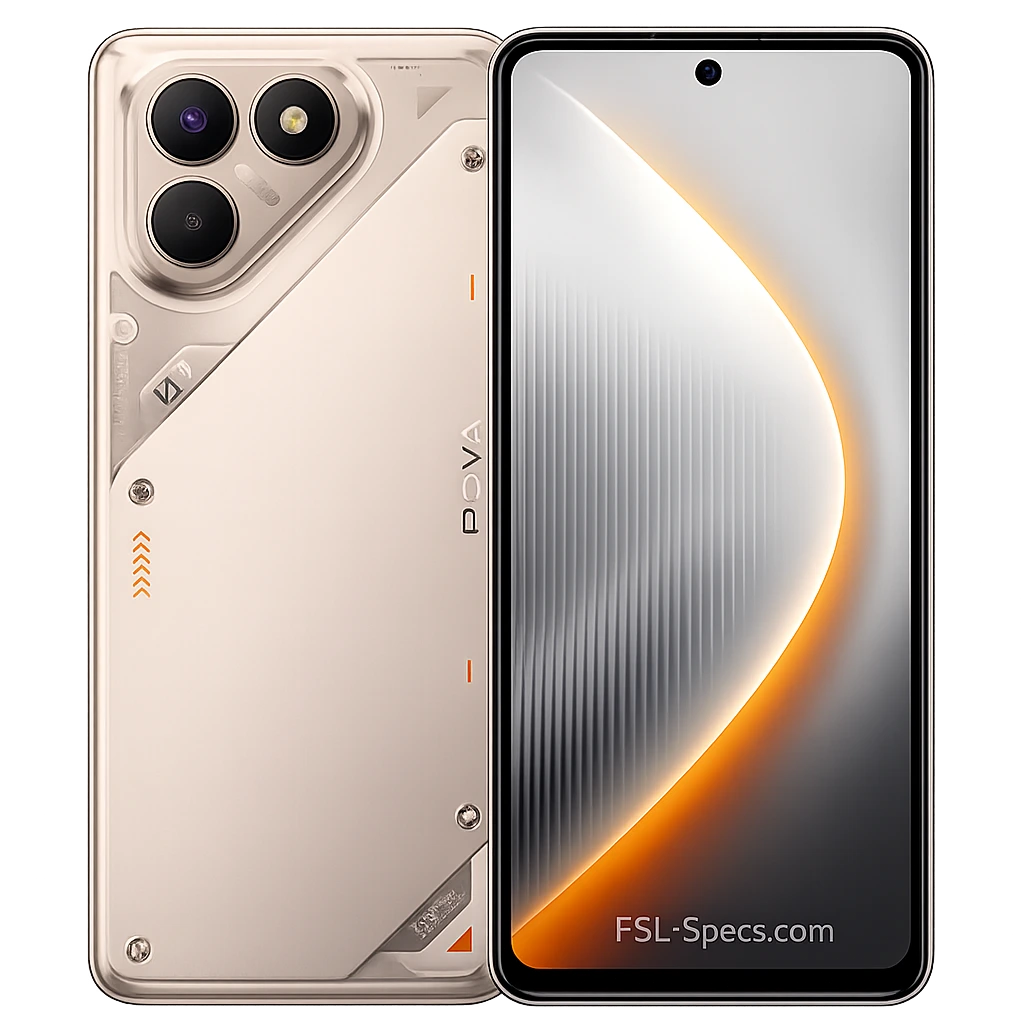
Meca Design in Back

BASIC INFO
Mobile
Tecno Pova 7 4G
Model
LJ6
Series
Pova Series
Category
Mid-Range
Release Date
25 June,2025
Year
2025
CONNECTIVITY
Sim
Nano-SIM + Nano-SIM
Network
4G
WiFi
Wi-Fi 5
Bluetooth
5.3
NFC
Yes
OS
Android 16 - HIOS 16
BODY
Dimensions
168.6 × 76.6 × 9.3 mm
Build
Plastic ( Frame And Back)
KG Weight
225 g
Screen Size
6.78 inch
Resolution
1080 × 2460 Pixels
Type
IPS LCD
Refresh Rate
120 Hz
Peak Brightness
900 nits
HBM Brightness
700 nits
Processor
Helio G100
Max Clock
2.2 GHz
Lithography
6 nm
GPU
Mali G57
CPU Cores
8 Cores
Antutu v11
400 k
Architecture
2×2.2 GHz Cortex-A76
6×2.0 GHz Cortex-A55
Ram Memory
8+256 GB
SD Card
Yes
Ram Type
LPDDR4X
Storage Type
UFS 2.2
Variants
8+128GB
8 +256GB
MP
Rear Camera
108 + 2 MP
Front Camera
8 MP
RECORDING FPS
Main Recording
2k@30fps
1080p@60fps
Front Recording
2k@30fps
1080p@60fps
RESOLUTION
Main Resolution
12000 x 9000 Pixels
Front Resolution
3264 × 2448 Pixels
ZOOM
D Digital Zoom
10 X
Stabilization
Digital
FLASH
Flash
Dual-LED Flash
Front Flash
Yes
Capacity
7000 mAH
Fast Charging
45 W
Li Battery Type
Li-Po
REVERSE
Reverse Wired
10 W
OTHER
Charging Time
70–85 minutes ( 0-100% )
AUDIO & SENSORS
Speaker
Dual Stereo Speaker
Fingerprint Sensor
Side Mounted
Other Sensors
Accelerometer
Ambient Light Sensor
Electronic Compass
Gyroscope
Infrared Remote Control (IR Blaster)
Proximity Sensor
Special Features

Meca Design in Back

Highlights & Review Of Tecno Pova 7 4G

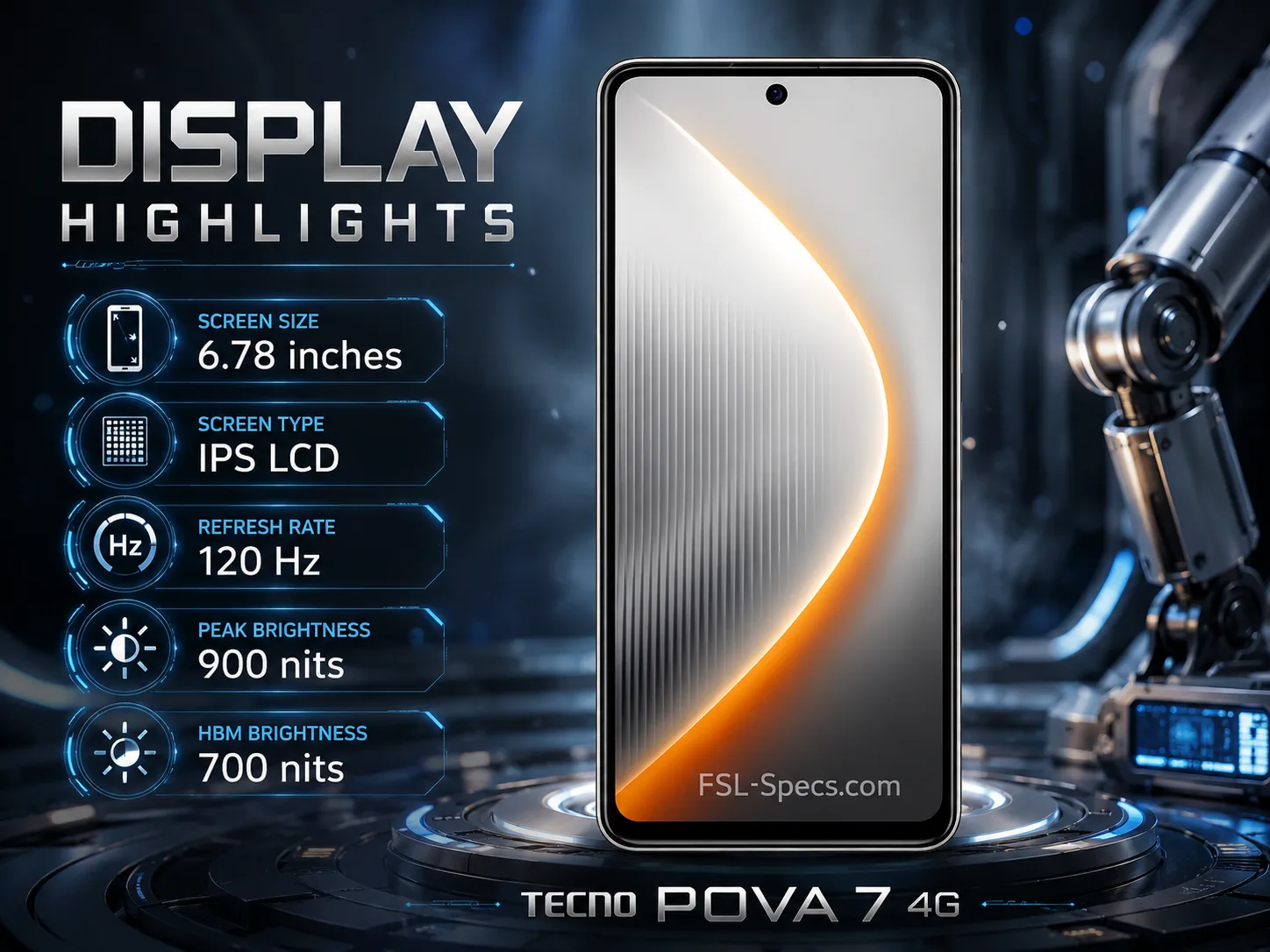
Tecno Pova 7 4G Display FSL-Specs.com
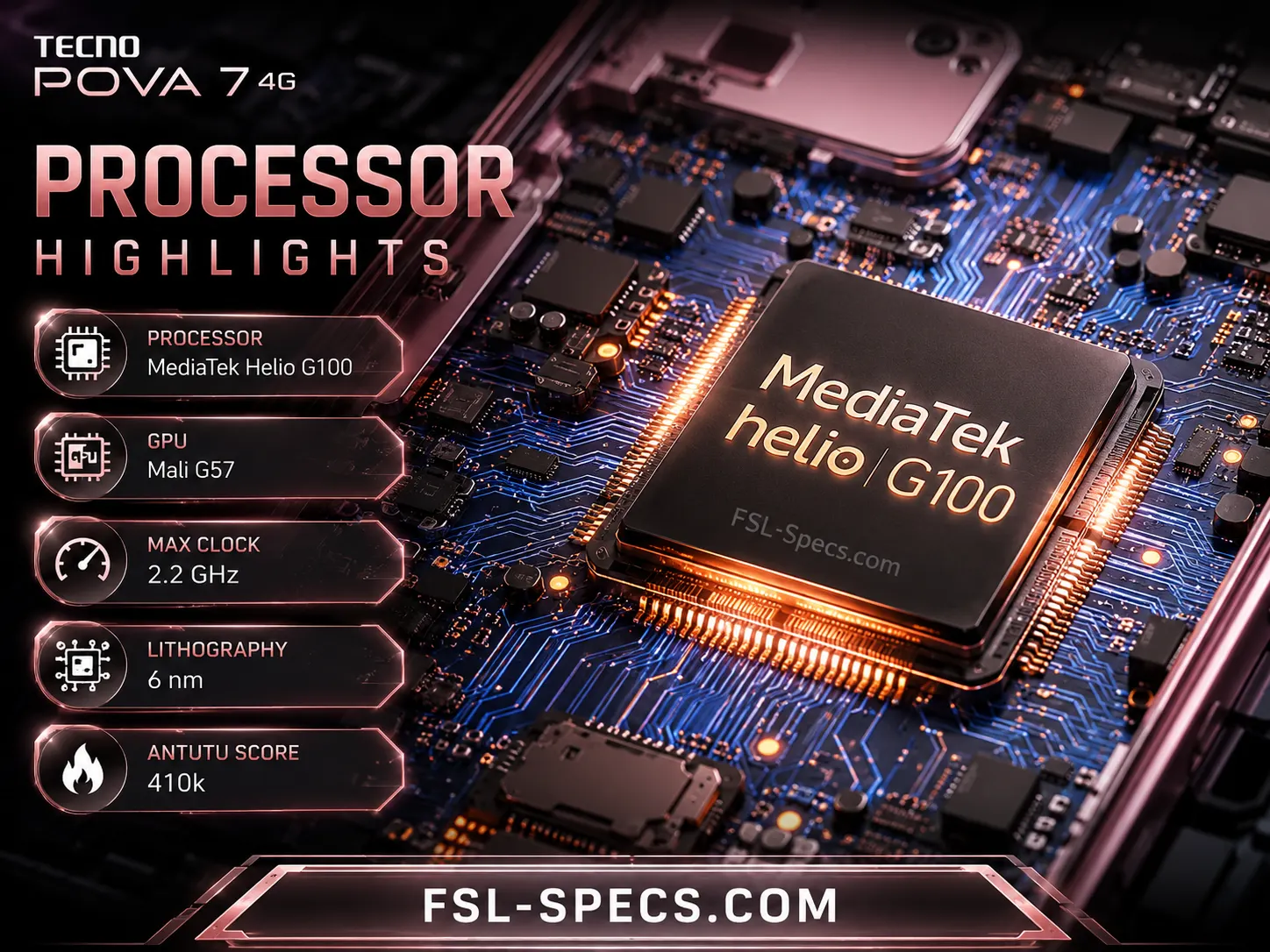
Tecno Pova 7 4G processor FSL-Specs.com
Tecno Pova 7 4G memory FSL-Specs.com
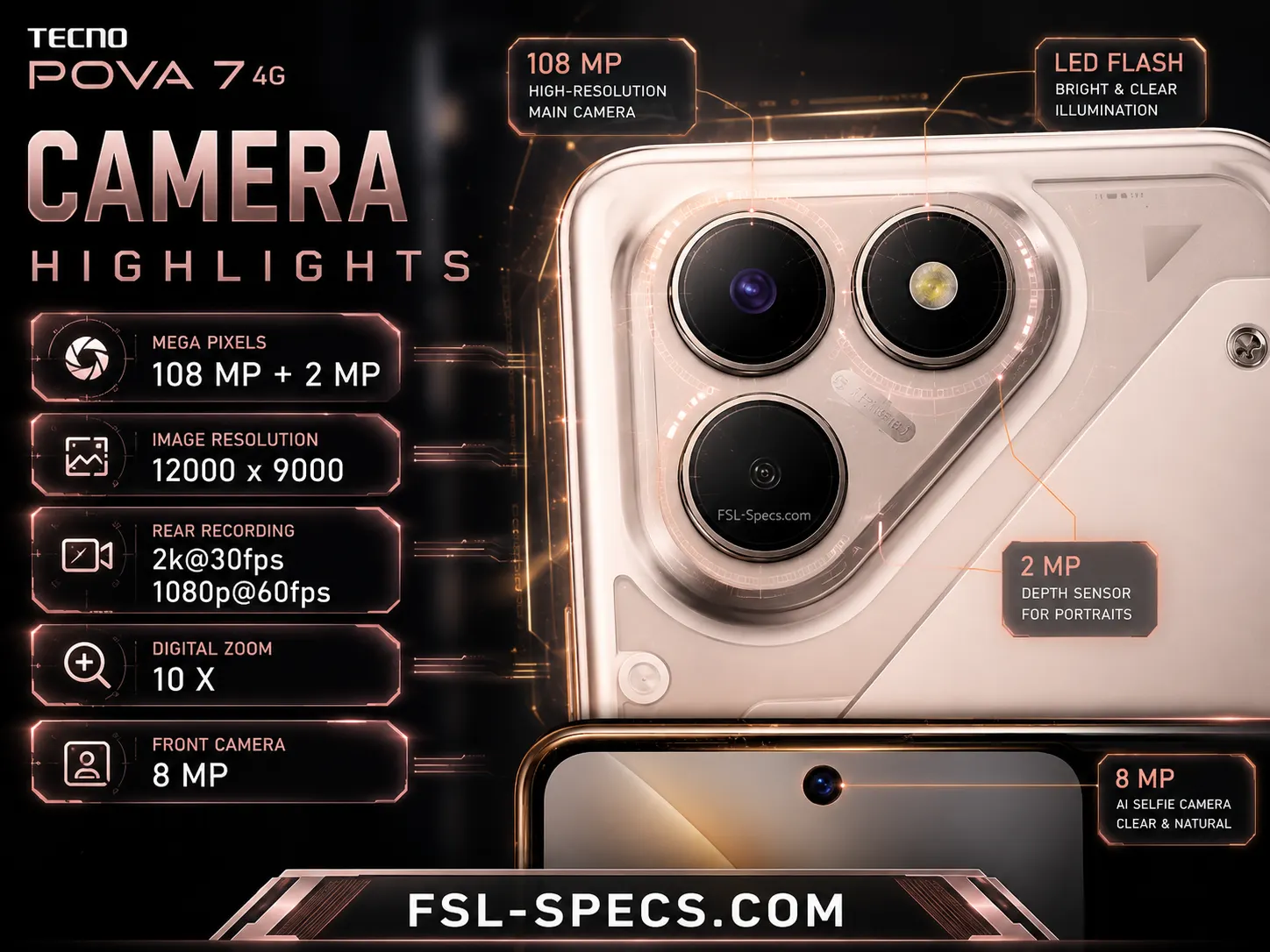
Tecno Pova 7 4G Camera FSL-Specs.com
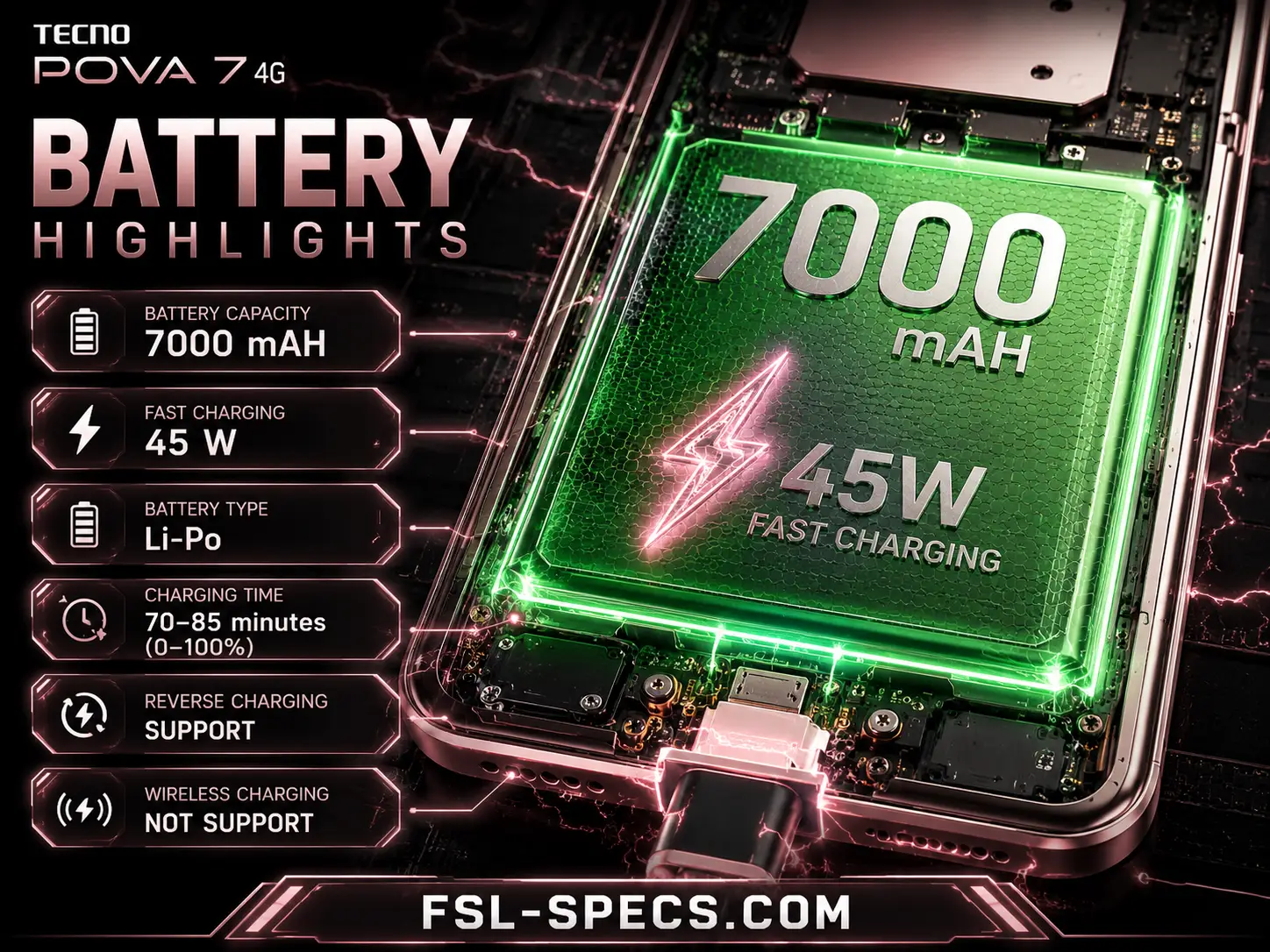
Tecno Pova 7 4G Battery FSL-Specs.com

Display Review:

The Tecno Pova 7 4G features a 6.78-inch FHD+ AMOLED display with 1080 × 2460-pixel resolution, 120Hz refresh rate, and up to 1,300 nits peak brightness, along with 2,304Hz PWM dimming for reduced eye strain. The Tecno Spark 40 Pro Plus uses a larger 6.78-inch 1.5K curved AMOLED panel with 1224 × 2720-pixel resolution, 144Hz refresh rate, and up to 4,500 nits peak brightness (1,600 nits HBM), making it significantly sharper and brighter for outdoor use.

The Tecno Pova 6 Pro also has a 6.78-inch FHD+ AMOLED display at 1080 × 2436 pixels, 120Hz refresh rate, and up to 1,300 nits peak brightness, closely matching the Pova 7 4G in size and brightness but with slightly lower resolution. The Xiaomi Redmi Note 15 offers a 6.77-inch FHD+ AMOLED panel with 1080 × 2392-pixel resolution, 120Hz refresh rate, and up to 3,200 nits peak brightness, positioning it between the Pova models and the Spark 40 Pro Plus in terms of peak brightness

On paper, the Spark 40 Pro Plus leads this group with its 1.5K resolution, 144Hz refresh rate, and 4,500-nit peak brightness, offering the sharpest and most visible display in bright sunlight. The Pova 7 4G and Pova 6 Pro are closely matched in size and peak brightness, but the Pova 7 4G’s slightly higher 2460-pixel vertical resolution gives it a marginal edge in sharpness. The Redmi Note 15’s 3,200-nit peak and compact 6.77-inch panel make it a strong contender for users who want high brightness in a slightly smaller form factor.

For Pakistani buyers at PKR 60,000, the Tecno Pova 7 4G’s 120Hz AMOLED and 1,300-nit peak make it a solid multimedia display at its price, while the Spark 40 Pro Plus at PKR 70,000 justifies its higher cost with a 1.5K 144Hz panel and far superior brightness. The Pova 6 Pro at the same PKR 60,000 offers similar size and brightness but with 12GB RAM, and the Redmi Note 15 at PKR 71,000 provides a bright, compact alternative for users who prefer Xiaomi’s tuning and ecosystem.

Verdict: The Tecno Pova 7 4G is the best choice for buyers who want a large 6.78-inch 120Hz AMOLED at PKR 60,000, the Tecno Spark 40 Pro Plus leads in sharpness and brightness with its 1.5K 144Hz 4,500-nit display, while the Tecno Pova 6 Pro and Xiaomi Redmi Note 15 suit users who prefer similar-sized panels with competitive brightness and brand-specific features.

Processor Review:

The Tecno Pova 7 4G is powered by the MediaTek Helio G100 Ultimate (6nm) chipset with a 2+6 core layout (2×2.2GHz Cortex-A76 + 6×2.0GHz Cortex-A55) and a Mali-G57 MC2 GPU, scoring around 439,480 points on AnTuTu v10 and roughly 590,000–600,000 points on AnTuTu v11 in third-party testing. The Tecno Spark 40 Pro Plus uses the older MediaTek Helio G200 (6nm) with 2×2.2GHz Cortex-A76 + 6×2.0GHz Cortex-A55 cores and a Mali-G57 MP2 GPU, achieving approximately 455,013 points on AnTuTu v10 and about 616,665 points on AnTuTu v11.

The Tecno Pova 6 Pro relies on the MediaTek Dimensity 6080 (6nm) with 2×2.4GHz Cortex-A76 + 6×2.0GHz Cortex-A55 and a Mali-G57 MC2 GPU, posting roughly 420,000–440,000 points on AnTuTu v10 and about 550,000–580,000 on AnTuTu v11. The Xiaomi Redmi Note 15 4G sits between them with the MediaTek Helio G100 Ultra (6nm) featuring 2×2.4GHz Cortex-A76 + 6×2.0GHz Cortex-A55 cores and a Mali-G57 MC2 GPU, scoring approximately 596,000 points on AnTuTu v11.

On raw performance, the Spark 40 Pro Plus’s Helio G200 leads this group by a modest margin, outscoring the Pova 7 4G’s Helio G100 Ultimate by roughly 20,000–30,000 AnTuTu points, while the Pova 6 Pro’s Dimensity 6080 trails slightly behind both. The Redmi Note 15 4G’s Helio G100 Ultra is very close to the Pova 7 4G, with a slight clock-speed advantage translating to a small performance gain. All four chipsets sit in the same upper-entry to lower-mid range tier, with real-world differences more noticeable in sustained gaming loads than in daily tasks.

For Pakistani buyers, the Pova 7 4G at PKR 60,000 delivers adequate performance that is closely matched by the Redmi Note 15 4G at PKR 71,000 and only slightly behind the Spark 40 Pro Plus at PKR 70,000. The Pova 6 Pro at PKR 60,000 offers similar performance but with 12GB RAM, which helps more with multitasking than raw chipset speed.

Verdict: The Tecno Spark 40 Pro Plus leads in raw performance with its Helio G200 and ~616K AnTuTu v11 score, the Xiaomi Redmi Note 15 4G and Tecno Pova 7 4G are very close with ~590K–600K, and the Tecno Pova 6 Pro sits slightly behind with ~550K–580K despite matching the Pova 7 4G’s price.

Ram & Memory Review:

The Tecno Pova 7 4G comes in an 8GB + 256GB configuration with LPDDR4X RAM and UFS 2.2 storage, and it supports microSD expansion up to 1TB via a dedicated slot. The Tecno Spark 40 Pro Plus also offers 8GB + 256GB with faster LPDDR5X RAM and UFS 3.1 storage, but it does not support any memory-card expansion. The Tecno Pova 6 Pro provides a more generous 12GB + 256GB setup with LPDDR4X RAM and UFS 2.2 storage, and like the Spark 40 Pro Plus, it lacks a microSD slot. The Xiaomi Redmi Note 15 4G matches the Pova 7 4G with 8GB + 256GB of LPDDR4X RAM and UFS 2.2 storage, though it also omits expandable storage.

On paper, the Spark 40 Pro Plus benefits from faster LPDDR5X RAM and UFS 3.1 storage compared with the Pova 7 4G’s LPDDR4X and UFS 2.2, which improves app launch times, multitasking responsiveness, and large file transfers. The Pova 6 Pro’s 12GB RAM gives it an advantage for heavy multitaskers who keep many apps open, while the Pova 7 4G and Redmi Note 15’s 8GB is adequate for most buyers but may require more frequent app reloads under heavy load.

For Pakistani buyers, the Pova 7 4G’s PKR 60,000 price point makes its 8GB + 256GB + microSD combination attractive for users who value expandability and budget-friendly storage. The Spark 40 Pro Plus at PKR 70,000 and Redmi Note 15 at PKR 71,000 offer faster RAM and storage standards but no expansion, while the Pova 6 Pro at PKR 60,000 provides the largest built-in RAM at 12GB but no memory-card option.

Verdict: The Tecno Pova 7 4G is the best choice for users who prioritize expandable storage and value at PKR 60,000, the Tecno Pova 6 Pro leads in raw RAM capacity with 12GB + 256GB, the Tecno Spark 40 Pro Plus offers the fastest LPDDR5X + UFS 3.1 combination, and the Xiaomi Redmi Note 15 4G sits in the middle with balanced 8GB + 256GB specs but no microSD support.

Cameras Review:

The Tecno Pova 7 4G uses a 108MP main camera with PDAF and an 8MP front camera, recording rear video up to 1440p@30fps and 1080p@60/120fps, plus 720p@240fps slow-motion, while the front is limited to 1080p@30fps. The Tecno Spark 40 Pro Plus features a 50MP main camera with PDAF but no OIS, paired with a 13MP front camera, and records rear video up to 1440p@30fps and 1080p@30fps, with the front capped at 1080p@30fps.

The Tecno Pova 6 Pro offers a 108MP main camera with PDAF and a 32MP front camera, supporting rear video up to 1440p@30fps and 1080p@60fps, and front video at 1080p@60fps. The Xiaomi Redmi Note 15 4G is equipped with a 108MP Samsung HM9 main sensor with PDAF (no OIS on the 4G model), a 2MP depth lens, and a 20MP front camera, with rear video up to 1080p@60fps and front video at 1080p@30fps.

On paper, all four phones rely on high-resolution 108MP or 50MP main sensors without OIS in their 4G variants, so low-light stability and handheld video smoothness are similar across the group. The Pova 7 4G and Pova 6 Pro both provide 1440p@30fps rear video and 1080p@60fps options, but the Pova 6 Pro’s 32MP front camera with 1080p@60fps makes it stronger for selfie video than the Pova 7 4G’s 8MP front unit.

The Spark 40 Pro Plus, despite its higher price, lacks 4K video and relies on a smaller 50MP sensor, while the Redmi Note 15 4G’s 108MP sensor is paired with a higher-resolution 20MP front camera but no 4K recording.

For everyday photography at PKR 60,000, the Pova 7 4G offers a solid 108MP setup that will handle most scenarios well, but it lacks the front-camera resolution of the Redmi Note 15 4G and the front-video capabilities of the Pova 6 Pro. The Spark 40 Pro Plus at PKR 70,000 targets users who value faster RAM/storage and wireless charging over camera specs, while the Redmi Note 15 4G at PKR 71,000 provides a balanced 108MP + 20MP selfie combination for users who prefer Xiaomi’s imaging tuning.

Verdict: The Tecno Pova 6 Pro leads in front-camera video with 32MP 1080p@60fps, the Tecno Pova 7 4G and Xiaomi Redmi Note 15 4G offer capable 108MP main cameras with 1440p@30fps and 1080p@60fps rear video, and the Tecno Spark 40 Pro Plus sits behind with a 50MP main camera lacking 4K recording and a 13MP front unit.

Battery Review:

The Tecno Pova 7 4G is equipped with a massive 7,000mAh battery and supports 45W wired fast charging, reaching 0–100% in around 70 minutes under test conditions, along with 10W reverse wired charging. The Tecno Spark 40 Pro Plus uses a smaller 5,200mAh battery but compensates with 45W wired, 30W wireless, and 5W reverse wireless charging, achieving 0–100% in about 55 minutes via wired charging.

The Tecno Pova 6 Pro features a 6,000mAh battery with 70W wired fast charging, hitting 0–100% in roughly 50 minutes, but lacks wireless charging. The Xiaomi Redmi Note 15 4G sits between them with a 6,000mAh battery and 33W wired charging, reaching 0–100% in about 90–100 minutes, though an adapter may not be included in all regions

In endurance terms, the Pova 7 4G’s 7,000mAh cell gives it the longest potential screen-on time, especially for heavy users, while the Pova 6 Pro and Redmi Note 15 4G’s 6,000mAh packs still offer strong all-day life. The Spark 40 Pro Plus’s 5,200mAh battery is the smallest here, but its 30W wireless and faster wired charging reduce downtime significantly, making it appealing for users who prioritize convenience over maximum capacity.

For Pakistani buyers, the Pova 7 4G at PKR 60,000 delivers excellent battery life with its 7,000mAh cell, though it charges more slowly than the Pova 6 Pro’s 70W system. The Spark 40 Pro Plus at PKR 70,000 offers the most versatile charging with wireless + reverse wireless, while the Redmi Note 15 4G at PKR 71,000 provides balanced endurance but the slowest 33W charging and potentially no included adapter.

Verdict: The Tecno Pova 7 4G is the battery endurance champion with 7,000mAh, the Tecno Pova 6 Pro leads in wired charging speed with 6,000mAh + 70W, the Tecno Spark 40 Pro Plus offers the most versatile 45W wired + 30W wireless + 5W reverse setup, and the Xiaomi Redmi Note 15 4G sits behind with 6,000mAh + 33W and slower full-charge times.

Final Verdict :

Across display, performance, memory, camera, and battery, the Tecno Pova 7 4G (8+256GB) at PKR 60,000 positions itself as the endurance and value king with a 6.78-inch 120Hz AMOLED, 7,000mAh battery, 108MP main camera, and microSD support, but it trails rivals in raw performance, charging speed, and camera features. The Tecno Spark 40 Pro Plus (8+256GB) at PKR 70,000 delivers the best all-round display and charging versatility with its 1.5K 144Hz curved AMOLED, 45W wired + 30W wireless + 5W reverse charging, and faster LPDDR5X + UFS 3.1 memory, despite a smaller 5,200mAh battery and only modest performance gains.

The Tecno Pova 6 Pro (12+256GB) at PKR 60,000 offers the largest RAM and a balanced FHD+ AMOLED display with 70W fast charging, but it is the performance laggard with its Dimensity 6080 and lacks OIS or 4K video. The Xiaomi Redmi Note 15 4G (8+256GB) at PKR 71,000 provides a bright 6.77-inch AMOLED panel, a capable 108MP + 20MP selfie camera system, and solid 6,000mAh endurance, though it has the slowest 33W charging and no included adapter in some regions.

For buyers strictly focused on battery life and value at this price, the Pova 7 4G remains a compelling pick with its 7,000mAh cell, 120Hz AMOLED, and expandable storage. However, for users who can stretch to PKR 70,000–71,000, the Spark 40 Pro Plus justifies its higher cost with a superior 1.5K 144Hz AMOLED panel and wireless charging, while the Redmi Note 15 4G offers a bright display and balanced camera system for users who prefer Xiaomi’s ecosystem. The Pova 6 Pro appeals most to multitaskers who want 12GB RAM and fast 70W charging at the same PKR 60,000 price as the Pova 7 4G.

Bottom line: The Tecno Spark 40 Pro Plus is the overall winner for display quality and charging versatility, the Tecno Pova 6 Pro leads in RAM capacity and wired charging speed, the Xiaomi Redmi Note 15 4G offers the best balance of display brightness and camera resolution, and the Tecno Pova 7 4G is the best value option for buyers who prioritize battery life, a 120Hz AMOLED, and microSD support.


Ranking:

  1. Tecno Spark 40 Pro Plus (8+256GB) – PKR 70,000

  2. Tecno Pova 6 Pro (12+256GB) – PKR 60,000

  3. Xiaomi Redmi Note 15 4G (8+256GB) – PKR 71,000

  4. Tecno Pova 7 4G (8+256GB) – PKR 60,000

Pros And Cons of Tecno Pova 7 4G

Pros of Mobile

✅7000mAh Massive Battery
✅45W Fast Charging
✅108MP Rear Camera
✅Stereo Dolby Atmos
✅Android 16

Cons of Mobile

❌No 5G Support
❌Heavy 225g Weight
❌Only 8MP Selfie
❌IPS Display

Best For - Not Best For

Best For

✅7000mAh Massive Battery
✅Heavy Battery Users
✅Budget Photo Lovers
✅Media & Entertainment
✅Students & Youth
✅Casual Gamers
✅First-time Buyers

Not Best For

❌No 5G Support
❌5G Network Users
❌Selfie-focused Users
❌Slim Phone Fans
❌Hardcore Mobile Gamers
❌Pro Video Creators

Trailer And Unboxing of Tecno Pova 7 4G

Disassembly Or Teardown And Gaming Test of Tecno Pova 7 4G

Camera Test Tecno Pova 7 4G

tecno spark 40 pro plus
infinix Hot 60 Pro Plus
Tecno Pova 6 Pro
Tecno Camon 40 4G
Redmi Note 15 Pro
Redmi Note 15
Poco M7 Pro

TECNO Series Row

FAQs Questions

Picture of Faisal Ur Rehman

Faisal Ur Rehman

Faisal Rehman is the founder and editor of FSL Specs, where he publishes in-depth smartphone specifications, comparisons, buying guides, and technology insights. With extensive experience in mobile hardware research and technical analysis, he provides accurate and up-to-date information on Android smartphones, processors, displays, cameras, batteries, performance benchmarks, and software features. His goal is to simplify complex specifications and help readers choose the right device with confidence.

The Tecno Pova 7 4G has a 6.78-inch IPS LCD display with Full HD+ resolution (1080 × 2460 pixels) and a 120Hz refresh rate.900 Nits Peak Brightness

It's powered by the MediaTek Helio G100 Ultimate (6nm) octa-core chip with a Mali-G57 MC2 GPU.

The Tecno Pova 7 4G uses LPDDR4X RAM and UFS 2.2 storage.

The rear camera is a 108MP wide sensor with PDAF, paired with a 2MP macro lens. 8MP Front Camera

It comes with a massive 7,000mAh battery with 45W fast charging.

8 + 256 GB
~50,000 PKR | ~₹14,000 |~ $160

Scroll to Top