
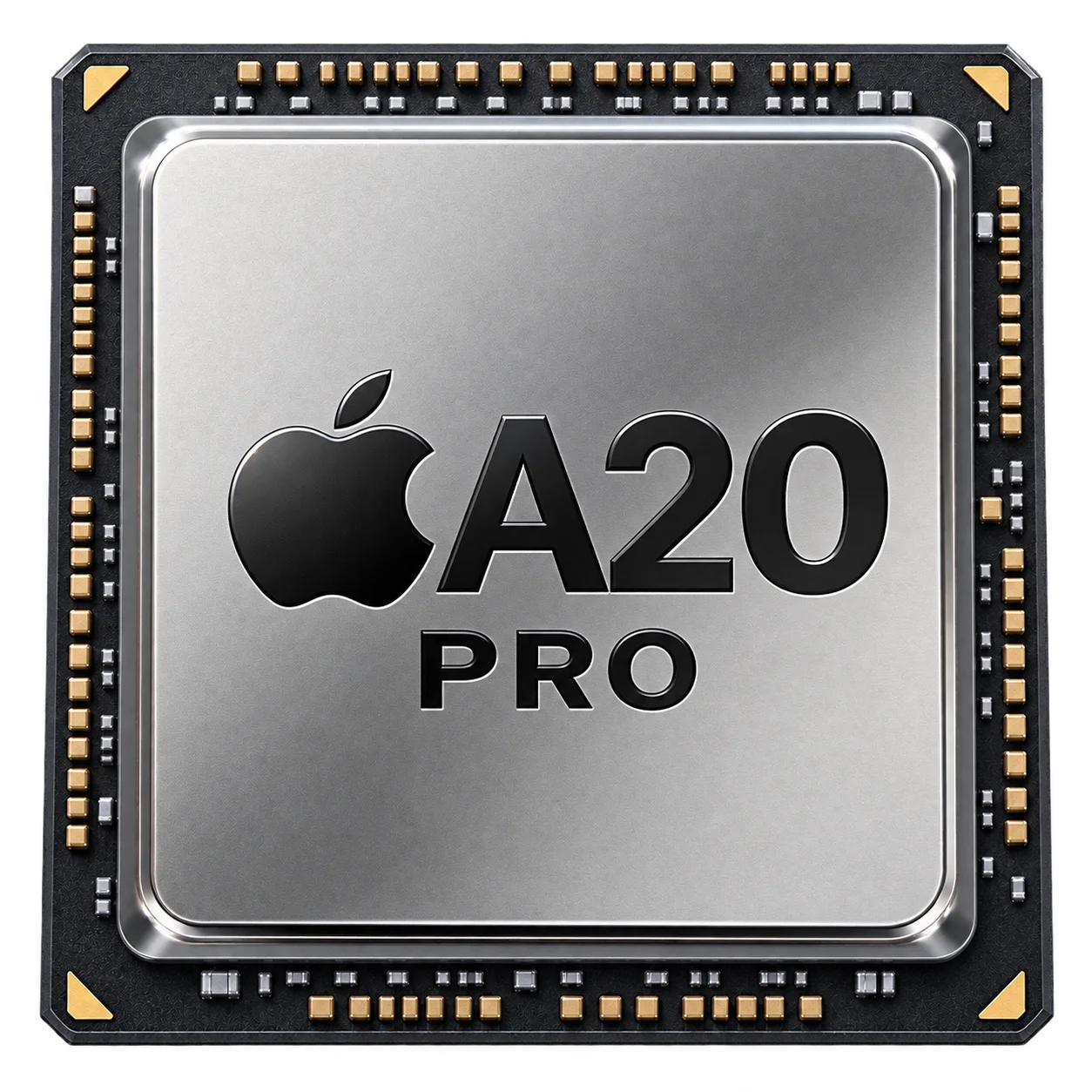
A20 Pro
The Apple A20 Pro is Apple's flagship chipset announced in September 2026, using 2× cores up to 4.93GHz and 4× cores up to 2.64GHz, paired with a 7‑pipeline Apple A20 Pro GPU. With LPDDR5X memory, NVMe storage, the Apple Neural Engine for on-device AI, Apple's own new Apple C2 5G modem, Wi‑Fi 7, and Bluetooth 6.0, it represents Apple's most advanced silicon to date.
Benchmark Scores
As a newly announced chip, Geekbench 6 data has not been published yet from source, and the 3DMark row did not clearly label which score belongs to which sub-test.
Measures CPU, GPU, RAM, and I/O performance in different scenarios.
Shows raw single-threaded CPU performance across real-world workloads.
Cross-platform benchmark assessing graphics performance in Vulkan/Metal. Source did not label which additional scores below belong to which sub-test.
CPU & AI Performance
4× cores up to 2.64GHz
(Core family names — e.g. Everest/Sawtooth — not specified in source)
Graphics, Memory & Storage
Multimedia (Camera, Display & ISP)
Connectivity
General Info
information About Apple A20 Pro
Introduction
The Apple A20 Pro, MediaTek Dimensity 9600 Pro, and Qualcomm Snapdragon 8 Elite Extreme Gen 6 were all announced within two weeks of each other in September 2026, making this a genuine snapshot of the newest flagship silicon across three different platforms — iOS and two Android chip vendors. This comparison matters because it surfaces a real methodological wrinkle: AnTuTu and Geekbench tell very different stories about the same three chips, and understanding why matters more here than in most comparisons. All three chips are new enough that a few specification fields aren’t yet fully populated. Every figure below comes from NanoReview’s published specification tables and benchmark data as currently listed community-submitted correction comments on these very new pages were not used, since they aren’t yet reflected in NanoReview’s verified specification tables.
Processor Overview
All three chips here launched within roughly two weeks of each other, and all three now rely on proprietary CPU core designs rather than licensed Arm Cortex cores. The Apple A20 Pro, announced September 9, 2026 on TSMC’s 2nm process, uses a 6-core layout — two performance cores at 4.93GHz and four efficiency cores at 2.64GHz — notably fewer cores than either rival. The Dimensity 9600 Pro, announced September 15, 2026 also on TSMC’s 2nm process, uses MediaTek’s own 8-core C2-Ultra/C2-Pro design. The Snapdragon 8 Elite Extreme Gen 6, announced September 22, 2026, also on TSMC’s 2nm process, uses an 8-core layout whose individual core names NanoReview doesn’t disclose. All three are TSMC-fabricated flagship chips on the same 2nm node, so this comparison isn’t complicated by a foundry or process-size difference.
CPU Architecture & Processing Power
This is the category where the two major benchmark suites tell sharply conflicting stories, and it’s worth explaining why before looking at the numbers. On AnTuTu 11’s total score, the Snapdragon 8 Elite Extreme Gen 6 leads by a wide margin at 5,195,978, ahead of the Dimensity 9600 Pro’s 4,838,033 (about 7.4% behind) and dramatically ahead of the A20 Pro’s 3,434,654 — a gap of roughly 51%. AnTuTu’s CPU sub-test shows the same lopsided pattern: Snapdragon 8 Elite Extreme Gen 6 leads at 1,407,243, Dimensity 9600 Pro follows at 1,388,289, and A20 Pro trails at just 879,839 — about 60% lower than the Snapdragon figure.
Geekbench 6 flips this picture almost entirely. On single-core, the A20 Pro leads clearly at 4772, about 10.3% ahead of the Snapdragon 8 Elite Extreme Gen 6’s 4327 and about 13.9% ahead of the Dimensity 9600 Pro’s 4188. On multi-core, all three chips land within about 2% of each other: the Dimensity 9600 Pro leads at 13145, followed by the A20 Pro at 12989 (just 1.2% behind, despite having only 6 cores versus the Dimensity’s 8) and the Snapdragon 8 Elite Extreme Gen 6 at 12873 (about 2.1% behind the Dimensity 9600 Pro).
This divergence between AnTuTu and Geekbench on the same three chips is large enough to flag directly: AnTuTu’s total and CPU scores have historically behaved differently across iOS and Android platforms due to how the test suite’s sub-components are weighted and executed on each operating system, so a roughly 50-60% AnTuTu gap alongside a Geekbench picture where the A20 Pro actually leads single-core outright is a known category of cross-platform benchmark inconsistency, not necessarily a reflection of a 50%+ real-world CPU performance gap. NanoReview’s own CPU Performance sub-score reflects a much narrower spread: Dimensity 9600 Pro and Snapdragon 8 Elite Extreme Gen 6 both score 99, with the A20 Pro close behind at 98. The practical read: the A20 Pro’s 6-core design is matching or beating two 8-core rivals on Geekbench’s single-core and near-tying on multi-core, a strong per-core efficiency result, even though its AnTuTu figures look dramatically lower.
GPU & Gaming Performance
GPU performance shows a similar split between benchmark types, driven partly by which graphics API each test uses. On theoretical output, the Dimensity 9600 Pro’s Mali-G2 Ultra NX MP12 leads at 5529.6 GFLOPS, ahead of the Snapdragon 8 Elite Extreme Gen 6’s Adreno 850 at 4454.4 GFLOPS and well ahead of the A20 Pro’s Apple A20 Pro GPU at 2903 GFLOPS — less than half the Dimensity’s rated output.
Geekbench’s GPU Compute test, which uses Apple’s native Metal API on iOS, inverts that order dramatically: the A20 Pro leads at 55120, about 54% higher than the Snapdragon 8 Elite Extreme Gen 6’s 35781 (no Geekbench GPU Compute score is supplied for the Dimensity 9600 Pro, so that specific comparison is two-way only). On AnTuTu’s GPU sub-score, however, the order reverts to favoring the Android chips: Snapdragon 8 Elite Extreme Gen 6 leads at 1,940,214, the Dimensity 9600 Pro follows at 1,881,401, and the A20 Pro trails at 1,407,166 — about 38% lower than the Snapdragon figure.
The most telling comparison is 3DMark, a cross-platform benchmark that runs comparable workloads on both iOS and Android. Here, all three chips land close together regardless of their wildly different theoretical GFLOPS and AnTuTu/Geekbench Compute results: on 3DMark Steel Nomad Light (available for Snapdragon 8 Elite Extreme Gen 6 and A20 Pro), the Snapdragon leads 4310 to 4263 — just 1.1% apart. On 3DMark Wild Life Extreme (available for Dimensity 9600 Pro and A20 Pro), the Dimensity leads 9245 to 9024 — just 2.5% apart. On 3DMark Solar Bay (available for Snapdragon 8 Elite Extreme Gen 6 and A20 Pro), the Snapdragon leads 18485 to 17850 — about 3.6% apart. In other words, on the one benchmark family that runs genuinely comparable workloads across platforms, these three 2026-generation flagship GPUs are essentially tied, despite the A20 Pro having under 53% of the Dimensity 9600 Pro’s theoretical GFLOPS. NanoReview’s Gaming Performance sub-score reflects this closeness: Dimensity 9600 Pro and Snapdragon 8 Elite Extreme Gen 6 both score a perfect 100, with the A20 Pro just one point behind at 99.
Manufacturing Process & Efficiency
All three chips share the same TSMC 2nm process, so this comparison isn’t affected by foundry or node-size differences. No TDP figure is disclosed for any of the three chips in the supplied data, consistent with how recently all three were announced.
Efficiency is where the A20 Pro has its clearest, most decisive lead: NanoReview’s Battery life sub-score gives it 96, versus 93 for both the Dimensity 9600 Pro and the Snapdragon 8 Elite Extreme Gen 6. That lines up with the A20 Pro’s smaller 6-core CPU layout and its much lower theoretical GPU GFLOPS figure — a design that trades raw peak output for measurably better battery performance, at least on the one disclosed metric available.
RAM, Memory & Storage Support
RAM capacity is a clear, disclosed difference: the Dimensity 9600 Pro and Snapdragon 8 Elite Extreme Gen 6 both support up to 24GB, while the A20 Pro is capped at 12GB — exactly half. On bandwidth, the order is closer: the Dimensity 9600 Pro leads at 128 Gb/s, the A20 Pro follows at 115.2 Gb/s, and the Snapdragon 8 Elite Extreme Gen 6 trails slightly at 113.8 Gb/s. Memory type also differs: both Android chips use LPDDR6, the newer standard, while the A20 Pro uses LPDDR5X.
Storage shows a genuine architectural difference rather than a simple speed gap: the A20 Pro uses an NVMe storage interface, while the Dimensity 9600 Pro and Snapdragon 8 Elite Extreme Gen 6 both support UFS 4.1 and UFS 5.0. NVMe and UFS are different storage protocols rather than directly comparable tiers of the same standard, and no read/write throughput figures are supplied for either implementation here, so this is worth noting as a notable platform difference rather than declaring one definitively faster without that data.
AI & NPU Capabilities
None of the three chips has a disclosed TOPS figure in the supplied data. The A20 Pro names its accelerator as the Apple Neural Engine, the Dimensity 9600 Pro names its accelerator as the MediaTek NPU 1090, and the Snapdragon 8 Elite Extreme Gen 6 names its accelerator as Hexagon — but none has a quantifiable AI performance number. Not enough disclosed data exists to compare AI throughput across these three chips.
ISP, Camera & Video Capabilities
Camera configuration differs by design philosophy rather than a simple resolution race: the A20 Pro supports a triple-sensor 3x48MP setup, while the Dimensity 9600 Pro supports a single 1x200MP sensor. The Snapdragon 8 Elite Extreme Gen 6 has no maximum camera resolution disclosed. These are chip-level ISP configurations rather than a prediction of actual photo output, which depends heavily on the specific sensors and image processing a phone maker pairs with the chip.
Video capability shows the clearest gap in this comparison, and it runs against the A20 Pro: both the Dimensity 9600 Pro and Snapdragon 8 Elite Extreme Gen 6 support 8K capture and playback at 60FPS, plus 4K at 120FPS, while the A20 Pro is limited to 4K at 120FPS with no 8K support listed at all. Codec support is more evenly split: the Snapdragon 8 Elite Extreme Gen 6 has the fullest core codec list (H.264, H.265, H.266/VVC, AV1, VP8, VP9); the Dimensity 9600 Pro supports H.264, H.265, H.266 (VVC), AV1, and VP9, but not VP8; and the A20 Pro supports H.264, H.265, AV1, VP8, VP9, and uniquely Motion JPEG, but doesn’t list H.266 (VVC) support at all.
Display Support
No maximum display resolution is disclosed for either the A20 Pro or the Dimensity 9600 Pro in the supplied data. The Snapdragon 8 Elite Extreme Gen 6 lists a maximum of 3840 x 2540, an unusually high figure, but since the other two chips have no comparable figure listed, this can’t be turned into a three-way comparison. Refresh rate figures are not disclosed for any of the three chips.
Modem, 5G & Connectivity
Connectivity disclosure is the most complete for one chip and the thinnest for another. The Snapdragon 8 Elite Extreme Gen 6 has a fully specified modem: the Qualcomm X105, rated up to 14800 Mbps download and 4200 Mbps upload. The A20 Pro’s modem is named — the Apple C2 — but no download or upload speed is disclosed for it. The Dimensity 9600 Pro has no modem name or speed disclosed at all. As with any modem specification, real-world 5G speeds rarely reach any chip’s theoretical maximum regardless of which modem is used.
Wi-Fi generation is tied across all three at Wi-Fi 7. Bluetooth slightly favors two of the three: Dimensity 9600 Pro and Snapdragon 8 Elite Extreme Gen 6 both support Bluetooth 6.2, while the A20 Pro supports Bluetooth 6.0. GNSS coverage is tied across all three, each listing the same six systems: GPS, GLONASS, Beidou, Galileo, QZSS, and NAVIC.
Benchmark Comparison
All three chips were tested with AnTuTu 11 and Geekbench 6, so those comparisons are valid across all three, with the caveat about cross-platform AnTuTu behavior noted in the CPU section above. 3DMark coverage differs by chip, so those comparisons are two-way only where noted.
AnTuTu 11 total score: Snapdragon 8 Elite Extreme Gen 6 leads at 5,195,978, followed by Dimensity 9600 Pro at 4,838,033 (about 7.4% behind) and A20 Pro at 3,434,654 (about 51.3% behind the Snapdragon figure). The CPU sub-score shows the same lopsided gap favoring both Android chips over the A20 Pro, while the GPU sub-score follows the same pattern — Snapdragon 8 Elite Extreme Gen 6 highest, Dimensity 9600 Pro close behind, A20 Pro clearly lowest.
Geekbench 6: A20 Pro leads single-core (4772) by a clear margin over both the Snapdragon 8 Elite Extreme Gen 6 (4327) and Dimensity 9600 Pro (4188). Multi-core is a near three-way tie, with Dimensity 9600 Pro leading at 13145, A20 Pro close behind at 12989, and Snapdragon 8 Elite Extreme Gen 6 at 12873 — all within about 2% of each other. On GPU Compute, A20 Pro leads decisively at 55120 against the Snapdragon’s 35781 (no score supplied for the Dimensity 9600 Pro).
3DMark: Each test is only shared between two of the three chips, and all three results are close: Snapdragon 8 Elite Extreme Gen 6 edges A20 Pro on Steel Nomad Light (4310 vs 4263, about 1.1% apart) and Solar Bay (18485 vs 17850, about 3.6% apart); Dimensity 9600 Pro edges A20 Pro on Wild Life Extreme (9245 vs 9024, about 2.5% apart). No single 3DMark test spans all three chips, so a full three-way graphics comparison isn’t possible with the currently supplied data.
Real-World Performance
Everyday use: Geekbench’s near-tied multi-core results and the A20 Pro’s clear single-core lead suggest day-to-day responsiveness is likely to feel comparable or even favor the A20 Pro, despite its dramatically lower AnTuTu scores — a case where the cross-platform benchmark gap likely overstates the real-world CPU difference.
Gaming: On the one benchmark family that runs genuinely comparable workloads across platforms (3DMark), all three chips are within about 1-4% of each other on whichever test they share, despite the A20 Pro having under 53% of the Dimensity 9600 Pro’s theoretical GPU output — suggesting real-world gaming performance is closer across these three chips than the spec sheet or AnTuTu GPU scores would imply.
AI: No TOPS figures are disclosed for any of the three chips, so no real-world AI performance comparison can be made from the supplied specifications.
Camera: The A20 Pro’s triple 48MP configuration and the Dimensity 9600 Pro’s single 200MP sensor reflect different camera system philosophies rather than a simple better-or-worse comparison; actual photo quality depends on the full camera module, not the chip’s ISP ceiling alone.
Battery/efficiency: A20 Pro’s clearly highest Battery life sub-score (96 versus 93 for both rivals) gives it the most efficient profile of the three, consistent with its smaller core count and lower theoretical GPU output.
Strengths & Weaknesses
A20 Pro
- Strength: Highest Geekbench 6 single-core score (4772) and by far the highest Geekbench GPU Compute score (55120) of the three.
- Strength: Highest Battery life sub-score (96), achieved with only 6 CPU cores versus 8 for both rivals.
- Weakness: Dramatically lower AnTuTu 11 total score and CPU/GPU sub-scores than both rivals, and the lowest theoretical GPU GFLOPS (2903) of the three.
- Weakness: Lowest maximum RAM (12GB, half of both rivals’ 24GB) and no 8K video support, unlike both rivals.
Dimensity 9600 Pro
- Strength: Highest Geekbench 6 multi-core score (13145), highest theoretical GPU GFLOPS (5529.6), and highest memory bandwidth (128 Gb/s) of the three.
- Strength: Edges the A20 Pro on 3DMark Wild Life Extreme, and matches the Snapdragon on top-tier video spec (8K/60FPS).
- Weakness: Lowest AnTuTu total score of the two Android chips, and no modem, display resolution, or Geekbench GPU Compute score disclosed.
- Weakness: Lacks VP8 codec support, the only chip of the three missing it.
Snapdragon 8 Elite Extreme Gen 6
- Strength: Highest AnTuTu 11 total score and both AnTuTu sub-scores (CPU and GPU) of the three by a clear margin.
- Strength: The only chip with a fully disclosed modem (14800/4200 Mbps), the highest disclosed display resolution, and the fullest video codec list.
- Weakness: Lowest Geekbench 6 multi-core score of the three (though within 2% of the others), and far behind the A20 Pro on Geekbench GPU Compute.
- Weakness: No camera resolution disclosed, and the lowest Battery life sub-score tied with the Dimensity 9600 Pro.
Best Processor For Different Users
- Best for Gaming: Snapdragon 8 Elite Extreme Gen 6 — edges out on two of three available 3DMark tests, though all three chips are extremely close on this cross-platform benchmark.
- Best for AI: Not enough disclosed data (no TOPS figures for any chip) to name a winner.
- Best for Efficiency: A20 Pro — clearly highest Battery life sub-score of the three.
- Best for Peak Single-Core/Compute: A20 Pro — dominant leads on Geekbench single-core and GPU Compute.
- Best for Raw Multi-Core and Memory: Dimensity 9600 Pro — highest Geekbench multi-core score and memory bandwidth.
- Best Balanced Choice: Snapdragon 8 Elite Extreme Gen 6 — the most category wins across AnTuTu, connectivity, and display specs.
Final Verdict
1. Snapdragon 8 Elite Extreme Gen 6 — Best Overall It leads the AnTuTu total score and both AnTuTu sub-scores by a wide margin, and has the most completely disclosed connectivity, modem, and display specifications of the three — the broadest category lead in this comparison, even though its Geekbench multi-core score is technically the lowest of the three (within 2%).
2. Dimensity 9600 Pro — Best For Multi-Core Throughput and Memory It leads Geekbench 6 multi-core, theoretical GPU GFLOPS, and memory bandwidth, and narrowly edges the A20 Pro on 3DMark Wild Life Extreme, but trails the Snapdragon 8 Elite Extreme Gen 6 on the AnTuTu benchmark family and has the thinnest connectivity disclosure of the three.
3. A20 Pro — Best For Efficiency and Peak Single-Core/Compute Performance It posts the most dramatic individual wins in this comparison — highest Geekbench single-core and GPU Compute scores by wide margins, and the clearest efficiency lead — using only 6 CPU cores and the lowest theoretical GPU output of the three, but trails badly on AnTuTu, has half the RAM ceiling of both rivals, and lacks 8K video support entirely.
Best for Gaming: Snapdragon 8 Elite Extreme Gen 6 (by a narrow margin on 3DMark) Best for AI: Not enough disclosed data to name a winner Best for Efficiency: A20 Pro Best Balanced Choice: Snapdragon 8 Elite Extreme Gen 6
Bottom Line: Choose a device built on the Snapdragon 8 Elite Extreme Gen 6 if you want the broadest overall benchmark lead and the most fully disclosed connectivity and display specifications. Choose the Dimensity 9600 Pro if multi-core throughput, theoretical GPU output, and memory bandwidth matter most to your workload. Choose the A20 Pro if single-core speed, GPU compute performance, and battery efficiency are the priority — and keep in mind that its strikingly lower AnTuTu scores likely reflect a known cross-platform benchmark quirk rather than a genuine 50%+ real-world performance gap, given how closely all three chips land on the cross-platform 3DMark tests. As with any chip announced this recently, it’s worth revisiting these figures once fuller specification sheets and retail-device benchmarks are published.
Images Of Apple A20 Pro
Trailer Of Apple A20 Pro

Author & Post Info
Faisal Ur Rehman
Faisal Rehman is the founder and editor of FSL Specs, where he publishes in-depth smartphone specifications, comparisons, buying guides, and technology insights. With extensive experience in mobile hardware research and technical analysis, he provides accurate and up-to-date information on Android smartphones, processors, displays, cameras, batteries, performance benchmarks, and software features. His goal is to simplify complex specifications and help readers choose the right device with confidence.
Explore FSL Specs
Questions About Apple A20 Pro
What are the main specifications of the Apple A20 Pro?
The Apple A20 Pro is a high-end smartphone chipset designed for demanding performance. Its key specifications include a powerful CPU, a next-generation Apple GPU, advanced AI/ML capabilities, and an efficient manufacturing process. It is designed to handle intensive gaming, photography, video processing, and everyday multitasking smoothly.
How powerful is the Apple A20 Pro?
The Apple A20 Pro is positioned as a flagship-level processor, focusing on both high performance and power efficiency. Its CPU is built to deliver fast app launches, smooth multitasking, and strong performance in demanding workloads, while the integrated GPU is designed for graphics-intensive games and applications.
What is the Apple A20 Pro AnTuTu score?
The AnTuTu score of the Apple A20 Pro can vary depending on the device, software version, cooling system, and benchmark version used. For this reason, benchmark results should be treated as performance indicators rather than a fixed specification. Check the latest tested result for the exact A20 Pro device when comparing it with other chipsets.
Does the Apple A20 Pro support AI features?
Yes. AI and machine-learning processing are an important part of the A20 Pro's design. Its neural processing capabilities help with tasks such as computational photography, voice processing, image recognition, generative AI features, and other on-device machine-learning workloads.
Is Apple A20 Pro good for gaming?
Yes, the A20 Pro is designed for high-end gaming. Its powerful CPU and GPU can handle demanding 3D games, high-resolution graphics, advanced visual effects, and sustained workloads. Actual gaming performance can still vary based on the phone's cooling system, game optimization, display resolution, and software.
How does Apple A20 Pro compare with other flagship processors?
The Apple A20 Pro competes in the flagship smartphone chipset segment. When comparing it with processors such as the Dimensity 9600 Pro or Snapdragon 8 Elite Extreme Gen 6, it is better to look at CPU performance, GPU performance, AI capabilities, power efficiency, benchmark results, and real-world gaming rather than relying on a single benchmark number.