
Dimensity 8200
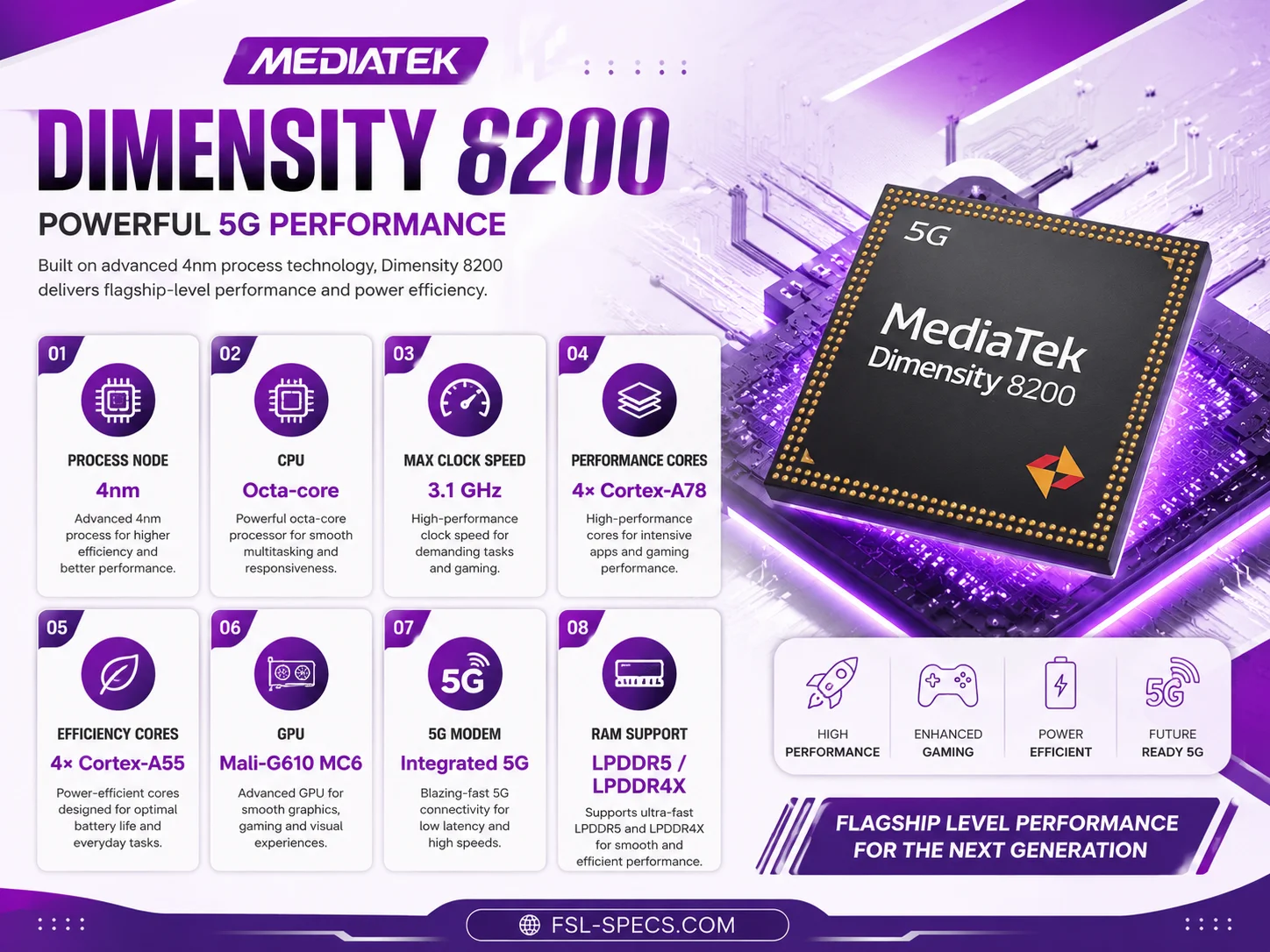
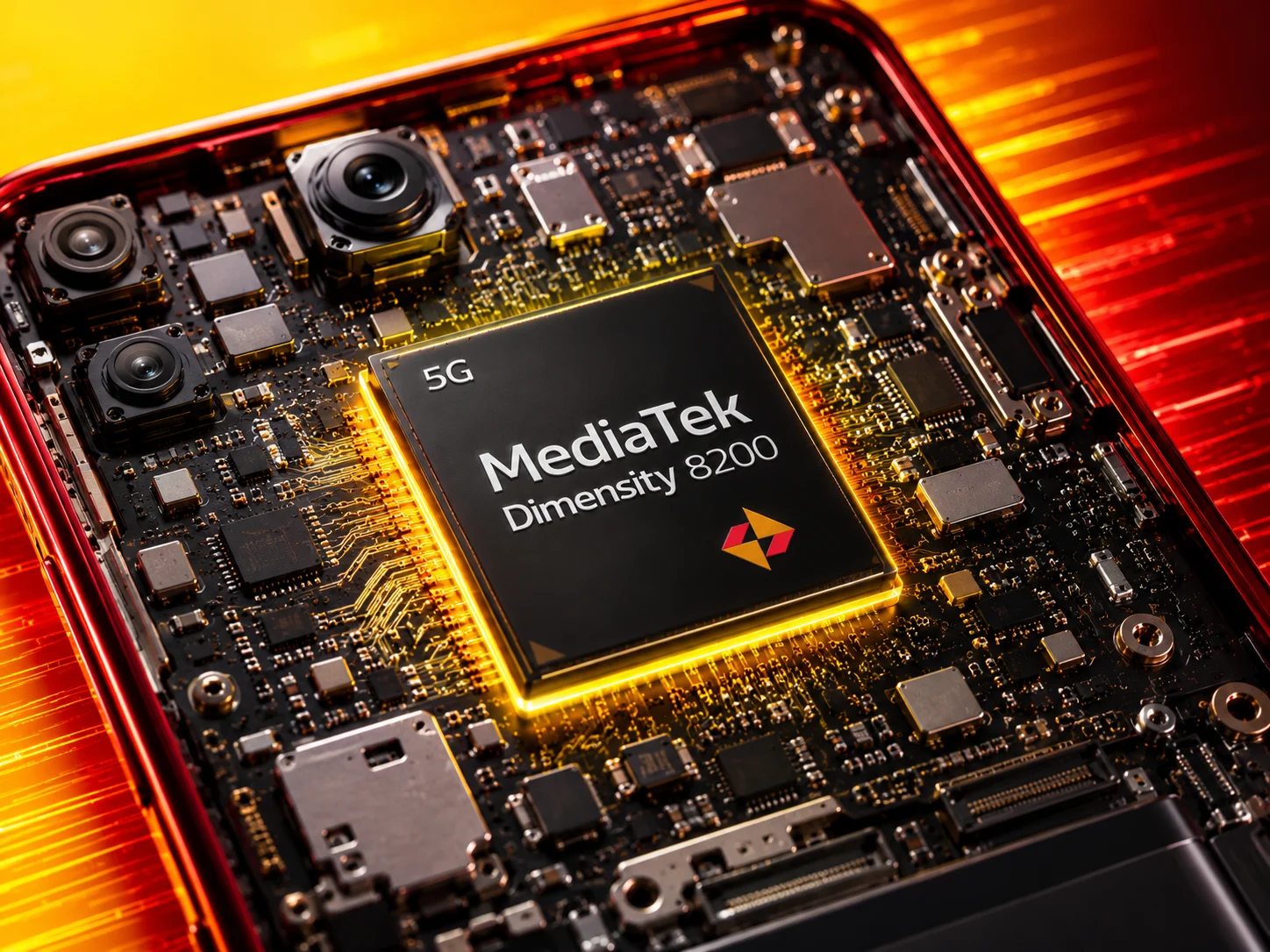
The MediaTek Dimensity 8200 is a mid‑range 5G chipset built on a 4nm process, using 1× Cortex‑A78 up to 3.1GHz, 3× Cortex‑A78 up to 3GHz, and 4× Cortex‑A55 up to 2GHz, paired with a Mali‑G610 MP6 GPU. With LPDDR5 memory, UFS 3.1 storage, the MediaTek NPU 580 for on-device AI, Wi‑Fi 6, and Bluetooth 5.3, it's built for smooth everyday performance.
Benchmark Scores
Measures CPU, GPU, RAM, and I/O performance in different scenarios.
Shows raw single-threaded CPU performance across real-world workloads. Only category scores are published for this chipset — no overall headline total.
Cross-platform benchmark assessing graphics performance in Vulkan/Metal.
Evaluates overall system performance in everyday workloads. Only category scores are published for this chipset — no overall headline total.
CPU & AI Performance
3× Cortex‑A78 up to 3GHz
4× Cortex‑A55 up to 2GHz
Graphics, Memory & Storage
Multimedia (Camera, Display & ISP)
Connectivity
General Info
information About MediaTek Dimensity 8200
Introduction
A three-year age gap and three very different design philosophies make this a genuinely close contest. This Dimensity 8200 vs Exynos 1580 vs Snapdragon 888 Plus comparison uses verified NanoReview specification and benchmark data to explain how these three chips perform in CPU work, gaming, camera processing, and connectivity, and whether the newer mid-rangers actually surpass the older Snapdragon flagship.
1. Processor Overview
The Dimensity 8200, announced December 2022, is an 8-core chip built on TSMC’s 4nm process, using a 1+3+4 layout: 1x Cortex-A78 at 3.1GHz, 3x Cortex-A78 at 3.0GHz, and 4x Cortex-A55 efficiency cores at 2.0GHz, paired with a Mali-G610 MP6 GPU.
The Exynos 1580, announced October 2024 and the newest chip here, also uses a 1+3+4 layout on Samsung’s own 4nm process: 1x Cortex-A720 at 2.9GHz, 3x Cortex-A720 at 2.6GHz, and 4x Cortex-A520 efficiency cores at 1.95GHz, paired with a Samsung Xclipse 540 GPU built on AMD’s RDNA 3 architecture.
The Snapdragon 888 Plus, announced June 2021 and by far the oldest chip in this comparison, uses an 8-core layout on Samsung’s 5nm process: 1x Cortex-X1 at 2.995GHz, 3x Cortex-A78 at 2.42GHz, and 4x Cortex-A55 at 1.8GHz, paired with an Adreno 660 GPU, reflecting its genuine flagship-class origins.
Despite being announced up to three years earlier than the Exynos 1580, the Snapdragon 888 Plus uses a Cortex-X1 prime core, a design tier that neither the Dimensity 8200 nor Exynos 1580 include, which shapes much of the benchmark picture below.
2. CPU Architecture & Processing Power
The Dimensity 8200 uses the older ARMv8.2-A instruction set, the Exynos 1580 uses the newer ARMv9.2-A, and the Snapdragon 888 Plus uses ARMv8.4-A with a genuine Cortex-X1 flagship prime core.
In Geekbench 6 single-core, the Snapdragon 888 Plus leads by a wide margin at 1605, about 22.8% higher than the Dimensity 8200 (1239) and about 18.4% higher than the Exynos 1580 (1356). The Cortex-X1 core’s architectural strength clearly outweighs both newer chips’ higher clock speeds. Between the two mid-rangers, the Exynos 1580 leads the Dimensity 8200 by about 9.4%.
Multi-core is much closer: the Snapdragon 888 Plus leads narrowly at 3996, just ahead of the Dimensity 8200 (3962, about 0.9% lower) and the Exynos 1580 (3888, about 2.7% lower than the Snapdragon 888 Plus). The Dimensity 8200 actually edges out the Exynos 1580 here by about 1.9%.
3. GPU & Gaming Performance
GPU architecture differs substantially. The Exynos 1580’s Xclipse 540, built on AMD’s RDNA 3, has the highest theoretical rating at 1331.2 Gigaflops, ahead of the Snapdragon 888 Plus’s Adreno 660 (1290.2 Gigaflops) and the Dimensity 8200’s Mali-G610 MP6 (729.6 Gigaflops, notably lower than both rivals).
Geekbench 6 GPU Compute confirms the Exynos 1580’s advantage: it leads clearly at 6878, about 37.9% higher than the Dimensity 8200 (4268) and about 22.7% higher than the Snapdragon 888 Plus (5605). The Snapdragon 888 Plus also outperforms the Dimensity 8200 here by about 31.3%.
3DMark results are only partially comparable, since each chip reports different sub-tests. The Dimensity 8200 and Exynos 1580 both disclose Steel Nomad Light, where the Exynos 1580 leads narrowly (655 versus 626, about 4.4% higher). The Dimensity 8200 and Snapdragon 888 Plus both disclose Wild Life Extreme, where the Dimensity 8200 leads by a wide margin (1788 versus 1252, about 42.8% higher). No Wild Life Extreme score is available for the Exynos 1580, and no Steel Nomad Light score is available for the Snapdragon 888 Plus, so a full three-way GPU comparison in 3DMark cannot be made.
4. Manufacturing Process & Efficiency
The Dimensity 8200 and Exynos 1580 share the newer 4nm process (TSMC for the Dimensity, Samsung’s own foundry for the Exynos), while the Snapdragon 888 Plus uses an older 5nm Samsung process. TDP is disclosed for the Dimensity 8200 (6W) and Snapdragon 888 Plus (8W); no TDP figure is supplied for the Exynos 1580.
NanoReview’s battery-life sub-scores favor the Dimensity 8200 slightly, at 91, ahead of both the Exynos 1580 and Snapdragon 888 Plus, which are tied at 89. NanoReview’s overall composite score favors the Snapdragon 888 Plus (50) by a narrow margin over the Exynos 1580 (49) and Dimensity 8200 (48).
5. RAM, Memory & Storage Support
All three chips use LPDDR5 memory. The Dimensity 8200 and Snapdragon 888 Plus both run at 3200MHz with a wider 4×16-bit bus, delivering 51.2Gb/s bandwidth; the Exynos 1580 uses a narrower 2×16-bit bus at the same frequency, resulting in lower 25.6Gb/s bandwidth. Maximum RAM support clearly favors the Snapdragon 888 Plus at 24GB, ahead of the Dimensity 8200 (16GB) and the Exynos 1580, which is limited to just 12GB, the lowest of the three despite being the newest chip.
Storage support is close: the Dimensity 8200 and Exynos 1580 both support UFS 3.1 only, while the Snapdragon 888 Plus supports UFS 3.0 and UFS 3.1.
6. AI & NPU Capabilities
AI hardware disclosure clearly favors the Exynos 1580, which is the only chip with a disclosed TOPS figure, at 14.7 TOPS. The Dimensity 8200 uses a named MediaTek APU 580, and the Snapdragon 888 Plus uses a named Hexagon 780, but neither has a disclosed TOPS rating. Because only one chip has a quantified AI performance figure, no full numeric ranking can be made, though the Exynos 1580 stands out as the only one with confirmed, measurable AI hardware.
7. ISP, Camera & Video Capabilities
Camera resolution favors the Dimensity 8200 on primary sensor resolution, at 320MP, though it lacks disclosed secondary sensor support. Both the Exynos 1580 (200MP plus 2x 32MP) and Snapdragon 888 Plus (200MP plus 2x 25MP) support multi-sensor configurations the Dimensity 8200’s supplied data does not list.
Video capability clearly favors the Snapdragon 888 Plus, which supports 8K capture at 30FPS and 4K capture at 120FPS, with 8K playback at 30FPS. Both the Dimensity 8200 and Exynos 1580 are limited to 4K at 60FPS for capture and playback. Codec support favors the Dimensity 8200, which adds AV1 alongside H.264, H.265, and VP9; both the Exynos 1580 and Snapdragon 888 Plus support H.264, H.265, VP8, and VP9, without AV1.
8. Display Support
The Snapdragon 888 Plus supports the highest maximum display resolution at 3840 x 2160, ahead of the Dimensity 8200 and Exynos 1580, which share the same 2960 x 1440 ceiling.
9. Modem, 5G & Connectivity
The Snapdragon 888 Plus, via its X60 modem, has the fastest disclosed 5G download speed at 7500 Mbps and upload of 3000 Mbps. The Exynos 1580 discloses a download speed of 5100 Mbps with a lower upload of 1280 Mbps. The Dimensity 8200 discloses the lowest download figure at 4700 Mbps, with an upload speed of 2500 Mbps, the second-highest upload figure of the three.
Wi-Fi 6 is common to all three. Bluetooth favors the Exynos 1580, at the newest version 5.4, ahead of the Dimensity 8200 (5.3) and the Snapdragon 888 Plus (5.2). GNSS support is broadest on the Dimensity 8200 and Snapdragon 888 Plus, both including NAVIC; the Exynos 1580’s supplied list omits NAVIC, ending at QZSS. These are theoretical maximums; real-world network speeds depend on carrier infrastructure and will not always reach these ceilings.
10. Benchmark Comparison
All benchmark figures below use AnTuTu 11 and Geekbench 6, so comparisons are apples-to-apples where data exists.
AnTuTu 11 Total:
- Exynos 1580: 1,251,512
- Dimensity 8200: 1,240,821 (trails the Exynos 1580 by about 0.9%, and leads the Snapdragon 888 Plus by about 2.7%)
- Snapdragon 888 Plus: 1,208,784 (the lowest of the three, despite being the oldest chip by up to three years)
Geekbench 6 Single-Core: Snapdragon 888 Plus leads by a wide margin with 1605, ahead of the Exynos 1580 (1356, about 15.5% lower) and Dimensity 8200 (1239, about 22.8% lower than the Snapdragon 888 Plus).
Geekbench 6 Multi-Core: Snapdragon 888 Plus leads narrowly with 3996, ahead of the Dimensity 8200 (3962, about 0.9% lower) and Exynos 1580 (3888, about 2.7% lower).
Geekbench 6 GPU Compute: Exynos 1580 leads clearly at 6878, ahead of the Snapdragon 888 Plus (5605, about 18.5% lower) and Dimensity 8200 (4268, about 37.9% lower than the Exynos 1580).
3DMark: Mixed results across different sub-tests. The Exynos 1580 leads Steel Nomad Light against the Dimensity 8200 by about 4.4%. The Dimensity 8200 leads Wild Life Extreme against the Snapdragon 888 Plus by about 42.8%.
PCMark 3.0: Dimensity 8200 leads (13,348), ahead of the Exynos 1580 (12,979, about 2.8% lower) and Snapdragon 888 Plus (12,644, about 5.6% lower than the Dimensity 8200).
The overall picture is genuinely split three ways: the Exynos 1580 wins AnTuTu total and GPU Compute, the Snapdragon 888 Plus wins single-core and multi-core, and the Dimensity 8200 wins PCMark and 3DMark Wild Life Extreme.
11. Real-World Performance
Everyday users should notice dramatically snappier single-core responsiveness on the Snapdragon 888 Plus, despite its age, thanks to its genuine Cortex-X1 prime core.
Multitaskers get essentially identical performance from the Snapdragon 888 Plus and Dimensity 8200 in multi-core, with the Exynos 1580 trailing slightly.
Gamers get the strongest GPU Compute result from the Exynos 1580, though the Dimensity 8200’s decisive Wild Life Extreme win over the Snapdragon 888 Plus shows the picture is not one-sided.
Content creators benefit clearly from the Snapdragon 888 Plus’s 8K video capture support, well ahead of both newer chips’ 4K/60FPS limit.
AI users benefit most from the Exynos 1580, the only chip with a disclosed and quantified NPU TOPS rating (14.7).
Camera users get the highest disclosed single-sensor resolution from the Dimensity 8200, while both rivals offer disclosed multi-sensor configurations it lacks.
Connectivity-focused users should lean toward the Snapdragon 888 Plus for the fastest disclosed 5G download and upload speeds, along with the highest max RAM support and display resolution.
12. Strengths & Weaknesses
MediaTek Dimensity 8200
- Strengths: Highest PCMark score of the three; leads 3DMark Wild Life Extreme by a wide margin; highest disclosed camera resolution (320MP); highest NanoReview battery-life sub-score (91); includes AV1 codec support, unique among the three.
- Weaknesses: Lowest Geekbench single-core score; trails the Exynos 1580 clearly in AnTuTu total and GPU Compute; slowest disclosed 5G download speed.
Samsung Exynos 1580
- Strengths: Highest AnTuTu 11 total score; leads Geekbench GPU Compute by a wide margin; only chip with a disclosed NPU TOPS figure (14.7); newest Bluetooth version (5.4).
- Weaknesses: Lowest max RAM support (12GB) despite being the newest chip; no disclosed TDP; narrower GNSS support (no NAVIC); trails the Snapdragon 888 Plus clearly in single-core.
Qualcomm Snapdragon 888 Plus
- Strengths: Highest Geekbench single-core and multi-core scores; highest max RAM support (24GB) and display resolution; widest video ceiling (8K capture); fastest disclosed 5G speeds; highest NanoReview composite score (50).
- Weaknesses: Lowest AnTuTu 11 total score of the three despite being the oldest chip’s flagship positioning; loses 3DMark Wild Life Extreme decisively to the Dimensity 8200; no AV1 codec support; oldest Bluetooth version (5.2).
13. Best Processor For Different Users
- Best for Gaming: Split between the Samsung Exynos 1580 (GPU Compute) and MediaTek Dimensity 8200 (Wild Life Extreme)
- Best for AI: Samsung Exynos 1580 (only disclosed TOPS)
- Best for Efficiency: MediaTek Dimensity 8200 (highest battery-life sub-score)
- Best for Camera Processing: MediaTek Dimensity 8200 (resolution), Exynos 1580 and Snapdragon 888 Plus (multi-sensor support)
- Best for Connectivity: Qualcomm Snapdragon 888 Plus
- Best for Balanced Performance: Qualcomm Snapdragon 888 Plus
Final Verdict
This Dimensity 8200 vs Exynos 1580 vs Snapdragon 888 Plus comparison produces a genuine three-way split, and the supplied data does not support automatically favoring the Primary Processor, the Dimensity 8200, which trails the Exynos 1580 in AnTuTu total score and GPU Compute, and trails the Snapdragon 888 Plus in single-core and multi-core speed.
Final Verdict
1. Qualcomm Snapdragon 888 Plus — Best Overall Despite being the oldest chip by up to three years, it leads Geekbench single-core and multi-core, offers the highest max RAM and display resolution, the widest video ceiling, and the fastest disclosed 5G speeds, along with the highest NanoReview composite score, making it the most complete performer even though it posts the lowest AnTuTu total score.
2. Samsung Exynos 1580 — Best For AnTuTu Score and AI It leads the composite AnTuTu 11 score and Geekbench GPU Compute by a wide margin, and is the only chip with a disclosed NPU TOPS figure, but its low max RAM ceiling and missing NAVIC support are real limitations for a chip announced years after its rivals.
3. MediaTek Dimensity 8200 — Best For Everyday Workloads and 3DMark Wild Life Extreme It leads PCMark and 3DMark Wild Life Extreme decisively, and offers the highest camera resolution and battery-life score, but trails both rivals in single-core speed and the Exynos 1580 in GPU Compute.
Best for Gaming: Split between Samsung Exynos 1580 and MediaTek Dimensity 8200 Best for AI: Samsung Exynos 1580 Best for Efficiency: MediaTek Dimensity 8200 Best Balanced Choice: Qualcomm Snapdragon 888 Plus
Bottom Line: This is one of the closest three-way splits in this series: no chip wins a clean majority of benchmarks. The Snapdragon 888 Plus, despite being the oldest chip here, remains the strongest all-round performer thanks to its single-core lead, wider connectivity, and higher NanoReview composite score, even though it posts the lowest AnTuTu total. The Exynos 1580 has the strongest claim on the single most commonly cited number, AnTuTu, and clearly wins GPU Compute and AI hardware disclosure. The Dimensity 8200 is a genuine value pick for everyday workloads and one specific graphics benchmark, but is outpaced elsewhere. Buyers should weigh which specific benchmark matters most to them rather than assume the newest chip automatically wins.
Images Of MediaTek Dimensity 8200
Trailer Of MediaTek Dimensity 8200

Author & Post Info
Faisal Ur Rehman
Faisal Rehman is the founder and editor of FSL Specs, where he publishes in-depth smartphone specifications, comparisons, buying guides, and technology insights. With extensive experience in mobile hardware research and technical analysis, he provides accurate and up-to-date information on Android smartphones, processors, displays, cameras, batteries, performance benchmarks, and software features. His goal is to simplify complex specifications and help readers choose the right device with confidence.
Explore FSL Specs
Questions About MediaTek Dimensity 8200
What manufacturing process is the Dimensity 8200 built on?
It's built on TSMC's 4nm process, which was considered a premium-tier node when the chip launched in late 2022. That process gives it a nice balance of solid performance without draining your battery too fast.
What's the CPU layout on the Dimensity 8200?
It uses an 8-core design with one Cortex-A78 core at 3.1GHz, three more Cortex-A78 cores at 3.0GHz, and four Cortex-A55 efficiency cores at 2.0GHz. This "1+3+4" arrangement was actually one of the first of its kind from MediaTek, giving it strong single-core punch for a mid-tier chip.
What GPU powers the Dimensity 8200, and does it support ray tracing?
It runs an Arm Mali-G610 MC6 GPU, and yes, it actually supports ray tracing through MediaTek's HyperEngine 6.0 and the Vulkan SDK, which was a pretty rare feature for a chip in this class at the time. Gaming performance is smooth, typically hitting 60 to 120 fps depending on the title.
What memory does the Dimensity 8200 support?
It pairs with quad-channel LPDDR5 RAM, giving it enough bandwidth for smooth multitasking and quick app switching. It's not flagship-tier memory, but it's more than enough for everyday use and moderately demanding games.
How does the Dimensity 8200 perform in benchmarks?
It typically scores around 900,000 to 940,000 points on AnTuTu v10, with Geekben ch 6 numbers landing near 1,200 single-core and 3,900 multi-core. That puts it roughly on par with chips like the Snapdragon 888 and ahead of the Snapdragon 7s Gen 4.
Which phones use the Dimensity 8200?
It's shown up in devices like the Vivo V30 Pro, Oppo Reno 11, and iQOO Neo7 SE, mostly landing in the upper-mid-range to near-flagship price bracket. It's a popular choice for phones that want strong performance without the full flagship price tag.