
Dimensity 8500
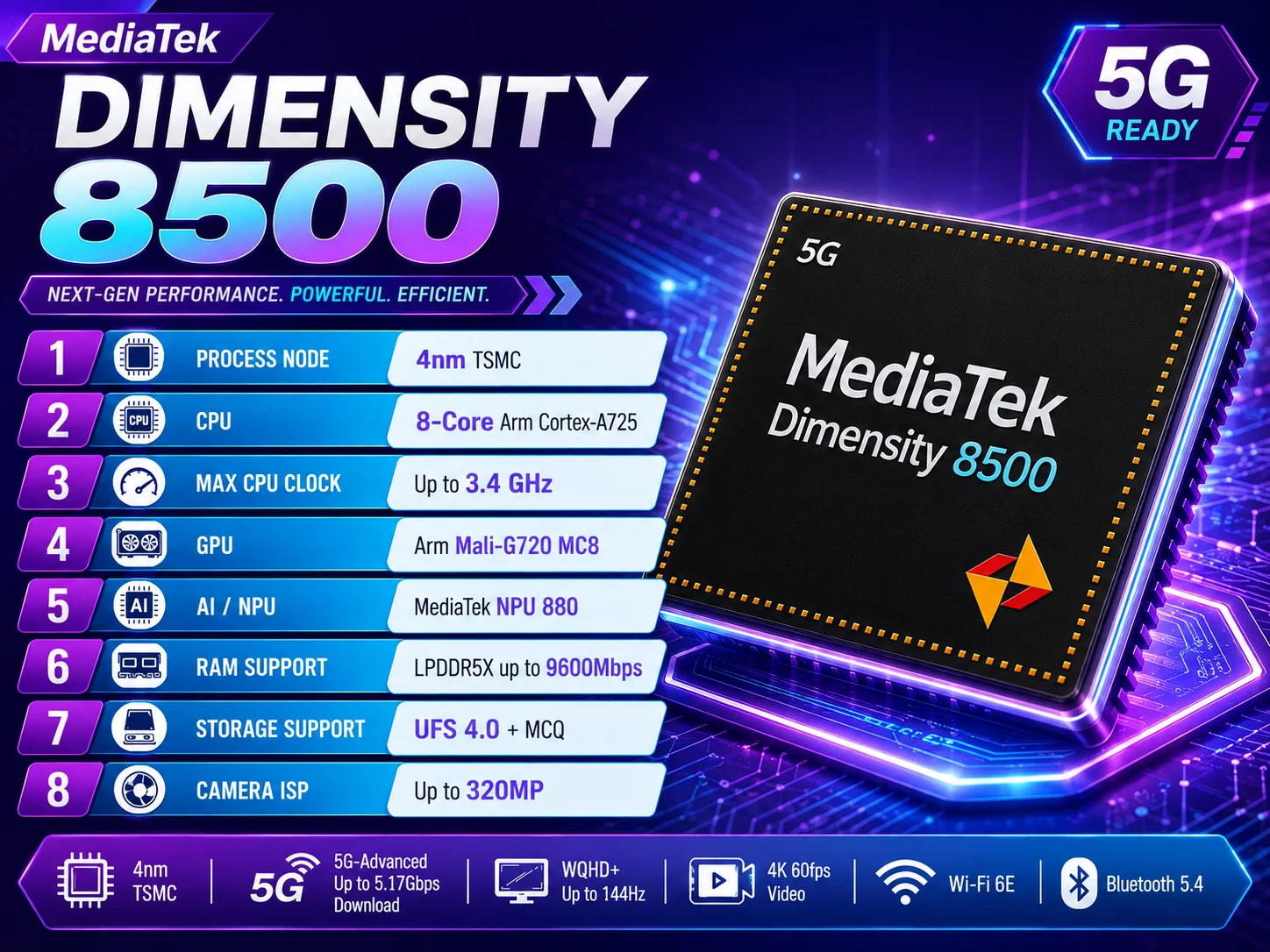
The MediaTek Dimensity 8500 is an upper mid‑range 5G chipset using 1× Cortex‑A725 up to 3.4GHz, 3× Cortex‑A725 up to 3.2GHz, and 4× Cortex‑A725 up to 2.2GHz cores, paired with a Mali‑G720 MP8 GPU. With LPDDR5X memory, UFS 4.0/4.1 + MCQ storage, the MediaTek NPU 880 for on-device AI, Wi‑Fi 6, and Bluetooth 6.0, it delivers strong performance with advanced 5G‑Advanced connectivity features.
Benchmark Scores
Measures CPU, GPU, RAM, and I/O performance in different scenarios.
Shows raw single-threaded CPU performance across real-world workloads. Only category scores are published for this chipset — no overall headline total.
Cross-platform benchmark assessing graphics performance in Vulkan/Metal.
CPU & AI Performance
3× Cortex‑A725 up to 3.2GHz (512KB L2)
4× Cortex‑A725 up to 2.2GHz (256KB L2)
Graphics, Memory & Storage
Multimedia (Camera, Display & ISP)
Connectivity
General Info
information About MediaTek Dimensity 8500
Introduction
Comparing two closely related MediaTek mid-rangers against a genuine Samsung flagship chip raises an obvious question: does the extra tier matter? This Dimensity 8500 vs Dimensity 8450 vs Exynos 2400 comparison uses verified NanoReview specification and benchmark data to explain how these three chips perform in CPU work, gaming, camera processing, and connectivity, and whether the flagship-class Exynos 2400 justifies its higher positioning.
1. Processor Overview
The Dimensity 8500, announced January 2026, is an 8-core mid-range chip built on TSMC’s 4nm process, using an all-performance-core layout: 1x Cortex-A725 at 3.4GHz, 3x Cortex-A725 at 3.2GHz, and 4x Cortex-A725 at 2.2GHz, paired with a Mali-G720 MP8 GPU.
The Dimensity 8450, announced May 2025 and also on TSMC 4nm, shares the same all-performance-core architecture but runs slightly slower: 1x Cortex-A725 at 3.25GHz, 3x Cortex-A725 at 3.0GHz, and 4x Cortex-A725 at 2.1GHz, alongside a smaller Mali-G720 MP7 GPU.
The Samsung Exynos 2400, announced January 2024 and the only flagship-class chip in this comparison, uses a 10-core layout on Samsung’s own 4nm process: 1x Cortex-X4 at 3.21GHz, 2x Cortex-A720 at 2.9GHz, 3x Cortex-A720 at 2.6GHz, and 4x Cortex-A520 efficiency cores at 1.95GHz, paired with a Samsung Xclipse 940 GPU built on AMD’s RDNA 3 architecture.
The core count difference stands out immediately: both Dimensity chips use 8 performance-class cores with no dedicated efficiency cores, while the Exynos 2400 uses 10 cores across four different clock tiers, including genuine efficiency cores that the Dimensity chips lack entirely.
2. CPU Architecture & Processing Power
The two Dimensity chips use ARMv9.2-A Cortex-A725 cores throughout. The Exynos 2400 also uses ARMv9.2-A, but with a Cortex-X4 prime core, a design Qualcomm and Samsung use in flagship chips and that outperforms MediaTek’s highest-clocked Cortex-A725 core in single-threaded work.
In Geekbench 6 single-core, the Exynos 2400 leads clearly with 2115, about 26.5% higher than the Dimensity 8500 (1555) and about 31.2% higher than the Dimensity 8450 (1612). The Cortex-X4 prime core’s architectural advantage is decisive here, and no amount of clock speed tuning closes this gap for either Dimensity chip.
Multi-core also favors the Exynos 2400: it leads with 6826, ahead of the Dimensity 8500 (6405, about 6.2% lower) and the Dimensity 8450 (6210, about 9.0% lower than the Exynos 2400). Despite using efficiency cores that contribute less raw throughput than full performance cores, the Exynos 2400’s 10-core layout and stronger prime core still win out over both all-performance-core Dimensity designs.
Between the two Dimensity chips, the Dimensity 8500 leads the Dimensity 8450 in multi-core by about 3.1%, reflecting its modest clock speed advantage across all three of its core tiers.
3. GPU & Gaming Performance
GPU architecture differs substantially. The Exynos 2400’s Samsung Xclipse 940 is built on AMD’s RDNA 3 architecture, with 6 pipelines and 768 total shaders, rated at 3406.8 Gigaflops. The Dimensity 8500’s Mali-G720 MP8 has 8 pipelines and 1024 shaders at 3088.4 Gigaflops, while the Dimensity 8450’s smaller Mali-G720 MP7 has 7 pipelines and 896 shaders at 2329.6 Gigaflops.
Geekbench 6 GPU Compute favors the Exynos 2400 clearly: it leads at 16273, about 17.3% higher than the Dimensity 8500 (13461) and about 32.1% higher than the Dimensity 8450 (12321). Between the two Dimensity chips, the Dimensity 8500 leads the Dimensity 8450 by about 9.3% in this test.
3DMark results are only partially comparable, since each chip reports different sub-tests. The Exynos 2400 discloses all three: Steel Nomad Light (1769), Solar Bay (8302), and Wild Life Extreme (3812). The Dimensity 8450 discloses Steel Nomad Light (1467, about 17.1% lower than the Exynos 2400) and Solar Bay (6549, about 21.1% lower than the Exynos 2400). The Dimensity 8500 discloses only Wild Life Extreme, where it actually leads the Exynos 2400 at 4058 versus 3812, about 6.5% higher, the one 3DMark test where a Dimensity chip outperforms the Exynos 2400.
Overall, the Exynos 2400 wins most directly comparable GPU benchmarks, though the Dimensity 8500’s Wild Life Extreme lead shows the picture is not entirely one-sided. No exact frame-rate data beyond these benchmark figures is supplied, so specific in-game FPS claims cannot be made.
4. Manufacturing Process & Efficiency
All three chips are built on a 4nm process, though the two Dimensity chips use TSMC’s node while the Exynos 2400 uses Samsung’s own foundry. TDP is disclosed for the Dimensity 8500 and Exynos 2400, both at 6W, while the Dimensity 8450 is disclosed higher at 7W.
NanoReview’s battery-life sub-scores favor both Dimensity chips: they share an identical score of 91, while the Exynos 2400 scores lower at 86. This is a meaningful gap and suggests that despite matching TDP figures with the Dimensity 8500, the Exynos 2400’s larger 10-core CPU and RDNA 3 GPU likely draw more sustained power in practice, a pattern echoed in comments about Exynos chips’ historically weaker modem efficiency.
5. RAM, Memory & Storage Support
All three chips use LPDDR5X memory. The Dimensity 8500 runs at the highest frequency (4800MHz, 76.8Gb/s bandwidth), followed by the Dimensity 8450 (4266MHz, 68.2Gb/s) and the Exynos 2400 (4200MHz, also 68.2Gb/s, essentially tied with the Dimensity 8450 on bandwidth). All three support up to 24GB RAM.
Storage support favors the Dimensity 8500, which supports both UFS 4.0 and UFS 4.1. The Dimensity 8450 supports UFS 4.0 only, and the Exynos 2400 supports UFS 3.1 and UFS 4.0, a slightly wider range than the Dimensity 8450 but without the newer UFS 4.1 standard the Dimensity 8500 offers.
6. AI & NPU Capabilities
Both Dimensity chips use a named MediaTek NPU 880, but no TOPS figure is disclosed for either. The Exynos 2400 confirms an NPU is present but also has no TOPS figure supplied in the data. Because none of the three chips has a disclosed TOPS rating, no numeric AI performance ranking can be made across this comparison.
7. ISP, Camera & Video Capabilities
Camera resolution is identical across all three at a maximum of 320MP for the primary sensor; both Dimensity chips additionally support 3x 32MP secondary sensors, a configuration not disclosed for the Exynos 2400.
Video capability strongly favors the Exynos 2400, which supports 8K capture at 30FPS and 4K capture at 120FPS, with playback reaching 8K at 60FPS and 4K at 120FPS. Both Dimensity chips are limited to 4K at 60FPS for capture and playback, a considerably lower ceiling. All three support H.264, H.265, AV1, and VP9 codecs.
8. Display Support
The Exynos 2400 supports the highest maximum display resolution at 3840 x 2400, reflecting its flagship-class positioning. Both Dimensity chips are limited to 2960 x 1440, still a high-resolution ceiling but clearly lower than the Exynos 2400’s.
9. Modem, 5G & Connectivity
The Exynos 2400 has by far the fastest disclosed 5G connectivity, with its Exynos 5400 modem supporting a theoretical download speed of up to 12100 Mbps and upload of 3670 Mbps. Both Dimensity chips are disclosed at a much lower 5170 Mbps download with no upload figure supplied, making the Exynos 2400’s download ceiling more than double that of either Dimensity chip.
Wi-Fi 6 is common to all three. Bluetooth favors the newer Dimensity chips, both at 6.0, ahead of the Exynos 2400’s 5.3. GNSS support is identical across all three, including NAVIC. These are theoretical maximums; real-world network speeds depend on carrier infrastructure and will not always reach these ceilings.
10. Benchmark Comparison
All benchmark figures below use AnTuTu 11 and Geekbench 6, so comparisons are apples-to-apples where data exists for all three.
AnTuTu 11 Total:
- Dimensity 8500: 2,120,347
- Samsung Exynos 2400: 2,046,435 (Dimensity 8500 leads by about 3.6%)
- Dimensity 8450: 2,016,572 (Dimensity 8500 leads by about 5.2%)
Geekbench 6 Single-Core: Exynos 2400 leads clearly with 2115, ahead of the Dimensity 8450 (1612, about 31.2% lower than the Exynos 2400) and Dimensity 8500 (1555, about 26.5% lower than the Exynos 2400).
Geekbench 6 Multi-Core: Exynos 2400 leads with 6826, ahead of the Dimensity 8500 (6405, about 6.2% lower) and Dimensity 8450 (6210, about 9.0% lower than the Exynos 2400).
Geekbench 6 GPU Compute: Exynos 2400 leads at 16273, ahead of the Dimensity 8500 (13461, about 17.3% lower) and Dimensity 8450 (12321, about 32.1% lower than the Exynos 2400).
3DMark: Mixed results across different sub-tests. The Exynos 2400 leads Steel Nomad Light and Solar Bay against the Dimensity 8450, but the Dimensity 8500 leads Wild Life Extreme against the Exynos 2400 by about 6.5%.
PCMark 3.0: Only disclosed for the Dimensity 8450 (17957) and Exynos 2400 (17172); the Dimensity 8450 leads by about 4.6%. Not disclosed for the Dimensity 8500.
The overall picture leans toward the Exynos 2400 on raw compute and GPU benchmarks, but the Dimensity 8500 wins the composite AnTuTu score and holds a real advantage in one GPU test (Wild Life Extreme), along with a clear battery-life edge over the flagship-class Exynos chip.
11. Real-World Performance
Everyday users should notice a real single-core responsiveness advantage on the Exynos 2400, which leads by more than 25% over either Dimensity chip in this test.
Multitaskers also benefit more from the Exynos 2400’s multi-core lead, despite its use of weaker efficiency cores alongside stronger performance cores.
Gamers get a mostly stronger picture from the Exynos 2400 in GPU Compute and two of three 3DMark sub-tests, though the Dimensity 8500’s Wild Life Extreme lead shows it is not universally behind.
Content creators benefit substantially from the Exynos 2400’s 8K/60FPS video ceiling, well ahead of both Dimensity chips’ 4K/60FPS limit.
AI users cannot be meaningfully differentiated here, since none of the three chips has a disclosed NPU TOPS figure.
Camera users get identical maximum resolution across all three, with the two Dimensity chips adding disclosed secondary sensor support the Exynos 2400 lacks.
Connectivity-focused users should clearly favor the Exynos 2400, with more than double the disclosed 5G download speed of either Dimensity chip.
Battery-conscious users should note both Dimensity chips share a meaningfully higher NanoReview battery-life score than the Exynos 2400.
12. Strengths & Weaknesses
MediaTek Dimensity 8500
- Strengths: Highest AnTuTu 11 total score of the three; leads 3DMark Wild Life Extreme even against the flagship-class Exynos 2400; widest storage support (UFS 4.0/4.1); tied for the highest battery-life sub-score.
- Weaknesses: Trails the Exynos 2400 by roughly 26% in single-core and 17% in GPU Compute; limited to 4K/60FPS video versus the Exynos 2400’s 8K/60FPS; slower disclosed 5G download speed.
MediaTek Dimensity 8450
- Strengths: Highest PCMark score of the three; tied for the highest battery-life sub-score; same camera and connectivity ceiling as the Dimensity 8500.
- Weaknesses: Lowest AnTuTu 11 total score; lowest scores in single-core, multi-core, and GPU Compute among the three; highest disclosed TDP (7W) despite being the mid-range chip.
Samsung Exynos 2400
- Strengths: Leads Geekbench single-core, multi-core, and GPU Compute by wide margins; highest max display resolution (3840×2400); widest video ceiling (8K/60FPS); fastest disclosed 5G speeds by a wide margin (12100/3670 Mbps).
- Weaknesses: Lowest AnTuTu 11 total score of the three; lowest NanoReview battery-life sub-score (86); loses 3DMark Wild Life Extreme to the Dimensity 8500; oldest Bluetooth version (5.3).
13. Best Processor For Different Users
- Best for Gaming: Samsung Exynos 2400 (mostly), with the Dimensity 8500 competitive in Wild Life Extreme
- Best for AI: Not determinable from supplied data
- Best for Efficiency: MediaTek Dimensity 8500 and Dimensity 8450 (tied on battery-life score)
- Best for Camera Processing: Samsung Exynos 2400 (video), MediaTek chips (secondary sensor support)
- Best for Connectivity: Samsung Exynos 2400
- Best for Balanced Performance: Samsung Exynos 2400
Final Verdict
This Dimensity 8500 vs Dimensity 8450 vs Exynos 2400 comparison shows the flagship-class Exynos 2400 winning most raw compute and GPU benchmarks, even though the Dimensity 8500, as the Primary Processor, leads the single most commonly cited composite score, AnTuTu 11.
Final Verdict
1. Samsung Exynos 2400 — Best Overall It leads Geekbench single-core, multi-core, and GPU Compute by wide margins, has by far the fastest disclosed 5G speeds and widest video ceiling, making it the strongest all-round performer despite its lower AnTuTu total score and weaker battery-life rating.
2. MediaTek Dimensity 8500 — Best For AnTuTu Score and Battery Life It posts the highest AnTuTu 11 total score of the three and matches the Dimensity 8450 on battery-life score, and even beats the Exynos 2400 outright in 3DMark Wild Life Extreme, but trails clearly in single-core, multi-core, and most GPU benchmarks.
3. MediaTek Dimensity 8450 — Best For PCMark It leads the everyday-workload PCMark test, but posts the lowest scores of the three in nearly every other benchmark category, making it the least compelling of the three overall.
Best for Gaming: Samsung Exynos 2400 Best for AI: Not determinable from supplied data Best for Efficiency: MediaTek Dimensity 8500 and Dimensity 8450 Best Balanced Choice: Samsung Exynos 2400
Bottom Line: The Dimensity 8500 wins the AnTuTu 11 total score by a modest 3.6-5.2% margin over its rivals, but the Exynos 2400 clearly outperforms both mid-range MediaTek chips on single-core, multi-core, and most GPU-focused benchmarks, along with offering substantially faster 5G and a much higher video ceiling. Buyers chasing the highest AnTuTu figure or the best battery-life score should note the Dimensity 8500, but those wanting the strongest all-round chip based on the fuller benchmark picture should lean toward the flagship-class Exynos 2400, keeping its lower battery-life rating in mind as a genuine trade-off.
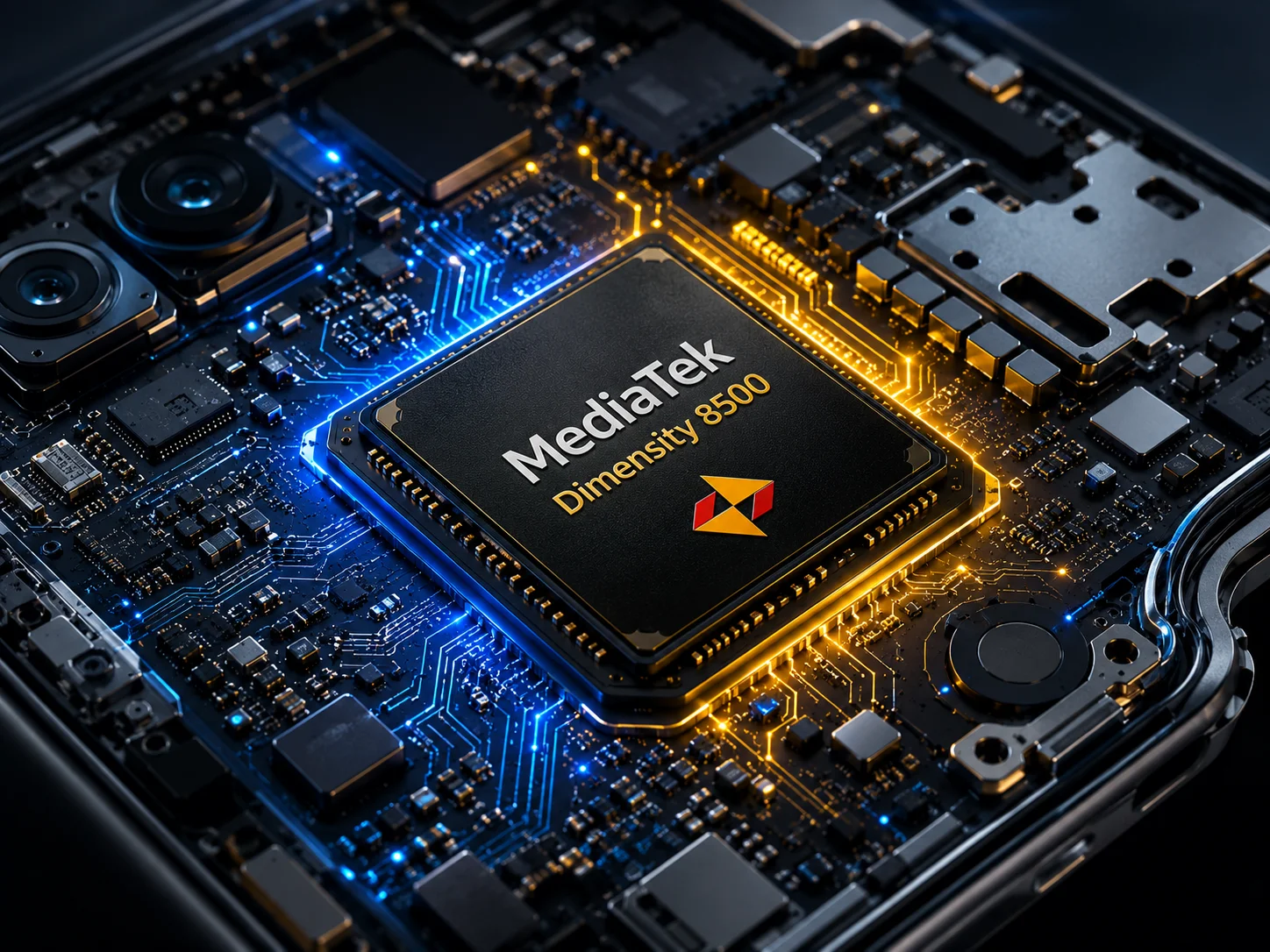
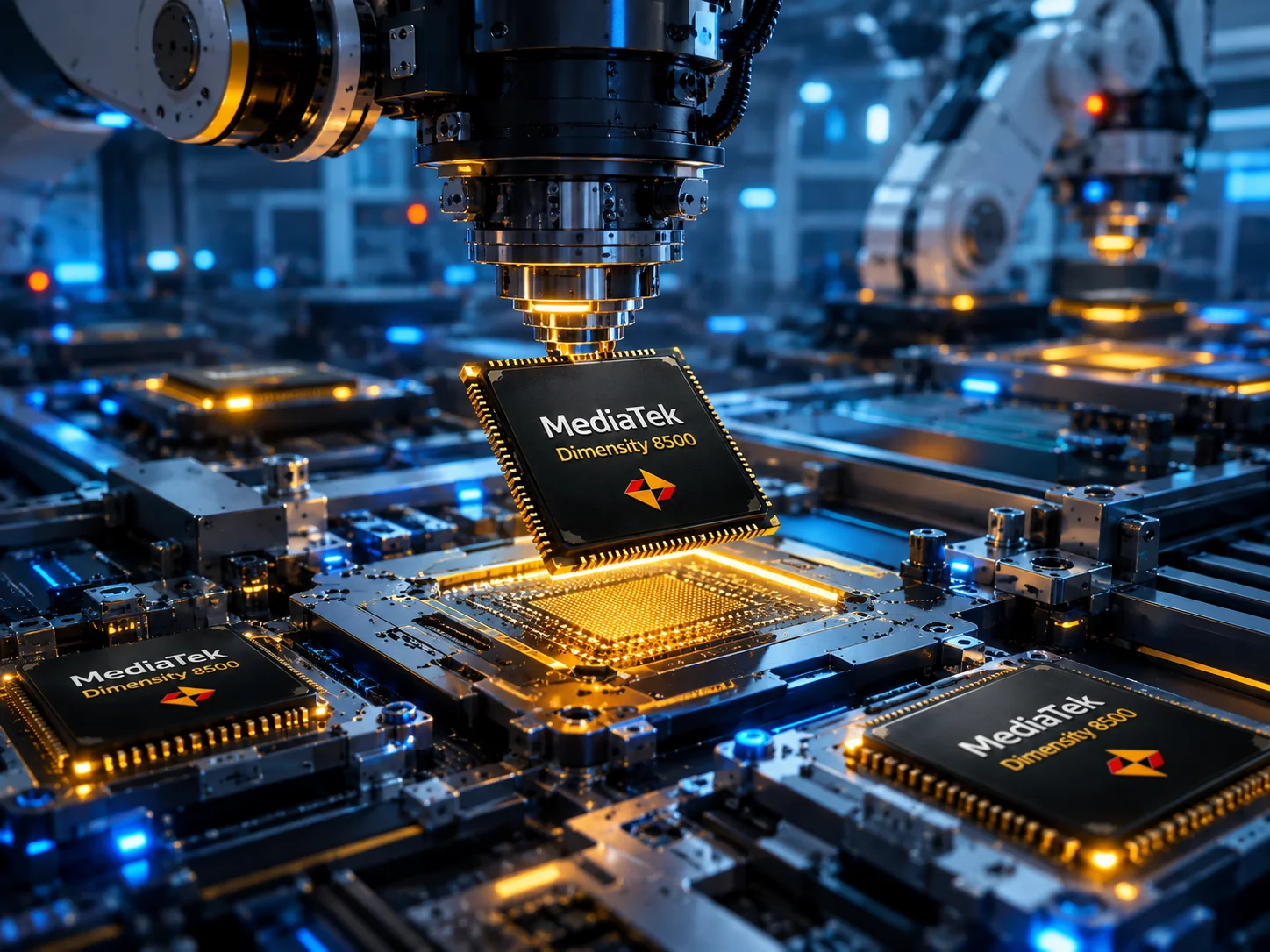
Images Of MediaTek Dimensity 8500
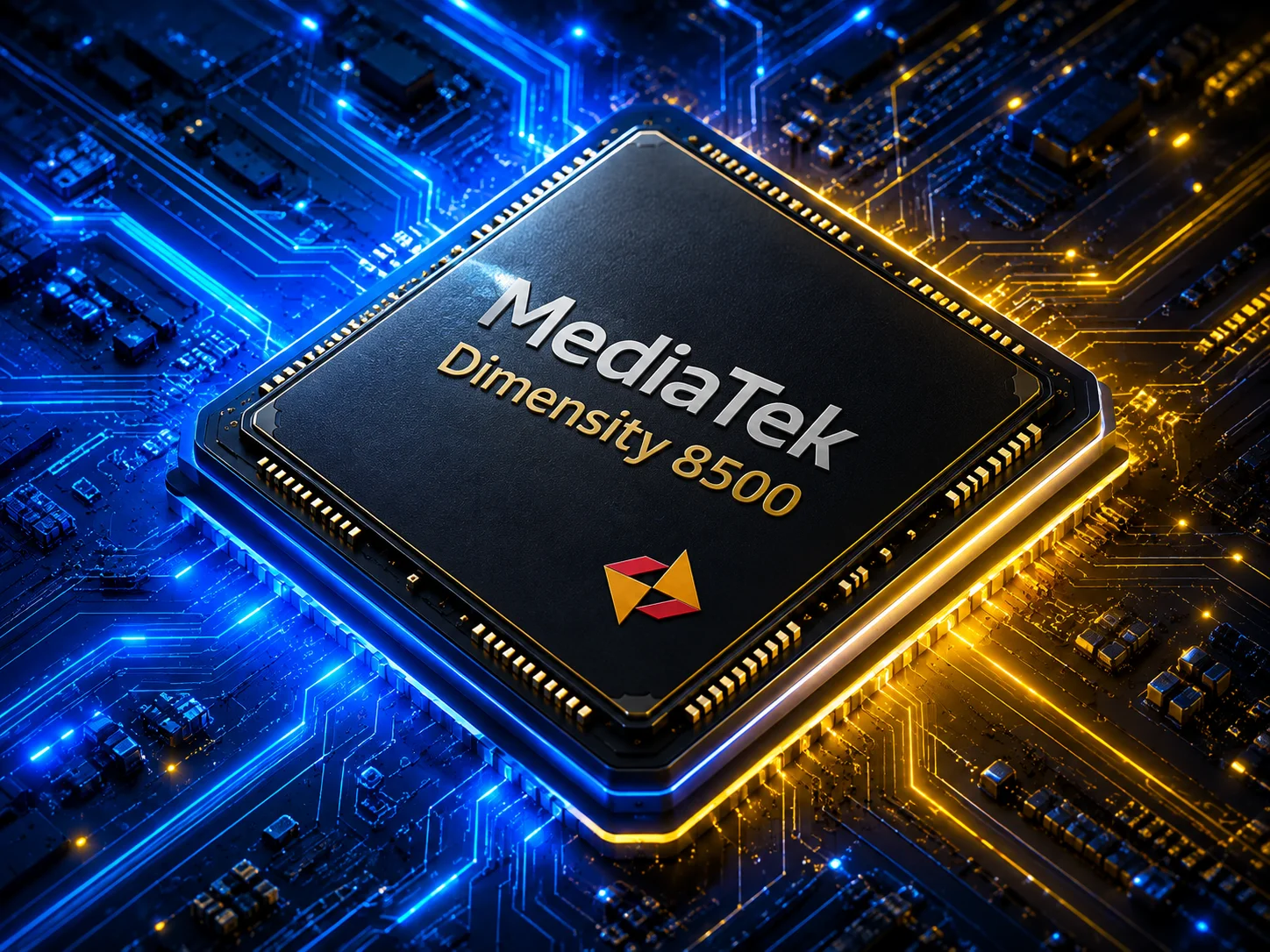
Trailer Of MediaTek Dimensity 8500

Author & Post Info
Faisal Ur Rehman
Faisal Rehman is the founder and editor of FSL Specs, where he publishes in-depth smartphone specifications, comparisons, buying guides, and technology insights. With extensive experience in mobile hardware research and technical analysis, he provides accurate and up-to-date information on Android smartphones, processors, displays, cameras, batteries, performance benchmarks, and software features. His goal is to simplify complex specifications and help readers choose the right device with confidence.
Explore FSL Specs
Questions About MediaTek Dimensity 8500
What is the MediaTek Dimensity 8500?
The MediaTek Dimensity 8500 is a premium 5G smartphone chipset designed for strong performance, gaming, AI processing, and power efficiency. Its 4nm manufacturing process helps deliver flagship-style performance while keeping power consumption under control.
How powerful is the Dimensity 8500?
The Dimensity 8500 uses an 8-core Arm Cortex-A725 CPU with a maximum clock speed of up to 3.4GHz. Its all-big-core design is focused on delivering strong performance for multitasking, demanding apps, and intensive workloads.
Is Dimensity 8500 good for gaming?
Yes, the Arm Mali-G720 MC8 GPU makes the Dimensity 8500 well suited for demanding mobile games. It is designed to provide high graphics performance while maintaining good efficiency during longer gaming sessions.
Does Dimensity 8500 support 5G?
Yes, the Dimensity 8500 includes 5G connectivity with support for advanced 5G features. This makes it suitable for high-speed mobile networks in markets such as Pakistan, India, and other Asian regions.
What RAM and storage does Dimensity 8500 support?
The chipset supports LPDDR5X memory at up to 9600Mbps and UFS 4.0 storage with MCQ. This combination can provide faster app loading, multitasking, file transfers, and overall system responsiveness.
What camera does Dimensity 8500 support?
The Dimensity 8500 supports camera sensors of up to 320MP and includes advanced AI and imaging processing through the MediaTek NPU 880. Actual camera performance depends on the sensor and software used by each smartphone manufacturer.
What video recording does Dimensity 8500 support?
The Dimensity 8500 supports 4K video recording at up to 60fps, along with advanced video processing features. The exact recording modes can vary between smartphones depending on the manufacturer's camera implementation.