Introduction
MediaTek’s recent flagship lineup includes three closely related chips that share nearly identical GPU hardware but differ in clock speed, memory, and connectivity refinements. This Dimensity 9300 Plus vs Dimensity 9300 vs Dimensity 9400e comparison uses verified NanoReview specification and benchmark data to explain how these three chips perform in CPU work, gaming, camera processing, and connectivity, and whether the “Plus” branding and newer “9400e” naming actually translate into meaningful upgrades.
1. Processor Overview
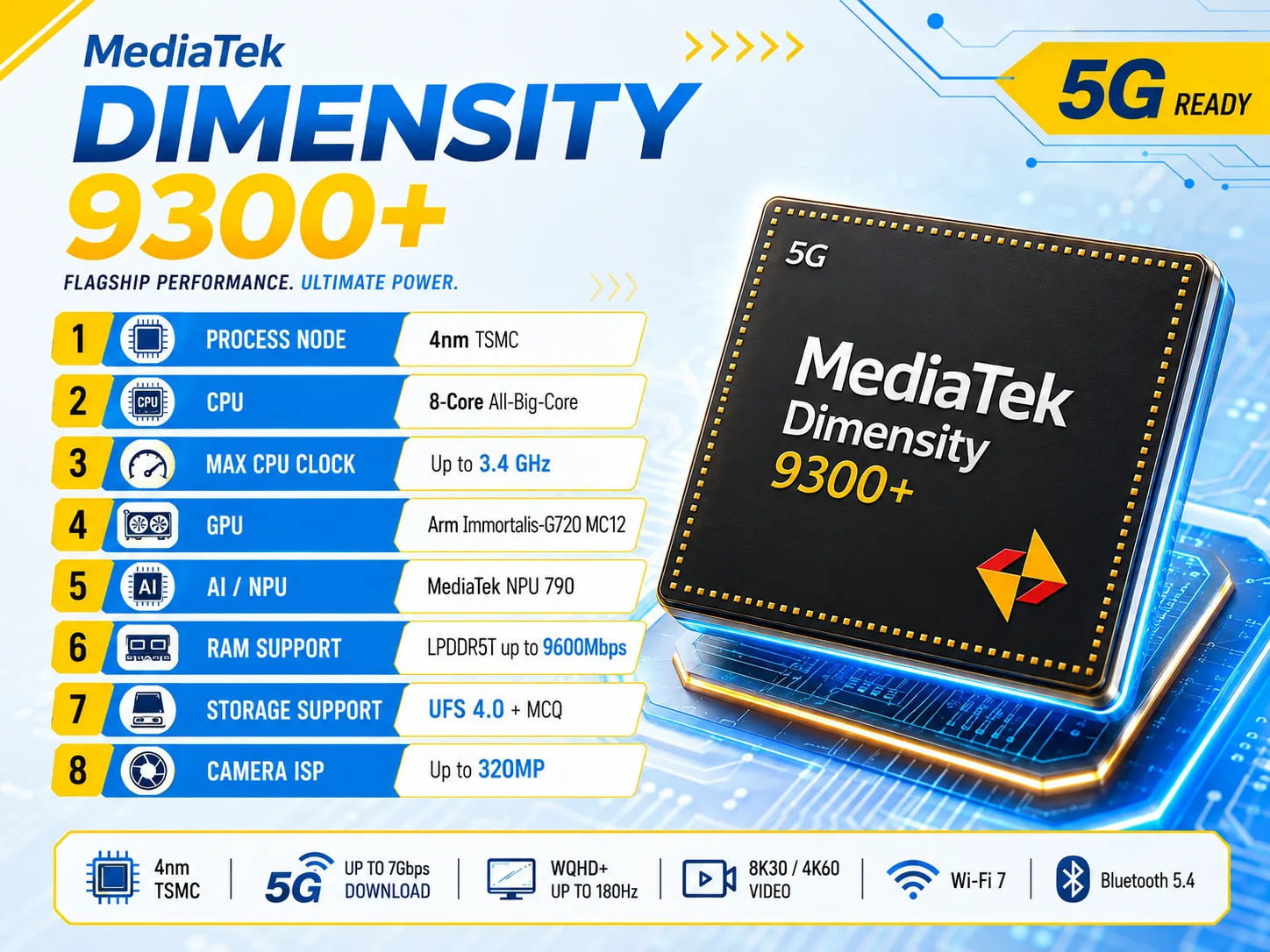
The Dimensity 9300 Plus, announced May 2024, is an 8-core chip built on TSMC’s 4nm process, using a 1+3+4 layout: 1x Cortex-X4 at 3.4GHz, 3x Cortex-X4 at 2.85GHz, and 4x Cortex-A720 at 2.0GHz, paired with a Mali-G720 Immortalis MP12 GPU.
The Dimensity 9300, announced November 2023 and the oldest chip here, uses the identical core layout and the same Mali-G720 Immortalis MP12 GPU, but with a slightly lower prime core clock of 3.25GHz versus the Plus variant’s 3.4GHz; the other seven cores run at identical clocks to the Dimensity 9300 Plus.
The Dimensity 9400e, announced May 2025 and the newest chip in this comparison, also uses the same 1+3+4 layout with an identical 3.4GHz prime core clock to the Dimensity 9300 Plus, and shares the exact same Mali-G720 Immortalis MP12 GPU configuration as both other chips.
All three chips share essentially the same CPU core layout and an identical GPU on paper, which makes this comparison less about raw hardware differences and more about how memory, connectivity, and platform refinements affect real-world benchmark results.
2. CPU Architecture & Processing Power
All three chips use ARMv9.2-A with the same Cortex-X4/Cortex-A720 core mix, an 8MB L3 cache, and a 22.7 billion transistor count where disclosed. TDP is only supplied for two of the three: the Dimensity 9300 Plus is rated at 7.3W, slightly higher than the Dimensity 9300’s 7W; no TDP figure is disclosed for the Dimensity 9400e.
In Geekbench 6 single-core, the Dimensity 9300 Plus actually leads with 2249, narrowly ahead of the Dimensity 9400e (2233, about 0.7% lower) and the Dimensity 9300 (2186, about 2.9% lower than the Dimensity 9300 Plus). This is a genuinely tight race, with less than 3% separating all three chips.
Multi-core tells a slightly different story: the Dimensity 9400e leads with 7478, followed by the Dimensity 9300 (7422, about 0.7% lower) and the Dimensity 9300 Plus (7352, about 1.7% lower than the Dimensity 9400e). Notably, the older Dimensity 9300 edges out its own “Plus” successor in this specific test, though the margin is under 1%.
3. GPU & Gaming Performance
All three chips use the identical Mali-G720 Immortalis MP12 GPU configuration: 12 pipelines, 1536 total shaders, and the same 3993.6 Gigaflops theoretical rating. On paper, GPU hardware is not a differentiator here at all.
Geekbench 6 GPU Compute results are correspondingly close but not identical: the Dimensity 9400e leads at 15981, ahead of the Dimensity 9300 Plus (15274, about 4.4% lower) and the Dimensity 9300 (15081, about 5.6% lower than the Dimensity 9400e). In 3DMark Steel Nomad Light, the Dimensity 9400e again leads (1916), ahead of the Dimensity 9300 Plus (1831, about 4.4% lower) and the Dimensity 9300 (1814, about 5.3% lower).
In 3DMark Solar Bay, the same ranking holds: the Dimensity 9400e leads at 8016, followed by the Dimensity 9300 (7667, about 4.4% lower) and the Dimensity 9300 Plus (7559, about 5.7% lower than the Dimensity 9400e). Only the Dimensity 9300 Plus and Dimensity 9300 report a 3DMark Wild Life Extreme score, where the Dimensity 9300 Plus leads (5071 versus 4692, about 8.1% higher); no Wild Life Extreme figure is supplied for the Dimensity 9400e.
Despite sharing identical GPU hardware on paper, the Dimensity 9400e consistently posts the highest real-world GPU benchmark scores, suggesting platform-level refinements (memory, drivers, or thermal design) rather than raw hardware account for the difference. No exact frame-rate data beyond these benchmark figures is supplied, so specific in-game FPS claims cannot be made.
4. Manufacturing Process & Efficiency
All three chips share the same TSMC 4nm process node, so node size is not a differentiator. TDP is disclosed for the Dimensity 9300 Plus (7.3W) and Dimensity 9300 (7W); no TDP figure is supplied for the Dimensity 9400e.
NanoReview’s battery-life sub-scores are close across all three: the Dimensity 9300 scores highest at 92, while the Dimensity 9300 Plus and Dimensity 9400e both score 91. The differences are minor and suggest all three are well optimized for sustained battery life relative to their performance class. NanoReview’s overall composite score slightly favors the newest chip: the Dimensity 9400e scores 79, edging out the Dimensity 9300 Plus and Dimensity 9300, both at 78.
5. RAM, Memory & Storage Support
Memory is one of the more interesting differences despite the shared GPU. The Dimensity 9300 Plus and Dimensity 9300 both use LPDDR5T memory at 4800MHz, while the Dimensity 9400e uses the more conventional LPDDR5X standard at the same 4800MHz frequency. All three deliver identical 76.8Gb/s bandwidth and support up to 24GB RAM, so despite the different memory type naming, practical throughput is unchanged across the three.
Storage support is identical across all three, with each supporting UFS 4.0 only.
6. AI & NPU Capabilities
All three chips use the identical named MediaTek NPU 790, and none of the three has a disclosed TOPS figure in the supplied data. Because AI hardware naming and disclosure are identical across all three, no differentiation can be made in this category based on the available specifications.
7. ISP, Camera & Video Capabilities
Camera and video specifications are identical across all three chips: each supports a maximum single camera resolution of 320MP and video capture and playback at 8K/30FPS and 4K/60FPS, with H.264, H.265, AV1, and VP9 codec support. This is one of the clearest examples of shared platform design across the three, with no meaningful differentiation in this category based on the supplied data.
8. Display Support
All three chips support an identical maximum display resolution of 3840 x 2160, so there is no differentiation in this category either.
9. Modem, 5G & Connectivity
The Dimensity 9300 Plus and Dimensity 9300 both use the named MediaTek T830 modem, with identical disclosed 5G speeds of up to 7900 Mbps download and 4200 Mbps upload, the fastest of the three. The Dimensity 9400e discloses a slightly lower 7300 Mbps download speed with no modem name or upload figure supplied, about 7.6% lower than the other two on the download figure that is available.
Wi-Fi 7 is common to all three. Bluetooth is where the newest chip pulls ahead: the Dimensity 9400e supports Bluetooth 6.0, newer than the 5.4 shared by the Dimensity 9300 Plus and Dimensity 9300. GNSS support is identical across all three, including NAVIC. These are theoretical maximums; real-world network speeds depend on carrier infrastructure and will not always reach these ceilings.
10. Benchmark Comparison
All benchmark figures below use AnTuTu 11 and Geekbench 6, so comparisons are apples-to-apples.
AnTuTu 11 Total:
- Dimensity 9400e: 2,502,910
- Dimensity 9300: 2,447,714 (Dimensity 9300 Plus trails the Dimensity 9400e by about 6.2%, and trails the Dimensity 9300 by about 4.1%)
- Dimensity 9300 Plus: 2,348,248 (the lowest AnTuTu total of the three)
Geekbench 6 Single-Core: Dimensity 9300 Plus leads narrowly with 2249, ahead of the Dimensity 9400e (2233, about 0.7% lower) and Dimensity 9300 (2186, about 2.9% lower than the Dimensity 9300 Plus).
Geekbench 6 Multi-Core: Dimensity 9400e leads with 7478, followed by the Dimensity 9300 (7422) and Dimensity 9300 Plus (7352, about 1.7% lower than the Dimensity 9400e).
Geekbench 6 GPU Compute: Dimensity 9400e leads at 15981, ahead of the Dimensity 9300 Plus (15274, about 4.4% lower) and Dimensity 9300 (15081, about 5.6% lower).
3DMark: The Dimensity 9400e leads Steel Nomad Light and Solar Bay; the Dimensity 9300 Plus leads Wild Life Extreme, the only sub-test where the Dimensity 9300 Plus outperforms the Dimensity 9300 by a meaningful margin (about 8.1%). No Wild Life Extreme figure is disclosed for the Dimensity 9400e.
PCMark 3.0: Dimensity 9400e leads clearly (16,664), ahead of the Dimensity 9300 Plus (14,255, about 14.5% lower) and Dimensity 9300 (14,063, about 15.6% lower than the Dimensity 9400e).
The overall picture is fairly consistent: the Dimensity 9400e wins the composite AnTuTu score, multi-core, GPU Compute, most 3DMark sub-tests, and PCMark by a clear margin, despite sharing identical GPU hardware with both older chips. The Dimensity 9300 Plus’s only clear wins are single-core speed and Wild Life Extreme.
11. Real-World Performance
Everyday users should see nearly identical single-core responsiveness across all three, with the Dimensity 9300 Plus holding a very slight edge.
Multitaskers benefit modestly from the Dimensity 9400e’s multi-core lead, though the differences between all three are small in absolute terms.
Gamers get the most consistent advantage from the Dimensity 9400e, which leads most GPU-focused benchmarks despite sharing identical GPU hardware with the older chips, suggesting better platform-level optimization.
Content creators get identical camera and video specifications across all three, so this category is effectively tied.
AI users cannot be differentiated here, since all three use the same named NPU with no disclosed TOPS figures.
Connectivity-focused users should note that the Dimensity 9300 Plus and Dimensity 9300 both offer slightly faster disclosed 5G download speeds than the Dimensity 9400e, though the Dimensity 9400e counters with the newest Bluetooth version.
12. Strengths & Weaknesses
MediaTek Dimensity 9300 Plus
- Strengths: Highest Geekbench single-core score, though narrowly; leads 3DMark Wild Life Extreme; matches the Dimensity 9300’s fastest disclosed 5G speeds (7900/4200 Mbps).
- Weaknesses: Lowest AnTuTu 11 total score of the three; trails the Dimensity 9400e in multi-core, GPU Compute, and PCMark; slightly higher disclosed TDP than the Dimensity 9300 (7.3W versus 7W).
MediaTek Dimensity 9300
- Strengths: Highest NanoReview battery-life sub-score (92); edges out its own “Plus” successor in multi-core, GPU Compute, and most 3DMark tests; matches the fastest disclosed 5G speeds.
- Weaknesses: Lowest Geekbench single-core score of the three; oldest chip in the comparison; trails the Dimensity 9400e clearly in AnTuTu, GPU Compute, and PCMark.
MediaTek Dimensity 9400e
- Strengths: Highest AnTuTu 11 total score; leads Geekbench multi-core, GPU Compute, Steel Nomad Light, Solar Bay, and PCMark by clear margins; newest Bluetooth version (6.0); highest NanoReview composite score (79).
- Weaknesses: Slowest disclosed 5G download speed of the three, with no upload figure or modem name supplied; no disclosed TDP figure; no Wild Life Extreme score supplied.
13. Best Processor For Different Users
- Best for Gaming: MediaTek Dimensity 9400e
- Best for AI: Not determinable from supplied data (identical NPU across all three)
- Best for Efficiency: MediaTek Dimensity 9300 (highest battery-life sub-score)
- Best for Camera Processing: Tied across all three (identical specifications)
- Best for Connectivity: MediaTek Dimensity 9300 Plus and Dimensity 9300 (tied on 5G speed)
- Best for Balanced Performance: MediaTek Dimensity 9400e
Final Verdict
This Dimensity 9300 Plus vs Dimensity 9300 vs Dimensity 9400e comparison shows that, despite sharing near-identical GPU hardware, the supplied data does not support automatically favoring the Primary Processor, the Dimensity 9300 Plus, which posts the lowest AnTuTu total score of the three and loses most benchmark categories to both the older Dimensity 9300 and the newer Dimensity 9400e.
Final Verdict
1. MediaTek Dimensity 9400e — Best Overall It leads AnTuTu 11 total score, Geekbench multi-core, GPU Compute, most 3DMark sub-tests, and PCMark by clear margins, and carries the newest Bluetooth version and highest NanoReview composite score, despite sharing identical GPU hardware with both older chips and having a slightly slower disclosed 5G download speed.
2. MediaTek Dimensity 9300 — Best For Battery Life It posts the highest NanoReview battery-life sub-score and narrowly outperforms its own “Plus” successor in multi-core, GPU Compute, and most 3DMark tests, though it trails the Dimensity 9400e clearly across most benchmarks and has the lowest single-core score of the three.
3. MediaTek Dimensity 9300 Plus — Best For Single-Core Speed It leads Geekbench single-core by a narrow margin and wins 3DMark Wild Life Extreme, but posts the lowest AnTuTu 11 total score of the three and trails both other chips in most other benchmarks.
Best for Gaming: MediaTek Dimensity 9400e Best for AI: Not determinable from supplied data Best for Efficiency: MediaTek Dimensity 9300 Best Balanced Choice: MediaTek Dimensity 9400e
Bottom Line: Despite the “Plus” branding suggesting an upgrade, the Dimensity 9300 Plus actually posts the lowest AnTuTu 11 total score of the three chips compared here, and even loses several benchmark categories to its own predecessor, the original Dimensity 9300. The newer Dimensity 9400e, sharing identical GPU hardware with both older chips, still manages to lead most benchmarks by a clear margin, likely reflecting platform-level refinements beyond the raw specification sheet. Buyers choosing between these three should lean toward the Dimensity 9400e for the strongest overall benchmark performance, with the original Dimensity 9300 as a close second thanks to its slightly better battery-life score, and the Dimensity 9300 Plus as the least compelling of the three despite its newer branding.