









• Mobiles
  • Processors
  • Mobiles
  • Processors
  • Mobiles
  • Processors

✪ iPhone 17 Pro ✪

iphone 17 pro - FSL Specs
United States flag United States
$1,100 USD
…
Pakistan flag Pakistan (PKR)
465,000 PKR
India flag India (INR)
₹128,000 INR

✪ iPhone 17 Pro ✪

iphone 17 pro - FSL Specs
Last Time Update : 7 October, 2026
0

Quick Specifications

OLED

Display Type

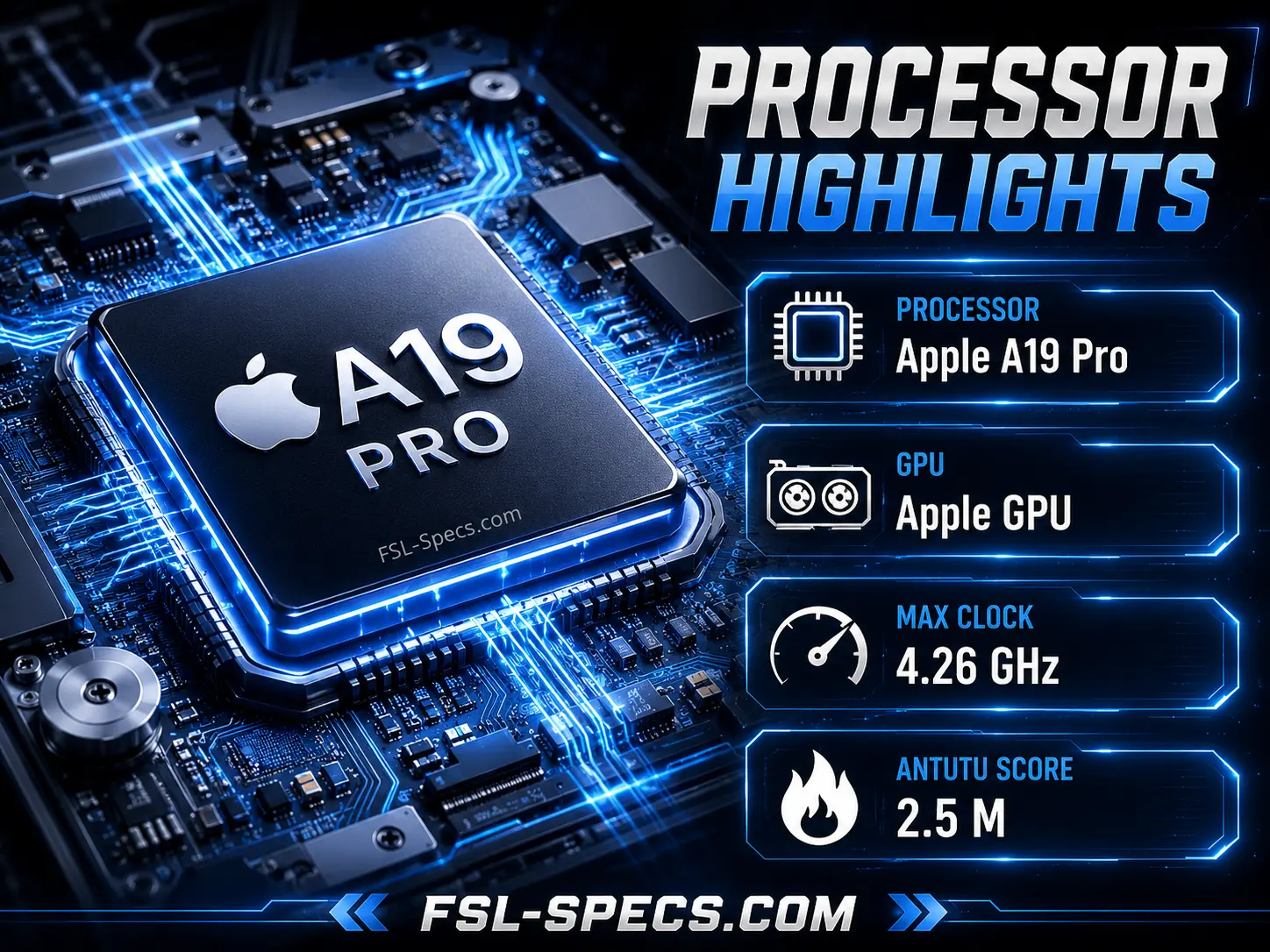
Apple A19 Pro

Processor

12 + 256 GB

Ram And Memory

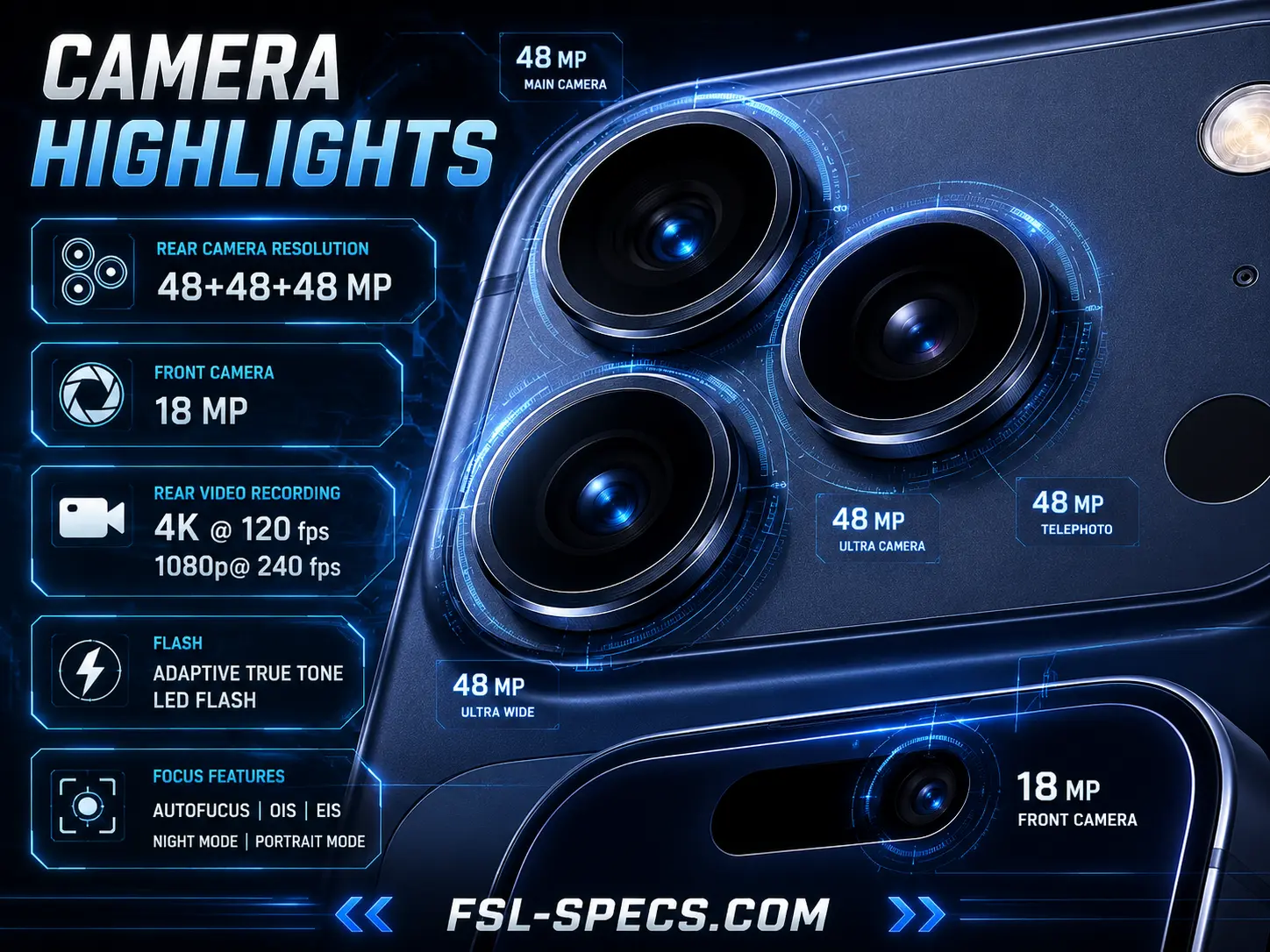
48 + 48 + 48 MP

Camera

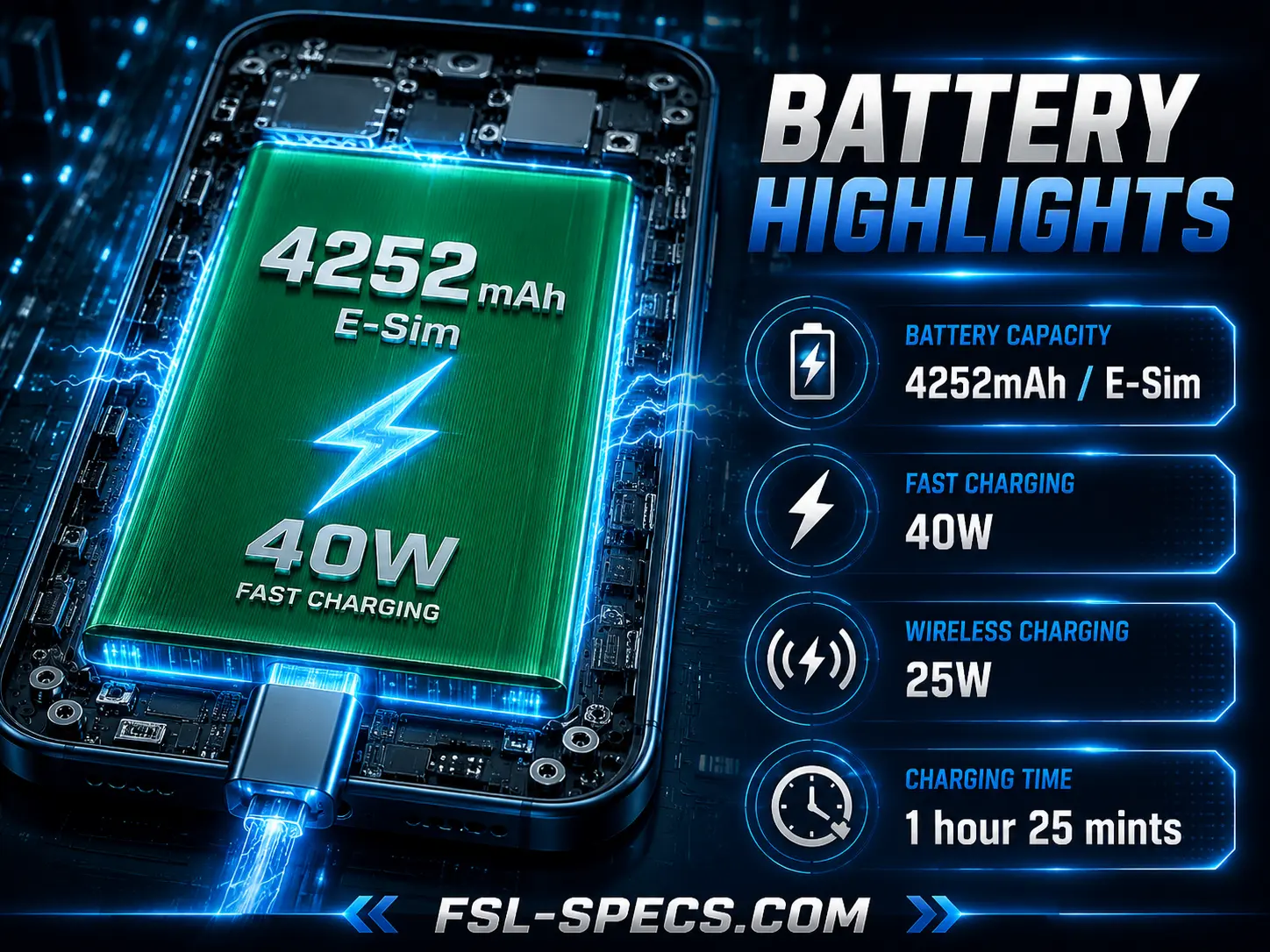
4252 E-Sim

Battery

40W

Fast Charging

Full Specification

BASIC INFO
Mobile
iPhone 17 Pro
Model
A3523
Series
iPhone 17 Series
Category
Flagship
Release Date
19 September,2025
Year
2025
CONNECTIVITY
Sim
Nano-SIM / E-Sim
Network
4G / 4G+ / 5G/ 5G+
WiFi
Wi-Fi 7 (802.11 a/b/g/n/ac/6e/be)
Bluetooth
6.0
NFC
Yes
OS
iOS 27
BODY
Dimensions
150 ×71.9 ×8.8 mm
Build
Frame And Back Aluminum
KG Weight
206 g
Screen Size
6.3 inch
Resolution
1206 × 2622 Pixels
Type
OLED
Refresh Rate
120 Hz
Peak Brightness
3000 nits
HBM Brightness
1600 nits
Processor
Apple A19 Pro
Processor Link
Max Clock
4.26 GHz
Lithography
3 nm
GPU
Apple GPU
CPU Cores
6 Cores
Antutu v11
2.5 M
Architecture
2× Everest 4.26 GHz
4× Sawtooth 2.6 GHz
Ram Memory
12 + 256 GB
Ram Type
LPDDR5X
Storage Type
NVMe
SD Card
No
Variants
12 + 256GB
12 + 512GB
12 + 1TB
MP
Rear Camera
48 + 48 + 48 MP
Front Camera
18 MP
SENSORS
Camera Sensors
48 MP = Sony IMX903
48 MP = Sony IMX972
48 MP = Sony IMX973
Front Sensors
18 MP = Sony IMX914
RECORDING FPS
Main Recording
4K @ 120 fps
1080p@ 240 fps
Front Recording
4K @60 fps
1080p @ 120 fps
RESOLUTION
Main Resolution
8064 x 6048 pixels
ZOOM
Optical Zoom
4 x
Stabilization
Yes
FLASH
Flash
Dual-LED dual-tone flash
Capacity
4252 E-Sim
Fast Charging
40W
Wireless Charging
25W
Li Battery Type
Li-Ion
REVERSE
Reverse Wired
4.5W
OTHER
Charging Time
1 hour 25 mints
AUDIO & SENSORS
Speaker
Dual Stereo Speaker
Fingerprint Sensor
Face ID
Other Sensors
Face ID
Accelerometer
Gyroscope
Barometer
Proximity
Compass
Ambient Light
LiDAR
Special Features

Emergency SOS via Satellite
Camera Control key

BASIC INFO
Mobile
iPhone 17 Pro
Model
A3523
Series
iPhone 17 Series
Category
Flagship
Release Date
19 September,2025
Year
2025
CONNECTIVITY
Sim
Nano-SIM / E-Sim
Network
4G / 4G+ / 5G/ 5G+
WiFi
Wi-Fi 7 (802.11 a/b/g/n/ac/6e/be)
Bluetooth
6.0
NFC
Yes
OS
iOS 27
BODY
Dimensions
150 ×71.9 ×8.8 mm
Build
Frame And Back Aluminum
KG Weight
206 g
Screen Size
6.3 inch
Resolution
1206 × 2622 Pixels
Type
OLED
Refresh Rate
120 Hz
Peak Brightness
3000 nits
HBM Brightness
1600 nits
Processor
Apple A19 Pro
Processor Link
Max Clock
4.26 GHz
Lithography
3 nm
GPU
Apple GPU
CPU Cores
6 Cores
Antutu v11
2.5 M
Architecture
2× Everest 4.26 GHz
4× Sawtooth 2.6 GHz
Ram Memory
12 + 256 GB
SD Card
No
Ram Type
LPDDR5X
Storage Type
NVMe
Variants
12 + 256GB
12 + 512GB
12 + 1TB
MP
Rear Camera
48 + 48 + 48 MP
Front Camera
18 MP
SENSORS
Main Camera Sensors
48 MP = Sony IMX903
48 MP = Sony IMX972
48 MP = Sony IMX973
Front Camera Sensors
18 MP = Sony IMX914
RECORDING FPS
Main Recording
4K @ 120 fps
1080p@ 240 fps
Front Recording
4K @60 fps
1080p @ 120 fps
RESOLUTION
Main Resolution
8064 x 6048 pixels
ZOOM
Optical Zoom
4 x
Stabilization
Yes
FLASH
Flash
Dual-LED dual-tone flash
Capacity
4252 E-Sim
Fast Charging
40W
Wireless Charging
25W
Li Battery Type
Li-Ion
REVERSE
Reverse Wired
4.5W
OTHER
Charging Time
1 hour 25 mints
AUDIO & SENSORS
Speaker
Dual Stereo Speaker
Fingerprint Sensor
Face ID
Other Sensors
Face ID
Accelerometer
Gyroscope
Barometer
Proximity
Compass
Ambient Light
LiDAR
Special Features

Emergency SOS via Satellite
Camera Control key

Highlights & Review Of iPhone 17 Pro

Display Review:

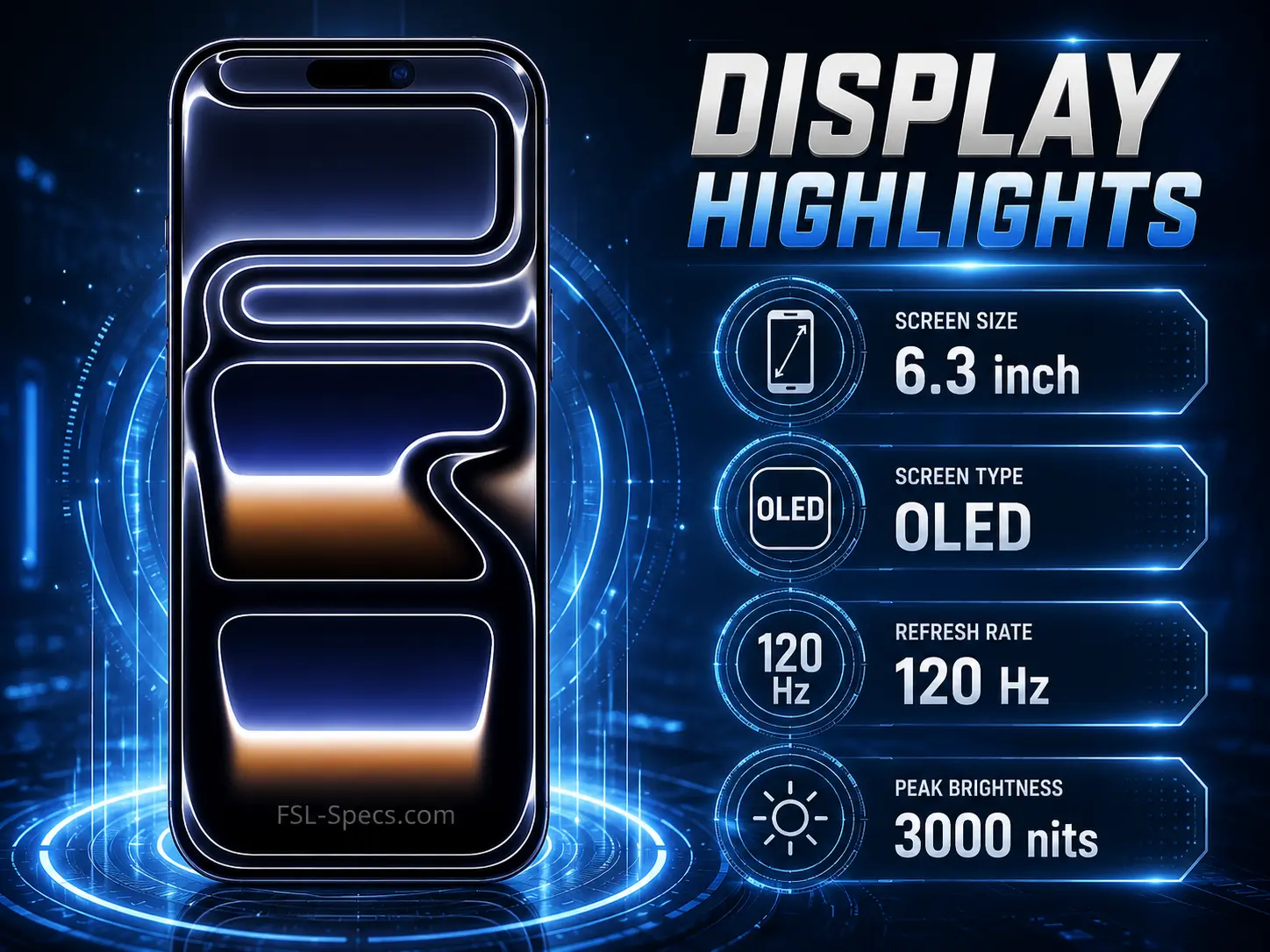
The iPhone 17 Pro uses a 6.3-inch LTPO Super Retina XDR OLED display with 2622 × 1206 resolution, 460 ppi, and an adaptive refresh rate up to 120Hz. Apple rates it at 1,000 nits typical brightness, 1,600 nits peak HDR brightness, and up to 3,000 nits outdoor brightness, while Dolby Vision, HDR10, P3 wide color and an anti-reflective coating strengthen its multimedia and outdoor-viewing experience.

The Samsung Galaxy S26 Ultra goes considerably larger with a 6.9-inch Dynamic LTPO AMOLED 2X panel at 3120 × 1440 resolution and approximately 500 ppi. Its refresh rate also reaches 120Hz, but Samsung’s 2,600-nit peak brightness is below the iPhone 17 Pro’s advertised 3,000-nit outdoor brightness. The Ultra nevertheless has a major sharpness advantage because of its higher resolution and pixel density, along with a DX anti-reflective coating and Privacy Display.

The Samsung Galaxy S26 Plus offers a 6.7-inch Dynamic LTPO AMOLED 2X screen with 3120 × 1440 resolution, approximately 516 ppi, 120Hz refresh rate and 2,600 nits peak brightness. Its 516 ppi density is the highest in this comparison, making fine text and detailed images exceptionally sharp, although it does not match Apple’s 3,000-nit outdoor rating.

The ZTE nubia RedMagic 11 Pro focuses more on gaming, featuring a larger 6.85-inch AMOLED display with 2688 × 1216 resolution, around 431 ppi, 144Hz refresh rate and 1,800 nits peak brightness. Its 144Hz refresh rate is the highest here, giving it an advantage for high-refresh gaming, but its lower pixel density and brightness place it behind the Samsung and iPhone panels for overall display quality.

Verdict: Samsung Galaxy S26 Ultra delivers the strongest overall display package for size, resolution and brightness, while the iPhone 17 Pro offers excellent 120Hz LTPO OLED quality and the highest advertised outdoor brightness; RedMagic 11 Pro wins specifically for its 144Hz gaming refresh rate.

Processor Review:

The iPhone 17 Pro is powered by Apple’s A19 Pro chipset, built on a 3nm process with 6 CPU cores clocked up to 4.26GHz and Apple’s 6-core GPU. The listed AnTuTu v11 result is approximately 2.5 million points, which is strong for a compact flagship, although the Android rivals in this comparison produce substantially higher overall AnTuTu numbers.

The Samsung Galaxy S26 Ultra uses the Snapdragon 8 Elite Gen 5 for Galaxy, a 3nm octa-core platform reaching 4.74GHz with an Adreno 840 GPU. Its AnTuTu v11 score is 3,934,365, around 57% higher than the iPhone 17 Pro’s 2.5 million result. Samsung also states that the customized Snapdragon platform is designed for demanding gaming, AI workloads and sustained performance, with an improved thermal system to help maintain performance under heavy loads.

The Samsung Galaxy S26 Plus is listed with the Snapdragon 8 Elite Gen 5 in the comparison data, with 8 CPU cores, a 4.74GHz maximum clock and Adreno 840 graphics. Its AnTuTu v11 result is approximately 3.81 million, putting it about 52% ahead of the iPhone 17 Pro. The difference is particularly important for graphics-heavy workloads, where Snapdragon’s newer Adreno architecture gives the Samsung a much higher aggregate GPU score than Apple’s A19 Pro in AnTuTu.

The ZTE nubia RedMagic 11 Pro is the raw-performance leader, using the Snapdragon 8 Elite Gen 5 with a maximum 4.6GHz CPU clock, Adreno 840 GPU, and dedicated RedCore R4 gaming chip. Its AnTuTu v11 score is around 4.1 million, approximately 64% higher than the iPhone 17 Pro. Its active cooling system, including fan-assisted and liquid-cooling hardware, is specifically designed to sustain high performance during extended gaming rather than just produce a high short benchmark burst.

Verdict: The ZTE nubia RedMagic 11 Pro ranks first for raw sustained performance, followed by the Samsung Galaxy S26 Ultra and Galaxy S26 Plus, while the iPhone 17 Pro remains highly capable but records the lowest AnTuTu v11 score in this four-phone comparison.

Ram & Memory Review:

The iPhone 17 Pro 12GB + 256GB variant combines 12GB RAM with 256GB NVMe storage. Its RAM capacity matches both Samsung rivals, but the iPhone provides only half the storage of their 512GB configurations. For users who keep large games, 4K/ProRes video, photos and offline media on the phone, the 256GB capacity is the main limitation in this comparison. Current Pakistan specification listings identify the 12GB + 256GB model with NVMe storage.

The Samsung Galaxy S26 Ultra in the selected 12GB + 512GB configuration doubles the iPhone 17 Pro’s storage while retaining 12GB RAM. Samsung’s Pakistan listing confirms the exact 12GB + 512GB variant, while specification databases list UFS 4.x storage and no microSD expansion. This gives the S26 Ultra a major capacity advantage for heavy users, although its RAM capacity is not higher than the iPhone’s.

The Samsung Galaxy S26 Plus also comes with 12GB RAM and 512GB built-in storage in the selected configuration, with UFS 4.x storage and no memory-card slot. On memory capacity alone, it therefore matches the Galaxy S26 Ultra and offers 2x the storage of the iPhone 17 Pro 256GB. The key distinction is that both Samsung phones give you the same RAM and storage capacity in this comparison.

The ZTE nubia RedMagic 11 Pro is the clear capacity leader with 16GB LPDDR5T RAM and 512GB UFS 4.1 Pro storage in the selected variant. That means 4GB more RAM than the iPhone 17 Pro and Samsung phones, while storage is double the iPhone’s capacity. RedMagic also offers 24GB + 1TB configurations, but those are outside this comparison.

Verdict: RedMagic 11 Pro wins the RAM and memory comparison with 16GB LPDDR5T + 512GB UFS 4.1 Pro, while Galaxy S26 Ultra and S26 Plus offer the best 12GB + 512GB balance; iPhone 17 Pro has equal RAM but the smallest 256GB storage capacity.

Cameras Review:

The iPhone 17 Pro has the most balanced camera system in this comparison, with 48MP Fusion Main, 48MP Fusion Ultra Wide, and 48MP Fusion Telephoto cameras. The main camera uses f/1.78 aperture and second-generation sensor-shift OIS, while the 4x telephoto uses a 48MP sensor with 100mm equivalent focal length, OIS and autofocus. Apple also provides an optical-quality 8x setting at 200mm. Its 18MP Center Stage selfie camera has autofocus and records 4K Dolby Vision at 60fps, while the rear system supports 4K Dolby Vision up to 120fps and ProRes recording.

The Samsung Galaxy S26 Ultra is the strongest rival for still photography and long-range shooting, using a 200MP f/1.4 main, 50MP f/1.9 ultrawide, 50MP f/2.9 5x periscope telephoto, and 10MP f/2.4 3x telephoto. All major rear cameras support autofocus, while the main and telephoto cameras include OIS. Samsung also supports 100x digital zoom, 8K at 30fps, and 4K at 120fps. Its 12MP autofocus selfie camera is capable, but the iPhone’s 18MP autofocus front camera is more advanced on paper.

The Samsung Galaxy S26 Plus has a 50MP f/1.8 main, 10MP f/2.4 telephoto with 3x optical zoom, and 12MP f/2.2 ultrawide, plus a 12MP autofocus selfie camera. It records 8K at 30fps and 4K at 60fps, making it well rounded, but its camera hardware is clearly below the Ultra.

The ZTE nubia RedMagic 11 Pro uses a 50MP OmniVision OV50E40 main with OIS and a 50MP ultrawide, plus a 16MP under-display selfie camera. Rear video reaches 8K30, while the front camera is limited to 1080p. Its hardware is respectable, but the lack of a dedicated telephoto camera makes it less versatile for zoom photography.

Verdict: iPhone 17 Pro wins for overall camera and video capability, Samsung Galaxy S26 Ultra is the better choice for high-resolution photography and versatile zoom, Galaxy S26 Plus is third, while RedMagic 11 Pro is last for camera versatility.

Battery Review:

The iPhone 17 Pro uses a 3,988mAh battery in physical-SIM models and 4,252mAh in eSIM-only models. Apple rates it for up to 33 hours of video playback and 30 hours of streamed video playback, while wired charging can reach 50% in around 20 minutes with a 40W adapter or higher. MagSafe wireless charging reaches 25W, and reverse wired charging is rated at 4.5W. Despite having the smallest battery capacity here, its tightly integrated hardware and software deliver strong endurance.

The Samsung Galaxy S26 Ultra carries a much larger 5,000mAh battery with 60W wired charging, 25W Qi2.2 wireless charging, and 4.5W reverse wireless charging. Samsung claims up to 75% charge in around 30 minutes, while GSMArena measured 84% in 30 minutes under its testing conditions. Its battery capacity is about 18% higher than the iPhone 17 Pro’s 4,252mAh eSIM version, although the iPhone remains highly competitive in endurance because of its efficiency.

The Samsung Galaxy S26 Plus has a 4,900mAh battery and supports 45W wired charging, 20W wireless charging, and 4.5W reverse wireless charging. Samsung states that it can reach 69% in around 30 minutes with a 45W adapter. Its capacity is only slightly below the S26 Ultra, but charging is slower and wireless charging is less powerful.

The ZTE nubia RedMagic 11 Pro dominates the hardware specifications with a massive 7,500mAh battery and 80W wired and wireless charging. GSMArena recorded a full charge in 68 minutes, while RedMagic claims up to 34.1 hours of daily use and 7.4 hours of Genshin Impact gaming. It also supports reverse wireless charging, giving it the most complete charging system in this comparison.

Verdict: RedMagic 11 Pro is the clear battery winner with its 7,500mAh cell and 80W wired/wireless charging, followed by Galaxy S26 Ultra, Galaxy S26 Plus, and iPhone 17 Pro; the iPhone compensates for its smaller battery with strong measured endurance and efficient hardware.

Final Verdict :

The Samsung Galaxy S26 Ultra is the best overall choice in this comparison at around PKR 450,000. It delivers the most complete flagship package, combining a 6.9-inch QHD+ 120Hz Dynamic AMOLED 2X display, a Snapdragon 8 Elite Gen 5, 12GB + 512GB memory, a versatile multi-camera system with dedicated telephoto cameras, and a 5,000mAh battery with 60W wired and 25W wireless charging. Its AnTuTu v11 average is around 3,939,244, giving it excellent high-end performance without sacrificing camera versatility or display quality.

The ZTE nubia RedMagic 11 Pro takes second place and is the strongest option for buyers who prioritize gaming and raw hardware. Its 16GB + 512GB configuration, Snapdragon 8 Elite Gen 5, active cooling system and approximately 4.07 million AnTuTu v11 performance make it the fastest-performing phone in this group. Its major weaknesses are camera versatility and its gaming-focused design, which make it less balanced than the Galaxy S26 Ultra for general flagship use. GSMArena measured 4,066,291 in AnTuTu v11 for the 16GB + 512GB model.

The iPhone 17 Pro ranks third despite having an excellent camera and video system. Its A19 Pro, 12GB RAM, premium 120Hz LTPO OLED display and strong camera/video capabilities make it a highly refined flagship, but the selected 256GB storage is half that of both Samsung models and the RedMagic. Its AnTuTu v11 average is about 2,427,225, substantially below the Android flagships in this comparison.

The Samsung Galaxy S26 Plus finishes fourth. Its 12GB + 512GB configuration offers excellent memory capacity at around PKR 370,000, but the overall package is less complete than the Ultra. Importantly, the S26 Plus chipset varies by market, with current benchmark listings showing Exynos 2600 at about 3,119,822 AnTuTu v11, while Snapdragon 8 Elite Gen 5 versions reach around 3,811,131. Therefore, the exact Pakistan variant should be identified before publishing a fixed performance figure.

Bottom line: Samsung Galaxy S26 Ultra is the best overall flagship, RedMagic 11 Pro is the best for gaming and raw performance, iPhone 17 Pro is the best camera/video-focused compact option, and Galaxy S26 Plus offers the strongest lower-cost Samsung alternative.

Ranking:

  1. Samsung Galaxy S26 Ultra – PKR 450,000
  2. ZTE nubia RedMagic 11 Pro – PKR 310,000
  3. iPhone 17 Pro – PKR 465,000
  4. Samsung Galaxy S26 Plus – PKR 370,000

Ranking Table:

RankPhonePriceRAM + StoragePerformanceDisplayCameraBatteryOverall
1Samsung Galaxy S26 UltraPKR 450,00012GB + 512GBExcellentBest overallExcellentVery strongBest overall flagship
2ZTE nubia RedMagic 11 ProPKR 310,00016GB + 512GBBest raw performanceBest for gamingGood, less versatileBest hardware packageBest gaming/value pick
3iPhone 17 ProPKR 465,00012GB + 256GBExcellentExcellentBest video/camera balanceExcellent efficiencyBest compact premium option
4Samsung Galaxy S26 PlusPKR 370,00012GB + 512GBVery strong, variant-dependentExcellentGoodGoodGood Samsung alternative

Pros And Cons of iPhone 17 Pro

Pros of Mobile

✅ Fastest mobile chip
✅ Professional video recording
✅ Triple 48 MP cameras
✅ Long-term software updates
✅ Top-tier LTPO OLED display
✅ Tough titanium construction
✅ Excellent durability

Cons of Mobile

❌ Very high price
❌ No fingerprint sensor
❌ No charger included in the box
❌ No microSD card slot
❌ No 3.5mm headphone jack
❌ Reported overheating

Best For - Not Best For

Best For

✅Professional content creators
✅Mobile videographers
✅7 Year Long-term Using
✅Premium flagship buyers
✅Mobile photographers
✅Business professionals
✅Users deeply invested in the Apple ecosystem

Not Best For

❌Value-for-money seekers
❌Fast-charging Lovers
❌Android power users
❌Budget-conscious gamers
❌Users wanting maximum customization
❌Buyers looking for the lowest cost per performance ratio

Trailer And Unboxing of iPhone 17 Pro

Disassembly Or Teardown And Gaming Test of iPhone 17 Pro

Camera Test iPhone 17 Pro

iphone Mobile Series

iphone Mobile Series

Picture of Faisal Ur Rehman

Faisal Ur Rehman

Faisal Rehman is the founder and editor of FSL Specs, where he publishes in-depth smartphone specifications, comparisons, buying guides, and technology insights. With extensive experience in mobile hardware research and technical analysis, he provides accurate and up-to-date information on Android smartphones, processors, displays, cameras, batteries, performance benchmarks, and software features. His goal is to simplify complex specifications and help readers choose the right device with confidence.

FAQs Questions

A 6.3-inch Super Retina XDR OLED with 120Hz,3000 Nits Peak Brightness

The A19 Pro chipset on 3nm architecture, the same silicon inside the Pro, with two high-performance

All variants carry 12GB LPDDR5X RAM with NVMe storage across four tiers: 256GB, 512GB, 1TB, and 2TB.

The iPhone 17 Pro has a 48+48+48 MP main camera and an 18 MP front camera.

The iPhone 17 Pro packs a 4252mAh battery with fast charging support.

12+256 GB  =  ₹135,000 INR | $1,100| PKR 435,000
12+512 GB  =  ₹155,000 INR | $1,300 | PKR 510,000
12+1 TB       =  ₹167,000 INR | $1,500 | PKR 660,000

Scroll to Top