


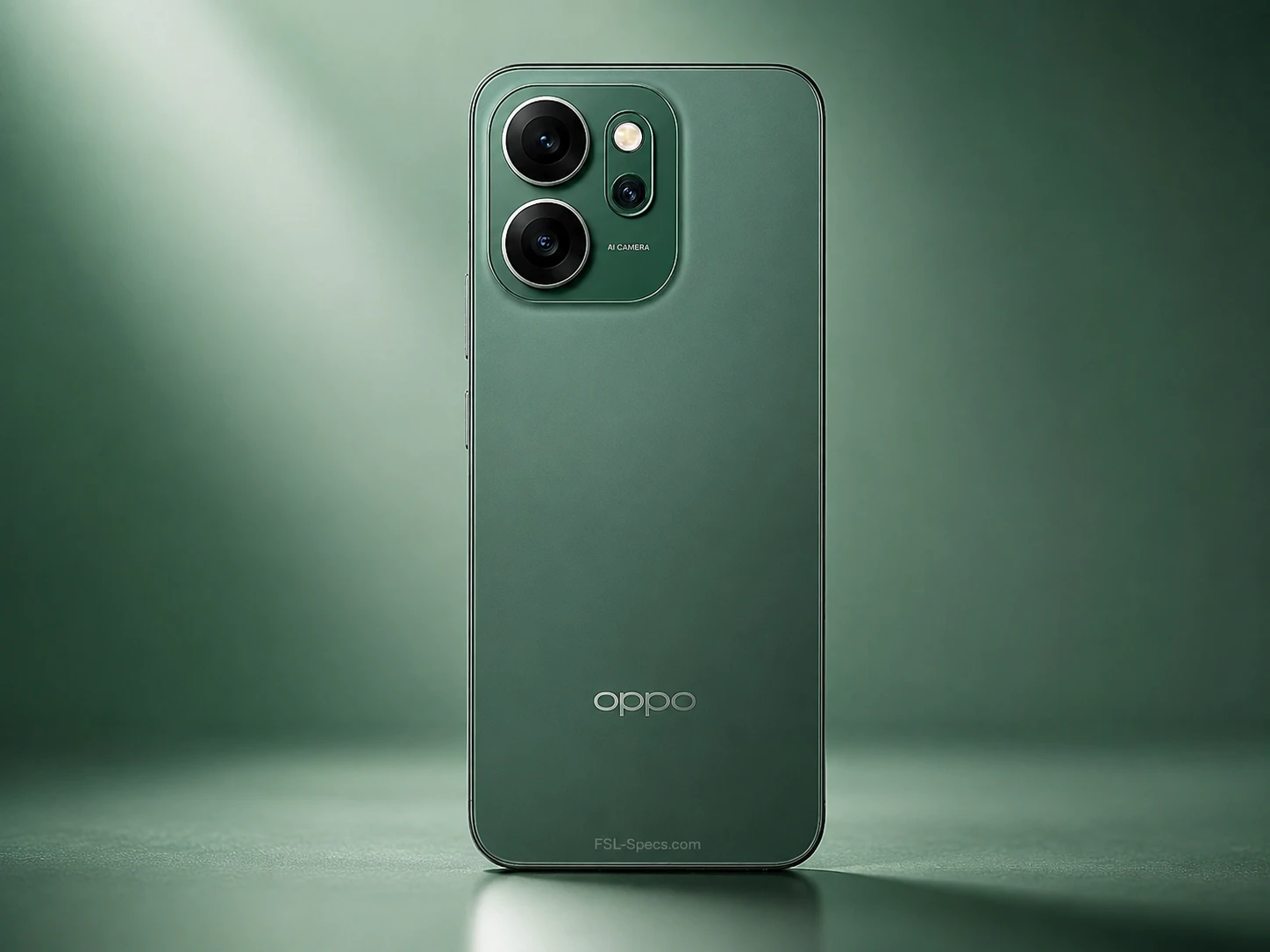
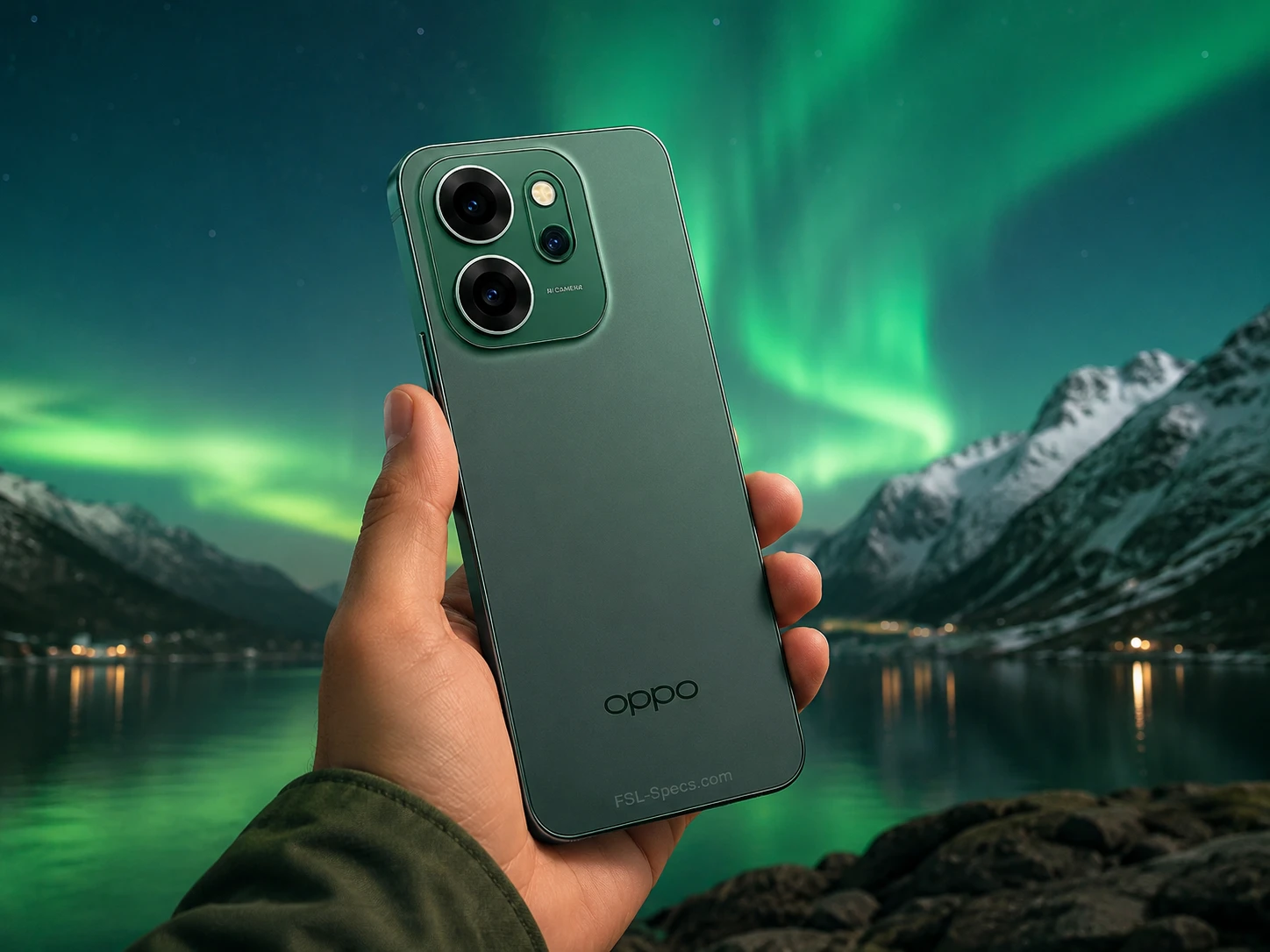
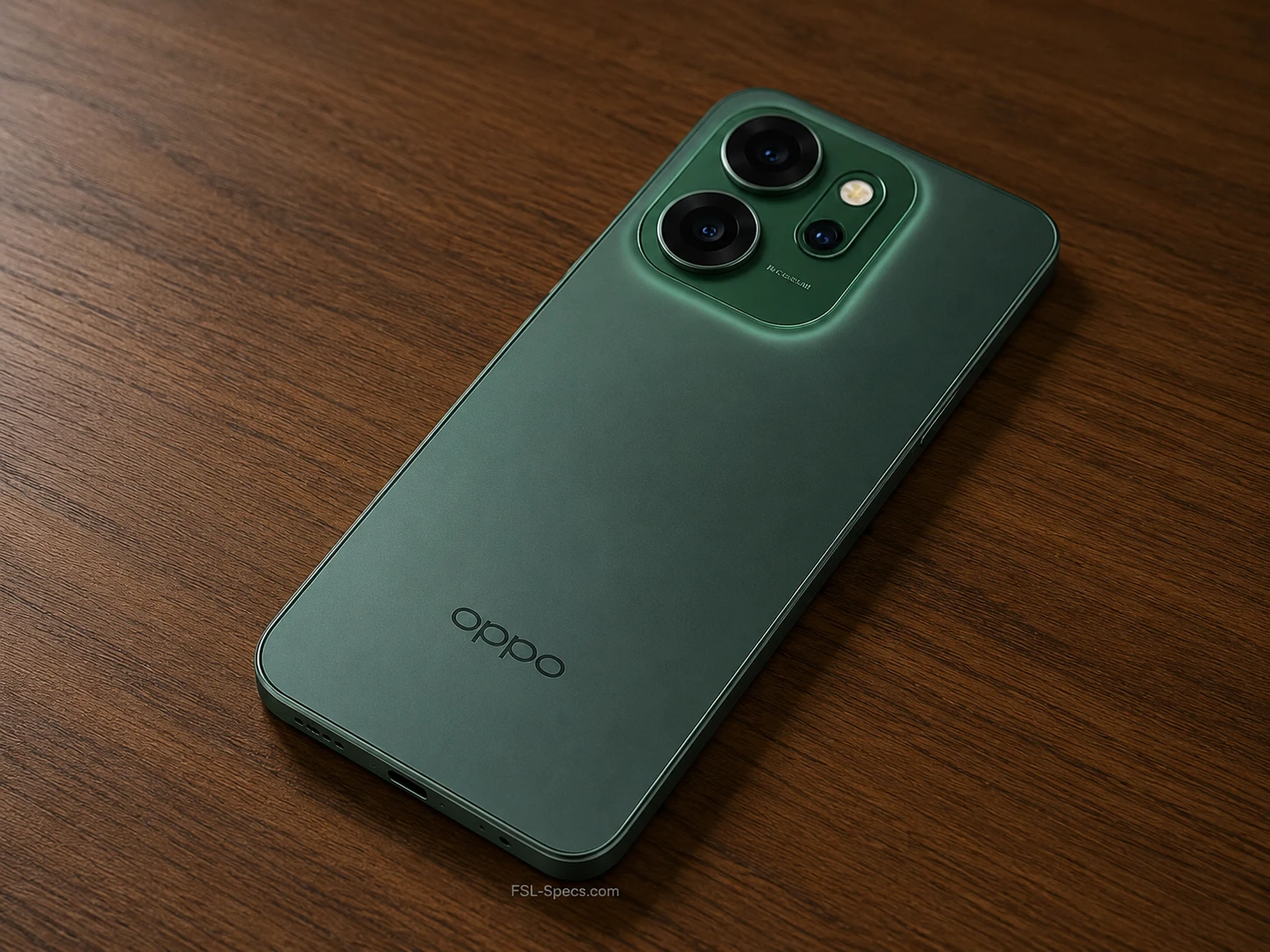












✪ Oppo Reno 14F ✪

Oppo Reno 14F Specs, Price, Camera, Battery & Best Review (2026)
United States flag United States
$320 USD
Pakistan flag Pakistan (PKR)
92,000 PKR
India flag India (INR)
₹30,000 INR

✪ Oppo Reno 14F ✪

Oppo Reno 14F Specs, Price, Camera, Battery & Best Review (2026)
Last Time Update : 11 August, 2026
0

Quick Specifications

Amoled

Display Type

Snapdragon 6 Gen 1

Processor

8+256 GB

Ram And Memory

50 + 8 + 2 MP

Camera

6000 mAh

Battery

45 W

Fast Charging

Full Specification

BASIC INFO
Mobile
Oppo Reno 14F
Model
CPH2743
Series
Oppo Reno Series
Category
Mid Range
Release Date
16 July,2025
Year
2025
CONNECTIVITY
Sim
Dual Nano-SIM
Network
4G / 4G+ / 5G
WiFi
Wi-Fi 5
Bluetooth
5.1
NFC
Yes
OS
Android 17 Now
BODY
Dimensions
158.1 x 75 x 7.7 mm
Build
Frame Plastic And Glass Back
KG Weight
180 g
Screen Size
6.57 inch
Resolution
1080 x 2372 Pixels
Type
Amoled
Refresh Rate
120 Hz
Peak Brightness
-
HBM Brightness
1400 nits
Processor
Snapdragon 6 Gen 1
Max Clock
2.2 GHz
Lithography
4 nm
GPU
Adreno 710
CPU Cores
8 Cores
Antutu v11
-
Antutu v10
570 K
Bootup Time
-
Architecture
4 x 2.2 GHz Cortex-A78
4 x 1.8 GHz Cortex-A55
Ram Memory
8+256 GB
Ram Type
LPDDR4X
Storage Type
UFS 3.1
SD Card
Yes
Variants
8 + 256 GB
12 + 256/512 GB
MP
Rear Camera
50 + 8 + 2 MP
Front Camera
32 MP
SENSORS
Camera Sensors
Front Sensors
RECORDING FPS
Main Recording
4K @ 30 fps
1080p @ 30/60/120 fps
Front Recording
1080p @ 30 fps
RESOLUTION
Main Resolution
8150 x 6150 pixels
Front Resolution
6,532 × 4,899 Pixel
ZOOM
Optical Zoom
-
D Digital Zoom
-
FLASH
Flash
Yes
Front Flash
-
Capacity
6000 mAh
Fast Charging
45 W
Wireless Charging
No
Li Battery Type
Li-ion
REVERSE
Reverse Wired
Yes
Reverse Wireless
No
OTHER
Battery PC Marks
-
Charging Time
Not Confirm
AUDIO & SENSORS
Speaker
Dual Stereo Speaker
Fingerprint Sensor
Front Finger
Other Sensors
Accelerometer
Gyroscope
Proximity
Compass
etc.
Special Features

BASIC INFO
Mobile
Oppo Reno 14F
Model
CPH2743
Series
Oppo Reno Series
Category
Mid Range
Release Date
16 July,2025
Year
2025
CONNECTIVITY
Sim
Dual Nano-SIM
Network
4G / 4G+ / 5G
WiFi
Wi-Fi 5
Bluetooth
5.1
NFC
Yes
OS
Android 17 Now
BODY
Dimensions
158.1 x 75 x 7.7 mm
Build
Frame Plastic And Glass Back
KG Weight
180 g
Screen Size
6.57 inch
Resolution
1080 x 2372 Pixels
Type
Amoled
Refresh Rate
120 Hz
Peak Brightness
-
HBM Brightness
1400 nits
Processor
Snapdragon 6 Gen 1
Max Clock
2.2 GHz
Lithography
4 nm
GPU
Adreno 710
CPU Cores
8 Cores
Antutu v11
-
Antutu v10
570 K
Bootup Time
-
Architecture
4 x 2.2 GHz Cortex-A78
4 x 1.8 GHz Cortex-A55
Ram Memory
8+256 GB
SD Card
Yes
Ram Type
LPDDR4X
Storage Type
UFS 3.1
Variants
8 + 256 GB
12 + 256/512 GB
MP
Rear Camera
50 + 8 + 2 MP
Front Camera
32 MP
SENSORS
Main Camera Sensors
Front Camera Sensors
RECORDING FPS
Main Recording
4K @ 30 fps
1080p @ 30/60/120 fps
Front Recording
1080p @ 30 fps
RESOLUTION
Main Resolution
8150 x 6150 pixels
Front Resolution
6,532 × 4,899 Pixel
ZOOM
Optical Zoom
-
D Digital Zoom
-
FLASH
Flash
Yes
Front Flash
-
Capacity
6000 mAh
Fast Charging
45 W
Wireless Charging
No
Li Battery Type
Li-ion
REVERSE
Reverse Wired
Yes
Reverse Wireless
No
OTHER
Battery Life PCMark
-
Charging Time
Not Confirm
AUDIO & SENSORS
Speaker
Dual Stereo Speaker
Fingerprint Sensor
Front Finger
Other Sensors
Accelerometer
Gyroscope
Proximity
Compass
etc.
Special Features

Highlights & Review Of Oppo Reno 14F

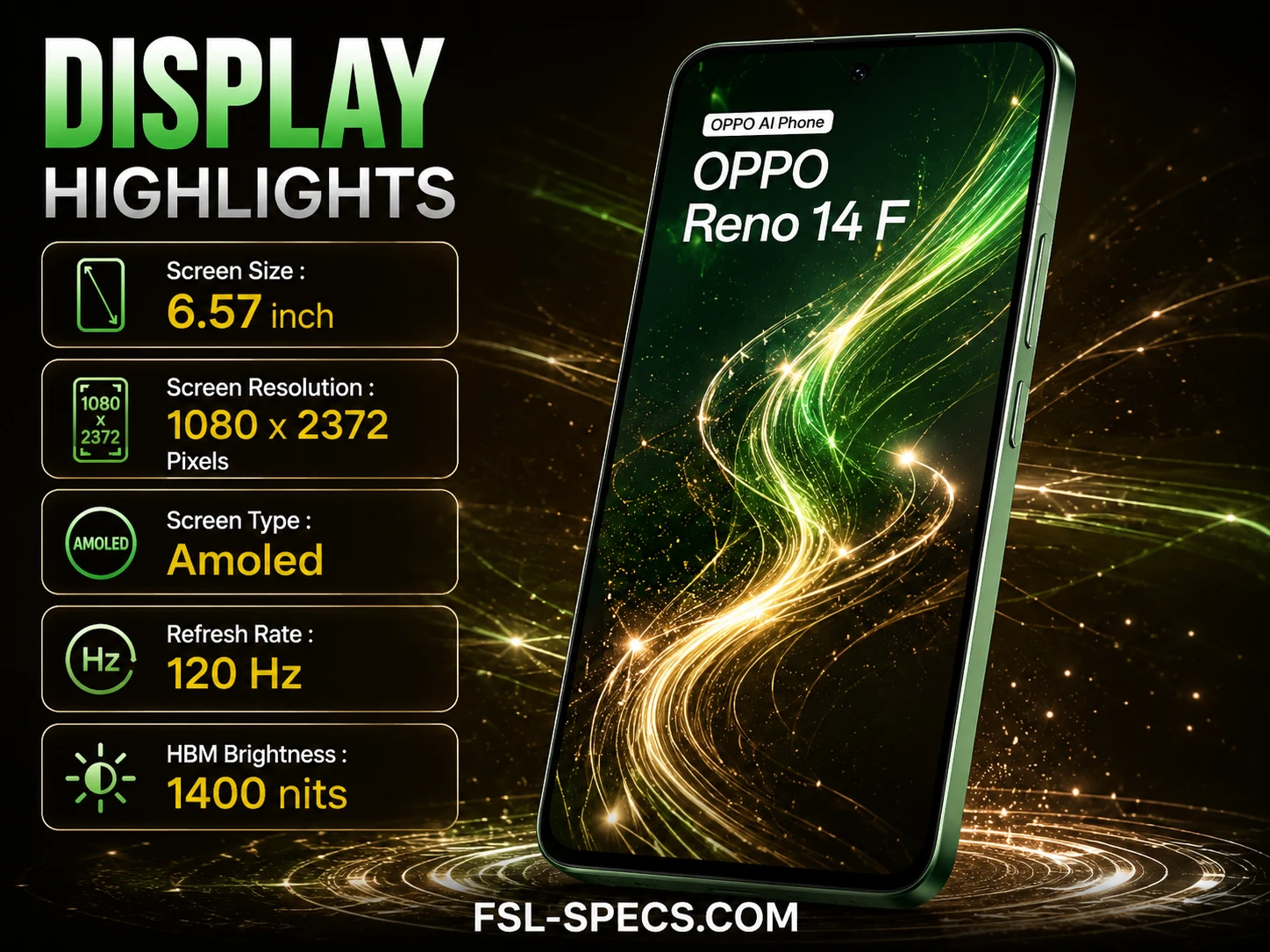
Display Review:

The Oppo Reno 14F 5G ships with a 6.57-inch AMOLED panel at 1080 x 2372 resolution, a 120Hz refresh rate, and 1400 nits HBM brightness. At PKR 92,000, the Samsung Galaxy A55 5G (same 92,000 PKR) counters with a slightly larger 6.6-inch Super AMOLED, matching 120Hz, but a lower on-paper 1000 nits HBM, though independent DXOMark testing measured it hitting 1638 nits under sunlight, meaning real-world outdoor visibility may actually edge out the Oppo Reno 14F despite the lower spec sheet number.

The Infinix Note 60 (PKR 95,000) pulls ahead on paper with a bigger 6.78-inch AMOLED, a sharper 1208 x 2644 resolution, and a faster 144Hz refresh rate, reaching 1600 nits HBM and 4500 nits peak, a meaningfully brighter and smoother screen than the Oppo Reno 14F for the same rough price bracket.

The Vivo V50 (PKR 100,000) goes further still with a 6.77-inch Quad Curved AMOLED, 120Hz refresh rate, 1300 nits HBM, and 4500 nits peak brightness, plus HDR10+ support that neither the Reno 14F nor the A55 officially list.

For everyday scrolling and casual gaming, the Oppo Reno 14F 120Hz panel keeps pace with all three rivals, but its 1400 nits HBM is now the middle of the pack rather than a standout, and it lacks the 144Hz smoothness of the Note 60 or the HDR10+ certification of the V50.

Verdict: The Reno 14F has a solid, well-calibrated AMOLED display, but the Infinix Note 60 offers a brighter, sharper, and faster screen at a similar price, making it the stronger pick for anyone who prioritizes display quality above all else.

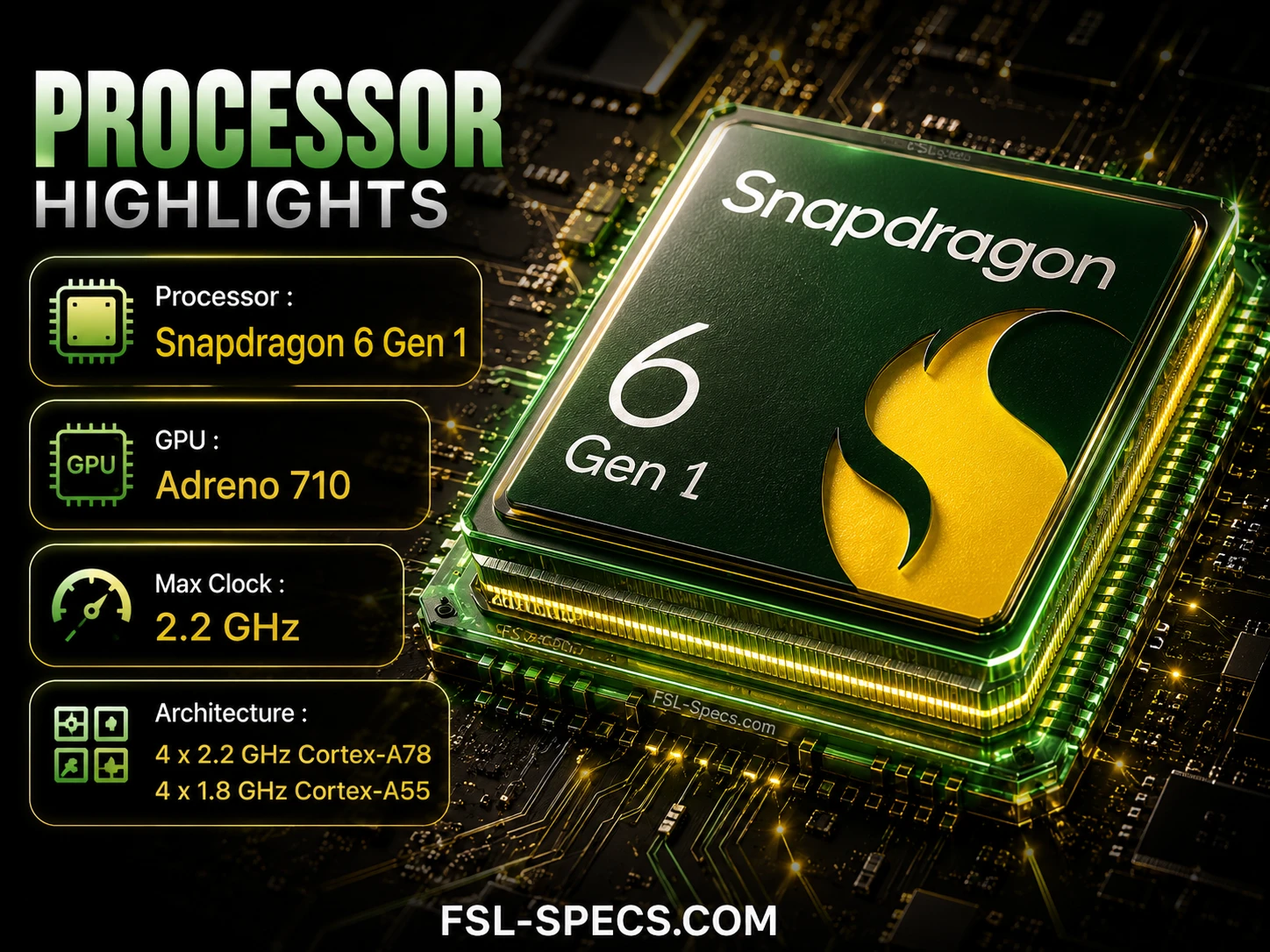
Processor Review:

The Oppo Reno 14F runs on the Snapdragon 6 Gen 1, a 4nm octa-core chip (4×2.2GHz Cortex-A78 + 4×1.8GHz Cortex-A55) paired with an Adreno 710 GPU, scoring 575,000 on AnTuTu v10. At PKR 92,000,

the Samsung Galaxy A55 (same 92,000 PKR) uses the Exynos 1480, also 4nm but with faster clocks (4×2.75GHz A78 + 4×2.05GHz A55) and an Xclipse 530 GPU, scoring 713,393 on AnTuTu v10, meaning the A55 offers noticeably stronger raw CPU and GPU headroom for the same price.

The Infinix Note 60 (PKR 95,000) steps up further with the Dimensity 7400, an octa-core chip (4×2.6GHz A78 + 4×2.0GHz A55) with a Mali-G615 MC2 GPU, scoring over 990,000 on AnTuTu v11. Since this is a newer benchmark version than the Oppo Reno 14F v10 result, the comparison isn’t perfectly apples-to-apples, but the gap is wide enough that the Note 60 clearly leads in multitasking and gaming headroom.

The Vivo V50 (PKR 100,000) uses the Snapdragon 7 Gen 3 with an Adreno 720 GPU, scoring 866,863 on AnTuTu v10, a direct and fair comparison against the Reno 14F’s own v10 score, and it comes out well ahead.

In real terms, the Oppo Reno 14F is the weakest performer of this group on paper. It handles everyday tasks and light gaming fine, but all three rivals, at similar or only slightly higher prices, offer meaningfully more processing power.

Verdict: The Oppo Reno 14F trails every rival here on raw performance. If gaming or heavy multitasking matters to you, the Infinix Note 60 or Vivo V50 are the stronger picks at this budget.

Ram & Memory Review:

The Oppo Reno 14F 8+256GB at PKR 92,000 uses 8GB LPDDR4X RAM paired with 256GB UFS 3.1 storage, and it does not offer a microSD card slot on global models, so buyers are locked into the 256GB they purchase.

The Samsung Galaxy A55 8+256GB (same 92,000 PKR) uses newer 8GB LPDDR5 RAM with 256GB UFS 3.1 storage, meaning faster memory bandwidth than the Oppo Reno 14F LPDDR4X on paper, and it adds a microSDXC slot supporting up to 1TB, a real practical advantage since the Reno 14F offers no expansion at all.

The Infinix Note 60 8+256GB (PKR 95,000) also jumps to 8GB LPDDR5X RAM, an even newer standard than the A55’s LPDDR5, paired with 256GB UFS 2.2 storage. UFS 2.2 is a step behind the Reno 14F’s UFS 3.1 in raw storage read/write speed, so while the RAM is faster, storage performance may actually lag slightly behind the Reno 14F in file transfers and large app installs. The Note 60 also has no microSD support.

The Vivo V50 12+256GB (PKR 100,000) offers the most RAM at 12GB LPDDR4X, the same memory type as the Oppo Reno 14F but a larger capacity, paired with 256GB UFS 2.2 storage, no microSD slot either.

For raw multitasking headroom, the V50’s extra RAM stands out, though its UFS 2.2 storage is a step behind the Oppo Reno 14F UFS 3.1. The A55 offers the best overall memory package: newer RAM, matching UFS 3.1 storage, and the only expandable storage option in this group.

Verdict: The Samsung Galaxy A55 offers the strongest all-round memory setup at the same price as the Reno 14F, combining faster RAM with expandable storage. Buyers who value future storage flexibility should lean toward the A55 over the Reno 14F.

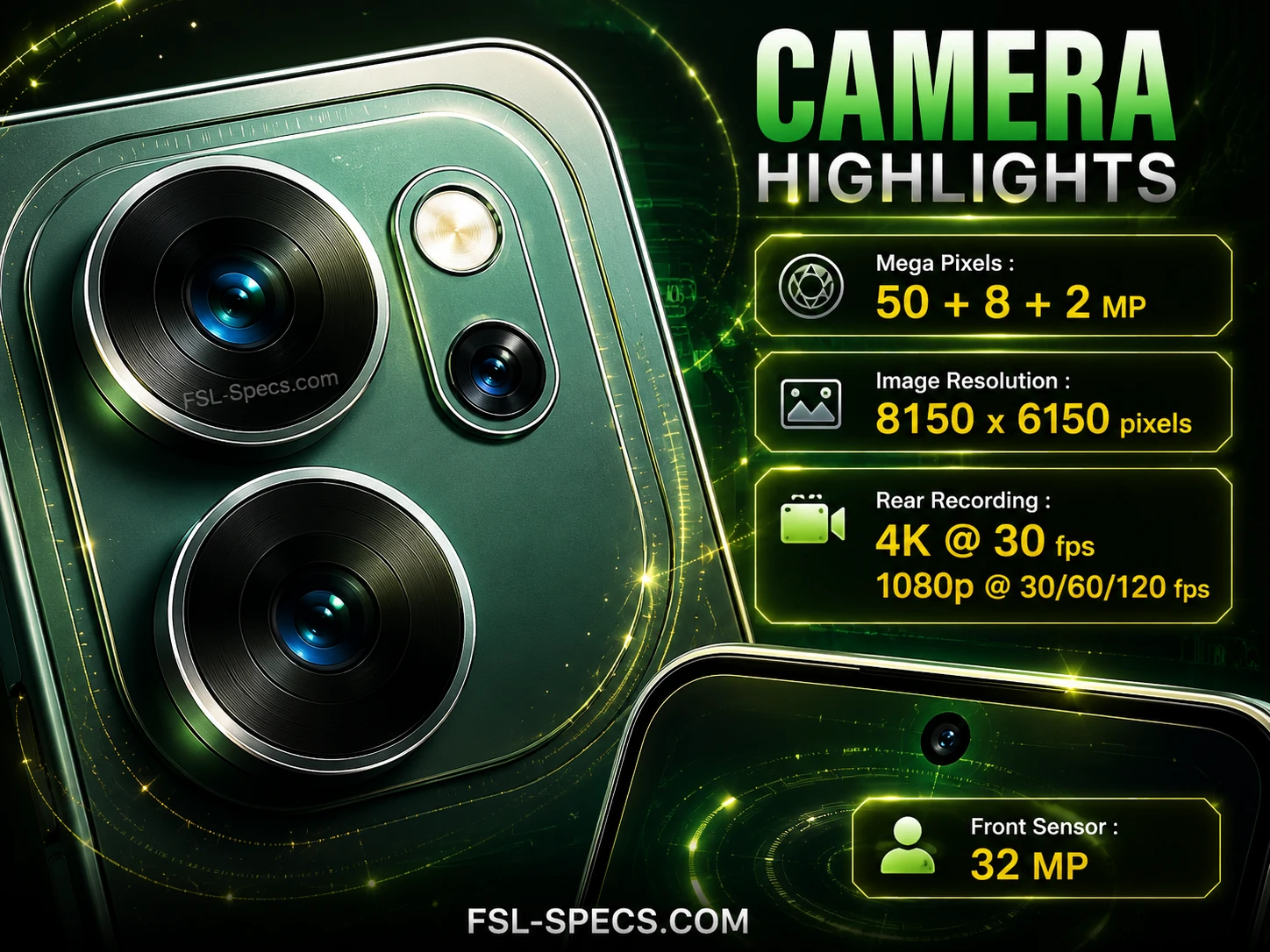
Cameras Review:

The Oppo Reno 14F 8+256GB at PKR 92,000 uses a 50MP Sony IMX882 main sensor at f/1.8 with 2-axis OIS, paired with an 8MP f/2.2 ultrawide and a 2MP f/2.4 macro, plus a 32MP autofocus front camera. Rear video tops out at 4K 30fps, while the front camera is limited to 1080p 30fps.

The Samsung Galaxy A55 8+256GB (same 92,000 PKR) uses a confirmed 50MP Sony IMX906 main sensor at f/1.8 with OIS, backed by a 12MP Sony IMX258 ultrawide at f/2.2, a real step up from the Reno 14F’s 8MP unit, plus a 5MP macro and a 32MP Sony IMX616 front camera. Rear video reaches 4K 30fps, same as the Reno 14F, but the A55 offers a verified, name-brand sensor across every lens, giving buyers more confidence in image quality than the Reno 14F’s undisclosed ultrawide and macro sensors.

The Infinix Note 60 8+256GB (PKR 95,000) has a 50MP f/1.6 main sensor with OIS, the brightest aperture of the group, though Infinix does not disclose the sensor brand or model, so buyers can’t verify it against known hardware. It pairs with an 8MP f/2.2 ultrawide and a 13MP f/2.2 front camera. Rear video reaches 4K 30fps with 1080p up to 120fps, offering smoother slow-motion than the Reno 14F.

The Vivo V50 12+256GB (PKR 100,000) uses a 50MP OmniVision OV50E main sensor at f/1.88 with OIS, plus a 50MP Samsung ISOCELL S5KJN1 ultrawide at f/2.0 with autofocus, both Zeiss co-engineered, and a 50MP Samsung ISOCELL S5KJN1 front camera at f/2.0 with autofocus, a notably higher-resolution selfie setup than any rival here.

GSMArena’s testing confirms 4K 30fps video on all three cameras. Some retail listings claim 4K60 on the front camera, but this conflicts with independent review data, so it should be treated as unconfirmed.

For everyday photography, the Reno 14F’s 8MP ultrawide is the weakest link in this group. Every rival offers either a higher-resolution ultrawide or a documented sensor advantage.

Verdict:  Vivo V50 wins outright for selfie and ultrawide resolution if you’re willing to pay more. while Samsung Galaxy A55 offers the most verifiable, well-rounded camera hardware at the same price as the Reno 14F.

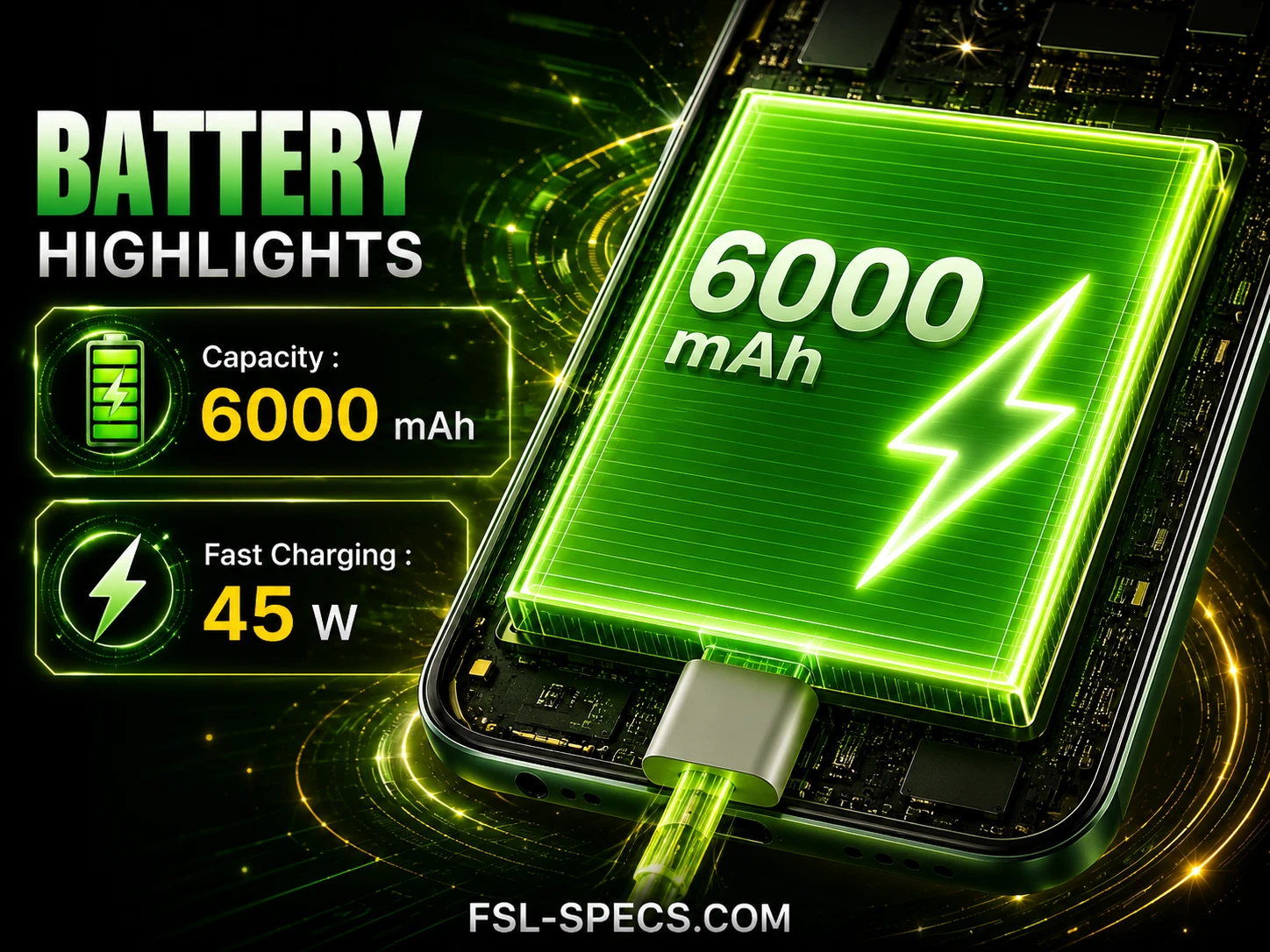
Battery Review:

The Oppo Reno 14F 8+256GB at PKR 92,000 packs a 6000mAh battery with 45W SUPERVOOC wired charging, no wireless charging, and reverse wired charging support. Oppo’s official 0-100% figure is 79 minutes, the slowest charging speed in this group by a wide margin.

The Samsung Galaxy A55 8+256GB (same 92,000 PKR) has a smaller 5000mAh battery and slower 25W wired charging, with no wireless charging either. DXOMARK’s lab testing measured a full charge taking 1 hour 24 minutes, meaning the A55 loses on both battery capacity and charging speed compared to the Reno 14F, despite matching its price.

The Infinix Note 60 8+256GB (PKR 95,000) jumps to a 6500mAh battery, the largest capacity here, with 45W wired charging plus 30W wireless charging, 10W reverse wired, and 5W reverse wireless charging, a meaningfully more versatile charging package than either the Reno 14F or A55.

Independent lab testing on the closely related Note 60 Pro (same 45W-tier charging system) recorded a 100% charge in around 41 minutes at 90W, though the standard Note 60 runs at 45W, so real-world owner data suggests closer to 80-90 minutes for a full charge, still faster than the Reno 14F’s 79-minute figure is roughly comparable, and it offers wireless charging which the Reno 14F lacks entirely.

The Vivo V50 12+256GB (PKR 100,000) uses a 6000mAh battery, matching the Reno 14F’s capacity, but with much faster 90W wired charging. Independent testing puts the 0-100% time at around 55 minutes, and vivo’s own marketing claims figures as low as 58 minutes for a full charge, both meaningfully faster than the Reno 14F. The V50 does not offer wireless charging.

Across the board, the Reno 14F’s 45W charging speed and lack of wireless charging leave it behind every rival except the Samsung A55, which trades battery capacity and charging speed for nothing extra at the same price.

Verdict: The Infinix Note 60 offers the strongest overall battery package here, combining the largest capacity with wireless and reverse charging. Buyers focused purely on charging speed should look at the Vivo V50 instead, while the Reno 14F only really beats the Samsung A55 on this front.

Final Verdict :

Across every category tested, the Oppo Reno 14F 8+256GB at PKR 92,000 struggles to justify its price against rivals in the same bracket. On display, its 1400 nits AMOLED panel is solid but is outpaced by the Infinix Note 60’s brighter 1600 nits HBM and faster 144Hz panel at just PKR 95,000.

On raw performance, the Reno 14F’s Snapdragon 6 Gen 1 trails every rival, scoring 575,000 on AnTuTu v10 versus the Samsung Galaxy A55’s 713,393 at the identical 92,000 PKR price point, and further behind the Note 60 and Vivo V50’s 866,863.

Memory tells a similar story: the A55 matches the Reno 14F’s price while offering newer LPDDR5 RAM and, critically, a microSDXC slot up to 1TB that the Reno 14F lacks entirely.

On camera, the Reno 14F’s 8MP ultrawide and unverified secondary sensors fall behind the A55’s confirmed Sony IMX906 main sensor and 12MP ultrawide, while the V50 offers the strongest overall camera hardware with dual 50MP Zeiss-tuned sensors. Battery is the Reno 14F’s one area of partial strength, with a 6000mAh cell beating the A55’s 5000mAh, but its 45W charging and 79-minute full-charge time lag behind the Note 60’s wireless-charging-equipped 6500mAh battery and the V50’s much faster 90W charging.

Taken together, the Samsung Galaxy A55 is the strongest rival at the exact same price as the Reno 14F, beating it on performance, memory, and camera verification, while the Infinix Note 60 edges ahead on display and battery versatility for a modest PKR 3,000 premium.

Bottom line: At PKR 92,000, the Oppo Reno 14F is outperformed by same-priced and near-priced rivals in nearly every measurable category, making the Samsung Galaxy A55 or Infinix Note 60 the smarter buys for most users also add 7000 more to get vivo v50

Pros And Cons of Oppo Reno 14F

Pros of Mobile

120Hz AMOLED 📱
6000mAh Battery 🔋
45W Charging
IP69 Rating 💧
Stereo Speakers 🔊
OIS Camera 📷

Cons of Mobile

Plastic Frame 🧱
Wi-Fi 5 📶
Bluetooth 5.1 📡
No eSIM 📵
USB 2.0 🔌
No Telephoto 🔭

Best For - Not Best For

Best For

🎯 Daily Use 📱
🎯 Social Media 📲
🎯 Casual Gaming 🎮
🎯 Content Streaming 🎬
🎯 Outdoor Photography 🌄
🎯 Long Battery 🔋

Not Best For

🚫 Pro Gaming 🎮
🚫 Zoom Photography 🔭
🚫 Wi-Fi 7 📶
🚫 Desktop Mode 🖥️
🚫 Pro Videography 🎥
🚫 Flagship Performance 🚀

Trailer And Unboxing of Oppo Reno 14F

Disassembly Or Teardown And Gaming Test of Oppo Reno 14F

Camera Test Oppo Reno 14F

Vivo V50
Vivo v40
infinix Note 60
Samsung Galaxy A55 5G

Tecno Camon 50 Pro

Picture of Faisal Ur Rehman

Faisal Ur Rehman

Faisal Rehman is the founder and editor of FSL Specs, where he publishes in-depth smartphone specifications, comparisons, buying guides, and technology insights. With extensive experience in mobile hardware research and technical analysis, he provides accurate and up-to-date information on Android smartphones, processors, displays, cameras, batteries, performance benchmarks, and software features. His goal is to simplify complex specifications and help readers choose the right device with confidence.

OPPO Series Row

FAQs Questions

The OPPO Reno 14F features a 6.57-inch AMOLED display with a 120Hz refresh rate and 1080 × 2372 resolution. It reaches 1400 nits HBM brightness, delivering vibrant colors, smooth scrolling, and good visibility even under bright sunlight.

Yes. It is powered by the Snapdragon 6 Gen 1 processor and Adreno 710 GPU, providing smooth performance for daily tasks, multitasking, and popular mobile games. The efficient chipset also helps keep power consumption and heat under control during extended use.

The phone features a 50MP + 8MP + 2MP rear camera system with a 32MP front camera. It captures detailed daylight photos, natural-looking portraits, and sharp selfies, making it a dependable choice for everyday photography and social media content.

The 6000mAh battery easily lasts a full day of browsing, gaming, streaming, and photography. When you need more power, 45W SUPERVOOC fast charging provides quick top-ups, reducing the time spent waiting for a recharge.

Yes, the phone supports 5G, NFC, Wi-Fi 5, and reverse wired charging, making it well equipped for modern connectivity and everyday convenience. eSIM support is not listed in the official specifications.

Yes. The OPPO Reno 14F comes with IP66, IP68, and IP69 ratings for dust and water resistance, offering strong protection against splashes, dust, and water exposure during everyday use.

The OPPO Reno 14F is available in 8GB + 256GB, 12GB + 256GB, and 12GB + 512GB variants. It uses LPDDR4X RAM with UFS 3.1 storage, providing smooth multitasking and fast app loading.

The rear camera supports 4K video recording at 30fps, along with multiple 1080p recording modes for smoother videos. However, 8K video recording is not supported.

8 + 256 GB
 | ~₹30,000 | ~$320 | ~ 92,000 PKR

Leave a Reply

Your email address will not be published. Required fields are marked *

Scroll to Top