






















• Mobiles
  • Processors
  • Mobiles
  • Processors
  • Mobiles
  • Processors

✪ Tecno Pova 7 5G ✪

United States flag United States
$190 USD
…
Pakistan flag Pakistan (PKR)
60,000 PKR
India flag India (INR)
₹15,000 INR

✪ Tecno Pova 7 5G ✪

Last Time Update : 7 October, 2026
0

Quick Specifications

IPS LCD

Display Type

MediaTek Dimensity 7300

Processor

8+256 GB

Ram And Memory

50 MP

Camera

6000 mAH

Battery

45 W

Fast Charging

Full Specification

BASIC INFO
Mobile
Tecno Pova 7 5G
Model
LJ7
Series
Pova Series
Category
Mid-Range
Release Date
10 July,2025
Year
2025
CONNECTIVITY
Sim
Nano-SIM + Nano-SIM
Network
4G / 4G+ / 5G
WiFi
Wi-Fi 6 (802.11 a/b/g/n/ac/ax),
Bluetooth
5.4
NFC
Yes
OS
Android 16 - HIOS 16
BODY
Dimensions
167.3 × 75.6 × 8.9 mm
Build
Plastic ( Frame And Back)
KG Weight
207 g
Screen Size
6.78 inch
Resolution
1080 × 2460 Pixels
Type
IPS LCD
Refresh Rate
144 Hz
Peak Brightness
900 nits
HBM Brightness
~700 nits
Processor
MediaTek Dimensity 7300
Max Clock
2.5 GHz
Lithography
4 nm
GPU
Mali G57
CPU Cores
8 Cores
Antutu v11
680 k
Bootup Time
~30s
Architecture
4×2.5 GHz Cortex-A78
4×2.0 GHz Cortex-A55
Ram Memory
8+256 GB
Ram Type
LPDDR4X
Storage Type
UFS 2.2
SD Card
Yes
Variants
8+128GB
8 +256GB
MP
Rear Camera
50 MP
Front Camera
13 MP
RECORDING FPS
Main Recording
4K @ 30fps
1080p @ 60fps
Front Recording
4K @ 30fps
1080p @ 60fps
RESOLUTION
Main Resolution
8160 x 6144 Pixels
Front Resolution
4128 x 3096 Pixels
ZOOM
D Digital Zoom
10 X
Stabilization
Digital
FLASH
Flash
LED Flash
Capacity
6000 mAH
Fast Charging
45 W
Wireless Charging
30 W
Li Battery Type
Li-Po
REVERSE
Reverse Wired
10 W
OTHER
Battery PC Marks
11h 20m
Charging Time
70–85 minutes ( 0-100% )
AUDIO & SENSORS
Speaker
Dual Stereo Speaker
Fingerprint Sensor
Side Mounted
Other Sensors
Accelerometer
Gyroscope
Proximity Sensor
Compass (Magnetometer)
Ambient Light Sensor
Special Features

Meca Design in Back

BASIC INFO
Mobile
Tecno Pova 7 5G
Model
LJ7
Series
Pova Series
Category
Mid-Range
Release Date
10 July,2025
Year
2025
CONNECTIVITY
Sim
Nano-SIM + Nano-SIM
Network
4G / 4G+ / 5G
WiFi
Wi-Fi 6 (802.11 a/b/g/n/ac/ax),
Bluetooth
5.4
NFC
Yes
OS
Android 16 - HIOS 16
BODY
Dimensions
167.3 × 75.6 × 8.9 mm
Build
Plastic ( Frame And Back)
KG Weight
207 g
Screen Size
6.78 inch
Resolution
1080 × 2460 Pixels
Type
IPS LCD
Refresh Rate
144 Hz
Peak Brightness
900 nits
HBM Brightness
~700 nits
Processor
MediaTek Dimensity 7300
Max Clock
2.5 GHz
Lithography
4 nm
GPU
Mali G57
CPU Cores
8 Cores
Antutu v11
680 k
Bootup Time
~30s
Architecture
4×2.5 GHz Cortex-A78
4×2.0 GHz Cortex-A55
Ram Memory
8+256 GB
SD Card
Yes
Ram Type
LPDDR4X
Storage Type
UFS 2.2
Variants
8+128GB
8 +256GB
MP
Rear Camera
50 MP
Front Camera
13 MP
RECORDING FPS
Main Recording
4K @ 30fps
1080p @ 60fps
Front Recording
4K @ 30fps
1080p @ 60fps
RESOLUTION
Main Resolution
8160 x 6144 Pixels
Front Resolution
4128 x 3096 Pixels
ZOOM
D Digital Zoom
10 X
Stabilization
Digital
FLASH
Flash
LED Flash
Capacity
6000 mAH
Fast Charging
45 W
Wireless Charging
30 W
Li Battery Type
Li-Po
REVERSE
Reverse Wired
10 W
OTHER
Battery Life PCMark
11h 20m
Charging Time
70–85 minutes ( 0-100% )
AUDIO & SENSORS
Speaker
Dual Stereo Speaker
Fingerprint Sensor
Side Mounted
Other Sensors
Accelerometer
Gyroscope
Proximity Sensor
Compass (Magnetometer)
Ambient Light Sensor
Special Features

Meca Design in Back

Highlights & Review Of Tecno Pova 7 5G

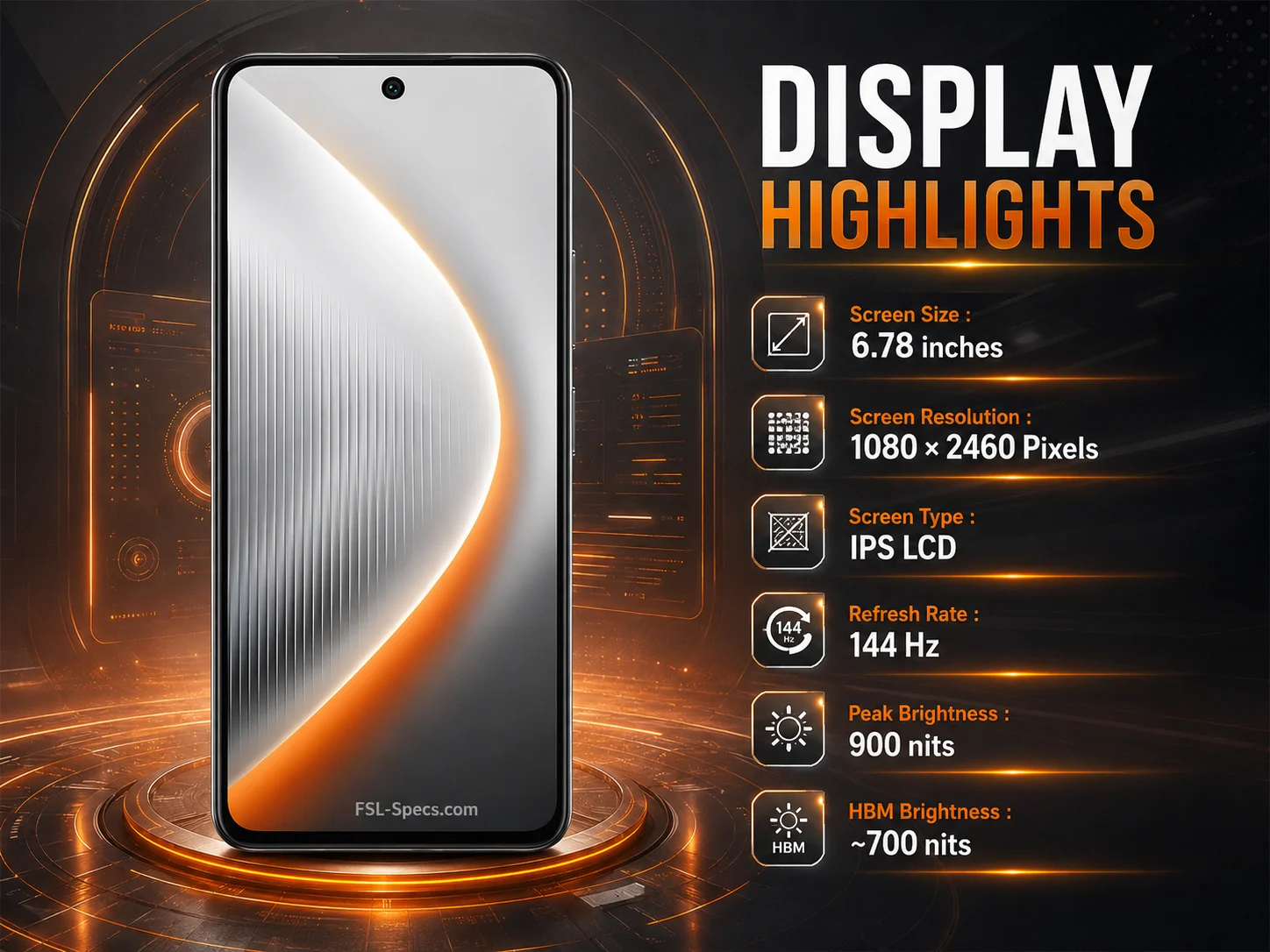
Tecno Pova 7 5G Display FSL-Specs.com
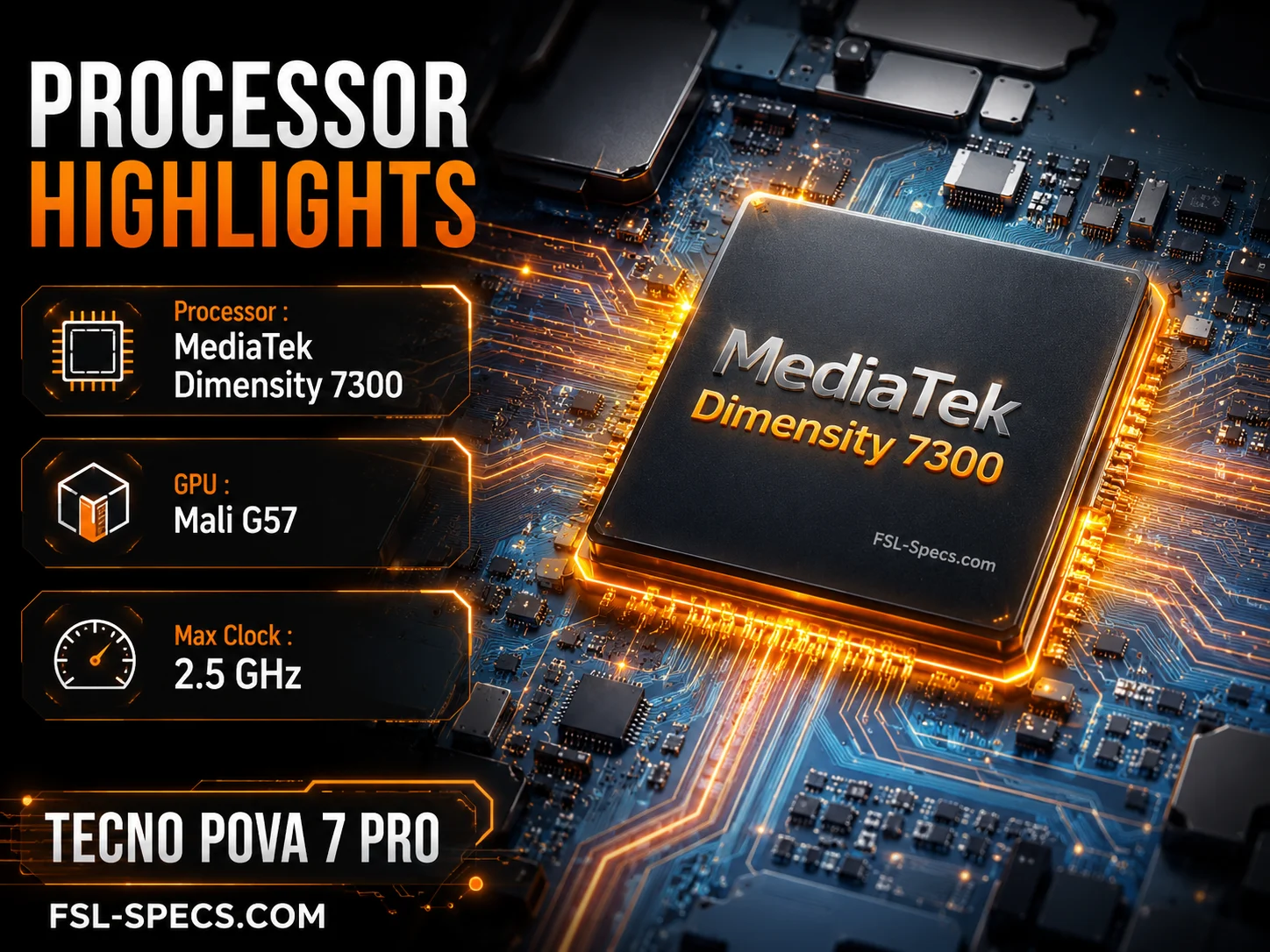
Tecno Pova 7 5G Processor FSL-Specs.com
Tecno Pova 7 5G Memory FSL-Specs.com
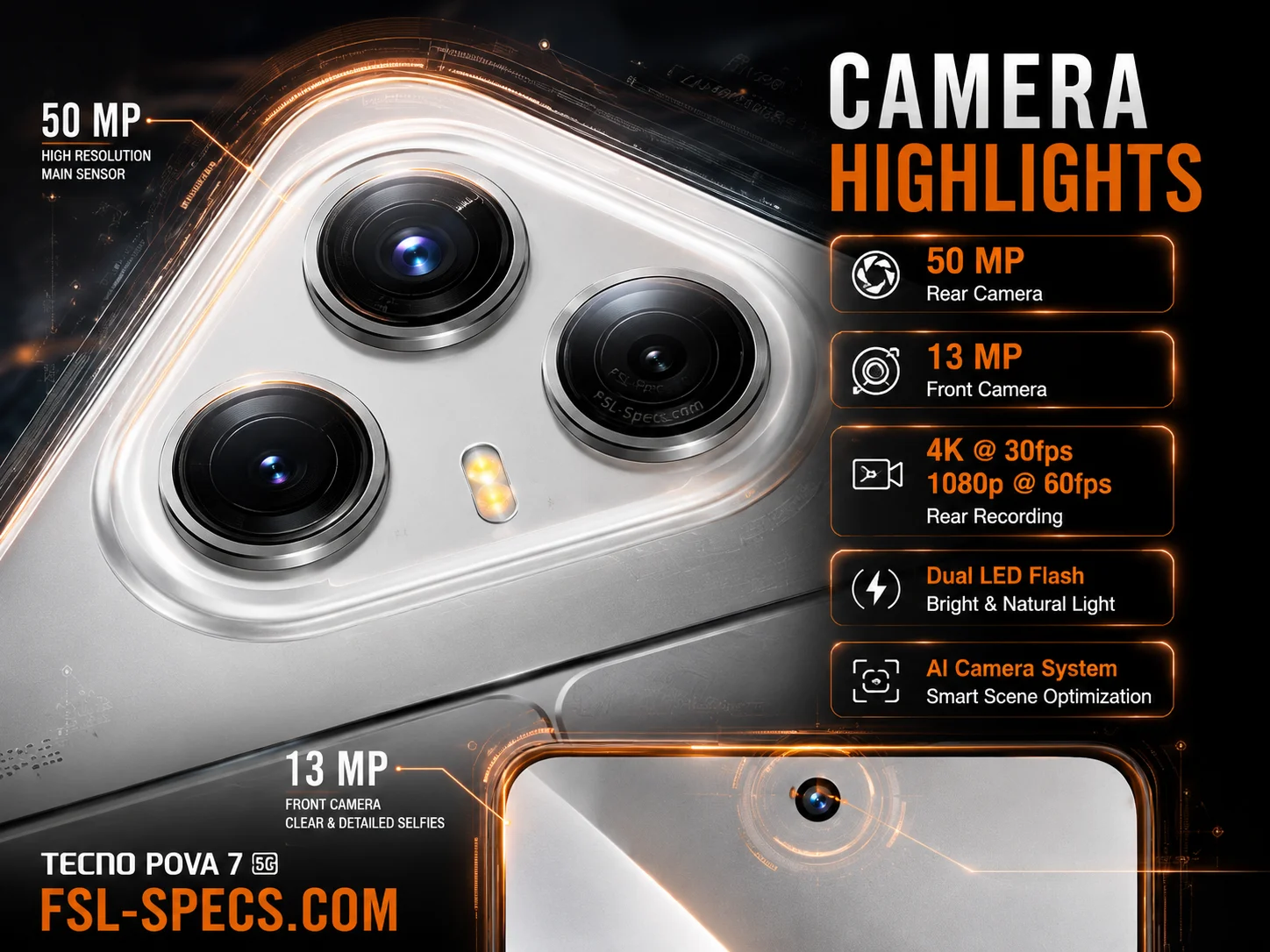
Tecno Pova 7 5G Camera FSL-Specs.com
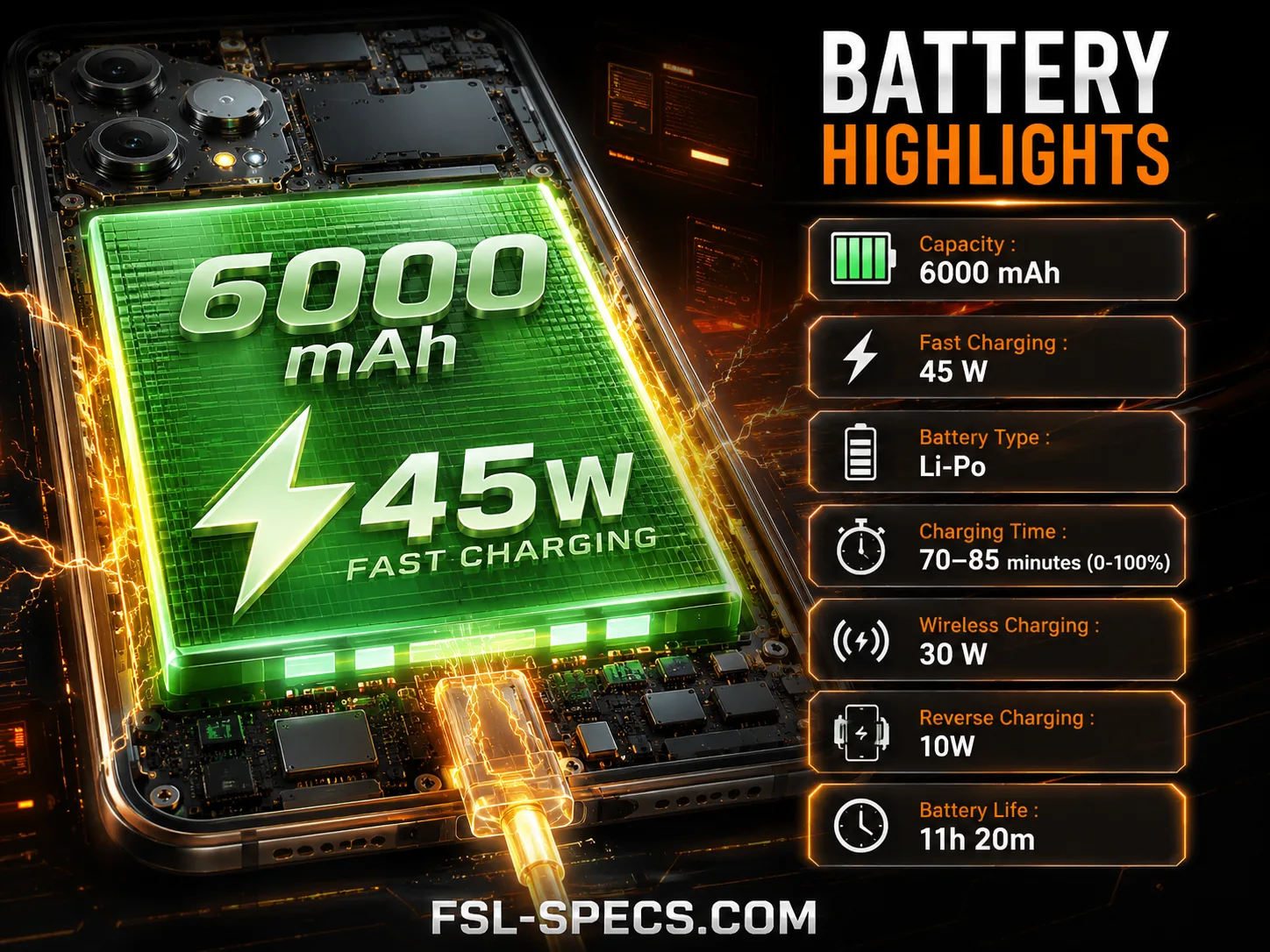
Tecno Pova 7 5G Battery FSL-Specs.com

Display Review:

The Tecno Pova 7 5G ships with a 6.78-inch IPS LCD panel at 1080 x 2460 resolution (~396 ppi) with a 144Hz refresh rate and 900 nits peak brightness in HBM mode, while all three rivals in this price bracket move to AMOLED. The Infinix GT 20 Pro matches the 144Hz refresh rate on its 6.78-inch AMOLED screen at 1080 x 2436 (~388 ppi) but pushes peak brightness to 1300 nits, noticeably brighter under direct sun than the Pova 7 5G’s LCD.

The Nothing Phone (2a) trims size to 6.7 inches at 1080 x 2412 (~394 ppi) and refresh rate to 120Hz, yet its AMOLED panel still reaches 1300 nits peak with 1100 nits HBM, giving it deeper blacks and better contrast than the Pova 7 5G despite the lower refresh rate. The Infinix Note 60 Pro leads the group outright with a 6.78-inch, 1208 x 2644 (~429 ppi) AMOLED panel running 144Hz alongside 1600 nits HBM and 4500 nits peak, the sharpest and brightest screen of the four.

Panel type is the real differentiator here, not just the numbers on paper: an IPS LCD like the Pova 7 5G’s cannot match AMOLED’s per-pixel contrast or true blacks, and this gap shows most in dark-mode use and outdoor glare, not in resolution or refresh-rate comparisons. Buyers who rank screen quality highly are better served by any of the three AMOLED rivals, while the Pova 7 5G’s LCD panel is the one area where its PKR 70,000 price doesn’t fully close the gap with phones costing PKR 40,000 to 48,000 more.

Verdict: The Infinix Note 60 Pro has the best display in this comparison with its 429 ppi AMOLED panel and 4500 nits peak brightness, but the Tecno Pova 7 5G’s IPS LCD panel, not its resolution or refresh rate, is the clearest technical downgrade against all three AMOLED-equipped rivals.

Processor Review:

The Tecno Pova 7 5G runs on the MediaTek Dimensity 7300 Ultimate (4nm) and averages 864,548 in AnTuTu v11 community testing, while the Infinix Note 60 Pro’s Snapdragon 7s Gen 4 pulls ahead at 1,065,801, a gap of roughly 23% on the same benchmark version. The Nothing Phone (2a), running the older Dimensity 7200 Pro, sits between the two at 985,261, meaning even a two-year-old Nothing chipset outscores the newer Pova 7 5G silicon, though the Nothing Phone (2a) costs PKR 40,000 more.

The Infinix GT 20 Pro’s Dimensity 8200 Ultimate dominates the group at 1,306,340 in AnTuTu v11, roughly 51% ahead of the Pova 7 5G and the strongest raw performer here, which lines up with its positioning as a dedicated gaming phone with a Pixelworks X5 Turbo co-processor the other three lack. All four scores come from NanoReview’s community AnTuTu v11 averages, so they are directly comparable on the same benchmark version, unlike listings that mix v10 and v11 figures.

For gaming and heavy multitasking specifically, the Tecno Pova 7 5G’s 144Hz refresh rate is let down by having the weakest chipset paired with the highest-refresh display of the four, meaning it can’t sustain that refresh rate in demanding titles the way the GT 20 Pro’s stronger GPU score can. Sustained performance under load also matters more than a single peak number, and gaming-focused silicon like the GT 20 Pro’s typically holds clocks longer than general-purpose chips tuned for battery efficiency, such as the Snapdragon 7s Gen 4 in the Note 60 Pro.

Verdict: The Infinix GT 20 Pro is the clear performance leader of this group at 1,306,340 AnTuTu v11, and the Tecno Pova 7 5G’s Dimensity 7300 Ultimate is the weakest chipset in the comparison despite carrying the same PKR 70,000 price bracket as phones with meaningfully faster hardware.

Ram & Memory Review:

The Tecno Pova 7 5G in this comparison runs 8GB LPDDR4X RAM paired with 256GB UFS 2.2 storage, and it is the only phone of the four with a microSD card slot, though it shares the tray with a SIM. The Infinix GT 20 Pro steps up to 12GB of faster LPDDR5X RAM and 256GB of UFS 3.1 storage, but drops expandable storage entirely, a trade-off buyers who shoot a lot of 4K video should weigh against its performance advantage.

The Nothing Phone (2a) also ships with 12GB RAM and 256GB storage with no card slot, but its exact memory specs are one of the more debated areas: Nothing’s own confirmation names UFS 2.2, while multiple user-run storage benchmarks on the 12GB/256GB variant have measured sequential speeds well above typical UFS 2.2 performance, so this is disputed and hasn’t been independently resolved by Nothing itself. The Infinix Note 60 Pro pairs 8GB of LPDDR5 RAM, plus up to 8GB of virtual RAM, with 256GB of UFS 2.2 storage and also has no card slot.

On raw storage speed, the Infinix GT 20 Pro’s confirmed UFS 3.1 is the fastest in the group, ahead of the Tecno Pova 7 5G and Infinix Note 60 Pro’s UFS 2.2 and the Nothing Phone (2a)’s disputed rating. For buyers who fill up storage with media and don’t want to rely on cloud backup, the Tecno Pova 7 5G’s microSD support is a genuine practical advantage the three AMOLED rivals simply don’t offer at any price in this bracket, even though its RAM capacity is the smallest of the four.

Verdict: The Infinix GT 20 Pro has the best confirmed memory setup with 12GB LPDDR5X RAM and UFS 3.1 storage, but the Tecno Pova 7 5G’s microSD slot, absent on all three rivals, is the more relevant differentiator for buyers who prioritize expandable storage over raw memory capacity.

Cameras Review:

Sensor identity is where this comparison splits sharply on confidence: the Infinix GT 20 Pro is the only phone here with a manufacturer-named main sensor, the Samsung ISOCELL HM6 108MP unit at f/1.75 with OIS, while the Tecno Pova 7 5G’s 50MP f/1.6 main camera, the Nothing Phone (2a)’s 50MP f/1.9 main camera, and the Infinix Note 60 Pro’s 50MP f/1.59 main camera all ship with the sensor brand undisclosed, so buyers are trusting megapixel count alone rather than a known sensor’s real-world track record. OIS is the bigger practical differentiator though:

the Nothing Phone (2a) and Infinix Note 60 Pro both confirm OIS on their main shooters, the Infinix GT 20 Pro confirms OIS on its 108MP sensor, but the Tecno Pova 7 5G has no OIS at all, only PDAF, making it the weakest of the four for low-light and handheld video despite matching the others on megapixels. Secondary cameras vary in usefulness: the Nothing Phone (2a) pairs its main sensor with a second 50MP ultrawide, genuinely widening the field of view, while the Infinix Note 60 Pro’s 8MP ultrawide and the Infinix GT 20 Pro’s 2MP macro and 2MP depth units add far less real capability, and the Tecno Pova 7 5G skips a second useful lens entirely with just a 13MP front camera and no ultrawide.

Front camera autofocus is absent across all four, with the GT 20 Pro’s 32MP and Nothing Phone (2a)’s 32MP selfie cameras both fixed-focus. Video tops out at 4K@30fps on every phone’s rear camera, with the GT 20 Pro alone adding 4K@60fps.

Verdict: The Infinix GT 20 Pro has the only confirmed premium sensor and the widest video range in this group, but the Tecno Pova 7 5G’s lack of OIS on any camera, at the same PKR 70,000 price as competitors with stabilized main sensors, is the clearest camera-hardware gap in this comparison.

Battery Review:

The Infinix Note 60 Pro leads this comparison on both fronts, its 6500mAh cell backed by 90W wired charging that GSMArena’s lab measured at 47% in 15 minutes and 100% in 41 minutes, alongside 30W wireless and even 7.5W reverse wired plus 5W reverse wireless charging, a feature set none of the other three phones fully match. The Tecno Pova 7 5G carries the second-largest battery at 6000mAh with 45W wired charging (50% in 29 minutes, 100% in 69 minutes), 30W wireless, and 10W reverse wired charging, giving it useful capacity but the slowest top-up speed of the four despite a similar battery size to the Note 60 Pro.

The Nothing Phone (2a) and Infinix GT 20 Pro both use smaller 5000mAh batteries with 45W wired charging and no wireless or reverse charging at all. The Nothing Phone (2a) hits 50% in 23 minutes and 100% in 59 minutes in GSMArena’s own lab test, while the Infinix GT 20 Pro’s charge time comes from third-party review testing rather than an official lab measurement, at roughly 51% in 30 minutes and 100% in about 60 minutes, so treat that figure as close but not lab-verified.

The real trade-off here is capacity versus speed: the Tecno Pova 7 5G and Infinix Note 60 Pro both pack 1000mAh more capacity than the Nothing Phone (2a) and Infinix GT 20 Pro, but only the Note 60 Pro turns that extra capacity into a faster full charge rather than a longer one. Wireless charging is also a genuine differentiator missing entirely from the Nothing Phone (2a) and Infinix GT 20 Pro at this price.

Verdict: The Infinix Note 60 Pro has the strongest battery package in this group, combining the largest tested charging speed with wireless and reverse charging, while the Tecno Pova 7 5G’s near-identical capacity is undercut by the slowest charging time of the four.

Final Verdict :

Across display, processor, memory, camera, and battery, the Infinix Note 60 Pro and Infinix GT 20 Pro come out as the two strongest phones in this comparison, each winning outright in different areas rather than one sweeping every category. The Infinix Note 60 Pro has the sharpest, brightest AMOLED panel at 429 ppi and 4500 nits peak, and the only battery setup with 90W wired plus 30W wireless and reverse charging, both areas where it beats every rival including the pricier Nothing Phone (2a).

The Infinix GT 20 Pro counters with the strongest chipset at 1,306,340 AnTuTu v11, the only manufacturer-confirmed 108MP sensor with OIS, and the fastest confirmed storage at UFS 3.1, making it the better pick for anyone prioritizing raw performance and camera hardware over screen size or charging speed. Weighted for real-world use, display quality and charging speed affect daily satisfaction more consistently than benchmark headroom most buyers will never fully exploit, which tips the balance slightly toward the Infinix Note 60 Pro despite its higher PKR 118,000 price.

The Nothing Phone (2a) sits in an awkward middle position: it doesn’t lead in any single section and costs PKR 110,000, nearly matching the Note 60 Pro’s price without matching its display or battery, and its RAM and storage specs remain disputed rather than confirmed. The Tecno Pova 7 5G is the clear value entry at PKR 70,000, but it trails in every performance category, lacks OIS entirely, and is the only phone here still using an LCD panel, making it best suited to buyers who prioritize price and microSD expandability over screen quality or camera performance.

Bottom line: The Infinix Note 60 Pro is the best all-around phone in this comparison thanks to its display and charging advantages, the Infinix GT 20 Pro is the better pick for raw performance and camera hardware, and the Tecno Pova 7 5G remains the budget choice only for buyers willing to trade screen and camera quality for a lower price.

Ranking:

  1. Infinix Note 60 Pro – PKR 118,000
  2. Infinix GT 20 Pro – PKR 75,000 (used market)
  3. Nothing Phone (2a) – PKR 110,000 (box pack)
  4. Tecno Pova 7 5G – PKR 70,000

Pros And Cons of Tecno Pova 7 5G

Pros of Mobile

✅Wi-Fi 6 support
✅30W wireless charging
✅144Hz display
✅Stereo Dolby speakers
✅IP64 rated
✅4nm chipset
✅6000mAh battery

Cons of Mobile

❌No headphone jack
❌Single rear camera
❌No OIS support
❌Plastic body only
❌USB 2.0 speed
❌1 year OS updates
❌IPS LCD panel
❌Hybrid SIM slot

Best For - Not Best For

Best For

✅Budget 5G users
✅Heavy battery usage
✅Gamers ( Normal )
✅Media consumption
✅NFC payment users
✅Wireless charging fans

Not Best For

❌No headphone jack
❌Pro photographers
❌Wired audio lovers
❌Premium build seekers
❌Long software support
❌Dual SIM + SD users

Trailer And Unboxing of Tecno Pova 7 5G

Disassembly Or Teardown And Gaming Test of Tecno Pova 7 5G

Camera Test Tecno Pova 7 5G

Nothing Phone (2a)
Infinix GT 20 Pro
Infinix Note 60 Pro
Infinix Note 60
Infinix Note 50 Pro
Tecno Spark 40 Pro +
Redmi Note 15 Pro

TECNO Series Row

FAQs Questions

Picture of Faisal Ur Rehman

Faisal Ur Rehman

Faisal Rehman is the founder and editor of FSL Specs, where he publishes in-depth smartphone specifications, comparisons, buying guides, and technology insights. With extensive experience in mobile hardware research and technical analysis, he provides accurate and up-to-date information on Android smartphones, processors, displays, cameras, batteries, performance benchmarks, and software features. His goal is to simplify complex specifications and help readers choose the right device with confidence.

The Pova 7 5G uses an IPS LCDDisplay a 6.78-inch panel with a 1080 x 2460 pixel resolution running at 144Hz.  900 Nits Peak Brightness

The Pova 7 5G runs on the MediaTek Dimensity 7300  built on a 4nm process.

The Pova 7 5G uses LPDDR5X RAM  and UFS 2.2 storage. 

The Tecno Pova 7 5G has a 50 MP main camera and a 13 MP front camera.

The Tecno Pova 7 5G has a 6,000mAh battery with 45W fast charging support.

8 +256GB = ~60,000 PKR | ~15,000 INR |~ 190$

Scroll to Top