






















• Mobiles
  • Processors
  • Mobiles
  • Processors
  • Mobiles
  • Processors

✪ Tecno Pova 7 Ultra ✪

Tecno Pova 7 Ultra Specs, Price, Camera, Battery & Review (2026)
United States flag United States
$350 USD
…
Pakistan flag Pakistan (PKR)
120,000 PKR
India flag India (INR)
₹33,000 INR

✪ Tecno Pova 7 Ultra ✪

Tecno Pova 7 Ultra Specs, Price, Camera, Battery & Review (2026)
Last Time Update : 7 October, 2026
0

Quick Specifications

Amoled

Display Type

Dimensity 8350

Processor

12+256 GB

Ram And Memory

108+ 8 MP

Camera

6000 mAH

Battery

70 W

Fast Charging

Full Specification

BASIC INFO
Mobile
Tecno Pova 7 Ultra
Model
LJ9
Series
Pova Series
Category
Mid-Range
Release Date
20 July,2025
Year
2025
CONNECTIVITY
Sim
Nano-SIM + Nano-SIM
Network
4G / 4G+ / 5G
WiFi
Wi-Fi 6
Bluetooth
Bluetooth 5.4
NFC
Yes
OS
Android 16 - HIOS 16
BODY
Dimensions
160 x 75.2 x 8.9 mm
Build
Plastic ( Frame And Back)
KG Weight
188 g
Screen Size
6.67 inch
Resolution
1260 x 2800 Pixels
Type
Amoled
Refresh Rate
144 Hz
Peak Brightness
4500 nits
HBM Brightness
1400 nits
Processor
Dimensity 8350
Processor Link
Max Clock
3.35 GHz
Lithography
4 nm
GPU
Mali G615-MC6
CPU Cores
8 Cores
Antutu v11
1.7 M
Bootup Time
28s
Architecture
1x 3.35 GHz Cortex A715
3x 3.20 GHz Cortex-A715
4x 2.20 GHz Cortex-A510
Ram Memory
12+256 GB
Ram Type
LPDDR5X
Storage Type
UFS 4.0
SD Card
No
Variants
12+256GB
8+256GB
MP
Rear Camera
108+ 8 MP
Front Camera
13 MP
SENSORS
Camera Sensors
108 MP = Samsung HM6
8 MP = GalaxyCore GC08A8
Front Sensors
13 MP = GalaxyCore GC13A0
RECORDING FPS
Main Recording
4K@30/60fps
1080p@30/60fps
Front Recording
4K@30/60fps
1080p@30/60fps
RESOLUTION
Main Resolution
12000 x 9000
Front Resolution
4160 x 3120 Pixels
ZOOM
Optical Zoom
2 X
D Digital Zoom
10 X
FLASH
Flash
Dual-LED Flash
Front Flash
Dual-LED Flash
Capacity
6000 mAH
Fast Charging
70 W
Wireless Charging
30 W
Li Battery Type
Li-Po
REVERSE
Reverse Wired
10 W
OTHER
Battery PC Marks
12 Hours 30 Mints
Charging Time
0% to 50% in ~ 18 minutes
AUDIO & SENSORS
Speaker
Dual Stereo Speaker
Fingerprint Sensor
Front Finger
Other Sensors
Ambient Light Sensor
Proximity Sensor
Hardware Gyroscope
G-Sensor (Accelerometer)
E-Compass (Magnetometer)
Hardware Gyroscope
G-Sensor (Accelerometer)
E-Compass (Magnetometer)
Special Features

Status light LED (on the back)

BASIC INFO
Mobile
Tecno Pova 7 Ultra
Model
LJ9
Series
Pova Series
Category
Mid-Range
Release Date
20 July,2025
Year
2025
CONNECTIVITY
Sim
Nano-SIM + Nano-SIM
Network
4G / 4G+ / 5G
WiFi
Wi-Fi 6
Bluetooth
Bluetooth 5.4
NFC
Yes
OS
Android 16 - HIOS 16
BODY
Dimensions
160 x 75.2 x 8.9 mm
Build
Plastic ( Frame And Back)
KG Weight
188 g
Screen Size
6.67 inch
Resolution
1260 x 2800 Pixels
Type
Amoled
Refresh Rate
144 Hz
Peak Brightness
4500 nits
HBM Brightness
1400 nits
Processor
Dimensity 8350
Processor Link
Max Clock
3.35 GHz
Lithography
4 nm
GPU
Mali G615-MC6
CPU Cores
8 Cores
Antutu v11
1.7 M
Bootup Time
28s
Architecture
1x 3.35 GHz Cortex A715
3x 3.20 GHz Cortex-A715
4x 2.20 GHz Cortex-A510
Ram Memory
12+256 GB
SD Card
No
Ram Type
LPDDR5X
Storage Type
UFS 4.0
Variants
12+256GB
8+256GB
MP
Rear Camera
108+ 8 MP
Front Camera
13 MP
SENSORS
Main Camera Sensors
108 MP = Samsung HM6
8 MP = GalaxyCore GC08A8
Front Camera Sensors
13 MP = GalaxyCore GC13A0
RECORDING FPS
Main Recording
4K@30/60fps
1080p@30/60fps
Front Recording
4K@30/60fps
1080p@30/60fps
RESOLUTION
Main Resolution
12000 x 9000
Front Resolution
4160 x 3120 Pixels
ZOOM
Optical Zoom
2 X
D Digital Zoom
10 X
FLASH
Flash
Dual-LED Flash
Front Flash
Dual-LED Flash
Capacity
6000 mAH
Fast Charging
70 W
Wireless Charging
30 W
Li Battery Type
Li-Po
REVERSE
Reverse Wired
10 W
OTHER
Battery Life PCMark
12 Hours 30 Mints
Charging Time
0% to 50% in ~ 18 minutes
AUDIO & SENSORS
Speaker
Dual Stereo Speaker
Fingerprint Sensor
Front Finger
Other Sensors
Ambient Light Sensor
Proximity Sensor
Hardware Gyroscope
G-Sensor (Accelerometer)
E-Compass (Magnetometer)
Hardware Gyroscope
G-Sensor (Accelerometer)
E-Compass (Magnetometer)
Special Features

Status light LED (on the back)

Highlights & Review Of Tecno Pova 7 Ultra

Display Review:

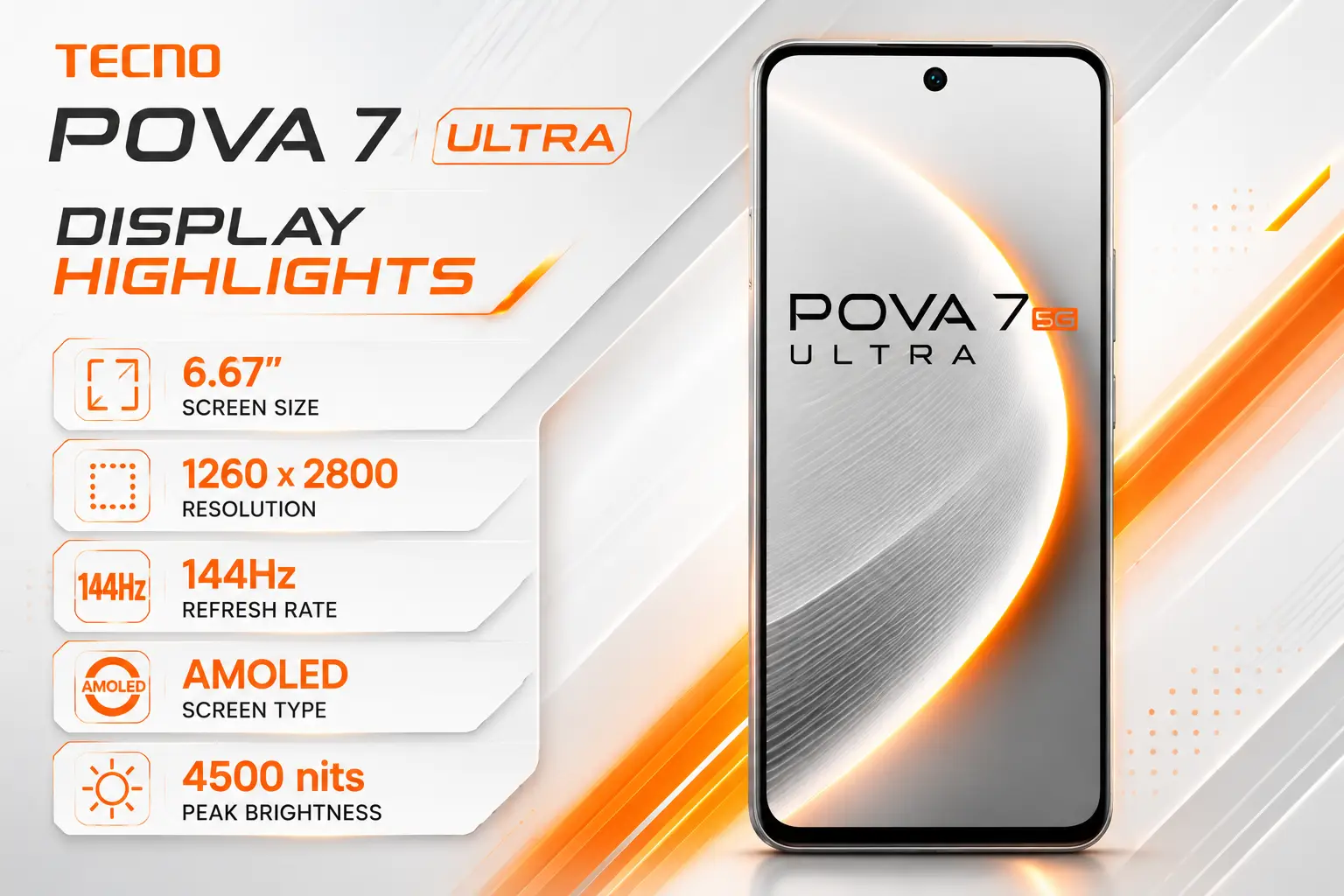
The Tecno Pova 7 Ultra (PKR 140,000–150,000) offers a strong display package with a 6.67-inch AMOLED panel, 1260 × 2800 resolution, 460 PPI, 144Hz refresh rate, and a 4,500-nit peak brightness rating. The G7i also offers similar protection. The Oppo Reno 15 (PKR 159,000) drops to a 120Hz refresh rate and a lower 1,200-nit HBM peak brightness, although its 1256 × 2760 resolution and 460 PPI density keep sharpness comparable to the Tecno Pova 7 Ultra. In everyday use, the Pova 7 Ultra’s higher refresh rate should feel noticeably smoother when scrolling and playing supported games, while the Reno 15 falls behind in rated outdoor brightness.

The Vivo V70 (PKR 159,000, used) also runs at 120Hz with a 1260 × 2750 resolution. However, GSMArena’s lab tests measured 1,800 nits global brightness and a 5,000-nit local brightness peak, giving it an advantage for outdoor visibility despite its lower refresh rate. Since this is a used unit rather than a boxed phone, buyers should inspect the display carefully for signs of wear before purchasing.

The Infinix GT 50 Pro (PKR 167,000) matches the Pova 7 Ultra with a 144Hz refresh rate and 4,500-nit peak brightness. However, its larger 6.78-inch panel uses a lower 1208 × 2644 resolution and 440 PPI density. It is also PKR 17,000–27,000 more expensive than the Tecno Pova 7 Ultra.

Verdict: The Tecno Pova 7 Ultra offers the best display value in this comparison, combining a 144Hz AMOLED display, 460 PPI, and 4,500-nit peak brightness at the lowest price. The Vivo V70 has an advantage in real-world brightness based on laboratory testing, but the Tecno Pova 7 Ultra provides the better overall balance of display specifications and price.

Processor Review:

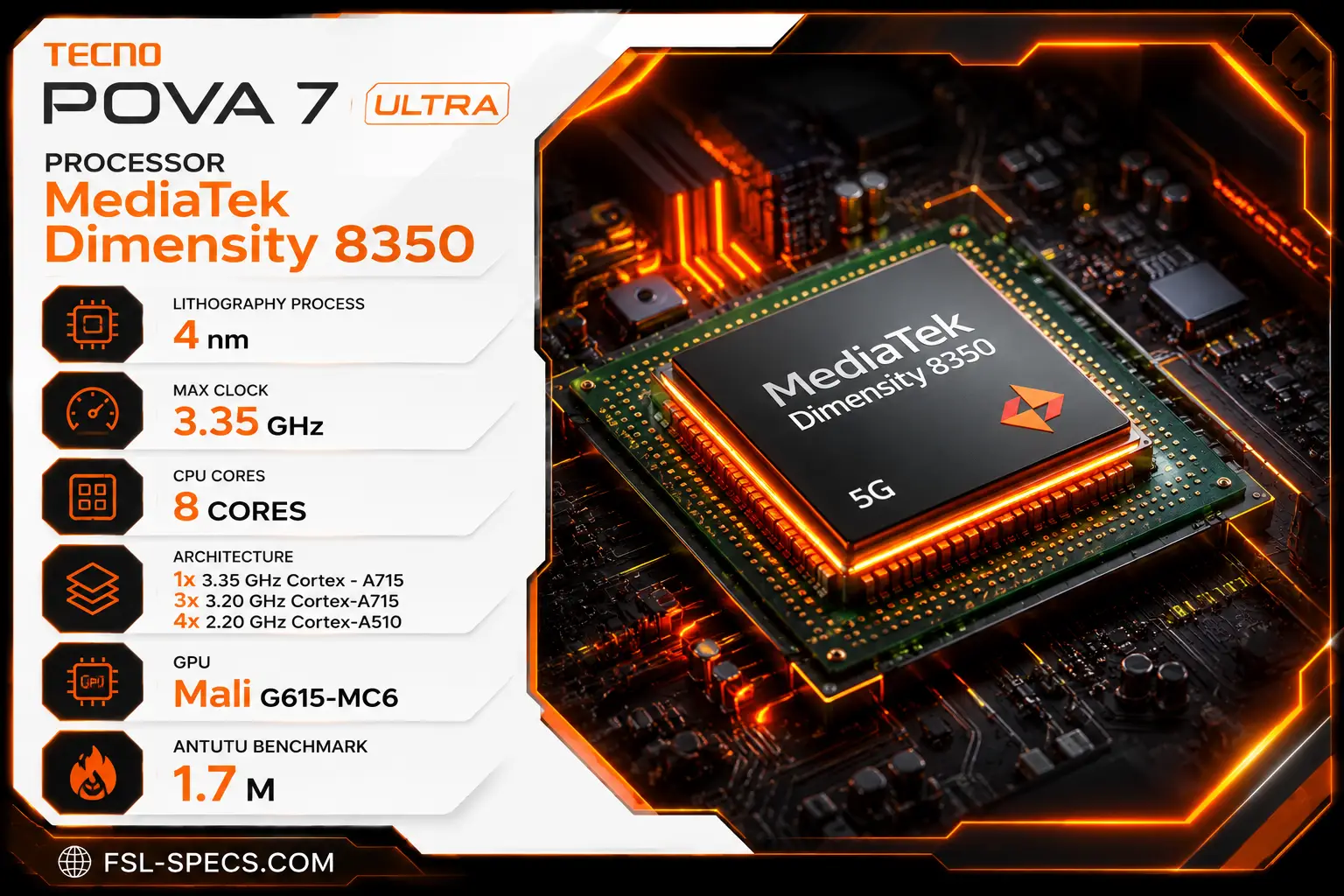
The Tecno Pova 7 Ultra runs on the MediaTek Dimensity 8350 Ultimate (4nm) with a Mali-G615 MC6 GPU, scoring 1,717,416 on AnTuTu v11. The Oppo Reno 15 (PKR 159,000) uses the Snapdragon 7 Gen 4 chipset with Adreno 722 graphics, but its 1,010,000 AnTuTu score is based on AnTuTu v10, so the two figures are not directly comparable. Even after accounting for the benchmark-version difference, the Tecno Pova 7 Ultra offers stronger raw performance potential for its price.

The Vivo V70 (PKR 159,000, used) also uses the Snapdragon 7 Gen 4 platform found in the Reno 15. Kimovil lists an AnTuTu v10 score of 1,010,000, while NanoReview and 91mobiles report 1,437,195, based on AnTuTu v11. Either way, the Tecno Pova 7 Ultra’s 1,717,416 AnTuTu v11 score remains higher. Since the Vivo V70 is a used unit, buyers should also consider the possibility of reduced sustained performance due to battery or thermal wear.

The Infinix GT 50 Pro (PKR 167,000) is the clear performance leader in this comparison. It uses the MediaTek Dimensity 8400 Ultimate (4nm) with a Mali-G720 MC7 GPU, achieving 1,934,579 on AnTuTu v11. Because this is also an AnTuTu v11 result, it provides a more direct comparison with the Tecno Pova 7 Ultra’s 1,717,416 score. The GT 50 Pro also benefits from UFS 4.0 storage, giving it an advantage in storage performance over the Tecno Pova 7 Ultra.

Conclusion: For raw gaming and multitasking performance, the Infinix GT 50 Pro takes the lead despite its higher price. The Tecno Pova 7 Ultra remains a strong value option, offering substantially higher benchmark performance than the Snapdragon 7 Gen 4 phones while costing less.

Ram & Memory Review:

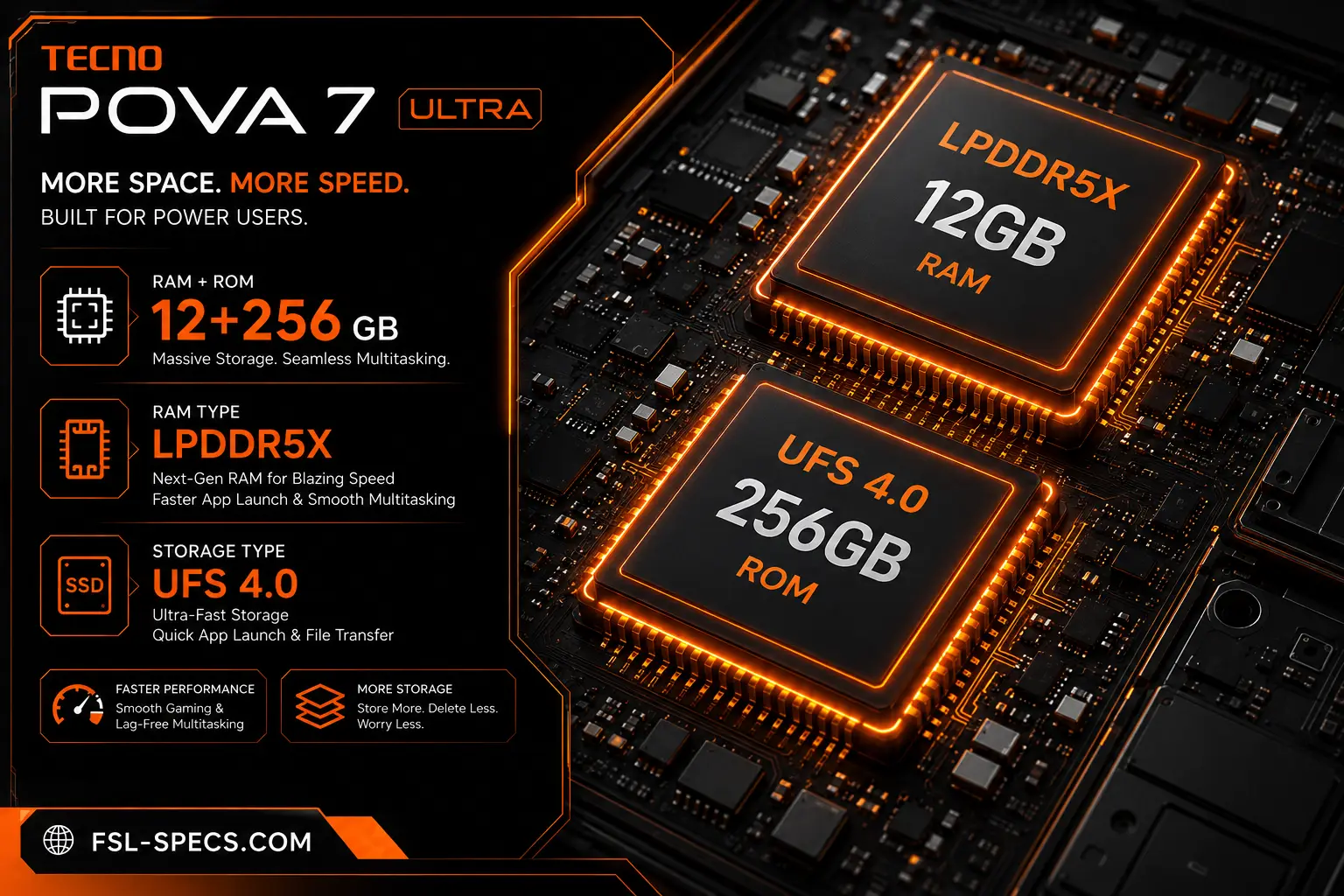
The Tecno Pova 7 Ultra (PKR 140,000–150,000) pairs 12GB LPDDR5X RAM with 256GB UFS storage. There is no microSD card slot, so the internal storage cannot be expanded. The Oppo Reno 15 (PKR 159,000) matches it with 12GB LPDDR5X RAM and 256GB storage, but uses the older UFS 3.1 standard. This gives the Tecno Pova 7 Ultra an advantage in storage performance, particularly for demanding file transfers and app loading.

The Vivo V70 (PKR 159,000, used) drops to 8GB LPDDR5X RAM, which is 4GB less than the Tecno Pova 7 Ultra and the other two phones. However, its 256GB UFS 4.1 storage is technically the fastest storage standard in this comparison. For users who frequently keep many apps running simultaneously, the Tecno Pova 7 Ultra’s additional 4GB of RAM can be more useful in everyday multitasking than the V70’s faster storage. None of these four phones support microSD expansion, so buyers are limited to the built-in storage capacity.

The Infinix GT 50 Pro (PKR 167,000) also comes with 12GB LPDDR5X RAM and 256GB UFS 4.1 storage. It therefore matches the Pova 7 Ultra for RAM while offering faster storage. However, it costs around PKR 17,000–27,000 more than the Tecno Pova 7 Ultra.

Conclusion: The Tecno Pova 7 Ultra and Infinix GT 50 Pro offer the strongest overall memory configurations in this comparison, with both providing 12GB LPDDR5X RAM and 256GB storage. The GT 50 Pro has the advantage in storage speed thanks to UFS 4.1, while the Tecno Pova 7 Ultra offers a lower entry price. The Oppo Reno 15’s UFS 3.1 storage and the Vivo V70’s 8GB RAM make them less attractive for heavy multitasking at their respective prices.

Cameras Review:

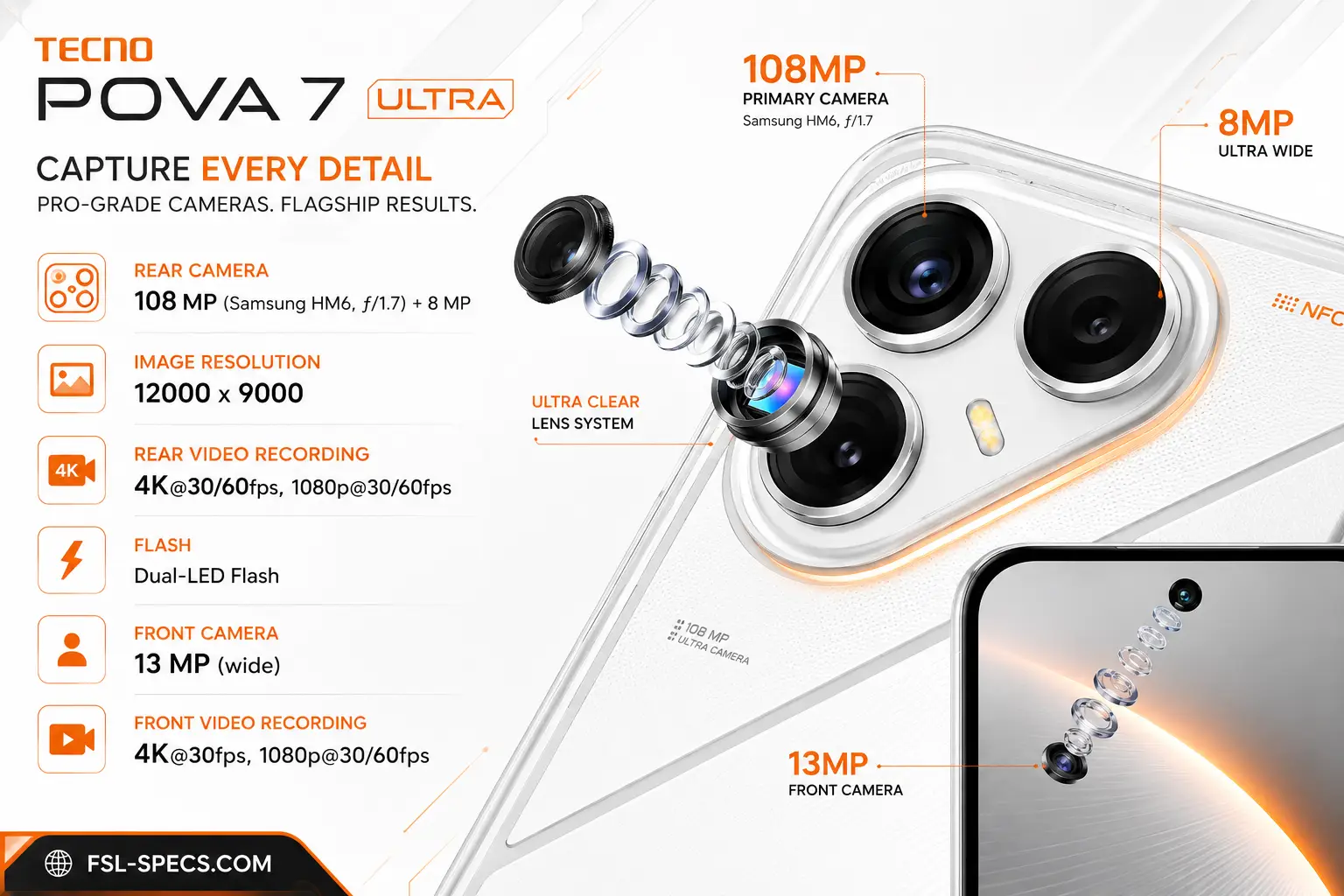
The Tecno Pova 7 Ultra relies on a 108MP Samsung HM6 ISOCELL main sensor (f/1.7), paired with an 8MP ultra-wide camera and a 13MP front camera. The rear camera supports 4K video recording at 30/60fps. Notably, GSMArena and several reviewers have not confirmed OIS on the main camera, so handheld low-light photography and video may show more shake than on stabilized competitors.

The Oppo Reno 15 (PKR 159,000) has a more versatile triple-camera setup. It combines a 50MP f/1.8 main camera with OIS, a 50MP f/2.8 telephoto camera with OIS and 3.5x optical zoom, and an 8MP ultra-wide camera. The front camera is 50MP and supports 4K@30fps video recording. Having OIS on both the main and telephoto cameras, along with genuine optical zoom, gives the Reno 15 a significant advantage over the Tecno Pova 7 Ultra for stabilization and framing flexibility.

The Vivo V70 (PKR 159,000, used) offers a similarly advanced camera system, featuring a 50MP f/1.9 main camera with OIS, a 50MP f/2.7 periscope telephoto camera with OIS and 3.7x optical zoom, an 8MP ultra-wide camera, and a 50MP selfie camera. Between the two Snapdragon-powered rivals, the V70’s slightly wider main aperture and longer optical zoom give it a small advantage. However, since this is a used unit, buyers should carefully inspect the camera glass, lenses, and sensor performance before purchasing.

The Infinix GT 50 Pro (PKR 167,000) uses a 50MP f/1.8 main camera with OIS, an 8MP ultra-wide camera, and a 13MP front camera. Its OIS gives it an important stabilization advantage over the Pova 7 Ultra. The Pova 7 Ultra, however, supports 4K@60fps rear video recording.

Verdict: The Tecno Pova 7 Ultra’s 108MP main sensor looks impressive on paper, but its lack of confirmed OIS puts it behind the competition for stabilization. The Oppo Reno 15 and Vivo V70 stand out with OIS and dedicated optical-zoom cameras, making them better choices for buyers who prioritize photography, video stabilization, and versatile framing over megapixel count.

Battery Review:

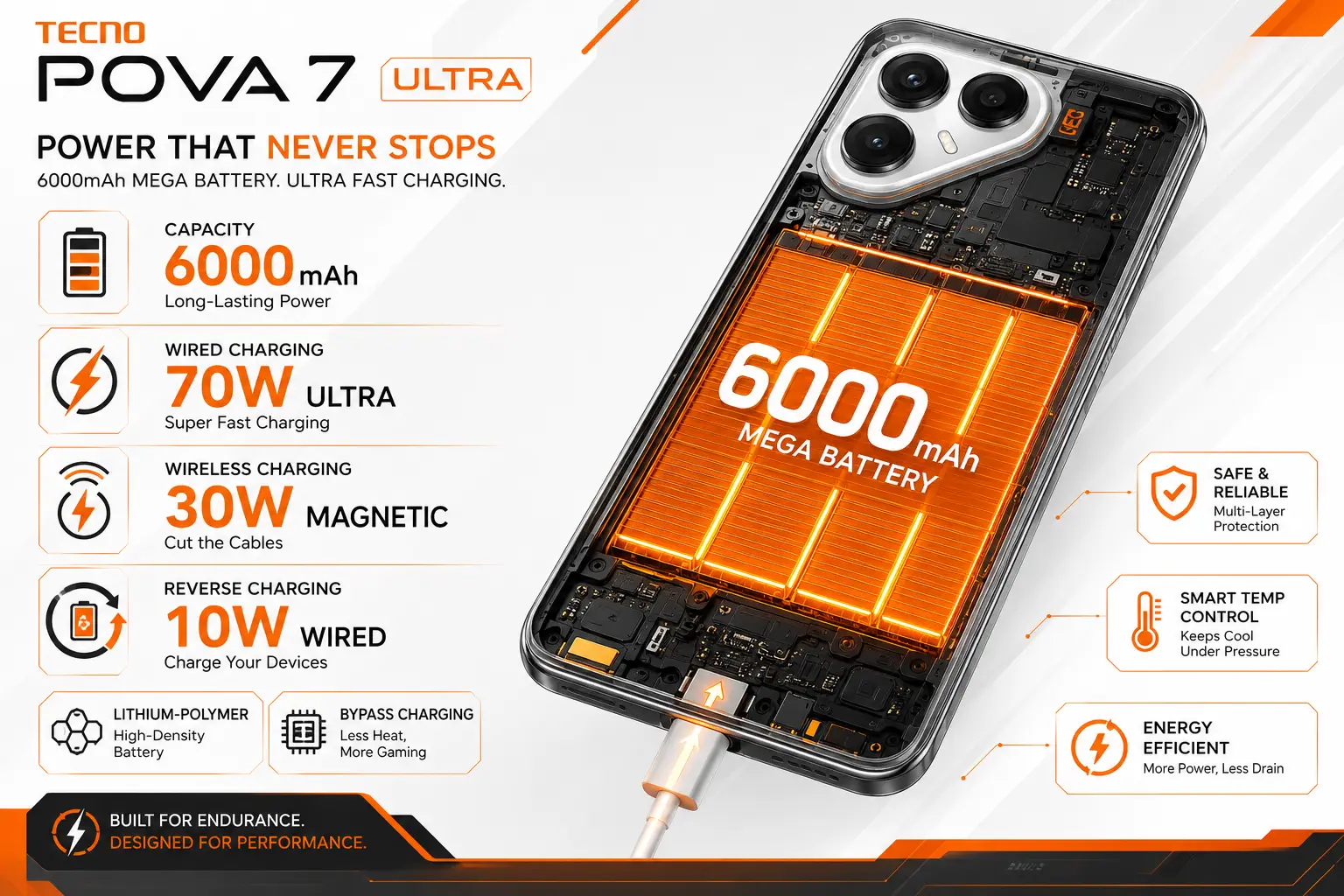
The Tecno Pova 7 Ultra packs a 6000mAh battery with 70W wired charging, reaching 50% in 18 minutes and a full 100% charge in 44 minutes. It also supports 30W wireless charging and 10W reverse wired charging, giving it a particularly versatile charging setup.

The Oppo Reno 15 (PKR 159,000) comes with a larger 6500mAh battery and faster 80W SuperVOOC wired charging. In GSMArena’s lab tests, it reached a full charge in 57 minutes, which is reasonably close to the Pova 7 Ultra despite having a larger battery. However, the Reno 15 does not support wireless charging, so the Pova 7 Ultra has the advantage for users who rely on wireless charging.

The Vivo V70 (PKR 159,000, used) also features a 6500mAh battery, along with 90W wired charging, making it the fastest wired-charging phone in this group on paper. However, no confirmed 0–100% charging time is available. Since this is a used unit, buyers should also check the battery health and charging performance before purchasing.

The Infinix GT 50 Pro (PKR 167,000) matches the Oppo and Vivo with a 6500mAh battery, but its 45W wired charging is considerably slower. It makes up for this with 30W wireless charging, 10W reverse wired charging, and wired and wireless bypass charging, which can help reduce heat during extended gaming sessions.

Verdict: The Vivo V70 leads in raw wired charging speed with 90W, while the Tecno Pova 7 Ultra and Infinix GT 50 Pro are the only two phones here offering wireless charging. Considering its 6000mAh battery, 70W wired charging, 30W wireless charging, and lower price, the Pova 7 Ultra provides the best overall charging package for the money.

PhoneBatteryWired ChargingWireless ChargingReverse Charging
Tecno Pova 7 Ultra6000mAh70W30W10W
Oppo Reno 156500mAh80WNoNo
Vivo V706500mAh90WNoNo
Infinix GT 50 Pro6500mAh45W30W10W

Final Verdict :

Across the display, processor, memory, camera, and battery categories, no single phone wins everything in this competition, but the Infinix GT 50 Pro consistently comes out on top. It posts the highest AnTuTu score of 1,934,579 (v11), matches the Tecno Pova 7 Ultra’s 144Hz refresh rate, and combines OIS, 30W wireless charging, and wired and wireless bypass charging. These features give it a strong advantage for gaming and everyday performance. The main trade-off is price: at PKR 167,000, it costs around PKR 17,000–27,000 more than the other phones.

The Tecno Pova 7 Ultra (PKR 140,000–150,000) is the strongest value pick, undercutting every competitor while offering 12GB RAM, a 144Hz AMOLED display, and wireless charging. Its main weakness is the lack of confirmed OIS on its 108MP main camera, which puts it behind the more camera-focused rivals for stabilization.

The Oppo Reno 15 and Vivo V70 (both PKR 159,000) stand out for their camera hardware, with both offering OIS and dedicated optical-zoom cameras. However, neither supports wireless charging. The Vivo V70 listed here is also a used unit with 8GB RAM, adding some uncertainty around battery health, camera condition, and long-term reliability.

Bottom line: If budget and value are the priorities, the Tecno Pova 7 Ultra offers the best specifications for the money. If overall performance, gaming, camera stabilization, and charging versatility matter more than price, the Infinix GT 50 Pro is the strongest all-rounder in this group.

Ranking — Overall Value

  1. Infinix GT 50 Pro — Best raw performance, OIS camera, 30W wireless charging, and bypass charging, but also the highest price.
  2. Tecno Pova 7 Ultra — Best price-to-specification ratio, with 12GB RAM, 144Hz AMOLED, and wireless charging; its main weakness is the lack of confirmed OIS.
  3. Oppo Reno 15 — Strong camera hardware with OIS and optical zoom, but no wireless charging and UFS 3.1 storage.
  4. Vivo V70 — Excellent camera hardware and 90W wired charging, but the used condition and 8GB RAM in this listing make it less attractive for long-term value.

Pros And Cons of Tecno Pova 7 Ultra

Pros of Mobile

✅ Dimensity 8350 Ultimate performance
✅ 1.5K  with 144Hz AMOLED
✅ 6000mAh + 70W + 30W wireless charging
✅ 108 MP Camera With Samsung Sensor
✅ Gaming-focused optimization
✅ Very aggressive value-for-money hardware
✅Notification Light in Backside

Cons of Mobile

❌Weak ultrawide camera
❌No telephoto camera
❌Heating during heavy gaming
❌Heavy/thick body
❌ No gaming triggers

Best For - Not Best For

Best For

✅ long battery backup
✅Fast charging lovers who want quick top-ups
✅PUBG/BGMI and COD Mobile players
✅futuristic gaming design

Not Best For

❌flagship-level camera quality
❌Professional content creators
❌Professional photographers
❌ low-light photography

Trailer And Unboxing of Tecno Pova 7 Ultra

Disassembly Or Teardown And Gaming Test of Tecno Pova 7 Ultra

Camera Test Tecno Pova 7 Ultra

Tecno Pova 8 Pro
Tecno Pova 7 Pro
Tecno Camon 50 Ultra
Vivo V70
Infinix GT 50 Pro
Oppo Reno 15

TECNO Series Row
Picture of Faisal Ur Rehman

Faisal Ur Rehman

Faisal Rehman is the founder and editor of FSL Specs, where he publishes in-depth smartphone specifications, comparisons, buying guides, and technology insights. With extensive experience in mobile hardware research and technical analysis, he provides accurate and up-to-date information on Android smartphones, processors, displays, cameras, batteries, performance benchmarks, and software features. His goal is to simplify complex specifications and help readers choose the right device with confidence.

FAQs Questions

it's features a 6.78-inch AMOLED display with a 144Hz refresh rate and a peak brightness of 4,500 nits, delivering vibrant visuals and excellent outdoor visibility.

it's is powered by the MediaTek Dimensity 8350 Ultimate chipset, built on a 4nm process, delivering strong performance for gaming, multitasking, and everyday use.

it uses LPDDR5X RAM the fastest mobile RAM standard currently available in either 8GB or 12GB configurations, paired with 256GB of UFS storage. LPDDR5X means smooth multitasking and quick app switching without background apps constantly reloading.

The main rear camera is 108MP with PDAF autofocus paired with an 8MP ultrawide lens. 13 MP Front Camera

it carries a 6000mAh Li-Polymer battery With 70W Fast Charging For This phone.

he Tecno Pova 7 Ultra is available at different prices depending on the region. In Pakistan, it is priced at around PKR 110k-130k, in India around INR 30,000 - 35,000 INR, and globally at approximately USD 350-400$, depending on the variant and market.

Scroll to Top