






✪ Tecno Pova Curve 2 ✪

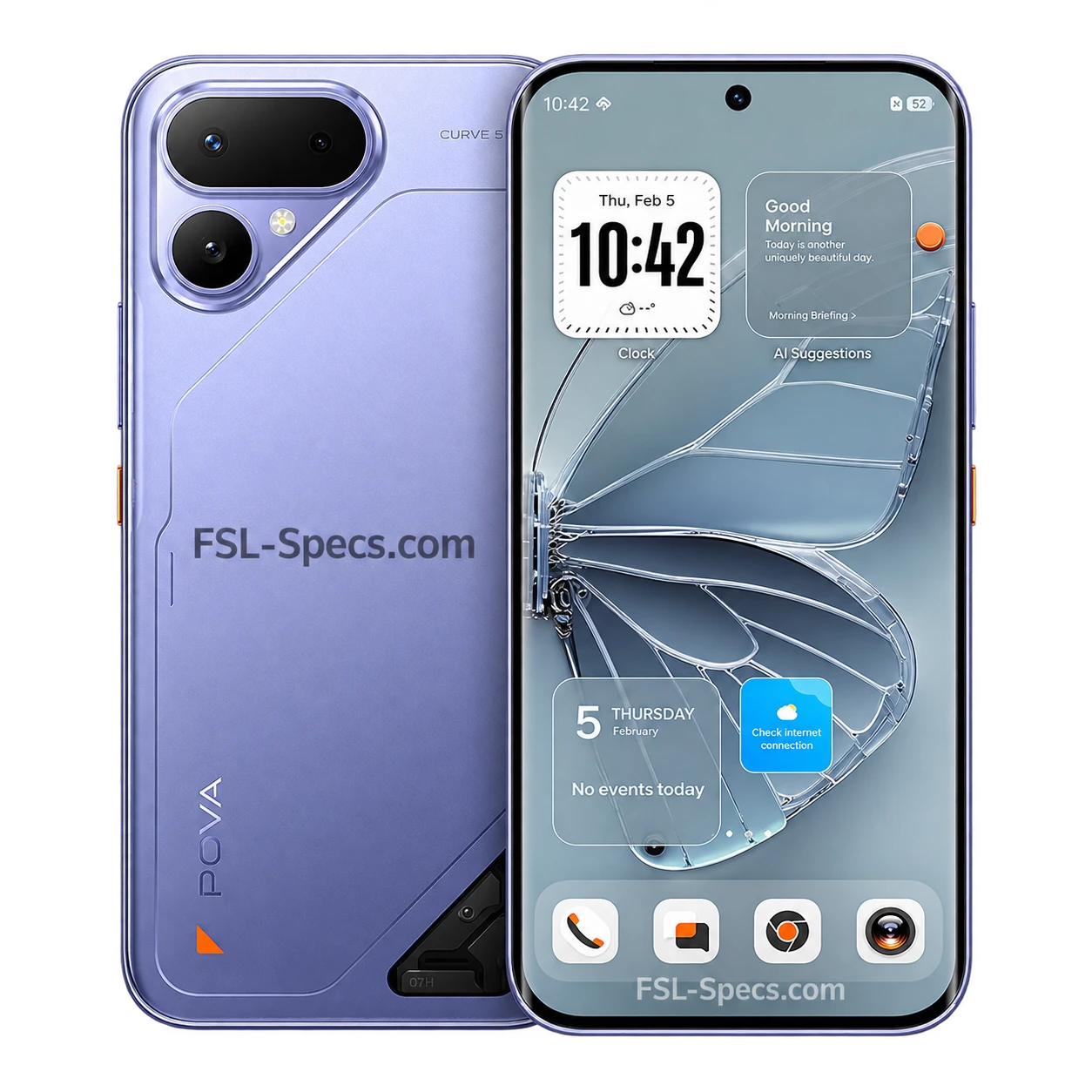
Tecno Pova Curve 2 png image
Last Time Update : 21 October, 2026
United States flagUnited States
320USD
…iPrice NoteYour Country price depends on USD. Prices may be different in your region due to taxes and duties.
Pakistan flagPakistan (PKR)
100000PKR
India flagIndia (INR)
34000INR

✪ Tecno Pova Curve 2 ✪

Tecno Pova Curve 2 png image
Quick Specs
Display
6.78 inchAMOLED144 Hz
Processor
Dimensity 71002.4 GHz
RAM & Storage
8 + 256 GB
Rear Camera
50+ 2 MP
Front Camera
13 MP
Battery & Charging
8000 mAh45 W

Full Specification

!
IMPORTANT INFORMATION

Specifications Disclaimer

NOTICE

Specifications are collected from official manufacturers and trusted sources. Actual details may vary by region, model variant, or software updates. We strive for accuracy but cannot guarantee error-free information.

Basic Info

Mobile
Tecno Pova Curve 2
Model
LK7K
Series
Pova Series
Category
Mid-range
Release Date
20 February,2026
Year
2026

Connectivity

SIM
Nano-SIM + Nano-SIM
Network
4G / 4G+ / 5G
WiFi
Wi-Fi 802.11 a/b/g/n/ac
Bluetooth
5.4
NFC
Yes
OS
Android 16 , Hi OS 16

Body

Dimensions
162.7 x 77.2 x 7.4 mm
Build
Plastic ( Frame And Back)
Weight
195 g
Screen Size
6.78 inch
Resolution
1080 x 2364 pixels
Type
AMOLED
Refresh Rate
144 Hz
Peak Brightness
4500 Nits
HBM Brightness
1600 nits
Processor Specs
Processor
Dimensity 7100
Processor Link
Max Clock
2.4 GHz
Lithography
6 nm
GPU
Mali-G610 MC2
CPU Cores
8 Cores
Antutu v11
810 K
Antutu v10
740 K
Bootup Time
32 s
Architecture
4 x 2.4 GHz 
4 x 2.0 GHz
RAM & ROM Specs
RAM Memory
8 + 256 GB
RAM Type
LPDDR5X
Storage Type
UFS 2.2
SD Card
No
Variants
8+128 GB
8+256 GB
12+256 GB
Camera Specs
MP
Rear Camera
50+ 2 MP
Front Camera
13 MP
Recording FPS
Main Recording
2K@30 FPS
1080p @ 60 FPS
Front Recording
2K@30 FPS
1080p @ 60 FPS
Zoom
Optical Zoom
-
Digital Zoom
15 X
Flash
Flash
Dual LED Flash
Front Flash
Screen Flash
Battery Specs
Capacity
8000 mAh
Fast Charging
45 W
Battery Type
Silicon-Carbon
Reverse
Reverse Wired
10W
Other
Battery PC Marks
15h 13m
Charging Time
1h 5m - 91 Mobiles
Other Specs
Audio & Sensors
IP Rating
IP 64
Speaker
Dual Stereo Speaker
Fingerprint Sensor
Front Finger
Other Sensors
– Proximity sensor
– Gyroscope
– Accelerometer
– Ambient light sensor
– Compass
– Fingerprint
Special Features

Status light LED (back)

BASIC INFO
Mobile
Tecno Pova Curve 2
Model
LK7K
Series
Pova Series
Category
Mid-range
Release Date
20 February,2026
Year
2026
CONNECTIVITY
Sim
Nano-SIM + Nano-SIM
Network
4G / 4G+ / 5G
WiFi
Wi-Fi 802.11 a/b/g/n/ac
Bluetooth
5.4
NFC
Yes
OS
Android 16 , Hi OS 16
BODY
Dimensions
162.7 x 77.2 x 7.4 mm
Build
Plastic ( Frame And Back)
Weight
195 g
Screen Size
6.78 inch
Resolution
1080 x 2364 pixels
Type
AMOLED
Refresh Rate
144 Hz
Peak Brightness
4500 Nits
HBM Brightness
1600 nits
Processor
Dimensity 7100
Processor Link
Max Clock
2.4 GHz
Lithography
6 nm
GPU
Mali-G610 MC2
CPU Cores
8 Cores
Antutu v11
810 K
Antutu v10
740 K
Bootup Time
32 s
Architecture
4 x 2.4 GHz 
4 x 2.0 GHz
Ram Memory
8 + 256 GB
SD Card
No
Ram Type
LPDDR5X
Storage Type
UFS 2.2
Variants
8+128 GB
8+256 GB
12+256 GB
MP
Rear Camera
50+ 2 MP
Front Camera
13 MP
RECORDING FPS
Main Recording
2K@30 FPS
1080p @ 60 FPS
Front Recording
2K@30 FPS
1080p @ 60 FPS
RESOLUTION
Main Resolution
8160 × 6144 pixels
Front Resolution
4160 × 3120 pixels
ZOOM
Optical Zoom
-
Digital Zoom
15 X
FLASH
Flash
Dual LED Flash
Front Flash
Screen Flash
Capacity
8000 mAh
Fast Charging
45 W
Battery Type
Silicon-Carbon
REVERSE
Reverse Wired
10W
OTHER
Battery Life PCMark
15h 13m
Charging Time
1h 5m - 91 Mobiles
PROTECTION
IP Rating
IP 64
AUDIO & SENSORS
Speaker
Dual Stereo Speaker
Fingerprint Sensor
Front Finger
Other Sensors
– Proximity sensor – Gyroscope – Accelerometer – Ambient light sensor – Compass – Fingerprint
Special Features

Status light LED (back)

Verify Mobile Specifications

Official information & trusted references

Official Manufacturer WebsiteExplore the original product information (opens in a new tab)

Trusted Specification Sources

Cross-reference · 5 sources

Links open third-party websites. The Purple ticks are a design marker only; they do not mean a source has verified these specifications or endorses FSL-Specs.

Last Time Update : 21 October, 2026

Highlights & Review Of Tecno Pova Curve 2

Display Highlights

The Tecno Pova Curve 2 has a 6.78-inch curved AMOLED display with a 1208 × 2644 resolution, approximately 429 ppi, and a 144Hz refresh rate. Its peak brightness is rated at 4,500 nits, with an HBM figure of 1,600 nits. The panel supports 1.07 billion colors, 2,400Hz touch sampling, anti-flicker technology, and a 5,000,000:1 contrast ratio, with Corning Gorilla Glass 7i protection. At approximately INR 31,000 for the 8GB + 128GB variant, it offers a large, smooth, and visually appealing display with excellent brightness and color depth for its class.

The Tecno Pova 8 uses a 6.76-inch IPS LCD display with a 1080 × 2344 resolution, around 381 ppi, and a 144Hz refresh rate. Its peak brightness is rated at 950 nits HBM and 760 nits typical, with independent testing measuring up to 991 nits in auto mode with extra brightness enabled. It supports 8-bit color and 240Hz touch sampling, but it lacks HDR hardware support and has a lower contrast ratio than AMOLED panels. At approximately INR 32,000 for the 8GB + 128GB variant, it offers a lower-quality display than the Pova Curve 2, with weaker outdoor visibility and less vibrant colors.

The Poco X8 has a 6.59-inch AMOLED display with a 1268 × 2756 resolution, around 447 ppi, and a 120Hz refresh rate. Its peak brightness is rated at 3,500 nits, with independent testing measuring up to 1,090 nits on a small patch in auto mode. It supports HDR10+, Dolby Vision, and 1,920Hz PWM dimming, making it a strong option for HDR content and eye comfort. At approximately INR 32,000 for the 8GB + 128GB variant, it offers a sharper and more HDR-capable display than the Pova Curve 2, though its smaller size and lower refresh rate make it less ideal for gaming.

The Motorola Edge 70 Fusion has a 6.78-inch quad-curved AMOLED display with a 1272 × 2772 resolution, around 450 ppi, and a 144Hz refresh rate. Its peak brightness is rated at 5,200 nits, with independent testing measuring up to 1,489 nits on a small patch in auto mode. It supports HDR10+, Dolby Vision, 10-bit DCI-P3, and Pantone-validated color accuracy, making it one of the most color-accurate displays in this group. At approximately INR 31,000 for the 12GB + 256GB variant, it offers the sharpest and most color-accurate display here, with excellent brightness and a premium quad-curved design.

Verdict: The Motorola Edge 70 Fusion offers the best display in this group with its 6.78-inch 144Hz QHD+-class AMOLED, 5,200-nit peak brightness, and Pantone-validated color accuracy; the Tecno Pova Curve 2 is a close second with its 144Hz panel and 4,500-nit brightness; the Poco X8 offers the sharpest resolution and best HDR support; while the Tecno Pova 8 ranks last with its lower-quality IPS LCD panel and weaker brightness.

Performance Highlights

The Tecno Pova Curve 2 runs on the MediaTek Dimensity 7100, built on a 6nm process. It has an octa-core CPU with four Cortex-A78 cores at 2.4GHz, four Cortex-A55 cores at 2.0GHz, and a Mali-G610 MC2 GPU. The Indian 8GB + 128GB model uses 8GB RAM and 128GB UFS 2.2 storage. India Today measured 717,994 on AnTuTu, 952 single-core and 2,701 multi-core on Geekbench 6, making it a dependable mid-range performer for daily use and casual gaming.

The Tecno Pova 8 uses the same Dimensity 7100 chipset, so its core CPU and GPU architecture are effectively identical to the Pova Curve 2. Its 8GB + 128GB version also uses UFS 2.2 storage, while benchmark databases record 757,391 AnTuTu v11 points. GSMArena describes it as a reliable performer for everyday tasks, though demanding games need lower graphics settings.

The Poco X8 uses the Qualcomm Snapdragon 6s Gen 4, a newer 4nm chipset with four Cortex-A78 cores at 2.4GHz, four Cortex-A55 cores at 1.8GHz, and an Adreno 710 GPU. The Indian 8GB + 128GB model uses 8GB LPDDR4X RAM and UFS 2.2 storage; the 256GB variants move to faster UFS 3.1 storage. NanoReview records 832,323 AnTuTu v11 points, with 1,005 single-core and 2,871 multi-core Geekbench scores.

The Motorola Edge 70 Fusion is the performance leader. Its India model uses the Snapdragon 7s Gen 4, a 4nm chipset with a 2.7GHz Cortex-A720 prime core, three 2.4GHz Cortex-A720 cores, four 1.8GHz Cortex-A520 cores, and an Adreno 810 GPU. Your specified 12GB + 256GB variant also has more RAM than every rival here. GSMArena measured 1,137,028 AnTuTu v11 points, 1,261 single-core and 3,508 multi-core Geekbench 6 points.

AnTuTu Percentage

Percentages are calculated against the Tecno Pova Curve 2’s tested 717,994 AnTuTu score.

PhoneProcessorRAM / StorageAnTuTu v11Difference vs Pova Curve 2
Tecno Pova Curve 2Dimensity 7100, 6nm8GB / 128GB, UFS 2.2717,994Baseline
Tecno Pova 8Dimensity 7100, 6nm8GB / 128GB, UFS 2.2757,391+5.5%
Poco X8Snapdragon 6s Gen 4, 4nm8GB / 128GB, UFS 2.2832,323+15.9%
Motorola Edge 70 FusionSnapdragon 7s Gen 4, 4nm12GB / 256GB1,137,028+58.4%

The Poco X8 is therefore about 10% faster than the Pova 8 in AnTuTu, despite both phones having 8GB RAM and UFS 2.2 storage in the specified 128GB configuration. The Edge 70 Fusion remains in a different performance class because it combines a stronger 4nm chipset with 12GB RAM and 256GB storage.

Real-World Performance

  • Tecno Pova Curve 2: Smooth for social media, browsing, streaming, and multitasking. India Today recorded up to 60FPS in BGMI and Call of Duty: Mobile at low graphics, so it is suitable for casual gaming rather than sustained high-end gaming.

  • Tecno Pova 8: Handles popular games such as BGMI at medium-to-high settings, but demanding titles such as Genshin Impact require reduced graphics. Its large battery and bypass charging make it practical for long sessions.

  • Poco X8: Delivers noticeably stronger performance than the two Dimensity 7100 phones, with enough power for everyday multitasking and mainstream gaming. Its 3DMark Wild Life Extreme stress test showed 99.5% stability, indicating consistent performance under sustained graphics load.

  • Motorola Edge 70 Fusion: Best for gaming and heavy multitasking, with Motorola claiming BGMI at 120FPS and COD Mobile at 90FPS. Its 12GB RAM also gives it an advantage for app switching, large games, and long-term software smoothness.

Performance Ranking

  1. Motorola Edge 70 Fusion — Best chipset, highest AnTuTu score, 12GB RAM, and strongest gaming potential.

  2. Poco X8 — Best value performer among the 8GB + 128GB phones, with a verified 832,323 AnTuTu score and stable sustained performance

  3. Tecno Pova 8 — Slightly ahead of the Pova Curve 2 despite using the same chipset, with stronger benchmark tuning and battery endurance.

  4. Tecno Pova Curve 2 — Reliable mid-range performance and good everyday usability, but the weakest benchmark performer in this comparison.

Memory & Storage Highlights

The Tecno Pova Curve 2 comes with 8GB LPDDR5X RAM and 128GB UFS 2.2 storage in the specified variant. It does not support expandable storage or a microSD card, so buyers must choose the 256GB version if they need more internal space. The LPDDR5X RAM is a strength because it enables faster app switching and better multitasking than LPDDR4X, but the UFS 2.2 storage is slower than UFS 3.1 or UFS 4.0

The Tecno Pova 8 also has 8GB LPDDR5X RAM and 128GB UFS 2.2 storage in the specified variant. Unlike the Pova Curve 2, it supports microSDXC expansion, giving users the option to add more storage later without paying upfront for a higher-capacity model. Its RAM and storage types are identical to the Pova Curve 2, so real-world app-switching and file-loading performance should be very similar.

The Poco X8 has 8GB LPDDR4X RAM and 128GB UFS 2.2 storage in the specified variant. It does not support expandable storage, and its LPDDR4X RAM is slower than the LPDDR5X used in both Tecno phones. However, POCO offers an 8GB + 256GB version with UFS 3.1 storage, which is a better option for users who need faster storage and more space.

The Motorola Edge 70 Fusion is the clear memory leader with 12GB LPDDR5X RAM and 256GB UFS 3.1 storage in the specified variant. It does not support expandable storage, but its combination of 12GB RAM, faster UFS 3.1 storage, and 256GB capacity gives it the best multitasking, app retention, and long-term storage headroom in this group.

Memory Comparison

PhoneRAMRAM TypeStorageStorage TypeExpandable Storage
Tecno Pova Curve 28GBLPDDR5X128GBUFS 2.2No
Tecno Pova 88GBLPDDR5X128GBUFS 2.2Yes, microSDXC
Poco X88GBLPDDR4X128GBUFS 2.2No
Motorola Edge 70 Fusion12GBLPDDR5X256GBUFS 3.1No

Real-World Impact

  • Tecno Pova Curve 2: Good for everyday multitasking, social media, and moderate gaming, but 128GB fills up quickly for users who store large videos, games, or offline media.

  • Tecno Pova 8: Same RAM and storage speed as the Pova Curve 2, but microSD support makes it the better choice for users who want low-cost storage expansion.

  • Poco X8: Adequate for daily use, but its slower LPDDR4X RAM makes it the weakest option for heavy app switching among the four phones.

  • Motorola Edge 70 Fusion: Best for gaming, video editing, heavy multitasking, and long-term use, thanks to 12GB RAM, 256GB storage, and faster UFS 3.1 memory.

Memory Ranking

  1. Motorola Edge 70 Fusion — Best RAM, storage capacity, and storage speed.

  2. Tecno Pova 8 — Best expandable-storage option, with the same RAM and storage speed as the Pova Curve 2.

  3. Tecno Pova Curve 2 — Strong LPDDR5X RAM, but limited 128GB storage and no card slot.

  4. Poco X8 — Weakest RAM type and no expandable storage in the 128GB variant, though the 256GB version improves storage speed.

Camera Highlights

The Tecno Pova Curve 2 has a dual rear setup with a 50MP f/1.8 main camera using a 1/2-inch sensor, PDAF, and a 2MP macro camera. It records up to 1440p at 30fps or 1080p at 60fps on the rear, while the 13MP fixed-focus front camera records up to 1080p at 60fps. It lacks OIS, ultrawide, and 4K recording, so it is best treated as a capable everyday camera rather than a video-first option.

The Tecno Pova 8 uses a 50MP Sony LYT-600-class main camera with a 1/1.95-inch sensor, 0.8-micron pixels, PDAF, and a light sensor; its secondary rear module is not independently usable. GSMArena found its daylight photos sharp and detailed, with good dynamic range and accurate white balance, while low-light shots were also very good. It records up to 1440p at 30fps or 1080p at 60fps, but has no OIS, no 4K, and stabilization is limited to 1080p at 30fps.

The Poco X8 has a 50MP f/1.8 main camera with OIS, a 2MP depth sensor, and a 16MP f/2.4 front camera. Its main camera is the key advantage here: OIS helps with handheld low-light shots and steadier video, while the f/1.8 aperture supports natural-looking daylight photos and usable night shots. However, video is capped at 1080p at 30fps, and the 2MP depth sensor is much less useful than a real ultrawide camera

The Motorola Edge 70 Fusion has the most complete camera system: a 50MP Sony LYTIA 710 main camera with OIS, a 13MP ultrawide, and a 32MP front camera. It supports 4K video recording, Pantone-validated color and skin tones, and Motorola’s AI imaging features. This gives it the strongest combination of main-camera quality, ultrawide coverage, selfie resolution, and video capability in this comparison.

Camera Comparison

PhoneMain CameraSecondary CameraFront CameraMax VideoOISUltrawide
Tecno Pova Curve 250MP f/1.8, 1/2-inch, PDAF2MP macro13MP f/2.21440p30 / 1080p60NoNo
Tecno Pova 850MP Sony LYT-600-class, 1/1.95-inch, PDAFLight sensor only13MP f/2.21440p30 / 1080p60NoNo
Poco X850MP f/1.8 with OIS2MP depth16MP f/2.41080p30YesNo
Motorola Edge 70 Fusion50MP Sony LYTIA 710 with OIS13MP ultrawide32MP4KYesYes

Photo Quality

  • Tecno Pova Curve 2: The 50MP main camera should produce good daylight photos, but the lack of OIS makes low-light shots more dependent on steady hands. Its 2MP macro camera is largely a filler sensor

  • Tecno Pova 8: Best-reviewed main camera among the two Tecno phones. GSMArena praised its sharp daylight detail, good dynamic range, accurate white balance, and strong low-light performance, though colors can look slightly muted and shadows can be too dark.

  • Poco X8: Delivers sharp, natural-looking daylight photos and benefits from OIS in evening, indoor, and low-light shooting. Its 2MP depth sensor is only useful for portrait depth data, not for wide shots.gadgets.

  • Motorola Edge 70 Fusion: Most versatile for photography because it combines a premium OIS main sensor with a genuine 13MP ultrawide camera. It is the best choice for landscapes, group shots, architecture, and wider indoor scenes.

Selfie and Video

  • Tecno Pova Curve 2: The 13MP selfie camera supports up to 1080p at 60fps, which is useful for calls and casual vlogs, but it is fixed-focus and lacks 4K.

  • Tecno Pova 8: Its 13MP selfie camera is well reviewed, with good detail, dynamic range, and pleasant skin tones. Both front and rear cameras top out at 1440p at 30fps or 1080p at 60fps.

  • Poco X8: The 16MP front camera is the highest-resolution selfie camera among the 8GB + 128GB phones, but video is limited to 1080p at 30fps

  • Motorola Edge 70 Fusion: The 32MP selfie camera and 4K video support make it the best option for creators, video calls, vlogs, and high-resolution social-media content.

Camera Ranking

  1. Motorola Edge 70 Fusion — Best overall camera system: OIS main camera, 13MP ultrawide, 32MP selfie camera, and 4K video.

  2. Poco X8 — Best main-camera stability for stills and low light among the 8GB + 128GB phones, thanks to OIS, but weak video cap and no ultrawide.

  3. Tecno Pova 8 — Best-reviewed 50MP main camera for daylight and low-light photos, with good selfies, but no OIS, ultrawide, or 4K.

  4. Tecno Pova Curve 2 — Capable everyday camera, but the weakest overall package due to its basic 2MP macro camera, no OIS, and no ultrawide.

Battery & Charging Highlights

The Tecno Pova Curve 2 has an 8,000mAh silicon-carbon battery with 45W wired fast charging and bypass charging for gaming. Tecno claims the phone is built for up to six years of durability, can operate and charge in temperatures from -20°C to 60°C, and is TÜV SÜD certified for long battery life. At just 7.42mm thick and 195g, it is one of the slimmest and lightest phones with an 8,000mAh battery in its class, making it a strong choice for users who want big endurance without a bulky body.

The Tecno Pova 8 also has an 8,000mAh battery with 45W fast charging. Croma lists a claimed 70-minute full charge time and 50% in 34 minutes, with the battery rated for 2,000 charging cycles. Its larger 229g body and 8.8mm thickness make it heavier than the Pova Curve 2, but its massive battery and larger thermal cooling system make it well suited for long gaming and streaming session

The Poco X8 has the largest battery in this comparison: an 8,340mAh silicon-carbon battery with 67W HyperCharge and 22.5W reverse wired charging. POCO claims more than two days of battery life, up to six years of battery health, and retention of 80% or more capacity after 1,600 charge cycles. It also carries a TÜV SÜD 5-star Battery Performance Certification and supports reverse charging, making it the most versatile battery package here. Note that POCO does not include a charger in the box, so buyers may need to purchase a 67W adapter separately.

The Motorola Edge 70 Fusion has a 7,000mAh battery with 68W TurboPower wired charging. Its battery capacity is smaller than the other three phones, but its 68W charging is the fastest here, which helps offset the difference in capacity. With its 4nm Snapdragon 7s Gen 4 chipset and efficient AMOLED display, it should still deliver strong all-day endurance, though it is not designed for the same two-day-plus use case as the Poco X8 or the two Tecno phones.

Battery Comparison

PhoneBattery CapacityBattery TypeWired ChargingReverse ChargingClaimed Charge TimeBest For
Tecno Pova Curve 28,000mAhSilicon-carbon45WNoNot officially statedSlim design with big battery
Tecno Pova 88,000mAhLithium polymer45WNo70 minutes to 100%, 34 minutes to 50%Long gaming and streaming sessions
Poco X88,340mAhSilicon-carbon67W HyperCharge22.5W wiredNot officially statedMaximum endurance and reverse charging
Motorola Edge 70 Fusion7,000mAhLithium-ion68W TurboPowerNoNot officially statedFastest charging

Real-World Battery Life

  • Tecno Pova Curve 2: The 8,000mAh battery should easily last a full day of heavy use and more than a day of moderate use. Its bypass charging feature helps reduce heat and battery stress during long gaming sessions, while its slim 7.42mm body makes it more pocket-friendly than most large-battery phones.

  • Tecno Pova 8: The 8,000mAh battery is designed for two days between charges under normal use, with Croma listing a 70-minute full charge time. Its 14,689 sq.mm heat-dissipation area helps maintain stable performance during extended gaming or video session

  • Poco X8: The 8,340mAh battery is the largest here and is rated for more than two days of use, with 67W charging providing fast top-ups. Its 22.5W reverse charging also lets it act as a power bank for earbuds, another phone, or other accessories.

  • Motorola Edge 70 Fusion: The 7,000mAh battery is smaller but should still comfortably last a full day, and its 68W charging is the fastest in this group, making quick top-ups very practical.

Final Verdict

The Tecno Pova Curve 2 (8GB + 128GB) is the best all-round choice at INR 31,000. It combines a 6.78-inch 144Hz curved AMOLED display with 4,500-nit peak brightness, an 8,000mAh battery in a slim 7.42mm, 195g body, 8GB LPDDR5X RAM, 45W charging, and 5G. Its weaknesses are the Dimensity 7100, which is slower than the Poco X8 and Edge 70 Fusion, a 2MP macro camera, no OIS, no ultrawide, and no 4K video. It is best for buyers who want a slim, stylish, long-lasting phone with a premium display and solid everyday performance.

The Tecno Pova 8 (8GB + 128GB) is the best option for users who prioritize battery endurance and camera quality over design. It has the same 8,000mAh battery and Dimensity 7100 as the Pova Curve 2, but adds a larger 50MP Sony LYT-600-class main camera with better-reviewed low-light performance, a 6.76-inch 144Hz display, microSD expansion, and a claimed 70-minute full charge. Its downsides are its heavier 229g body, IPS LCD display, no OIS, no ultrawide, and no 4K video.

The Poco X8 (8GB + 128GB) is the best battery and performance-value option. It has the largest 8,340mAh battery, fastest 67W HyperCharge, 22.5W reverse charging, a Snapdragon 6s Gen 4 chipset that scores 832,323 on AnTuTu v11, and a 50MP OIS main camera. However, its LPDDR4X RAM, 1080p-only video, 2MP depth camera, and no ultrawide or expandable storage limit its camera and memory appeal. It is best for users who want maximum endurance, fast charging, and stronger performance than the two Tecno phones.

The Motorola Edge 70 Fusion (12GB + 256GB) is the best overall phone in this comparison despite its smaller 7,000mAh battery. It has the strongest Snapdragon 7s Gen 4 chipset, 12GB LPDDR5X RAM, 256GB UFS 3.1 storage, the sharpest 6.78-inch 144Hz display with 5,200-nit brightness, the most complete 50MP OIS + 13MP ultrawide + 32MP camera system, and 4K video. Its only real trade-off is the smaller battery, though its 68W TurboPower charging is the fastest here. At INR 31,000, it offers the best combination of performance, display, camera, memory, and software support.

Ranking

  1. Motorola Edge 70 Fusion (12GB + 256GB) — INR 31,000
    Best overall: strongest processor, most RAM and storage, best display, best camera system, and fastest charging.

  2. Poco X8 (8GB + 128GB) — INR 32,000
    Best battery and performance value: largest battery, 67W charging, reverse charging, OIS main camera, and stronger chipset than the Tecno phones.

  3. Tecno Pova Curve 2 (8GB + 128GB) — INR 31,000
    Best slim all-rounder: huge 8,000mAh battery in a 7.42mm body, premium 144Hz AMOLED display, LPDDR5X RAM, and 5G.

  4. Tecno Pova 8 (8GB + 128GB) — INR 32,000
    Best endurance and camera among the Tecno options: 8,000mAh battery, strong 50MP main camera, microSD support, but heavier body and IPS LCD display.

Pros and Cons

Pros

  • ✅ 8000mAh Battery 🔋
  • ✅ 144Hz AMOLED Display 📱
  • ✅ 1.5K Resolution 🖥️
  • ✅ 7.42mm Slim Body 📏
  • ✅ Dimensity 7100 5G 🚀
  • ✅ Gorilla Glass 7i 🛡️

Cons

  • ❌ 50MP No OIS 📸
  • ❌ No Ultrawide Camera 📷
  • ❌ Mono Speaker 🔊
  • ❌ 45W Charging ⚡
  • ❌ Average Performance 🎮
  • ❌ IP64 Protection 💧

Who Is It Best For?

Best For

  • 🎯 Long Battery Life 🔋
  • 🎯 Smooth AMOLED Viewing 📱
  • 🎯 5G Connectivity 📶
  • 🎯 Slim Big-Battery 📏
  • 🎯 Casual Gaming 🎮
  • 🎯 Media Consumption 🎬

Not Best For

  • 🚫 Camera Enthusiasts 📸
  • 🚫 Heavy Gaming 🎮
  • 🚫 Ultrawide Photography 📷
  • 🚫 Stereo Audio Fans 🔊
  • 🚫 Fast Charging Seekers ⚡
  • 🚫 Rugged Phone Users 🛡️
Video Reviews & Tests
// hands-on videos for this phone

Official Trailer

Launch Teaser
Official Trailer

Unboxing

What's In The Box
Unboxing

Disassembly / Teardown

Inside Look
Disassembly / Teardown

PUBG Gaming Test

FPS & Heat Test
PUBG Gaming Test

Camera Test

Photo & Video Samples
Camera Test

Related Comparisions

TECNO Series Row

FAQs Questions

Picture of Faisal Ur Rehman

Faisal Ur Rehman

Faisal Rehman is the founder and editor of FSL Specs, where he publishes in-depth smartphone specifications, comparisons, buying guides, and technology insights. With extensive experience in mobile hardware research and technical analysis, he provides accurate and up-to-date information on Android smartphones, processors, displays, cameras, batteries, performance benchmarks, and software features. His goal is to simplify complex specifications and help readers choose the right device with confidence.

The Tecno Pova Curve 2 5G is powered by the MediaTek Dimensity 7100 5G, an octa-core 6nm chipset clocked up to 2.4GHz. It is aimed at smooth everyday use and mid-range gaming.

Yes, it features a 6.78-inch curved AMOLED display with a 144Hz refresh rate and 2364 × 1080 resolution. The panel also reaches up to 4,500 nits peak brightness

The Pova Curve 2 packs a huge 8,000mAh battery, making battery life one of its biggest strengths. It supports 45W fast charging and 10W reverse charging.

It has a 50MP + 2MP dual rear camera and a 13MP front camera. The camera setup is more focused on everyday photography than flagship-level versatility.

It is a capable mid-range gaming phone, thanks to the Dimensity 7100 5G, 144Hz AMOLED screen and 8,000mAh battery. It is better suited to casual and moderate gaming than demanding flagship-level gaming.


The phone measures just 7.42mm thick and weighs around 195g, which is relatively slim considering its huge 8,000mAh battery. This is one of its more interesting design advantages.

Yes, the Tecno Pova Curve 2 supports 5G connectivity along with 4G, 3G and 2G networks. It also includes features such as NFC and Bluetooth 5.4, depending on the regional version.

Yes, the phone carries an IP64 rating, providing protection against dust and water splashes. It is suitable for everyday splash protection but is not designed for underwater use.

Scroll to Top