
Dimensity 7100
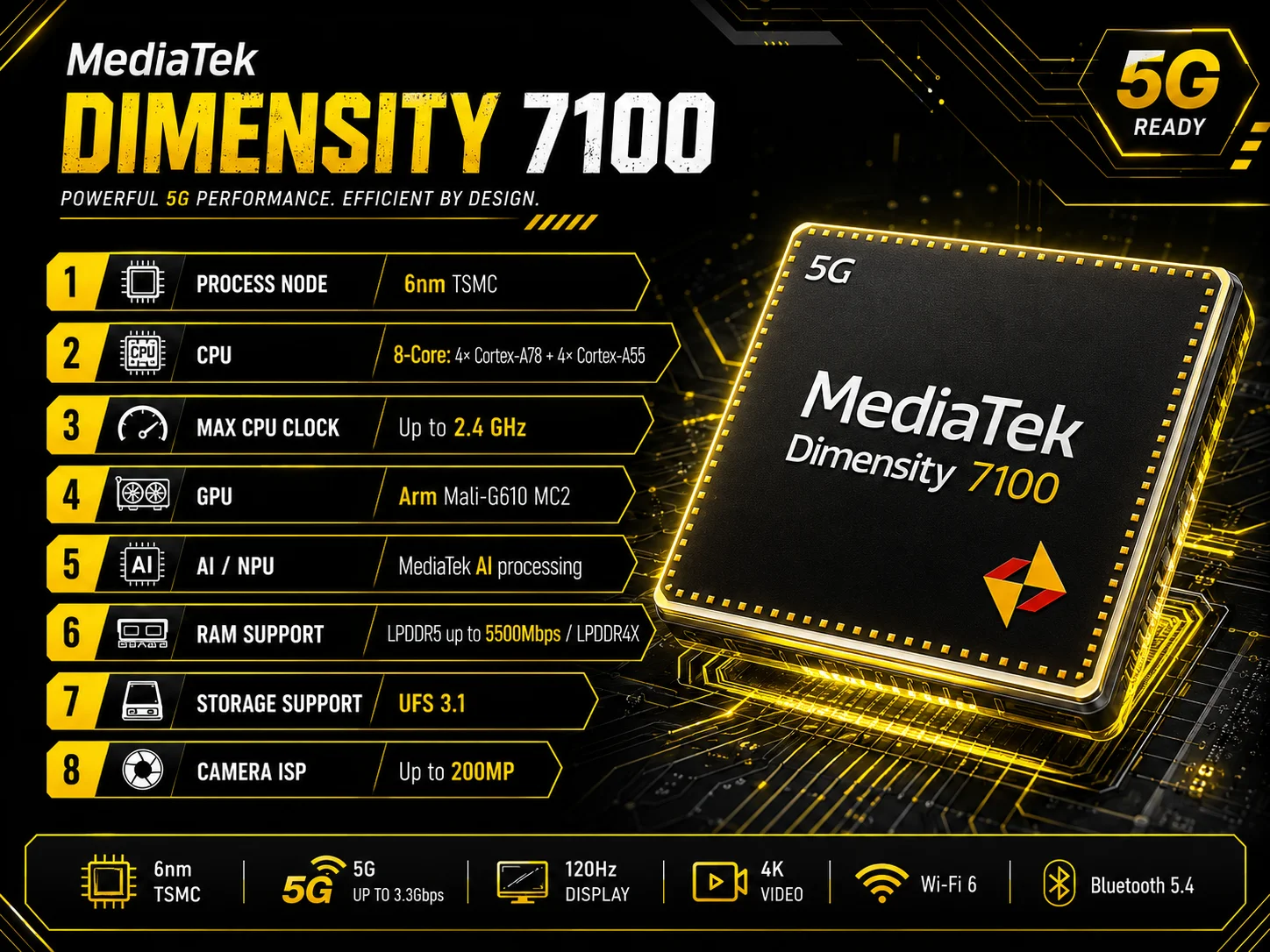
The MediaTek Dimensity 7100 is a mid‑range 5G chipset built on a 6nm process, using 4× Cortex‑A78 cores up to 2.4GHz and 4× Cortex‑A55 cores up to 2GHz, paired with a Mali‑G610 MP2 GPU. With LPDDR5 memory, UFS 3.1 storage, Wi‑Fi 6, and Bluetooth 5.3, it's built for smooth everyday performance.
Benchmark Scores
Measures CPU, GPU, RAM, and I/O performance in different scenarios.
Shows raw single-threaded CPU performance across real-world workloads. Only category scores are published for this chipset — no overall headline total.
Cross-platform benchmark assessing graphics performance in Vulkan/Metal.
Evaluates overall system performance in everyday workloads. Only category scores are published for this chipset — no overall headline total.
CPU Performance
4× Cortex‑A55 up to 2GHz
Graphics, Memory & Storage
Multimedia (Camera, Display & ISP)
Connectivity
General Info
information About MediaTek Dimensity 7100
Introduction
Comparing a brand-new budget MediaTek chip against a 2019 Samsung flagship processor raises a genuinely interesting question: does a modern mid-ranger actually beat an aging flagship? This Dimensity 7100 vs Exynos 9825 vs Dimensity 7050 comparison uses verified NanoReview specification and benchmark data to explain how these three chips perform in CPU work, gaming, camera processing, and connectivity, and where each one actually holds an edge.
1. Processor Overview
The Dimensity 7100, announced January 2026, is an 8-core chip built on TSMC’s 6nm process, pairing 4x Cortex-A78 cores at 2.4GHz with 4x Cortex-A55 efficiency cores at 2.0GHz, alongside a modest Mali-G610 MP2 GPU.
The Samsung Exynos 9825, announced August 2019 and by far the oldest chip in this comparison, is an 8-core chip on Samsung’s older 7nm process. It uses a distinctive three-tier layout: 2x custom Samsung M4 cores at 2.73GHz, 2x Cortex-A75 at 2.4GHz, and 4x Cortex-A55 at 1.95GHz, paired with a much larger 12-core Mali-G76 MP12 GPU, a leftover from its original flagship positioning in the Galaxy Note 10 series.
The Dimensity 7050, announced May 2023 and built on the same TSMC 6nm process as the Dimensity 7100, uses a lighter 2+6 layout: 2x Cortex-A78 at 2.6GHz and 6x Cortex-A55 at 2.0GHz, alongside a Mali-G68 MP4 GPU.
The core layout split matters immediately: the Dimensity 7100 uses a heavier 4+4 configuration favoring multi-core work, while the Dimensity 7050 uses a lighter 2+6 split, and the Exynos 9825 uses a unique three-tier design built around Samsung’s now-discontinued custom CPU cores.
2. CPU Architecture & Processing Power
All three chips use the same ARMv8.2-A instruction set, though the Exynos 9825 mixes custom Samsung M4 cores with licensed ARM cores, while both Dimensity chips use standard Cortex-A78/A55 designs.
In Geekbench 6 single-core, the Exynos 9825 actually leads with 1035, ahead of the Dimensity 7100 (995, about 3.9% lower). The Dimensity 7050 leads all three at 1061, about 6.2% higher than the Dimensity 7100 and 2.5% higher than the Exynos 9825, thanks to its higher 2.6GHz peak clock despite having fewer performance cores.
Multi-core clearly favors the Dimensity 7100’s 4+4 layout: it leads with 2925, about 15.7% higher than the Exynos 9825 (2528) and 22.0% higher than the Dimensity 7050 (2398). Despite its age, the Exynos 9825 still outperforms the newer Dimensity 7050 in multi-core, a reminder that core count and layout matter more than release year in sustained multi-threaded work.
3. GPU & Gaming Performance
This is where the age gap flips dramatically in the older chip’s favor. The Exynos 9825’s Mali-G76 MP12 has 12 pipelines, more than double either Dimensity chip’s GPU, and posts the highest theoretical FLOPS rating at 434.3 Gigaflops, ahead of the Dimensity 7050 (243.2 Gigaflops) and Dimensity 7100 (256 Gigaflops).
Geekbench 6 GPU Compute confirms this is not just a paper advantage: the Exynos 9825 scores 5214, more than double the Dimensity 7100 (2401) and Dimensity 7050 (2392), which are themselves virtually tied with each other (about a 0.4% difference). In 3DMark Steel Nomad Light, the Exynos 9825 again leads clearly at 393, about 29.3% higher than the Dimensity 7100 (278) and 68.7% higher than the Dimensity 7050 (233).
For gaming, the six-year-old Exynos 9825’s larger GPU configuration gives it a real, measurable advantage over both newer MediaTek chips in every comparable graphics benchmark. No exact frame-rate data beyond these benchmark figures is supplied, so specific in-game FPS claims cannot be made, though NanoReview’s own Gaming Performance sub-score also favors the Exynos 9825 (15) over the Dimensity 7100 (11) and Dimensity 7050 (10).
4. Manufacturing Process & Efficiency
The two Dimensity chips share the newer TSMC 6nm process, while the Exynos 9825 uses an older Samsung 7nm node. TDP is only disclosed for the Dimensity 7050, at 4W; no TDP figure is supplied for the Dimensity 7100 or Exynos 9825.
NanoReview’s battery-life sub-scores clearly favor the newer chips: the Dimensity 7100 and Dimensity 7050 both score 87, while the Exynos 9825 scores notably lower at 80. This is consistent with the older 7nm process and the power demands of the Exynos 9825’s larger 12-core GPU, and suggests that despite its graphics advantage, the Exynos 9825 likely draws more power to achieve it.
5. RAM, Memory & Storage Support
The two Dimensity chips both use LPDDR5 memory, with the Dimensity 7050 running at a higher frequency (3200MHz versus 2750MHz) and correspondingly higher bandwidth (25.6Gb/s versus 22Gb/s) than the Dimensity 7100. Both support up to 16GB RAM. The Exynos 9825 uses the older LPDDR4X standard at 2133MHz, with lower bandwidth (33.4Gb/s, still higher than the Dimensity 7100 despite the older standard) and a lower maximum of 12GB.
Storage support favors the Dimensity 7050, which supports the widest range: UFS 2.1, 2.2, 3.0, and 3.1. The Dimensity 7100 supports UFS 3.1 only, and the Exynos 9825 supports the oldest standards, UFS 2.1 and UFS 3.0.
6. AI & NPU Capabilities
AI hardware disclosure is uneven and, surprisingly, favors the oldest chip. The Exynos 9825 is the only chip of the three with a disclosed NPU and TOPS figure, at 1.86 TOPS. The Dimensity 7050 uses a named MediaTek APU 550, but no TOPS figure is supplied. The Dimensity 7100’s specification data does not disclose any NPU information at all, leaving its AI hardware unconfirmed in the supplied data.
Because only one chip has both a confirmed NPU and a disclosed TOPS rating, no meaningful AI performance ranking can be made across all three.
7. ISP, Camera & Video Capabilities
Camera and video capability show another surprising reversal in the older chip’s favor. The Exynos 9825 supports the widest video ceiling by far: 8K at 30FPS and 4K at 120FPS, for both capture and playback. Both Dimensity chips are far more limited: the Dimensity 7050 supports 4K at 30FPS, while the Dimensity 7100 is capped at just 2K at 30FPS, the lowest of the three.
Maximum camera resolution favors the two Dimensity chips on paper, both supporting a single 200MP sensor, versus the Exynos 9825’s lower-resolution but multi-sensor configuration of 1x 32MP plus 2x 16MP. All three support H.264, H.265, and VP9 codecs.
8. Display Support
The Exynos 9825 supports the highest maximum display resolution by a wide margin, at 3840 x 2400, reflecting its original flagship positioning. Both Dimensity chips are limited to 2520 x 1080, a considerably lower ceiling that restricts phones using these chips to Full HD+ class displays.
9. Modem, 5G & Connectivity
This category clearly favors the newer chips. The Dimensity 7050 has the fastest disclosed 5G download speed at 2770 Mbps and upload at 1250 Mbps. The Exynos 9825, despite being the newest to actually list 5G support here, discloses much slower figures via its Exynos 5100 modem: 2000 Mbps download and just 316 Mbps upload, reflecting how early-generation its 5G implementation was. No 5G speed figures are disclosed for the Dimensity 7100.
Wi-Fi 6 is common to all three. Bluetooth clearly favors the newer chips: the Dimensity 7100 has the newest version at 5.3, ahead of the Dimensity 7050 (5.2) and the Exynos 9825’s much older 5.0. GNSS support is also broadest on the two Dimensity chips, both including NAVIC alongside GPS, GLONASS, Beidou, Galileo, and QZSS; the Exynos 9825’s supplied list omits QZSS and NAVIC entirely. These are theoretical maximums; real-world network speeds depend on carrier infrastructure and will not always reach these ceilings.
10. Benchmark Comparison
All benchmark figures below use AnTuTu 11 and Geekbench 6, so comparisons are apples-to-apples.
AnTuTu 11 Total:
- Dimensity 7050: 806,012
- Samsung Exynos 9825: 794,839 (Dimensity 7100 trails the Dimensity 7050 by about 2.6%, and trails the Exynos 9825 by about 1.2%)
- MediaTek Dimensity 7100: 785,352 (the lowest AnTuTu total of the three)
Geekbench 6 Single-Core: Dimensity 7050 leads with 1061, ahead of the Exynos 9825 (1035, about 2.5% lower) and Dimensity 7100 (995, about 6.2% lower than the Dimensity 7050).
Geekbench 6 Multi-Core: Dimensity 7100 leads clearly at 2925, ahead of the Exynos 9825 (2528, about 15.7% lower) and Dimensity 7050 (2398, about 22.0% lower).
Geekbench 6 GPU Compute: Exynos 9825 leads by a wide margin at 5214, more than double the Dimensity 7100 (2401) and Dimensity 7050 (2392), which are essentially tied.
3DMark Steel Nomad Light: Exynos 9825 leads clearly (393), ahead of the Dimensity 7100 (278, about 29.3% lower) and Dimensity 7050 (233, about 40.7% lower than the Exynos 9825).
PCMark 3.0 (everyday workloads): Dimensity 7100 leads (12,106), ahead of the Dimensity 7050 (11,853, about 2.1% lower) and Exynos 9825 (9,254, about 30.8% lower than the Dimensity 7100).
The overall picture is genuinely split: the Dimensity 7050 leads the composite AnTuTu score and single-core speed, the Dimensity 7100 leads multi-core and PCMark, and the Exynos 9825, despite being six years older, dominates GPU Compute and 3DMark by wide margins.
11. Real-World Performance
Everyday users browsing and messaging should see similar single-core responsiveness across all three, with the Dimensity 7050 having a modest edge.
Multitaskers benefit most from the Dimensity 7100’s 4+4 core layout, which posts the highest multi-core score of the three by a clear margin.
Gamers face a genuine surprise here: the Exynos 9825’s larger GPU gives it a real, measurable advantage in both Geekbench GPU Compute and 3DMark over both newer MediaTek chips, though its higher power draw (reflected in its lower battery-life score) is a real trade-off.
Content creators get by far the best video ceiling from the Exynos 9825, with 8K/30FPS and 4K/120FPS support versus the Dimensity 7050’s 4K/30FPS and the Dimensity 7100’s 2K/30FPS limit.
Camera users benefit from the Dimensity chips’ higher-resolution single-sensor support (200MP) versus the Exynos 9825’s lower-resolution multi-sensor setup.
AI users get the only confirmed and quantified NPU from the Exynos 9825 (1.86 TOPS); no TOPS is disclosed for either Dimensity chip, and the Dimensity 7100 has no NPU information disclosed at all.
Connectivity-focused users should clearly favor the Dimensity 7050, with the fastest disclosed 5G speeds and the widest storage support of the three.
12. Strengths & Weaknesses
MediaTek Dimensity 7100
- Strengths: Highest Geekbench multi-core score; highest PCMark score; newest Bluetooth version (5.3); widest GNSS support tied with the Dimensity 7050.
- Weaknesses: Lowest AnTuTu 11 total score of the three; lowest video ceiling (2K/30FPS only); no disclosed NPU information at all; no disclosed 5G speed figures.
Samsung Exynos 9825
- Strengths: Leads GPU Compute and 3DMark by wide margins; highest max display resolution (3840×2400); widest video ceiling (8K/30FPS, 4K/120FPS); only chip with a disclosed NPU TOPS figure (1.86); highest NanoReview composite score (37).
- Weaknesses: Lowest NanoReview battery-life sub-score (80); slowest disclosed 5G speeds (2000/316 Mbps); oldest Bluetooth version (5.0); lowest max RAM support (12GB); oldest manufacturing process (7nm).
MediaTek Dimensity 7050
- Strengths: Highest AnTuTu 11 total score; highest Geekbench single-core score; fastest disclosed 5G speeds (2770/1250 Mbps); widest storage support (UFS 2.1 through 3.1); lowest disclosed TDP (4W).
- Weaknesses: Lowest Geekbench multi-core score of the three; trails the Exynos 9825 by roughly 41% in Geekbench GPU Compute; limited to a 2520×1080 max display resolution.
13. Best Processor For Different Users
- Best for Gaming: Samsung Exynos 9825
- Best for AI: Samsung Exynos 9825 (only chip with disclosed TOPS)
- Best for Efficiency: MediaTek Dimensity 7050 (only disclosed TDP, tied battery-life score)
- Best for Camera Processing: MediaTek chips for resolution, Samsung Exynos 9825 for video capability
- Best for Connectivity: MediaTek Dimensity 7050
- Best for Balanced Performance: MediaTek Dimensity 7050
Final Verdict
This Dimensity 7100 vs Exynos 9825 vs Dimensity 7050 comparison produces a genuinely split result, and the supplied data does not support automatically favoring the Primary Processor, the Dimensity 7100, which posts the lowest AnTuTu total score of the three despite being the newest chip by announcement date.
Final Verdict
1. MediaTek Dimensity 7050 — Best Overall It leads the composite AnTuTu 11 score and Geekbench single-core, and has the fastest disclosed 5G connectivity and widest storage support, giving it the strongest balance of everyday performance and modern features, even though it clearly loses the GPU-focused benchmarks to the Exynos 9825.
2. Samsung Exynos 9825 — Best For Gaming and Video Despite being six years old, it dominates GPU Compute and 3DMark by wide margins and offers by far the best video recording and display specifications, at the cost of the lowest battery-life score, slowest 5G speeds, and oldest connectivity standards of the three.
3. MediaTek Dimensity 7100 — Best For Multitasking It posts the highest Geekbench multi-core and PCMark scores, reflecting genuine strength in sustained everyday workloads, but its low AnTuTu total, weak video ceiling, and lack of disclosed NPU or 5G speed data leave it behind both rivals overall.
Best for Gaming: Samsung Exynos 9825 Best for AI: Samsung Exynos 9825 Best for Efficiency: MediaTek Dimensity 7050 Best Balanced Choice: MediaTek Dimensity 7050
Bottom Line: This comparison is a useful reminder that release date alone does not determine chip performance. The Dimensity 7050 is the strongest all-round pick thanks to its AnTuTu lead, fast connectivity, and low power draw, but the aging Exynos 9825 remains genuinely superior for GPU-heavy gaming and video work, a full six years after its original launch. The Dimensity 7100, despite being the newest chip here, trails both rivals in overall AnTuTu score and offers the weakest video and AI specifications of the three, making it the least compelling choice unless its specific multi-core and PCMark strengths are the priority.
Images Of MediaTek Dimensity 7100
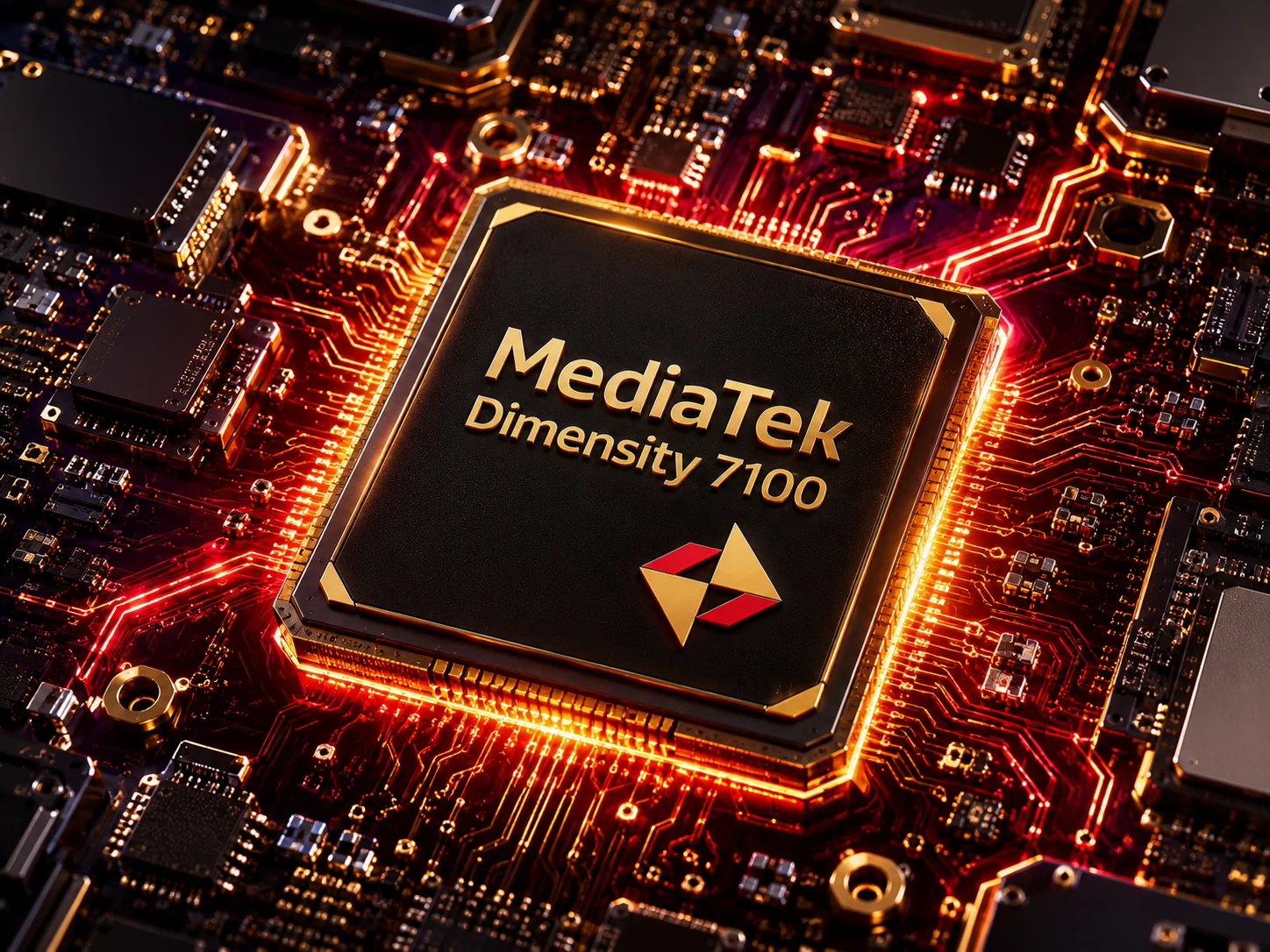
Trailer Of MediaTek Dimensity 7100

Author & Post Info
Faisal Ur Rehman
Faisal Rehman is the founder and editor of FSL Specs, where he publishes in-depth smartphone specifications, comparisons, buying guides, and technology insights. With extensive experience in mobile hardware research and technical analysis, he provides accurate and up-to-date information on Android smartphones, processors, displays, cameras, batteries, performance benchmarks, and software features. His goal is to simplify complex specifications and help readers choose the right device with confidence.
Explore FSL Specs
Questions About MediaTek Dimensity 7100
What is the MediaTek Dimensity 7100?
The MediaTek Dimensity 7100 is a 6nm 5G smartphone chipset designed for mid-range devices. It offers a balance of everyday performance, gaming, camera processing, and power efficiency.
How powerful is the Dimensity 7100?
It features an 8-core CPU with 4× Cortex-A78 performance cores and 4× Cortex-A55 efficiency cores, reaching up to 2.4GHz. This setup handles multitasking, social apps, streaming, and daily workloads comfortably.
Is Dimensity 7100 good for gaming?
Yes, its Arm Mali-G610 MC2 GPU provides solid graphics performance for mid-range gaming. Popular titles can run smoothly with suitable graphics settings, although it is below flagship-level chipsets.
Does Dimensity 7100 support 5G?
Yes, the Dimensity 7100 features an integrated 5G modem with theoretical download speeds of up to 3.3Gbps. It is suitable for 5G smartphones across markets such as Pakistan, India, and other Asian regions.
What RAM and storage does Dimensity 7100 support?
The chipset supports LPDDR5 memory up to 5500Mbps as well as LPDDR4X. For storage, it supports UFS 3.1, helping smartphones deliver faster app loading and file-transfer performance.
What camera does Dimensity 7100 support?
The Dimensity 7100 supports cameras of up to 200MP and provides advanced hardware-based imaging and AI processing. Actual photo quality depends on the camera sensor, software, and tuning used by the smartphone manufacturer.
What video recording does Dimensity 7100 support?
The Dimensity 7100 supports 4K video recording at up to 30fps, with hardware-accelerated video processing. Available resolutions and frame rates can vary depending on the specific smartphone implementation.