
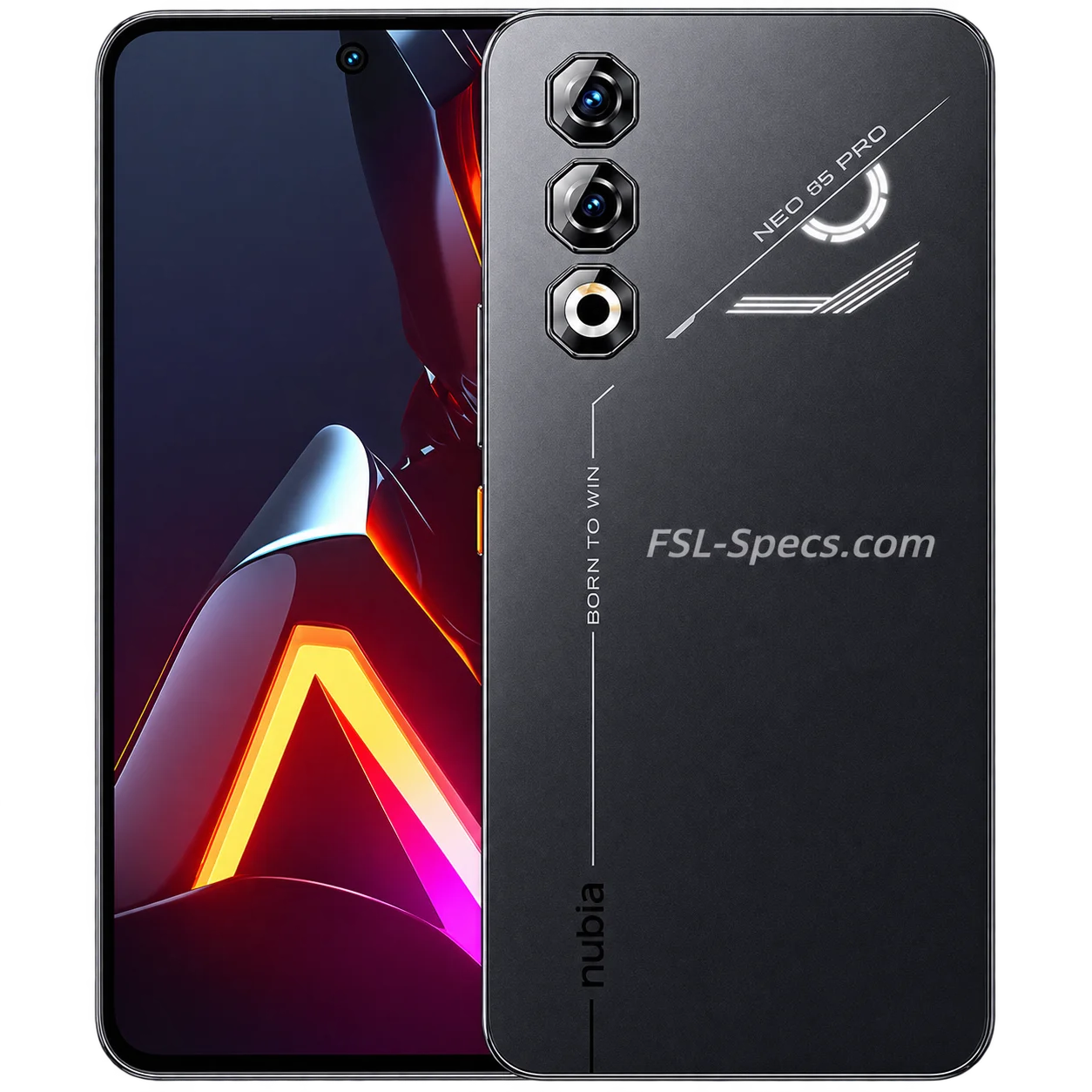




✪ ZTE Nubia Neo 5 Pro ✪

ZTE Nubia Neo 5 Pro
Last Time Update : 1 November, 2026
Pakistan flagPakistan (PKR)
120000PKR

✪ ZTE Nubia Neo 5 Pro ✪

ZTE Nubia Neo 5 Pro
Quick Specs
Display
6.8 inchAMOLED120 Hz
Processor
Unisoc T91002.7 GHz
RAM & Storage
12 + 256 GB
Rear Camera
50 MP
Front Camera
16 MP
Battery & Charging
6000 mAh80 W

Full Specification

!
IMPORTANT INFORMATION

Specifications Disclaimer

NOTICE

Specifications are collected from official manufacturers and trusted sources. Actual details may vary by region, model variant, or software updates. We strive for accuracy but cannot guarantee error-free information.

Basic Info

Mobile
ZTE Nubia Neo 5 Pro
Series
Nubia Neo
Category
Mid Range
Release Date
1 April,2026
Year
2026

Connectivity

SIM
Nano-SIM / E-Sim
Network
4G / 4G+ / 5G
WiFi
Wi-Fi 5
Bluetooth
5.4
NFC
Yes / region dependent
OS
Android 16

Body

Dimensions
166.1 x 78.8 x 8.5 mm
Build
Plastic ( Frame And Back)
Weight
210 g
Screen Size
6.8 inch
Resolution
1080 x 2392 pixels
Type
AMOLED
Refresh Rate
120 Hz
HBM Brightness
1000 nits
Processor Specs
Processor
Unisoc T9100
Processor Link
Max Clock
2.7 GHz
Lithography
6 nm
GPU
Mali-G57
CPU Cores
8 Cores
Antutu v11
695 K
Architecture
1 x 2.7 GHz Cortex-A76
3 x 2.3 GHz Cortex-A76
4 x 2.1 GHz Cortex-A55
RAM & ROM Specs
RAM Memory
12 + 256 GB
RAM Type
LPDDR4X
Storage Type
UFS 3.1
SD Card
No
Variants
12 + 256 GB 
8 + 256 GB 
Camera Specs
MP
Rear Camera
50 MP
Front Camera
16 MP
Recording FPS
Main Recording
4k @ 30 FPS
1080 @ 30 FPS
Front Recording
1080p @ 30/60 FPS
Flash
Flash
Flash
Battery Specs
Capacity
6000 mAh
Fast Charging
80 W
Battery Type
Li-Po
Reverse
Reverse Wired
Yes
Other Specs
Audio & Sensors
IP Rating
ip 64
Speaker
Dual Stereo Speaker
Fingerprint Sensor
Front Finger
Special Features

Pressure sensitive zones (550Hz touch-sensing)
RGB light (on the back)

BASIC INFO
Mobile
ZTE Nubia Neo 5 Pro
Series
Nubia Neo
Category
Mid Range
Release Date
1 April,2026
Year
2026
CONNECTIVITY
Sim
Nano-SIM / E-Sim
Network
4G / 4G+ / 5G
WiFi
Wi-Fi 5
Bluetooth
5.4
NFC
Yes / region dependent
OS
Android 16
BODY
Dimensions
166.1 x 78.8 x 8.5 mm
Build
Plastic ( Frame And Back)
Weight
210 g
Screen Size
6.8 inch
Resolution
1080 x 2392 pixels
Type
AMOLED
Refresh Rate
120 Hz
HBM Brightness
1000 nits
Processor
Unisoc T9100
Processor Link
Max Clock
2.7 GHz
Lithography
6 nm
GPU
Mali-G57
CPU Cores
8 Cores
Antutu v11
695 K
Architecture
1 x 2.7 GHz Cortex-A76
3 x 2.3 GHz Cortex-A76
4 x 2.1 GHz Cortex-A55
Ram Memory
12 + 256 GB
SD Card
No
Ram Type
LPDDR4X
Storage Type
UFS 3.1
Variants
12 + 256 GB 
8 + 256 GB 
MP
Rear Camera
50 MP
Front Camera
16 MP
RECORDING FPS
Main Recording
4k @ 30 FPS
1080 @ 30 FPS
Front Recording
1080p @ 30/60 FPS
RESOLUTION
Main Resolution
8150 x 6150 pixels
FLASH
Flash
Flash
Capacity
6000 mAh
Fast Charging
80 W
Battery Type
Li-Po
REVERSE
Reverse Wired
Yes
PROTECTION
IP Rating
ip 64
AUDIO & SENSORS
Speaker
Dual Stereo Speaker
Fingerprint Sensor
Front Finger
Special Features

Pressure sensitive zones (550Hz touch-sensing) RGB light (on the back)

Verify Mobile Specifications

Official information & trusted references

Official Manufacturer WebsiteExplore the original product information (opens in a new tab)

Trusted Specification Sources

Cross-reference · 4 sources

Links open third-party websites. The Purple ticks are a design marker only; they do not mean a source has verified these specifications or endorses FSL-Specs.

Last Time Update : 1 November, 2026

Highlights & Review Of ZTE Nubia Neo 5 Pro

Display Highlights

The ZTE Nubia Neo 5 Pro has a 6.8-inch AMOLED display at 1080 x 2392 pixels (about 386 PPI) with a 120 Hz refresh rate and 1000 nits HBM brightness. That is the lowest resolution and the lowest HBM brightness of the four phones. The Infinix Note 60 Pro costs the same PKR 120,000 and offers a 6.78-inch AMOLED at 1208 x 2644 (about 429 PPI), 144 Hz and 1600 nits HBM.

All four phones use AMOLED, so panel type does not separate them. The differences are sharpness and brightness. The Poco M8 Pro 5G (1280 x 2772, about 447 PPI) and the Vivo V70 FE (1260 x 2800, about 450 PPI) both have 6.83-inch screens and sit roughly 60 PPI above the Nubia Neo 5 Pro, a gap that shows up in fine text and icons.

HBM is the only brightness figure all four phones list, so it is the fair basis for comparison. The Vivo V70 FE leads at 1900 nits, followed by the Poco M8 Pro 5G at 1800 nits, the Infinix Note 60 Pro at 1600 nits and the Nubia Neo 5 Pro at 1000 nits. Peak brightness is listed only for the Infinix Note 60 Pro (4500 nits) and the Poco M8 Pro 5G (3200 nits). The Nubia Neo 5 Pro and Vivo V70 FE have no peak figure, and peak and HBM are different measurements.

The Infinix Note 60 Pro is the only phone with a 144 Hz refresh rate, while the other three run at 120 Hz. The Nubia Neo 5 Pro does have one feature the others do not list, pressure-sensitive zones with 550 Hz touch sensing.

PhoneSizeResolutionPanelRefresh RateBrightness (as listed)
ZTE Nubia Neo 5 Pro6.8-inch1080 x 2392AMOLED120 Hz1000 nits HBM
Infinix Note 60 Pro6.78-inch1208 x 2644AMOLED144 Hz4500 nits peak, 1600 nits HBM
Poco M8 Pro 5G6.83-inch1280 x 2772AMOLED120 Hz3200 nits peak, 1800 nits HBM
Vivo V70 FE6.83-inch1260 x 2800AMOLED120 Hz1900 nits HBM

Verdict: The Infinix Note 60 Pro is the best display value here, with 144 Hz, 1600 nits HBM and a sharper panel than the Nubia Neo 5 Pro at the same PKR 120,000. The Vivo V70 FE has the sharpest screen and the highest HBM at PKR 122,000. The Nubia Neo 5 Pro has the weakest display of the four, and only its touch-zone feature offsets that.


Performance Highlights

The ZTE Nubia Neo 5 Pro scores 695K AnTuTu (v11) on its Unisoc T9100, the lowest of the four phones. The Poco M8 Pro 5G leads at 1.04M AnTuTu (v11) and the Infinix Note 60 Pro scores 1M. The Vivo V70 FE posts 990K on its Dimensity 7360 Turbo. All four phones have a v11 score, so v11 is the fair basis for this comparison.

The Nubia Neo 5 Pro trails the Poco M8 Pro 5G by 345K points, or about 50%, and trails the Infinix Note 60 Pro by 305K and the Vivo V70 FE by 295K. The Infinix Note 60 Pro lists a rounded 1M score, so its exact gap to the Poco M8 Pro 5G is not confirmed. The three phones above the Nubia sit within 50K of each other.

The Infinix Note 60 Pro and Poco M8 Pro 5G use the same Snapdragon 7s Gen 4 on 4 nm, with one 2.7 GHz Cortex-A720 core, three 2.4 GHz Cortex-A720 cores and an Adreno 810 GPU. The Vivo V70 FE uses 4 x 2.5 GHz Cortex-A78 and 4 x 2.0 GHz Cortex-A55 cores with a Mali-G615 MC2 GPU, also on 4 nm.

The Nubia Neo 5 Pro is built on 6 nm with a Mali-G57 GPU and Cortex-A76 performance cores (1 x 2.7 GHz and 3 x 2.3 GHz), an older design than the other three. The Nubia’s listing does not give a GPU core count.

Prices are retailer quotes from 1 November 2026. The Nubia Neo 5 Pro and Infinix Note 60 Pro both cost PKR 120,000, so the Infinix delivers 305K more points at the same price. The Vivo V70 FE costs PKR 122,000 and the Poco M8 Pro 5G costs PKR 130,000, all new.

PhoneProcessorProcessGPUCPU CoresAnTuTu v11
ZTE Nubia Neo 5 ProUnisoc T91006 nmMali-G571x 2.7 GHz A76 + 3x 2.3 GHz A76 + 4x 2.1 GHz A55695K
Infinix Note 60 ProSnapdragon 7s Gen 44 nmAdreno 8101x 2.7 GHz A720 + 3x 2.4 GHz A720 + 4x 1.8 GHz A5201M
Poco M8 Pro 5GSnapdragon 7s Gen 44 nmAdreno 8101x 2.7 GHz A720 + 3x 2.4 GHz A720 + 4x 1.8 GHz A5201.04M
Vivo V70 FEDimensity 7360 Turbo4 nmMali-G615 MC24x 2.5 GHz A78 + 4x 2.0 GHz A55990K

Verdict: The Infinix Note 60 Pro is the best performance value here at 1M AnTuTu (v11) and PKR 120,000, while the Poco M8 Pro 5G is the fastest at 1.04M for PKR 10,000 more. The ZTE Nubia Neo 5 Pro costs the same as the Infinix but scores 305K lower on an older 6 nm chip, which makes it the weakest performer of the four.

Memory & Storage Highlights

The ZTE Nubia Neo 5 Pro (12 + 256 GB) has 12 GB LPDDR4X RAM and 256 GB UFS 3.1 storage, with no microSD slot. It is the only phone here with 12 GB of RAM, which is 4 GB more than the other three phones’ 8 GB.

The Vivo V70 FE (8 + 256 GB) uses 8 GB LPDDR5 with UFS 3.1, so it matches the Nubia on storage standard and has a newer RAM type. The Infinix Note 60 Pro (8 + 256 GB) has the fastest RAM type, LPDDR5X, but its storage is UFS 2.2. The Poco M8 Pro 5G (8 + 256 GB) has LPDDR4X and UFS 2.2, the oldest combination of the four.

RAM capacity and RAM type pull in different directions here. The Nubia Neo 5 Pro has the most RAM but the older LPDDR4X type, while the Infinix Note 60 Pro and Vivo V70 FE have newer RAM with less of it. The extra 4 GB gives the Nubia more room to keep apps open, though its 695K AnTuTu (v11) processor limits how much heavy use will benefit.

Storage type affects app installs, game loading and large file copies. The Nubia Neo 5 Pro and Vivo V70 FE use UFS 3.1, while the Infinix Note 60 Pro and Poco M8 Pro 5G use UFS 2.2.

Expandability is the other differentiator. The Nubia Neo 5 Pro, Vivo V70 FE and Poco M8 Pro 5G all list no microSD support, and the Infinix Note 60 Pro lists it as not confirmed. Buyers should treat 256 GB as the fixed ceiling on all four phones. Only the 12 + 256 GB Nubia and 8 + 256 GB variants of the rivals are compared here.

PhoneVariantRAMRAM TypeStorage TypemicroSD
ZTE Nubia Neo 5 Pro12 + 256 GB12 GBLPDDR4XUFS 3.1No
Infinix Note 60 Pro8 + 256 GB8 GBLPDDR5XUFS 2.2–
Poco M8 Pro 5G8 + 256 GB8 GBLPDDR4XUFS 2.2No
Vivo V70 FE8 + 256 GB8 GBLPDDR5UFS 3.1No

Verdict: The ZTE Nubia Neo 5 Pro has the best memory package for the money, with 12 GB RAM and UFS 3.1 at PKR 120,000. The Vivo V70 FE is the best choice for faster memory technology, since it pairs LPDDR5 with UFS 3.1 for PKR 2,000 more. The Poco M8 Pro 5G is the weakest memory value at PKR 130,000, with 8 GB LPDDR4X and UFS 2.2.

Camera Highlights

The Vivo V70 FE has the highest-resolution rear camera here, a 200 MP Samsung ISOCELL HP5 main sensor with an 8 MP secondary, against the 50 MP main cameras on the ZTE Nubia Neo 5 Pro, Infinix Note 60 Pro and Poco M8 Pro 5G. The Nubia Neo 5 Pro is the only phone with a single rear camera, and it does not name its sensor. The Poco M8 Pro 5G is the only phone naming both rear sensors (OmniVision OVX8000 and OV08F) and its front sensor (OmniVision OV32D). Sensor brand and stabilization matter more than megapixel count here, and optical stabilization is listed only on the Poco M8 Pro 5G. The Infinix Note 60 Pro lists digital stabilization, and the Nubia Neo 5 Pro and Vivo V70 FE list none.

Front cameras vary more than the rear ones. The Vivo V70 FE and Poco M8 Pro 5G both have 32 MP selfie cameras, while the Infinix Note 60 Pro has 13 MP (GalaxyCore GC13AO) and the Nubia Neo 5 Pro has 16 MP. The Vivo V70 FE listing also gives a 50 MP front camera for India, so its selfie resolution depends on region, and its front sensor is not confirmed.

Rear video is 4K 30 fps on all four phones. The Infinix Note 60 Pro adds 1080p 120 fps and the Poco M8 Pro 5G adds 720p 240 fps. The Nubia Neo 5 Pro lists only 1080p 30 fps beyond 4K, the narrowest range. The Vivo V70 FE has the longest digital zoom at 30x, and none of the four lists an optical zoom.

Prices are retailer quotes from 1 November 2026, all new.

PhoneRear CameraFront CameraNamed SensorsStabilizationRear Video
ZTE Nubia Neo 5 Pro50 MP16 MP––4K 30 fps, 1080p 30 fps
Infinix Note 60 Pro50 + 8 MP13 MPFront: GC13AODigital4K 30 fps, 1080p 30/60/120 fps
Poco M8 Pro 5G50 + 8 MP32 MPOVX8000, OV08F, OV32DOptical4K 30 fps, HD 30/60 fps, 720p 240 fps
Vivo V70 FE200 + 8 MP32 MP (50 MP India)Rear: ISOCELL HP5 (200 MP)–4K 30 fps, 1080p 30/60 fps

Verdict: The Poco M8 Pro 5G has the most reliable camera hardware here, with optical stabilization and named sensors on both cameras, at PKR 130,000. The Vivo V70 FE offers the best rear resolution and a 32 MP front camera for PKR 122,000. The ZTE Nubia Neo 5 Pro has the weakest camera setup of the four at PKR 120,000, with one undisclosed 50 MP sensor and a 16 MP front camera.

Battery & Charging Highlights

The ZTE Nubia Neo 5 Pro has a 6000 mAh Li-Po battery with 80W wired charging, the smallest capacity of the four phones. The Vivo V70 FE leads on capacity with 7000 mAh, which is 1000 mAh or about 17% more than the Nubia. The Infinix Note 60 Pro and Poco M8 Pro 5G both carry 6500 mAh. The Nubia Neo 5 Pro lists no wireless charging, and its reverse wired charging is listed as “Yes” without a wattage.

Wired speeds are closer together. The Poco M8 Pro 5G is the fastest at 100W, while the Infinix Note 60 Pro and Vivo V70 FE both charge at 90W. The Nubia Neo 5 Pro trails the Poco by 20W. Cell chemistry also differs. The Vivo V70 FE and Poco M8 Pro 5G use silicon-carbon batteries, which is how they fit higher capacity into a similar body size, while the Nubia and Infinix use Li-Po.

Extra charging features separate the Infinix Note 60 Pro from the rest. It is the only phone with wireless charging, at 30W, and it also lists 7.5W reverse wired and 5W reverse wireless charging. The Poco M8 Pro 5G offers the strongest reverse wired output at 22.5W. The Vivo V70 FE lists no wireless charging or reverse wireless, and its reverse wired charging is not confirmed.

PhoneCapacityWired ChargingWireless ChargingReverse WiredReverse WirelessBattery Type
ZTE Nubia Neo 5 Pro6000 mAh80W–Yes–Li-Po
Infinix Note 60 Pro6500 mAh90W30W7.5W5WLi-Po
Poco M8 Pro 5G6500 mAh100W–22.5W–Silicon-Carbon
Vivo V70 FE7000 mAh90WNoNot confirmedNoSilicon-Carbon

Verdict: The Vivo V70 FE has the best battery for endurance, with 7000 mAh and about 16 hours of PCMark life for PKR 122,000. The Infinix Note 60 Pro offers the most complete charging package, with 90W wired and 30W wireless at PKR 120,000. The ZTE Nubia Neo 5 Pro has the smallest battery and the lowest wired speed at the same price, which makes it the weakest battery choice of the four.

Final Verdict

The Vivo V70 FE is the overall winner in this comparison. It has the sharpest display (1260 x 2800, about 450 PPI) with the highest HBM brightness at 1900 nits, the largest battery at 7000 mAh with 90W charging, UFS 3.1 storage and the highest-resolution rear sensor, a 200 MP Samsung ISOCELL HP5, for PKR 122,000. Its 990K AnTuTu (v11) score trails the Poco M8 Pro 5G and Infinix Note 60 Pro by only 10K to 50K, a gap that is hard to notice in daily use.

The Infinix Note 60 Pro takes second place at PKR 120,000, with 1M AnTuTu (v11), the only 144 Hz panel, 30W wireless charging and LPDDR5X RAM. The Poco M8 Pro 5G is third. It has the best camera hardware, with optical stabilization and named sensors on every camera, plus the fastest processor at 1.04M and 100W charging. It costs PKR 10,000 more than the Infinix for the same Snapdragon 7s Gen 4, with older LPDDR4X and UFS 2.2 memory.

The ZTE Nubia Neo 5 Pro finishes last at PKR 120,000. Its 12 GB RAM and UFS 3.1 storage are the best memory package in the group, but it has the lowest AnTuTu score at 695K (v11), the dimmest display at 1000 nits HBM, the weakest camera setup and the smallest battery at 6000 mAh.

The Infinix Note 60 Pro costs the same and beats it in all four of those areas. In this ranking, display, processor and battery carry the most weight, followed by camera and then memory. Prices are retailer quotes from 1 November 2026, all new.

Bottom line: The Vivo V70 FE is the best overall buy at PKR 122,000, the Infinix Note 60 Pro is the best choice at PKR 120,000 for 144 Hz and wireless charging, and the ZTE Nubia Neo 5 Pro is only worth considering if 12 GB RAM matters most.

Ranking:

  1. Vivo V70 FE – PKR 122,000 (new)
  2. Infinix Note 60 Pro – PKR 120,000 (new)
  3. Poco M8 Pro 5G – PKR 130,000 (new)
  4. ZTE Nubia Neo 5 Pro – PKR 120,000 (new)

Display Highlights

The ZTE Nubia Neo 5 Pro has a 6.8-inch AMOLED display at 1080 x 2392 pixels (about 386 PPI) with a 120 Hz refresh rate and 1000 nits HBM brightness. That is the lowest resolution and the lowest HBM brightness of the four phones. The Infinix Note 60 Pro costs the same PKR 120,000 and offers a 6.78-inch AMOLED at 1208 x 2644 (about 429 PPI), 144 Hz and 1600 nits HBM.

All four phones use AMOLED, so panel type does not separate them. The differences are sharpness and brightness. The Poco M8 Pro 5G (1280 x 2772, about 447 PPI) and the Vivo V70 FE (1260 x 2800, about 450 PPI) both have 6.83-inch screens and sit roughly 60 PPI above the Nubia Neo 5 Pro, a gap that shows up in fine text and icons.

HBM is the only brightness figure all four phones list, so it is the fair basis for comparison. The Vivo V70 FE leads at 1900 nits, followed by the Poco M8 Pro 5G at 1800 nits, the Infinix Note 60 Pro at 1600 nits and the Nubia Neo 5 Pro at 1000 nits. Peak brightness is listed only for the Infinix Note 60 Pro (4500 nits) and the Poco M8 Pro 5G (3200 nits). The Nubia Neo 5 Pro and Vivo V70 FE have no peak figure, and peak and HBM are different measurements.

The Infinix Note 60 Pro is the only phone with a 144 Hz refresh rate, while the other three run at 120 Hz. The Nubia Neo 5 Pro does have one feature the others do not list, pressure-sensitive zones with 550 Hz touch sensing.

PhoneSizeResolutionPanelRefresh RateBrightness (as listed)
ZTE Nubia Neo 5 Pro6.8-inch1080 x 2392AMOLED120 Hz1000 nits HBM
Infinix Note 60 Pro6.78-inch1208 x 2644AMOLED144 Hz4500 nits peak, 1600 nits HBM
Poco M8 Pro 5G6.83-inch1280 x 2772AMOLED120 Hz3200 nits peak, 1800 nits HBM
Vivo V70 FE6.83-inch1260 x 2800AMOLED120 Hz1900 nits HBM

Verdict: The Infinix Note 60 Pro is the best display value here, with 144 Hz, 1600 nits HBM and a sharper panel than the Nubia Neo 5 Pro at the same PKR 120,000. The Vivo V70 FE has the sharpest screen and the highest HBM at PKR 122,000. The Nubia Neo 5 Pro has the weakest display of the four, and only its touch-zone feature offsets that.

Performance Highlights

The ZTE Nubia Neo 5 Pro scores 695K AnTuTu (v11) on its Unisoc T9100, the lowest of the four phones. The Poco M8 Pro 5G leads at 1.04M AnTuTu (v11) and the Infinix Note 60 Pro scores 1M. The Vivo V70 FE posts 990K on its Dimensity 7360 Turbo. All four phones have a v11 score, so v11 is the fair basis for this comparison.

The Nubia Neo 5 Pro trails the Poco M8 Pro 5G by 345K points, or about 50%, and trails the Infinix Note 60 Pro by 305K and the Vivo V70 FE by 295K. The Infinix Note 60 Pro lists a rounded 1M score, so its exact gap to the Poco M8 Pro 5G is not confirmed. The three phones above the Nubia sit within 50K of each other.

The Infinix Note 60 Pro and Poco M8 Pro 5G use the same Snapdragon 7s Gen 4 on 4 nm, with one 2.7 GHz Cortex-A720 core, three 2.4 GHz Cortex-A720 cores and an Adreno 810 GPU. The Vivo V70 FE uses 4 x 2.5 GHz Cortex-A78 and 4 x 2.0 GHz Cortex-A55 cores with a Mali-G615 MC2 GPU, also on 4 nm.

The Nubia Neo 5 Pro is built on 6 nm with a Mali-G57 GPU and Cortex-A76 performance cores (1 x 2.7 GHz and 3 x 2.3 GHz), an older design than the other three. The Nubia’s listing does not give a GPU core count.

Prices are retailer quotes from 1 November 2026. The Nubia Neo 5 Pro and Infinix Note 60 Pro both cost PKR 120,000, so the Infinix delivers 305K more points at the same price. The Vivo V70 FE costs PKR 122,000 and the Poco M8 Pro 5G costs PKR 130,000, all new.

PhoneProcessorProcessGPUCPU CoresAnTuTu v11
ZTE Nubia Neo 5 ProUnisoc T91006 nmMali-G571x 2.7 GHz A76 + 3x 2.3 GHz A76 + 4x 2.1 GHz A55695K
Infinix Note 60 ProSnapdragon 7s Gen 44 nmAdreno 8101x 2.7 GHz A720 + 3x 2.4 GHz A720 + 4x 1.8 GHz A5201M
Poco M8 Pro 5GSnapdragon 7s Gen 44 nmAdreno 8101x 2.7 GHz A720 + 3x 2.4 GHz A720 + 4x 1.8 GHz A5201.04M
Vivo V70 FEDimensity 7360 Turbo4 nmMali-G615 MC24x 2.5 GHz A78 + 4x 2.0 GHz A55990K

Verdict: The Infinix Note 60 Pro is the best performance value here at 1M AnTuTu (v11) and PKR 120,000, while the Poco M8 Pro 5G is the fastest at 1.04M for PKR 10,000 more. The ZTE Nubia Neo 5 Pro costs the same as the Infinix but scores 305K lower on an older 6 nm chip, which makes it the weakest performer of the four.

Memory & Storage Highlights

The ZTE Nubia Neo 5 Pro (12 + 256 GB) has 12 GB LPDDR4X RAM and 256 GB UFS 3.1 storage, with no microSD slot. It is the only phone here with 12 GB of RAM, which is 4 GB more than the other three phones’ 8 GB.

The Vivo V70 FE (8 + 256 GB) uses 8 GB LPDDR5 with UFS 3.1, so it matches the Nubia on storage standard and has a newer RAM type. The Infinix Note 60 Pro (8 + 256 GB) has the fastest RAM type, LPDDR5X, but its storage is UFS 2.2. The Poco M8 Pro 5G (8 + 256 GB) has LPDDR4X and UFS 2.2, the oldest combination of the four.

RAM capacity and RAM type pull in different directions here. The Nubia Neo 5 Pro has the most RAM but the older LPDDR4X type, while the Infinix Note 60 Pro and Vivo V70 FE have newer RAM with less of it. The extra 4 GB gives the Nubia more room to keep apps open, though its 695K AnTuTu (v11) processor limits how much heavy use will benefit.

Storage type affects app installs, game loading and large file copies. The Nubia Neo 5 Pro and Vivo V70 FE use UFS 3.1, while the Infinix Note 60 Pro and Poco M8 Pro 5G use UFS 2.2.

Expandability is the other differentiator. The Nubia Neo 5 Pro, Vivo V70 FE and Poco M8 Pro 5G all list no microSD support, and the Infinix Note 60 Pro lists it as not confirmed. Buyers should treat 256 GB as the fixed ceiling on all four phones. Only the 12 + 256 GB Nubia and 8 + 256 GB variants of the rivals are compared here.

PhoneVariantRAMRAM TypeStorage TypemicroSD
ZTE Nubia Neo 5 Pro12 + 256 GB12 GBLPDDR4XUFS 3.1No
Infinix Note 60 Pro8 + 256 GB8 GBLPDDR5XUFS 2.2–
Poco M8 Pro 5G8 + 256 GB8 GBLPDDR4XUFS 2.2No
Vivo V70 FE8 + 256 GB8 GBLPDDR5UFS 3.1No

Verdict: The ZTE Nubia Neo 5 Pro has the best memory package for the money, with 12 GB RAM and UFS 3.1 at PKR 120,000. The Vivo V70 FE is the best choice for faster memory technology, since it pairs LPDDR5 with UFS 3.1 for PKR 2,000 more. The Poco M8 Pro 5G is the weakest memory value at PKR 130,000, with 8 GB LPDDR4X and UFS 2.2.

Camera Highlights

The Vivo V70 FE has the highest-resolution rear camera here, a 200 MP Samsung ISOCELL HP5 main sensor with an 8 MP secondary, against the 50 MP main cameras on the ZTE Nubia Neo 5 Pro, Infinix Note 60 Pro and Poco M8 Pro 5G. The Nubia Neo 5 Pro is the only phone with a single rear camera, and it does not name its sensor. The Poco M8 Pro 5G is the only phone naming both rear sensors (OmniVision OVX8000 and OV08F) and its front sensor (OmniVision OV32D). Sensor brand and stabilization matter more than megapixel count here, and optical stabilization is listed only on the Poco M8 Pro 5G. The Infinix Note 60 Pro lists digital stabilization, and the Nubia Neo 5 Pro and Vivo V70 FE list none.

Front cameras vary more than the rear ones. The Vivo V70 FE and Poco M8 Pro 5G both have 32 MP selfie cameras, while the Infinix Note 60 Pro has 13 MP (GalaxyCore GC13AO) and the Nubia Neo 5 Pro has 16 MP. The Vivo V70 FE listing also gives a 50 MP front camera for India, so its selfie resolution depends on region, and its front sensor is not confirmed.

Rear video is 4K 30 fps on all four phones. The Infinix Note 60 Pro adds 1080p 120 fps and the Poco M8 Pro 5G adds 720p 240 fps. The Nubia Neo 5 Pro lists only 1080p 30 fps beyond 4K, the narrowest range. The Vivo V70 FE has the longest digital zoom at 30x, and none of the four lists an optical zoom.

Prices are retailer quotes from 1 November 2026, all new.

PhoneRear CameraFront CameraNamed SensorsStabilizationRear Video
ZTE Nubia Neo 5 Pro50 MP16 MP––4K 30 fps, 1080p 30 fps
Infinix Note 60 Pro50 + 8 MP13 MPFront: GC13AODigital4K 30 fps, 1080p 30/60/120 fps
Poco M8 Pro 5G50 + 8 MP32 MPOVX8000, OV08F, OV32DOptical4K 30 fps, HD 30/60 fps, 720p 240 fps
Vivo V70 FE200 + 8 MP32 MP (50 MP India)Rear: ISOCELL HP5 (200 MP)–4K 30 fps, 1080p 30/60 fps

Verdict: The Poco M8 Pro 5G has the most reliable camera hardware here, with optical stabilization and named sensors on both cameras, at PKR 130,000. The Vivo V70 FE offers the best rear resolution and a 32 MP front camera for PKR 122,000. The ZTE Nubia Neo 5 Pro has the weakest camera setup of the four at PKR 120,000, with one undisclosed 50 MP sensor and a 16 MP front camera.

Battery & Charging Highlights

The ZTE Nubia Neo 5 Pro has a 6000 mAh Li-Po battery with 80W wired charging, the smallest capacity of the four phones. The Vivo V70 FE leads on capacity with 7000 mAh, which is 1000 mAh or about 17% more than the Nubia. The Infinix Note 60 Pro and Poco M8 Pro 5G both carry 6500 mAh. The Nubia Neo 5 Pro lists no wireless charging, and its reverse wired charging is listed as “Yes” without a wattage.

Wired speeds are closer together. The Poco M8 Pro 5G is the fastest at 100W, while the Infinix Note 60 Pro and Vivo V70 FE both charge at 90W. The Nubia Neo 5 Pro trails the Poco by 20W. Cell chemistry also differs. The Vivo V70 FE and Poco M8 Pro 5G use silicon-carbon batteries, which is how they fit higher capacity into a similar body size, while the Nubia and Infinix use Li-Po.

Extra charging features separate the Infinix Note 60 Pro from the rest. It is the only phone with wireless charging, at 30W, and it also lists 7.5W reverse wired and 5W reverse wireless charging. The Poco M8 Pro 5G offers the strongest reverse wired output at 22.5W. The Vivo V70 FE lists no wireless charging or reverse wireless, and its reverse wired charging is not confirmed.

PhoneCapacityWired ChargingWireless ChargingReverse WiredReverse WirelessBattery Type
ZTE Nubia Neo 5 Pro6000 mAh80W–Yes–Li-Po
Infinix Note 60 Pro6500 mAh90W30W7.5W5WLi-Po
Poco M8 Pro 5G6500 mAh100W–22.5W–Silicon-Carbon
Vivo V70 FE7000 mAh90WNoNot confirmedNoSilicon-Carbon

Verdict: The Vivo V70 FE has the best battery for endurance, with 7000 mAh and about 16 hours of PCMark life for PKR 122,000. The Infinix Note 60 Pro offers the most complete charging package, with 90W wired and 30W wireless at PKR 120,000. The ZTE Nubia Neo 5 Pro has the smallest battery and the lowest wired speed at the same price, which makes it the weakest battery choice of the four.

Final Verdict

The Vivo V70 FE is the overall winner in this comparison. It has the sharpest display (1260 x 2800, about 450 PPI) with the highest HBM brightness at 1900 nits, the largest battery at 7000 mAh with 90W charging, UFS 3.1 storage and the highest-resolution rear sensor, a 200 MP Samsung ISOCELL HP5, for PKR 122,000. Its 990K AnTuTu (v11) score trails the Poco M8 Pro 5G and Infinix Note 60 Pro by only 10K to 50K, a gap that is hard to notice in daily use.

The Infinix Note 60 Pro takes second place at PKR 120,000, with 1M AnTuTu (v11), the only 144 Hz panel, 30W wireless charging and LPDDR5X RAM. The Poco M8 Pro 5G is third. It has the best camera hardware, with optical stabilization and named sensors on every camera, plus the fastest processor at 1.04M and 100W charging. It costs PKR 10,000 more than the Infinix for the same Snapdragon 7s Gen 4, with older LPDDR4X and UFS 2.2 memory.

The ZTE Nubia Neo 5 Pro finishes last at PKR 120,000. Its 12 GB RAM and UFS 3.1 storage are the best memory package in the group, but it has the lowest AnTuTu score at 695K (v11), the dimmest display at 1000 nits HBM, the weakest camera setup and the smallest battery at 6000 mAh.

The Infinix Note 60 Pro costs the same and beats it in all four of those areas. In this ranking, display, processor and battery carry the most weight, followed by camera and then memory. Prices are retailer quotes from 1 November 2026, all new.

Bottom line: The Vivo V70 FE is the best overall buy at PKR 122,000, the Infinix Note 60 Pro is the best choice at PKR 120,000 for 144 Hz and wireless charging, and the ZTE Nubia Neo 5 Pro is only worth considering if 12 GB RAM matters most.

Ranking:

  1. Vivo V70 FE – PKR 122,000 (new)
  2. Infinix Note 60 Pro – PKR 120,000 (new)
  3. Poco M8 Pro 5G – PKR 130,000 (new)
  4. ZTE Nubia Neo 5 Pro – PKR 120,000 (new)

Pros and Cons

Pros

  • Bright 120Hz AMOLED display
  • Capable Dimensity 7400 performance
  • Huge 6,000mAh battery
  • Very fast 80W wired charging
  • Useful gaming shoulder triggers
  • 5G, NFC, and bypass charging

Cons

  • Basic 50MP dual camera
  • No ultrawide camera
  • No telephoto zoom lens
  • No microSD expansion

Who Is It Best For?

Best For

  • Budget mobile gamers
  • FPS and MOBA players
  • Battery-focused users
  • Video streaming fans
  • Gaming-trigger users
  • Fast-charging seekers

Not Best For

  • Photography enthusiasts
  • Zoom photography fans
  • Wide-angle photography users
  • Compact-phone seekers
  • Storage expansion seekers
  • Flagship performance seekers
Video Reviews & Tests
// hands-on videos for this phone

Unboxing

What's In The Box
Unboxing

PUBG Gaming Test

FPS & Heat Test
PUBG Gaming Test

Camera Test

Photo & Video Samples
Camera Test

Related Comparisions

ZTE Series Row
Picture of Faisal Ur Rehman

Faisal Ur Rehman

Faisal Rehman is the founder and editor of FSL Specs, where he publishes in-depth smartphone specifications, comparisons, buying guides, and technology insights. With extensive experience in mobile hardware research and technical analysis, he provides accurate and up-to-date information on Android smartphones, processors, displays, cameras, batteries, performance benchmarks, and software features. His goal is to simplify complex specifications and help readers choose the right device with confidence.

FAQs Questions

It has a large 7.5-inch IPS LCD with a 1280 x 2772 pixel (1.5K) resolution and a 120 Hz refresh rate. Peak brightness is 4500 nits and HBM brightness is 1800 nits, so it should stay readable even in strong sunlight.

It is powered by the MediaTek Dimensity 7100, an octa-core chip built on a 6 nm process with a Mali-G610 MC2 GPU. The CPU uses 4 x 2.4 GHz Cortex-A78 performance cores and 4 x 2.0 GHz Cortex-A55 efficiency cores, for a maximum clock of 2.4 GHz. It scores around 780K on AnTuTu v11, which is strong for daily use and gaming at this price.

It comes in two variants: 8 GB + 256 GB and 8 GB + 512 GB. The RAM is LPDDR4X and the storage is UFS 2.2. There is no SD card slot, so storage can’t be expanded.

It has a 50 MP main rear camera (photos up to 8150 x 6150 pixels) paired with a 2 MP secondary sensor, plus a flash and a 16 MP front camera. The 2 MP lens is most likely a depth or auxiliary sensor, so the 50 MP main camera does the real work. This is a practical everyday camera rather than a standout one.

It has a very large 7100 mAh Li-Ion battery with 45W fast charging. That should easily last a full day of heavy use, and often into a second day for lighter users. The phone is heavy at 245 g, which is the cost of the big battery and screen.

  • 5G: Yes. It supports 4G, 4G+ and 5G networks, and the Dimensity 7100 is a 5G chipset.
  • NFC: Yes, but it is region dependent, so some markets may not get it.
Scroll to Top