
Dimensity 7400
The MediaTek Dimensity 7400 is a mid‑range 5G chipset using 4× Cortex‑A78 cores up to 2.6GHz and 4× Cortex‑A55 cores, paired with a Mali‑G615 MP2 GPU. With LPDDR5 memory, UFS 3.1 storage, the MediaTek APU 655 (6th‑gen NPU) for on-device AI, Wi‑Fi 6, and Bluetooth 5.4, it's built for smooth everyday performance.
Benchmark Scores
Measures CPU, GPU, RAM, and I/O performance in different scenarios.
Shows raw single-threaded CPU performance across real-world workloads. Only category scores are published for this chipset — no overall headline total.
Cross-platform benchmark assessing graphics performance in Vulkan/Metal.
Evaluates overall system performance in everyday workloads. Only category scores are published for this chipset — no overall headline total.
CPU & AI Performance
4× Cortex‑A55 up to 2GHz
Graphics, Memory & Storage
Multimedia (Camera, Display & ISP)
Connectivity
General Info
information About MediaTek Dimensity 7400
Introduction
Three MediaTek mid-range chips spanning three different eras and two different manufacturing nodes make for a genuinely revealing comparison. This Dimensity 7400 vs Dimensity 8050 vs Dimensity 7450 comparison uses verified NanoReview specification and benchmark data to explain how these three chips perform in CPU work, gaming, camera processing, and connectivity, and whether the newest naming actually means the newest performance.
1. Processor Overview
The Dimensity 7400, announced February 2025, is an 8-core chip built on TSMC’s 4nm process, pairing 4x Cortex-A78 cores at 2.6GHz with 4x Cortex-A55 efficiency cores at 2.0GHz, alongside a Mali-G615 MP2 GPU.
The Dimensity 8050, announced May 2023 and the oldest chip here despite its higher model number, uses a 1+3+4 layout on TSMC’s older 6nm process: 1x Cortex-A78 at 3.0GHz, 3x Cortex-A78 at 2.6GHz, and 4x Cortex-A55 at 2.0GHz, paired with a larger Mali-G77 MP9 GPU.
The Dimensity 7450, announced April 2026 and the newest chip in this comparison, shares an essentially identical specification sheet with the Dimensity 7400: the same 4x Cortex-A78 at 2.6GHz plus 4x Cortex-A55 at 2.0GHz layout, the same Mali-G615 MP2 GPU, and the same TDP, memory, and connectivity figures.
The GPU pipeline count is the most telling early signal here: the Dimensity 8050’s Mali-G77 MP9 has 9 pipelines, far more than either newer chip’s 2-pipeline Mali-G615 MP2, despite the 8050 using an older architecture generation and process node.
2. CPU Architecture & Processing Power
All three chips use the same ARMv8.2-A instruction set with Cortex-A78/A55 core combinations, though the Dimensity 8050 uses a 1+3+4 clock tiering rather than the flat 4+4 split used by the Dimensity 7400 and Dimensity 7450.
In Geekbench 6 single-core, the Dimensity 8050 leads with 1146, about 7.4% higher than both the Dimensity 7400 (1061) and Dimensity 7450 (1069, which are themselves nearly tied with each other). The Dimensity 8050’s higher-clocked prime core at 3.0GHz outpaces both newer chips’ flat 2.6GHz clock.
Multi-core reverses this: the Dimensity 7450 leads with 3349, ahead of the Dimensity 7400 (3185, about 4.9% lower) and, most notably, the Dimensity 8050 (2336, about 30.2% lower than the Dimensity 7450). The Dimensity 7400’s flat 4+4 layout at a consistent 2.6GHz clearly outperforms the Dimensity 8050’s tapering 1+3+4 design in sustained multi-threaded work, leading it by about 36.3%.
3. GPU & Gaming Performance
Despite its older architecture and process node, the Dimensity 8050’s Mali-G77 MP9 has a real hardware advantage in pipeline count (9 versus 2), though its lower GPU clock (886MHz versus 1300MHz) and fewer shading units bring its theoretical FLOPS rating below both newer chips: 510.3 Gigaflops versus 665.6 Gigaflops for the Dimensity 7400 and Dimensity 7450.
Geekbench 6 GPU Compute tells a very different story from the theoretical numbers: the Dimensity 8050 scores 4802, about 36.1% higher than the Dimensity 7400 (3069) and about 32.7% higher than the Dimensity 7450 (3233). The Dimensity 7450 edges out the Dimensity 7400 here by about 5.1%.
In 3DMark Steel Nomad Light, the Dimensity 8050 again leads, at 445 versus the Dimensity 7400’s 406, about 8.8% higher; no Steel Nomad Light figure is disclosed for the Dimensity 7450. The Dimensity 8050 also uniquely discloses a 3DMark Wild Life Extreme score of 1300, with no equivalent test available for either newer chip. Real-world gaming discussions around the Dimensity 8050 note it historically trails Snapdragon rivals in optimization and driver support, though its raw GPU Compute and 3DMark numbers here clearly outperform both of its own newer MediaTek siblings.
4. Manufacturing Process & Efficiency
The Dimensity 7400 and Dimensity 7450 share the newer TSMC 4nm process, while the Dimensity 8050 uses the older TSMC 6nm node. TDP is disclosed for the Dimensity 7400 and Dimensity 7450, both at 4W; no TDP figure is supplied for the Dimensity 8050.
NanoReview’s battery-life sub-scores favor the two newer chips, both at 91, versus the Dimensity 8050’s lower 87. Despite this efficiency gap, all three chips share the same overall NanoReview composite score of 40, reflecting how the Dimensity 8050’s stronger CPU and GPU benchmark results offset its lower battery-life rating in the overall scoring.
5. RAM, Memory & Storage Support
The Dimensity 7400 and Dimensity 7450 both use LPDDR5 memory at 3200MHz with 25.6Gb/s bandwidth. The Dimensity 8050 uses the older LPDDR4X standard at 2133MHz, but with a wider 4×16-bit bus that actually delivers higher bandwidth at 34.1Gb/s, despite the technically older memory generation. All three support up to 16GB RAM.
Storage support is identical across all three, with each supporting UFS 3.1 only.
6. AI & NPU Capabilities
The Dimensity 7400 and Dimensity 7450 both use a named MediaTek APU 655, while the Dimensity 8050 uses an older MediaTek APU 570. None of the three has a disclosed TOPS figure, so no numeric AI performance ranking can be made, though all three confirm dedicated NPU hardware is present.
7. ISP, Camera & Video Capabilities
Camera resolution is identical across all three, each supporting a maximum single sensor resolution of 200MP. Video capability clearly favors the Dimensity 8050, which supports 4K at 60FPS for both capture and playback, double the frame rate of the Dimensity 7400 and Dimensity 7450’s shared 4K at 30FPS limit. Codec support also favors the Dimensity 8050, which adds AV1 alongside H.264, H.265, and VP9; both newer chips support H.264, H.265, and VP9 only, notably missing AV1 despite being announced years later.
8. Display Support
All three chips support an identical maximum display resolution of 2520 x 1080, so there is no differentiation in this category.
9. Modem, 5G & Connectivity
The Dimensity 8050 has a more complete connectivity profile, disclosing both a 5G download speed of up to 4700 Mbps and an upload speed of 2500 Mbps. The Dimensity 7400 and Dimensity 7450 share a lower disclosed download figure of 3270 Mbps, with no upload speed supplied for either.
Wi-Fi 6 is common to all three. Bluetooth favors the two newer chips, both at 5.4, ahead of the Dimensity 8050’s older 5.2. GNSS support is identical across all three, including NAVIC. These are theoretical maximums; real-world network speeds depend on carrier infrastructure and will not always reach these ceilings.
10. Benchmark Comparison
All benchmark figures below use AnTuTu 11 and Geekbench 6, so comparisons are apples-to-apples.
AnTuTu 11 Total:
- Dimensity 8050: 1,029,484
- Dimensity 7450: 979,808 (Dimensity 7400 trails the Dimensity 8050 by about 7.4%, and trails the Dimensity 7450 by about 2.7%)
- Dimensity 7400: 953,150 (the lowest of the three, despite sitting between the other two by announcement date)
Geekbench 6 Single-Core: Dimensity 8050 leads with 1146, ahead of the Dimensity 7450 (1069, about 6.7% lower) and Dimensity 7400 (1061, about 7.4% lower than the Dimensity 8050).
Geekbench 6 Multi-Core: Dimensity 7450 leads with 3349, ahead of the Dimensity 7400 (3185, about 4.9% lower) and Dimensity 8050 (2336, about 30.2% lower than the Dimensity 7450).
Geekbench 6 GPU Compute: Dimensity 8050 leads by a wide margin at 4802, about 36.1% higher than the Dimensity 7400 (3069) and about 32.7% higher than the Dimensity 7450 (3233).
3DMark Steel Nomad Light: Dimensity 8050 leads (445), about 8.8% higher than the Dimensity 7400 (406); not disclosed for the Dimensity 7450.
PCMark 3.0: Dimensity 7400 leads (15,466), about 6.3% higher than the Dimensity 8050 (14,549); not disclosed for the Dimensity 7450.
The overall picture strongly favors the older Dimensity 8050 in AnTuTu total score, single-core, and GPU Compute, while the newer Dimensity 7400 and Dimensity 7450 only pull ahead in multi-core and, for the Dimensity 7400 specifically, PCMark.
11. Real-World Performance
Everyday users should notice snappier single-core responsiveness on the Dimensity 8050 despite its age, thanks to its higher-clocked prime core.
Multitaskers benefit more from the Dimensity 7450 or Dimensity 7400’s flat 4+4 layout, which clearly outperforms the Dimensity 8050 in sustained multi-threaded work.
Gamers get a real surprise from the Dimensity 8050, which leads GPU Compute by a wide margin over both newer chips and is the only one with a disclosed Wild Life Extreme score, though real-world driver optimization for a chip this old is worth keeping in mind.
Content creators benefit clearly from the Dimensity 8050’s 4K/60FPS video ceiling and AV1 codec support, both absent from the Dimensity 7400 and Dimensity 7450.
AI users cannot be meaningfully differentiated here, since none of the three chips has a disclosed NPU TOPS figure.
Connectivity-focused users get a more complete 5G profile from the Dimensity 8050, the only chip with both download and upload speeds disclosed.
Battery-conscious users should lean toward the Dimensity 7400 or Dimensity 7450, both with a meaningfully higher NanoReview battery-life score than the Dimensity 8050.
12. Strengths & Weaknesses
MediaTek Dimensity 7400
- Strengths: Highest PCMark score of the three; tied for the highest battery-life sub-score and lowest TDP (4W); newer Bluetooth version tied with the Dimensity 7450.
- Weaknesses: Lowest AnTuTu 11 total score of the three; trails the Dimensity 8050 clearly in single-core and GPU Compute; no AV1 codec support and lower video ceiling (4K/30FPS) despite being newer.
MediaTek Dimensity 8050
- Strengths: Highest AnTuTu 11 total score; leads Geekbench single-core and GPU Compute by wide margins; widest video ceiling (4K/60FPS) with AV1 codec support; most complete 5G speed disclosure (both download and upload).
- Weaknesses: Lowest Geekbench multi-core score by a wide margin; lowest NanoReview battery-life sub-score (87); no disclosed TDP; oldest Bluetooth version (5.2).
MediaTek Dimensity 7450
- Strengths: Highest Geekbench multi-core score of the three; edges out the Dimensity 7400 in AnTuTu total and GPU Compute; tied for the highest battery-life sub-score and lowest TDP.
- Weaknesses: Lowest disclosed benchmark data overall (no 3DMark or PCMark figures supplied); trails the Dimensity 8050 clearly in single-core and GPU Compute; essentially a specification-for-specification repeat of the Dimensity 7400.
13. Best Processor For Different Users
- Best for Gaming: MediaTek Dimensity 8050
- Best for AI: Not determinable from supplied data
- Best for Efficiency: MediaTek Dimensity 7400 and Dimensity 7450 (tied)
- Best for Camera Processing: MediaTek Dimensity 8050 (video capability)
- Best for Connectivity: MediaTek Dimensity 8050
- Best for Balanced Performance: MediaTek Dimensity 8050
Final Verdict
This Dimensity 7400 vs Dimensity 8050 vs Dimensity 7450 comparison is a clear example of model numbers not tracking actual performance. The Primary Processor, the Dimensity 7400, posts the lowest AnTuTu total score of the three despite sitting between the Dimensity 8050 and Dimensity 7450 chronologically, and the two-year-older Dimensity 8050 wins most of the benchmarks that matter for everyday responsiveness and gaming.
Final Verdict
1. MediaTek Dimensity 8050 — Best Overall It leads AnTuTu 11 total score, Geekbench single-core, GPU Compute, and 3DMark Steel Nomad Light, and offers the widest video ceiling and most complete 5G speed disclosure, despite being the oldest and technically lowest-specced chip on paper (6nm process, LPDDR4X memory).
2. MediaTek Dimensity 7450 — Best For Multi-Core It leads Geekbench multi-core and edges out its near-twin, the Dimensity 7400, in AnTuTu total score and GPU Compute, but lacks disclosed 3DMark and PCMark data, and trails the Dimensity 8050 clearly in single-core and GPU Compute.
3. MediaTek Dimensity 7400 — Best For PCMark It leads the everyday-workload PCMark test, but posts the lowest AnTuTu total score of the three and is essentially indistinguishable from the Dimensity 7450 on every other spec, making it the least individually compelling of the group.
Best for Gaming: MediaTek Dimensity 8050 Best for AI: Not determinable from supplied data Best for Efficiency: MediaTek Dimensity 7400 and Dimensity 7450 Best Balanced Choice: MediaTek Dimensity 8050
Bottom Line: Despite being announced nearly two years before either newer chip, the Dimensity 8050 remains the strongest performer in this comparison across AnTuTu, single-core, GPU Compute, and video capability. The Dimensity 7400 and Dimensity 7450 are close to identical on paper and in most benchmarks, offering better multi-core throughput and slightly better efficiency, but neither clearly surpasses the older Dimensity 8050 in the areas that most affect day-to-day responsiveness and gaming. Buyers should not assume the higher or newer-looking model number automatically performs better within MediaTek’s own mid-range lineup.
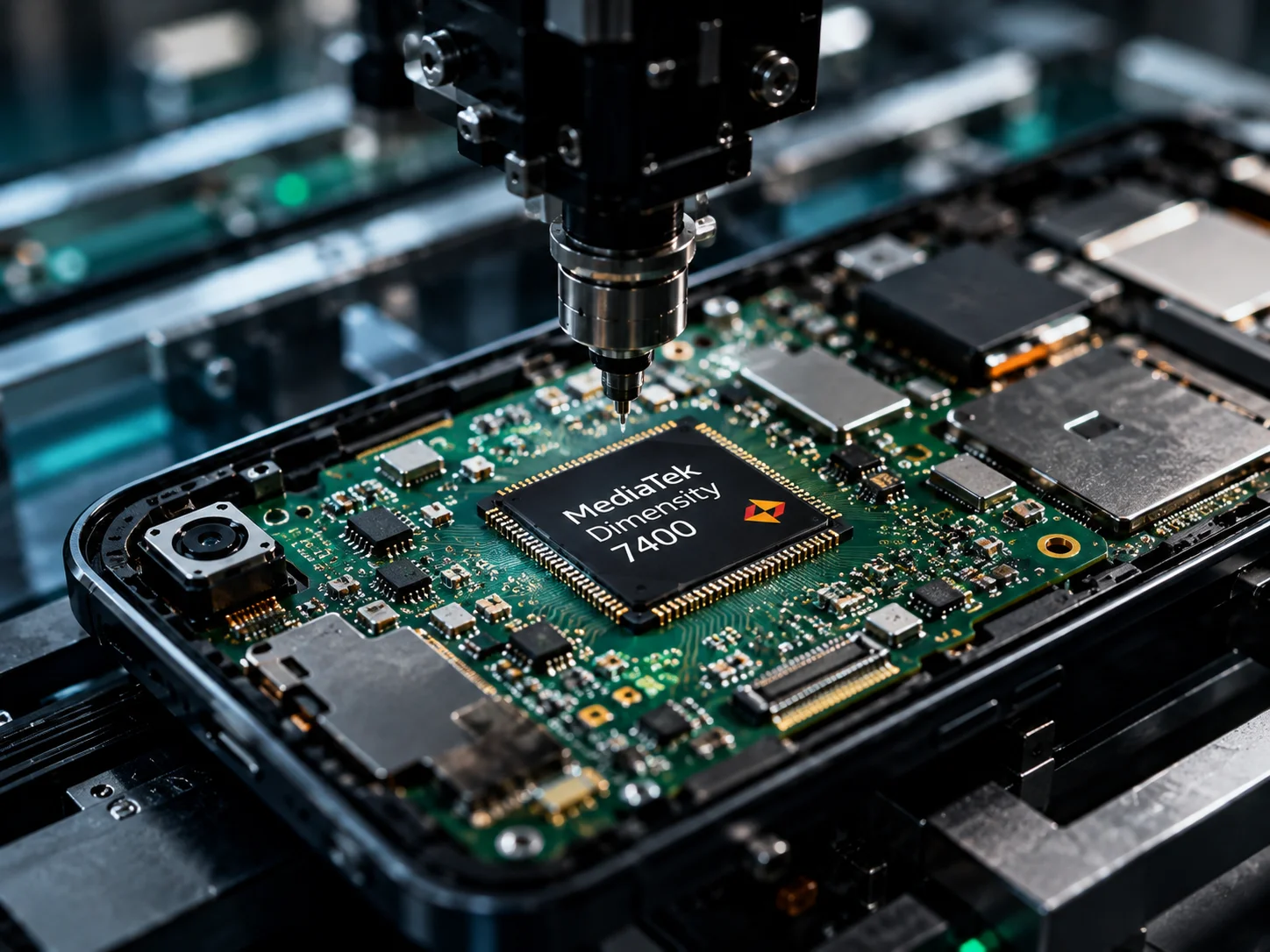
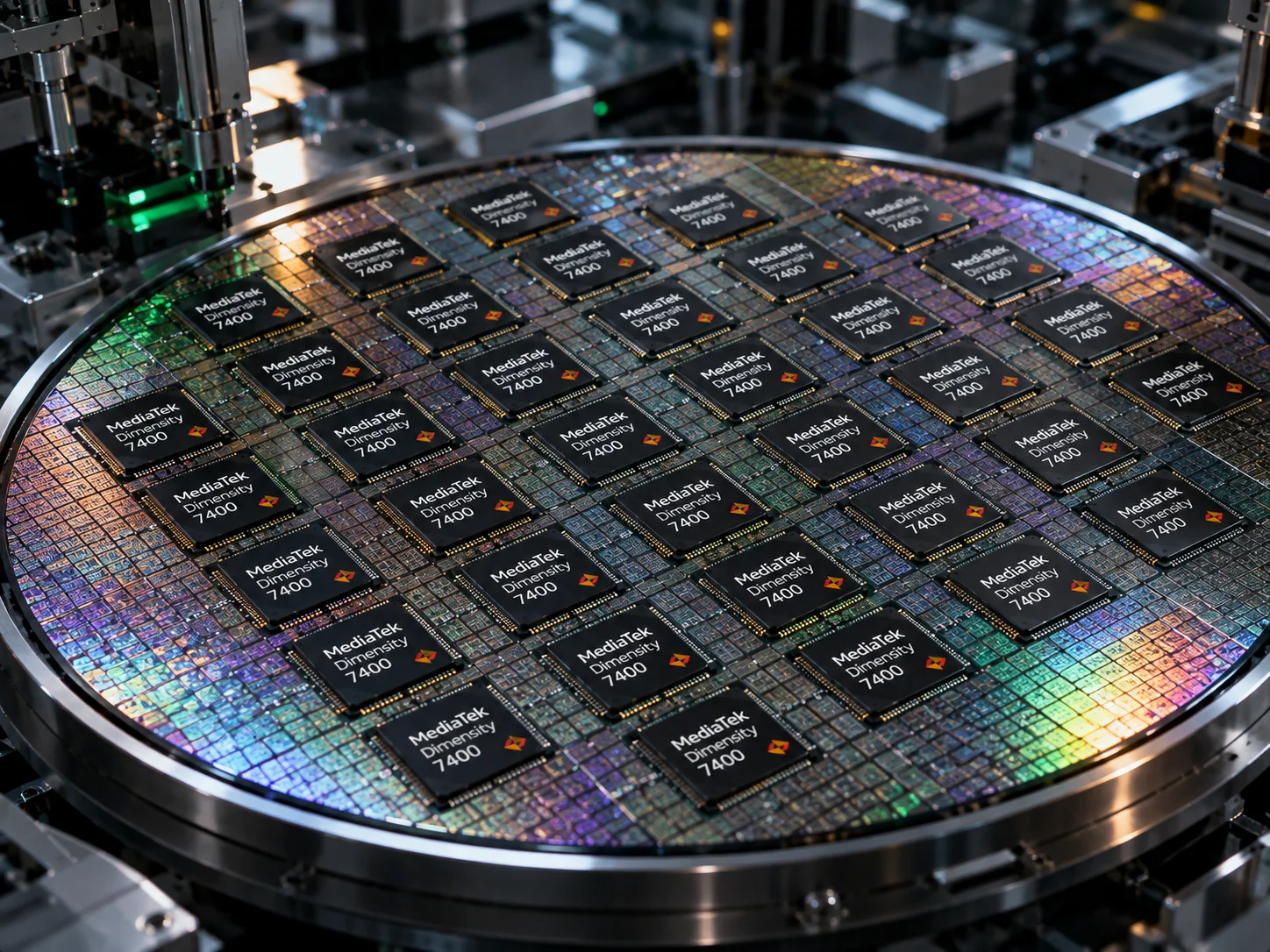
Images Of MediaTek Dimensity 7400
Trailer Of MediaTek Dimensity 7400

Author & Post Info
Faisal Ur Rehman
Faisal Rehman is the founder and editor of FSL Specs, where he publishes in-depth smartphone specifications, comparisons, buying guides, and technology insights. With extensive experience in mobile hardware research and technical analysis, he provides accurate and up-to-date information on Android smartphones, processors, displays, cameras, batteries, performance benchmarks, and software features. His goal is to simplify complex specifications and help readers choose the right device with confidence.
Explore FSL Specs
Questions About MediaTek Dimensity 7400
What manufacturing process is the Dimensity 7400 built on?
It's built on a 4nm process, announced by MediaTek in February 2025 as part of a trio of new mid-range chips alongside the 7400X and 6400. It's positioned as an "ultra-efficient" chipset aimed squarely at gaming and AI camera performance in mid-range phones.
What's the CPU layout on the Dimensity 7400?
It uses an 8-core setup with four Cortex-A78 performance cores running up to 2.6GHz and four Cortex-A55 efficiency cores at 2.0GHz. It's a proven hybrid design that handles everyday tasks smoothly while saving battery for lighter background work.
What GPU does the Dimensity 7400 use, and how's gaming performance?
It runs an Arm Mali-G615 MC2 GPU, which handles popular titles like Genshin Impact and Call of Duty Mobile comfortably at 60fps on medium settings. It's solid for everyday gaming, though it's clearly not built for 4K or ray-traced graphics — that's where it shows its mid-range limits.
Does the Dimensity 7400 support 5G and Wi-Fi 6E?
Yes, it comes with a 5G R16 modem using 3CC carrier aggregation for download speeds up to 3.27Gbps, plus tri-band Wi-Fi 6E support. MediaTek says its power-saving tech also cuts connectivity power use by around 20% compared to rival chips.
How does the Dimensity 7400 perform in benchmarks?
It typically scores around 920,000 to 980,000 on AnTuTu, with Geekbench multi-core numbers landing near 3,000 points. CPU performance holds up well even under sustained load, though GPU performance is noticeably its weaker side compared to rivals in the same price range.
Which phones use the Dimensity 7400?
You'll find it in devices like the Realme P4x, Motorola Edge 60 Fusion, and Tecno Camon 50 Ultra 5G, generally in the affordable-to-mid-range price bracket. It's a good pick if you want smooth everyday performance and decent gaming without paying flagship prices.