






✪ OnePlus 15 ✪

oneplus 15 png image
Last Time Update : 22 October, 2026
United States flagUnited States
900USD
…iPrice NoteYour Country price depends on USD. Prices may be different in your region due to taxes and duties.
Pakistan flagPakistan (PKR)
290000PKR
India flagIndia (INR)
90000INR

✪ OnePlus 15 ✪

oneplus 15 png image
Quick Specs
Display
6.78 inchLTPO AMOLED165 Hz
Processor
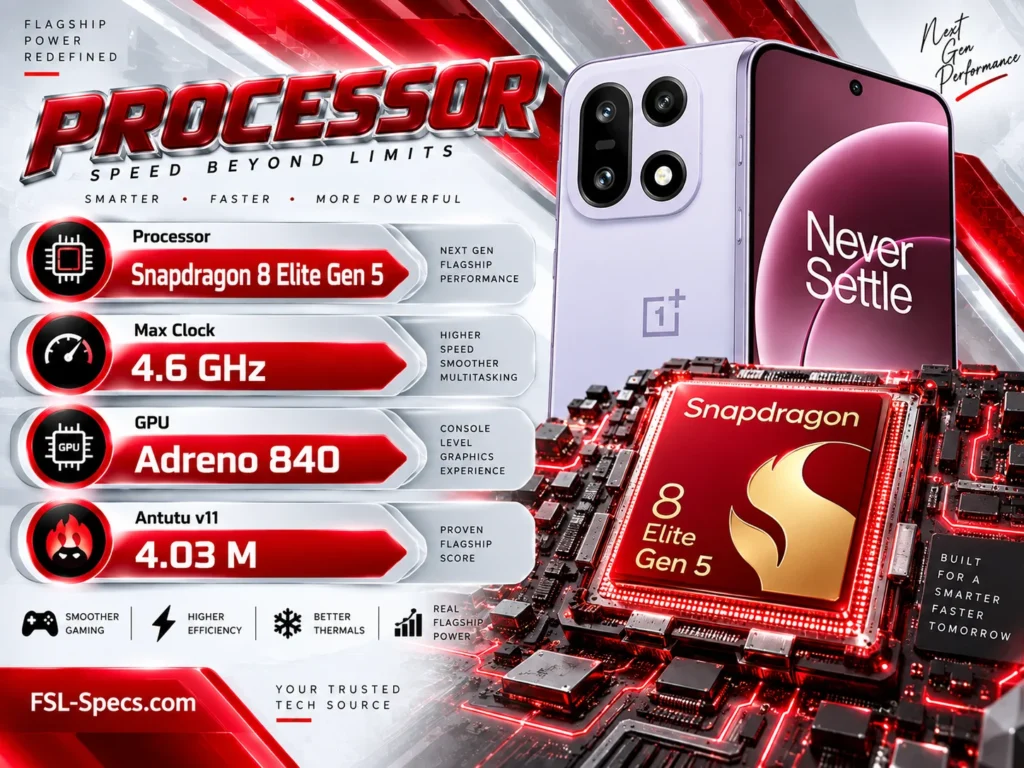
Snapdragon 8 Elite Gen 54.6 GHz
RAM & Storage
16 + 512 GB
Rear Camera
50 + 50 + 50 MP
Front Camera
32 MP
Battery & Charging
7300 mAH120 W50 W Wireless

Full Specification

!
IMPORTANT INFORMATION

Specifications Disclaimer

NOTICE

Specifications are collected from official manufacturers and trusted sources. Actual details may vary by region, model variant, or software updates. We strive for accuracy but cannot guarantee error-free information.

Basic Info

Mobile
OnePlus 15
Model
CPH2747, CPH2745, PLK110, CPH2749
Series
Oneplus Number
Category
Flagship
Release Date
28 October,2025
Year
2025

Connectivity

SIM
Nano-SIM / E-Sim
Network
4G / 4G+ / 5G/ 5G+
WiFi
WiFi 7
Bluetooth
6.0
NFC
No
OS
Android 16

Body

Dimensions
161.4 x 76.7 x 8.1 mm
Build
aluminum frame, glass back
Weight
211 grams
Screen Size
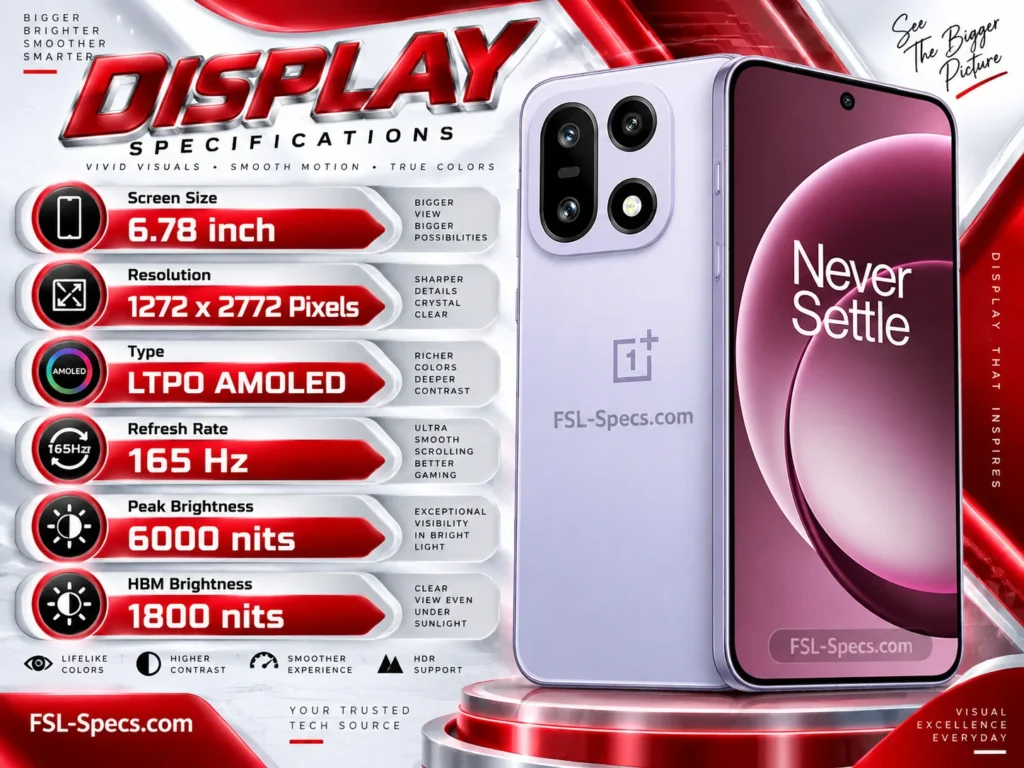
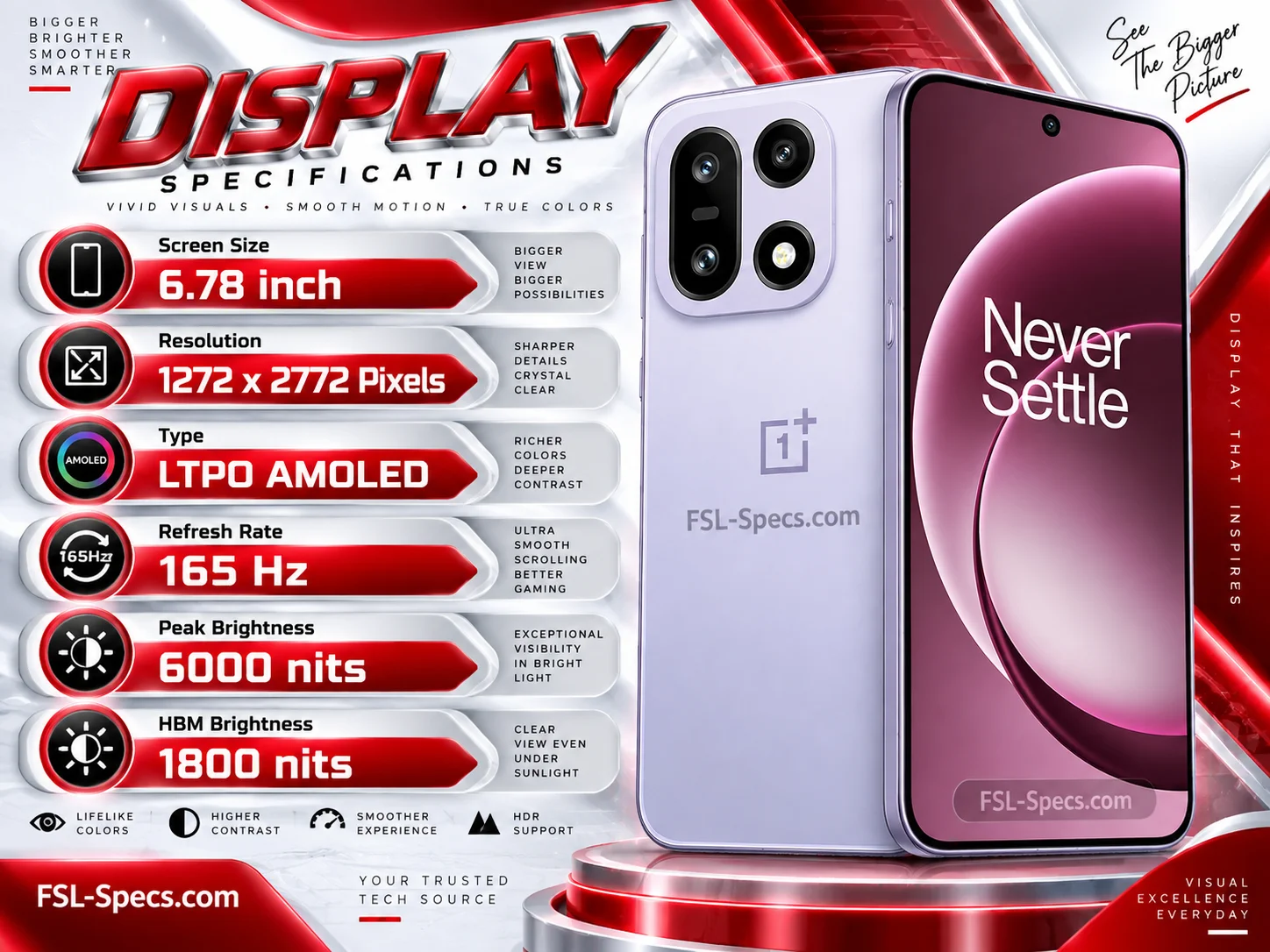
6.78 inch
Resolution
1272 x 2772 Pixels
Type
LTPO AMOLED
Refresh Rate
165 Hz
Peak Brightness
6000 nits
HBM Brightness
1800 nits
Processor Specs
Processor
Snapdragon 8 Elite Gen 5
Max Clock
4.6 GHz
Lithography
3 nm
GPU
Adreno 840
CPU Cores
8 Cores
Antutu v11
4.03 M
Architecture
2 x 4.6 GHz Oryon V3 Phoenix L
6 x 3.62 GHz Oryon V3 Phoenix M
RAM & ROM Specs
RAM Memory
16 + 512 GB
RAM Type
LPDDR5X
Storage Type
UFS 4.1
SD Card
No
Variants
12 + 256 / 512 GB
16 + 256 / 512 GB
16 + 1 TB
Camera Specs
MP
Rear Camera
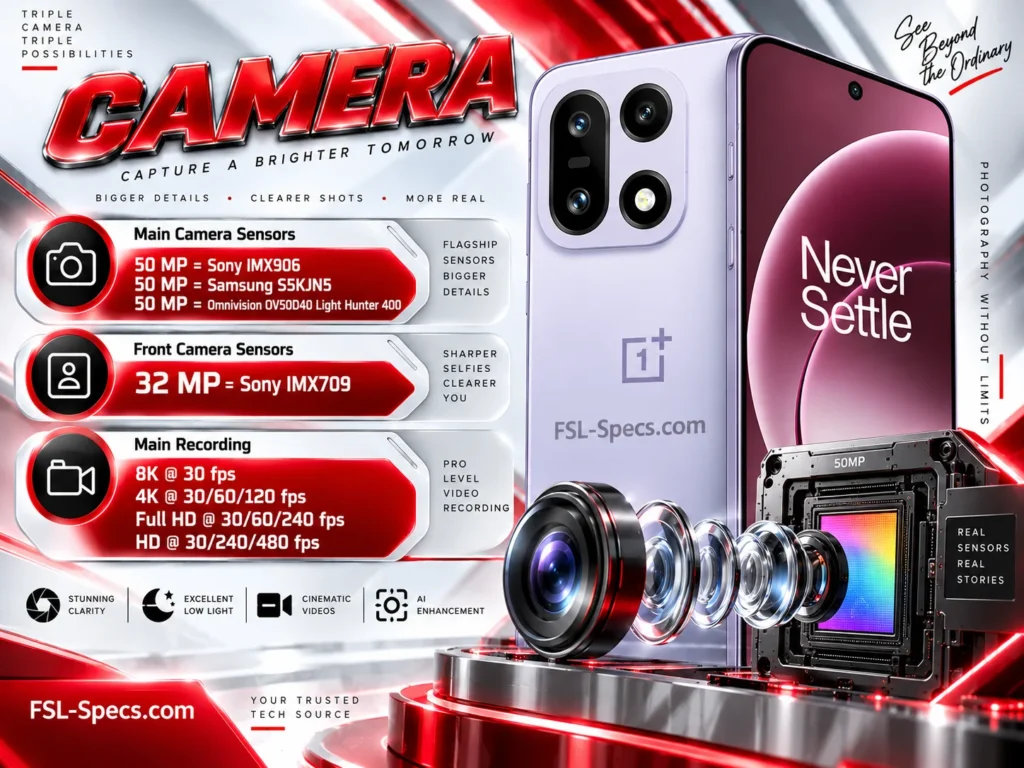
50 + 50 + 50 MP
Front Camera
32 MP
Sensors
Camera Sensors
50 MP = Sony IMX906
50 MP = Samsung S5KJN5
50 MP = Omnivision OV50D40 Light Hunter 400
Front Sensors
32 MP= Sony IMX709
Recording FPS
Main Recording
8k @30 fps
4k @30/60/120 fps
Full HD @30/60/240 fps
HD @30/240/480 fps
Front Recording
4k @30/60 fps
Full HD @30/60 fps
Zoom
Optical Zoom
3.5 x
Digital Zoom
120 x
Stabilization
Yes
Flash
Flash
LED Flash
Front Flash
Screen Flash
Battery Specs
Capacity
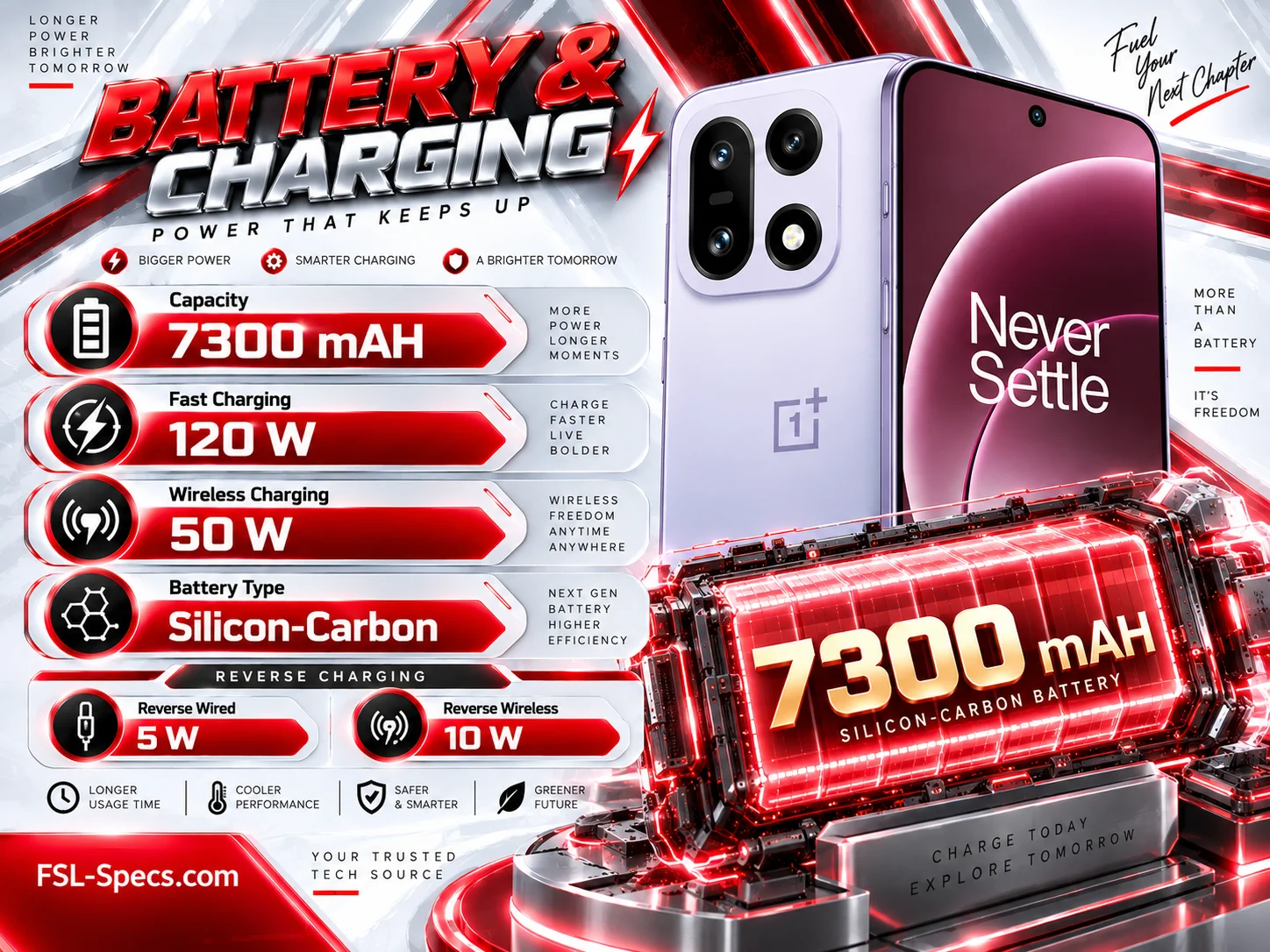
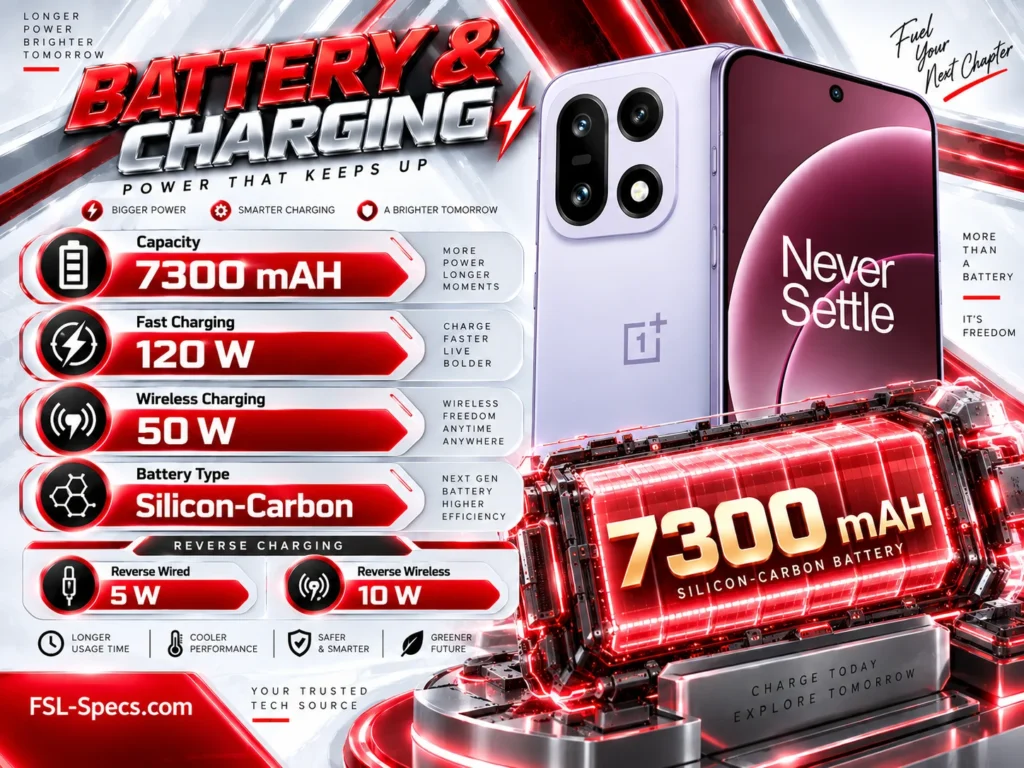
7300 mAH
Fast Charging
120 W
Wireless Charging
50 W
Battery Type
Silicon-Carbon
Reverse
Reverse Wired
5 W
Reverse Wireless
10 W
Other
Battery PC Marks
17h 06m
Charging Time
30m
Other Specs
Audio & Sensors
IP Rating
IP68 / IP69K
Speaker
Dual Stereo Speaker
Fingerprint Sensor
Hyper Sonic Front Finger
Other Sensors
Accelerometer
Gyroscope
Proximity Sensor
Ambient Light Sensor
Electronic Compass (Magnetometer)
Gravity Sensor
Pedometer
IR Blaster
BASIC INFO
Mobile
OnePlus 15
Model
CPH2747, CPH2745, PLK110, CPH2749
Series
Oneplus Number
Category
Flagship
Release Date
28 October,2025
Year
2025
CONNECTIVITY
Sim
Nano-SIM / E-Sim
Network
4G / 4G+ / 5G/ 5G+
WiFi
WiFi 7
Bluetooth
6.0
NFC
No
OS
Android 16
BODY
Dimensions
161.4 x 76.7 x 8.1 mm
Build
aluminum frame, glass back
Weight
211 grams
Screen Size
6.78 inch
Resolution
1272 x 2772 Pixels
Type
LTPO AMOLED
Refresh Rate
165 Hz
Peak Brightness
6000 nits
HBM Brightness
1800 nits
Processor
Snapdragon 8 Elite Gen 5
Max Clock
4.6 GHz
Lithography
3 nm
GPU
Adreno 840
CPU Cores
8 Cores
Antutu v11
4.03 M
Architecture
2 x 4.6 GHz Oryon V3 Phoenix L
6 x 3.62 GHz Oryon V3 Phoenix M
Ram Memory
16 + 512 GB
SD Card
No
Ram Type
LPDDR5X
Storage Type
UFS 4.1
Variants
12 + 256 / 512 GB
16 + 256 / 512 GB
16 + 1 TB
MP
Rear Camera
50 + 50 + 50 MP
Front Camera
32 MP
SENSORS
Main Camera Sensors
50 MP = Sony IMX906
50 MP = Samsung S5KJN5
50 MP = Omnivision OV50D40 Light Hunter 400
Front Camera Sensors
32 MP= Sony IMX709
RECORDING FPS
Main Recording
8k @30 fps
4k @30/60/120 fps
Full HD @30/60/240 fps
HD @30/240/480 fps
Front Recording
4k @30/60 fps
Full HD @30/60 fps
RESOLUTION
Main Resolution
8160 × 6144 Pixels
Front Resolution
6528 × 4896 Pixels
ZOOM
Optical Zoom
3.5 x
Digital Zoom
120 x
Stabilization
Yes
FLASH
Flash
LED Flash
Front Flash
Screen Flash
Capacity
7300 mAH
Fast Charging
120 W
Wireless Charging
50 W
Battery Type
Silicon-Carbon
REVERSE
Reverse Wired
5 W
Reverse Wireless
10 W
OTHER
Battery Life PCMark
17h 06m
Charging Time
30m
PROTECTION
IP Rating
IP68 / IP69K
AUDIO & SENSORS
Speaker
Dual Stereo Speaker
Fingerprint Sensor
Hyper Sonic Front Finger
Other Sensors
Accelerometer Gyroscope Proximity Sensor Ambient Light Sensor Electronic Compass (Magnetometer) Gravity Sensor Pedometer IR Blaster

Verify Mobile Specifications

Official information & trusted references

Official Manufacturer WebsiteExplore the original product information (opens in a new tab)

Trusted Specification Sources

Cross-reference · 4 sources

Links open third-party websites. The Purple ticks are a design marker only; they do not mean a source has verified these specifications or endorses FSL-Specs.

Last Time Update : 22 October, 2026

Highlights & Review Of OnePlus 15

Display Highlights

Display Highlights

The OnePlus 15, in the 16GB + 512GB variant priced at PKR 280,000–290,000 from Pakistani retailers, has a 6.78-inch LTPO AMOLED display with 2772 × 1272 resolution, approximately 450 ppi, and a 1–120Hz adaptive refresh rate. OnePlus states that gaming can reach up to 165Hz, making it the highest refresh-rate option among the three slab phones here. Its listed brightness is 1800 nits HBM, while its peak-brightness figure is not consistently published in the available official specifications.

The Xiaomi 17T Pro, priced at approximately PKR 269,000 for the 12GB + 512GB variant, uses a larger 6.83-inch AMOLED display with 2772 × 1280 resolution, around 447 ppi, and a 144Hz refresh rate. It supports 12-bit colour, 100% DCI-P3, HDR10+, Dolby Vision, 3840Hz PWM dimming, 2000 nits HBM, and up to 3500 nits UHBM peak brightness. This gives it the strongest brightness and eye-comfort specification among the slab phones.

The Motorola Razr 50 Ultra, available for approximately PKR 290,000 for the 16GB + 512GB variant, is a foldable with two screens: a 6.9-inch LTPO pOLED main display at 2640 × 1080, around 414 ppi, and a 4-inch cover display at 1272 × 1080. Both support up to 165Hz. Motorola claims up to 3000 nits peak brightness on the main screen and 2400 nits on the cover screen, while independent testing measured around 1928 nits and 1947 nits respectively. Its foldable design offers a unique cover-screen experience, but the inner display has a visible hinge crease and lower resolution than the Xiaomi 17T Pro or OnePlus 15.

The Samsung Galaxy S26, priced at approximately PKR 225,000 for the 12GB + 512GB variant, features a 6.3-inch Dynamic LTPO AMOLED 2X display with 2340 × 1080 resolution, around 411 ppi, and a 1–120Hz adaptive refresh rate. It supports HDR10+ and up to 2600 nits peak brightness. Independent testing measured approximately 1400 nits on a large white area and 2552 nits on a small bright patch. It is the most compact slab phone here, but its FHD+ resolution is lower than the OnePlus 15, Xiaomi 17T Pro, and Razr 50 Ultra.

Verdict: The Xiaomi 17T Pro wins on overall display specifications with its 6.83-inch 1.5K AMOLED panel, 144Hz refresh rate, 2000 nits HBM, and 3500 nits peak brightness. The OnePlus 15 is the best choice for high-frame-rate gaming, the Razr 50 Ultra is the only foldable and offers a large cover display, while the Galaxy S26 is the most compact but has the lowest resolution among the slab phones.

Performance Highlights

Performance Highlights

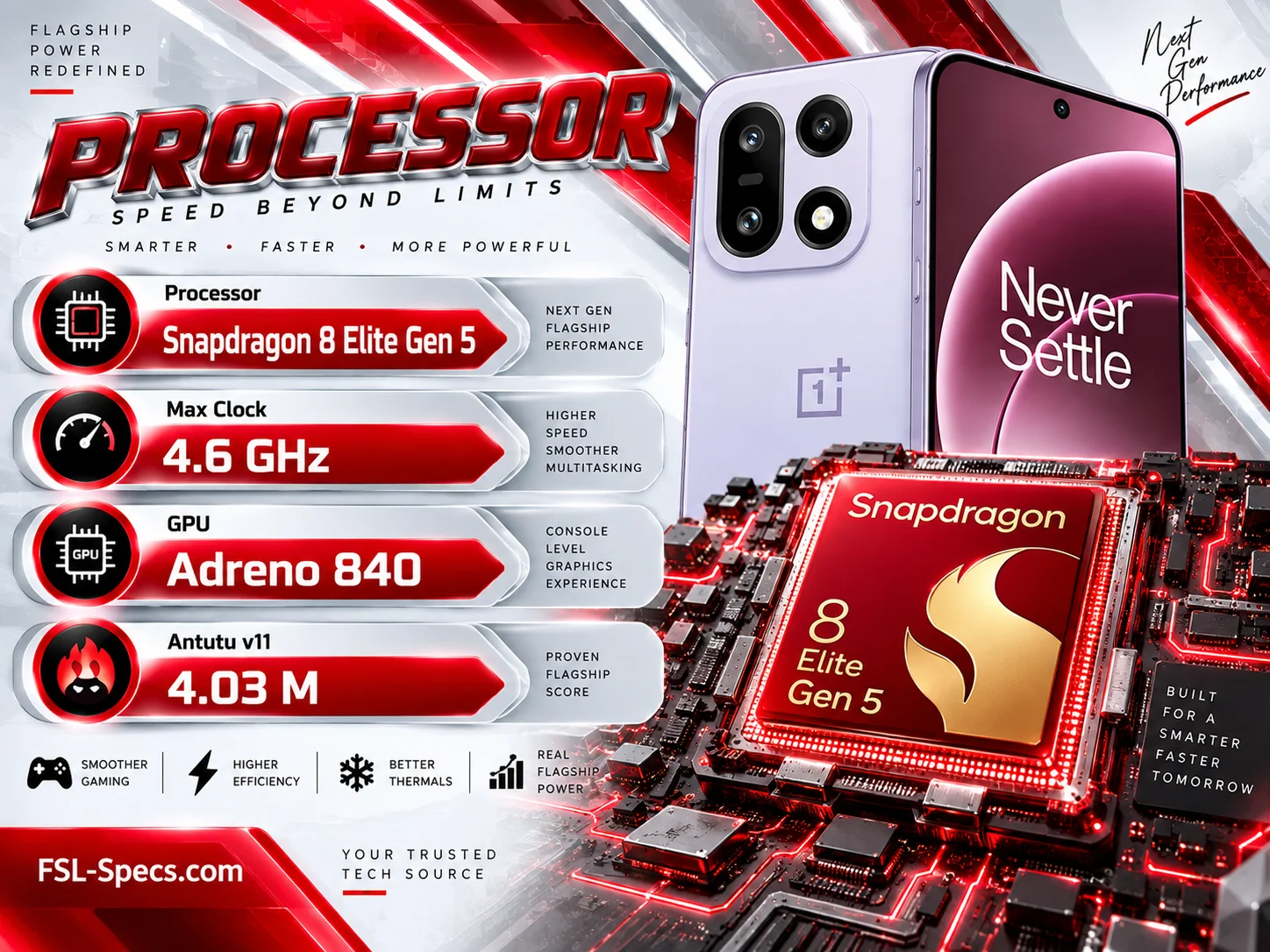
The OnePlus 15 is the performance leader in this comparison. It runs the Qualcomm Snapdragon 8 Elite Gen 5 (SM8850-AC, 3nm) chipset and, in the 16GB + 512GB variant, is priced at PKR 280,000–290,000 from Pakistani retailers. GSMArena recorded approximately 2.79 million on AnTuTu v10, 3.69 million on AnTuTu v11, 11,062 on Geekbench 6 multi-core, and 7,370 on 3DMark Wild Life Extreme. Geekbench’s user-result database shows an average of 3,457 single-core, 10,218 multi-core, and 26,799 Vulkan GPU scores.

The Xiaomi 17T Pro, at approximately PKR 269,000 for the 12GB + 512GB variant, uses the MediaTek Dimensity 9500. It is the closest competitor to the OnePlus 15: GSMArena recorded about 2.80 million on AnTuTu v10, 9,766 on Geekbench 6 multi-core, and 6,939 on 3DMark Wild Life. Other published results place it around 3.3–3.6 million on newer AnTuTu versions and roughly 3,077–3,099 single-core and 9,438–9,608 multi-core on Geekbench 6.

The Motorola Razr 50 Ultra, priced around PKR 290,000 for the 16GB + 512GB variant, is the clear performance laggard. It uses the Qualcomm Snapdragon 8s Gen 3, a 2024 upper-midrange flagship chipset rather than a current top-tier flagship platform. Geekbench user results average 1,843 single-core, 4,528 multi-core, and 8,813 Vulkan GPU scores, which is far below both the OnePlus 15 and Xiaomi 17T Pro.

The Samsung Galaxy S26, available for approximately PKR 225,000 in the 12GB + 512GB variant, is the value-performance option. Its processor differs by market: Samsung uses its Exynos 2600 in many regions, while some markets receive a Qualcomm Snapdragon variant. Exact Pakistan-market chipset and benchmark results should be verified from the local unit, because Samsung’s regional chip allocation can materially affect gaming and sustained performance.

Benchmark comparison

PhoneChipsetGeekbench 6 single-coreGeekbench 6 multi-coreAnTuTuGPU / gaming result
OnePlus 15Snapdragon 8 Elite Gen 53,45710,2182.79M (v10) / 3.69M (v11)26,799 Vulkan; 7,370 3DMark Wild Life Extreme
Xiaomi 17T ProDimensity 95003,077–3,0999,438–9,7662.80M (v10) / 3.3–3.6M newer versions6,939 3DMark Wild Life
Motorola Razr 50 UltraSnapdragon 8s Gen 31,8434,528Not consistently published8,813 Vulkan
Samsung Galaxy S26Exynos 2600 or Snapdragon, market-dependentRegion-dependentRegion-dependentRegion-dependentNeeds local-unit verification

Verdict: For raw CPU, GPU, gaming, and sustained flagship performance, the OnePlus 15 is the best choice, with the Xiaomi 17T Pro a very close second. The Razr 50 Ultra is not a performance buy at this price, while the Galaxy S26 could be the strongest value option if its local variant performs well.

Memory & Storage Highlights

Memory & Storage Highlights

The OnePlus 15 has the strongest memory configuration in this comparison. Its 16GB + 512GB variant uses 16GB LPDDR5X Ultra/Ultra+ RAM and 512GB UFS 4.1 storage, which is ideal for heavy multitasking, large games, 4K video editing, and long-term storage. OnePlus does not list microSD expansion, so the storage is fixed. 

The Xiaomi 17T Pro offers 12GB LPDDR5X RAM running at 9600Mbps and 512GB UFS 4.1 storage in its specified variant. It is very capable for gaming and multitasking, but its 12GB RAM is 4GB lower than the OnePlus 15. Xiaomi also does not provide a microSD slot; its storage options include 256GB, 512GB, and 1TB.

The Motorola Razr 50 Ultra matches the OnePlus 15 on RAM with 16GB RAM and 512GB storage. However, it uses the older UFS 4.0 storage standard rather than UFS 4.1, and its Snapdragon 8s Gen 3 platform limits its real-world performance despite the generous RAM. Motorola does not offer microSD expansion.

The Samsung Galaxy S26 comes with 12GB RAM and 512GB storage in the specified variant. Samsung uses fast internal storage, but the exact UFS generation and RAM type can vary by chipset and market, so buyers should confirm the Pakistan variant before purchase. Like the other three phones, it has no microSD card slot.

Memory comparison

PhoneVariantRAMStorageMemory standardmicroSD
OnePlus 1516GB + 512GB16GB512GBLPDDR5X Ultra/Ultra+; UFS 4.1No
Xiaomi 17T Pro12GB + 512GB12GB512GBLPDDR5X 9600Mbps; UFS 4.1No
Motorola Razr 50 Ultra16GB + 512GB16GB512GBUFS 4.0No
Samsung Galaxy S2612GB + 512GB12GB512GBMarket-dependentNo

Verdict: The OnePlus 15 is the best RAM-and-storage choice because it combines 16GB RAM, 512GB storage, LPDDR5X Ultra/Ultra+, and UFS 4.1. The Razr 50 Ultra also has 16GB RAM but uses slower UFS 4.0 storage, while the Xiaomi 17T Pro and Galaxy S26 offer 12GB RAM with 512GB storage.

Camera Highlights

Camera Highlights

The OnePlus 15, priced at PKR 280,000–290,000 for the 16GB + 512GB variant, has the most balanced triple-camera setup. It uses a 50MP Sony IMX906 main sensor with a 1/1.56-inch size, f/1.8 aperture, 23mm focal length, PDAF, and OIS. Its 50MP 3.5x telephoto uses a Samsung ISOCELL JN5 sensor with f/2.8, 85mm, 1/2.76-inch size, PDAF, and OIS, while the 50MP OmniVision OV50D ultrawide has f/2.0, 16mm, a 116-degree field of view, and autofocus. It supports 8K30 recording on the main camera and 4K120 on the telephoto

The Xiaomi 17T Pro, at approximately PKR 269,000 for the 12GB + 512GB variant, is the strongest for long-range zoom. Its 50MP main camera has a larger 1/1.31-inch sensor, f/1.67 aperture, and 23mm focal length, paired with Leica tuning. The 50MP Samsung JN5 periscope telephoto offers 5x optical zoom, 115mm, f/3.0, OIS, multi-directional PDAF, and close-focus macro capability. Its weakness is the 13MP OmniVision OV13B ultrawide, which has a smaller 1/3.0-inch sensor, fixed focus, and 15mm focal length.

The Motorola Razr 50 Ultra, priced around PKR 290,000 for the 16GB + 512GB variant, has only two rear cameras. Its 50MP main camera uses a 1/1.95-inch sensor, f/1.7 aperture, 24mm focal length, dual-pixel PDAF, and OIS. Its 50MP telephoto uses a 1/2.76-inch sensor, f/2.0 aperture, 47mm focal length, and 2x optical zoom, but there is no ultrawide camera. The cover display can act as a high-quality selfie viewfinder, which is a major advantage for self-portraits.

The Samsung Galaxy S26, available for approximately PKR 225,000 in the 12GB + 512GB variant, offers the most conventional compact-flagship camera setup. It has a 50MP Samsung ISOCELL GN3 main sensor with 1/1.56-inch size, f/1.8 aperture, 24mm focal length, PDAF, and OIS; a 12MP Sony IMX564 ultrawide with f/2.2, 13mm, and 1/2.55-inch sensor; and a 10MP Samsung S5K3K1 telephoto with 3x optical zoom, 69mm, f/2.4, OIS, and PDAF.

Camera comparison

PhoneMain cameraTelephotoUltrawideBest camera strength
OnePlus 1550MP Sony IMX906, 1/1.56″, f/1.8, OIS50MP JN5, 3.5x, 85mm, f/2.8, OIS50MP OV50D, 16mm, f/2.0, AFMost balanced triple setup; 8K30 video
Xiaomi 17T Pro50MP, 1/1.31″, f/1.67, OIS50MP JN5 periscope, 5x, 115mm, f/3.0, OIS13MP OV13B, 15mm, fixed focusBest zoom and largest main sensor
Motorola Razr 50 Ultra50MP, 1/1.95″, f/1.7, OIS50MP, 2x, 47mm, f/2.0NoneBest selfie workflow via cover screen; no ultrawide
Samsung Galaxy S2650MP ISOCELL GN3, 1/1.56″, f/1.8, OIS10MP S5K3K1, 3x, 69mm, f/2.4, OIS12MP IMX564, 13mm, f/2.2Compact all-rounder with reliable 3x zoom

Verdict: Choose the Xiaomi 17T Pro for the best main-camera sensor and long-distance 5x zoom. Choose the OnePlus 15 for the most versatile all-round camera system, especially if you want a high-resolution ultrawide and 8K video. The Galaxy S26 is a strong value option with a dependable 3x telephoto, while the Razr 50 Ultra is best only if you prioritize selfies and foldable-style photography over zoom range and ultrawide coverage.

Battery & Charging Highlights

Battery & Charging Highlights

The OnePlus 15 is the best choice for both battery endurance and charging speed. It has a 7300mAh battery, 120W wired SuperVOOC charging, 50W wireless charging, 10W reverse wireless, and 5W reverse wired charging. In GSMArena testing, it reached 44% in 15 minutes, 78% in 30 minutes, and a full charge in 41 minutes.

The Xiaomi 17T Pro is the closest competitor. It has a 7000mAh battery, 100W wired HyperCharge, 50W wireless charging, and 22.5W reverse wired charging. Xiaomi claims 20.3 hours of continuous use, 30.7 hours of video playback, and at least 80% battery health after 1,600 charge cycles. Independent testing also found it lasted 23 hours 32 minutes in a PCMark battery loop and 27 hours 41 minutes in a 1080p YouTube loop.

The Motorola Razr 50 Ultra has the smallest battery at 4000mAh, with 45W wired TurboPower and 15W wireless charging. Motorola claims a full day of power in about 12 minutes of charging, but that refers to rapid top-up rather than full battery endurance. Its compact foldable battery is the main limitation here, especially for heavy gaming or extended outdoor use.

The Samsung Galaxy S26 has a 4300mAh battery and 25W wired charging, but no wireless-charging speed advantage over the Xiaomi or OnePlus. GSMArena recorded 34% in 15 minutes, 62% in 30 minutes, and a full charge in 64 minutes. Real-world testing suggests around 5.5 hours of screen-on time, enough for a full day of moderate use but not class-leading endurance

Battery comparison

PhoneBatteryWired chargingWireless charging
OnePlus 157300mAh120W SuperVOOC50W
Xiaomi 17T Pro7000mAh100W HyperCharge50W
Motorola Razr 50 Ultra4000mAh45W TurboPower15W
Samsung Galaxy S264300mAh25WSupported

Verdict: The OnePlus 15 wins overall with the largest battery, fastest wired charging, and 50W wireless charging. The Xiaomi 17T Pro is an excellent alternative with nearly the same endurance and very fast 100W charging. The Galaxy S26 offers acceptable all-day battery life but slow charging, while the Razr 50 Ultra has the weakest battery capacity due to its foldable design.

Final Verdict

Overall ranking

RankPhoneVariant / PriceBest forMain limitation
1OnePlus 1516GB + 512GB, PKR 280,000–290,000Overall performance, battery, charging, balanced camerasHighest price among slab phones
2Xiaomi 17T Pro12GB + 512GB, PKR 269,000Display, 5x zoom camera, battery, charging12GB RAM; weaker ultrawide
3Samsung Galaxy S2612GB + 512GB, PKR 225,000Compact size, software experience, valueSlower charging; smaller battery
4Motorola Razr 50 Ultra16GB + 512GB, PKR 290,000Foldable design, cover-screen selfiesOld chipset, small battery, no ultrawide

Why OnePlus 15 ranks first

The OnePlus 15 combines the Snapdragon 8 Elite Gen 5, 16GB LPDDR5X Ultra/Ultra+ RAM, 512GB UFS 4.1 storage, a 7300mAh battery, 120W wired charging, and a versatile triple-camera system. It leads in raw performance, endurance, charging speed, and memory configuration, making it the most complete flagship at its price.

Its 50MP Sony IMX906 main camera, 50MP 3.5x telephoto, and 50MP ultrawide also make it more versatile than the Xiaomi 17T Pro, whose ultrawide is only 13MP.

Why Xiaomi 17T Pro ranks second

The Xiaomi 17T Pro is the best alternative if you want a bigger, brighter display and superior long-range photography. Its 6.83-inch 1.5K 144Hz AMOLED panel, 3500 nits peak brightness, 7000mAh battery, 100W charging, and 50MP 5x periscope telephoto make it excellent for media, outdoor use, and zoom shots.

It falls behind the OnePlus 15 mainly because it has 12GB RAM instead of 16GB, a smaller battery, slower wired charging, and a less capable ultrawide camera.

Why Galaxy S26 ranks third

The Galaxy S26 is the smartest purchase for buyers who want a premium compact phone at the lowest price. At around PKR 225,000, it offers a 6.3-inch 120Hz Dynamic LTPO AMOLED 2X display, 12GB RAM, 512GB storage, a reliable 50MP main camera, and 3x optical zoom.

However, its 4300mAh battery and 25W charging are clearly behind the OnePlus 15 and Xiaomi 17T Pro. It is a strong value choice, but not the best performance or battery option.

Why Razr 50 Ultra ranks fourth

The Razr 50 Ultra is the only foldable here and offers a unique 6.9-inch inner display, a large 4-inch cover screen, and 165Hz refresh rates on both panels. Its 16GB RAM is generous, and the cover screen is excellent for selfies using the rear cameras.

But at PKR 290,000, it is hard to recommend over the OnePlus 15 or Xiaomi 17T Pro. Its Snapdragon 8s Gen 3, 4000mAh battery, 45W charging, lack of an ultrawide camera, and older platform make it a design-first purchase rather than a performance-first one.

Best choice by need

  • Best overall: OnePlus 15 — performance, RAM, battery, charging, and camera balance.

  • Best display and zoom camera: Xiaomi 17T Pro — 144Hz 1.5K AMOLED and 5x periscope telephoto.

  • Best value: Samsung Galaxy S26 — compact flagship experience at PKR 225,000

  • Best foldable: Motorola Razr 50 Ultra — choose it only for its foldable form factor and cover-screen selfies.

Display Highlights

Display Highlights

The OnePlus 15, in the 16GB + 512GB variant priced at PKR 280,000–290,000 from Pakistani retailers, has a 6.78-inch LTPO AMOLED display with 2772 × 1272 resolution, approximately 450 ppi, and a 1–120Hz adaptive refresh rate. OnePlus states that gaming can reach up to 165Hz, making it the highest refresh-rate option among the three slab phones here. Its listed brightness is 1800 nits HBM, while its peak-brightness figure is not consistently published in the available official specifications.

The Xiaomi 17T Pro, priced at approximately PKR 269,000 for the 12GB + 512GB variant, uses a larger 6.83-inch AMOLED display with 2772 × 1280 resolution, around 447 ppi, and a 144Hz refresh rate. It supports 12-bit colour, 100% DCI-P3, HDR10+, Dolby Vision, 3840Hz PWM dimming, 2000 nits HBM, and up to 3500 nits UHBM peak brightness. This gives it the strongest brightness and eye-comfort specification among the slab phones.

The Motorola Razr 50 Ultra, available for approximately PKR 290,000 for the 16GB + 512GB variant, is a foldable with two screens: a 6.9-inch LTPO pOLED main display at 2640 × 1080, around 414 ppi, and a 4-inch cover display at 1272 × 1080. Both support up to 165Hz. Motorola claims up to 3000 nits peak brightness on the main screen and 2400 nits on the cover screen, while independent testing measured around 1928 nits and 1947 nits respectively. Its foldable design offers a unique cover-screen experience, but the inner display has a visible hinge crease and lower resolution than the Xiaomi 17T Pro or OnePlus 15.

The Samsung Galaxy S26, priced at approximately PKR 225,000 for the 12GB + 512GB variant, features a 6.3-inch Dynamic LTPO AMOLED 2X display with 2340 × 1080 resolution, around 411 ppi, and a 1–120Hz adaptive refresh rate. It supports HDR10+ and up to 2600 nits peak brightness. Independent testing measured approximately 1400 nits on a large white area and 2552 nits on a small bright patch. It is the most compact slab phone here, but its FHD+ resolution is lower than the OnePlus 15, Xiaomi 17T Pro, and Razr 50 Ultra.

Verdict: The Xiaomi 17T Pro wins on overall display specifications with its 6.83-inch 1.5K AMOLED panel, 144Hz refresh rate, 2000 nits HBM, and 3500 nits peak brightness. The OnePlus 15 is the best choice for high-frame-rate gaming, the Razr 50 Ultra is the only foldable and offers a large cover display, while the Galaxy S26 is the most compact but has the lowest resolution among the slab phones.
Performance Highlights

Performance Highlights

The OnePlus 15 is the performance leader in this comparison. It runs the Qualcomm Snapdragon 8 Elite Gen 5 (SM8850-AC, 3nm) chipset and, in the 16GB + 512GB variant, is priced at PKR 280,000–290,000 from Pakistani retailers. GSMArena recorded approximately 2.79 million on AnTuTu v10, 3.69 million on AnTuTu v11, 11,062 on Geekbench 6 multi-core, and 7,370 on 3DMark Wild Life Extreme. Geekbench’s user-result database shows an average of 3,457 single-core, 10,218 multi-core, and 26,799 Vulkan GPU scores.

The Xiaomi 17T Pro, at approximately PKR 269,000 for the 12GB + 512GB variant, uses the MediaTek Dimensity 9500. It is the closest competitor to the OnePlus 15: GSMArena recorded about 2.80 million on AnTuTu v10, 9,766 on Geekbench 6 multi-core, and 6,939 on 3DMark Wild Life. Other published results place it around 3.3–3.6 million on newer AnTuTu versions and roughly 3,077–3,099 single-core and 9,438–9,608 multi-core on Geekbench 6.

The Motorola Razr 50 Ultra, priced around PKR 290,000 for the 16GB + 512GB variant, is the clear performance laggard. It uses the Qualcomm Snapdragon 8s Gen 3, a 2024 upper-midrange flagship chipset rather than a current top-tier flagship platform. Geekbench user results average 1,843 single-core, 4,528 multi-core, and 8,813 Vulkan GPU scores, which is far below both the OnePlus 15 and Xiaomi 17T Pro.

The Samsung Galaxy S26, available for approximately PKR 225,000 in the 12GB + 512GB variant, is the value-performance option. Its processor differs by market: Samsung uses its Exynos 2600 in many regions, while some markets receive a Qualcomm Snapdragon variant. Exact Pakistan-market chipset and benchmark results should be verified from the local unit, because Samsung’s regional chip allocation can materially affect gaming and sustained performance.

Benchmark comparison

PhoneChipsetGeekbench 6 single-coreGeekbench 6 multi-coreAnTuTuGPU / gaming result
OnePlus 15Snapdragon 8 Elite Gen 53,45710,2182.79M (v10) / 3.69M (v11)26,799 Vulkan; 7,370 3DMark Wild Life Extreme
Xiaomi 17T ProDimensity 95003,077–3,0999,438–9,7662.80M (v10) / 3.3–3.6M newer versions6,939 3DMark Wild Life
Motorola Razr 50 UltraSnapdragon 8s Gen 31,8434,528Not consistently published8,813 Vulkan
Samsung Galaxy S26Exynos 2600 or Snapdragon, market-dependentRegion-dependentRegion-dependentRegion-dependentNeeds local-unit verification

Verdict: For raw CPU, GPU, gaming, and sustained flagship performance, the OnePlus 15 is the best choice, with the Xiaomi 17T Pro a very close second. The Razr 50 Ultra is not a performance buy at this price, while the Galaxy S26 could be the strongest value option if its local variant performs well.

Memory & Storage Highlights

Memory & Storage Highlights

The OnePlus 15 has the strongest memory configuration in this comparison. Its 16GB + 512GB variant uses 16GB LPDDR5X Ultra/Ultra+ RAM and 512GB UFS 4.1 storage, which is ideal for heavy multitasking, large games, 4K video editing, and long-term storage. OnePlus does not list microSD expansion, so the storage is fixed. 

The Xiaomi 17T Pro offers 12GB LPDDR5X RAM running at 9600Mbps and 512GB UFS 4.1 storage in its specified variant. It is very capable for gaming and multitasking, but its 12GB RAM is 4GB lower than the OnePlus 15. Xiaomi also does not provide a microSD slot; its storage options include 256GB, 512GB, and 1TB.

The Motorola Razr 50 Ultra matches the OnePlus 15 on RAM with 16GB RAM and 512GB storage. However, it uses the older UFS 4.0 storage standard rather than UFS 4.1, and its Snapdragon 8s Gen 3 platform limits its real-world performance despite the generous RAM. Motorola does not offer microSD expansion.

The Samsung Galaxy S26 comes with 12GB RAM and 512GB storage in the specified variant. Samsung uses fast internal storage, but the exact UFS generation and RAM type can vary by chipset and market, so buyers should confirm the Pakistan variant before purchase. Like the other three phones, it has no microSD card slot.

Memory comparison

PhoneVariantRAMStorageMemory standardmicroSD
OnePlus 1516GB + 512GB16GB512GBLPDDR5X Ultra/Ultra+; UFS 4.1No
Xiaomi 17T Pro12GB + 512GB12GB512GBLPDDR5X 9600Mbps; UFS 4.1No
Motorola Razr 50 Ultra16GB + 512GB16GB512GBUFS 4.0No
Samsung Galaxy S2612GB + 512GB12GB512GBMarket-dependentNo

Verdict: The OnePlus 15 is the best RAM-and-storage choice because it combines 16GB RAM, 512GB storage, LPDDR5X Ultra/Ultra+, and UFS 4.1. The Razr 50 Ultra also has 16GB RAM but uses slower UFS 4.0 storage, while the Xiaomi 17T Pro and Galaxy S26 offer 12GB RAM with 512GB storage.

Camera Highlights

Camera Highlights

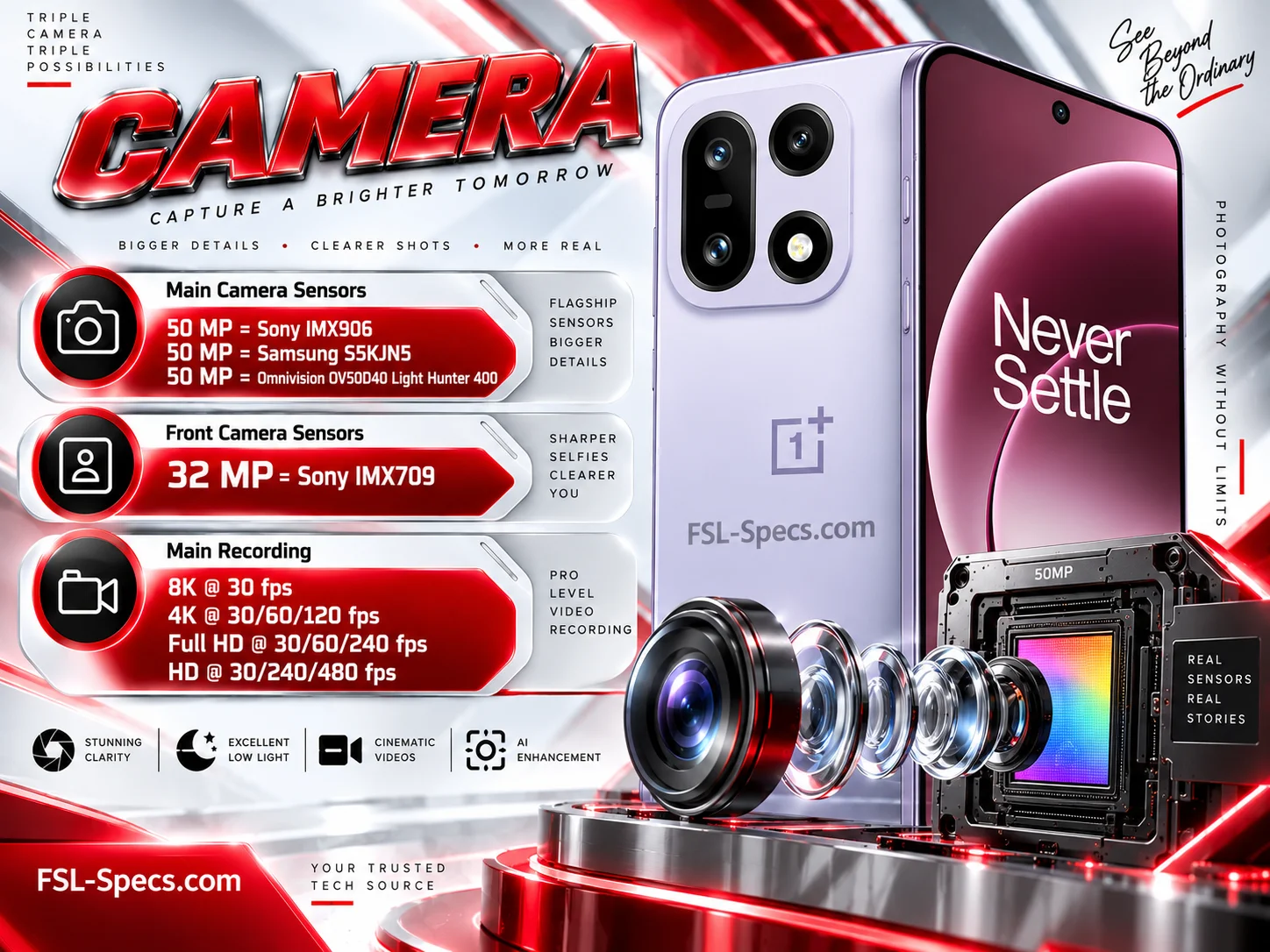
The OnePlus 15, priced at PKR 280,000–290,000 for the 16GB + 512GB variant, has the most balanced triple-camera setup. It uses a 50MP Sony IMX906 main sensor with a 1/1.56-inch size, f/1.8 aperture, 23mm focal length, PDAF, and OIS. Its 50MP 3.5x telephoto uses a Samsung ISOCELL JN5 sensor with f/2.8, 85mm, 1/2.76-inch size, PDAF, and OIS, while the 50MP OmniVision OV50D ultrawide has f/2.0, 16mm, a 116-degree field of view, and autofocus. It supports 8K30 recording on the main camera and 4K120 on the telephoto

The Xiaomi 17T Pro, at approximately PKR 269,000 for the 12GB + 512GB variant, is the strongest for long-range zoom. Its 50MP main camera has a larger 1/1.31-inch sensor, f/1.67 aperture, and 23mm focal length, paired with Leica tuning. The 50MP Samsung JN5 periscope telephoto offers 5x optical zoom, 115mm, f/3.0, OIS, multi-directional PDAF, and close-focus macro capability. Its weakness is the 13MP OmniVision OV13B ultrawide, which has a smaller 1/3.0-inch sensor, fixed focus, and 15mm focal length.

The Motorola Razr 50 Ultra, priced around PKR 290,000 for the 16GB + 512GB variant, has only two rear cameras. Its 50MP main camera uses a 1/1.95-inch sensor, f/1.7 aperture, 24mm focal length, dual-pixel PDAF, and OIS. Its 50MP telephoto uses a 1/2.76-inch sensor, f/2.0 aperture, 47mm focal length, and 2x optical zoom, but there is no ultrawide camera. The cover display can act as a high-quality selfie viewfinder, which is a major advantage for self-portraits.

The Samsung Galaxy S26, available for approximately PKR 225,000 in the 12GB + 512GB variant, offers the most conventional compact-flagship camera setup. It has a 50MP Samsung ISOCELL GN3 main sensor with 1/1.56-inch size, f/1.8 aperture, 24mm focal length, PDAF, and OIS; a 12MP Sony IMX564 ultrawide with f/2.2, 13mm, and 1/2.55-inch sensor; and a 10MP Samsung S5K3K1 telephoto with 3x optical zoom, 69mm, f/2.4, OIS, and PDAF.

Camera comparison

PhoneMain cameraTelephotoUltrawideBest camera strength
OnePlus 1550MP Sony IMX906, 1/1.56″, f/1.8, OIS50MP JN5, 3.5x, 85mm, f/2.8, OIS50MP OV50D, 16mm, f/2.0, AFMost balanced triple setup; 8K30 video
Xiaomi 17T Pro50MP, 1/1.31″, f/1.67, OIS50MP JN5 periscope, 5x, 115mm, f/3.0, OIS13MP OV13B, 15mm, fixed focusBest zoom and largest main sensor
Motorola Razr 50 Ultra50MP, 1/1.95″, f/1.7, OIS50MP, 2x, 47mm, f/2.0NoneBest selfie workflow via cover screen; no ultrawide
Samsung Galaxy S2650MP ISOCELL GN3, 1/1.56″, f/1.8, OIS10MP S5K3K1, 3x, 69mm, f/2.4, OIS12MP IMX564, 13mm, f/2.2Compact all-rounder with reliable 3x zoom

Verdict: Choose the Xiaomi 17T Pro for the best main-camera sensor and long-distance 5x zoom. Choose the OnePlus 15 for the most versatile all-round camera system, especially if you want a high-resolution ultrawide and 8K video. The Galaxy S26 is a strong value option with a dependable 3x telephoto, while the Razr 50 Ultra is best only if you prioritize selfies and foldable-style photography over zoom range and ultrawide coverage.

Battery & Charging Highlights

Battery & Charging Highlights

The OnePlus 15 is the best choice for both battery endurance and charging speed. It has a 7300mAh battery, 120W wired SuperVOOC charging, 50W wireless charging, 10W reverse wireless, and 5W reverse wired charging. In GSMArena testing, it reached 44% in 15 minutes, 78% in 30 minutes, and a full charge in 41 minutes.

The Xiaomi 17T Pro is the closest competitor. It has a 7000mAh battery, 100W wired HyperCharge, 50W wireless charging, and 22.5W reverse wired charging. Xiaomi claims 20.3 hours of continuous use, 30.7 hours of video playback, and at least 80% battery health after 1,600 charge cycles. Independent testing also found it lasted 23 hours 32 minutes in a PCMark battery loop and 27 hours 41 minutes in a 1080p YouTube loop.

The Motorola Razr 50 Ultra has the smallest battery at 4000mAh, with 45W wired TurboPower and 15W wireless charging. Motorola claims a full day of power in about 12 minutes of charging, but that refers to rapid top-up rather than full battery endurance. Its compact foldable battery is the main limitation here, especially for heavy gaming or extended outdoor use.

The Samsung Galaxy S26 has a 4300mAh battery and 25W wired charging, but no wireless-charging speed advantage over the Xiaomi or OnePlus. GSMArena recorded 34% in 15 minutes, 62% in 30 minutes, and a full charge in 64 minutes. Real-world testing suggests around 5.5 hours of screen-on time, enough for a full day of moderate use but not class-leading endurance

Battery comparison

PhoneBatteryWired chargingWireless charging
OnePlus 157300mAh120W SuperVOOC50W
Xiaomi 17T Pro7000mAh100W HyperCharge50W
Motorola Razr 50 Ultra4000mAh45W TurboPower15W
Samsung Galaxy S264300mAh25WSupported

Verdict: The OnePlus 15 wins overall with the largest battery, fastest wired charging, and 50W wireless charging. The Xiaomi 17T Pro is an excellent alternative with nearly the same endurance and very fast 100W charging. The Galaxy S26 offers acceptable all-day battery life but slow charging, while the Razr 50 Ultra has the weakest battery capacity due to its foldable design.

Final Verdict

Overall ranking

RankPhoneVariant / PriceBest forMain limitation
1OnePlus 1516GB + 512GB, PKR 280,000–290,000Overall performance, battery, charging, balanced camerasHighest price among slab phones
2Xiaomi 17T Pro12GB + 512GB, PKR 269,000Display, 5x zoom camera, battery, charging12GB RAM; weaker ultrawide
3Samsung Galaxy S2612GB + 512GB, PKR 225,000Compact size, software experience, valueSlower charging; smaller battery
4Motorola Razr 50 Ultra16GB + 512GB, PKR 290,000Foldable design, cover-screen selfiesOld chipset, small battery, no ultrawide

Why OnePlus 15 ranks first

The OnePlus 15 combines the Snapdragon 8 Elite Gen 5, 16GB LPDDR5X Ultra/Ultra+ RAM, 512GB UFS 4.1 storage, a 7300mAh battery, 120W wired charging, and a versatile triple-camera system. It leads in raw performance, endurance, charging speed, and memory configuration, making it the most complete flagship at its price.

Its 50MP Sony IMX906 main camera, 50MP 3.5x telephoto, and 50MP ultrawide also make it more versatile than the Xiaomi 17T Pro, whose ultrawide is only 13MP.

Why Xiaomi 17T Pro ranks second

The Xiaomi 17T Pro is the best alternative if you want a bigger, brighter display and superior long-range photography. Its 6.83-inch 1.5K 144Hz AMOLED panel, 3500 nits peak brightness, 7000mAh battery, 100W charging, and 50MP 5x periscope telephoto make it excellent for media, outdoor use, and zoom shots.

It falls behind the OnePlus 15 mainly because it has 12GB RAM instead of 16GB, a smaller battery, slower wired charging, and a less capable ultrawide camera.

Why Galaxy S26 ranks third

The Galaxy S26 is the smartest purchase for buyers who want a premium compact phone at the lowest price. At around PKR 225,000, it offers a 6.3-inch 120Hz Dynamic LTPO AMOLED 2X display, 12GB RAM, 512GB storage, a reliable 50MP main camera, and 3x optical zoom.

However, its 4300mAh battery and 25W charging are clearly behind the OnePlus 15 and Xiaomi 17T Pro. It is a strong value choice, but not the best performance or battery option.

Why Razr 50 Ultra ranks fourth

The Razr 50 Ultra is the only foldable here and offers a unique 6.9-inch inner display, a large 4-inch cover screen, and 165Hz refresh rates on both panels. Its 16GB RAM is generous, and the cover screen is excellent for selfies using the rear cameras.

But at PKR 290,000, it is hard to recommend over the OnePlus 15 or Xiaomi 17T Pro. Its Snapdragon 8s Gen 3, 4000mAh battery, 45W charging, lack of an ultrawide camera, and older platform make it a design-first purchase rather than a performance-first one.

Best choice by need

  • Best overall: OnePlus 15 — performance, RAM, battery, charging, and camera balance.

  • Best display and zoom camera: Xiaomi 17T Pro — 144Hz 1.5K AMOLED and 5x periscope telephoto.

  • Best value: Samsung Galaxy S26 — compact flagship experience at PKR 225,000

  • Best foldable: Motorola Razr 50 Ultra — choose it only for its foldable form factor and cover-screen selfies.

Pros and Cons

Pros

  • Snapdragon 8 Elite Gen 5 ⚡
  • 7300mAh Massive Battery 🔋
  • 165Hz LTPO AMOLED 📱
  • Triple 50MP Cameras 📸
  • 120W Fast Charging 🚀
  • IP69K Protection 🛡️

Cons

  • FHD+ Resolution 🖥️
  • No microSD Slot 💾
  • Limited Camera Zoom 🔭

Who Is It Best For?

Best For

  • Hardcore Gaming 🎮
  • Long Battery Life 🔋
  • Fast Charging ⚡
  • Action Photography 📸
  • Heavy Multitasking 🚀
  • Outdoor Durability 🛡️

Not Best For

  • Maximum Display Resolution 🖥️
  • Lightweight Phone Lovers ⚖️
  • Expandable Storage 💾
  • Magnetic Accessories 🧲
  • Extreme Zoom Photography 🔭
Video Reviews & Tests
// hands-on videos for this phone

Official Trailer

Launch Teaser
Official Trailer

Unboxing

What's In The Box
Unboxing

Disassembly / Teardown

Inside Look
Disassembly / Teardown

PUBG Gaming Test

FPS & Heat Test
PUBG Gaming Test

Camera Test

Photo & Video Samples
Camera Test
OnePlus Series Row
Picture of Faisal Ur Rehman

Faisal Ur Rehman

Faisal Rehman is the founder and editor of FSL Specs, where he publishes in-depth smartphone specifications, comparisons, buying guides, and technology insights. With extensive experience in mobile hardware research and technical analysis, he provides accurate and up-to-date information on Android smartphones, processors, displays, cameras, batteries, performance benchmarks, and software features. His goal is to simplify complex specifications and help readers choose the right device with confidence.

FAQs Questions

The OnePlus 15 is powered by the Snapdragon 8 Elite Gen 5, paired with LPDDR5X RAM and UFS 4.1 storage. It is built for demanding gaming, multitasking and flagship-level performance.

The OnePlus 15 has a 6.78-inch LTPO AMOLED display with a 1.5K resolution and up to 165Hz refresh rate for gaming. It also supports 10-bit color, Dolby Vision and up to 1,800 nits HBM brightness.

It packs a huge 7,300mAh battery, making it one of the more battery-focused flagship phones. For heavy users in Pakistan, India and other markets, this should provide excellent endurance for gaming, streaming and everyday use.

Yes, the OnePlus 15 supports 120W SUPERVOOC wired charging and 50W AIRVOOC wireless charging in markets where these charging specifications are offered. Charging performance can vary by region and charger.

The OnePlus 15 features a triple 50MP rear camera system, including a 50MP main camera with OIS and a 50MP telephoto camera with 3.5x optical zoom. It is designed for detailed photos across daylight, night and zoom photography.

Yes, gaming is one of its biggest strengths, thanks to the Snapdragon 8 Elite Gen 5, 165Hz display and dedicated gaming technologies. OnePlus also claims stable 120 FPS gaming in supported titles such as MLBB.

The OnePlus 15 comes with 12GB or 16GB LPDDR5X RAM and 256GB or 512GB UFS 4.1 storage, depending on the market and configuration. Storage is not expandable with a microSD card.

Scroll to Top